

AI-Native Laravel: How Laravel 12/13's Vector Support and Boost v2.0 Are Changing Hiring Needs
Laravel 12 and 13 include built-in AI features like vector embeddings and Boost v2.0. These updates make AI-powered Laravel development faster and more scalable. Businesses now need Laravel developers with practical AI skills.

Kalpesh Rajora
As a Project Manager at Acquaint Softtech, an Official Laravel Partner recognized by Laravel's creator Taylor Otwell, the question I hear most from SaaS founders and CTOs right now is this: our job description says Laravel developer, so why can nobody on the team ship the AI feature we promised?
The candidates look right on paper. They know Eloquent, queues, testing, everything you would expect. Then the semantic search ships, the results are mediocre, and nobody can explain why.
The cause is rarely skill. It is that the framework absorbed a new capability faster than the hiring profile caught up. Our team presented on how vector databases work at Laracon India 2026, so what follows comes from shipping this, not reading about it.

- CTOs and founders planning to add AI features to their Laravel products.
- Hiring managers updating Laravel roles to meet modern AI development needs.
- Engineering leads deciding whether to upskill existing teams or hire AI specialists.
- Product teams building AI-powered search, recommendations, and RAG features with Laravel.
- Companies evaluating whether upgrading from Laravel 10 or 11 to Laravel 12/13 is worthwhile.
- Businesses adopting AI early before skilled Laravel AI developers become harder to hire.
This is not hype. The shift is documented in the official Laravel documentation, where these capabilities now sit alongside Eloquent and queues as first-party concerns rather than community add-ons. That distinction is the whole story: when a capability enters the framework, a convention forms, and an expectation follows that a competent Laravel developer knows how to use it.
Done right, the payoff is real: features your competitors cannot ship quickly, built by a team that already knows your codebase. Done wrong, you get an AI feature that demos well and quietly degrades for a year. That is why getting the skills plan right early matters, and where a short discovery workshop pays for itself before you write a single job description.
What AI-Native Laravel Actually Means
Two changes sit underneath the trend, and they are easy to mix up. Getting them straight makes every later hiring decision clearer.
Vector support means your application can store and query embeddings natively. An embedding is a numeric representation of meaning, so search stops matching characters and starts matching intent. A user searching for "cancel my subscription" finds the article titled "Ending your plan" because the two sit close together mathematically, even though they share no words.
Boost v2.0 means AI coding agents get structured, version-aware knowledge of your specific project. Without it, an agent generates code based on an average of every Laravel tutorial ever written, which is why it confidently suggests APIs deprecated two major versions ago. The Laravel Boost repository is the reference worth reading before you configure it, because the value depends entirely on pointing it at your real codebase rather than accepting defaults.
Before and after: what changed for your team
Capability | Before Laravel 12/13 | With AI-native Laravel |
Semantic search | Separate vector database, sync layer, custom glue code | Vector columns, casts, and similarity queries in Eloquent |
Infrastructure | A second data store to run, secure, and keep in sync | Your existing database, migrations, and query builder |
AI agent code quality | Generic Laravel output, often version-mismatched | Boost-informed output matching your version and conventions |
Who could build it | Teams with dedicated ML or infra capacity | Any competent Laravel team with the right guidance |
Barrier to entry | Operational overhead most teams could not justify | Framework conventions your developers already know |
Read that right-hand column carefully. The framework removed the infrastructure barrier. It did not remove the judgement, and that gap is exactly what the new hiring profile has to cover..
Not Sure What to Hire For? Ask a Senior Laravel Engineer.
Tell us what AI capability you want to ship and how your Laravel team is structured today. A senior engineer will tell you which skills to hire and which to train, and map the gap. This conversation takes 15 minutes.
Why Companies Are Suddenly Hiring for a Different Laravel Skillset

Four pressures push companies this way the moment an AI feature reaches the roadmap, and each maps to a real business cost.
First, the old job description stopped describing the work. You can hire an excellent Laravel developer on the conventional checklist and still have nobody who can tell you whether your retrieval quality is good. The skill is not on the list, so it does not get screened for.
Second, AI features fail quietly. A broken payment flow announces itself within minutes. A semantic search returning slightly wrong results looks fine on the surface and erodes trust for months. Catching that needs evaluation discipline, which is a genuinely new expectation for a Laravel hire.
Third, cost became an engineering concern. Every embedding generated and every model call made is metered. A developer who does not think about caching, batching, or model sizing builds something that works in staging and produces an alarming invoice in production.
Fourth, the talent window is open but closing. This capability landed recently, so engineers with real production experience are not yet priced as scarce specialists. Teams building the capability now do it on far better terms than teams that wait.
Realising these gains is mostly an execution problem, which is why growing teams lean on IT staff augmentation to add senior Laravel hands who have shipped this before, without long-term overhead.
How Laravel Supports an AI-Native Build
This is where Laravel quietly shines. Almost everything you need to build retrieval-backed features is first-party or core ecosystem, so you are not bolting on foreign tools or standing up a parallel stack.
Laravel tool | What it gives your AI-native build |
Vector support | Store and query embeddings through migrations, casts, and the query builder |
Eloquent | Similarity queries expressed alongside ordinary where clauses, in familiar syntax |
Boost v2.0 | Version-aware project knowledge so AI agents generate code that fits your codebase |
Queues + Horizon | Embedding generation, backfills, and model migrations as managed background work |
Events + listeners | Regenerate embeddings automatically when source content changes |
Cache | Avoid regenerating embeddings for content that has not meaningfully changed |
API Resources | Clean contracts for exposing retrieval results to web, mobile, and partners |
Rate limiting | Protect metered model calls from runaway clients and cost spikes |
A typical AI-native Laravel application stores embeddings alongside its ordinary data, generates and updates them through queued jobs triggered by model events, caches aggressively to control cost, and exposes retrieval through versioned API Resources. Every one of those pieces is standard Laravel. That is precisely why a strong Laravel developer picks this up in weeks, while a machine learning specialist learning Laravel takes far longer.
If your app is on an older release, none of this is available to you at all. Laravel publishes its release and support policy openly, so the upgrade path is never a mystery, and version upgrade services get you onto a current version where these tools are first-party rather than a research project.
The Skillset That Barely Existed Six Months Ago
When I scope these projects, the required skills cluster into four areas. Almost none appeared in a standard Laravel job description a year ago, and this table is as much a training plan as a hiring specification.
The conventional Laravel hire | The AI-native Laravel hire |
Eloquent, migrations, relationships | All of that, plus vector columns, embedding casts, and similarity queries |
Full-text and keyword search | Semantic retrieval, chunking strategy, and hybrid search combining both |
Deterministic tests and assertions | Evaluation sets and retrieval quality metrics on probabilistic output |
Query performance and caching | All of that, plus token cost, embedding cache strategy, and latency budgets |
Writes most application code by hand | Specifies, reviews, and corrects substantial agent-generated code |
Queues for email and exports | Queues for embedding generation, backfills, and model migration pipelines |
The left column has not become obsolete, and an engineer missing it is not ready for the right column. The point is that the right column is now additive, and it is what separates a candidate who can build these features from one who can only maintain them.
The skill most teams underestimate
Evaluation. Traditional Laravel testing is deterministic: given this input, assert this exact output. AI output is probabilistic. It is not right or wrong; it is better or worse, and it degrades quietly when you change a model, a prompt, or a chunking strategy.
A team without evaluation discipline ships an AI feature and genuinely cannot answer whether it works. Every other skill on the list is recoverable later. This one compounds, because by the time quality problems surface, the feature is embedded in the product.
Planning an AI Feature? Get a Free Laravel AI Readiness Map.
Tell us your Laravel version and the capability you want to ship. A senior engineer sends a one-page map: your upgrade path, the embedding pipeline design, the evaluation approach, and the exact roles you need, so you can move without guessing. Our team presented vector databases at Laracon India 2026.
How to Adopt AI-Native Laravel Without a Risky Rewrite
The fear is that adopting this means re-architecting the application, and it is the right fear, because that is how these projects run late. You do not need one. The proven approach is to grow the capability inside your existing application, one narrow feature at a time.
Step 1: Get onto a current version
Nothing here works on Laravel 10 or 11. The upgrade is the first line item, and on a well-tested codebase it is routine work rather than a project.
Step 2: Pick one high-value use case
Choose a single feature where semantic capability creates obvious value, usually search over content you already own. One narrow use case teaches the team more than three broad ones, and it fails cheaply if the approach needs adjusting.
Step 3: Build the pipeline properly
Generation, updates, backfills, and reprocessing, on queues with failure handling from day one rather than a script someone runs manually. Laravel developers who have worked seriously with queues adapt to this fastest, which makes queue experience the single best predictor of who picks this up quickly.
Step 4: Establish evaluation before you scale
Build the evaluation set while the feature is small. Retrofitting measurement onto a live feature is painful and usually gets skipped. Because each step is contained, teams often run this with a small dedicated software team owning the AI track while product work continues in parallel, and founders who want a senior second opinion on sequencing use virtual CTO services before committing budget.
Case Study: A Regulated Fintech Platform, Modernized for AI Readiness
This is a verified project from our portfolio. It shows the incremental approach applied under the hardest conditions: a live, regulated platform serving 200+ active clients that could not go down or break compliance for a moment. It is not a vector search build, but it is the precondition for one, and that is the point.
Stage | What happened |
Situation | A regulated fintech platform with live regulatory reporting pipelines serving 200+ active clients. Legacy backend with audit gaps, access ambiguities, and scalability risks, where any downtime or compliance slip was unacceptable. No path to modern framework features while the codebase stayed in that state. |
Action | A full audit of backend flows first, then incremental modernization across six workstreams: refactoring legacy components into maintainable Laravel services, encrypted handling of sensitive data, immutable audit logs tied to every user and system action, stronger API authentication and authorization, strict role-based access guards, and backward compatibility with existing reporting throughout. |
Result | A strengthened, immutable audit trail with no loss of transaction throughput, and a compliance review passed that had previously failed, delivered incrementally with the platform live the entire time. The codebase reached a state where current-version framework capability became a routine upgrade rather than a rewrite. |
The lesson maps directly onto this article. The team did not rewrite. They modernized a live monolith piece by piece until it could absorb new framework capability safely, which is exactly the position you need to be in before adding embeddings and retrieval to a production system.
Most teams asking about AI-native Laravel discover their real first task is this kind of groundwork. To scope a modernization like this for your platform, software development outsourcing delivers it against a fixed plan.
Why Acquaint Softtech Approaches AI-Native Laravel This Way
We rarely recommend hiring a machine learning specialist as the first move. After 200+ Laravel projects across SaaS, fintech, healthcare, and enterprise platforms, we have seen that most AI feature failures come from unclear evaluation and undisciplined pipelines, not from a lack of model expertise.
That is why our approach starts with the Laravel team you already have: we help clients get onto a current version, design the embedding pipeline as ordinary queued work, and establish evaluation before the feature scales.
When a project genuinely needs specialist model selection or evaluation design, our AI development services cover it, but we bring that in around a Laravel core rather than the other way round. For teams that need dedicated implementation help, you can hire Laravel developers who have shipped retrieval features in production. Our goal is not to add AI to your product; it is a capability your team can maintain, measure, and extend after we leave.
What AI-Native Laravel Capability Costs in the US, UK, EU, and Australia
Cost depends mostly on scope and on where your team sits. Two teams building the same capability can differ 3x in price based only on the region of the developers. The figures below are indicative 2026 ranges for senior Laravel work, to help you budget, not a quote.
Region | Senior Laravel rate (per hour) | Semantic search feature | Full AI-native capability |
United States | $100 to $180 | $45k to $90k | $120k to $260k+ |
United Kingdom | £80 to £140 | £38k to £75k | £100k to £210k+ |
European Union | €75 to €135 | €36k to €72k | €95k to €200k+ |
Australia | A$110 to A$190 | A$60k to A$120k | A$160k to A$340k+ |
Acquaint (offshore) | $22/hr or $3,200/mo | $15k to $32k | $45k to $95k |
The pattern holds across regions: an Official Laravel Partner working offshore typically delivers the same scope at 50 to 70% less than US, UK, EU, or Australian local rates, with the same seniority. Here is where the budget actually goes.
Phase | Share of build | What it covers |
Version upgrade + audit | 10 to 20% | Getting onto Laravel 12/13 and assessing codebase readiness |
Embedding pipeline | 25 to 30% | Generation, updates, backfills, queues, and failure handling |
Retrieval + application layer | 25 to 30% | Similarity queries, chunking strategy, and the feature itself |
Evaluation infrastructure | 15 to 20% | Evaluation sets, quality metrics, and regression detection |
Cost + performance hardening | 10 to 15% | Caching, batching, indexing, and latency budgets |
Notice that evaluation is a named line item rather than an afterthought. That single choice is the difference between a capability you can improve and one you can only hope for. The variable that moves these numbers most is not the AI work itself; it is the state of the existing codebase, which is why the upgrade and audit phase is listed first.
After launch, support and maintenance keep the pipeline healthy and the framework current as embedding models and Laravel releases both move on their own schedule.
Ready to Go AI-Native? Get a Costed Laravel AI Plan.
Book a 30-minute call with a senior Laravel engineer. You leave with a clear plan: your upgrade path, the pipeline and evaluation design, the hire-or-train split for your team, a timeline, and a fixed price for your region and scope.
Frequently Asked Questions
-
What is AI-native Laravel?
AI-native Laravel describes Laravel 12 and 13 moving AI capability into the framework itself rather than leaving it to third-party packages. Vector embeddings are now first-party, so semantic search and retrieval work through Eloquent and the query builder. Boost v2.0 gives AI coding agents accurate knowledge of your specific application.
-
What is vector support in Laravel used for?
Vector support lets you store embeddings, which are numeric representations of meaning, and query them by similarity. It powers semantic search that matches intent rather than keywords, recommendations based on real content similarity, and retrieval-augmented features that answer using your own data. Previously, this required a separate vector database and a synchronisation layer.
-
What is Laravel Boost v2.0?
Boost v2.0 gives AI coding agents structured, version-aware knowledge of your Laravel project, including your version, packages, and conventions. Without it, agents generate code averaged from every Laravel tutorial online, which often means deprecated APIs. With it, generated code is far more likely to be correct for your codebase.
-
Do I need to hire machine learning engineers for this?
Usually not. Most AI-native Laravel work is applied engineering: choosing an embedding model, designing a chunking strategy, building a queued pipeline, and measuring retrieval quality. A strong Laravel developer picks this up in weeks, far faster than a machine learning specialist learns Laravel.
-
How is hiring for AI-native Laravel different?
The conventional checklist of Eloquent, queues, and testing is still required but no longer sufficient. Candidates now need embedding and retrieval literacy, evaluation discipline for probabilistic output, cost and latency awareness, and the judgement to review agent-generated code critically. Screening for those four areas is what most job descriptions currently miss.
-
Can I upgrade to Laravel 12 or 13 just for these features?
Yes, and it is the mandatory first step because none of this exists on Laravel 10 or 11. On a well-tested codebase, the upgrade is routine work rather than a project. On a neglected codebase, it needs remediation first, which is usually the larger line item.
-
How long does it take to add AI capability to a Laravel app?
A focused semantic search feature on a current, healthy Laravel codebase typically takes weeks. A full capability with a production embedding pipeline, evaluation infrastructure, and multiple retrieval features is a multi-month build. The largest variable is the state of your existing application, not the AI work itself.
-
What does AI-native Laravel capability cost?
A semantic search feature runs roughly 45,000 to 90,000 US dollars at US rates, and a full AI-native capability runs 120,000 to 260,000 or more. Offshore delivery with an Official Laravel Partner typically costs 50 to 70 percent less at the same seniority. Scope and codebase condition drive the range more than anything else.
-
What is the biggest mistake teams make with AI features?
Shipping without evaluation. Traditional Laravel tests are deterministic, so teams assume existing testing covers the new feature, and it does not. AI output degrades quietly when a model, prompt, or chunking strategy changes, and without measurement nobody notices for months.
-
Should I train my existing Laravel team or hire specialists?
Most teams do both, and the balance depends on urgency. Training is cheaper and builds lasting capability, but unreviewed learning produces confident bad habits. Augmenting with engineers who have shipped this before solves the timing problem and transfers knowledge while the first feature ships.
I am Kalpesh Rajora, a Project Manager at Acquaint Softtech with 8+ years of experience leading Laravel and full-stack delivery teams. I specialise in sprint planning, client communication, and shipping complex software projects on time across distributed teams. I write about the delivery side of software: how projects are scoped, where timelines slip, and what keeps remote teams aligned.
Table of Contents
Get Started with Acquaint Softtech
- 13+ Years Delivering Software Excellence
- 1300+ Projects Delivered With Precision
- Official Laravel & Laravel News Partner
- Official Statamic Partner
Related Blog

Skills-Based Hiring Over Job Titles: The New Staff Augmentation Model for Laravel and DevOps Pods
A Laravel and DevOps pod is a small cross-functional unit bought as one thing: usually two Laravel engineers, a part-share of a DevOps engineer, a part-share of QA, and delivery oversight. It replaces the old model of hiring one developer by job title, because modern Laravel work needs several skills at once and rarely needs a full-time person for each of them.
Kalpesh Rajora
August 27, 2026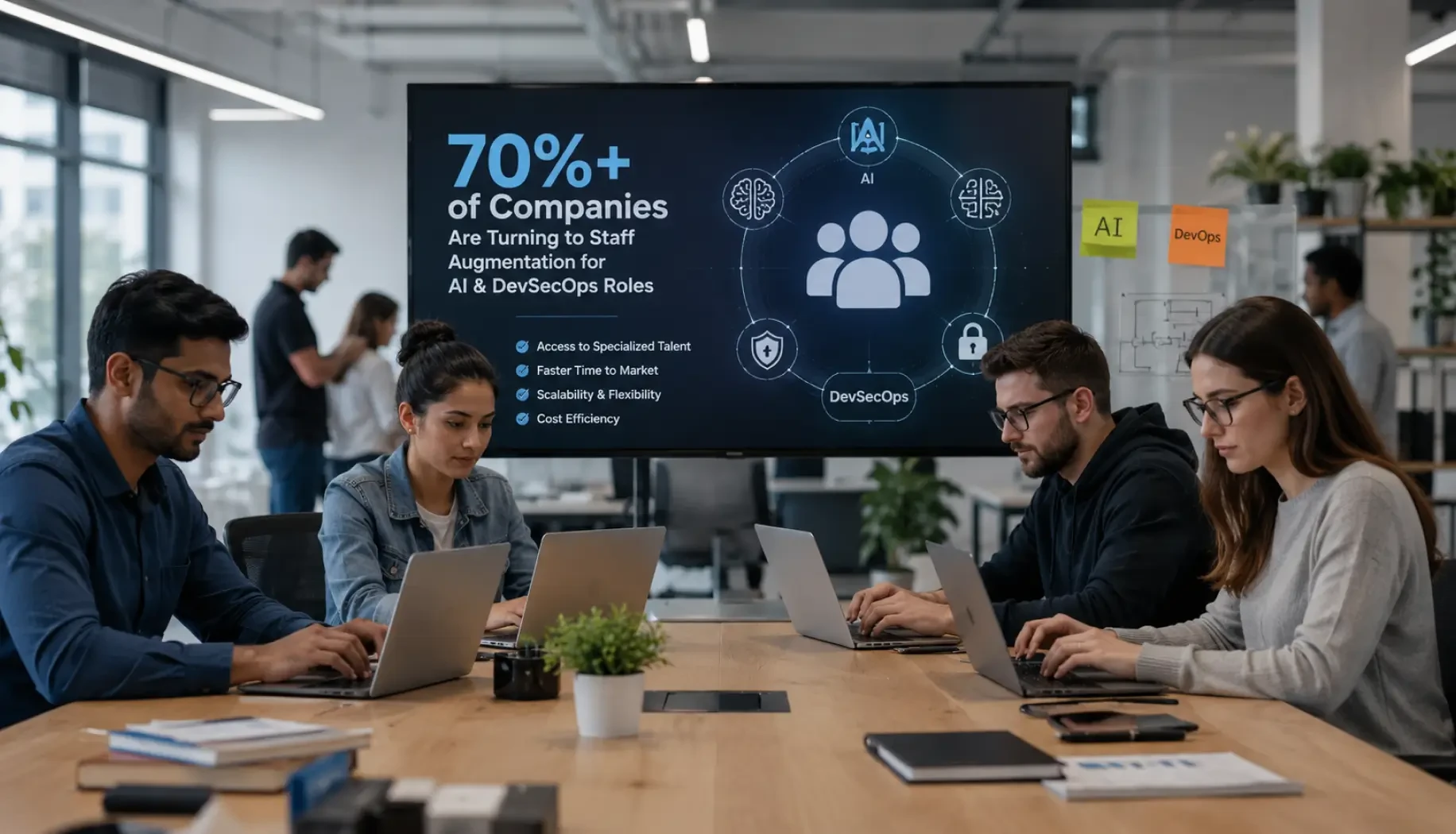
Why 70%+ of Companies Are Turning to Staff Augmentation for AI and DevSecOps Roles
AI and DevSecOps are the two hardest roles in tech to hire right now. Demand is growing far faster than supply, the required skills keep changing, and a senior AI hire takes about three months to close. Staff augmentation places a vetted specialist in days instead, without committing to permanent headcount before the work has proven its value.
Kalpesh Rajora
August 24, 2026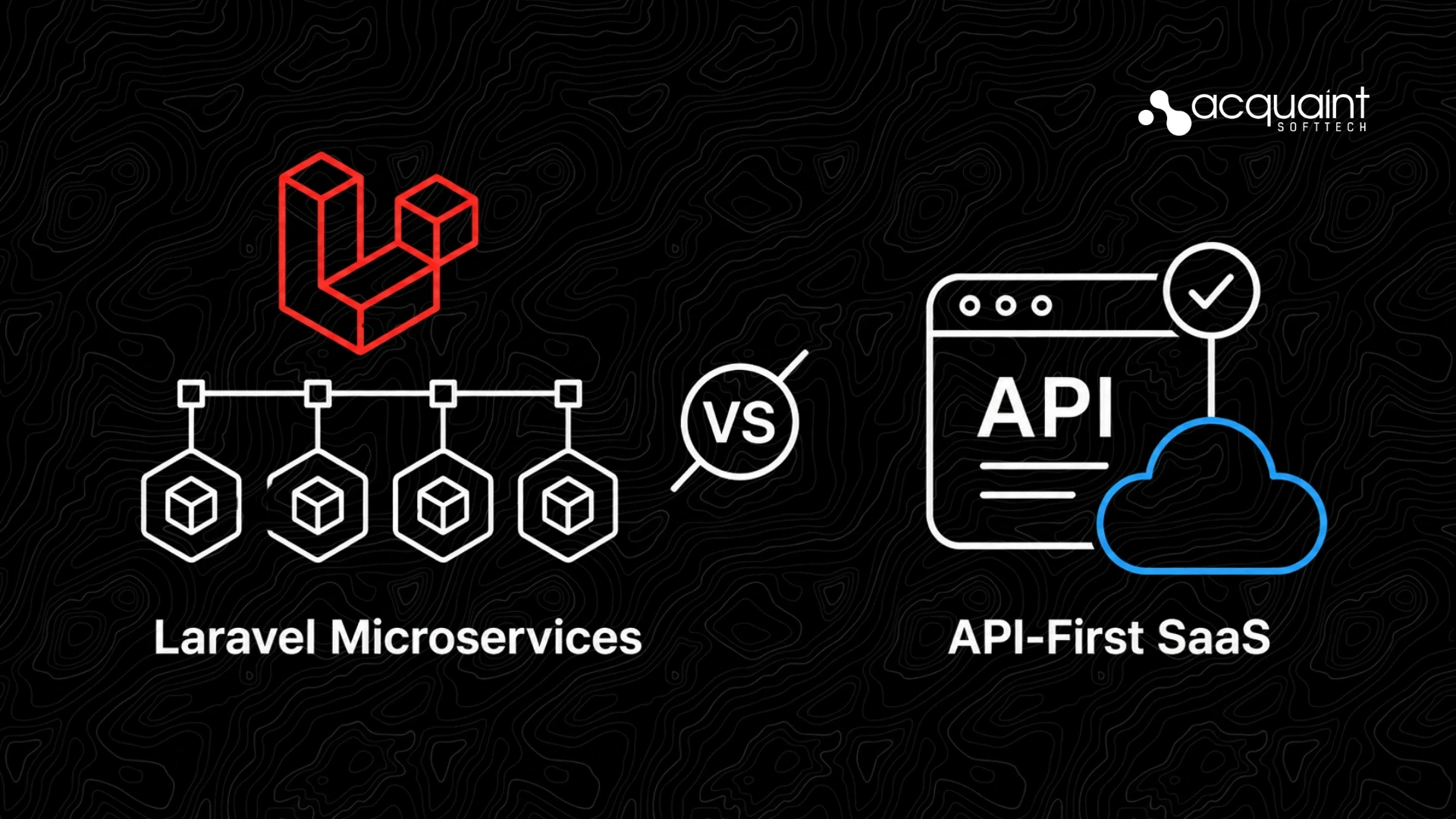
Laravel Microservices and API-First SaaS: Why Scalable Companies Are Going Modular in 2026
Scalable SaaS companies are moving to modular, API-first Laravel because it improves team velocity, enables independent scaling, isolates failures, and supports partner and mobile integrations. Most start with a modular monolith and use the strangler pattern to reach microservices only where the business benefits justify it.
Kalpesh Rajora
July 6, 2026India (Head Office)
203/204, Shapath-II, Near Silver Leaf Hotel, Opp. Rajpath Club, SG Highway, Ahmedabad-380054, Gujarat
USA
7838 Camino Cielo St, Highland, CA 92346
UK
The Powerhouse, 21 Woodthorpe Road, Ashford, England, TW15 2RP
New Zealand
42 Exler Place, Avondale, Auckland 0600, New Zealand
Canada
141 Skyview Bay NE , Calgary, Alberta, T3N 2K6