

Python Development Cost in 2027: Project Pricing by Type, Industry and AI Scope
Most Python projects cost between $5,000 and $200,000. Automation tools often sit at $5,000 to $35,000, web applications at $8,000 to $80,000, and AI or ML products at $15,000 to $300,000 or more.

Acquaint Softtech
Ask ten vendors how much a Python development project costs and you will get ten different answers. Most of them will be either dangerously low to win the deal or vague enough to mean nothing. What businesses actually need is an honest, project-type-specific breakdown of what Python development pricing looks like in 2027, built on real market data, not ballpark estimates. That is how we price our own Python development services, and it is what I want to give you here.
I will be straight with you, founder to founder. I have run a software company for more than 13+ years, and I have watched the same moment play out many times: someone holds two quotes for what looks like the same project, one for $15,000 and one for $90,000, and has no idea which one is real. Usually neither is wrong. They are pricing different things, and nobody explained the difference.

- You are budgeting a Python web app, automation tool, data platform or AI product.
- You have quotes that are wildly different and want to know what is real.
- You need to know how much AI or predictive analytics adds to the bill.
- You are deciding between fixed price, a dedicated team and staff augmentation.
That is what this guide delivers. Whether you are a startup founder budgeting your first Python web application, a CTO planning an enterprise data platform, or a product manager scoping an AI or ML feature, the numbers below will help you walk into any vendor conversation with clarity.
It also pulls together nine of our earlier posts on budgets, industry pricing, ownership cost, ROI, pricing models and vendor red flags, so you do not have to read them separately. Where figures differed between those posts, I have used the ranges we stand behind today.
FOUNDER'S NOTE "The cheapest quote is rarely the cheapest project. Ask every vendor what is not included, how they handle change, and who maintains it after launch. Those three answers tell you more than the price." Mukesh Ram, Founder and CEO, Acquaint Softtech |
How Much Does a Python Project Cost?
If you only read one table, read this one. It shows typical ranges for the most common kinds of Python work, delivered by an experienced offshore partner. US and UK agencies often charge two to five times more for the same scope.
Project type | Typical cost | Typical timeline |
Automation script or workflow | $1,500 to $35,000 | 1 week to 4 months |
Web application or API | $8,000 to $80,000 | 1 to 5 months |
Enterprise web platform | $60,000 to $200,000+ | 5 to 12 months |
Data or analytics platform | $10,000 to $150,000+ | 1 to 10 months |
AI or ML product | $15,000 to $300,000+ | 2 to 12 months |
FinTech or HealthTech app | $20,000 to $180,000 | 2 to 9 months |
The wide ranges are honest, not lazy. A "web app" can mean a two-screen internal tool or a multi-tenant SaaS platform with billing, roles and audit logs. The rest of this guide shows you how to work out where your project actually sits.
Why Python Development Costs Vary So Widely
Python itself is free. Skilled Python developers are not. Five factors drive almost every difference you will see between quotes.
Project complexity
The number of user roles, integrations, data sources and business rules matters far more than the number of screens. Each external integration, from payments to ERPs, adds design, testing and failure handling.
Developer experience
Junior developers often cost $20 to $45 an hour; senior AI, ML or enterprise specialists can reach $80 to $150 an hour in Western markets. Seniors cost more per hour and usually less per finished feature.
Location
The same senior skill set can cost very different amounts depending on where the team is based, because employment costs differ, not because the quality does.
Engagement model
Fixed price, a dedicated team and staff augmentation spread risk differently, and that shows up in the price. I cover this in detail further down.
Domain and compliance
Healthcare, finance and other regulated work needs encryption, audit trails, access controls and documentation from day one. That adds real effort, and it is far cheaper to design in than to bolt on later.
Python Development Cost by Project Type
Automation scripts and workflow tools
Complexity level | Estimated cost | Timeline |
Single script | $1,500 to $5,000 | 1 to 3 weeks |
Multi-step workflow with API integrations | $5,000 to $15,000 | 3 to 8 weeks |
Internal automation platform with dashboard | $15,000 to $35,000 | 2 to 4 months |
Automation is often the fastest payback in software. One warning: budget for maintenance from the start. Scripts that touch other systems break when those systems change.
Python web application development
Project type | Cost range | Typical team |
MVP or proof of concept | $8,000 to $20,000 | 1 to 2 developers |
Internal business tool | $15,000 to $40,000 | 2 to 3 developers |
Customer-facing web app | $25,000 to $80,000 | 3 to 5 developers |
Enterprise web platform | $60,000 to $200,000+ | 5 to 10+ developers |
Large consumer platforms at global scale run far beyond these numbers, but very few businesses need to start there. If timing matters as much as budget, see how long Python web application development actually takes.
Data engineering and analytics platforms
Scope | Cost range | Timeline |
Data dashboard or reporting tool | $10,000 to $30,000 | 4 to 10 weeks |
ETL pipeline with cloud integration | $20,000 to $60,000 | 2 to 5 months |
Full analytics platform with BI | $50,000 to $150,000+ | 4 to 10 months |
Healthcare analytics is a good example of how domain pushes cost up: compliant data pipelines need senior developers who understand both Python and the data rules of that industry.
AI and machine learning development
AI or ML project type | Cost range | What drives cost |
Basic ML model integration | $15,000 to $45,000 | Data readiness |
Custom NLP or computer vision | $40,000 to $120,000 | Training data, accuracy |
Full AI product or platform | $80,000 to $300,000+ | Product plus model plus MLOps |
Enterprise GenAI or deep learning | $150,000 to $1M+ | Scale and governance |
The part people underestimate is data. Cleaning, labelling and validating data often takes a third or more of the effort on an AI project, before anyone tunes a model.
FinTech, HealthTech and compliance-driven applications
Application type | Estimated range | Main cost driver |
Payment integration or FinTech API | $20,000 to $60,000 | Security and testing |
Algorithmic trading or risk model | $50,000 to $180,000 | Accuracy and audits |
Healthcare analytics platform | $40,000 to $120,000 | Privacy and compliance |
Python Development Cost by Industry
Industry changes cost mainly through compliance, integrations and the stakes of getting things wrong. These ranges are for full production platforms built with a vetted offshore partner, not MVPs.
Industry | Typical platform cost | Compliance premium |
Healthcare | $75,000 to $250,000+ | 30% to 50% |
FinTech | $90,000 to $300,000+ | 20% to 35% |
B2B SaaS | $50,000 to $200,000+ | 20% to 35% |
eCommerce | $30,000 to $150,000+ | 10% to 20% |
Logistics | $50,000 to $250,000+ | 10% to 20% |
What the compliance premium actually pays for
It pays for encryption, access controls, audit logging, data retention rules, security testing and documentation that auditors can read. Formal certifications add more: a security attestation programme can take six to nine months and tens of thousands of dollars in the first year, and a single deep integration with a healthcare records system can cost $50,000 or more on its own.
The cost of skipping it
Retrofitting compliance into a live system typically costs two to three times more than designing it in. If you know you will sell to hospitals, banks or enterprise buyers, build for it from the first sprint.
How Much Does Adding AI or Predictive Analytics Add?

This is the question I get most in 2027. The honest answer: adding AI to an existing Python product usually costs tens of thousands of dollars, and the range depends on how central AI is to the product.
Base project | AI or ML add-on | Typical use |
Automation tool | +$15,000 to $40,000 | Document or data extraction |
Simple web app or API | +$20,000 to $60,000 | Search, classification |
SaaS MVP | +$25,000 to $75,000 | Assistant or recommendations |
Full SaaS platform | +$40,000 to $100,000 | Predictions across the product |
Predictive analytics specifically
Predictive analytics, such as forecasting demand, scoring churn risk or estimating prices, is often the most practical first AI investment, because it uses data you already have.
At Acquaint Softtech, a predictive model project starts from $8,000, an AI proof of concept typically costs $12,000 to $20,000, and a dedicated ML engineer costs $4,400 a month.
If you want forecasts and risk scores built into your product, our predictive analytics services cover data preparation, model building and dashboards, with a one-week risk-free trial.
What makes AI cost more than expected
Three things: messy data, unclear success metrics and ongoing running costs. Model calls, retraining and monitoring continue after launch. Budget for them the same way you budget for hosting.
For broader AI work, from LLM features to automation and agents, our AI development services typically take production-ready solutions live in three to six months, and all code, models and data stay yours.
What an AI and Predictive Build Involves: A Real Example
Here is a real predictive build from our work. A family-owned New Zealand real estate group, with more than 850 team members across 80+ locations, had property data scattered across spreadsheets and appraisals prepared by hand. A team of 6 to 10 professionals spent 1,216 hours building a property intelligence platform in Python. Read the full property intelligence case study.
What the build included
Component | What it involved | Guide range |
Data ingestion | Centralising property and market data | $20,000 to $60,000 |
Prediction | Valuation ranges agents can review | $15,000 to $45,000 |
Dashboards | Regional trends and market reporting | $10,000 to $30,000 |
Integration | Secure API to internal systems | Part of build |
A note on honesty: the case study does not publish the project budget, so the third column shows the typical ranges from this guide for each component, not what this client paid. It is how I would help you scope a similar build.
What it delivered
The team ran discovery workshops, built the data layer first, piloted with a group of agents, then rolled out with feedback-driven updates. Appraisal preparation became much faster, managers could track demand and pricing in dashboards, and valuations often aligned closely with final sale outcomes. The managing director put it simply: the technology felt practical rather than experimental, which was exactly what they needed.
The Minimum Budget to Start a Python Project
Founders always ask me for the minimum. Here is the honest floor for a production-ready first version, not a demo.
Project | Realistic minimum | If regulated |
Automation | $5,000 to $20,000 | $15,000 to $35,000 |
Simple web app or API | $15,000 to $35,000 | $35,000 to $70,000 |
SaaS MVP | $25,000 to $55,000 | $50,000 to $90,000 |
Full SaaS product | $55,000 to $120,000 | $90,000 to $200,000 |
AI analytics product | $35,000 to $100,000 | $70,000 to $200,000 |
Rules of thumb I give every founder
The 1.5x rule: if the build quote is $100,000, plan for $150,000 to $200,000 across the first year once hosting, maintenance and changes are included.
Pay for discovery: spending 5 to 10 percent of the budget on discovery usually saves far more in rework.
Count features honestly: each feature beyond your core three to five typically adds 10 to 20 percent.
Plan running costs: hosting for an MVP is often $100 to $500 a month, rising as you scale.
When your budget is too low
Cut scope, not quality. Launch with fewer features built properly, rather than many features built badly. A smaller, solid product can grow; a large, fragile one usually has to be rebuilt.
Fixed Price vs Dedicated Team vs Staff Augmentation
Fixed price or dedicated team? It depends on how settled your scope is and how long the work will run.
Model | Best for | Cost profile |
Fixed price | Well-defined, bounded scope | Predictable; scope creep raises cost |
Dedicated team | Ongoing products, evolving needs | Monthly rate; scales with team |
Staff augmentation | Filling skill gaps short term | Hourly; most flexible |
Fixed price
Fixed-price Python projects start from about $5,000. They work best for builds of roughly 4 to 16 weeks with stable requirements. Because the vendor carries the risk, fixed quotes usually include a buffer, often 10 to 20 percent above time-and-materials pricing, and changes go through change requests.
Dedicated team
A dedicated developer costs $3,200 a month for 176 hours with us. It suits products that will keep evolving for three months or more, because the developer builds context and you can reprioritise every sprint without renegotiating a contract.
Staff augmentation
Staff augmentation adds developers to your team by the hour, from $22 an hour part-time. It is the most flexible option and the right one when you already have technical leadership and just need more hands or a specific skill.
Monthly retainer or project-based pricing?
Many teams do best with a hybrid: a short fixed-price discovery phase to define scope and architecture, followed by a monthly retainer or dedicated team for delivery. You get a predictable start and flexibility once real users begin asking for changes.
Option | Monthly cost of one developer | Notes |
US in-house, mid-level | $12,000 to $18,000 | Plus hiring time |
Western Europe in-house | $8,000 to $14,000 | Plus employment costs |
Eastern Europe contractor | $4,500 to $8,000 | Varies by seniority |
Acquaint dedicated developer | $3,200 | 176 hours, no hiring fees |
For a deeper comparison of the three models, including management effort and risk, read our guide to staff augmentation vs dedicated team vs outsourcing.
Not sure which pricing model fits your project?
Tell me what you are building and how settled the scope is. We will recommend fixed price, a dedicated team or a hybrid, and send an honest estimate. No sales pitch.
Python Developer Hourly Rates by Region in 2027
Rates explain a lot of the difference between quotes. In the US, salary data published in early 2027 put the average Python developer salary at roughly $124,000 to $129,000 a year, with senior developers above $170,000, before benefits and hiring costs.
Region | Junior hourly | Senior hourly |
US and Canada | $70 to $100 | $120 to $150+ |
Western Europe | $60 to $90 | $100 to $140 |
Eastern Europe | $30 to $55 | $60 to $90 |
India | $20 to $40 | $35 to $75 |
Southeast Asia | $20 to $35 | $35 to $65 |
For salary data by seniority and a full breakdown of hiring costs, see how much it costs to hire a Python developer.
And if you want to know what actually sits behind an hourly number, our guide to the Python developer hourly rate explains it line by line.
The Real Cost of Ownership After Launch
The budget that gets approved is rarely the budget that gets spent. The build is only the first cost. Over a few years, running and improving the software usually costs more than building it.
The seven parts of total cost
Build: the initial project cost.
Infrastructure: hosting, databases and services, often 15 to 30 percent of the build cost each year.
Maintenance: fixes, updates and small improvements, typically around 15 to 20 percent of the build cost each year, and more for ML systems.
Technical debt: shortcuts that slow every future change.
Security and compliance: audits, patches and controls; far cheaper when designed in than retrofitted.
Team and hiring: turnover, onboarding and knowledge loss.
Scaling: performance work as users and data grow.
A simple five-year example
Take an $80,000 platform. At around 20 percent a year, maintenance alone is roughly $16,000 a year, or $80,000 over five years. Add hosting and you are looking at well over twice the original build cost across five years. That is normal, and it is why the cheapest build is so often the most expensive product.
Why maintenance never stops
Security updates are a good example. On 26 October 2027, the Python team released expedited security fixes for five supported Python versions. Every Python product in production needed someone to apply them. That work is part of ownership cost, whether you budget for it or not.
Cost vs Value: How to Estimate ROI and Payback
Price only makes sense next to value. Before approving any Python project, I would want to know two numbers: the return and the payback period.
The two formulas that matter
ROI: ((annual benefit x years) minus investment) divided by investment, times 100.
Payback period: investment divided by monthly net benefit.
Example: an $80,000 build that saves $120,000 a year delivers a three-year ROI of 350 percent. If it saves $10,000 a month, it pays for itself in eight months.
Where the benefit comes from
Benefits usually fall into four buckets: hours saved (hours eliminated multiplied by the loaded hourly cost), errors avoided, revenue enabled and risk reduced. For example, a business processing 10,000 orders a month that cuts its error rate from 2 percent to 0.2 percent, at $25 per error, saves about $54,000 a year.
Cheap vs good: the quality-adjusted rate
The hourly rate you pay is not the rate you get. If a cheap developer's work needs heavy rework, the effective cost per finished feature can be several times the quoted rate. A slightly higher rate with little rework is usually the lower real cost. When comparing quotes, ask: what will this cost per working feature, not per hour?
Pricing Red Flags That Signal a Bad Vendor
The most expensive project often starts with the cheapest quote. These are the pricing red flags I would walk away from.
A fixed quote within a day or two of one call, before any discovery.
Bundled line items with no breakdown of development, QA and project management.
No change-request process written into the contract.
Credentials or case studies you cannot verify.
Rates 30 to 40 percent below market for the stated seniority.
No NDA or IP assignment before work starts.
An architecture chosen before anyone understands your requirements.
New costs that appear after signing.
No plan for continuity if a developer leaves.
Price escalation clauses with no clear triggers.
What a transparent quote looks like
A good quote separates development from QA (often 15 to 25 percent of effort) and project management (often 10 to 20 percent), states what is excluded, explains how changes are priced, and sets out maintenance costs after launch. I also recommend keeping a contingency of 10 to 20 percent for the unknowns every project has.
When expensive is legitimate
Higher prices are justified by regulated data, complex integrations, real-time performance needs, AI accuracy targets or a very short deadline. The difference between legitimate and inflated is whether the vendor can explain exactly why.
The Most Expensive Python Development Mistakes Businesses Make

Choosing on hourly rate alone
A low rate with slow delivery and heavy rework costs more than a fair rate with steady progress. Compare cost per delivered feature, not per hour.
No documented scope
Without written scope, every disagreement becomes a cost. Even a short discovery document saves money.
Skipping QA
Bugs found after release cost many times more to fix than bugs caught during development, and they cost trust as well.
Ignoring maintenance
Software that nobody maintains decays. Budget maintenance from day one.
Using marketplace freelancers for production systems
Freelancers can be great for small tasks. For production systems, the risk-adjusted cost of a structured partner with continuity and accountability is almost always lower.
How Acquaint Softtech Structures Python Development Pricing
Pricing that is transparent from day one
Engagement | Price | Best for |
Part-time or hourly | From $22/hr (up to 4 hrs/day) | Support and small features |
Full-time dedicated | $3,200/month (176 hours) | Ongoing product work |
Fixed-budget project | From $5,000 | Clearly defined builds |
There is no agency markup, onboarding fee or account-management charge. Our service pages put the typical saving at around 40 percent compared with traditional hiring, and that comes from removing recruitment, overheads and turnover, not from cutting corners.
What sets us apart from typical freelance platforms
When you hire Python developers from us, you get 2 to 3 vetted profiles within 24 hours and onboarding within 48 hours. Every developer is a full-time, in-house employee. You get full IP ownership, an NDA before any discussion, time-zone overlap with US, UK and European teams, and a free replacement with full context handover if a developer ever leaves.
I will finish where I started. Ask every vendor what is not included, how they handle change and who maintains it after launch. If the answers are clear, the price will make sense. If they are vague, no discount will save the project.
Want an honest number for your Python project?
Book a free 30-minute consultation. Share what you are building and we will give you a realistic range, the right engagement model and the hidden costs to plan for. No sales pitch, just honest advice.
Frequently Asked Questions
-
How much does a Python project cost?
Most Python projects cost $5,000 to $200,000. Automation tools often cost $5,000 to $35,000, web apps $8,000 to $80,000, and AI or ML products $15,000 to $300,000 or more.
-
How much does adding AI or predictive analytics add?
Adding AI to an existing Python product typically adds $15,000 to $100,000, depending on depth. A predictive model project can start from about $8,000.
-
Fixed price or dedicated team?
Choose fixed price for stable, well-defined scope of a few weeks to four months. Choose a dedicated team for products that will keep evolving for three months or more.
-
What is the minimum budget for a Python project?
A production-ready first version usually needs at least $5,000 to $20,000 for automation, $15,000 for a simple web app, and $25,000 for a SaaS MVP.
-
How much does Python maintenance cost per year?
Plan for around 15 to 20 percent of the build cost each year for maintenance, plus hosting. ML systems usually need more.
-
Why do Python development quotes vary so much?
Quotes vary because of scope, seniority, location, compliance and engagement model. Ask what each quote includes, excludes and how changes are priced.
We’re Acquaint Softtech, your technology growth partner. Whether you're building a SaaS product, modernizing enterprise software, or hiring vetted remote developers, we’re built for flexibility and speed. Our official partnerships with Laravel, Statamic, and Bagisto reflect our commitment to excellence, not limitation. We work across stacks, time zones, and industries to bring your tech vision to life.
Table of Contents
Get Started with Acquaint Softtech
- 13+ Years Delivering Software Excellence
- 1300+ Projects Delivered With Precision
- Official Laravel & Laravel News Partner
- Official Statamic Partner
Related Blog
Python Developer Cost in 2027: Hourly Rates by Country, Role and AI specialization
A Python developer costs $20 to $150+ an hour in 2027. Vetted India-based developers typically cost $20 to $60 an hour, Eastern Europe $40 to $80, and the US $60 to $150+. AI/ML Python engineers usually cost 20 to 40 percent more than general backend developers.
Acquaint Softtech
March 5, 2026
Python Developer Hourly Rate: What You're Actually Paying For
Python developer rates range $20-$150+/hr in 2026. See what experience, specialisation & hidden costs actually determine the price. Save 40% with vetted offshore talent.
Acquaint Softtech
March 9, 2026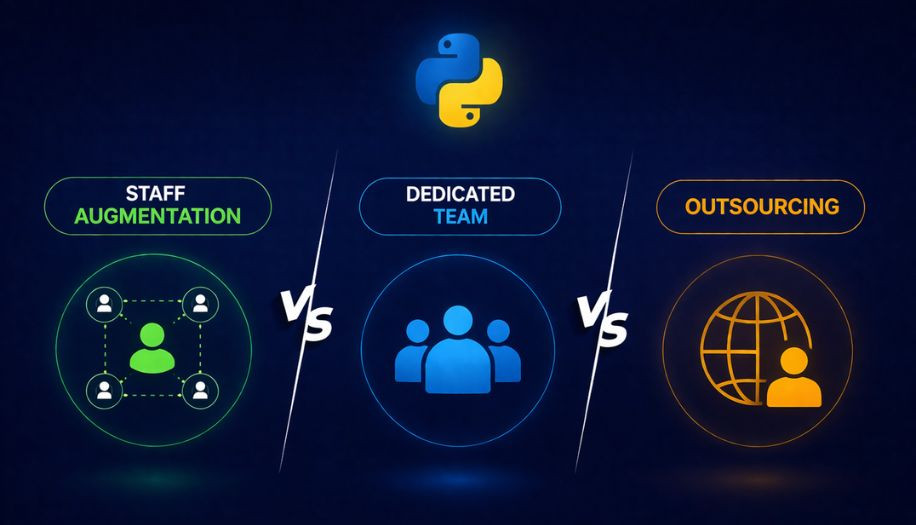
Staff Augmentation vs Dedicated Team vs Outsourcing: Which Python Model Is Right for You?
Compare Python staff augmentation, dedicated team, and project outsourcing models. Real 2026 data on cost, control, speed, and IP risk. Find which model fits your project stage.
Acquaint Softtech
April 6, 2026Your Project. Our Expertise. Let’s Connect.
Get in touch with our team to discuss your goals and start your journey with vetted developers in 48 hours.