

Python Development Lifecycle From Discovery to Deployment
The Python development lifecycle 2026: from discovery to deployment. Seven phases, realistic timelines, and the practices that prevent project failure.

Acquaint Softtech
Introduction: Why Most Python Projects Fail Between Brief and Production
Every Python development project starts with the same optimism. The product team has a clear vision. The engineering team has the skills. The budget is approved. The timeline looks reasonable. Three months later, the project is six weeks behind schedule, the scope has expanded twice, and the senior engineer who was supposed to be the architect is firefighting a database design that nobody actually reviewed before implementation started. The team will eventually ship something, but it will not be what was promised, when it was promised, or for what it was budgeted.
The structural insights from modern SDLC practice in 2026 are unambiguous. According to the 2026 Software Development Life Cycle definitive guide by Hyscaler, the practices that distinguish high-performing teams are well documented: shift security left (integrate security testing from requirements through deployment, not just at the end), automate everything (CI/CD pipelines, automated testing, infrastructure provisioning reduce errors and speed delivery), embrace observability (monitoring, logging, and tracing in production creates a feedback loop back into the SDLC), and involve users early (prototypes and beta programs in the design and testing phases dramatically reduce costly late-stage changes).
This guide walks through the Python development lifecycle from discovery to deployment as it actually operates in 2026 across mature engineering organizations. It covers the seven phases of the lifecycle, the discovery work that is the single biggest variance reducer in any project, the sprint-based development rhythm that ships predictably, the testing and quality discipline that prevents the most common failures, the deployment and observability that turn launches into operational success, and how to staff and structure the work so the project actually delivers what was promised. It is written for founders, CTOs, technical product managers, and engineering leaders running or about to run Python projects who want a defensible operating model rather than the ad-hoc pattern most teams default to.
If you are also building the team that will execute the lifecycle, the complete guide to hiring Python developers sets the wider context on engagement models, rates, and the team composition that affects lifecycle outcomes as much as the methodology does.
The Seven Phases of the Python Development Lifecycle
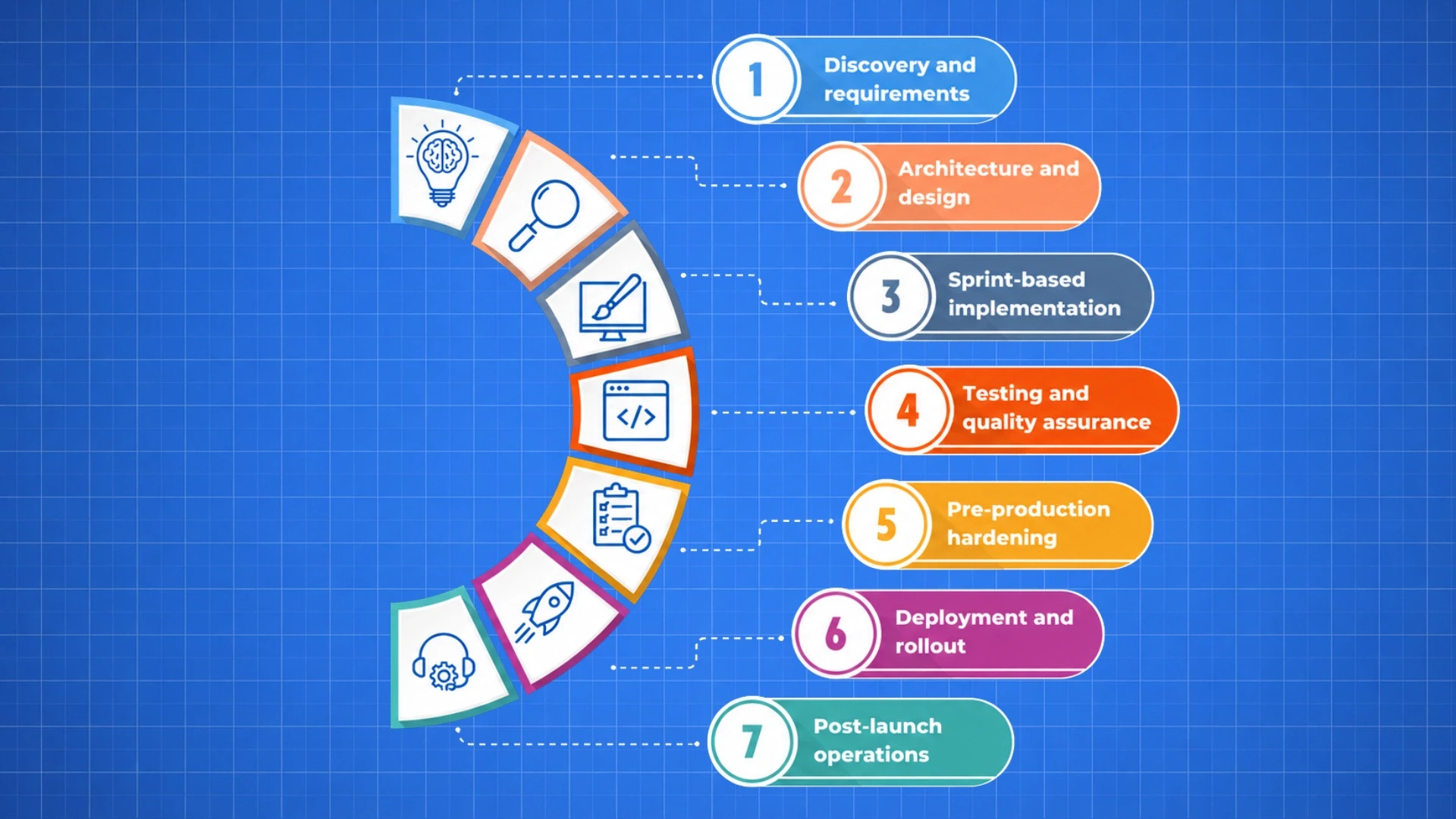
The Python development lifecycle in 2026 has converged on seven well-defined phases across mature engineering organizations. Each phase has clear owners, concrete deliverables, and a definition of done that lets the next phase begin with confidence. Compressing or skipping phases is the most common cause of project failure, because the cost of catching an issue in the right phase is dramatically lower than catching it in the next phase. A requirement misunderstood in Phase 1 (discovery) costs hours to fix. The same misunderstanding caught in Phase 5 (testing) costs days. Caught in Phase 7 (post-launch), it costs weeks and may damage customer trust permanently.
The Seven Phases of the Python Development Lifecycle
Phase | Duration | Key Deliverable |
|---|---|---|
1. Discovery and requirements | 1 to 4 weeks | Documented scope, user stories, success metrics |
2. Architecture and design | 1 to 3 weeks | Architecture decisions, data model, design system |
3. Sprint-based implementation | 4 to 24 weeks | Working software shipped every two weeks |
4. Testing and quality assurance | Parallel to Phase 3 | Tests on every PR, integration verified continuously |
5. Pre-production hardening | 1 to 2 weeks | Load testing, security review, deployment readiness |
6. Deployment and rollout | 1 to 2 weeks | Production deployment with monitoring active |
7. Post-launch operations | Continuous | Observability, iteration, maintenance, optimization |
Why This Phased Structure Beats the Default Pattern
Discovery is 5 to 10% of project cost but reduces overspending by 40 to 60%. Teams that skip discovery to look fast or cheap consistently spend 40 to 60% more than properly scoped projects, because the real scope gets discovered during implementation at five to ten times the cost of finding it during planning. Discovery is the variance reducer.
Architecture decisions in Phase 2 lock total cost of ownership for years. The framework choice (Django, FastAPI, Flask), database choice (PostgreSQL, MongoDB), and architectural pattern (modular monolith, microservices) made in Phase 2 determine engineering velocity, scaling cost, and maintenance burden for the entire product lifecycle. Get these wrong and Year 2 is a rewrite.
Sprint-based delivery in Phase 3 keeps small problems small. Two-week sprints with working software shipped to staging at each boundary catch contract drift, scope drift, and design mistakes in days rather than months. According to Standish CHAOS research, small projects shipped iteratively succeed roughly 90% of the time while large projects shipped in big bang have less than 10% success rate.
Testing in parallel with implementation prevents the testing-bottleneck pattern. Phase 4 runs concurrently with Phase 3, not afterwards. Tests are written alongside features, contract tests verify the spec in CI, integration tests run on every PR. This is the difference between shipping confidently and the panic-fix cycle in the final week before launch.
Observability in Phase 6 starts in Phase 1. The metrics that matter and the alert thresholds that catch real issues are decided during discovery, not bolted on after the first production incident. By the time the system ships, observability is operating, which is why mature teams catch production issues in minutes rather than days.
Phase 1 to 2: Discovery and Architecture Design
The structural purpose of the discovery and architecture phases is captured directly in the AWS guide to the software development lifecycle: the goal of SDLC is to minimize project risks through forward planning so that software meets customer expectations during production and beyond. All stakeholders agree on goals and requirements upfront, and the team has a plan to achieve them. The same guide emphasises a critical 2026 shift: security testing is no longer a separate process after software is built. DevSecOps integrates security from requirements through deployment, with security flaws caught during design rather than discovered after release. The cost of catching a security issue in Phase 1 versus Phase 7 differs by orders of magnitude, which is why mature teams treat discovery as the highest-leverage phase in the lifecycle.
What Phase 1 Discovery Actually Produces
Documented scope and acceptance criteria. Every user-facing feature has user stories with acceptance criteria written down before development. The team can read the scope document and answer 'is this in or out?' for any feature without escalation. This single artefact prevents 30 to 50% of the rework that consumes unscoped projects.
User personas, journeys, and success metrics. Who uses this product, what they are trying to accomplish, and how the team will measure success. Smart 2026 teams now spend 15 to 25% of total project time in this stage because the cost of building the wrong product is dramatically higher than the cost of slow discovery.
Risk identification and mitigation plan. Third-party API dependencies, data migration complexity, compliance requirements, authentication edge cases, performance unknowns at scale. Every non-trivial Python project has these risks, and surfacing them in Phase 1 is significantly cheaper than discovering them in Phase 3.
Realistic budget and timeline with contingency. Quoting at 1x the optimistic estimate is the predictable cause of project overspend; the 1.5x rule (plan budget at 1.5x to 2x the optimistic quote) is the discipline that produces projects which actually finish within budget.
What Phase 2 Architecture Design Actually Produces
Framework and technology stack decisions. Django for content-heavy SaaS and admin-driven products. FastAPI for high-throughput APIs and AI/ML serving. PostgreSQL for the database. Redis for caching. Celery for background jobs. These are not preferences; they are deliberate choices made based on the product's actual requirements, documented as architecture decision records (ADRs).
Data model and entity relationships. The database schema is designed before implementation, with migrations planned for the entire build phase. Getting the data model wrong is one of the most expensive Phase 2 mistakes because every feature in Phase 3 touches it.
Modular architecture with bounded contexts. The 2026 consensus answer for new Python products is the modular monolith with clear domain boundaries. Services get extracted later when specific scaling, deployment, or team coordination problems genuinely require it, not on Day 1 because microservices sound modern.
Security, compliance, and observability designed in. Authentication mechanism, authorization model, audit logging, structured logging, error tracking, latency monitoring, GDPR/HIPAA/PCI-DSS where applicable. All decided in Phase 2, all built in from Phase 3, none retrofitted later.
The realistic budget for the discovery and architecture phases is well documented and consistently undervalued. The detailed analysis on the minimum budget required to start a Python development project walks through why properly scoped discovery costs 5 to 10% of total project budget but reduces total project cost by eliminating the rework that consumes 30 to 50% of unscoped projects, with concrete budget ranges by project type.
Need a Python Development Lifecycle That Actually Delivers?
Acquaint Softtech runs structured 7-phase Python development lifecycles with discovery as the variance reducer, sprint-based implementation, testing in parallel, and production observability from Phase 1. 8 to 16 week MVPs from $15,000, transparent pricing from $20/hour, senior engineers with multi-year production experience.
Phase 3 to 5: Sprint-Based Development, Testing, and Quality
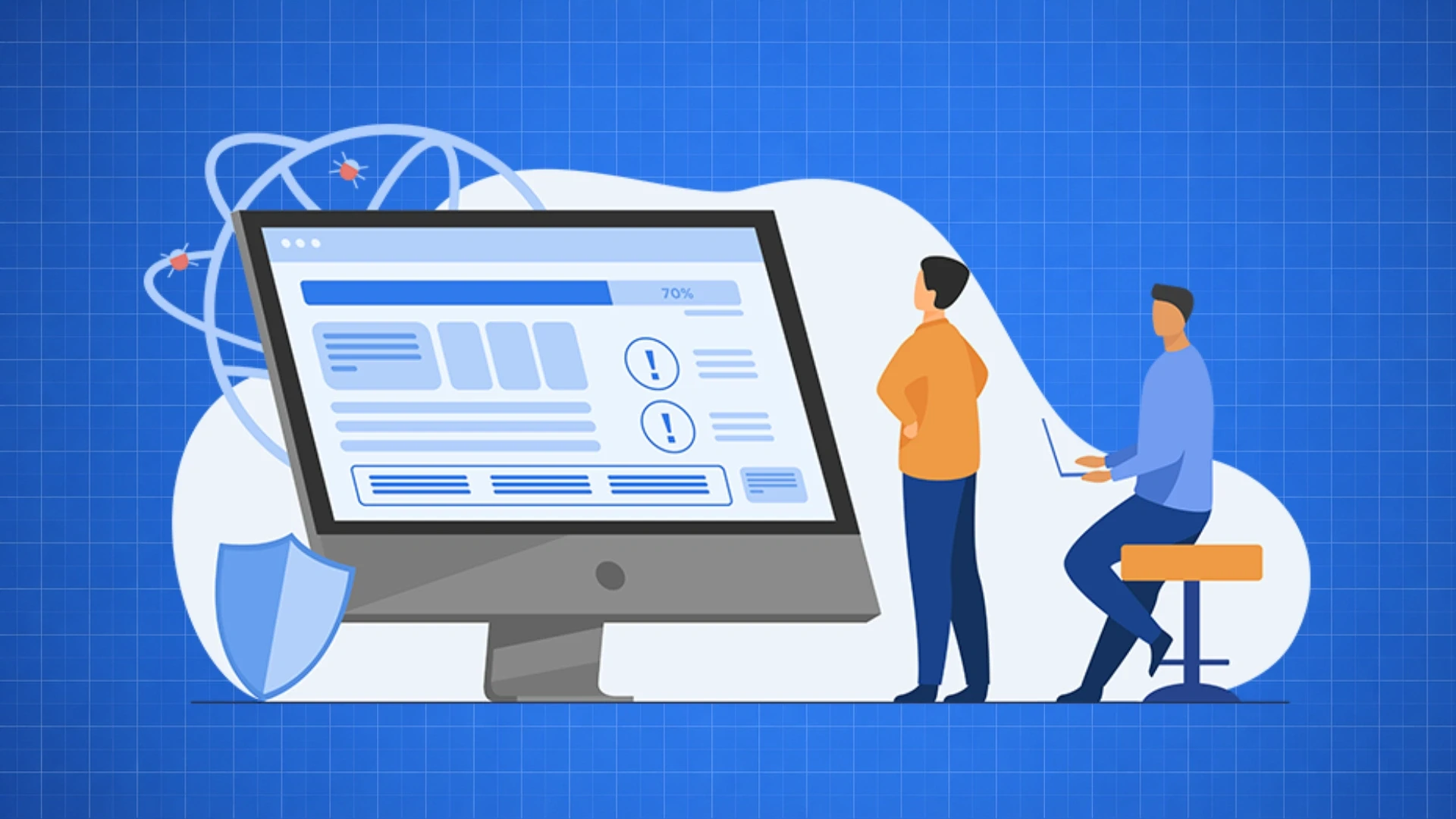
Once discovery and architecture are locked, implementation moves to a sprint cadence that ships working software to staging every two weeks. This is the operational rhythm that distinguishes Python projects that deliver predictably from those that produce one giant integration at the end of the timeline. Each sprint delivers tested, demoable functionality that stakeholders can interact with, and feedback from each sprint informs the next, which is how scope misalignments surface in days rather than months.
The Sprint Rhythm for Python Development (Phases 3-5)
Sprint Block | Focus | Deliverable by End of Block |
|---|---|---|
Foundation (Sprints 1 to 2) | Auth, base middleware, CI/CD, observability hooks | Working auth flow, deployed to staging |
Core flows (Sprints 3 to 5) | Primary user journeys, core data models | Customer-facing primary feature shipped |
Supporting features (Sprints 4 to 8) | Secondary flows, admin interface, integrations | Full feature set in staging, demoable end-to-end |
Hardening (Final sprint) | Load testing, security review, polish | Production-ready application with monitoring active |
The Three Testing Layers That Catch Real Issues
Unit tests for individual functions. Pytest is the default in 2026. Aim for 70 to 80% coverage on business logic, lower coverage on boilerplate. The goal is fast feedback (under 30 seconds for a unit test run) and confidence that individual functions behave as expected. This is the layer that catches most regressions during refactoring.
Integration tests with real dependencies. Pytest with testcontainers-python spins up a real PostgreSQL, real Redis, and real dependencies for integration tests. These tests are slower (minutes, not seconds) and run on every PR in CI. They catch the wiring-level bugs that unit tests miss and the integration drift that production traffic surfaces.
End-to-end and user acceptance tests. Playwright or Selenium for browser-based tests, Schemathesis for API contract verification, manual UAT for the critical user flows that automated tests cannot reliably cover. These run before each release, not on every commit, because they are slower and more brittle than the lower-layer tests.
The Sprint Ceremonies That Make This Cadence Work
Sprint planning that produces a committed, sized backlog. Not a wishlist. A set of items the team commits to delivering, each with acceptance criteria, sized in points or time, with the team's capacity for the sprint already accounted for (leave, holidays, on-call rotations).
Daily standups that surface blockers, not status reports. Each person answers what they are working on today and whether they need anything from anyone. The 15-minute limit is sacred. Detailed problem-solving conversations happen after the standup, with only the people who need to be there.
Sprint review demos to actual stakeholders. Working software, demonstrated by the engineer who built it, in front of the product owner, sales, or customers depending on the audience. Real software in front of real stakeholders is what builds trust between the team and the business every sprint.
Sprint retrospective that produces specific changes. The output of a healthy retrospective is one or two concrete process changes that get implemented in the next sprint and reviewed in the following retrospective. Retrospectives that produce a list of observations and no changes are theatre.
The operational discipline that distinguishes serious sprint-based delivery from sprint theatre is covered in detail in the analysis on how to run a Python development sprint that actually ships, which walks through the structural difference between sprints that ship customer-visible work every two weeks and sprints that produce ceremony without delivery.
Phase 6 to 7: Deployment and Post-Launch Operations
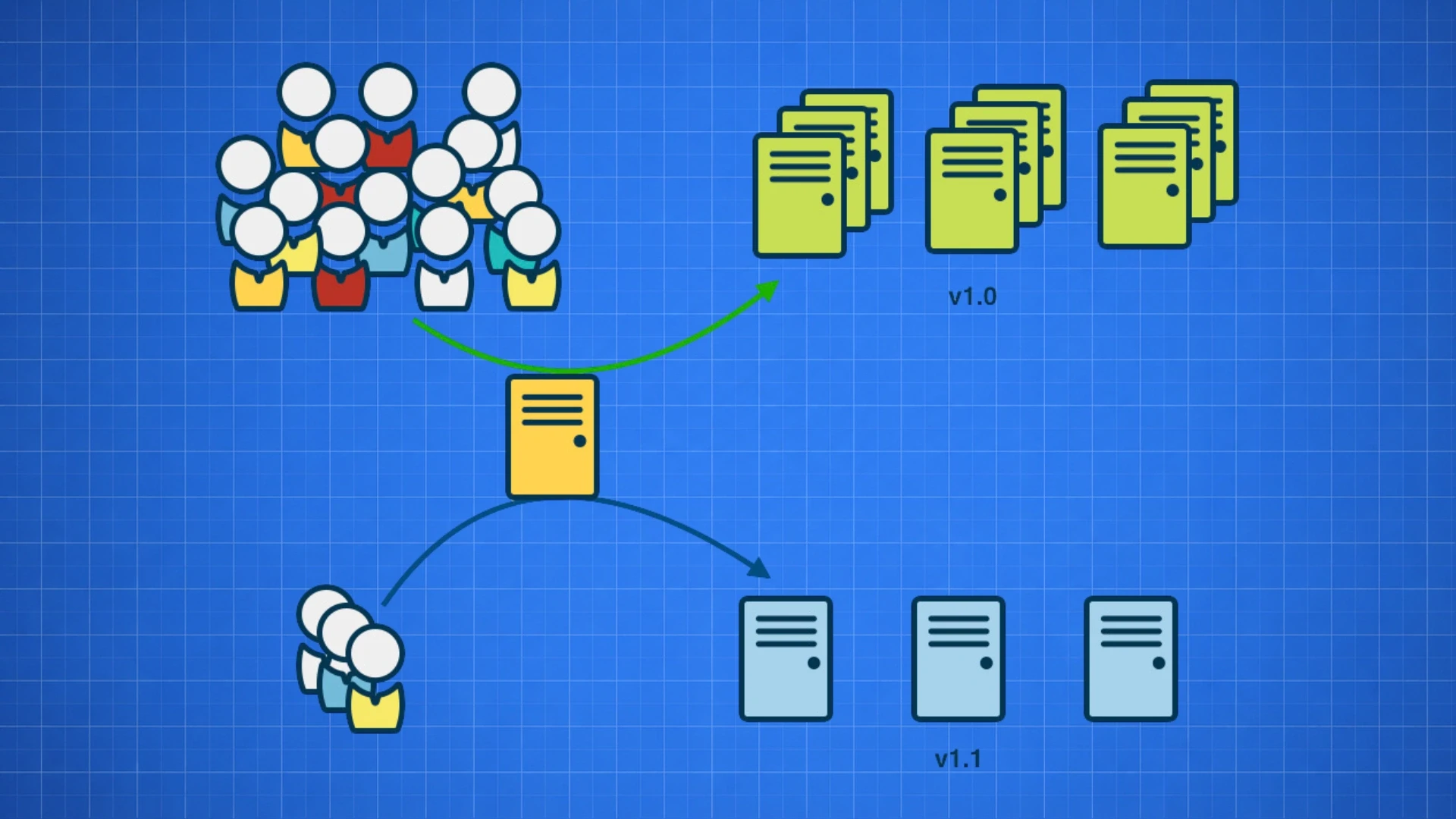
The phases that distinguish a Python project that succeeds long-term from one that quietly degrades after launch are 6 and 7. Most teams treat deployment as the end of the project; mature teams treat it as the start of the operational phase that continues for the product's entire lifetime. The decisions made in these phases determine whether the application ships features cleanly six months later or whether the team spends six months firefighting production issues that should have been caught earlier.
Phase 6: Deployment That Sets You Up for Phase 7
Blue-green or canary deployment, not big-bang. Deploy the new version alongside the existing one (blue-green) or route a small percentage of traffic to it first (canary). Both patterns let you roll back instantly when something is wrong, which is the difference between a 5-minute incident and a 5-hour incident.
Feature flags for endpoint-level control. LaunchDarkly, Unleash, or your own flag system controls which features are exposed to which users. This separates deployment (binary ships to production) from release (users can hit the feature), which is the safest pattern for high-stakes applications.
Database migrations run separately from application deploys. Schema changes run first, applications deploy second, applications use the new schema third. This prevents the deployment dance where the app expects a column that does not exist yet. Alembic for SQLAlchemy and Django migrations support this pattern natively.
Automated rollback when error rates spike. If error rates exceed a threshold within the first 15 minutes of deployment, automated rollback fires without human intervention. This is the safety net that lets teams deploy multiple times per day without fear.
Phase 7: Post-Launch Operations That Actually Work
Production observability operating from day one. p50/p95/p99 latency tracking per endpoint with alerts on p99. Error rates and exception counts via Sentry. Cache hit rates, database connection pool depth, queue depths for background workers. All configured and alerting before launch, not after the first production incident.
Real user monitoring captures actual experience. Datadog RUM, Sentry Performance, or similar tools capture frontend performance from the user's perspective. This is the layer that catches the situations where infrastructure metrics look fine but actual users are experiencing problems.
Maintenance budget allocated, not assumed. Per Gartner, over 60% of software budgets go into maintenance, not initial development. Plan for 15 to 25% of initial development cost per year in ongoing maintenance: security patches, dependency updates, bug fixes, minor improvements, infrastructure changes. Teams that treat post-launch as zero-cost discover the cost the expensive way.
Iteration based on user feedback, not assumptions. Post-launch is the phase where the product earns or loses product-market fit. The discipline is shipping small changes based on real user behaviour rather than re-architecting based on team preferences. Most successful products iterate continuously for months after launch and reach product-market fit through that iteration rather than launching to it.
The full observability and performance optimization patterns that distinguish Python applications that hold up under production load from those that struggle are covered in detail in the analysis on post-migration performance optimization in Python, which walks through the production diagnostics, query optimization, caching, and async patterns that recover performance when applications hit unexpected scale.
How Acquaint Softtech Runs Python Development Lifecycles
Acquaint Softtech is a Python development and IT staff augmentation company based in Ahmedabad, India, with 1,300+ Python projects delivered globally across healthcare, FinTech, SaaS, EdTech, eCommerce, and enterprise platforms. Our engagements follow the seven-phase lifecycle framework described above and the architectural principles in the complete guide to hiring Python developers, with senior engineers experienced in discovery, modular architecture, sprint-based delivery, contract testing, and the production observability that distinguishes serious Python engineering from endpoint-by-endpoint scrambling.
Discovery-first methodology always. Every engagement starts with a structured discovery phase (1 to 4 weeks depending on project complexity), producing the documented scope, architecture decisions, and risk mitigation plan that protect the rest of the lifecycle from the rework that derails most projects.
Modular monolith default for new products. Python framework choice (Django, FastAPI, or hybrid) based on actual product requirements, not architectural fashion. PostgreSQL with proper indexing for the database. Redis for caching. Celery for background work. Modular monolith with clear bounded contexts, with services extracted later when measurement justifies it.
Sprint-based delivery with weekly demos. Two-week sprints with scope locked at sprint boundaries, sprint reviews where working software is demonstrated to stakeholders, daily standups that surface blockers, and retrospectives that produce committed action items. This is the operational rhythm that produces Python projects delivered within their committed timeline.
Production-grade testing and observability from Phase 1. Unit tests with Pytest, integration tests with testcontainers-python, contract tests where APIs serve multiple consumers. Sentry, Datadog, or Prometheus plus Grafana for production observability, configured in Phase 1 not retrofitted later. p99 latency alerting, error rate monitoring, structured logging, database health metrics.
Transparent pricing from $20/hour. Lean Python MVPs from $15,000 in 8 to 12 weeks. Mid-complexity SaaS platforms 4 to 6 months. Enterprise applications with compliance 6 to 12 months. Dedicated Python engineering teams from $3,200/month per engineer, roughly 40% less than equivalent US in-house hiring, with full IP assignment and NDA from day one.
The success patterns that consistently appear across our Python engagements, regardless of industry, are documented in the analysis on Python case study patterns, which walks through the seven patterns (outcome-aligned design, compliance from day one, domain context inside the team, boring proven technology, small scope shipped iteratively, observability built in, continuity through team ownership) that distinguish projects that ship from projects that struggle.
To get senior Python engineers with full-lifecycle production experience onto your project quickly, with profiles shared in 24 hours and onboarding into your tools within 48, you can hire Python developers without the procurement delays that slow traditional engineering hires.
Want a Python Project Delivered Through a Defensible Lifecycle?
Book a free 30-minute project consultation. Tell us your product requirements, target timeline, and constraints, and we will give you an honest answer: what the seven-phase lifecycle would look like for your specific project, where the highest-leverage discovery investment lives, what realistic timeline and budget look like, and how Acquaint Softtech engineers integrate into your team to ship without the rework cycle that catches most projects.
The Bottom Line
Python development in 2026 succeeds when teams follow a disciplined seven-phase lifecycle from discovery through deployment and refuse to skip the phases that look like overhead. Discovery is the variance reducer that costs 5 to 10% of project budget and eliminates the 40 to 60% overspending that catches teams who skip it. Architecture decisions in Phase 2 lock total cost of ownership for years, which is why framework choice, database choice, and modular monolith versus microservices are not preferences but deliberate decisions made based on actual product requirements.
The teams that consistently ship Python projects on time and within budget are not the ones with the best engineers or the most generous timelines. They are the ones who actually follow the lifecycle, invest in discovery, design architecture deliberately, run real sprints, test continuously, deploy with safety nets, and operate observability from day one. The Standish CHAOS research is consistent on this: small projects shipped iteratively succeed roughly 90% of the time while large projects shipped in big bang succeed less than 10% of the time.
Frequently Asked Questions
-
What does the Python development lifecycle look like in 2026?
Seven phases. Discovery and requirements (1 to 4 weeks producing documented scope, user stories, success metrics). Architecture and design (1 to 3 weeks producing architecture decisions, data model, design system). Sprint-based implementation (4 to 24 weeks shipping working software every two weeks). Testing and quality assurance (parallel to implementation, not sequential).
-
Why is the discovery phase so important in Python development?
Because it is the single biggest variance reducer in any project. Teams that skip discovery overspend by 40 to 60% on average, because the real scope gets discovered during implementation at five to ten times the cost of finding it during planning. Discovery itself costs 5 to 10% of total project budget but eliminates the rework that consumes 30 to 50% of unscoped projects. Smart 2026 teams spend 15 to 25% of total project time in discovery because the cost of building the wrong product is dramatically higher than the cost of slow discovery. The 1.5x rule (plan budget at 1.5x to 2x optimistic quote) reflects the cost of skipping discovery.
-
How long does a typical Python project take from discovery to deployment?
Project Type
Typical Timeline
Lean Python MVP
8 – 12 Weeks
Internal Tools & Dashboards
4 – 10 Weeks
Mid-Complexity SaaS Platform
4 – 6 Months
AI/ML Integrated Application
4 – 8 Months
Enterprise Application with Compliance
6 – 12 Months
-
What testing layers does a production Python project need?
Three layers minimum, applied in parallel with implementation rather than sequentially after it. Unit tests (Pytest with 70 to 80% coverage on business logic, fast feedback under 30 seconds). Integration tests (Pytest with testcontainers-python spinning up real PostgreSQL and Redis, running on every PR in CI).
-
How does Agile fit into the Python development lifecycle?
Agile is the rhythm; SDLC is the structure. Every Agile sprint runs through mini-versions of all SDLC phases: requirements refined in sprint planning, design and coding during the sprint, testing continuous throughout, deployment at the end of the sprint. The SDLC provides what (the seven phases with deliverables), Agile provides how (two-week sprints with planning, standups, reviews, retrospectives).
-
What is the most expensive lifecycle phase to skip in Python development?
Discovery, by a wide margin. Teams that skip discovery to look fast or cheap consistently overspend by 40 to 60% and miss their original timelines by 50 to 70%. The next most expensive phase to skip is architecture (Phase 2), where wrong framework or database choices lock in technical debt for the entire product lifecycle. Skipping testing in parallel with implementation (Phase 4) produces the panic-fix cycle in the final week before launch.
-
How much should I budget for post-launch operations in a Python project?
Per Gartner research, over 60% of software budgets go into maintenance rather than initial development. Plan for 15 to 25% of initial development cost per year for ongoing maintenance: security patches, dependency updates, bug fixes, minor improvements, infrastructure changes. Add infrastructure costs ($100 to $500/month for MVP-scale applications, scaling to $1,000 to $10,000+/month for production SaaS depending on traffic).
We’re Acquaint Softtech, your technology growth partner. Whether you're building a SaaS product, modernizing enterprise software, or hiring vetted remote developers, we’re built for flexibility and speed. Our official partnerships with Laravel, Statamic, and Bagisto reflect our commitment to excellence, not limitation. We work across stacks, time zones, and industries to bring your tech vision to life.
Table of Contents
Get Started with Acquaint Softtech
- 13+ Years Delivering Software Excellence
- 1300+ Projects Delivered With Precision
- Official Laravel & Laravel News Partner
- Official Statamic Partner
Related Blog
How to Hire Python Developers Without Getting Burned: A Practical Checklist
Avoid costly hiring mistakes with this practical checklist on how to hire Python developers in 2026. Compare rates, vetting steps, engagement models, red flags, and more.
Acquaint Softtech
March 30, 2026
Total Cost of Ownership in Python Development Projects: The Full Financial Picture
The build cost is just the beginning. This guide breaks down the complete TCO of Python development projects across every lifecycle phase, with real benchmarks, a calculation framework, and 2026 data.
Acquaint Softtech
March 23, 2026
Python Developer Hourly Rate: What You're Actually Paying For
Python developer rates range $20-$150+/hr in 2026. See what experience, specialisation & hidden costs actually determine the price. Save 40% with vetted offshore talent.
Acquaint Softtech
March 9, 2026India (Head Office)
203/204, Shapath-II, Near Silver Leaf Hotel, Opp. Rajpath Club, SG Highway, Ahmedabad-380054, Gujarat
USA
7838 Camino Cielo St, Highland, CA 92346
UK
The Powerhouse, 21 Woodthorpe Road, Ashford, England, TW15 2RP
New Zealand
42 Exler Place, Avondale, Auckland 0600, New Zealand
Canada
141 Skyview Bay NE , Calgary, Alberta, T3N 2K6
Your Project. Our Expertise. Let’s Connect.
Get in touch with our team to discuss your goals and start your journey with vetted developers in 48 hours.