

The True Cost of Building a Python Application In-House vs Outsourcing
Python in-house vs outsourcing true cost in 2026: fully loaded salary math, 3-year TCO comparison, hidden costs, and the hybrid model that most CTOs pick.

Mukesh Ram
Introduction: Why the Hourly Rate Comparison Lies
Every Python hiring decision starts with the same mistake. Someone calculates "US developer at $80/hour vs offshore developer at $25/hour = 69% savings" and treats that number as the answer. It is not. Hourly rate is the input, not the outcome. What determines actual cost is the fully-loaded total (salary + benefits + taxes + overhead + hiring cost + management time + rework + attrition) across a 3-year engagement horizon. As Peter Drucker observed, "There is nothing so useless as doing efficiently that which should not be done at all." Applied to Python hiring, choosing the wrong model efficiently is worse than choosing the right model imperfectly, which is the discipline detailed across the complete guide to hiring Python developers.
The fully-loaded numbers are stark. According to the 2026 offshore development cost analysis by Codebrand, a US senior Python developer costs $200,000+ per year fully loaded (salary + benefits + equipment + recruiting + overhead), before hiring lag and attrition risk. Offshore engagements deliver 40-60% total-cost savings when structured correctly, with fully-loaded offshore developer cost landing at $42,000-$68,000 per year including all overhead. On a team of 5 Python developers, that is $900,000-$1.55 million saved annually. This guide walks through the true fully-loaded cost of both approaches, the 3-year TCO comparison, hidden costs both sides miss, and the hybrid model that most successful 2026 Python teams actually run.
The True Fully-Loaded Cost of a US In-House Python Developer
The base salary is only the beginning. Fully-loaded cost includes every dollar the company spends to actually have that developer produce code, from recruitment through retention.
US Python Developer Fully-Loaded Annual Cost (2026)
Cost Category | Mid-Level Python Dev | Senior Python Dev |
|---|---|---|
Base salary (US average 2026) | $128,750 | $172,428 |
Payroll taxes (~7.65%) | $9,850 | $13,190 |
Health, dental, vision insurance | $14,000 | $16,000 |
401(k) match + retirement (~5%) | $6,437 | $8,621 |
Equipment, software, workspace | $8,000 | $10,000 |
Recruiting cost (amortized) | $15,000 | $25,000 |
Training, learning budgets | $3,500 | $5,000 |
PTO, holidays (reduced productivity) | $12,000 | $16,000 |
Management/HR overhead | $8,000 | $12,000 |
Total fully-loaded annual cost | $205,537 | $278,239 |
Why the Numbers Are Higher Than Founders Expect
Base salary is 55-65% of fully-loaded cost, not 90%. Most founders mentally model "$128K salary means $128K cost." The other $75K-$105K comes from benefits, taxes, equipment, workspace, recruiting, and management overhead. Ignoring this half of the cost stack produces every miscalculated hiring decision.
Recruiting cost is $15,000-$25,000 per hire per Codebrand's 2026 data. Senior Python developer searches routinely run 3-6 months with agency fees at 20-25% of first-year salary. That cost amortizes over the developer's tenure, which for US tech is typically 2-3 years.
Bay Area and NYC add 30-40% to base cost. A San Francisco senior Python developer costs $220,831 fully loaded per BLS 2024 data with standard multiplier. Phoenix costs $143,819. Location matters enormously for the US in-house cost calculation.
Attrition triggers replacement cost cascade. When a US Python developer leaves after 2 years, the company absorbs another $15K-$25K recruitment cost plus 6-9 months salary in ramp cost per SHRM data. Bad hires (roughly 30% of technical hires per SHRM) cost 150-200% of annual salary in productivity loss.
The complete US Python developer salary and hourly rate analysis with location-specific breakdowns, including how ZipRecruiter, Glassdoor, and Indeed 2026 data align on the $128K-$172K range, is covered in Python developer cost, which walks through the specific numbers by seniority and location.
The True Fully-Loaded Cost of Outsourced Python Development

Outsourced Python development has its own fully-loaded cost stack that goes beyond the invoice. Hidden costs on the outsourcing side include management time, timezone overhead, and rework risk that many teams underestimate.
Outsourced Python Developer Fully-Loaded Annual Cost (2026)
Cost Category | Vetted Offshore (India) | Nearshore (LatAm/EU) |
|---|---|---|
Base engagement cost (annual) | $38,400 ($3,200/mo) | $78,000 ($6,500/mo) |
Management time overhead (~10%) | $3,840 | $7,800 |
Timezone/communication tooling | $1,200 | $800 |
Occasional travel/onsite visits | $2,500 | $4,000 |
Onboarding time (2-4 weeks) | $2,000 | $4,000 |
Rework and quality review buffer | $3,500 | $5,000 |
Total fully-loaded annual cost | $51,440 | $99,600 |
Savings vs US mid-level in-house | $154,097 (75%) | $105,937 (52%) |
Savings vs US senior in-house | $226,799 (81%) | $178,639 (64%) |
Why Offshore Savings Are Real But Not Automatic
Vetted offshore agencies deliver 75-81% savings vs US senior in-house. Acquaint Softtech's dedicated Python engineers at $3,200/month deliver equivalent production quality to US mid-level developers for 25% of the fully-loaded cost. Savings compound when the offshore team is properly vetted and continuity is protected via contract clauses.
Marketplace freelancer engagements typically underdeliver on the savings. Cheap hourly rate + high management overhead + rework risk + attrition + IP exposure often erases the apparent savings. Codebrand's 2026 analysis: fully loaded offshore cost typically runs 1.4x to 1.8x the quoted hourly rate once management and ramp are counted honestly.
Rework is the single largest hidden offshore cost. Codebrand 2026: rework generates more review cycles, which cross the timezone gap, which delay the next fix, which pushes the timeline. Poorly-vetted offshore engagements produce rework costs that can consume the entire nominal savings.
Management overhead varies dramatically by engagement structure. Direct-hire freelancer engagements often require 20-25% senior time for coordination. Vetted agency dedicated team engagements typically require 5-10% because the agency manages the internal team dynamics. Structure determines overhead.
As Warren Buffett has observed: "Price is what you pay. Value is what you get." Applied to Python hiring, the hourly rate is the price. Total delivered production quality across a 3-year horizon is the value. Companies that optimize on price and ignore value produce the failed outsourcing engagements that generate anti-offshore sentiment. Companies that optimize on value with structural discipline produce the 40-75% savings the data documents.
The complete Python freelancer versus dedicated agency cost comparison covering the 6 hidden cost categories that make freelancer economics deceptive is covered in hidden costs of hiring a Python freelancer vs a dedicated agency, which walks through the patterns that determine actual delivered value.
Skip the Fully-Loaded Cost Math: Predictable $3,200/Month Python Engineers
Every Acquaint Softtech dedicated Python engineer includes all overhead in one predictable monthly rate: fully-vetted senior talent, NDA + Day 1 IP assignment, free replacement guarantee, and structured onboarding. No hiring lag, no recruitment cost, no benefits calculation, no attrition risk. 40-60% verified savings vs US in-house across 1,300+ Python engagements.
The 3-Year TCO Comparison: In-House vs Outsourcing
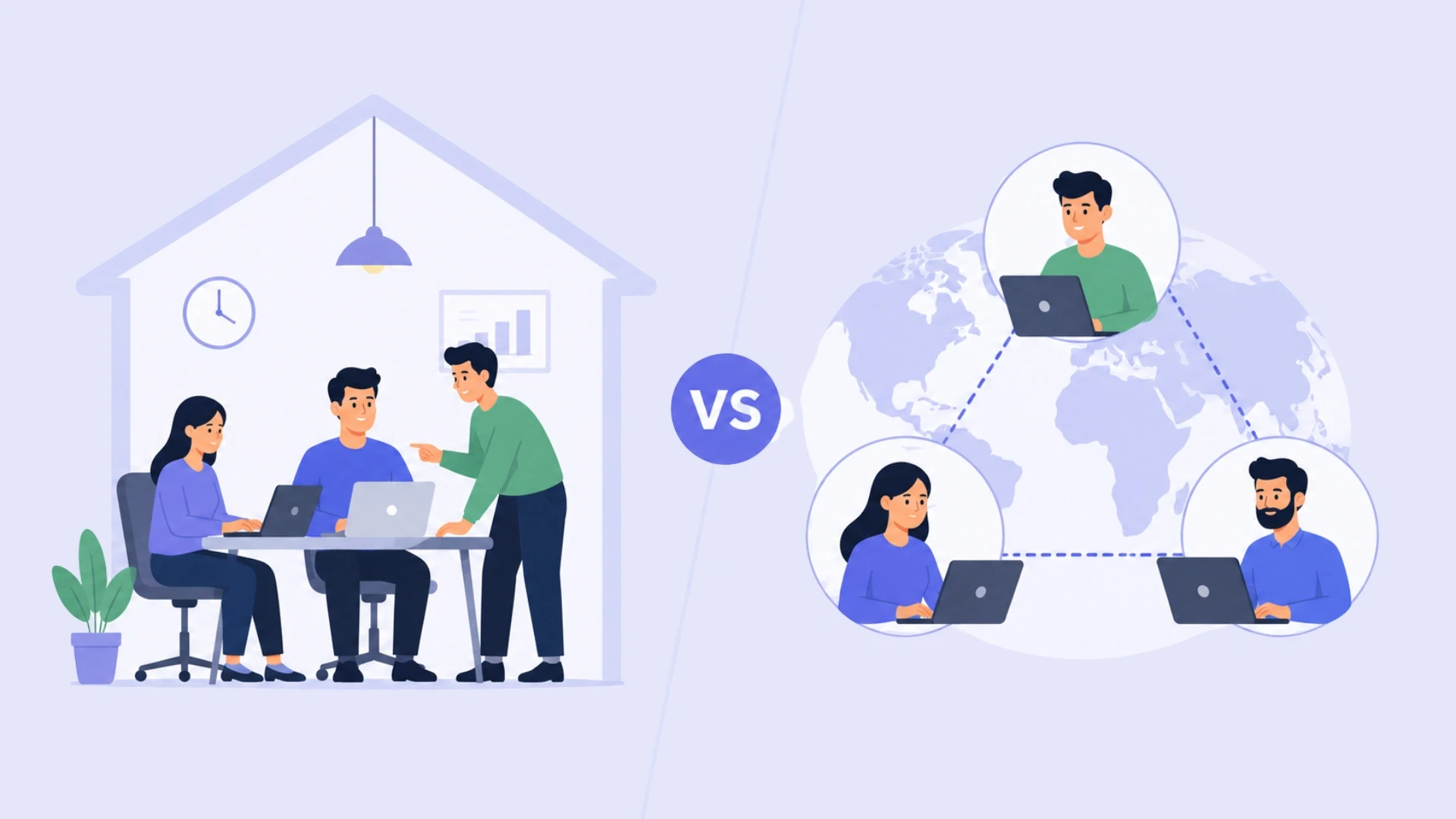
Total Cost of Ownership across 3 years is where the real math surfaces. Single-year cost comparisons miss the accumulated impact of attrition, hiring lag, and management overhead over the actual product engagement horizon.
3-Year TCO for a Team of 5 Python Developers
Cost Category | US In-House | Vetted Offshore |
|---|---|---|
Year 1 fully-loaded team cost | $1,027,685 | $257,200 |
Year 2 fully-loaded team cost (5% raise) | $1,079,069 | $270,060 |
Year 3 fully-loaded team cost (5% raise) | $1,133,022 | $283,563 |
Attrition replacement cost (30% turnover) | $180,000 | $0 (free replacement) |
Hiring lag delay cost (3-6 months) | $285,000 | $0 (48-hour start) |
Management/HR overhead 3 years | $120,000 | $60,000 |
3-year total TCO (5 developers) | $3,824,776 | $870,823 |
3-year savings | Baseline | $2,953,953 (77% saved) |
What the 3-Year Math Reveals
77% TCO savings across 3 years for a team of 5. Nearly $3 million saved on a 5-developer team by outsourcing to a vetted agency versus building US in-house. This aligns with Medium Predict's 2026 analysis showing $900K-$1.55M annual savings per 5-developer team, extended across the 3-year product horizon.
Attrition and hiring lag compound the in-house disadvantage. US tech attrition runs 20-30% annually, meaning 1-2 developers on a team of 5 leave every year. Each departure triggers $15K-$25K recruitment cost plus 3-6 months of lost velocity. Offshore vetted agency engagements with free replacement guarantees eliminate both.
Salary inflation adds 5% annually to in-house teams. US Python developer salaries rose 4.6% in 2025 per Glassdoor and are trending similarly in 2026. Offshore engagement rates have been substantially more stable, widening the cost gap over multi-year horizons.
Even a 50% quality discount does not close the gap. Some in-house advocates argue offshore delivers 50% of US quality. Even at that discount, offshore is still 50% cheaper on a quality-adjusted basis. With vetted agencies delivering equivalent production quality, the math is not close.
The specific comparison of Python hiring models (staff augmentation, dedicated team, project outsourcing) that make up the outsourcing side of this analysis is covered in Python hiring models comparison staff augmentation vs dedicated team vs outsourcing, which walks through when each specific model wins.
Hidden Costs Most Teams Miss on Both Sides
Both in-house and outsourcing have hidden costs that never appear in the initial budget calculations. Understanding these hidden costs is what separates informed decisions from expensive learning experiences.
Hidden In-House Costs (Most Teams Underestimate)
Hiring lag opportunity cost. US senior Python roles typically take 3-6 months to fill. During that period, the roadmap stalls, competitors ship, and the market opportunity narrows. For fast-moving product companies, this opportunity cost frequently exceeds the direct hiring cost.
Ramp-up productivity gap. A new US Python developer typically takes 3-6 months to reach full productivity. During ramp, the developer produces at 30-60% of eventual output. Salary is 100% during the ramp period; productivity is not.
Bad hire cost (150-200% of annual salary per SHRM). Approximately 30% of technical hires do not work out per SHRM data. Each bad hire costs 150-200% of annual salary in productivity loss, replacement cost, and team morale damage. Compounds over multi-year horizons.
Real estate and workspace overhead. Even in remote-first companies, workspace allowances, coworking stipends, and occasional-office costs add $5K-$15K per developer annually. Offshore engagement models absorb this cost within the agency.
Hidden Outsourcing Costs (Most Teams Underestimate)
Management time (5-25% of senior in-house time). Vetted agency dedicated teams typically require 5-10% senior time for coordination. Direct-hire freelancer engagements often require 20-25%. Poorly-structured outsourcing engagements have the same management overhead as in-house teams, which erases the savings.
Rework and quality review cycles. The single largest hidden cost per Codebrand 2026 analysis. Rework generates more review cycles that cross timezone gaps, delaying the next fix and pushing timeline. Preventable through senior vetting and clear specification.
Communication and coordination tooling. Slack, video conferencing, project management tools, VPN access, secrets management. Typically $1K-$3K per developer annually. Small individually, meaningful across large teams.
Cultural and process integration cost. First 2-4 weeks of any engagement require alignment on communication norms, engineering practices, and product context. Structured onboarding processes minimize this cost; ad-hoc engagements amplify it.
The Hybrid Model: When Both Approaches Win Together

Most successful 2026 Python teams do not choose one approach exclusively. They run a hybrid model that captures the strengths of both, calibrated to specific role requirements and engagement stages.
The Hybrid Model Decision Matrix
Role/Function | In-House Wins | Outsource Wins |
|---|---|---|
Product architecture and strategy | Always | Rarely |
Senior engineering leadership | Usually | Sometimes (staff aug) |
Core product engineering | For long-term IP | For scaling capacity |
Feature development at scale | Rarely | Usually |
Compliance-critical systems | Depends | With vetted agency |
MVP and prototype builds | Rarely | Almost always |
Ongoing maintenance and support | Never | Almost always |
Specialized skills (ML, security) | For core needs | For project needs |
As Reid Hoffman, cofounder of LinkedIn, has observed: "The best way to build a company is to have a great team." Applied to Python engineering economics, the great team is often hybrid: a small in-house core (product leadership + senior architecture) plus a larger outsourced execution team (scaling engineering capacity). This structure captures in-house ownership of strategy while capturing outsourced cost efficiency on execution. Companies that run hybrid models successfully report cost savings of 40-60% relative to pure in-house teams with equivalent or better delivery velocity.
The Pragmatic Hybrid Structure
In-house: Product leadership, senior architecture, compliance strategy. Founder-CTO, VP Engineering, principal engineers holding product context and architecture ownership. Typically 2-4 senior in-house engineers per 8-12 outsourced engineers.
Outsourced: Feature engineering, scaling capacity, specialized skills. Dedicated Python engineering team through vetted agency at $3,200/month per engineer. Scales up or down as roadmap requires without hiring lag or attrition risk.
Ratio typically 1:3 or 1:4 (in-house to outsourced). Every senior in-house engineer supervises 3-4 outsourced engineers. Ratio calibrated by team maturity, product complexity, and coordination discipline.
Contract structure ensures continuity and quality. Named resource clauses, free replacement guarantees, structured 30-day handover, quality gates in CI/CD. The contract structure that makes outsourced engagement equivalent to extended in-house team.
The specific analysis of why in-house Python teams outperform marketplace developers on continuity and quality, including when the hybrid model with vetted agency outsourcing wins over pure in-house or pure marketplace approaches, is covered in in-house Python team vs marketplace developers, which walks through the specific structural differences between vetted agency and marketplace outsourcing.
The Bottom Line
The true cost of building a Python application in-house versus outsourcing is a fully-loaded 3-year TCO calculation, not an hourly rate comparison. US senior Python developers cost $200,000+ per year fully loaded. Vetted offshore Python developers cost $42,000-$68,000 per year fully loaded. Across a 5-developer team for 3 years, the TCO gap runs $2.9-$3.0 million with vetted offshore delivering 77% savings when structured correctly.
The pragmatic 2026 approach is hybrid: keep product leadership and senior architecture in-house (20-30% of engineering), outsource execution capacity through vetted agencies at $3,200/month per engineer (70-80% of engineering). Ratio typically 1:3 or 1:4 in-house to outsourced. This captures in-house strategy ownership plus outsourced cost efficiency, produces 40-60% cost savings versus pure in-house, and delivers equivalent or better velocity. Pick the model that matches your engagement stage, structure the contract with continuity and IP guarantees, and Python economics stops being a hiring problem and becomes a competitive advantage.
Turn the In-House vs Outsourcing Decision Into Clear TCO Math
Book a free 30-minute cost consultation with Acquaint Softtech. Share your current team size, engagement horizon, and specific Python roles, and we will model your fully-loaded 3-year TCO for both approaches side by side. Get specific savings projections for your engagement plus a hybrid model recommendation calibrated to your product stage.
Frequently Asked Questions
-
What is the true cost difference between in-house and outsourced Python developers in 2026?
US senior Python developer costs $200,000+ per year fully loaded (salary + benefits + taxes + equipment + recruiting). Vetted offshore Python developer costs $42,000-$68,000 per year fully loaded. Net savings run 40-77% depending on engagement structure and geography, with vetted agency dedicated teams delivering the largest savings.
-
What hidden costs does in-house Python hiring actually carry?
Recruiting cost $15K-$25K per hire, ramp-up productivity gap (3-6 months at 30-60% output), attrition replacement cost (20-30% annual turnover in US tech), workspace and equipment overhead, and bad hire cost of 150-200% of annual salary per SHRM. These typically add 40-60% to base salary fully loaded.
-
What hidden costs does outsourced Python development actually carry?
Management time overhead (5-25% senior time depending on engagement structure), rework and quality review cycles (single largest hidden cost per Codebrand 2026), communication tooling ($1K-$3K per developer annually), and cultural/process integration cost during first 2-4 weeks. Vetted agency engagements minimize these; marketplace freelancer engagements amplify them.
-
What is the 3-year TCO for a team of 5 Python developers?
US in-house: approximately $3.8M fully loaded across 3 years including attrition, hiring lag, and management overhead. Vetted offshore: approximately $870K including all overhead. Net savings: approximately $3M over 3 years, or 77% TCO reduction. This aligns with Medium Predict's 2026 analysis of $900K-$1.55M annual savings per 5-developer team.
-
When does in-house Python hiring actually win?
Product architecture and strategy leadership, senior engineering roles requiring deep product context, and compliance-critical systems where control matters more than cost. Most successful Python teams keep 20-30% of engineering in-house (leadership + architecture) and outsource 70-80% of execution engineering.
-
What is the hybrid Python engineering model?
Small in-house core (product leadership + senior architecture) plus larger outsourced execution team through vetted agency. Typical ratio 1:3 or 1:4 in-house to outsourced. Captures in-house ownership of strategy plus outsourced cost efficiency on execution. Companies running hybrid models report 40-60% cost savings vs pure in-house with equivalent or better delivery velocity.
I love to make a difference. Thus, I started Acquaint Softtech with the vision of making developers easily accessible and affordable to all. Me and my beloved team have been fulfilling this vision for over 15 years now and will continue to get even bigger and better.
Table of Contents
Get Started with Acquaint Softtech
- 13+ Years Delivering Software Excellence
- 1300+ Projects Delivered With Precision
- Official Laravel & Laravel News Partner
- Official Statamic Partner
Related Blog
How to Measure Business Impact After Python Development Deployment
How to measure business impact after Python development deployment. KPIs, DORA + DX Core 4 framework, ROI attribution, and anti-patterns to avoid in 2026.

Acquaint Softtech
June 30, 2026
Python Development in 2026: Architecture Patterns, Frameworks and Real-World Industry Applications
Explore Python backend architecture patterns, framework comparisons (Django vs FastAPI vs Flask), scalability decisions, and real-world Python development use cases across healthcare, FinTech, SaaS, EdTech, and logistics in 2026.
Acquaint Softtech
March 4, 2026
Python Development Cost: Fixed Price vs Dedicated Team vs Staff Augmentation
Compare Python development costs across fixed price, dedicated team, and staff augmentation models. Real 2026 data, expert insights, and Acquaint Softtech pricing to help you decide.
Acquaint Softtech
March 10, 2026India (Head Office)
203/204, Shapath-II, Near Silver Leaf Hotel, Opp. Rajpath Club, SG Highway, Ahmedabad-380054, Gujarat
USA
7838 Camino Cielo St, Highland, CA 92346
UK
The Powerhouse, 21 Woodthorpe Road, Ashford, England, TW15 2RP
New Zealand
42 Exler Place, Avondale, Auckland 0600, New Zealand
Canada
141 Skyview Bay NE , Calgary, Alberta, T3N 2K6