

Python Microservices Architecture When to Break the Monolith and How
Python microservices architecture in 2026. When to break the monolith, how to migrate safely, and the real costs Netflix and Uber learned the hard way.

Acquaint Softtech
Introduction: The Microservices Question Most Teams Get Wrong
Every growing engineering team eventually has the same conversation. Deployments are getting slow. One team's bug took down another team's feature. The codebase has grown to a size where new engineers take three months to feel productive. Somebody on the leadership call mentions Netflix, and within two weeks a microservices migration is on the roadmap. Six months later, the team has 27 microservices, three times the operational overhead, and the same business problems they started with.
The honest 2026 answer is that microservices solve specific problems, not general ones. According to a 2026 analysis of Netflix, Amazon, and Atlassian architectures published by AWS in Plain English, a bad microservices architecture is worse than a well-maintained monolith. Twitter's early microservices migration created a disaster. Shopify handles billions in Black Friday sales on a Rails monolith. Stack Overflow serves millions of developers without microservices. The architecture is a tool, not a destination.
This playbook covers when a Python monolith should actually be broken into microservices, when it should not, and how to execute the migration without producing a distributed monolith that combines the worst of both architectures. It is written for CTOs, founders, and senior engineers who are either staring at a monolith that has started to creak or planning a Python architecture from scratch and want to make the right call early.
If you are still building the team that will execute the architecture, the complete guide to hiring Python developers in 2026 sets the wider hiring context. The decisions below assume you have engineers who can implement them safely.
When You Should Not Break the Monolith
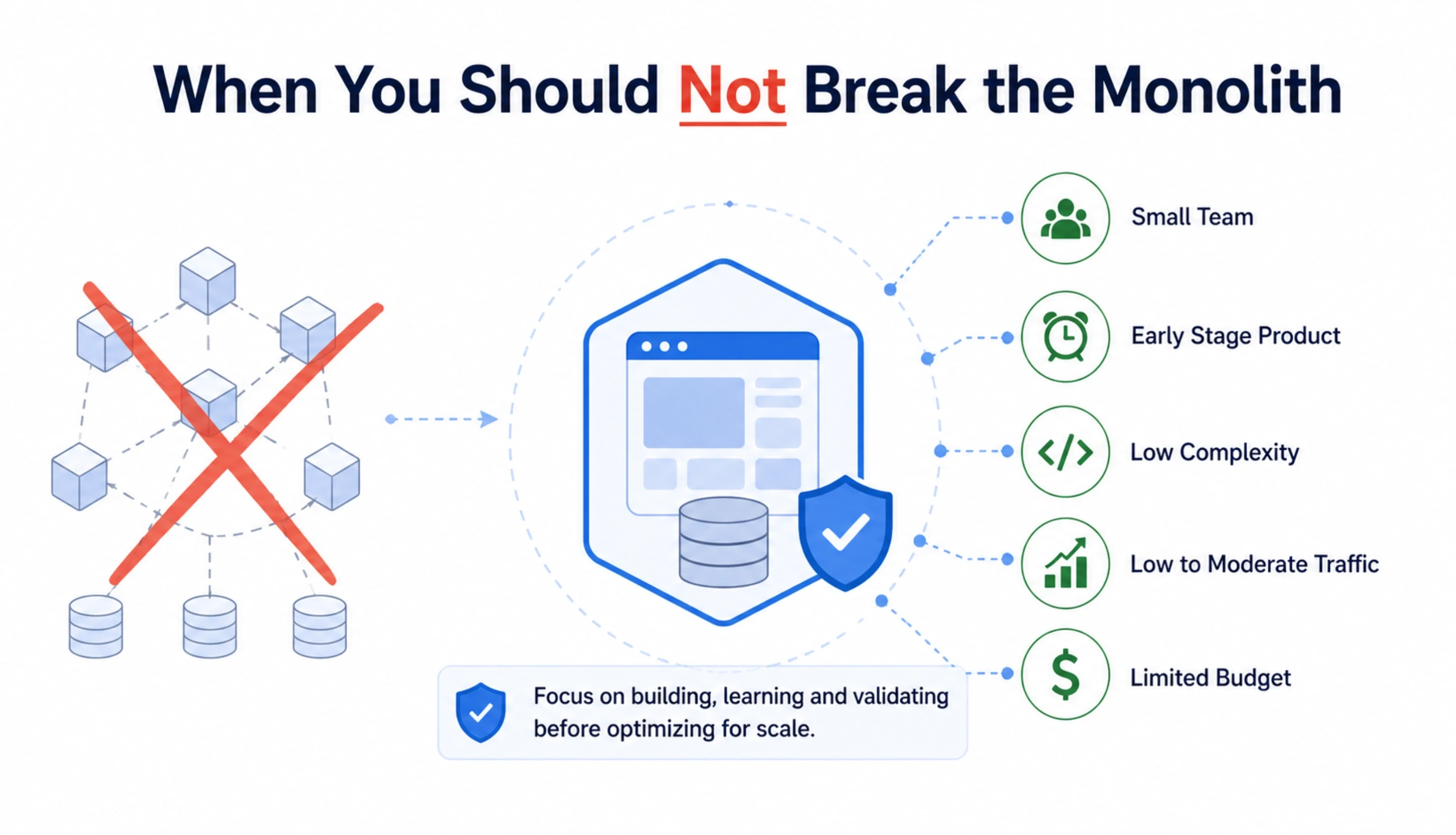
Start with the case for staying. Most teams that consider microservices in 2026 should not migrate yet. The cost of premature decomposition is high and the benefits do not arrive until specific organisational and traffic conditions are met.
Engineering team under 20 people. Microservices benefits scale with team size. Below 20 engineers, the coordination overhead of a distributed system is higher than the coordination overhead of a well-modularised monolith.
Product still finding fit. If your domain boundaries are still shifting weekly, drawing service boundaries today guarantees you will redraw them in three months. Lock the domain first.
No clear scaling bottleneck. If the monolith is not actually being constrained by a specific component, splitting will not solve a problem you do not have.
Limited DevOps maturity. Microservices require service mesh, distributed tracing, centralised logging, and 24/7 incident response. Without that infrastructure, the migration creates more incidents than it prevents.
Single product, single deployment cadence. If everything ships together anyway, the deployment independence that microservices give you is irrelevant.
For teams in any of these situations, the right move is a modular monolith with disciplined boundaries, covered in detail in the guide on Python development architecture and frameworks. A well-modularised monolith can scale further than most companies will ever need.
When You Should Actually Break the Monolith
The case for migration becomes clear when specific pressure points emerge. Hyscaler's 2026 microservices analysis documents Uber's original architecture as a single Python monolith called 'ubercarpool', and notes that as Uber expanded internationally to hundreds of cities, the monolith became a serious impediment to scaling and team autonomy. Netflix open-sourced tools like Hystrix for fault tolerance and Eureka for service discovery to manage the same complexity. The pattern is consistent: monoliths break when team coordination cost exceeds service coordination cost.
The five legitimate triggers for breaking a Python monolith in 2026 are listed below. If two or more of these apply concurrently, the migration is justified. If only one applies, fix that single issue inside the monolith first.
Engineering organisation past 50 people. At this scale, multiple teams need to ship independently without stepping on each other's commits. Microservices align deployment boundaries with team boundaries.
Wildly different scaling profiles. If one feature handles 10x the traffic of another, scaling them together wastes infrastructure. Microservices let each component scale on its own pattern.
Different reliability requirements. A payment service that must be 99.99% available has different operational needs than a recommendation engine that can absorb a five-minute outage. Splitting protects the critical path.
Technology diversity needed. Some workloads need Python, some need Go for performance, some need a JVM language for legacy integration. Microservices allow each team to use the right tool.
Deployment cadence mismatch. If one feature ships daily and another ships quarterly, releasing them together creates either velocity tax or stability risk. Splitting decouples the cadences.
The Decision Matrix: Should You Break or Hold?
Use this matrix to score your situation. The decision is rarely binary, but the dimensions below produce a clearer answer than gut feel.
Table : Python Monolith vs Microservices Decision Matrix (2026)
Dimension | Stay Monolith | Break to Microservices |
|---|---|---|
Team size | Under 20 engineers | 50+ engineers |
Product maturity | Pre-PMF, evolving domain | Stable domain, scaling phase |
Scaling pattern | Uniform across features | Wildly uneven by feature |
Reliability needs | Same SLA across all features | Different SLAs per feature |
DevOps maturity | Basic CI/CD only | Service mesh, tracing, on-call |
Deployment cadence | Same release rhythm | Different teams, different speeds |
Daily traffic | Under 1M requests | 10M+ requests |
How to Break the Monolith Without Breaking Production
If the matrix points to migration, the next decision is execution. Most failed microservices projects fail not because the strategy was wrong, but because the execution was rushed. The proven 2026 approach is the strangler pattern: extract services one at a time from the monolith while keeping it operational, retire pieces of the monolith as services replace them, and never run a 'big bang' rewrite.
Step 1: Identify the First Service to Extract
Pick the part of the monolith that is most painful and most isolated. Authentication is a common first choice because it has clear boundaries. Notifications and search are also good candidates because they have well-defined inputs and outputs. Avoid extracting the core domain first; that is a multi-quarter project that will fail before it ships.
Step 2: Define the Service Contract
Write the API contract before writing the service. OpenAPI specifications, gRPC proto files, or async event schemas. The contract is what protects the monolith from regressions during the migration. If the contract is fuzzy, the new service will leak its internals into the monolith and you will have built a distributed monolith.
Step 3: Extract Behind a Feature Flag
Run the new service in parallel with the existing monolith functionality. Use feature flags to route a percentage of traffic to the new service. Compare results between the two implementations. Move from 1% to 100% over weeks, not hours. This is how Stripe, GitHub, and others have migrated production systems without user-visible incidents.
Step 4: Decompose the Database Last
Splitting a shared database is the hardest part of any microservices migration. Do it last, not first. The new service can read from the monolith's database during the transition. Once the service is stable and owns its writes, migrate it to its own database with a planned data sync, then cut the monolith's read path.
Step 5: Repeat Until the Monolith Is the Smallest Service
The goal is not zero monolith. The goal is the right shape. Many mature 2026 architectures keep a small core monolith for cross-cutting concerns and run 5 to 15 microservices around it for the parts that genuinely benefit from independent deployment. 700 microservices is a Netflix problem, not a typical company problem.
The Real Cost of Microservices in 2026
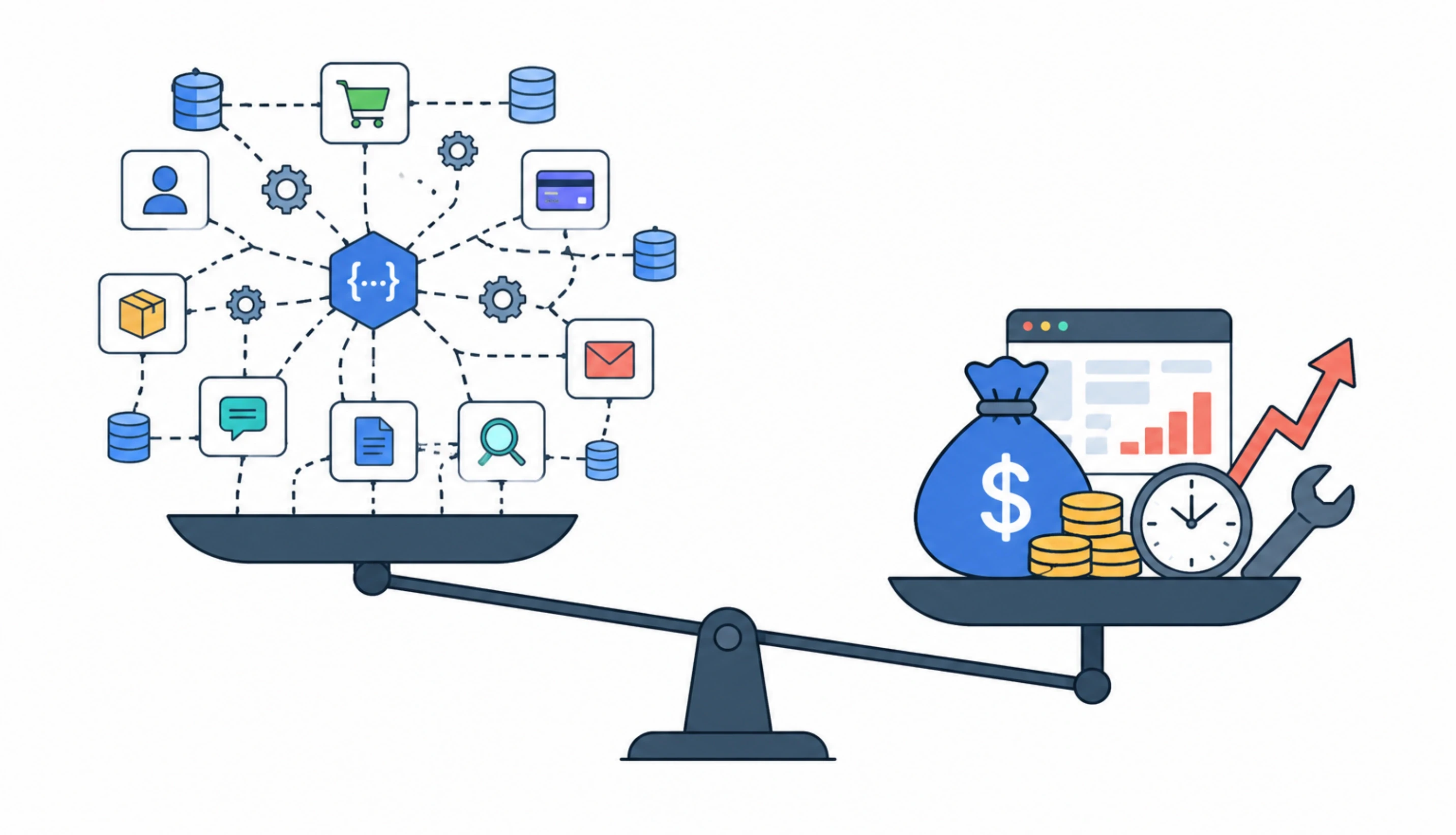
Microservices come with costs that monoliths do not have, and most teams underestimate them. Java Code Geeks' 2026 architecture guide notes that internal service-to-service HTTP calls typically add 10 to 50ms of latency each, accounting for serialisation, network transit, and deserialisation. Netflix runs over 700 microservices and openly acknowledges that running them requires sophisticated service mesh implementations, custom deployment platforms, and chaos engineering practices, which represent millions of dollars in engineering time and infrastructure costs.
Table : Hidden Costs of Microservices vs Monolith at the Same Scale
Cost Category | Monolith | Microservices (10 services) |
|---|---|---|
Inter-service latency | Microseconds (in-process) | 10 to 50ms per hop |
Infrastructure | 1 deployment unit | 10 services + service mesh |
Observability tooling | Basic APM | Distributed tracing required |
DevOps headcount | 1 to 2 engineers | 3 to 6 engineers |
Debugging complexity | Single stack trace | Cross-service correlation |
Schema changes | Coordinated in code | Versioned API contracts |
For the full operational cost picture across the lifetime of a Python project, including the engineering and infrastructure premium that microservices add, the analysis on ownership cost of Python projects walks through the 24-month total cost of ownership in detail.
Planning a Python Monolith to Microservices Migration?
Acquaint Softtech provides senior Python engineers with hands-on experience in strangler-pattern migrations, FastAPI microservices, gRPC contracts, distributed tracing setup, and database decomposition. Profiles in 24 hours. Onboarding in 48. Starting at $20/hour. Full IP assignment from day one
Python-Specific Microservices Patterns That Work in 2026
Python brings specific strengths and constraints to microservices that other languages do not share. Designing for these patterns is the difference between a system that scales smoothly and one that fights its own runtime.
FastAPI for High-Throughput Services
FastAPI on Uvicorn is the 2026 default for new Python microservices. ASGI async support, automatic OpenAPI generation, and Pydantic validation give each service a clean, documented contract from day one. Use FastAPI for any service where the primary work is I/O-bound API handling.
Django for Domain-Heavy Services
Django stays valuable as a microservice when the service owns substantial domain logic, admin interfaces, or complex ORM operations. The batteries-included framework reduces per-service development time, even if individual services are slightly slower than FastAPI on raw RPS.
Celery and Dramatiq for Async Work
Background work that crosses service boundaries belongs in a queue, not in synchronous HTTP calls. Celery remains the workhorse for complex pipelines. Dramatiq is the cleaner modern alternative for new services that do not need Celery's full feature set.
gRPC for Internal Service-to-Service
REST is fine for external APIs. For internal service-to-service communication where latency matters, gRPC with protobuf is meaningfully faster and gives you typed contracts. The Python gRPC ecosystem has matured significantly and is production-stable in 2026.
Event-Driven With Kafka or NATS
For microservice communication that does not need synchronous responses, event streams are more resilient than direct calls. Kafka for high-volume event processing, NATS for lightweight pub-sub. Event-driven design also avoids the latency tax of chained HTTP calls.
The Pitfalls That Turn Microservices Into Distributed Monoliths
A distributed monolith has all the operational complexity of microservices and none of the benefits. Watch for these patterns during and after migration.
Services that always deploy together. If three services must always be released as a coordinated set, they are one service in disguise. Re-evaluate the boundary.
Shared database across services. If two services write to the same tables, neither owns its data. Schema changes require coordination, the worst feature of monoliths plus the network latency of microservices.
Synchronous chains 4+ deep. If a single user request triggers Service A calling B calling C calling D, your tail latency is the sum of all four. Use events or aggregation patterns instead.
Cross-service transactions. True ACID transactions across services are nearly impossible. Use eventual consistency with sagas. If you need strict consistency, the operations belong in one service.
No service ownership. Every service must have a clearly named owning team. Services without owners decay into legacy code that nobody understands or maintains.
These pitfalls are the structural reasons microservices migrations turn into rebuild cycles, and they map closely to the warning signs covered in the guide on Python development expensive red flags.
Realistic Migration Timeline and Team Composition
A Python monolith to microservices migration is not a quarter-long project. For a real production system with users, plan for a 12 to 24 month phased migration where the monolith stays operational throughout. Trying to compress this timeline is the most reliable way to produce a distributed monolith.
Table : Realistic Python Microservices Migration Phases
Phase | Duration | Key Activities |
|---|---|---|
Discovery and modular refactor | 2 to 3 months | Map domain, refactor monolith into clear modules |
First service extraction | 2 to 3 months | Auth or notifications service, full strangler pattern |
Infrastructure foundation | 1 to 2 months | Service mesh, tracing, CI/CD, on-call setup |
Iterative extraction (5 services) | 6 to 9 months | One service per 6 to 8 weeks, in parallel |
Database decomposition | 3 to 6 months | Service-owned databases, sync, cutover |
Stabilisation | 2 to 3 months | Performance tuning, runbook hardening |
Team composition during migration typically includes senior backend engineers, a DevOps lead for the infrastructure foundation, and a part-time architect for cross-cutting decisions. The right engagement model for this kind of multi-quarter work is usually a dedicated team, covered in the Python hiring models comparison.
How Acquaint Softtech Approaches Microservices Migrations
Acquaint Softtech is a Python development and IT staff augmentation company based in Ahmedabad, India, with 1,300+ software projects delivered globally across healthcare, FinTech, SaaS, EdTech, and enterprise platforms. We have led monolith-to-microservices migrations across multiple domains, applying the same hiring framework described in the complete guide to hiring Python developers to staff each engagement with engineers who have shipped distributed systems in production.
Senior Python engineers with strangler-pattern experience. Hands-on with FastAPI microservices, gRPC, Celery pipelines, Kafka event streams, and database decomposition.
DevOps and infrastructure depth. Service mesh setup, distributed tracing with OpenTelemetry, observability stacks across AWS, GCP, and Azure.
Healthcare and FinTech compliance experience. GDPR-compliant architecture for BIANALISI, Italy's largest diagnostics group; FinTech systems with audit-grade event sourcing.
Transparent pricing from $20/hour. Dedicated team engagements from $3,200/month per engineer. Architecture audits from $5,000.
To bring senior Python engineers onto your migration project quickly, you can hire Python developers with profiles shared in 24 hours and a defined onboarding plan within 48.
The Bottom Line
Microservices are not the answer to architecture. Architecture is the answer to specific problems, and microservices are the answer to specific architectural problems: large team coordination, divergent scaling profiles, divergent reliability needs, divergent deployment cadences. If those problems are not present, microservices add cost without adding value.
If they are present, the right migration is patient, phased, and built on the strangler pattern. Extract one service at a time. Define contracts before code. Decompose databases last. Aim for the smallest number of services that solves the actual problem, not the largest number that looks impressive on an architecture diagram. Start boring, ship fast, let real pain drive real change. The architecture your team can operate at 3 AM is the right one.
Want a Honest Read on Whether to Break Your Python Monolith?
Book a free 30-minute architecture review. We will look at your current monolith, your team size, and your scaling profile, and tell you straight whether microservices will help or hurt. No sales pitch. Just a senior engineer's honest assessment of your situation.
How Acquaint Softtech Builds Scalable Python Backends
Acquaint Softtech is a Python development and IT staff augmentation company based in Ahmedabad, India, with 1,300+ software projects delivered globally across healthcare, FinTech, SaaS, EdTech, and enterprise platforms. Our scalable backend engagements follow the architecture principles in the complete guide to hiring Python developers, and our senior engineers have shipped systems holding well over 100,000 concurrent users across the FinTech and analytics domains.
Senior Python engineers across Django, FastAPI, Flask, with hands-on experience in async architecture, PostgreSQL replica setups, Redis cluster operations, and Celery worker design.
Production-grade infrastructure expertise. AWS, GCP, Azure deployment with auto-scaling, observability, and disaster recovery built into every engagement.
Healthcare-grade compliance experience. GDPR-compliant analytics platform delivered for BIANALISI, Italy's largest diagnostics group, processing patient records across multiple labs.
Transparent pricing from $20/hour. Dedicated engineering teams from $3,200/month. Fixed-budget architecture audits from $5,000.
To bring senior Python engineers onto your scaling project quickly, you can hire Python developers with profiles shared in 24 hours and a defined onboarding plan within 48.
The Bottom Line
Building a Python backend that holds at 100,000 users is not a heroic feat. It is a series of disciplined architectural choices made early enough to compound. Stateless workers behind a load balancer. Async where I/O dominates. PgBouncer and read replicas in front of PostgreSQL. Redis caching with explicit invalidation. Background workers absorbing anything over 200ms. Observability that tells you what is breaking before users do.
Get those seven layers right and Python scales as far as your business does. Get them wrong and the framework debate becomes irrelevant, because the backend will collapse at 20,000 users regardless of which one you picked. Architecture wins. Frameworks come along for the ride.
Planning a Backend Rewrite or a Scale Audit?
Book a free 30-minute architecture review. We will look at your current backend, identify the three highest-impact scaling bottlenecks, and give you a written remediation plan. No sales pitch. Just a senior engineer's honest read on where the system will break first.
Frequently Asked Questions
-
When is the right time to break a Python monolith into microservices?
When you have at least two of these conditions concurrently: an engineering team of 50+ people, components with wildly different scaling profiles, different reliability SLAs across features, or deployment cadences that diverge between teams. If only one condition applies, fix that single issue inside the monolith first. Premature decomposition is the most common reason microservices projects fail.
-
Can a Python monolith handle large-scale traffic without splitting?
Yes, comfortably. Instagram and Pinterest run on Django monoliths at scales far above 100,000 users, and Shopify processes billions in Black Friday transactions on a Rails modular monolith. A well-architected Python monolith with proper caching, async I/O, and database scaling can handle traffic that most companies will never reach. The architecture limits hit team size and deployment patterns long before they hit raw throughput.
-
What is a 'distributed monolith' and why is it dangerous?
It is a microservices architecture where services cannot actually be deployed or scaled independently because they share databases, deploy in coordinated sets, or have synchronous call chains 4+ deep. You inherit the operational complexity of microservices (tracing, service mesh, network latency) without the benefits (independent scaling, deployment, ownership). This pattern is the worst architectural outcome and the most common failure mode of rushed migrations.
-
Should I split the database when I split a service?
Yes, eventually, but not on day one. Database decomposition is the hardest part of any microservices migration and should happen after the service is stable and own its writes. The standard approach is to let the new service read from the monolith's database during the transition, then migrate to its own database with a planned data sync, then cut the monolith's read path. This usually adds 3 to 6 months to the migration but prevents most of the data integrity issues that doom rushed splits.
-
What is the strangler pattern and why is it the safest migration approach?
The strangler pattern extracts services from the monolith one at a time while keeping the monolith operational. New functionality goes into the new service, old functionality is gradually rerouted to it through feature flags, and the monolith shrinks as services replace its components. The pattern is safer than a 'big bang' rewrite because production never goes down during the migration and you can roll back any service without breaking the rest of the system.
-
How long does a real Python microservices migration take?
Plan for 12 to 24 months for a real production system, broken into discovery, infrastructure foundation, iterative extraction, database decomposition, and stabilisation phases. Trying to compress this timeline produces distributed monoliths and outages. The teams that succeed treat migration as a phased program, not a project, and keep the monolith operational throughout.
-
How many microservices should a typical 2026 Python product end up with?
Far fewer than most teams imagine. A typical mature 2026 architecture has 5 to 15 microservices around a small core monolith for cross-cutting concerns. 700 microservices is a Netflix problem, not a typical company problem. The right number is 'as few as possible while still aligning service boundaries to team boundaries and scaling profiles.' Each additional service is operational tax that has to earn its keep.
We’re Acquaint Softtech, your technology growth partner. Whether you're building a SaaS product, modernizing enterprise software, or hiring vetted remote developers, we’re built for flexibility and speed. Our official partnerships with Laravel, Statamic, and Bagisto reflect our commitment to excellence, not limitation. We work across stacks, time zones, and industries to bring your tech vision to life.
Table of Contents
Get Started with Acquaint Softtech
- 13+ Years Delivering Software Excellence
- 1300+ Projects Delivered With Precision
- Official Laravel & Laravel News Partner
- Official Statamic Partner
Related Blog

When Is Python Development Too Expensive? Pricing Red Flags That Signal a Bad Vendor
Not all expensive Python development is justified. This guide identifies the exact pricing red flags that signal a bad vendor, with real benchmarks, warning signs, and what fair Python pricing actually looks like in 2026.
Acquaint Softtech
March 26, 2026
How to Hire Python Developers Without Getting Burned: A Practical Checklist
Avoid costly hiring mistakes with this practical checklist on how to hire Python developers in 2026. Compare rates, vetting steps, engagement models, red flags, and more.
Acquaint Softtech
March 30, 2026
Total Cost of Ownership in Python Development Projects: The Full Financial Picture
The build cost is just the beginning. This guide breaks down the complete TCO of Python development projects across every lifecycle phase, with real benchmarks, a calculation framework, and 2026 data.
Acquaint Softtech
March 23, 2026India (Head Office)
203/204, Shapath-II, Near Silver Leaf Hotel, Opp. Rajpath Club, SG Highway, Ahmedabad-380054, Gujarat
USA
7838 Camino Cielo St, Highland, CA 92346
UK
The Powerhouse, 21 Woodthorpe Road, Ashford, England, TW15 2RP
New Zealand
42 Exler Place, Avondale, Auckland 0600, New Zealand
Canada
141 Skyview Bay NE , Calgary, Alberta, T3N 2K6
Your Project. Our Expertise. Let’s Connect.
Get in touch with our team to discuss your goals and start your journey with vetted developers in 48 hours.