

Quality Assurance Strategy in Python Development Projects
Quality assurance strategy in Python development 2026: what serious teams do differently. Testing pyramid, quality gates, and key anti-patterns to avoid.

Acquaint Softtech
Introduction: The QA Strategy That Separates Serious Teams from the Rest
Every Python development team claims to take quality seriously. Almost none of them actually do. The difference is visible in the first sprint and becomes overwhelming by month three. Serious teams have pytest running on every pull request before anyone reviews the code, with coverage thresholds enforced and CI blocking PRs that drop below them. They run static analysis in the same pipeline, catching SQL injection patterns, hardcoded credentials, and OWASP Top 10 violations before they reach the main branch. They run integration tests against real PostgreSQL containers spun up in CI, not against mocked-out databases that hide real bugs.
The data on what actually distinguishes serious QA teams is well documented. According to a 2026 quality assurance best practices analysis by Nearshore Business Solutions, 62% of engineering organizations cite detecting defects earlier as a primary quality goal per the Capgemini World Quality Report, but fewer than half have operationalized it. The same analysis identifies the structural practices that distinguish operationalized QA from aspirational QA: Three Amigos sessions where a developer, QA engineer, and product owner collaboratively review requirements before development begins, four quality gates that must pass before any story moves to development (acceptance criteria validation in Given/When/Then format with QA holding veto authority, testability assessment, test approach definition, and risk classification).
This guide walks through what a serious Python QA strategy actually looks like in 2026. It covers what 'serious QA' means beyond test coverage percentages, the Python testing pyramid that consistently catches defects at the right layer, the shift-left and quality gate discipline that prevents bad code from merging, the anti-patterns that make test suites worse than nothing, and how to staff and structure QA so it compounds project quality rather than slowing it down. It is written for engineering leaders, CTOs, QA leads, and senior Python developers who suspect their current QA process is more theatre than substance and want a concrete framework for fixing it.
If you are also building the team that will execute the QA strategy, the complete guide to hiring Python developers sets the wider context. Serious Python QA work specifically requires senior engineers with testing culture built into their habits, which is a profile meaningfully different from generic Python feature development.
What "Serious QA" Actually Means (Beyond Test Coverage Percentages)
.webp "What")
Engineering teams routinely confuse activity with discipline when it comes to QA. They measure test count, coverage percentage, and number of bugs found, and then wonder why their projects still ship with the same categories of issues sprint after sprint. Coverage is a useful indicator, but high coverage with bad tests is worse than lower coverage with good ones, because high coverage with bad tests creates false confidence. The five properties below distinguish QA that genuinely improves project quality from QA that performs the rituals without producing the outcomes.
The Five Properties of Genuinely Serious Python QA
Tests block bad code at the PR layer, not after merge. Pytest runs in CI on every pull request. Coverage threshold enforced. Type checking with mypy or pyright enforced. Linting with Ruff enforced. Static analysis (Bandit for security, SonarQube for code smells) enforced. If any check fails, the PR cannot merge. The reviewer does not need to remember to run tests because the pipeline already did.
Test code is treated with the same engineering discipline as production code. Fixtures organized cleanly. Test helpers refactored when they grow. Brittle tests rewritten rather than tolerated. Flaky tests fixed within the sprint they appear or marked as known issues with a timeline to repair. The test suite is a first-class asset of the codebase, not a graveyard of forgotten attempts to test things.
Quality gates are non-negotiable, even for senior engineers. The CTO's PR also needs 80% coverage on new code. The principal engineer's branch also needs to pass linting. The exception that proves the rule is the exception that breaks the discipline. Teams where the rules apply selectively produce the same outcomes as teams with no rules at all.
QA participates in design, not just verification. Three Amigos sessions before development. QA engineers reviewing technical design documents. Acceptance criteria written in Given/When/Then format with negative cases and boundary conditions explicitly covered. Testability assessed as part of architecture review, not discovered when QA tries to write tests against an untestable design.
Production observability is part of QA, not separate from it. Error rates monitored. p99 latency tracked per endpoint. Real user monitoring catching frontend issues. The team treats production incidents as the highest-fidelity testing environment available. Every incident produces a regression test that ensures the same issue cannot ship again.
What Serious QA Is Not
Serious QA is not 100% code coverage. It is not a six-month manual testing phase before launch. It is not a separate QA department that catches defects engineers introduce. It is not a slide deck about quality processes. All of these can coexist with shipping the same categories of bugs sprint after sprint. Serious QA is a culture and discipline that engineers and product owners share, with tooling that enforces the discipline mechanically and a process that catches the categories of defects that human review consistently misses.
The testing culture pattern is one of the most reliable signals of senior Python developer quality. As covered in the analysis on Python developer hourly rates, testing culture (pytest, unit coverage, integration test discipline) consistently appears in the profile of engineers who deliver production-grade Python work versus those who produce code that needs a quarter of cleanup after they leave.
The Python Testing Pyramid That Actually Works
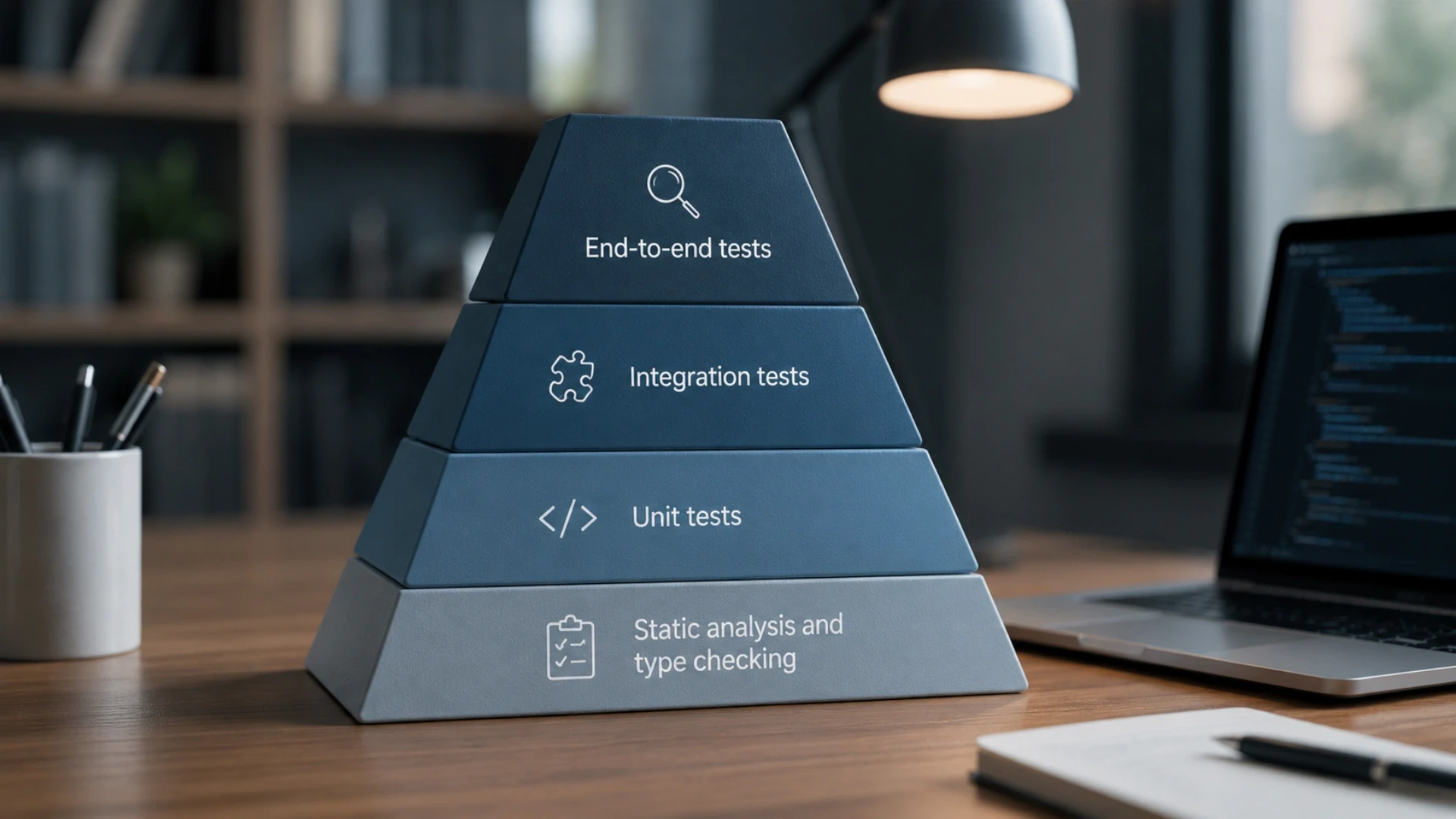
The testing pyramid is one of the oldest and still most useful concepts in software QA, and serious Python teams in 2026 implement it with specific tooling discipline. According to a 2026 analysis of software quality assurance best practices by DeviQA, the automation pyramid principle remains foundational: many unit tests, fewer integration tests, minimal UI tests, because each layer up the pyramid is slower, more brittle, and more expensive to maintain than the layer below it. The same analysis stresses that test suites must be actively maintained, with tests for deprecated features actively retired rather than left as dead weight, because outdated tests are worse than no tests when they create false confidence about coverage. Mature Python teams add a fourth layer at the base of the pyramid in 2026 (static analysis and type checking before any test runs) and treat the entire stack as the quality gate that gates merges.
The Four-Layer Python Testing Pyramid (2026)
Layer | Tools | What It Catches |
|---|---|---|
Static analysis and type checking | Ruff, mypy, pyright, Bandit, SonarQube | Syntax errors, type mismatches, security patterns |
Unit tests (largest band) | Pytest, pytest-cov, pytest-xdist for parallelism | Function-level bugs, regressions during refactoring |
Integration tests | Pytest + testcontainers-python, real PostgreSQL/Redis | Wiring bugs, database queries, ORM patterns |
End-to-end tests (smallest band) | Playwright, Selenium, Schemathesis for APIs | User flows, contract drift, critical path validation |
Why This Specific Layering Works for Python
Static analysis catches what tests cannot. Ruff catches 800+ rule violations in seconds. mypy or pyright catches type mismatches that would otherwise surface in production. Bandit catches insecure patterns (hardcoded passwords, weak crypto). SonarQube catches structural code smells. None of these require running the code; all of them catch real bugs.
Unit tests are the biggest band because they are the fastest feedback. Pytest with a well-organized fixture system runs hundreds of tests in seconds. With pytest-xdist parallel execution, a 30-minute suite becomes a 5-minute suite on 6 workers. Fast feedback is what makes test-driven habits sustainable; slow tests produce skipped tests, which produce undetected bugs.
Integration tests use real dependencies, not mocks. Testcontainers-python spins up actual PostgreSQL, Redis, RabbitMQ in CI. Tests run against real schemas, real query plans, real cache eviction. Mocked databases hide the bugs that real databases surface, which is why mocked integration tests routinely pass while production breaks.
End-to-end tests are reserved for critical paths. Playwright or Selenium covering the 5 to 10 user flows that absolutely must work (signup, payment, primary user action). E2E tests are slow and brittle; their value comes from catching cross-system integration failures that lower layers miss, not from comprehensive coverage of every screen.
Parallel Execution Is Not Optional at Scale
Python test suites grow superlinearly with codebase size. A team that does not invest in parallel execution discovers their 5-minute test suite has become a 45-minute suite, at which point developers start skipping tests locally and CI becomes the bottleneck. Pytest-xdist or pytest-parallel splits tests across CI workers; a 30-minute test suite becomes a 5-minute suite on 6 parallel workers. The detailed monorepo CI optimization patterns are covered in the analysis on structuring a Python monorepo for growing engineering teams, which walks through affected-only test execution, path-based triggers, and the CI design that keeps test feedback fast as the codebase scales.
Need a Python Team With Serious QA Discipline?
Acquaint Softtech delivers Python projects with the QA discipline that distinguishes serious teams: pytest with coverage thresholds enforced in CI, static analysis with Ruff and mypy gating PRs, integration tests against real PostgreSQL containers, SonarQube quality gates, and Three Amigos sessions before every meaningful feature. Senior engineers, transparent pricing from $20/hour.
Shift-Left and Quality Gates: How Serious Teams Catch Defects Before Merge
The single highest-leverage QA shift in 2026 is moving quality checks left, before code is merged rather than after. Defects caught at the PR layer cost minutes to fix. The same defect caught in staging costs hours. The same defect caught in production costs days, plus customer trust. Serious teams configure their CI/CD pipeline as a quality gate that mechanically blocks defects from reaching shared branches, with thresholds set deliberately and enforced consistently. The configuration matters; the same pipeline can be a serious quality gate or a rubber stamp depending on what it actually checks and how the team responds when checks fail.
The Quality Gate Configuration That Distinguishes Serious Python Teams
Check | Threshold | Tooling |
|---|---|---|
New code coverage | Minimum 80% | pytest-cov, codecov, SonarQube |
Type checking | Zero errors on changed files | mypy or pyright in strict mode |
Linting and style | Zero violations | Ruff (replaces Black + isort + flake8) |
Security scanning | Zero new critical vulnerabilities | Bandit, Snyk, GitHub Dependabot |
Static analysis | Zero new bugs, zero critical code smells | SonarQube Quality Gate |
Integration tests | 100% pass on changed components | Pytest with testcontainers-python |
Performance regression | p95 latency within 10% of baseline | Locust or k6 smoke runs |
Why These Specific Thresholds Work
80% coverage on new code, not on the whole codebase. Trying to retrofit 80% coverage on a legacy codebase produces months of low-value work. Requiring 80% on new code only is achievable, sustainable, and produces a codebase that gradually improves rather than one that stays stuck at whatever coverage it inherited. SonarQube's Quality Gate enforces this pattern natively.
Type checking on changed files first. Strict mypy or pyright across an entire codebase that grew without type hints produces overwhelming initial noise. Strict checking on changed files only allows the team to gradually type the codebase without halting feature work for a typing project. The codebase becomes typed by accretion, not by big-bang migration.
Zero new bugs and critical vulnerabilities is the only sensible threshold. 'Less than 5 new bugs' is a threshold that allows bugs. The serious threshold is zero, with explicit waivers for known issues that have committed paydown dates. This is non-negotiable in regulated industries (HIPAA, PCI-DSS, GDPR) where any new vulnerability creates compliance exposure.
Performance regression checks prevent silent degradation. A simple Locust or k6 run against the staging deployment, comparing p95 latency against the previous baseline. If latency degrades more than 10% on a key endpoint, the PR fails. This catches the sync ORM in async endpoints, the N+1 query introduction, and the cache miss patterns that human review consistently misses.
The detailed implementation of SonarQube quality gates in a Python CI/CD pipeline, including the GitHub Actions and Jenkins configurations that serious teams use, is covered in the analysis on SonarQube in CI/CD: what a DevOps engineer implements, which walks through quality gate configuration with concrete thresholds and the failure modes that the gate catches that automated tests do not.
The QA Anti-Patterns That Make Test Suites Worse Than Nothing
Bad QA is worse than no QA, because bad QA creates false confidence that lets bugs ship while everyone assumes they were caught. The anti-patterns below appear consistently in Python teams whose QA produces ceremony without quality, and recognizing them is the most cost-effective way to redirect QA investment toward outcomes that actually matter.
Coverage as the only metric. A team that hits 90% coverage with tests that only exercise happy paths catches no bugs the day a real user does something unexpected. Coverage measures lines exercised, not behaviour validated. Pair coverage with mutation testing (mutmut, cosmic-ray) periodically to verify that tests actually fail when the code is broken, not just that they execute.
Mocking the database in integration tests. Mocked databases hide schema issues, missing indexes, ORM N+1 patterns, and transaction boundary bugs. Tests pass against mocks while production breaks against the real database. Testcontainers-python spins up real PostgreSQL in CI with negligible overhead; use it.
Flaky tests tolerated rather than fixed. A test that fails 5% of the time eventually trains the team to ignore failed test runs and re-run them until they pass. By the time real bugs surface, nobody trusts the test suite. Fix flaky tests in the sprint they appear or mark them with explicit timelines to repair; never let them accumulate.
Big-bang manual testing before launch. A 6-week manual testing phase before launch is a sign that the team did not test continuously during development. Defects surface late, fixes ship hastily, and the team relearns the same lessons every release. Continuous testing in CI eliminates the need for big-bang manual phases entirely.
Test suites that no engineer can run locally. If the test suite takes 45 minutes locally, developers stop running it before committing. They rely on CI to catch failures, which means feedback comes minutes after commit rather than seconds before. Test suite speed is a first-class developer experience metric; aim for under 5 minutes locally with parallel execution.
QA as a separate team that catches what engineers introduce. Quality emerges from how the work is done, not from a checkpoint at the end of it. Teams where QA is a separate department producing bug reports for engineers to fix consistently ship lower-quality software than teams where QA engineers pair with developers on design and engineers own the tests for their own code.
Tests for deprecated features that nobody removes. Test suites accumulate tests for features that no longer exist or have been replaced. These tests slow the suite, create maintenance overhead, and produce false signals when they break. Review and retire automated tests regularly; tests for deprecated features are dead weight.
The success patterns from real Python projects across industries consistently include QA discipline as a non-negotiable element. The detailed analysis on Python case study patterns walks through the seven patterns common to successful Python projects regardless of industry, with observability and continuous quality discipline being two of the most consistently present across healthcare, FinTech, SaaS, and enterprise platforms.
How Acquaint Softtech Runs QA in Python Projects
Acquaint Softtech is a Python development and IT staff augmentation company based in Ahmedabad, India, with 1,300+ Python projects delivered globally including QA-critical engagements in healthcare (HIPAA-compliant analytics platforms), FinTech (PCI-DSS-compliant transaction systems), and enterprise SaaS. Our QA approach follows the framework in the complete guide to hiring Python developers, with senior engineers experienced in pytest discipline, CI/CD quality gates, static analysis integration, and the testing culture that distinguishes serious Python QA from ceremony.
Four-layer testing pyramid from Sprint 1. Static analysis (Ruff + mypy + Bandit) gating every PR. Unit tests with pytest and 80% new-code coverage enforced via CI. Integration tests with testcontainers-python spinning up real PostgreSQL and Redis. End-to-end tests with Playwright for critical user flows. All four layers run in CI on every pull request, all four block merge when they fail.
Three Amigos sessions before meaningful features. Developer, QA engineer, and product owner aligning on acceptance criteria in Given/When/Then format before development begins. QA holds veto authority on acceptance criteria, which prevents the situation where 'done' means different things to different team members.
SonarQube quality gates in CI/CD. Configured with zero new bugs, zero new critical vulnerabilities, and 80% coverage on new code. PRs cannot merge when the gate fails. This catches structural code smells, security issues, and maintainability problems that automated tests do not address.
Load testing before every significant launch. Locust or k6 simulating 2x projected peak load against staging. Performance regression detected as part of the CI/CD pipeline for the largest endpoints. p95 and p99 latency tracked continuously in production with Datadog or Prometheus plus Grafana.
Transparent pricing from $20/hour. Dedicated Python engineering teams with QA discipline built in from $3,200/month per engineer, roughly 40% less than equivalent US in-house hiring. Full IP assignment and NDA from day one with a free replacement guarantee on dedicated engagements.
The production-readiness disciplines that QA strategy feeds into, including load testing protocols, p99 latency monitoring, and observability patterns, are covered in the analysis on how to build a scalable Python backend, which walks through the engineering patterns that QA strategy must support for Python applications operating at production scale.
To get senior Python engineers with serious QA discipline onto your project quickly, with profiles shared in 24 hours and onboarding into your CI/CD pipeline within 48, you can hire Python developers without the procurement delays that slow traditional QA-conscious engineering hires.
Want Python QA That Actually Catches Defects Before Launch?
Book a free 30-minute QA consultation. Tell us your current QA process, where defects are slipping through, and what your CI/CD pipeline looks like, and we will give you an honest answer: what is missing in your testing pyramid, which quality gates you should add, what your shift-left investment should focus on, and how Acquaint Softtech engineers integrate into your QA discipline. No sales pitch. Just senior engineers who have built QA pipelines for Python projects across healthcare, FinTech, SaaS, and enterprise platforms.
The Bottom Line
Serious Python QA in 2026 is a culture and discipline that engineers and product owners share, with tooling that enforces the discipline mechanically and a process that catches defects before they merge. The four-layer testing pyramid (static analysis, unit tests, integration tests with real dependencies, end-to-end tests on critical paths) runs in CI on every PR. Quality gates are non-negotiable with concrete thresholds (80% coverage on new code, zero type errors, zero linting violations, zero new vulnerabilities, zero new critical bugs, integration tests passing, performance within 10% of baseline).
The teams that achieve this are not the ones with the most elaborate QA processes or the highest test counts. They are the ones with the engineering practices that make QA actually compound: test code treated with the same discipline as production code, flaky tests fixed within the sprint they appear, deprecated tests retired rather than accumulated, integration tests against real PostgreSQL not mocks, and the cultural commitment that the rules apply to every engineer regardless of seniority.
Frequently Asked Questions
-
What distinguishes serious QA from ceremony in a Python project?
Five concrete properties. Tests block bad code at the PR layer before review, not after merge. Test code is treated with the same engineering discipline as production code. Quality gates are non-negotiable even for senior engineers. QA participates in design through Three Amigos sessions, not just verification at the end. Production observability is part of QA, not a separate operations concern. Teams with these properties consistently ship Python projects with fewer post-launch incidents than teams with high test counts but missing discipline.
-
What does the Python testing pyramid look like in 2026?
Four layers. Static analysis at the base (Ruff for linting, mypy or pyright for type checking, Bandit for security patterns, SonarQube for code smells). Unit tests as the largest band (pytest with pytest-cov for coverage, pytest-xdist for parallelism, 80% coverage on new code). Integration tests in the middle (pytest with testcontainers-python spinning up real PostgreSQL and Redis, not mocked databases). End-to-end tests as the smallest band (Playwright or Selenium for the 5 to 10 critical user flows). All four layers run in CI on every PR.
-
What quality gates should I configure in a Python CI/CD pipeline?
Seven minimum thresholds. New code coverage minimum 80% via pytest-cov or SonarQube. Type checking zero errors on changed files via mypy or pyright. Linting zero violations via Ruff (which replaces Black, isort, and flake8). Security scanning zero new critical vulnerabilities via Bandit, Snyk, or Dependabot. Static analysis zero new bugs and zero critical code smells via SonarQube Quality Gate. Integration tests 100% pass on changed components. Performance regression p95 latency within 10% of baseline. When any threshold fails, the PR cannot merge.
-
What QA anti-patterns should I avoid in a Python project?
Seven recurring anti-patterns. Coverage as the only metric (high coverage with bad tests is worse than lower coverage with good ones). Mocking the database in integration tests (mocks hide schema, indexing, and ORM bugs). Flaky tests tolerated rather than fixed (trains the team to ignore test failures). Big-bang manual testing before launch (defects surface late at the worst time).
-
What is shift-left testing and why does it matter for Python projects?
Shift-left testing means moving quality checks earlier in the development lifecycle, before code is merged rather than after. Defects caught at the PR layer cost minutes to fix; the same defect caught in production costs days plus customer trust. 62% of engineering organizations cite detecting defects earlier as a primary quality goal per Capgemini's World Quality Report, but fewer than half have operationalized it.
-
How do I keep my Python test suite fast as the codebase grows?
Three practices. Parallel test execution with pytest-xdist or pytest-parallel splits the suite across CI workers; a 30-minute suite becomes 5 minutes on 6 workers. Affected-only test execution runs tests only for changed packages; pytest path-based markers or Pants native detection enables this in monorepos. Real-dependency integration tests with testcontainers-python only spin up containers for the affected components, not the entire stack. With these in place, a Python test suite stays under 5 minutes locally even as the codebase grows past 100,000 lines.
-
How should QA be staffed in a Python project?
QA participation throughout the lifecycle, not as a separate department catching what engineers introduce. Three Amigos sessions before meaningful features (developer, QA engineer, product owner). QA engineers reviewing technical design documents for testability. Engineers writing the tests for their own code (developer ownership of test quality). A QA lead or QA architect owning the testing strategy across teams, not running manual test execution. The 72% of organizations that have implemented test automation per Kobiton data find that most automation becomes unmaintainable within 18 months when QA is structurally separated from development; integrated QA produces sustainable automation.
We’re Acquaint Softtech, your technology growth partner. Whether you're building a SaaS product, modernizing enterprise software, or hiring vetted remote developers, we’re built for flexibility and speed. Our official partnerships with Laravel, Statamic, and Bagisto reflect our commitment to excellence, not limitation. We work across stacks, time zones, and industries to bring your tech vision to life.
Table of Contents
Get Started with Acquaint Softtech
- 13+ Years Delivering Software Excellence
- 1300+ Projects Delivered With Precision
- Official Laravel & Laravel News Partner
- Official Statamic Partner
Related Blog

How to Hire Python Developers Without Getting Burned: A Practical Checklist
Avoid costly hiring mistakes with this practical checklist on how to hire Python developers in 2026. Compare rates, vetting steps, engagement models, red flags, and more.
Acquaint Softtech
March 30, 2026
Total Cost of Ownership in Python Development Projects: The Full Financial Picture
The build cost is just the beginning. This guide breaks down the complete TCO of Python development projects across every lifecycle phase, with real benchmarks, a calculation framework, and 2026 data.
Acquaint Softtech
March 23, 2026
Python Developer Hourly Rate: What You're Actually Paying For
Python developer rates range $20-$150+/hr in 2026. See what experience, specialisation & hidden costs actually determine the price. Save 40% with vetted offshore talent.
Acquaint Softtech
March 9, 2026India (Head Office)
203/204, Shapath-II, Near Silver Leaf Hotel, Opp. Rajpath Club, SG Highway, Ahmedabad-380054, Gujarat
USA
7838 Camino Cielo St, Highland, CA 92346
UK
The Powerhouse, 21 Woodthorpe Road, Ashford, England, TW15 2RP
New Zealand
42 Exler Place, Avondale, Auckland 0600, New Zealand
Canada
141 Skyview Bay NE , Calgary, Alberta, T3N 2K6
Your Project. Our Expertise. Let’s Connect.
Get in touch with our team to discuss your goals and start your journey with vetted developers in 48 hours.