

REST vs GraphQL in Python A Production-Grade Decision Framework
REST vs GraphQL in Python for production. 2026 benchmarks, FastAPI vs Strawberry comparison, decision framework, and migration costs that actually matter.

Acquaint Softtech
Introduction: The Honest Answer Most Tutorials Skip
The REST vs GraphQL debate has been running since 2015 and neither side has won. In 2026, that is the actual answer most tutorials avoid telling you. Both win in their right domain, both lose when used outside it, and the engineering mistake is applying either universally because the team read one good article. The decision is not about which protocol is more modern. It is about which one matches the specific shape of your data, the specific consumers of your API, and the specific cost profile you can afford to operate.
Recent benchmarks confirm that the trade-off is real, not theoretical. According to a 2026 production benchmark analysis published by Tech-Insider, GraphQL achieves 28% lower latency (180ms vs 250ms) for complex queries that would otherwise require multiple REST calls, while REST handles 33% more simple requests per second (20,000 vs 15,000) and uses 20% less CPU. GraphQL enterprise adoption has surged 340% since 2023, with GitHub, Shopify, Netflix, Airbnb, Pinterest, and PayPal running it in production. The numbers do not pick a winner. They pick a use case.
This guide is a decision framework, not a feature comparison. It is written for CTOs, engineering leads, and senior Python developers who are choosing an API style for a new product, evaluating whether to migrate, or designing a hybrid stack that uses both. Every recommendation below is grounded in production data, not blog-post hype.
If you are still building the team that will implement the architecture, the complete guide to hiring Python developers in 2026 sets the wider hiring context. The decisions below assume you have engineers who can ship either approach safely.
The Quick Verdict (For Readers Short on Time)
Use REST in Python when you are building public APIs, simple CRUD, server-to-server integrations, or systems where HTTP caching matters. FastAPI on Uvicorn is the 2026 default and benchmarks at 10,000+ requests per second.
Use GraphQL in Python when your frontend needs flexible data shapes, your API aggregates from multiple backend services, you are building a backend-for-frontend layer for mobile and web simultaneously, or your clients suffer from over-fetching and under-fetching with REST. Strawberry is the 2026 Python GraphQL default for new projects.
Use both in a hybrid pattern when the answer is genuinely 'it depends per endpoint'. This is increasingly the production norm in 2026 and it is not a compromise. It is a recognition that one API style does not fit every consumer.
The 2026 Adoption Reality
The market data is clear that REST is not going anywhere. According to a 2026 statistics review by JSONConsole citing Postman and RapidAPI data, REST powers 83% of public APIs, 92% of Fortune 1000 companies have REST APIs in production, the REST API management market is worth $4.2 billion annually, and 78% of microservices architectures primarily use REST for inter-service communication. GraphQL adoption is growing fast, but it grows alongside REST, not as a replacement.
Table : REST vs GraphQL Adoption and Performance Snapshot in 2026
Dimension | REST | GraphQL |
|---|---|---|
Public API share | 83% | Growing in enterprise |
Fortune 1000 production | 92% | 50 to 60% |
Microservices inter-service | 78% | Less common |
Latency on complex queries | 250ms baseline | 180ms (28% lower) |
RPS on simple queries | 20,000+ | 15,000 |
CPU efficiency | 20% less than GraphQL | Higher CPU on parsing |
Bandwidth on complex fetches | Higher (over-fetching) | 30 to 50% lower |
Tooling maturity | Decades | Maturing fast |
When REST Wins in Python
REST is still the right answer for a long list of use cases in 2026. The ecosystem maturity, HTTP-native caching behaviour, and operational simplicity remain meaningful advantages that GraphQL has not fully closed.
Public APIs and developer ecosystems. If your API has external consumers you do not control, REST gives them documentation, tooling, and SDK support that GraphQL still cannot match at the same maturity level.
Simple CRUD operations. If 90% of your endpoints are getting and updating single resources, REST endpoints are simpler to build, test, document, and reason about. GraphQL adds overhead without adding value.
HTTP caching matters. REST naturally uses GET requests with cacheable URLs. CDN caching, browser caching, and reverse-proxy caching all work out of the box. GraphQL's POST-to-/graphql pattern bypasses most of this without explicit work.
Server-to-server APIs. Internal microservice communication where the client is another backend usually benefits from REST simplicity, or even gRPC for performance-critical paths. GraphQL's flexibility is wasted between backend systems.
Maximum throughput at lowest CPU. If raw RPS per server matters more than client flexibility, REST on FastAPI handles more traffic per dollar of infrastructure than GraphQL on the same hardware.
When GraphQL Wins in Python
GraphQL solves a real set of problems that REST struggles with. When those problems are present in your application, GraphQL is not a luxury. It is the architecturally correct answer.
Mobile and web clients with different data needs. If your iOS app, Android app, and web app each need different subsets of the same data, GraphQL lets each client request exactly what it needs. REST forces either over-fetching or maintaining many endpoint variants.
Aggregating multiple backend services. When a single user-facing screen needs data from 4 to 6 microservices, GraphQL acts as a clean aggregation layer. REST equivalents either chain calls (latency tax) or build custom backend-for-frontend endpoints (maintenance tax).
Frontend teams that ship fast. GraphQL lets frontend developers query new combinations of existing data without backend changes. Velocity gains are real for product teams iterating quickly on UI.
Reducing bandwidth on complex queries. For data-heavy dashboards or social feeds, GraphQL typically reduces total bandwidth by 30 to 50% compared to REST by eliminating over-fetched fields.
Schema-driven contracts with strong typing. GraphQL's schema is a forced architectural discipline. Every change is explicit, every field is typed, every breaking change is visible at the schema level.
For the broader architectural patterns these decisions sit inside, the guide on Python development architecture and frameworks walks through how API style fits into a complete Python backend.
Python Tooling for REST and GraphQL in 2026
The Python ecosystem in 2026 has converged on clear winners for both styles. According to Nucamp's 2026 API development guide, FastAPI for the REST layer and Strawberry for GraphQL is the pragmatic stack, with Pydantic models on top for typed contracts. FastAPI benchmarks at 10,000+ requests per second and is used in production by companies including OpenAI. GraphQL enterprise adoption sits around 50 to 60%, which makes a hybrid stack the realistic 2026 choice for most production systems.
Table : Python REST and GraphQL Library Recommendations for 2026
Use Case | Recommended Library | Why |
|---|---|---|
REST API (default) | FastAPI + Pydantic | Async, OpenAPI native, 10K+ RPS |
REST in Django ecosystem | Django REST Framework | Mature, full-featured, ORM-tight |
GraphQL (default for new) | Strawberry | Type hints native, async-first, Pythonic |
GraphQL in Django | Strawberry-Django or Graphene | Direct ORM integration |
GraphQL Federation | Apollo Federation gateway | Multi-service GraphQL aggregation |
High-perf internal RPC | gRPC + protobuf | Lower latency than REST or GraphQL |
Need Python Engineers Who Have Shipped Both REST and GraphQL APIs?
Acquaint Softtech provides senior Python engineers with production experience in FastAPI, Django REST Framework, Strawberry GraphQL, Apollo Federation, and gRPC microservices. Profiles in 24 hours. Onboarding in 48.
The Production Decision Framework
Score your project against the dimensions below. If three or more lean GraphQL, build a GraphQL-primary API. If three or more lean REST, build REST. If they are split evenly, build a hybrid with REST as the default and GraphQL only on the endpoints that genuinely benefit from it.
Table : REST vs GraphQL Production Decision Matrix
Dimension | Lean REST | Lean GraphQL |
|---|---|---|
Primary client type | Server-to-server, public | Mobile, SPA, multi-platform |
Data fetching pattern | Single resource per call | Nested, related data graphs |
Aggregation across services | Rare | Common |
Caching priority | HTTP cache critical | App-level cache acceptable |
Frontend iteration speed | Predictable, slow-moving UI | Frequent UI experimentation |
Bandwidth sensitivity | Low (server clients) | High (mobile clients) |
Team familiarity | REST experience deep | GraphQL experience present |
Operational maturity | Standard ops only | Schema governance ready |
The Hybrid Pattern That Most 2026 Production Systems Use
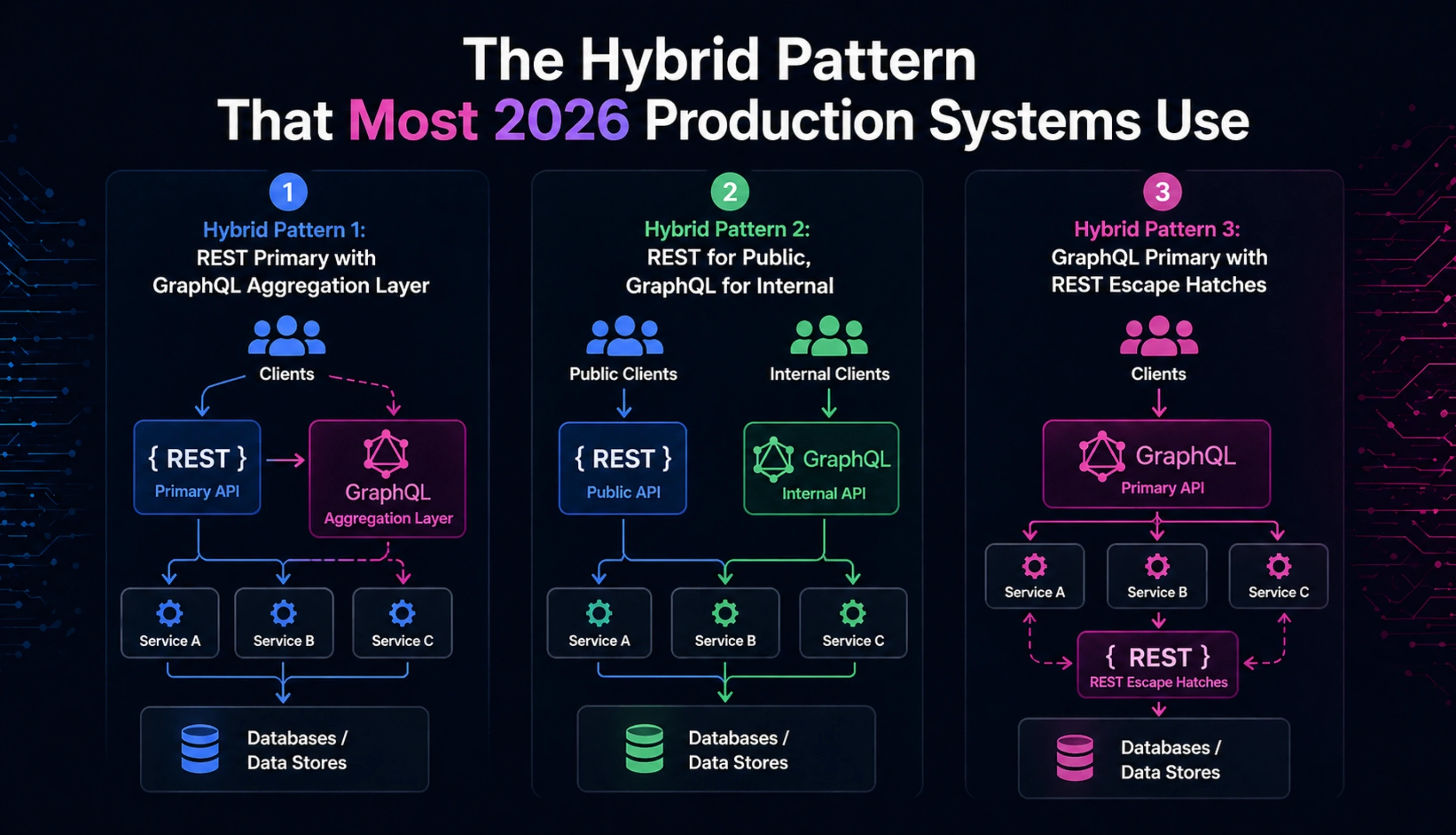
The dirty secret of API architecture in 2026 is that most production systems run both. REST handles the bulk of routine work and external integrations. GraphQL sits on top for client-facing aggregations, mobile clients, or backend-for-frontend layers. Neither approach is treated as a religion. Each is used where it earns its keep.
Hybrid Pattern 1: REST Primary with GraphQL Aggregation Layer
REST microservices for each domain (user, billing, inventory, search) and a single GraphQL gateway in front for client consumption. The gateway joins data from multiple REST endpoints, returns a unified shape, and handles client-specific projections. This pattern is common at companies running 10 to 30 microservices internally and serving mobile and web clients externally.
Hybrid Pattern 2: REST for Public, GraphQL for Internal
Public-facing API stays REST for ecosystem compatibility, third-party integrations, and HTTP caching. Internal client apps (your mobile app, your dashboard) use GraphQL for flexible data fetching. The two share underlying services and data models, just exposed differently to different consumers.
Hybrid Pattern 3: GraphQL Primary with REST Escape Hatches
GraphQL handles the bulk of API traffic, but specific high-throughput endpoints (file uploads, webhooks, health checks) stay REST for performance and operational simplicity. This is the pattern many GitHub-style products use: GraphQL for the main API surface, REST for the long tail of operations that do not benefit from GraphQL's flexibility.
If You Are Migrating From REST to GraphQL
Most teams considering GraphQL today are migrating from REST, not building greenfield. The migration timeline and approach matter as much as the architecture decision itself. The 2026 norm is incremental migration using a gateway pattern, not big-bang rewrites.
A typical mid-sized application migration takes 8 to 16 weeks across four phases: schema design (1 to 2 weeks), gateway deployment in front of existing REST endpoints (2 to 4 weeks), DataLoader-based optimization to eliminate N+1 queries (4 weeks), and direct data access where the GraphQL service queries databases instead of calling REST endpoints (4 to 8 weeks). The gateway approach is critical because it lets you migrate incrementally without disrupting existing REST clients.
Do not deprecate REST endpoints during migration. REST clients will not migrate on your timeline. Run both for at least 12 months after the GraphQL launch.
Invest in DataLoader from day one. Naive GraphQL implementations create N+1 query disasters. DataLoader batches and caches database calls per request to prevent this.
Add query complexity limits. GraphQL flexibility is also a denial-of-service surface. Limit query depth, breadth, and computational cost per request.
Schema versioning is non-trivial. Plan deprecation cycles, schema governance, and breaking-change processes before you launch the public schema.
For the full ownership cost picture across an API migration, including engineering, infrastructure, and observability, the analysis on ownership cost of Python projects walks through the 24-month total cost of ownership in detail.
Pitfalls That Burn Production Teams
Both REST and GraphQL have failure modes that show up only at production scale. Awareness of these patterns is the difference between a stable launch and a 3 AM incident.
REST Pitfalls
Endpoint proliferation. Without discipline, REST APIs grow into 200+ endpoints with no clear ownership. Use OpenAPI specs and API governance from day one.
Client over-fetching. Mobile apps pulling 50KB of JSON to display 3 fields. Either trim payloads server-side or accept that GraphQL might genuinely fit better.
Versioning complexity. v1, v2, v3 endpoint trees become unmaintainable. Use additive changes and deprecation periods, not version forks.
GraphQL Pitfalls
N+1 query disasters. A single nested query can trigger thousands of database calls without DataLoader. This is the most common 'why is GraphQL slow' complaint.
Resolver-level complexity. Schema design without thinking about resolver performance produces APIs that look elegant and run terribly.
Caching is harder. HTTP-level caching does not work for POST /graphql. You need application-level caching or persisted queries to recover the benefit.
API abuse and rate limiting. GraphQL's flexibility makes rate limiting per-query non-trivial. Costing each query before execution is a production requirement, not optional.
These pitfalls are common contributors to expensive rebuilds and architecture rewrites, mapping directly to the warning signs covered in the guide on Python development expensive red flags.
How Acquaint Softtech Builds REST and GraphQL APIs
Acquaint Softtech is a Python development and IT staff augmentation company based in Ahmedabad, India, with 1,300+ software projects delivered globally across healthcare, FinTech, SaaS, EdTech, and enterprise platforms. Our API engagements follow the architectural framework described in the complete guide to hiring Python developers, and our senior engineers have shipped both REST and GraphQL APIs in production at scale.
FastAPI and Django REST Framework expertise. Production-grade REST APIs with OpenAPI specs, Pydantic validation, JWT authentication, and rate limiting from day one.
Strawberry and Graphene GraphQL implementations. Schema-first GraphQL APIs with DataLoader batching, query complexity limits, persisted queries, and schema governance.
Hybrid architecture experience. REST microservices with GraphQL gateways for client aggregation, deployed across AWS, GCP, and Azure with full observability.
Healthcare and FinTech compliance experience. GDPR-compliant API platform delivered for BIANALISI, Italy's largest diagnostics group, with audit-grade logging across both API styles.
Transparent pricing from $20/hour. Dedicated Python engineering teams from $3,200/month per engineer. Architecture audits from $5,000.
To bring senior Python engineers onto your API project quickly, you can hire Python developers with profiles shared in 24 hours and a defined onboarding plan within 48.
The Bottom Line
REST vs GraphQL is not a debate to win. It is a decision to make per use case. REST owns the public API, the simple CRUD, the cacheable resource, and the server-to-server integration. GraphQL owns the multi-client aggregation, the mobile bandwidth-sensitive screen, the backend-for-frontend layer, and the schema-driven contract. Both are stable, both are production-grade, both have specific failure modes you can plan around.
The teams that succeed in 2026 stop treating either as a religion and start treating them as tools in a toolkit. Pick REST when REST fits. Pick GraphQL when GraphQL fits. Build hybrid when both fit. Score the decision against your data, your clients, and your team, not against whatever Hacker News is praising this week. The architecture your team can ship and operate is the one that wins.
Choosing Between REST, GraphQL, or a Hybrid Stack?
Book a free 30-minute architecture review. We will look at your client requirements, data shape, and team maturity, and tell you straight whether REST, GraphQL, or a hybrid is the right call. No sales pitch. Just a senior engineer's honest read on your specific use case.
Frequently Asked Questions
-
Is GraphQL faster than REST in Python?
It depends on the query. GraphQL is approximately 28% faster on complex queries that would otherwise need multiple REST round-trips, but REST is approximately 33% faster on simple single-resource queries and uses about 20% less CPU. The right answer is not 'which is faster' but 'which matches my actual query patterns.' Most production systems benefit from REST on simple endpoints and GraphQL on data-aggregation endpoints.
-
Should I use FastAPI or Strawberry for a new Python API in 2026?
Use FastAPI if your API is REST-shaped and your clients fetch single resources or simple lists. Use Strawberry if your clients need flexible data shapes, especially mobile and SPA clients pulling nested data from multiple sources. Many production systems use both: FastAPI for the bulk of REST endpoints and Strawberry behind a GraphQL gateway that aggregates data from FastAPI services for client consumption.
-
Why is REST still dominant in 2026 if GraphQL is more flexible?
REST powers 83% of public APIs and 92% of Fortune 1000 production deployments because the trade-off is not just about flexibility. REST has decades of tooling maturity, native HTTP caching, simpler operational model, and broader engineer familiarity. GraphQL adds value where its flexibility solves a real problem, but flexibility itself is overhead when the use case does not need it.
-
What is the N+1 query problem in GraphQL and how do you fix it?
N+1 happens when a GraphQL resolver fetches a list of items, then makes a separate database query for each item's related data, generating one parent query plus N child queries. The fix is DataLoader, which batches and caches database calls per request so that fetching 100 items generates 1 batch query for related data instead of 100 separate ones. DataLoader is non-optional in any production GraphQL Python service.
-
Can I migrate from REST to GraphQL incrementally?
Yes, and the gateway pattern is the standard 2026 approach. Deploy a GraphQL gateway in front of your existing REST APIs first, then move resolver logic into direct database access service-by-service over 8 to 16 weeks. Critically, do not deprecate REST endpoints during migration. External clients will not migrate on your timeline, so plan for at least 12 months of running both APIs in parallel.
-
How do I handle authentication and rate limiting in GraphQL APIs?
Authentication works the same as REST: JWT or session tokens validated per request. Rate limiting is harder because a single GraphQL query can be cheap or extremely expensive depending on its depth and breadth. The 2026 best practice is per-query cost analysis, where each query is scored before execution and rejected if it exceeds the user's budget. Tools like Apollo Server's complexity plugins or custom Strawberry extensions handle this.
-
Is gRPC a third option I should consider for Python APIs?
Yes, for specific use cases. gRPC with protocol buffers achieves up to 10x lower latency than REST in benchmarks (around 25ms vs 250ms) and is the right choice for high-throughput internal service-to-service communication where every millisecond matters. gRPC is rarely the right choice for public APIs or browser-facing endpoints, but a 2026 hybrid stack often runs gRPC internally and exposes REST or GraphQL externally.
We’re Acquaint Softtech, your technology growth partner. Whether you're building a SaaS product, modernizing enterprise software, or hiring vetted remote developers, we’re built for flexibility and speed. Our official partnerships with Laravel, Statamic, and Bagisto reflect our commitment to excellence, not limitation. We work across stacks, time zones, and industries to bring your tech vision to life.
Table of Contents
Get Started with Acquaint Softtech
- 13+ Years Delivering Software Excellence
- 1300+ Projects Delivered With Precision
- Official Laravel & Laravel News Partner
- Official Statamic Partner
Related Blog

When Is Python Development Too Expensive? Pricing Red Flags That Signal a Bad Vendor
Not all expensive Python development is justified. This guide identifies the exact pricing red flags that signal a bad vendor, with real benchmarks, warning signs, and what fair Python pricing actually looks like in 2026.
Acquaint Softtech
March 26, 2026
How to Hire Python Developers Without Getting Burned: A Practical Checklist
Avoid costly hiring mistakes with this practical checklist on how to hire Python developers in 2026. Compare rates, vetting steps, engagement models, red flags, and more.
Acquaint Softtech
March 30, 2026
Total Cost of Ownership in Python Development Projects: The Full Financial Picture
The build cost is just the beginning. This guide breaks down the complete TCO of Python development projects across every lifecycle phase, with real benchmarks, a calculation framework, and 2026 data.
Acquaint Softtech
March 23, 2026India (Head Office)
203/204, Shapath-II, Near Silver Leaf Hotel, Opp. Rajpath Club, SG Highway, Ahmedabad-380054, Gujarat
USA
7838 Camino Cielo St, Highland, CA 92346
UK
The Powerhouse, 21 Woodthorpe Road, Ashford, England, TW15 2RP
New Zealand
42 Exler Place, Avondale, Auckland 0600, New Zealand
Canada
141 Skyview Bay NE , Calgary, Alberta, T3N 2K6
Your Project. Our Expertise. Let’s Connect.
Get in touch with our team to discuss your goals and start your journey with vetted developers in 48 hours.