

SOC 2 Type II for SaaS: Technical Controls You Need to Implement
SOC 2 Type II is an independent audit, defined by the AICPA Trust Services Criteria, that verifies a SaaS company's security controls actually work over a period of time, usually three to twelve months. Unlike Type I, which checks that controls exist at a single point, Type II tests that they operate consistently. The core technical controls a SaaS product must implement are role-based access control, encryption at rest and in transit, comprehensive audit logging, change management, vulnerability management, and continuous monitoring, all producing evidence the auditor can review.

Chirag Daxini

- An enterprise prospect is blocking your deal until you produce a SOC 2 report.
- You are a CTO who needs to know which technical controls SOC 2 actually requires.
- You are deciding whether to pursue SOC 2 Type I first or go straight to Type II.
- Your product was built fast, and you suspect it lacks audit logging or proper access control.
- You want to build SOC 2 controls into a new product rather than retrofit them later.
- You need to estimate the cost and timeline of becoming SOC 2 ready.
Why SOC 2 Is the Deal-Blocker Nobody Warns You About
The deal is ready to close. The demo impressed, pricing is approved, and everyone is aligned—until one question changes everything: “Can you share your SOC 2 Type II report?” Without it, even the best SaaS product can be stopped at the procurement stage.
SOC 2 is more than a compliance checkbox. It proves that your security controls, access management, encryption, and audit processes work in the real world. For enterprise buyers, it is often a non-negotiable requirement. The challenge is that SOC 2 readiness cannot be created overnight. The most successful SaaS companies build these controls early, turning compliance from a deal blocker into a competitive advantage that unlocks larger customers and faster growth.
The guidance comes from Acquaint Softtech's experience delivering software product development for SaaS companies that have passed SOC 2 audits and closed the enterprise deals that depended on them.
Acquaint Softtech has implemented SOC 2 readiness controls for regulated SaaS products where audit logging, encryption, and access control are not optional, and much of that work lives in the infrastructure layer. Teams that hire DevOps developers for compliance work get engineers who build these controls into the deployment pipeline rather than treating them as a separate project.
The guide How to Scale Your Laravel SaaS App on acquaintsoft.com documents a real fintech client that reached SOC 2 readiness and closed three enterprise contracts within 90 days of implementing the right controls.
What SOC 2 Type II Actually Is (and How It Differs From Type I)
.webp "What SOC 2 Type II Actually Is")
SOC 2 is more than a security certification; it is proof that your SaaS business can be trusted with customer data. While SOC 2 Type I verifies that security controls are in place, SOC 2 Type II demonstrates that those controls consistently work over time. Think of Type I as a snapshot and Type II as a track record.
For SaaS companies targeting enterprise customers, SOC 2 Type II is often the key that unlocks larger deals, accelerates security reviews, and builds credibility with customers, investors, and partners. It transforms security from a compliance requirement into a powerful growth enabler.
Acquaint Softtech's dedicated software development teams build the evidence-generating controls from the start, so the Type II observation window can begin as early as possible rather than after months of remediation.
The SOC 2 for SaaS trends 2026 show buyers asking for SOC 2 earlier in a company's life, often before Series A, because security expectations have risen across the board. AI-powered SaaS products in particular face scrutiny over how they handle the data they process. The article Why Businesses Choose Laravel for Scalable Applications on acquaintsoft.com describes how enterprise fintech and healthcare platforms rely on immutable audit logs, encrypted records, and role-based access hierarchies, which are exactly the controls SOC 2 examines.
The Trust Services Criteria, in Plain Language
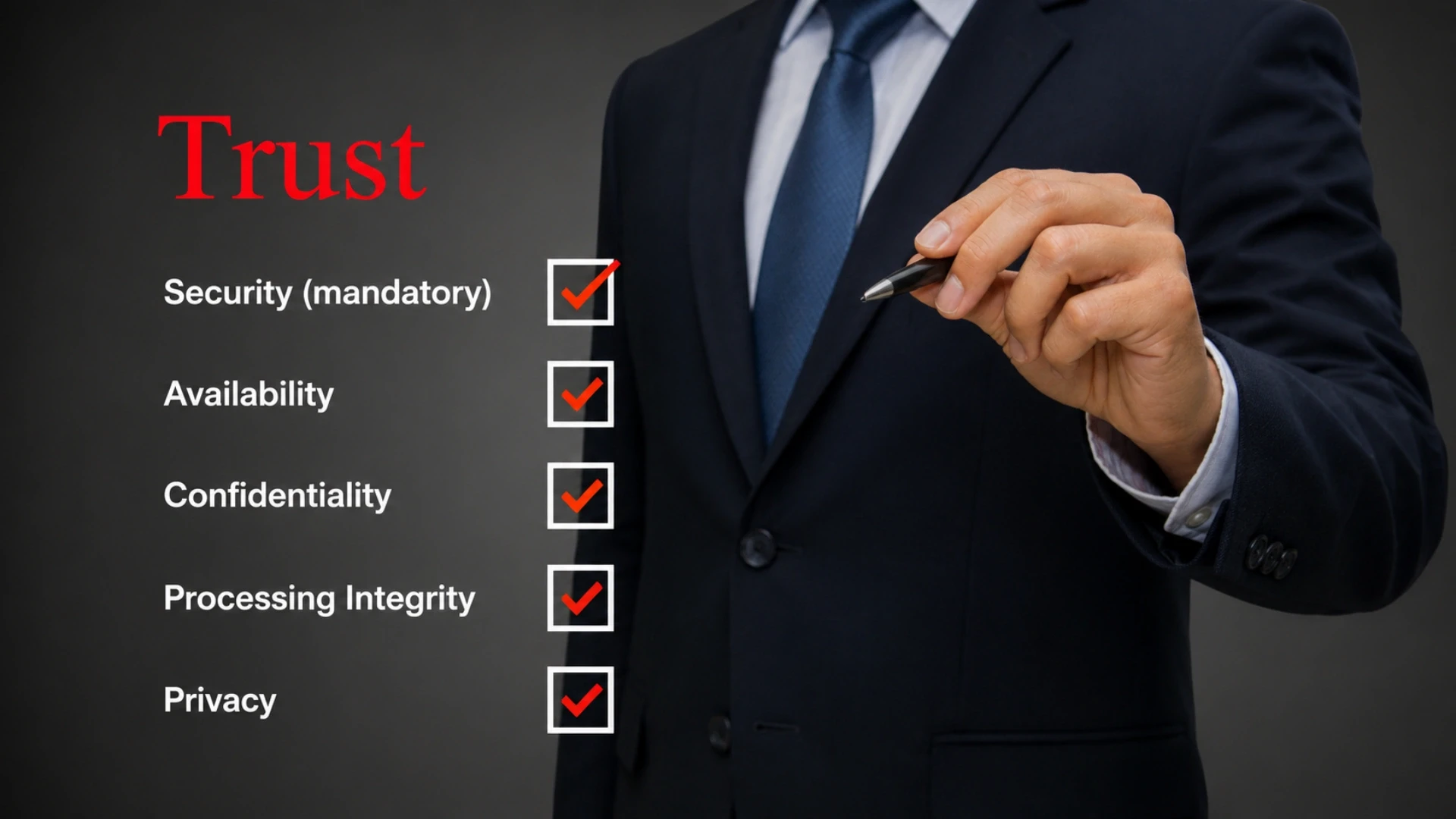
SOC 2 is built on five Trust Services Criteria defined by the AICPA. You do not have to address all five; only Security is mandatory, and the others are chosen based on the promises you make to customers and the nature of your service. Understanding which criteria apply to your product is the first scoping decision in any SOC 2 effort.
Trust Services Criterion | What It Covers | When It Applies |
Security (mandatory) | Protection against unauthorised access, physical and logical | Always required for every SOC 2 report |
Availability | System uptime and performance meet committed levels | When you promise uptime SLAs |
Confidentiality | Sensitive data is protected and access-restricted | When you handle confidential business data |
Processing Integrity | System processing is complete, accurate, and timely | When data accuracy is core to the service |
Privacy | Personal information is handled per your privacy notice | When you process personal data of individuals |
Security is the foundational criterion, and it is where the bulk of the technical controls live. Most early-stage SaaS products scope their first SOC 2 to Security alone, adding Availability, Confidentiality, Processing Integrity, or Privacy as their commitments to customers expand. Scoping narrowly at first keeps the audit achievable, then broadens as the product matures. This scoping flexibility is one of the SOC 2 for SaaS features that makes the framework practical for companies of different sizes. Acquaint Softtech's software development outsourcing teams help clients scope the right criteria for their stage, so they implement the controls that matter without over-engineering for criteria their customers are not yet asking about.
Each criterion maps to specific technical controls, and the rest of this guide walks through the five control areas that satisfy the Security criterion and most of the others. The important mindset shift is that SOC 2 is not a document you write; it is a set of behaviours your system performs continuously and proves with evidence. The auditor does not take your word for it. They examine logs, configuration, access reviews, and deployment records as proof.
The guide Laravel 12 for SaaS, Fintech, and Regulated Industry Apps on acquaintsoft.com explains how modern frameworks support audited environments with zero-downtime deployment, queue isolation, and the strong default security that compliance depends on. Teams that hire backend developers experienced in compliance build the application-layer controls that produce this evidence automatically.
Enterprise Deal Blocked by SOC 2? We Can Help.
Acquaint Softtech implements SOC 2 readiness controls into your SaaS product and infrastructure so the audit becomes routine. 1,300+ projects delivered. Teams deployed within 48 hours of brief.
Control Area 1: Access Control and Authentication
Access control is the foundation of SOC 2 compliance and one of the first areas auditors review. The goal is simple: give every user, employee, and system only the access they truly need—nothing more. Strong role-based permissions, multi-factor authentication, unique user accounts, and regular access reviews help protect sensitive data and reduce security risks. For multi-tenant SaaS platforms, effective access control also ensures complete customer data isolation, strengthening both security and trust.
Acquaint Softtech hires Laravel developers to build RBAC as middleware enforced on every request and tie it to tenant scope, so access decisions are centralised and auditable rather than scattered across individual endpoints.
Evidence is what makes the control count. For access control, the auditor wants to see the RBAC configuration, logs of access being granted and revoked, records of periodic access reviews, and proof that offboarded employees lost access promptly. This means the system must record these events automatically. Manual access management does not scale to an audit, because the evidence is incomplete and inconsistent.
The article How to Build a Scalable Fintech App with Laravel on acquaintsoft.com covers how authenticated APIs, strict access guards, and role-based permissions form the backbone of a compliant financial application. Teams that hire MERN stack developers for the application layer implement the access-review tooling and automated deprovisioning that turns access control from a policy into provable evidence.
Control Area 2: Encryption at Rest and in Transit
Encryption is your SaaS product’s last line of defence, protecting sensitive data even if other security layers are compromised. SOC 2 requires data to be encrypted both in transit and at rest, ensuring information stays secure whether it is moving across networks or stored in databases, backups, and cloud storage. By implementing strong encryption, managed key services, and automated certificate management from day one, SaaS companies can strengthen security, simplify compliance, and build customer trust without costly retrofits later.
Key management is the part teams most often get wrong. Encryption is only as strong as the protection of the keys, so SOC 2 expects keys to be stored in a dedicated key management service or secrets vault, never in application code or environment files committed to a repository, and to be rotatable without downtime. The auditor will examine how keys are stored, who can access them, and how they are rotated.
The guide Laravel SaaS Architecture on acquaintsoft.com describes how encrypted data handling and secure secrets management fit into a production SaaS architecture. Teams that hire Python developers for data-sensitive services implement field-level encryption and vault-based key management as part of the application design rather than as an afterthought.
Control Area 3: Audit Logging and Monitoring
Audit logging is the backbone of SOC 2 compliance, turning security controls into verifiable proof. It creates a complete record of user actions, system changes, and security events, allowing organisations to demonstrate that their controls are working as intended. With immutable, tamper-resistant logs, SaaS companies gain the visibility needed for audits, faster incident investigations, and stronger trust with enterprise customers. Acquaint Softtech's software product engineering teams build append-only audit log pipelines that capture these events automatically and ship them to centralised, tamper-resistant storage, so the evidence exists without developers having to remember to create it.
Monitoring turns logs into active protection. Beyond recording events, SOC 2 expects continuous monitoring that detects anomalies, alerts the team to suspicious activity, and supports incident response. This means centralised log aggregation, automated alerting on security-relevant events, and dashboards that make the system's security posture visible in real time. For a Type II audit, the auditor wants evidence that monitoring was active throughout the observation period and that alerts were actually investigated. The article Laravel 12 for SaaS, Fintech, and Regulated Industry Apps explains how observability tooling and queue-based processing keep an audited platform visible and responsive.
Teams that hire MEAN stack developers for the monitoring layer build the alerting and log-aggregation infrastructure that proves monitoring was continuous, not occasional.
Build Audit-Ready Logging and Monitoring From Day One
Acquaint Softtech builds immutable audit logging, centralised monitoring, and the evidence pipelines SOC 2 Type II requires. Up to 40% lower cost than Western agencies. Deployed within 48 hours.
Control Area 4: Change Management and Secure Deployment
Change management is where security meets software delivery. SOC 2 requires proof that every code change is reviewed, tested, approved, and deployed through a controlled process. Strong version control, automated testing, CI/CD pipelines, and deployment tracking help teams release updates with confidence while reducing security and operational risks. Combined with clear separation between development, staging, and production environments, effective change management protects customer data, improves reliability, and demonstrates the operational discipline enterprise customers expect.
The guide How to Scale Your Laravel SaaS App on acquaintsoft.com describes how CI/CD with rollback tracking and environment separation form part of a compliant, scalable deployment process, drawing on a real fintech client that passed its pre-certification audit. Teams that hire QA engineers with compliance experience set up the staging-to-production promotion process and access controls that satisfy the change-management criteria without slowing delivery.
Control Area 5: Vulnerability and Incident Management
Strong security is not about avoiding every risk—it is about finding and fixing issues before they become problems. SOC 2 requires SaaS companies to continuously monitor vulnerabilities, scan code and infrastructure, patch critical issues quickly, and maintain a clear incident response process. By combining automated security scanning, dependency monitoring, and rapid remediation workflows, businesses can reduce risk, strengthen compliance, and demonstrate the resilience enterprise customers expect.
Acquaint Softtech's support and maintenance services teams run continuous vulnerability scanning and managed patching as an ongoing service, which keeps the evidence current through the entire Type II observation window rather than only before the audit.
Incident management means having a documented incident response plan that defines how incidents are detected, escalated, contained, communicated, and resolved, and crucially, evidence that the plan has been tested. SOC 2 also expects post-incident reviews that capture what happened and what changed to prevent recurrence. For products in regulated industries, incident management connects to broader obligations around breach notification.
The article How to Build a Scalable Fintech App with Laravel on acquaintsoft.com covers how security, monitoring, and compliance processes combine in a regulated financial application. Teams that hire cloud engineers for the infrastructure layer build the scanning, alerting, and incident-response tooling that turns vulnerability and incident management from a plan on paper into a tested, evidenced capability.
Build It In vs Bolt It On: The Readiness Roadmap
The central lesson of SOC 2 is that building controls into a product from the start costs a fraction of retrofitting them later. Controls like audit logging, access control, and encryption add a few days of development time when they are part of the initial architecture. The same controls, retrofitted into a live product, require changes to the database schema, the application layer, and the deployment pipeline simultaneously, often taking weeks and carrying the risk of disrupting customers already using the system.
For teams that have the luxury of building SOC 2 readiness into a new product, the roadmap is straightforward: design the access control model, encryption strategy, and audit logging into the architecture before writing feature code, set up the CI/CD pipeline with change management from the first deployment, and instrument monitoring from day one. This is the approach that Acquaint Softtech's discovery workshop services build into the architecture decision record, so the controls are specified before development begins, and the Type II observation window can start as soon as the product is live.
THE SOC 2 READINESS ROADMAP
1. Scope the criteria
Decide which Trust Services Criteria apply. Start with Security; add others as customer commitments require.
2. Run a gap assessment
Compare current controls against SOC 2 requirements. Identify what is missing across the five control areas.
3. Implement the technical controls
Build access control, encryption, audit logging, change management, and vulnerability management into the system.
4. Start the observation window
Run the controls continuously while they generate evidence. Type II requires three to twelve months of operation.
5. Engage the auditor
Provide system documentation, network diagrams, data flows, and evidence logs to the independent CPA firm.
6. Maintain continuously
For products that need to be retrofitted, the work is real but manageable with the right sequencing: prioritise the controls that produce evidence over time, audit logging and monitoring, first, because the observation window cannot start until they are running. Teams that hire remote developers with SOC 2 experience run this remediation as a focused workstream alongside ongoing product development.
The guide Laravel SaaS Architecture on acquaintsoft.com covers event-driven architecture for domains where full audit history matters, which is the foundation of evidenced compliance. Teams can also use staff augmentation to add compliance-experienced engineers without pausing the roadmap.
Cost, Timeline, and Tech Stack for SOC 2 Readiness
The cost and timeline of becoming SOC 2 ready depend heavily on how many controls already exist and how much must be retrofitted. The figures below cover the technical implementation work, separate from the auditor's fee, which is a distinct cost paid to the CPA firm.
Starting Point | Technical Readiness Timeline | Relative Cost |
Controls built in from MVP | Minimal; observation window only | Lowest |
Partial controls, some gaps | 6 to 12 weeks of remediation | Moderate |
Built fast, few controls | 12 to 20 weeks of remediation | Highest |
How much does SOC 2 readiness cost to build?
The technical implementation of SOC 2 controls typically costs $20,000 to $80,000 with an offshore partner, depending on how much must be retrofitted versus how much already exists. This is separate from the auditor's fee, which a CPA firm charges directly. Building controls into a new product adds far less, often only a few days per control area at the architecture stage. Teams evaluating a SOC 2 SaaS development cost estimate or deciding whether to hire developers for SOC 2 SaaS work should price the gap remediation, not just the audit.
Acquaint Softtech delivers this implementation at up to 40% lower cost than equivalent USA or UK agency rates, and treats it as product engineering rather than a separate compliance project.
What tech stack is best for SOC 2 SaaS?
SOC 2 is framework-agnostic; what matters is that the stack supports the controls. In practice, mature ecosystems make compliance easier: Laravel offers strong default security, role-based access control, queue isolation, and zero-downtime deployment tooling suited to audited environments, while Python with Django or FastAPI provides robust authentication and validation.
The infrastructure layer matters most: AWS, GCP, or Azure for managed key services and encrypted storage, a secrets vault for key management, centralised logging such as CloudWatch or an ELK stack, and a CI/CD pipeline with rollback tracking. The guide Laravel 12 for SaaS, Fintech, and Regulated Industry Apps explains why this combination suits regulated, audited products.
For AI products that must evidence how they handle data, Acquaint Softtech's AI development services build the logging and access controls into the model-serving layer, and teams needing compliance-experienced infrastructure engineers on demand use dedicated development team engagements to add them quickly.
Case Study: SOC 2 Readiness Delivered by Acquaint Softtech
CASE STUDY: Fintech SaaS SOC 2 Readiness
Client: Growth-stage fintech SaaS handling financial transaction data for business customers, selling into enterprise accounts in the USA and Europe.
Situation: The product had been built quickly to reach market and was winning interest from enterprise buyers. Then three separate enterprise deals stalled at the security-review stage, each requiring a SOC 2 report the company did not have. The product stored payment card details in-app, had inconsistent audit logging, and deployed without change-management controls. The founders needed SOC 2 readiness fast to avoid losing the deals.
Diagnosis: Acquaint Softtech's readiness assessment found three critical gaps: in-app storage of card data created unnecessary PCI and SOC 2 exposure, financial actions were not consistently logged so there was no audit trail to evidence, and the deployment process had no rollback tracking or change records. None of these could be solved with documentation; all required technical remediation.
What Acquaint Softtech Built:
Removed in-app card storage entirely by shifting payment handling to Stripe, taking the product out of the highest-risk compliance scope.
Implemented immutable audit logging for all financial actions, creating the evidence trail the Type II audit required.
Set up a CI/CD pipeline with rollback tracking and change records, satisfying the change-management controls.
Added role-based access control with documented access reviews and multi-factor authentication on privileged access.
Configured centralised monitoring and alerting so the observation-window evidence was generated continuously.
Outcome: With minimal code rewrites focused on the specific gaps, the client passed their pre-certification audit and secured three enterprise contracts within 90 days. SOC 2 readiness shifted from a deal-blocker to a selling point the sales team used proactively. The audit-logging and access controls also improved the team's own ability to investigate issues, an operational benefit beyond compliance. The controls were built to keep generating evidence, so subsequent annual audits became routine rather than emergency projects.
Team and Timeline: One DevOps and cloud lead, one backend engineer, one QA engineer. Deployed within 48 hours of brief. Remediation completed without disrupting the live product or existing customers.
“We did not realise SOC 2 was a technical problem until three deals stalled on it at once. We had assumed it was paperwork. Acquaint Softtech found the actual gaps in our system, fixed the ones that mattered, and got us audit-ready in time to save the deals. The thing that surprised us was how much the same controls improved our own engineering visibility.” — Client Testimonial, Growth-stage Fintech SaaS, USA
For SaaS teams facing the same SOC 2 wall, the guide How to Outsource SaaS Product Development Without Losing Control the engagement model that kept this client in full control of their codebase and roadmap throughout the remediation. Teams can also hire dedicated developers with compliance experience to run a comparable readiness project on their own product.
Join 200+ Companies Who Built Trust With Acquaint Softtech
From SOC 2 readiness to full compliant SaaS builds, Acquaint Softtech implements the technical controls enterprise buyers demand. 4.9/5 on Clutch. 50+ verified reviews. Premier Verified.
Frequently Asked Questions
-
What is SOC 2 Type II for SaaS?
SOC 2 Type II is an independent audit based on AICPA Trust Services Criteria that verifies a SaaS company's security controls work effectively over a 3–12 month period. It is the compliance standard most enterprise buyers expect before purchasing SaaS products.
-
What is the difference between SOC 2 Type I and Type II?
SOC 2 Type I checks whether security controls are designed correctly at a specific point in time. SOC 2 Type II verifies that those controls are consistently operated over several months, making it more valuable for enterprise security reviews.
-
What technical controls are required for SOC 2?
SOC 2 commonly requires:
RBAC and MFA
Encryption at rest and in transit
Audit logging and monitoring
Secure CI/CD pipelines
Vulnerability management
Incident response processes
These controls must continuously generate evidence for auditors.
-
How much does SOC 2 readiness cost?
SOC 2 technical implementation typically costs between $20,000 and $80,000, excluding CPA audit fees. Building controls from day one is usually much cheaper than retrofitting them later.
-
How long does SOC 2 readiness take?
SOC 2 readiness usually requires 6–20 weeks of remediation if controls are missing, followed by a 3–12 month observation period to collect audit evidence.
-
Do startups need SOC 2?
Yes, if they plan to sell to mid-market or enterprise customers. Building SOC 2 controls early helps startups close deals faster and avoid expensive compliance retrofits later.
-
Which tech stack is best for SOC 2 compliance?
SOC 2 is framework-agnostic, but popular choices include:
Laravel
Django
FastAPI
AWS
Azure
GCP
The key requirement is support for security, logging, monitoring, and access controls.
-
Can you pass SOC 2 with documentation alone?
No. SOC 2 Type II requires proof that controls operated effectively over time. Auditors review logs, access records, monitoring reports, and deployment history, not just written policies.
-
What is the biggest SOC 2 mistake SaaS companies make?
The most common mistake is waiting until an enterprise deal requires compliance. Retrofitting logging, monitoring, and security controls later is significantly more expensive and time-consuming than building them from the start.
With over 11 years of experience in web application development and project management, I excel in leading cross-functional teams to deliver innovative digital solutions. My expertise spans eCommerce platforms, ERP systems, and JS & PHP-based frameworks, including WordPress, React JS, and Laravel. As a Technical Project Manager, I specialize in strategic planning, system design, and end-to-end project execution, transforming complex ideas into scalable, high-impact applications.
Table of Contents
Get Started with Acquaint Softtech
- 13+ Years Delivering Software Excellence
- 1300+ Projects Delivered With Precision
- Official Laravel & Laravel News Partner
- Official Statamic Partner
Related Blog
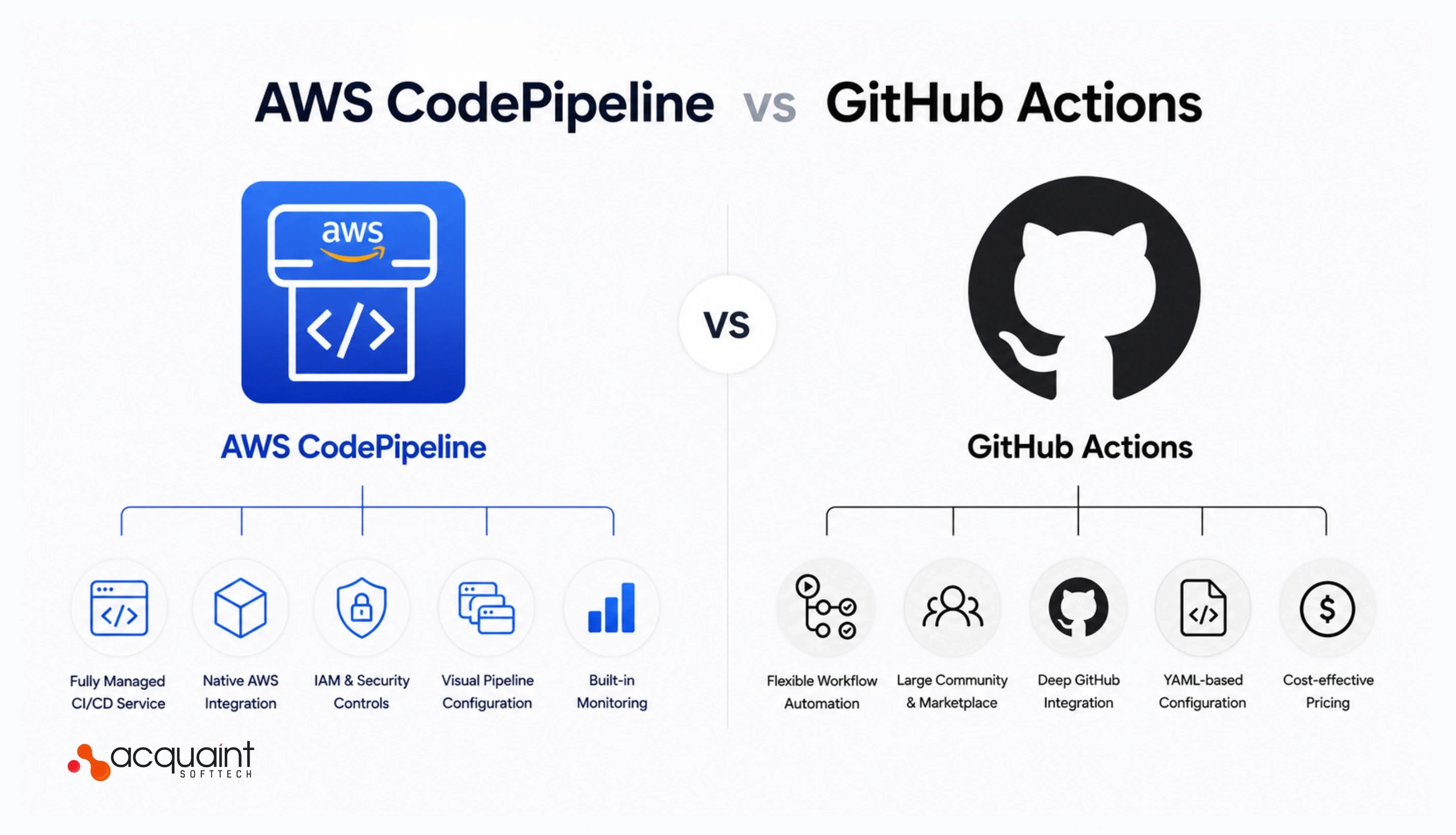
AWS CodePipeline vs GitHub Actions for SaaS: What a DevOps Engineer Recommends and Why
AWS CodePipeline and GitHub Actions both work on AWS. But they solve different problems. Here is the honest comparison and what a DevOps engineer recommends for SaaS startups in 2026.
Taukir katava
May 12, 2026
The Complete Guide to SaaS Product Development in 2026
SaaS product development in 2026 is five interlocking decisions: architecture, billing, compliance, AI, and team model, each with a costly alternative if made in the wrong order. This guide covers all five with specific cost ranges, comparison tables, and real delivery data from 1,300+ projects.

Acquaint Softtech
May 7, 2026
From MVP to Scale: The Laravel SaaS Architecture Blueprint for 2026
From MVP to 100K users, the architecture decisions that felt small at month one become expensive at month twelve. Here is the Laravel SaaS blueprint we use across 200+ Laravel projects.
Acquaint Softtech
March 10, 2026India (Head Office)
203/204, Shapath-II, Near Silver Leaf Hotel, Opp. Rajpath Club, SG Highway, Ahmedabad-380054, Gujarat
USA
7838 Camino Cielo St, Highland, CA 92346
UK
The Powerhouse, 21 Woodthorpe Road, Ashford, England, TW15 2RP
New Zealand
42 Exler Place, Avondale, Auckland 0600, New Zealand
Canada
141 Skyview Bay NE , Calgary, Alberta, T3N 2K6