

Should You Start With a Trial Python Project Before Full Engagement?
Should you start with a trial Python project before full engagement? Honest 2026 answer backed by real data, with success criteria and clear exceptions.

Acquaint Softtech
Introduction: The Honest Answer Most Vendors Will Not Give You
Every Python vendor pitches the same thing at the end of the sales call: a smooth, long-term engagement starting immediately. The logic sounds clean. Skip the trial, save the onboarding cost twice, and hit the ground running. For the vendor, it is also the most profitable outcome, because the sunk cost of two onboardings becomes your problem, not theirs.
The honest answer most vendors will not give you is that a trial Python project protects the buyer more than it protects the vendor, and the buyer is the one taking the larger financial risk on the engagement. A well-structured trial costs between 1% and 5% of an annual engagement, and in return it tests everything the scorecard and reference call could not: code quality under your real constraints, communication discipline under sprint pressure, and whether the named developer in the proposal is the one who actually writes the code.
The research on project size and success rates is stark. The Standish Group's CHAOS data compiled by OpenCommons shows that small projects achieve around 90% success rates, while large projects succeed less than 10% of the time. Projects exceeding $10 million are more than ten times more likely to be cancelled than those under $1 million. A trial Python project turns the first phase of a risky large engagement into a small, high-success-rate project by design. That is the mathematical case for the trial.
This guide gives you the honest answer. When a trial Python project makes sense, when it actively wastes time, how to structure one that actually tests what matters, and how to convert from trial to full engagement without losing momentum. For the broader hiring framework that sits around this decision, start with the complete guide to hiring Python developers in 2026.
What a Trial Python Project Actually Is
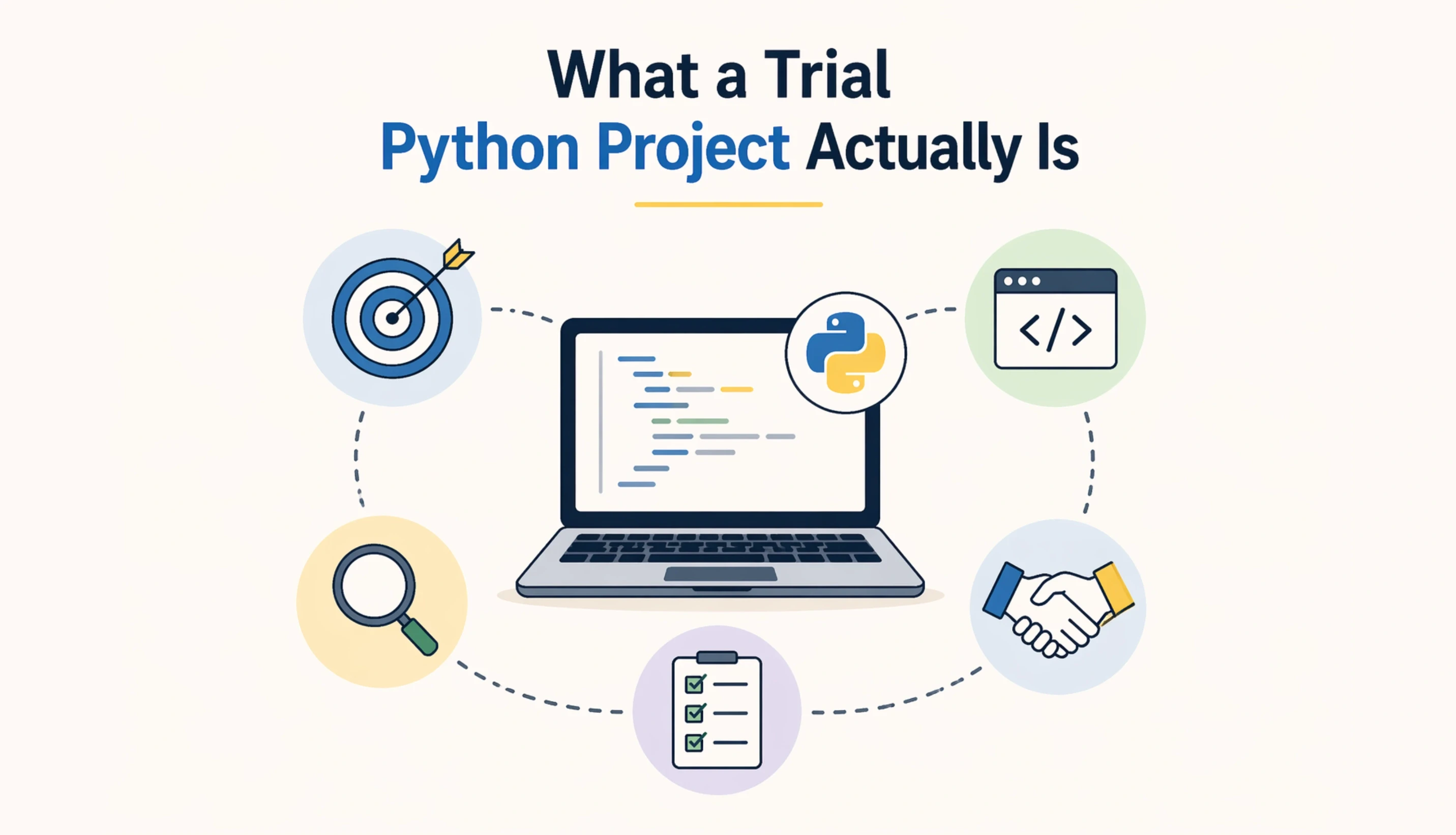
A trial Python project is a paid, time-boxed, real-deliverable engagement that sits between a sales pitch and a full commitment. It is not a free trial, not a sample code assignment, and not a proof of concept for the vendor's internal use. The deliverable produced during the trial is real production code that stays in your repository whether or not the engagement continues.
The industry definition aligns with how Quickbase frames the pilot project pattern. A pilot or trial tests new ideas or technologies on a smaller scale so you can identify and mitigate potential risks like miscommunication, scope creep, mismanaged funds, and data security before they become bigger problems. Applied to Python outsourcing, this means running one real two-to-four-week delivery cycle with the vendor before committing to six months of monthly retainer or a fixed-scope project.
Table : Trial Python Project vs Full Engagement at a Glance
Dimension | Trial Project | Full Engagement |
|---|---|---|
Duration | 2 to 4 weeks | 3 to 24 months |
Scope | One bounded deliverable | Multi-sprint roadmap |
Cost | $3,000 to $10,000 | $30,000 to $500,000+ |
Risk to buyer | Low, reversible | High, costly to exit |
Decision produced | Yes/no on long-term fit | Delivery of final product |
Onboarding required | Light | Full onboarding and context build |
When a Trial Python Project Makes Sense
A trial Python project is the right call in five specific situations. Outside these, it adds friction without adding protection.
First-time outsourcing to this vendor:
You have never worked with them. Reference calls were good but not certain. A trial is the cheapest way to verify delivery quality before committing.
Large engagement ahead (6+ months or $50K+):
The cost of a bad full engagement is much higher than the cost of a trial. A 2 to 4 week trial at 3% of the full budget is the highest-ROI insurance you can buy on an outsourcing decision.
Your domain has unusual complexity:
Regulated data (HIPAA, GDPR), legacy systems, custom infrastructure, or niche frameworks. Trial surfaces whether the vendor can actually handle your specific context, not just their generic capabilities.
Stakeholder alignment is weak:
Your CTO is confident, your CFO is skeptical, your PM is worried about delays. A successful trial produces evidence that aligns the room faster than any PowerPoint.
Two vendors are tied on your scorecard:
If you are stuck between two finalists, a parallel trial on two small deliverables is faster than three more rounds of interviews. The work itself is the evidence.
For the full due-diligence framework that makes a trial even more effective, the guide on how to evaluate a Python development partner walks through the evidence collection that pairs with a trial to produce a confident decision.
When to Skip the Trial and Start Full Engagement
A trial is not always the right move. In these four scenarios, the trial adds delay and cost without adding protection.
Short, well-scoped project under $10K:
If the full engagement is itself small and bounded, the engagement is the trial. Adding a trial on top creates double onboarding for no additional insight.
You have worked with this vendor before:
Past successful delivery is better evidence than any trial could produce. Move directly to the full engagement and skip the ceremony.
Time-critical delivery windows:
If you have an immovable deadline in 6 weeks, a 3-week trial followed by a 4-week delivery is arithmetic that does not work. Vet harder up front, sign with a strong exit clause, and move fast.
Staff augmentation with a named senior developer:
When the vendor contractually names the specific engineer and commits them to your project, the augmentation model itself limits risk more than a trial would.
The engagement model you choose changes whether a trial is worth the time, which is why the Python hiring models comparison is the right companion read when you are deciding between a trial-first or full-commitment start.
How to Structure a Trial Python Project That Actually Tests Something
A badly structured trial tells you nothing. According to Simploud's analysis of successful software trial periods, too many companies engage in month-long trials only to reach the end and realise they do not have a clear understanding of whether the trial was successful or not. The fix is disciplined setup: engaged team, clear success criteria, identified decision-makers, and defined scope before the first day of work.
Pick the Right Deliverable
The trial deliverable should mirror real production work, not synthetic exercises. A representative API endpoint integrated with your actual database. A data pipeline segment that handles your real schema. A bug-fix or refactor on a specific, isolated production issue. The test is whether they can work with your real code, your real constraints, and your real stakeholders, not whether they can solve a LeetCode problem.
Define Success Criteria Upfront
Write down what a passing trial looks like before the work starts. Code review quality at your team's standards. Documentation included by default. On-time delivery against agreed sprint boundaries. Communication within 4 business hours. At least one constructive pushback on scope when the requirement is unclear. These criteria become the evidence base for the conversion decision.
Choose the Right Duration and Budget
Table : Recommended Trial Structure by Engagement Size
Planned Full Engagement | Trial Duration | Trial Budget |
|---|---|---|
Under $25K | 1 to 2 weeks | $2,000 to $4,000 |
$25K to $100K | 2 to 3 weeks | $4,000 to $8,000 |
$100K to $500K | 3 to 4 weeks | $8,000 to $15,000 |
$500K+ or multi-year | 4 to 6 weeks | $15,000 to $30,000 |
Include a Conversion Clause in the Contract
The trial contract should specify exactly what happens on success: rate lock for the full engagement, named developer continuation, IP assignment carrying forward, and a fast-track onboarding that does not repeat the work already done. It should also specify exactly what happens on failure: clean exit, full code ownership, no termination fee, and reference-free parting.
Want to Start a Real Trial Python Project in 7 Days?
Acquaint Softtech runs paid trial engagements with named senior Python developers, transparent conversion pricing from $20/hour, and IP assignment signed before the first commit. Real deliverables, not synthetic tests. Full exit clean if the trial does not convert.
What a Bad Trial Looks Like and How to Avoid It
Not every vendor trial protects the buyer. Some are designed to pass regardless of the actual engineering quality. Watch for these patterns during the trial setup and execution.
Vendor proposes a free trial:
A free trial signals either a throwaway engagement the vendor will not prioritise, or hidden cost that appears later. Pay for the trial. It aligns incentives and produces real effort.
Senior developer pitches, junior executes:
The most common bait-and-switch. Require that the developer delivering the trial is the same developer named in the full engagement contract. No substitutions without approval.
Deliverable is too generic:
If the trial task could have been picked from a tutorial, it tests nothing useful. Insist on work tied to your actual codebase, data, and stakeholders.
Success criteria defined after the trial ends:
If nobody agreed what success looks like before day one, the conversion conversation becomes a negotiation, not an evaluation. Criteria belong in the trial contract.
No code review by your team:
If the trial code is not reviewed by someone on your side who can evaluate it, the trial is measuring the wrong thing. Code review is the entire point.
These patterns map directly to broader warning signs covered in the guide on red flags when outsourcing Python development. A trial that ignores any of these signals is not reducing risk. It is just delaying the discovery of a bad fit.
The Real Cost of a Trial (and Why It Is Lower Than You Think)
.webp "the real cost of trial")
The perception that a trial is expensive ignores what a bad full engagement costs. A 6-month Python engagement at $15,000 per month represents $90,000 in direct spend and typically 2 to 3 times that in opportunity cost when the product ships late or needs a rebuild. A 3-week trial at $6,000 represents 7% of the direct spend and buys certainty that the $90,000 will produce a working product.
Table: Cost-Benefit Analysis of a Trial Python Project
Scenario | Without Trial | With Trial |
|---|---|---|
Vendor works out well | $90,000 full engagement | $6,000 trial + $90,000 full |
Vendor does not work out | $90,000 write-off + rebuild | $6,000 trial + clean exit |
Uncertainty cost | Unknown until month 3 | Resolved by week 4 |
Emotional / political cost | High if project fails | Low, trial provides evidence |
The only scenario where the trial adds pure cost is when the vendor would have worked out anyway. That scenario costs you $6,000 of double onboarding. The scenario where the trial saves you from a bad fit saves you $90,000+ plus the time lost. The expected value of the trial is strongly positive on any engagement above roughly $25,000.
How to Convert From Trial to Full Engagement Smoothly
A successful trial creates a second decision moment: convert to full engagement on what terms. Handle this phase badly and you lose the entire advantage of having run the trial. Handle it well and the full engagement starts with momentum instead of cold onboarding.
Lock in the named developer:
The developer who delivered your trial has context you do not want to rebuild. The full engagement contract should commit that specific engineer for a defined period, with named substitution rules.
Carry forward IP and documentation:
Work produced in the trial must already belong to you. The conversion should not trigger a new IP assignment discussion. It should acknowledge what already exists.
Negotiate rate based on the real engagement size:
If the trial was a smaller unit of work, the rate for the full engagement reflects the larger commitment. Use the leverage the trial gives you.
Compress onboarding, do not repeat it:
The full engagement starts with the trial's context, tools, and relationships already in place. A two-week onboarding becomes a two-day handoff.
The conversion contract should also tighten what the trial proposal did not fully specify, including breach remedies and escalation paths, covered in detail in the guide on SLAs in Python development contracts.
What to Do If the Trial Does Not Convert
Not every trial should convert. A trial that produced average work is telling you something. Forcing a conversion because you have already invested in the vendor is the sunk-cost fallacy, and it is the exact reason trials exist. Respect the evidence.
Exit cleanly per the contract:
A well-drafted trial contract makes exit simple. Code stays with you, final invoice settles, no termination fee. Move on without acrimony.
Document what the trial revealed:
Whether the miss was communication, code quality, or responsiveness, write it down. That documentation sharpens your next vendor evaluation and prevents you from scoring the same weakness weakly twice.
Reuse the deliverable:
The production work from the trial is yours. Even if the vendor does not continue, the code can be handed to the next team with clean IP and documentation from day one.
Move to vendor number two on your shortlist:
You ran a scorecard. You have a second-place vendor. Skip restarting the evaluation from scratch and offer the next trial to your runner-up.
How Acquaint Softtech Runs Trial Python Projects
Acquaint Softtech is a Python development and IT staff augmentation company based in Ahmedabad, India, with 1,300+ software projects delivered globally across healthcare, FinTech, SaaS, EdTech, and enterprise platforms. Paid trial engagements are part of our standard onboarding for any client who wants one, structured around the framework described in the complete guide to hiring Python developers.
Real deliverables, not sample assignments. Trial work is production code in your repository, reviewed by your team, owned by you from the first commit.
Named senior developer from day one. The engineer who delivers the trial is the engineer named in the full engagement contract. No bait-and-switch.
Transparent pricing from $20/hour. Typical 2 to 4 week trial between $3,200 and $12,000 depending on scope. Full engagement rate locked in the trial contract.
Conversion and exit both written. The trial agreement specifies what happens on success (fast-track conversion) and on failure (clean exit, full IP, no fees).
To run a structured trial with a pre-vetted team, you can hire Python developers with profiles shared in 24 hours and a scoped trial proposal returned within 48.
The Bottom Line
A trial Python project is the most underused risk reduction tool in outsourcing. The math is overwhelming in favour of running one on any engagement above $25,000. Small projects succeed at 90%. Large projects fail at the same rate. A trial turns the first phase of a risky large project into a small, high-success project by design.
Pay for the trial. Scope it around real production work. Write success criteria before the first day. Name the developer in the contract. Carry forward everything on conversion, or exit cleanly and move to your runner-up. The trial is not a delay on the engagement. It is the part of the engagement that decides whether the rest of it succeeds.
Ready to Test a Python Team Without Committing 6 Months Upfront?
Book a free 30-minute consultation. We will help you scope a trial deliverable that tests what actually matters for your project, set up success criteria with your team, and lock conversion terms before day one. No sales pressure. No lock-in.
Frequently Asked Questions
-
Should a trial Python project be paid or free?
Paid, every time. A free trial signals low vendor commitment and often hides the real cost in the full engagement contract, or produces throwaway work that tests nothing important. A paid trial aligns incentives, attracts the vendor's real senior engineers, and produces production code you keep regardless of the outcome.
-
How long should a trial Python project last?
Two to four weeks for most engagements, scaled to the size of the full commitment ahead. One week is usually too short to test communication discipline and code review cycles meaningfully, while anything over six weeks stops being a trial and starts being a full engagement without the contract terms to support it.
-
What is a realistic budget for a trial Python project in 2026?
Expect to spend roughly 3 to 7% of the full engagement budget on the trial. For a $100,000 full engagement, a trial in the $4,000 to $8,000 range is typical. The trial cost buys you certainty on the remaining 93 to 97% of your spend, which is the highest-ROI insurance available on any outsourcing decision.
-
What should the trial deliverable actually be?
A bounded piece of real production work tied to your actual codebase, not a synthetic exercise from a tutorial or coding challenge. Good examples include a single API endpoint integrated with your database, a data pipeline segment handling your real schema, or a specific bug-fix in a live system. The test is whether the vendor can work within your real constraints, not whether they can code in isolation.
-
What are the clearest signals that a trial has failed?
Missed timeline without proactive communication, code review scores below your internal standard, vague responses to clarifying questions, and any bait-and-switch where the trial developer differs from the one promised. Any one of these signals on its own is a reason to not convert. Two or more together is a reason to move on quickly.
-
Can a trial be run in parallel with two vendors?
Yes, and this is one of the strongest tie-breaker tactics when two vendors are close on your scorecard. Give both vendors the same bounded deliverable with the same success criteria and the same deadline. The delivery itself becomes the comparison, which is far more reliable than another round of sales calls.
-
Does the trial count toward the full engagement timeline?
It should, and the conversion contract should say so explicitly. Work delivered during the trial is production code in your repository, so the full engagement starts from where the trial left off, not from onboarding day one. A vendor who treats the trial as separate from the engagement is signaling they plan to charge for the same onboarding twice.
We’re Acquaint Softtech, your technology growth partner. Whether you're building a SaaS product, modernizing enterprise software, or hiring vetted remote developers, we’re built for flexibility and speed. Our official partnerships with Laravel, Statamic, and Bagisto reflect our commitment to excellence, not limitation. We work across stacks, time zones, and industries to bring your tech vision to life.
Table of Contents
Get Started with Acquaint Softtech
- 13+ Years Delivering Software Excellence
- 1300+ Projects Delivered With Precision
- Official Laravel & Laravel News Partner
- Official Statamic Partner
Related Blog

When Is Python Development Too Expensive? Pricing Red Flags That Signal a Bad Vendor
Not all expensive Python development is justified. This guide identifies the exact pricing red flags that signal a bad vendor, with real benchmarks, warning signs, and what fair Python pricing actually looks like in 2026.
Acquaint Softtech
March 26, 2026
How to Hire Python Developers Without Getting Burned: A Practical Checklist
Avoid costly hiring mistakes with this practical checklist on how to hire Python developers in 2026. Compare rates, vetting steps, engagement models, red flags, and more.
Acquaint Softtech
March 30, 2026
Total Cost of Ownership in Python Development Projects: The Full Financial Picture
The build cost is just the beginning. This guide breaks down the complete TCO of Python development projects across every lifecycle phase, with real benchmarks, a calculation framework, and 2026 data.
Acquaint Softtech
March 23, 2026India (Head Office)
203/204, Shapath-II, Near Silver Leaf Hotel, Opp. Rajpath Club, SG Highway, Ahmedabad-380054, Gujarat
USA
7838 Camino Cielo St, Highland, CA 92346
UK
The Powerhouse, 21 Woodthorpe Road, Ashford, England, TW15 2RP
New Zealand
42 Exler Place, Avondale, Auckland 0600, New Zealand
Canada
141 Skyview Bay NE , Calgary, Alberta, T3N 2K6
Your Project. Our Expertise. Let’s Connect.
Get in touch with our team to discuss your goals and start your journey with vetted developers in 48 hours.