

5 PHP Quality Assurance Tools You Must Check Out in 2026
The five PHP quality tools worth adopting in 2026 are PHPStan for static analysis, PHPUnit or Pest for unit and feature tests, Laravel Dusk or Playwright for browser testing, PHP-CS-Fixer for consistent style, and Rector for automated upgrades. Start with static analysis rather than tests, because PHPStan finds real bugs in an existing codebase without you writing anything. Two tools recommended in the original version of this article, Atoum and Kahlan, are now dormant and should not be chosen for new work.

Mukesh Ram
As the Founder and CEO at Acquaint Softtech, an Official Laravel Partner, I can tell you the first thing our engineers do when they inherit a PHP codebase, and it is not writing tests. It is running PHPStan at level zero and reading the output. On a mature application that has never seen static analysis, that single command typically surfaces several hundred genuine problems in about ninety seconds: methods called on values that can be null, arguments of the wrong type, references to properties that no longer exist.
None of it required a test to be written, and all of it was already shipping to production. Across the 1,300+ projects we have delivered, that habit has caught more real defects than any other single practice, which is why teams who hire Laravel developers from us get it configured in the first week rather than the first quarter.
The original version of this article listed five testing frameworks as though they were alternatives to one another. They are not. Two of them do the same job, one does a completely different job, and the tool that would have helped most was missing because the category barely existed in PHP in 2018.

- You have a PHP application with few tests and do not know where to begin.
- Your team argues about code style in pull requests.
- Every release breaks something that used to work.
- You are stuck on an old PHP or Laravel version and dread the upgrade.
- You are being asked to justify spending time on quality rather than features.
One correction before the list. The original said PHP is the most favoured programming language, which was not accurate then and is not now. PHP is enormously widely deployed, particularly on the web, and it has improved dramatically since version 8, but overstating it damages credibility with the exact technical reader this article is written for. The honest position is that PHP is a mature, fast, well-tooled language with an unusually strong quality ecosystem, and that ecosystem is the actual subject here.
Start Here: Which Quality Layer Is Missing

Quality tooling has five layers, and most teams are missing one specific layer rather than all of them. Find the symptom that matches your team and start at that row.
What keeps happening | The layer you are missing | The tool to add |
Null errors and type bugs in production | Static analysis | PHPStan |
Refactoring feels dangerous | Unit and feature tests | Pest or PHPUnit |
Checkouts or logins break unnoticed | Browser tests | Dusk or Playwright |
Pull requests argue about formatting | Automated style | PHP-CS-Fixer |
Stuck on an old PHP or framework version | Automated refactoring | Rector |
Tests exist but bugs still ship | Test quality, not quantity | Infection |
Checks pass locally, break on main | Continuous integration | GitHub Actions |
If several rows apply, take them in that order. Static analysis first because it needs no new code, then tests around whatever you are about to change, then everything else. Trying to introduce all five at once is how quality initiatives stall in week three, and sequencing them properly is one of the things we settle during discovery workshop services on inherited applications.
Scorecard: How the 2018 List Aged
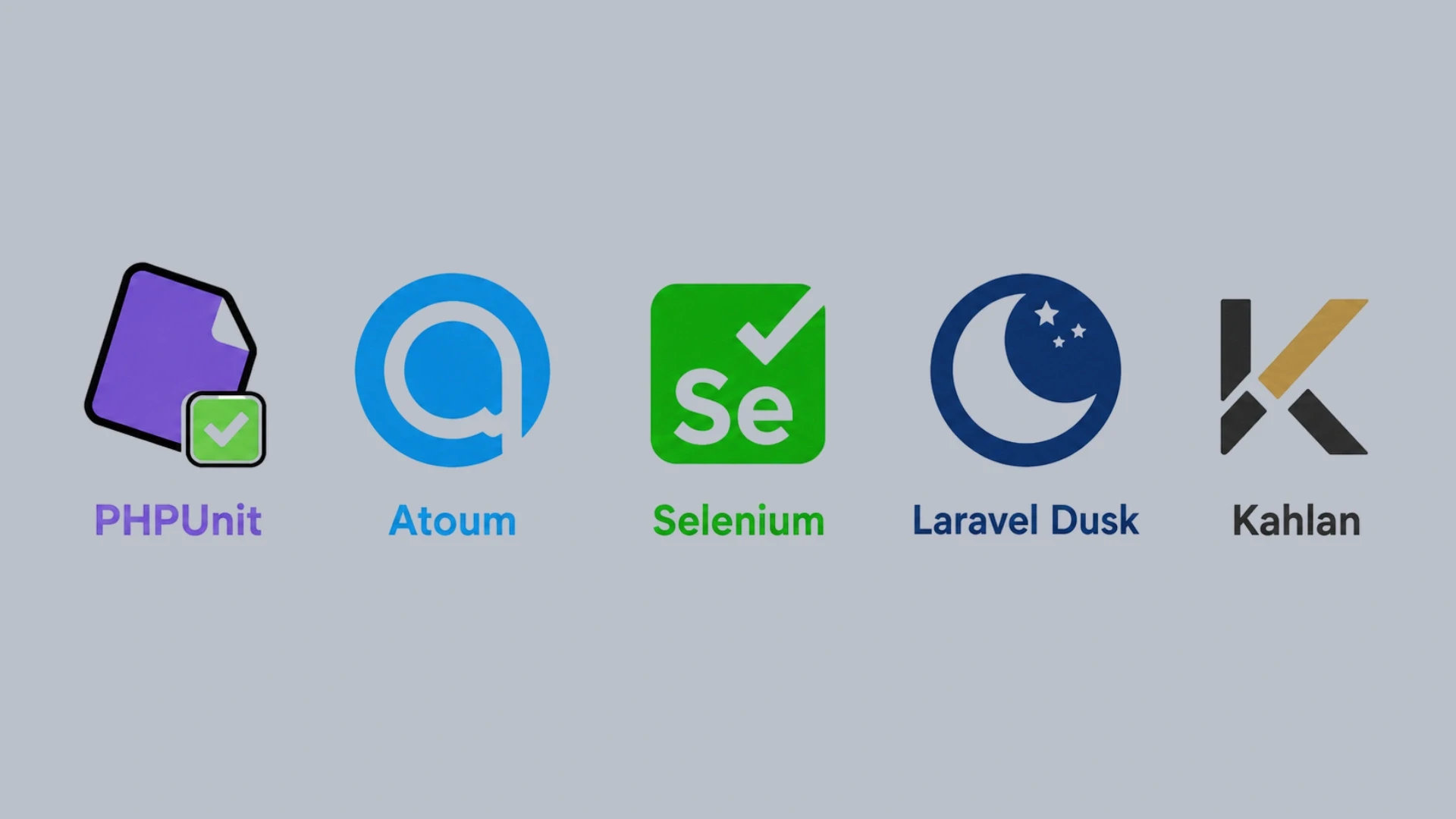
Three of the original five are still reasonable choices, and two should be avoided for new work. Here is the state of each.
2018 tool | Status in 2026 | Verdict |
PHPUnit | Actively developed, now v12 | Still the standard |
Atoum | No meaningful development | Do not start new projects on it |
Selenium | Alive, less used in PHP | Superseded by Dusk and Playwright |
Laravel Dusk | Actively maintained | Still excellent for Laravel |
Kahlan | Largely dormant | Use Pest instead |
The pattern is worth noticing because it repeats across every ecosystem. Testing frameworks with a single maintainer and a small user base fade quietly rather than announcing an end, and a project that looks fine on its homepage may have had no substantive commits in years. Before adopting any tool, check the commit history and the number of active maintainers, not the marketing page.
One important change to PHPUnit itself. Recent major versions replaced the old docblock annotations with PHP attributes, so test suites written years ago need updating rather than merely upgrading.
PHPStan, and Why Static Analysis Comes First
Static analysis reads your code and finds bugs without executing it, which means it works on codebases that have no tests at all. That is why it is the correct first investment rather than the last.
How the levels work
PHPStan runs at increasing strictness levels, and the intended approach is to start low and raise gradually. Level 0 catches unknown classes and methods. The middle levels add return types, argument types, and null safety. The highest levels demand full type coverage including generics and array shapes.
vendor/bin/phpstan analyse src --level=0 # once clean, raise it vendor/bin/phpstan analyse src --level=1
The baseline is what makes it practical
On an existing application, the first run will produce an overwhelming list. Generate a baseline file, which records all current errors and hides them, so the tool only reports problems in code you write from now on. The existing errors get fixed opportunistically as you touch those files. This one feature is the difference between static analysis being adopted and being abandoned after an afternoon.
vendor/bin/phpstan analyse --generate-baseline
Psalm is a well-regarded alternative with a similar model. Either is a good choice; running both is unnecessary. What matters is that one of them runs on every commit and that the level ratchets upward rather than drifting down when a deadline approaches.
Curious what static analysis would find in your codebase?
Give me read access to your repository, and I will run PHPStan across it, then send you the real error count, the most serious findings, and a realistic plan to clear them.
PHPUnit and Pest for Tests You Will Actually Write
PHPUnit remains the foundation of PHP testing, and Pest is a friendlier interface built on top of it. They are not competitors in the way the original article's list implied; Pest runs on PHPUnit underneath.
Which to choose
For a new project, Pest. Its syntax is shorter, which sounds trivial and is not, because the main reason test suites stay thin is friction. For an existing PHPUnit suite, keep PHPUnit; there is no benefit in a rewrite, and Pest can run alongside it if you want to write new tests in the newer style.
// Pest it('rejects an expired coupon', function () { expect(applyCoupon('EXPIRED'))->toBeFalse(); });
What to test first on a legacy application
Not everything, and not in order of importance. Write tests around the code you are about to change, and around the two or three flows whose failure would genuinely cost money, which for most businesses means authentication, checkout, or billing. A small suite covering the paths that matter beats a large suite covering the paths that were easy to test, and it is achievable in days rather than quarters.
Browser Testing With Dusk and Playwright
Browser tests drive a real browser through a real flow, which is the only way to catch failures that live in the gap between your backend and your interface. The original was right to include this category, and the tooling has moved on.
Dusk for Laravel, Playwright for everything else
Laravel Dusk remains the most convenient option on a Laravel project because it understands your application's database, authentication, and environment. Outside Laravel, Playwright has become the general-purpose choice, with better speed and reliability than the Selenium setups the original recommended. Pest also now offers browser testing, which is worth evaluating if your suite already uses it.
Keep this layer small deliberately
Browser tests are slow and comparatively brittle, so a suite of two hundred of them becomes something the team routes around rather than relies on. Cover the handful of journeys that must never break, run them on every deployment, and push everything else down into faster feature tests. A browser suite that finishes in four minutes gets run; one that takes forty does not.
PHP-CS-Fixer for Style Nobody Argues About
Automated formatting removes an entire category of pull request comments, and its value is social rather than technical. Every minute spent debating brace placement is a minute not spent reviewing logic.
Adopt a published standard rather than inventing one, run the fixer automatically before commit, and enforce it in continuous integration so it cannot drift. Laravel Pint is a thin wrapper around PHP-CS-Fixer with sensible defaults and is the fastest way to get this in place on a Laravel project. The decision to make once, and then never revisit, is which standard you follow; the tool then applies it without anyone's opinion being involved.
There is a review benefit worth naming. When formatting is automatic, every remaining comment in a pull request is about substance, which measurably improves the quality of review and shortens the cycle. This is one of the small practices that keeps our sprint delivery at 95% on time, because review queues are where most schedules quietly slip.
Rector for Upgrades You Would Otherwise Postpone
Rector performs automated refactoring across a whole codebase, and it is the reason version upgrades no longer need to be a quarter-long project. It applies rule sets that rewrite outdated syntax and framework calls mechanically.
What it handles well
PHP version migrations, framework upgrade paths, converting PHP Unit annotations to attributes, adding type declarations, and applying consistent modernization across thousands of files.
vendor/bin/rector process src --dry-run
Always run the dry run first and read the diff. Rector is good, not infallible, and the review step is what keeps it safe. Used properly, it turns the most-postponed job in PHP maintenance into a reviewable pull request, which is exactly how our version upgrade services handle framework migrations without freezing feature work for weeks.
The Coverage Number That Fools People
Test coverage measures which lines ran, not whether anything was verified. A suite can report ninety percent coverage and catch almost nothing, which is why coverage targets so often produce reassurance instead of reliability.
The failure mode is simple. Tests written to satisfy a percentage tend to exercise getters, setters, and constructors, because those are trivially easy to cover. The complicated conditional logic where bugs actually live is harder to test and gets skipped. The number goes up and the risk stays exactly where it was.
Mutation testing tells you the truth
Infection deliberately introduces small changes into your code, flipping a comparison or altering a return value, then runs your tests to see whether any of them notice. Changes that survive show you tests that execute code without verifying it. It is slower than coverage, and it is the only measure that answers the question you actually care about, which is whether your tests would catch a real mistake.
A practical target: cover the paths where failure costs money, verify that coverage with mutation testing on those paths only, and ignore the overall percentage entirely. Reporting a coverage figure to a board is a habit worth breaking, and an independent view through virtual CTO services is often what gets that conversation started.
Putting It Together in CI
None of these tools help until they run automatically on every commit. A check that depends on somebody remembering is not a check.
A sensible pipeline order
Run the fast, cheap checks first, so failures come back in seconds: style, then static analysis, then unit and feature tests, then browser tests last because they are slowest. Fail the build on any of them. The whole pipeline should finish inside ten minutes, because beyond that developers start pushing without waiting and the feedback loop breaks.
The rule that makes it stick
Nothing merges with a failing check, and the standard never gets lowered to unblock a release. The moment a team starts skipping checks under deadline pressure, the tooling becomes decorative. Setting the pipeline up properly takes a day or two, and it is normally handled by whoever you hire DevOps engineers to own delivery infrastructure.
Proof: What This Looks Like on Real Work
Quality tooling is easy to argue for in theory and easier to justify with an outcome. Here is one from our own client work rather than a hypothetical.
Client: Ailleron, banking technology, Krakow Ailleron's reporting was scattered across disconnected sources, which made compliance reporting slow and error-prone. Acquaint Softtech consolidated it into a centralised data warehouse with three BI and compliance dashboards built on top. Result: around 200 hours a week saved across the reporting function, and report creation reduced from four days to one. The engagement holds a 5.0 out of 5 rating on Clutch. |
The relevance to this article is the part that does not appear in the headline numbers. A reporting platform that regulated users depend on cannot ship regressions, and the only reason a small team can change that kind of system confidently is that the checks described above run on every commit. Static analysis and tests are what make a four-day process safe to compress into one.
The wider record is verifiable rather than asserted: 1,300+ delivered projects, 95% on-time sprint delivery, an average team tenure beyond 24 months, and a 4.9 out of 5 rating across verified Clutch reviews. Our software case studies and client testimonials are worth reading for the long-running engagements in particular, since sustained delivery is what quality tooling actually buys you.
Ship changes without holding your breath
Book a free 30-minute call, and I will review your current PHP setup, then show you the smallest set of checks that would stop regressions reaching production.
What a PHP Quality Setup Costs

Quality work is priced as a one-off setup plus a small ongoing cost, and each item prevents a specific and more expensive failure. This table is arranged by what you get back rather than by project size.
Investment | What it prevents | Cost and timing |
Static analysis with baseline | Type and null bugs reaching users | USD 2,000 to 6,000, week one |
Tests on money-critical flows | Broken checkout or login going live | USD 4,000 to 15,000, first month |
Browser tests, key journeys only | Silent front-end regressions | USD 3,000 to 10,000, first quarter |
Style automation in CI | Review time lost to formatting | USD 800 to 2,500, one afternoon |
Rector-assisted version upgrade | Falling onto unsupported versions | USD 5,000 to 25,000, annually |
Mutation testing on core paths | False confidence from coverage | USD 3,000 to 9,000, once |
CI pipeline with enforced gates | Anything above quietly lapsing | USD 2,500 to 8,000, then ongoing |
For comparison, a single production incident on a payment or authentication flow typically costs more than the entire first column combined, before counting the engineering hours spent on the emergency rather than on the roadmap. That is the argument for doing this work in a quiet month rather than a loud one.
Where the work is done | Senior PHP rate | Same setup, relative cost |
New York, USA | USD 110 to 200 / hour | Highest |
United States (national) | USD 90 to 170 / hour | Very high |
Australia | AUD 110 to 200 / hour | High |
United Kingdom | GBP 65 to 130 / hour | High |
Europe (EU) | EUR 70 to 140 / hour | High |
India (Acquaint Softtech) | USD 25 to 49 / hour | Up to 40% lower |
Quality work suits offshore delivery unusually well, because it is bounded, reviewable and produces artefacts you can inspect: a passing pipeline, a falling error count, a diff. You are not taking anything on trust.
Where the constraint is capacity rather than budget, adding an engineer through IT staff augmentation for a quarter is usually enough to establish all of it, and our guide to web application development cost covers how this sits inside a wider budget.
Get a PHP team that treats quality as part of the build
Book a free 30-minute call, and I will introduce the engineers who would work with you and show you the checks they run before anything reaches your users.
Frequently Asked Questions
-
What are the best PHP quality assurance tools in 2026?
PHPStan for static analysis, PHPUnit or Pest for tests, Dusk or Playwright for browser testing, PHP-CS-Fixer for style, and Rector for automated upgrades.
-
Should I start with tests or static analysis?
Static analysis. PHPStan finds real bugs in an existing codebase without you writing any new code, so it delivers value in the first hour rather than the first month.
-
Is Atoum or Kahlan still worth using?
Not for new projects. Both have seen little meaningful development in recent years. Use PHPUnit or Pest instead.
-
PHPUnit or Pest, which should I choose?
Pest for new projects, because its shorter syntax reduces the friction that keeps suites thin. Keep PHPUnit on existing suites, since Pest runs on PHPUnit underneath anyway.
-
What PHPStan level should I aim for?
Start at level 0 with a baseline, then raise one level at a time. The level matters far less than the ratchet only ever moving upward.
-
Is 100 percent test coverage worth pursuing?
No. Coverage shows which lines ran, not whether anything was verified. Cover the flows where failure costs money and check them with mutation testing instead.
-
What is mutation testing?
It introduces small deliberate changes into your code and checks whether your tests notice. Surviving changes reveal tests that execute code without actually verifying it.
-
How does Rector help with upgrades?
It applies rule sets that rewrite outdated syntax and framework calls across the whole codebase automatically. Always run the dry run and review the diff before applying.
-
How long does it take to add quality tooling to an existing app?
Static analysis with a baseline takes days. Tests on critical flows take a few weeks. A full setup with CI enforcement typically lands within a quarter.
-
How do I justify quality work to non-technical stakeholders?
Price it against a single incident. One failure on checkout or authentication usually costs more than the entire setup, before counting the engineering time lost to the emergency.
I love to make a difference. Thus, I started Acquaint Softtech with the vision of making developers easily accessible and affordable to all. Me and my beloved team have been fulfilling this vision for over 15 years now and will continue to get even bigger and better.
Table of Contents
Get Started with Acquaint Softtech
- 13+ Years Delivering Software Excellence
- 1300+ Projects Delivered With Precision
- Official Laravel & Laravel News Partner
- Official Statamic Partner
Related Blog

How the Laravel AI SDK Enhances Modern Web Apps
The Laravel AI SDK is Laravel's official first-party package that enables developers to build AI-powered web applications using a single, unified API.

Chirag Daxini
April 15, 2026
Rome Was Not Built in a Day: The Journey to Developing a Unicorn SaaS
Building a unicorn SaaS company is a marathon, not a sprint. Just like Rome, great products aren’t built overnight. From refining your MVP to scaling for growth.
Mukesh Ram
September 26, 2024
10 Must Follow Steps of Mobile App Development Process
The mobile app development process is a structured set of 10 steps that moves an idea from concept to a published app: ideation, target audience and monetization, choosing the platform, UI/UX design, picking tools, choosing the right partner, fast development, testing and deployment, marketing, and post-launch maintenance. Following the steps in order, rather than rushing to publish, is what separates apps that get downloads from the ones that get ignored.
Mukesh Ram
July 29, 2019India (Head Office)
203/204, Shapath-II, Near Silver Leaf Hotel, Opp. Rajpath Club, SG Highway, Ahmedabad-380054, Gujarat
USA
7838 Camino Cielo St, Highland, CA 92346
UK
The Powerhouse, 21 Woodthorpe Road, Ashford, England, TW15 2RP
New Zealand
42 Exler Place, Avondale, Auckland 0600, New Zealand
Canada
141 Skyview Bay NE , Calgary, Alberta, T3N 2K6