

AI in On-Demand Apps: Matching, Pricing, Fraud Detection, and Predictive Analytics
AI in on-demand apps powers four high-value functions: matching customers with the best provider, setting dynamic prices from real-time demand, detecting fraud as it happens, and predicting demand, ETAs, and churn. It works by training machine-learning models on platform data, then serving their predictions live inside the app.

Manish Patel
Everyone wants an AI-powered on-demand app in 2026, but adding a chatbot alone does not create business value. The real impact comes when AI improves matching, pricing, fraud detection, and demand forecasting, helping the platform operate smarter and scale faster. The winners are not the apps that showcase AI, but the ones that use it to solve real marketplace problems and drive measurable growth.
This article fixes that. It explains the real AI use cases in on-demand platforms, how Uber uses machine learning in practice, and where ML for gig platforms creates measurable value, then walks through matching, pricing, fraud detection, and predictive analytics in turn. Adoption is no longer fringe; surveys such as the McKinsey State of AI show AI moving into core operations across industries, which raises the bar for any platform competing without it.

- You want to know where AI actually pays off in an on-demand app.
- You are deciding which AI features to build first.
- You are unsure whether to build models or use AI APIs.
- You need a realistic view of AI cost and ROI before committing.
- You are choosing an engineering partner for AI and ML work.
As CIO of Acquaint Softtech, I have led the architecture of AI and machine-learning systems, the matching, pricing, fraud, and prediction models described in this guide, across a company that has delivered 1,300+ projects over 13+ years through dedicated AI development services for clients across the USA, UK, Europe, Australia, and New Zealand. The patterns below come from models my teams shipped to production, not slideware.
If you want the wider category context first, this guide to On-Demand App Development in 2026, which frames AI alongside the architecture and verticals it enhances. Read on for where AI actually earns its keep.
What AI Actually Does in an On-Demand App

The most useful way to understand AI use cases in on-demand platforms is to see them as prediction problems. Matching predicts which provider will give the best outcome, pricing predicts the price that balances supply and demand, fraud detection predicts whether a transaction is genuine, and analytics predicts what will happen next. Acquaint Softtech builds these models with Python developers who work in the language most machine learning is written in.
What separates AI from the simple rules most apps start with is the number of signals it can weigh at once. A rule says assign the nearest driver; a model weighs distance, traffic, driver rating, acceptance history, and dozens more factors to predict the best match. That richer reasoning is what lifts conversion, retention, and margin, and capturing it is the work of AI and ML engineers who design, train, and tune the models.
AI is not a single feature; it is a capability layered across the platform, and the strongest on-demand apps apply it where the payoff is largest rather than everywhere at once. Seeing the underlying platform first makes this concrete, and the on-demand home services app development guide lays out the kind of marketplace these models plug into, from booking to fulfilment.
The Data Foundation: Pipelines Before Intelligence
Before any model earns its keep, the platform needs clean, reliable data, because AI is only as good as what it learns from. The unglamorous work of capturing events, storing them well, and serving them to models is what most failed AI projects skip. Acquaint Softtech builds this data backbone first with DevOps engineers who stand up the pipelines, storage, and serving layers that models depend on.
A working data foundation has a few parts: event capture from every app action, a store that keeps history for training, a feature pipeline that turns raw data into model inputs, and a serving layer that delivers predictions fast enough to use live. Each must be reliable, because a broken pipeline silently poisons every model downstream. Standing this up properly is exactly the kind of foundational work a dedicated software development team should own from the first sprint.
The discipline here is well established in the field; practitioners widely cite that the hardest part of machine learning is the data and engineering around the model, not the model itself. Google's own Rules of Machine Learning opens with the guidance to get the infrastructure right before chasing sophisticated models, advice that applies directly to any on-demand platform adding AI.
AI for Matching: Smarter Supply-Demand Pairing

AI improves matching by predicting the best provider for each request instead of just the nearest. ML-powered matching algorithms weigh distance, ETA, ratings, acceptance likelihood, and context to maximise completed, high-quality transactions. This raises fill rates and satisfaction on both sides, which is why matching is often the first place AI pays off.
Matching is where AI most visibly beats rules, because the best provider is rarely just the closest one. ML-powered matching algorithms predict the likelihood that a given pairing leads to a completed, well-rated transaction, weighing ETA, ratings, acceptance history, and live context together. Acquaint Softtech builds these matching engines with MERN stack developers who connect the model's scores into the live request flow.
This is how the big platforms work under the hood: instead of a single rule, a model ranks candidates by predicted outcome, learns from every completed and cancelled trip, and improves over time. The lift is real, since a few percentage points of fill-rate improvement compound across millions of requests. Tuning and retraining these models as conditions change is ongoing work, which is why marketplace teams often add specialist capacity through staff augmentation services when matching becomes a priority.
Matching is fundamentally the same problem across mobility, delivery, and services: pair the right supply with the right demand at the right moment. The real-time pairing layer is detailed in the breakdown of the cost to develop an on-demand taxi booking application, where the matching engine that AI upgrades is described end to end.
Want AI That Moves a Metric, Not Just a Slide?
Acquaint Softtech targets AI where it pays off, matching, pricing, fraud, and prediction, on a data foundation built to support it. 1,300+ projects delivered. Teams deployable within 48 hours of brief. Build intelligence that earns its budget.
AI for Dynamic Pricing and Demand Forecasting
AI-driven pricing sets prices from real-time supply, demand, and context rather than fixed rates. Models forecast demand by area and time, then adjust prices to balance the marketplace, the mechanism behind surge pricing. Done well, it increases availability when demand spikes and improves earnings for providers and revenue for the platform.
Dynamic pricing is one of the clearest examples of AI-driven pricing and fraud detection working in the open, because riders feel surge directly. The model forecasts demand for a given area and time, compares it to available supply, and sets a price that keeps the marketplace balanced, drawing more supply out when demand spikes. Acquaint Softtech builds the forecasting and pricing services for this with Django developers who handle the data-heavy prediction logic.
The art is in fairness and trust, because pricing that feels arbitrary erodes loyalty even when it is mathematically sound. Good systems are transparent about why a price moved, cap extremes, and forecast far enough ahead to position supply before a spike rather than only reacting to it. Building and validating these models carefully is delivered through flexible software development outsourcing that adds data-science capacity without permanent overhead.
Demand forecasting extends well beyond pricing: knowing the next hour's demand by neighbourhood drives staffing, incentives, and positioning across the whole operation. The peak-load patterns that make this essential are detailed in the guide on how to create an on-demand food delivery app like Uber Eats, where predictable dinner-time surges show why forecasting pays for itself.
AI for Fraud Detection in Real Time

AI detects fraud by learning the patterns of normal behaviour and flagging anomalies in real time: fake accounts, payment fraud, collusion, and fake reviews. Unlike fixed rules, machine-learning models adapt as fraudsters change tactics, scoring each action by risk so the platform can block, challenge, or review it before money or trust is lost.
Fraud is an arms race, and static rules lose it, because fraudsters adapt the moment a rule is known. Machine-learning models instead learn what normal looks like and score each action by how far it deviates, catching fake accounts, payment fraud, driver-rider collusion, and review manipulation as they happen. Acquaint Softtech builds these real-time scoring services with MEAN stack developers who wire model scores into the transaction flow without slowing it down.
The key advantage is adaptability: a model retrained on fresh data keeps pace with new tactics in a way a hand-written rule never can, and it can weigh hundreds of subtle signals a human would miss. Keeping these models current and their thresholds tuned as patterns shift is continuous work, which is why fraud systems pair naturally with ongoing support and maintenance services after launch. This same real-time scoring approach is central to modern payment fraud prevention, where flagging risky transactions as they happen matters far more than catching them after the fact.
Get an AI Roadmap Built on Real ROI
Acquaint Softtech clients save up to 40% versus Western agency rates, with a 95% on-time sprint delivery record and a 4.9/5 Clutch rating from 50+ verified reviews. Book a scoping call and receive a prioritised AI roadmap and cost estimate within 48 hours.
Predictive Analytics, Personalisation, and Recommendations
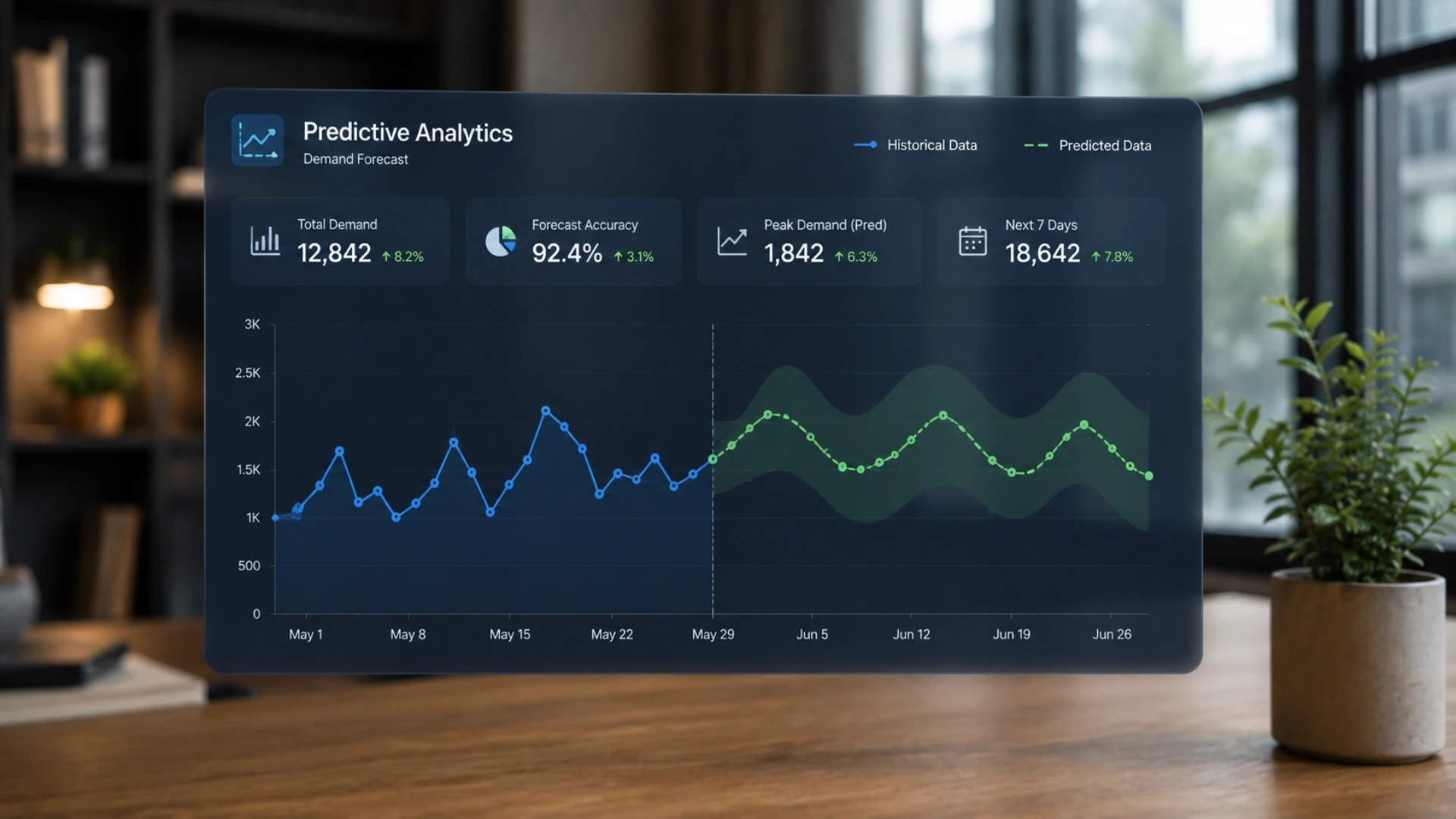
Beyond the live decisions, AI helps the platform see around corners through predictive analytics for marketplaces: forecasting demand, predicting churn, estimating accurate ETAs, and recommending what each user is most likely to want. These predictions turn raw history into decisions about staffing, incentives, and experience. Acquaint Softtech builds the customer-facing side of this with React Native developers who surface recommendations and ETAs smoothly in the app.
Prediction | What It Forecasts | Business Use |
Demand | Orders by area and time | Staffing and incentives |
Churn | Users likely to leave | Targeted retention offers |
ETA | Accurate arrival times | Trust and planning |
Recommendations | What a user wants next | Higher conversion |
Churn prediction is one of the most profitable models a marketplace can run, because keeping an existing user costs far less than acquiring a new one. A model that flags a customer or provider likely to leave lets the platform intervene with the right offer before they go. Keeping these analytics models accurate as behaviour shifts is part of the lifecycle handled through version upgrade services that retrain and re-tune as data evolves.
Accurate ETAs deserve special mention, because they quietly shape trust more than almost any other number in the app. Predicting arrival precisely, accounting for traffic, handoffs, and real-world delays, is a model that touches every delivery, and the prediction-heavy lifecycle behind it is detailed in the breakdown of the cost to develop an on-demand courier services app, where ETA and routing predictions run through the whole journey.
Build vs Buy: Models, APIs, and MLOps
On-demand platforms should buy commodity AI through APIs, vision, speech, and language- and build custom models where their own data is the advantage, like matching and fraud. The deciding factor is whether the problem is unique to your marketplace. Either way, MLOps, the pipelines that train, deploy, monitor, and retrain models, is what keeps AI working in production.
Not every AI feature should be built from scratch, and knowing the difference saves a fortune. Commodity capabilities such as image recognition, speech, translation, and general language tasks are best bought through mature APIs, while the models that depend on your own marketplace data, matching and fraud, are where building pays off. Acquaint Softtech helps founders draw this line and wire in the right mix with automation engineers who integrate APIs and build pipelines around them.
Whatever the mix, the part teams underestimate is MLOps: the discipline of deploying models, monitoring their accuracy in production, and retraining them as data drifts. A model is not shipped once; it decays as the world changes, so the pipeline that keeps it healthy matters as much as the model itself. Setting this operational foundation correctly often benefits from senior direction through a virtual CTO service that establishes the ML lifecycle before scale.
The practices for running models reliably in production are now well codified, and following them prevents the slow accuracy decay that quietly breaks AI features. Google Cloud's guidance on MLOps and continuous delivery for machine learning lays out the automation pipelines that keep models accurate over time, principles every serious on-demand AI effort should adopt.
The Cost and ROI of Adding AI

AI on-demand development cost in India and other offshore hubs depends on whether you are integrating APIs or building and operating custom models, and the data foundation is usually the highest hidden cost. The ranges below reflect Acquaint Softtech project economics, and a sensible first step is a focused, high-ROI model rather than a broad AI programme, often begun with remote developers who prove value on one use case first.
AI Scope | Estimated Cost (India Team) | Typical Timeline |
API integration (vision, language) | $8,000 to $20,000 | 3 to 6 weeks |
One custom model plus data pipeline | $25,000 to $55,000 | 8 to 16 weeks |
Matching or fraud system with MLOps | $55,000 to $120,000 | 16 to 28 weeks |
Full AI suite across the platform | $120,000 to $250,000+ | 28 to 48+ weeks |
Western agency and specialist AI-lab rates for the same work run 40 to 60% higher, driven by overhead and scarce talent premiums rather than better outcomes. The right question is not what AI costs but what it returns: a matching model that lifts fill rate, or a fraud model that cuts losses, pays back quickly. Packaging proven models into a reusable foundation can accelerate this through white-label software development that ships sensible AI defaults.
ROI is the only honest justification for AI spend, and it should be measured per use case: revenue from better matching, margin from smarter pricing, losses prevented by fraud detection, and retention from churn prediction. The macro trend supports the investment, with analysts such as those behind the Stanford AI Index documenting AI's rapid move from experiment to measurable business value across sectors.
Case Study: Production AI at 99.9% Accuracy
Theory matters less than a model that ships. The engagement below is a real, published Acquaint Softtech project that exercises the same AI muscles an on-demand platform needs: high-accuracy models, real-time inference, self-learning feedback loops, confidence scoring, and explainable results that users trust. You can read the full story at Beyond the Naked Eye: Precision AI for the Modern Fleet.
Case Study: Good2Know, AI-Powered Inspection Platform
Client: Good2Know, an AI vehicle-inspection company (Co-Founder and CEO Tomi Keinanen).
Challenge: Manual inspections were slow, subjective, and costly. Good2Know needed to upgrade its AI platform into a scalable, enterprise-ready SaaS that combined high model accuracy with real-world field usability, supporting high-volume inspections at low latency while making AI decisions trustworthy to operators.
Approach: Acquaint Softtech engineered an AI-driven system with models reaching up to 99.9% detection accuracy and real-time alerts, an insight-first dashboard showing detections and confidence scores, self-learning feedback loops where operator actions improve the model, and a multi-tenant architecture scaling from 1,000 to over 1,000,000 scans.
Results: Good2Know gained a high-accuracy, explainable AI platform that surfaced the most critical issues first, scaled across enterprise volumes, and turned subjective manual checks into fast, consistent, data-driven decisions operators could trust.
Why It Matters for On-Demand AI: The parallels are direct. High-accuracy real-time inference maps to live matching and fraud scoring, confidence scores and explainability map to AI users will trust, and self-learning feedback loops map to the retraining that keeps on-demand models sharp.
"They were willing to address real issues, and this made the end product seem more helpful in real-life scenarios." -- Tomi Keinanen, Co-Founder and CEO, Good2Kno
The high-accuracy models, real-time inference, and self-learning feedback loops at the heart of this project are exactly what AI in an on-demand app demands. Acquaint Softtech brings that production-grade ML capability to marketplaces through dedicated software product development that treats models as living systems, not one-off deliverables.
Founders should judge a partner by shipped, measurable AI rather than promises. A full library of verified engagements across AI, real-time, and on-demand work is available, and independent client ratings can be checked on the Acquaint Softtech Clutch profile, where the company holds a 4.9/5 score with Premier Verified status.
Why Acquaint Softtech for On-Demand AI
The decisions made early which use cases to target, how to build the data foundation, and whether to build or buy each model, determine whether AI returns its cost or quietly drains the budget. The partner who builds the first models and pipelines shapes that outcome, so choosing a team that has shipped production AI matters more than choosing one that merely talks about it. Acquaint Softtech sets that direction rigorously, often through a discovery workshop that prioritises AI by ROI before any model is trained.
Three things matter most here. The first is shipped AI experience: over 13+ years and 1,300+ projects across 20+ industries, the team has built production machine-learning systems, including high-accuracy detection, real-time scoring, and feedback-loop models, for clients in the USA, UK, Europe, Australia, and New Zealand. The second is team stability, with an average engagement tenure of 24+ months, so the engineers who train your models are the ones who monitor and retrain them as data drifts, kept on track by experienced project managers who own delivery cadence.
The third is speed without compromise: a dedicated team deploys within 48 hours of a signed brief, and the first sprint review happens in two weeks, materially faster than the four- to eight-week onboarding common at Western agencies and AI labs.
"The mistake I see most often is treating AI as a feature to announce rather than a system to operate. We start by finding the one or two predictions that change the economics of a marketplace, build the data foundation under them, and put the MLOps in place to keep them accurate. AI that is measured, monitored, and retrained earns its budget. AI that is bolted on for the pitch deck does not." -- Manish Patel, CIO, Acquaint Softtech
Ready to Add AI That Actually Pays Off?
Join 200+ technology companies that scaled with Acquaint Softtech. 1,300+ projects delivered. 4.9/5 Clutch rating. 50+ verified reviews. Teams deployable in 48 hours. The fastest path from AI ambition to models running in production.
Frequently Asked Questions
-
How does Uber use AI?
Uber uses AI for driver-rider matching, dynamic pricing, ETA prediction, fraud detection, and demand forecasting. Machine learning helps reduce wait times and improve marketplace efficiency. AI also predicts demand so drivers can be positioned before ride requests increase.
-
What AI features should an on-demand app have?
The most valuable AI features are smart matching, dynamic pricing, ETA prediction, fraud detection, and personalised recommendations. These features improve user experience and operational efficiency. Most startups should begin with one high-impact AI use case.
-
How much does AI add to on-demand app development costs?
AI integrations using existing APIs typically cost between $8,000 and $20,000. Custom AI models with training pipelines usually cost $25,000 to $55,000. Advanced matching, pricing, or fraud systems can exceed $120,000.
-
Can machine learning improve marketplace efficiency?
Yes, machine learning improves match quality, reduces cancellations, and increases booking success rates. It also helps balance supply and demand through predictive pricing. Even small improvements can significantly increase revenue at scale.
-
Should I build custom AI models or use AI APIs?
Use AI APIs for common features like chat, speech, and image recognition. Build custom models for marketplace-specific challenges such as matching, pricing, and fraud detection. Your proprietary data is usually the strongest reason to build.
-
What data is needed for AI in an on-demand app?
AI requires clean historical data, including bookings, cancellations, payments, ratings, locations, and user activity. Better data produces more accurate predictions. Most AI projects succeed or fail based on data quality.
-
What is MLOps and why is it important?
MLOps is the process of deploying, monitoring, and retraining AI models in production. It ensures models stay accurate as customer behaviour and market conditions change. Without MLOps, AI performance gradually declines over time.
-
Is AI worth it for a startup?
Yes, but startups should focus on one AI feature that directly impacts growth or profitability. Matching quality and fraud prevention are often the best starting points. A focused AI strategy delivers better ROI than adding multiple AI features at once.
-
How does AI improve demand forecasting?
AI analyses historical trends, location data, weather, events, and real-time activity to predict future demand. Businesses can prepare supply before demand spikes occur. This improves service availability and reduces customer wait times.
-
What is the best AI use case for an on-demand marketplace?
Smart matching is often the highest-ROI AI feature for on-demand platforms. It connects the right customer with the right provider based on location, availability, and predicted outcomes. Better matching increases conversions, satisfaction, and retention.
I lead technology and client success at Acquaint Softtech with one goal in mind. Deliver work that feels personal, reliable, and worthy of long term trust. I stay close to both our clients and our developers to make sure every project moves with clarity, quality, and accountability.
Table of Contents
Get Started with Acquaint Softtech
- 13+ Years Delivering Software Excellence
- 1300+ Projects Delivered With Precision
- Official Laravel & Laravel News Partner
- Official Statamic Partner
Related Blog
The Complete Guide to On-Demand App Development in 2026
Not every on-demand app is Uber. Not every marketplace is Amazon. This 2026 guide maps every platform type, its architecture, real cost, and the cold-start sequence that separates launches that work from those that fail.

Acquaint Softtech
May 7, 2026.jpg "On-demand home service apps: A Complete Development Guide")
On-demand home service apps: A Complete Development Guide
Unveil the top features and trends driving the popularity of home service apps in today’s fast-paced world.

Mukesh Ram
August 22, 2024
Food Delivery App Like Zomato & DoorDash: Architecture, Features, and Scale
Zomato and DoorDash are not apps. They are data platforms. Every feature you see in the consumer interface is the output of a precisely designed data model, a set of platform entities with defined relationships, and a state machine with explicit transition rules. This guide walks through the data architecture, the platform design decisions, and the six scaling triggers that tell you when the platform needs to grow.
Manish Patel
May 21, 2026India (Head Office)
203/204, Shapath-II, Near Silver Leaf Hotel, Opp. Rajpath Club, SG Highway, Ahmedabad-380054, Gujarat
USA
7838 Camino Cielo St, Highland, CA 92346
UK
The Powerhouse, 21 Woodthorpe Road, Ashford, England, TW15 2RP
New Zealand
42 Exler Place, Avondale, Auckland 0600, New Zealand
Canada
141 Skyview Bay NE , Calgary, Alberta, T3N 2K6