

AIOps and Self-Healing Pipelines: Should You Build In-House or Staff-Augment Your DevOps Team?
Build in-house if AIOps will be a permanent, differentiating capability and you already employ senior DevOps engineers with spare capacity. Staff-augment if you need the capability working within a quarter, cannot justify two permanent AIOps hires, or want your existing team trained by people who have shipped self-healing pipelines before. Most mid-sized teams land on a hybrid: augment to build it, retain in-house to run it.

Kalpesh Rajora
That is the real question, and it is harder than the technology. As a Project Manager at Acquaint Softtech, I sit in this conversation most weeks. A CTO has approval to invest in self-healing pipelines, the alert fatigue is genuine, the business case is signed off. Then the question arrives: do we hire two permanent DevOps engineers, retrain the team we have, or bring in IT staff augmentation for a quarter and keep the capability afterwards?
Nobody in the room has done this before, so everybody is guessing. Choosing the wrong approach can delay projects, increase costs, and create long-term operational risks. Whether you hire, train, or outsource, success depends on the right expertise and knowledge transfer from the start.

- You are deciding whether to hire, train, or augment for AIOps capability this budget cycle
- Your on-call rotation is burning out, and alert volume keeps climbing
- You have been asked to justify an AIOps investment with a number, not a narrative
- Your CI/CD pipeline fails often enough that someone manually restarts things weekly
- You want self-healing capability without committing to two permanent senior salaries
- You tried an AIOps tool already, and it produced better-organised noise
Meanwhile the underlying problem compounds. Alert volume keeps climbing, your best engineers keep getting paged at 3 am, and the ones you cannot afford to lose start updating their profiles. Google's own reliability practice treats this as a hard limit rather than a cultural quirk: if operational work is eating more than half an engineer's time, the answer is engineering, not endurance.
So this article is not another explainer on what AIOps is. It is the decision framework I use with clients: what the capability actually requires in people, which of the three staffing routes fits which situation, a scorecard you can fill in yourself, what each path costs, and how to sequence the first ninety days so you find out early whether it is working rather than at the end of the budget.
What AIOps and Self-Healing Pipelines Actually Mean
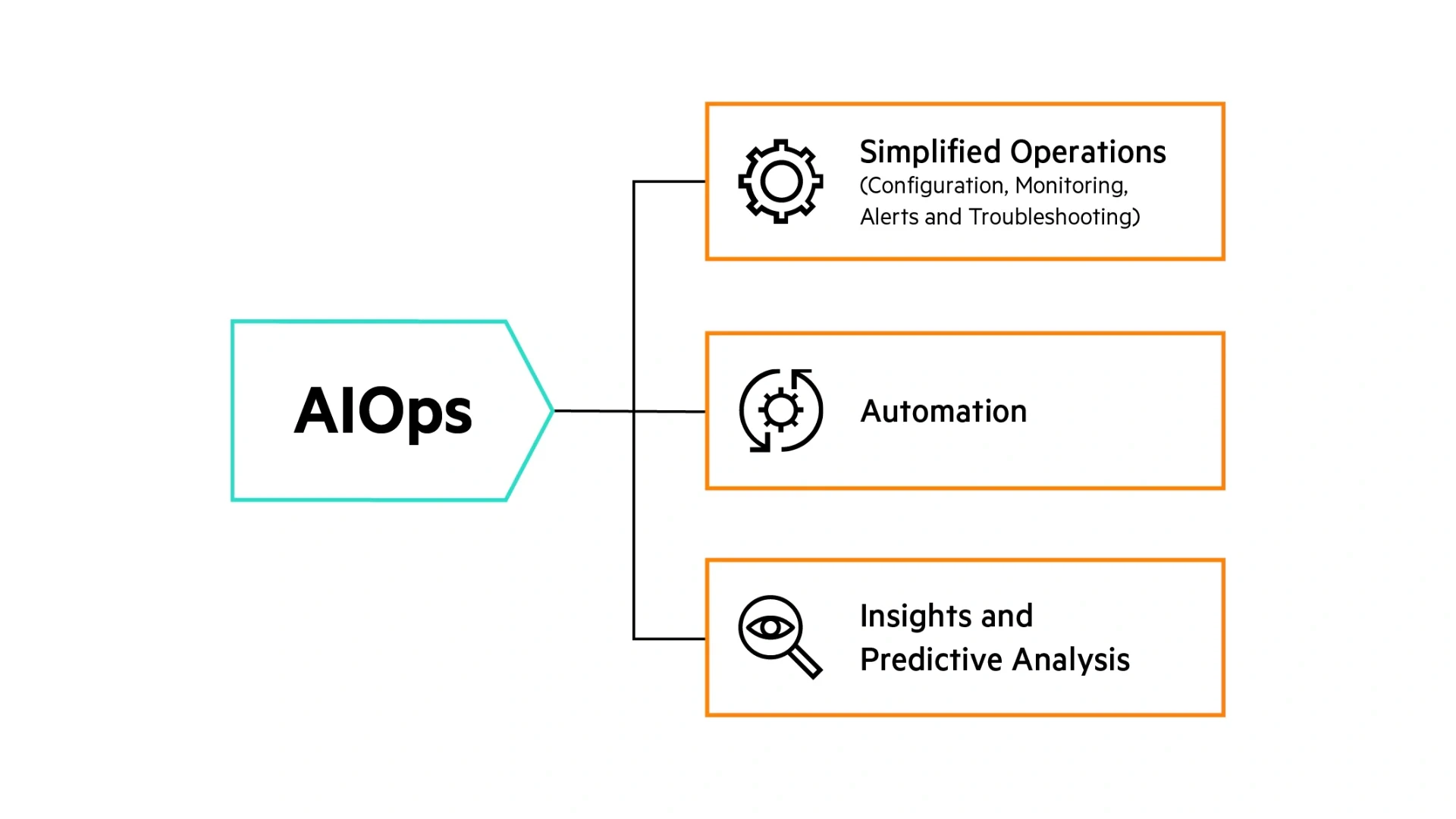
The terms get used loosely, which is part of why teams buy the wrong thing. Worth separating them precisely, because they require different people to build.
AIOps
AIOps applies machine learning to operational data: logs, metrics, traces, and events. Its core job is correlation and prediction. Instead of forty alerts firing from one root cause, AIOps groups them into one incident and, at its best, flags the anomaly before the threshold is breached. It is a detection and understanding layer.
Self-healing pipelines
Self-healing is the action layer sitting on top. When a known failure pattern is detected, the system remediates without waking anyone: retry the flaky integration test, roll back the deploy whose error rate spiked, restart the stuck queue worker, scale the service that is saturating. The pipeline recovers itself and logs what it did.
The concept underneath both: toil
Google's SRE practice gives this a precise name. Toil is defined in the Google SRE Workbook as mundane, repetitive operational work that provides no enduring value and scales linearly with service growth.
Their example is almost comically ordinary: an engineer logging into a server to delete log files whenever a directory hits 95% capacity. If your team has runbooks that read “log in to X, run this command, check the output, restart Y if you see...”, those instructions are already pseudocode. Someone just needs to write them properly.
That reframing matters for the staffing decision, because it tells you where to look for the business case. You are not buying AI. You are converting documented human procedures into tested automation, and the value is measured in engineering hours returned to product work.
Why the distinction matters for hiring
Detection is largely a data and observability problem. Remediation is a reliability engineering problem, and it carries real risk, because a remediation script firing on a false positive can cause the outage it was meant to prevent. Teams that hire only for one half of this end up with a system that either sees everything and does nothing, or acts confidently on bad signals.
The Self-Healing Maturity Ladder: Where Are You Now?
Before choosing a staffing path, locate yourself honestly. Most teams asking about AIOps are at Level 1 and assume they are at Level 2. The gap between those two is where budgets get wasted.
Level | What it looks like | Who fixes a failure |
0. Reactive | Alerts fire, humans triage everything, no correlation | A person, after being paged |
1. Consolidated | Logs and metrics centralised, dashboards exist, alerts still noisy | A person, but faster |
2. Correlated | Related alerts grouped into incidents, root cause surfaced automatically | A person, with better information |
3. Assisted | System recommends the fix and offers one-click remediation | A person, approving a suggestion |
4. Self-healing | Known failure patterns remediated automatically, humans review after | The system, with an audit trail |
You cannot skip levels. Attempting Level 4 automation on Level 1 data is exactly how the failed projects fail, and it is why data silos account for such a large share of AIOps disappointments. If your telemetry is fragmented across eight tools, no model will rescue you. That is a plumbing problem, and it is cheaper to fix than a failed platform purchase.
This is also the structure the CNCF Platform Engineering Maturity Model recommends thinking in: find yourself in the model, then target the adjacent level rather than the end state. That model was built with contributions from roughly 50 practitioners across small and large organisations, and its central warning applies here too. Each level up carries greater requirements for funding and people's time, so jumping two rungs is not ambition; it is overspend.
Find Out Which Level You Are Actually On
Send us your current monitoring stack and alert volume. A senior DevOps engineer will place you on the maturity ladder and tell you the single highest-value next step. Takes 15 minutes, no pitch.
Why This Became the Defining DevOps Theme of 2026
Three forces converged, and none of them are hype.
Alert volume outgrew human attention
Operations teams now field alert volumes where the overwhelming majority require no action at all. Once noise dominates, engineers rationally start ignoring alerts, and the one that mattered gets missed. No amount of discipline fixes a signal-to-noise ratio that bad. Only correlation does.
Downtime got more expensive
As more revenue moves through always-on systems, the cost of an hour of degraded service climbed into six figures for many mid-sized businesses. That changes the maths on prevention. When a single avoided incident pays for a quarter of engineering work, the investment case stops being theoretical.
The talent supply did not keep up
Skilled reliability engineers were scarce before AIOps added a new specialism on top. This is the part most trend reports underplay: the technology matured faster than the hiring market. Which is precisely why the build-versus-augment question is the practical one, and why hiring DevOps engineers permanently has become slower and more expensive than most budget cycles allow for.
Why This Is a Staffing Decision, Not a Tooling Decision
Every AIOps vendor will tell you their platform is the decision. It is not. The platform is the easy part, and switching platforms later is annoying rather than fatal. The hard, expensive, hard-to-reverse decision is who builds and owns the thing.
Here is why. A self-healing pipeline encodes your team's operational judgement: which failures are safe to auto-remediate, what the rollback criteria are, when to escalate rather than retry. That judgement has to come from engineers who have watched systems fail in production and understand the blast radius of an automated action. You cannot buy it in a licence, and a junior engineer following a tutorial will confidently automate something dangerous.
The SRE literature is blunt about the economics too. Before starting any toil-reduction project, confirm that the time saved will at minimum be proportional to the time spent building and then maintaining the automation. That maintenance clause is the one teams forget, and it is a staffing question by definition. Somebody owns those remediation rules for as long as the system runs.
So the question becomes: where do you source that judgement, and how permanently do you need to own it?
Path A: Build the Capability In-House
Hire one or two senior DevOps or platform engineers permanently and grow the capability internally.
Strengths | Weaknesses |
Knowledge stays permanently in the business | Hiring cycle for senior DevOps commonly runs 3 to 6 months |
Deep context on your specific systems | Salary plus overhead is a permanent fixed cost |
Best when AIOps is a competitive differentiator | Learning on your production system is expensive tuition |
Full control over the roadmap | One or two hires recreates the bottleneck you are solving |
No dependency on an external partner | Nobody in-house to review the first design decisions |
Build in-house when AIOps is genuinely core to your product, you already have senior reliability experience on staff to guide it, and your timeline tolerates a hiring cycle plus a learning curve. If two of those three are missing, this path is slower and riskier than it looks on the budget sheet.
Path B: Staff-Augment Your DevOps Team

Bring in senior engineers who have already built self-healing pipelines, embed them in your team, ship the capability, and keep the knowledge. If you need experienced professionals without the delays of full-time hiring, you can hire DevOps developers who already have hands-on experience with AIOps, CI/CD automation, Kubernetes, cloud infrastructure, and observability.
This approach helps your team deliver production-ready self-healing pipelines faster while ensuring knowledge transfer throughout the engagement.
Strengths | Weaknesses |
Capability live in weeks rather than quarters | You are renting capacity, not owning headcount |
Engineers who have made these mistakes elsewhere | Requires deliberate knowledge transfer or it walks out |
Cost scales down when the build phase ends | Needs a clear scope to avoid an open-ended retainer |
Your team learns by working alongside, not from docs | Onboarding time to your systems is real |
No permanent salary commitment before proving value | Partner quality varies enormously |
Augment when the timeline matters more than the org chart, when you cannot justify permanent senior hires before the capability has proven its value, or when your team is strong but has never built this specific thing. The critical success factor is contractual: insist that knowledge transfer and documentation are deliverables, not goodwill.
Path C: The Hybrid Route Most Teams Actually Take
In practice, the majority of mid-sized teams I work with end up here, and it is usually the right answer rather than a compromise.
The pattern: augment for the build phase with engineers who have done it before, pair them with one or two of your own engineers throughout, and hand operational ownership to your internal team once the pipeline is running and documented. You buy speed and experience for the risky part, and you own the boring, valuable part afterwards.
Phase | Who leads | Duration |
Assessment and data consolidation | Augmented senior engineer | 2 to 3 weeks |
Correlation and detection layer | Augmented, paired with internal | 3 to 5 weeks |
First automated remediations | Augmented, internal reviewing | 3 to 4 weeks |
Expansion to more failure patterns | Internal, augmented advising | 4 to 6 weeks |
Steady-state operation | Internal team | Ongoing |
Notice how ownership shifts left to right. That gradient is the whole point. A hybrid engagement that never transfers ownership has failed regardless of how well the pipeline runs, which is why we scope the handover explicitly rather than leaving it to the final week.
The Build vs Augment Decision Scorecard
Score each row honestly, then total. This is the same set of questions I work through with clients on a first call.
Question | Score 1 (favours augment) | Score 3 (favours build) |
Is AIOps core to your product? | It supports delivery | It is a differentiator we sell |
Do you have senior reliability experience in-house? | No, or one stretched person | Yes, more than one |
What is your timeline to working capability? | This quarter | Next financial year is fine |
Can you fund permanent senior headcount? | Not until value is proven | Approved and budgeted |
What is your maturity level today? | Level 0 or 1 | Level 2 or above |
How stable is your system architecture? | Changing significantly | Stable and well understood |
Who reviews the first automation designs? | Nobody experienced | An experienced internal owner |
Totals, and what they mean:
7 to 11 points: Staff augmentation is almost certainly right. You need experience faster than you can hire it.
12 to 16 points: Hybrid. Augment for the build, retain ownership internally. This is the largest group by some distance.
17 to 21 points: Build in-house. You have the people, the time, and the strategic reason.
If you score in the middle and the decision still feels uncomfortable, that discomfort is usually about sequencing rather than staffing, and a short discovery workshop or an outside opinion through virtual CTO services resolves it faster than another internal debate.
Get a Free AIOps Staffing Plan
Send us your scorecard total, your stack, and your timeline. A senior engineer returns a one-page plan: build, augment, or hybrid, the roles you need, the sequence, and a realistic cost for your region. 70+ in-house engineers · 1,300+ projects delivered · Engineer ready in 48 hours
Case Study: Waterlily AI Document Pipeline
This is a Clutch-verified engagement, and it is the closest example I can give you of Path B executed properly. Waterlily is a San Francisco company using AI to make long-term care planning more affordable for families.
They came to us with exactly the problem this article describes: a real automation need, a small internal engineering team, and no appetite for the overhead of immediate full-time hires. You can read the full review on our Clutch profile, and browse similar work in our case studies.
Engagement snapshot
Field | Detail |
Client | Waterlily, long-term care planning technology |
Reviewer | Lily Vittayarukskul, Co-Founder and CEO |
Location and size | San Francisco, California, 1 to 10 employees |
Industry | Financial services |
Services | Custom software development and IT staff augmentation |
Timeline | May 2025 to February 2026 |
Project size | $10,000 to $49,999 |
Clutch rating | 5.0 overall: Quality 5.0, Schedule 5.0, Cost 5.0, Willing to Refer 5.0 |
The problem they brought us
Their team was spending hours cross-referencing care facility invoices against bank statements by hand. Accuracy requirements were unforgiving, because small errors compound through financial reconciliation and can jeopardise a family's long-term care budget.
They needed reliable automation without removing human review from uncertain cases, and they needed it without a hiring cycle. In their own stated objectives, one goal was to augment the internal engineering team with specialised AI backend developers to accelerate the roadmap without the overhead of immediate full-time hires.
What was delivered
Deliverable | Why it matters for self-healing |
AI document intelligence engine that ingests, parses, and structures unstructured financial data | The detection layer: turning raw input into structured signal |
Human-in-the-loop dashboard for reviewing flagged or low-confidence extractions | The guardrail: automation defers rather than guesses |
Secure API integrations connecting the pipeline to the existing application | Clean boundaries so the automation can evolve independently |
Augmented backend engineers and a QA specialist embedded in daily stand-ups | Path B in practice: capacity inside the team, not outside it |
The outcome
Documents that previously took hours of manual cross-referencing are now processed with what the client described as vastly faster processing and reduced operational workload with controlled exception handling.
The phrasing that matters most for this article is theirs: the automation reduced routine effort without removing oversight. That is the correct target for a self-healing system, and it is the opposite of the failure mode where a remediation script acts confidently on a bad signal.
What we would do differently
The client's own feedback names it, and it is worth repeating because it is the most common friction point in augmentation engagements. Long-term care involves specific terminology and regulatory structures, and the first weeks required domain knowledge transfer that a prepared glossary would have shortened.
If you are augmenting, budget the first fortnight for domain onboarding and prepare the material in advance. It is the cheapest week of the engagement to get right.
The transferable lesson
Notice what the augmented team was praised for: designing a system that knows its own limits. Not maximum automation, but correctly scoped automation with a human path for the uncertain cases.
That is precisely the judgement call you are hiring for when you build a self-healing pipeline, and it is the thing that distinguishes engineers who have shipped this before from engineers following a tutorial.
How Acquaint Softtech Helps You Decide and Deliver

We do not sell an AIOps platform, which means we have no incentive to tell you that you need one. After 1,300+ projects delivered by a 70+ engineer in-house team over 13+ years, our honest observation is that a meaningful share of teams asking about self-healing pipelines get more value in the first quarter from consolidating their telemetry and fixing three flaky tests than from any model.
Your situation | How we help | Engagement |
Unsure whether to build, hire, or augment | An outside assessment and a costed recommendation | Discovery Workshop |
Need capability this quarter, cannot hire fast enough | Senior engineers embedded in your team, knowledge transferred | Staff Augmentation |
Want a team to own the reliability track end to end | A dedicated squad running alongside product delivery | Dedicated Software Team |
Need specific reliability and automation skills only | Vetted DevOps and automation engineers | Hire DevOps Engineers |
Want the whole build delivered against a fixed plan | Scoped delivery with defined milestones | Software Development Outsourcing |
Pipeline live and needs to stay healthy | Monitoring, tuning, and rule refinement as systems change | Support and Maintenance |
The practical route most clients take: a short assessment first, then staff augmentation or a dedicated software development team for the build phase, with DevOps engineers covering specific reliability skills, and support and maintenance once it is running.
Where a client prefers a fixed scope over an embedded team, software development outsourcing delivers the same work against defined milestones. Every engagement is NDA-backed with 100% IP ownership and a one-week risk-free trial, because the first week is when you find out whether the fit is real.
What Each Path Costs in 2026
Indicative 2026 ranges for senior DevOps and reliability work, to help you budget rather than quote you. The build column assumes reaching Level 3 or early Level 4 on the maturity ladder.
Region | Senior DevOps rate | AIOps build (Level 3 to 4) |
United States | $110 to $190 / hour | $95k to $220k |
United Kingdom | £85 to £145 / hour | £78k to £180k |
European Union | €80 to €140 / hour | €74k to €170k |
Australia | A$120 to A$200 / hour | A$130k to A$290k |
Acquaint (offshore) | $25 to $49 / hour, from $3,200 / month | $32k to $78k |
The comparison people forget to make is against the permanent alternative. Two senior DevOps engineers hired in the US carry a fully loaded annual cost well above the entire offshore build range, before you account for the three- to six-month hiring cycle during which nothing ships. That is not an argument against hiring. It is an argument for being clear about what you are buying with each option.
Where the budget goes
Phase | Share of build | What it covers |
Assessment and consolidation | 20 to 25% | Unifying telemetry, closing data silos, baselining |
Correlation and detection | 25 to 30% | Alert grouping, anomaly detection, noise reduction |
Remediation automation | 25 to 30% | Safe auto-actions, rollback criteria, guardrails |
Guardrails and testing | 10 to 15% | False-positive protection and blast-radius limits |
Documentation and handover | 10% | Runbooks and knowledge transfer to your team |
Your First 90 Days: A Practical Rollout Plan
Whichever staffing path you choose, this sequence holds. Each phase produces something you can evaluate, so you find out early if the approach is wrong.
Days | Focus | What success looks like |
1 to 15 | Baseline and consolidate | Alert volume measured, telemetry in one place |
16 to 35 | Correlate | Related alerts grouped, noise measurably reduced |
36 to 55 | First safe remediation | One low-risk failure pattern auto-resolved with logging |
56 to 75 | Guardrails and expansion | Blast-radius limits set, two or three more patterns added |
76 to 90 | Measure and hand over | MTTR and page volume compared to baseline, runbooks written |
Two rules I would hold to regardless of who does the work. First, measure your baseline in the first fortnight, or you will never prove the value. Second, the first automated remediation should be something boring and low-risk, because the goal of week eight is to build trust in the system, not to solve your hardest problem.
Ready to Move on AIOps Without Overcommitting?
Book a 30-minute call with a senior engineer. You leave with a clear recommendation: build, augment, or hybrid, your maturity level, the 90-day sequence, and a fixed price for your region and scope.
Frequently Asked Questions
-
What is AIOps?
AIOps applies machine learning to operational data such as logs, metrics, and traces. Its main jobs are correlating related alerts into single incidents and predicting problems before thresholds are breached.
-
What is a self-healing pipeline?
A pipeline that detects a known failure pattern and remediates it automatically, such as rolling back a bad deploy or restarting a stuck worker. The system recovers itself and logs what it did for later review.
-
Should we build AIOps in-house or use staff augmentation?
Build in-house if AIOps is a product differentiator and you already employ senior reliability engineers. Augment if you need it working this quarter or cannot justify permanent senior hires yet. Most teams end up hybrid.
-
How long does an AIOps build take?
Roughly four to seven months building in-house from scratch, or six to twelve weeks with augmented engineers who have done it before. Your data maturity affects this more than your team size.
-
What does AIOps cost to implement?
Around $95k to $220k at US rates for a Level 3 to 4 capability, or $32k to $78k offshore at equal seniority. Consolidating fragmented telemetry usually drives the range more than the automation itself.
-
Why do AIOps projects fail?
Data silos are the most common cause, accounting for roughly 28% of failures. Fragmented telemetry means the model never sees a complete picture, so no amount of tuning produces reliable correlation.
-
Can self-healing automation make things worse?
Yes, and this is the main risk. A remediation firing on a false positive can cause the outage it was meant to prevent, which is why guardrails and blast-radius limits matter more than detection accuracy.
-
How much toil is too much?
Google's SRE practice caps operational work at 50% of an engineer's time. Consistently above that line, the honest answer is that you have an engineering problem rather than a staffing shortage.
-
Do we need AIOps if our system is small?
Probably not yet. If your alert volume is manageable and incidents are rare, consolidating telemetry and fixing flaky tests will deliver more value this quarter than any AIOps platform.
-
How do we measure whether it is working?
Track mean time to resolution, page volume per engineer per week, and the percentage of incidents resolved without human action. Baseline all three before you start, or you cannot prove the return.
I am Kalpesh Rajora, a Project Manager at Acquaint Softtech with 8+ years of experience leading Laravel and full-stack delivery teams. I specialise in sprint planning, client communication, and shipping complex software projects on time across distributed teams. I write about the delivery side of software: how projects are scoped, where timelines slip, and what keeps remote teams aligned.
Table of Contents
Get Started with Acquaint Softtech
- 13+ Years Delivering Software Excellence
- 1300+ Projects Delivered With Precision
- Official Laravel & Laravel News Partner
- Official Statamic Partner
Related Blog
Platform Engineering vs Traditional DevOps: What Laravel Teams Need to Know in 2026
Gartner predicts that 80% of large engineering organizations will adopt platform engineering by 2026. This guide explains how Laravel teams can apply platform engineering using Forge, Envoyer, and Vapor instead of Kubernetes.
Kalpesh Rajora
September 9, 2026
AI-Native Laravel: How Laravel 12/13's Vector Support and Boost v2.0 Are Changing Hiring Needs
Laravel 12 and 13 include built-in AI features like vector embeddings and Boost v2.0. These updates make AI-powered Laravel development faster and more scalable. Businesses now need Laravel developers with practical AI skills.
Kalpesh Rajora
September 1, 2026
Skills-Based Hiring Over Job Titles: The New Staff Augmentation Model for Laravel and DevOps Pods
A Laravel and DevOps pod is a small cross-functional unit bought as one thing: usually two Laravel engineers, a part-share of a DevOps engineer, a part-share of QA, and delivery oversight. It replaces the old model of hiring one developer by job title, because modern Laravel work needs several skills at once and rarely needs a full-time person for each of them.
Kalpesh Rajora
August 27, 2026India (Head Office)
203/204, Shapath-II, Near Silver Leaf Hotel, Opp. Rajpath Club, SG Highway, Ahmedabad-380054, Gujarat
USA
7838 Camino Cielo St, Highland, CA 92346
UK
The Powerhouse, 21 Woodthorpe Road, Ashford, England, TW15 2RP
New Zealand
42 Exler Place, Avondale, Auckland 0600, New Zealand
Canada
141 Skyview Bay NE , Calgary, Alberta, T3N 2K6