

Corporate Learning Platform: Onboarding, Compliance & Upskilling
A corporate learning platform is software that manages how a company trains its workforce, covering onboarding, compliance, upskilling, and performance tracking in one system. It goes beyond a traditional LMS by tying every course to a business outcome: faster ramp-up, audit-ready compliance, closed skill gaps, and measurable performance, all connected to the HR systems a company already runs.

Manish Patel

- You run L&D or HR tech, and your current LMS cannot keep up.
- You are deciding whether to build a custom platform or buy one.
- You need onboarding, compliance, and upskilling in one system.
- You want training tied to performance, not just course completions.
- You need a clear cost and timeline before you pitch the budget.
Introduction
Most companies do not lack training content. They lack a system that connects training to what the business actually needs: people who ramp up fast, stay compliant, build the right skills, and perform. A generic LMS hosts videos and tracks completions, then stops exactly where the value begins.
That gap is why a growing number of L&D and HR leaders move from a rented LMS to a custom corporate learning platform, and building one well starts with treating it as a serious software product development, not a content-hosting project. Compliance raises the stakes further. In the United States, many federal rules require employers to train workers and prove it, and OSHA states plainly that employee training is mandated across its safety standards, which means your platform is handling legal evidence, not just learning records.
This article talks through the four jobs a corporate learning platform must do, the build-versus-buy decision, the integration layer, and real cost and timeline figures. It sits under our complete EdTech software development guide, which frames the wider learning technology landscape. Acquaint Softtech has delivered 1,300+ software projects across 20+ industries in 13+ years, with a team of 70+ in-house engineers. Clients across the USA, UK, Europe, Australia, New Zealand, and India deploy their first dedicated engineer within 48 hours of brief.
Why companies outgrow their off-the-shelf LMS
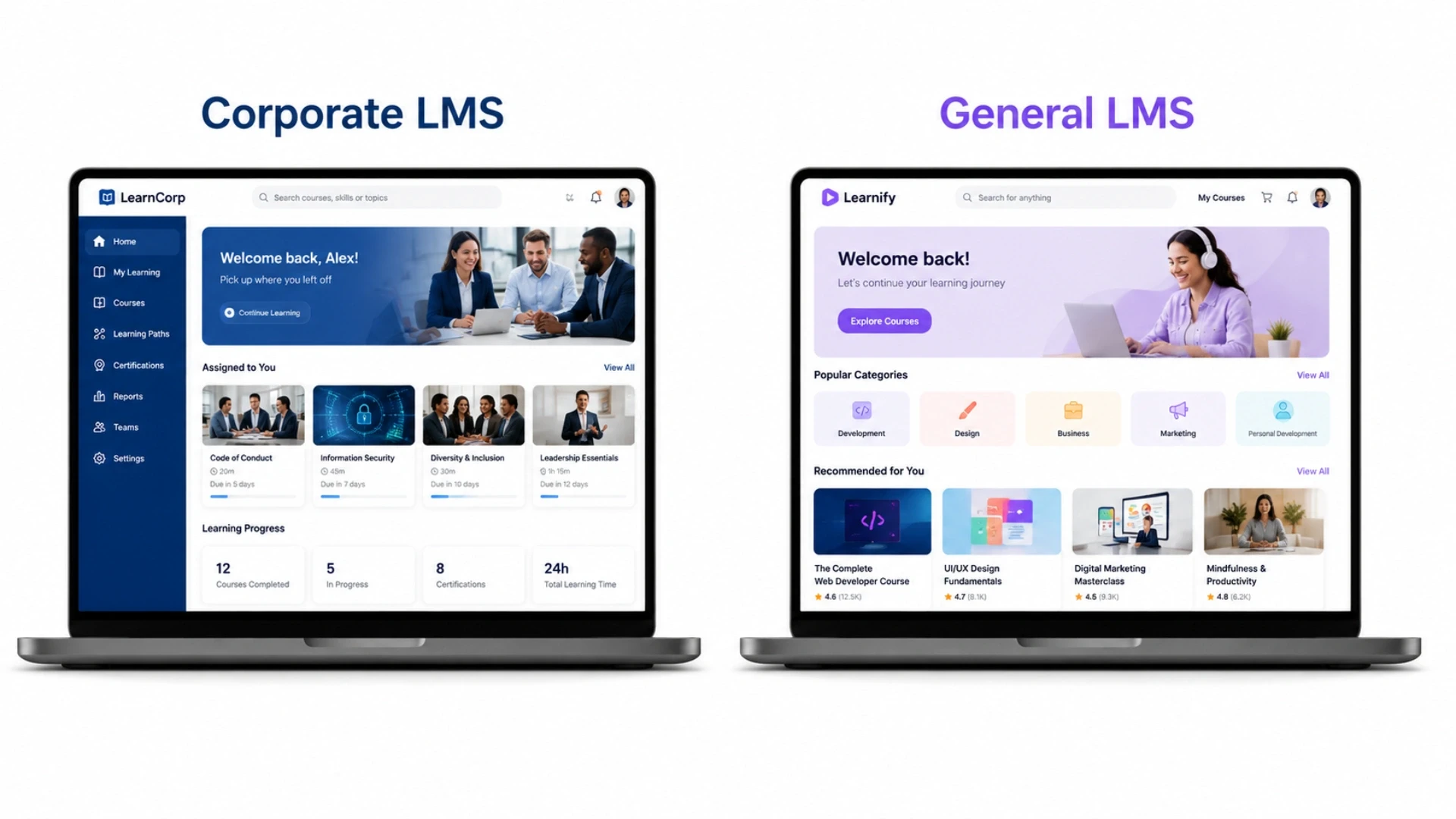
Companies outgrow a rented LMS when training stops being about courses and starts being about outcomes. An off-the-shelf employee training system handles content delivery well, but it rarely adapts to your onboarding workflow, your compliance rules, or your skills model, so teams end up bolting on spreadsheets and side tools to fill the gaps.
What is a corporate learning platform?
A corporate learning platform is the system that manages onboarding, compliance, upskilling, and performance in one place, connected to your HR stack. The difference from a basic LMS is intent: an LMS stores and serves content, while a learning platform drives a business result and reports on it.
The trigger to switch is usually scale or risk. Once headcount, regulatory exposure, or skill complexity grows past what a generic tool handles, companies move to a custom build, often phasing the work through structured software development outsourcing to control spend.
Capacity is the other constraint. L&D teams rarely carry engineers, so they add delivery through staff augmentation to build the platform without a permanent hiring cycle.
Build vs buy: when a custom platform pays off
Buy when your training is standard, and you can adapt to a vendor's workflow; build when onboarding, compliance, or skills logic is specific enough that configuration fights you. The deciding factors are how unusual your processes are, how many systems you must integrate, and how much the platform is core to how the business runs.
Off-the-shelf suites win on speed and low upfront cost, but they charge per seat, limit customisation, and own your data model. For organisations evaluating platforms beyond the standard enterprise LMS market, comparing Docebo alternatives can also help clarify which tools offer the right balance of customisation, integrations, and scalability. This comparison is especially useful before deciding whether configuring an existing platform or building a custom solution makes more financial and operational sense. A custom L&D platform costs more to start and pays back through fit, ownership, and the absence of per-user fees as headcount grows.
Factor | Lean toward buy | Lean toward build |
Process fit | Standard training | Unusual workflows |
Integrations | One or two | Many systems |
Scale | Stable headcount | Fast growth |
Data control | Vendor-hosted is fine | You must own it |
The honest answer for most mid-to-large companies is a hybrid: build the parts that are core and integrate the rest. Mapping that line is the work of a structured discovery workshop before any code is written.
Companies that build usually want the same engineers across every release, which is why a dedicated development team model fits L&D platforms better than rotating contractors. The tradeoffs around custom versus configured learning software are explored further in our guide to developing virtual classroom and e-learning software, which applies the same build logic.
The four jobs a corporate learning platform must do
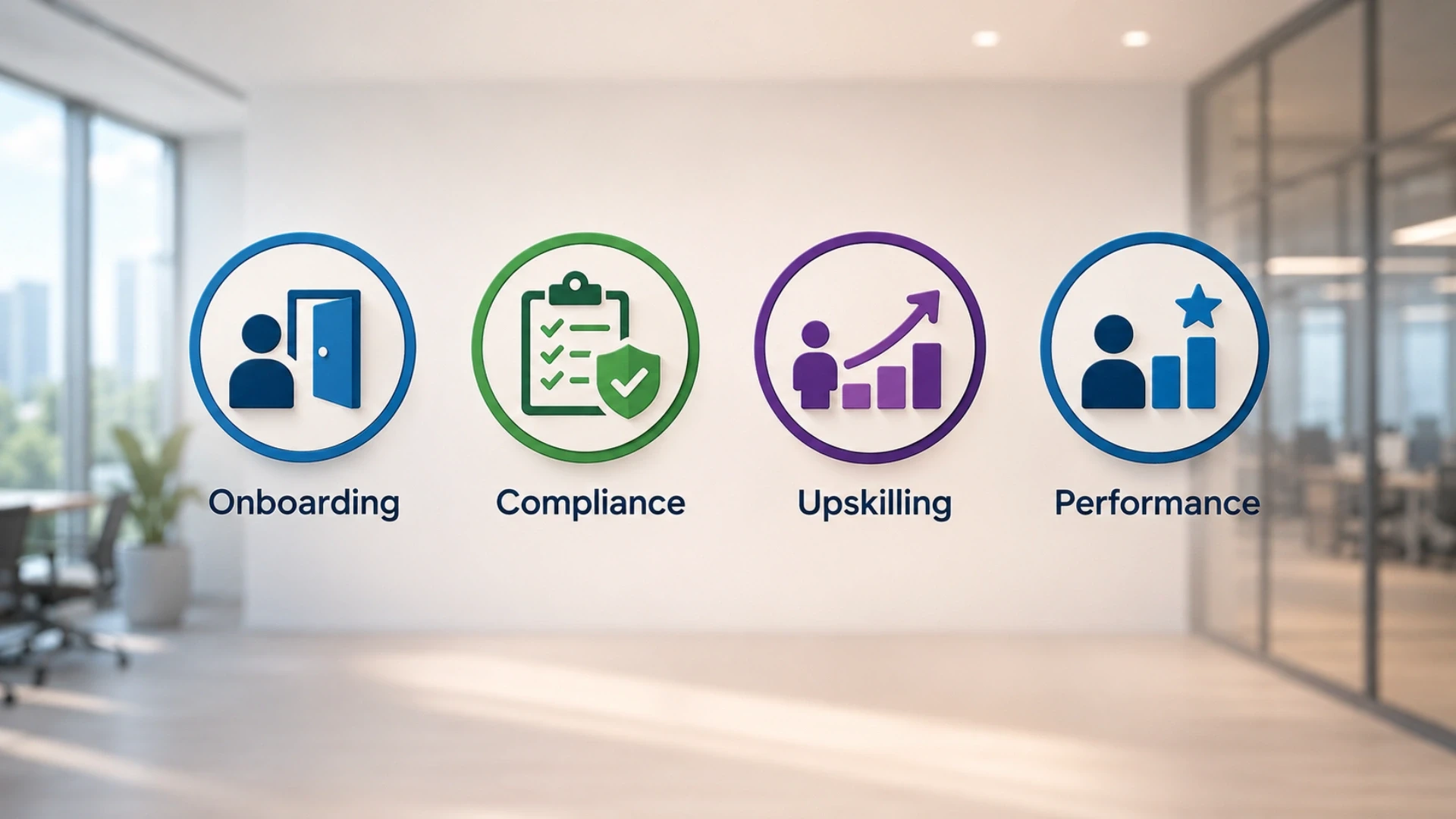
A corporate learning platform has four jobs: get new hires productive, keep the company compliant, close skill gaps, and prove learning changed performance. Most platforms do the first two and ignore the last two, which is exactly where leadership stops seeing value.
Framing the build around these four outcomes, rather than a list of features, is what separates a platform from a content library. This outcome-first scoping is what experienced MERN stack development teams bring to the first planning sprint.
Job | Outcome it drives | Who owns it |
Onboarding | Faster time to productivity | People ops |
Compliance | Audit-ready, lower risk | Legal and L&D |
Upskilling | Closed skill gaps | L&D and managers |
Performance | Measurable business impact | Leadership |
Each job becomes a module, but they share one employee record, so a skill earned in onboarding is visible in performance later. Staffing these parallel workstreams without a permanent team is why companies hire dedicated developers for specific modules.
How these jobs connect into one learning ecosystem is the kind of architecture covered in our guide to building a virtual classroom platform, which maps live and asynchronous delivery together.
Building a corporate learning platform?
Acquaint Softtech designs and builds custom L&D platforms, from onboarding automation to compliance engines and skills analytics, for HR and L&D teams across the USA, UK, Europe, Australia, New Zealand, and India. Your first engineer deploys within 48 hours of brief.
Onboarding: turning day one into a workflow
The onboarding module turns a new hire's first weeks into a structured, automated journey: paperwork, role-specific training, system access, and check-ins, all triggered on schedule rather than chased by a manager. Done well, it cuts time-to-productivity and removes the chaos of a manual first week.
What is onboarding automation?
Onboarding automation is the platform logic that assigns the right tasks and courses to a new hire based on their role, start date, and department, then tracks completion without manual follow-up. It replaces a checklist in someone's inbox with a workflow the system runs on its own.
The engineering depth here is in the rules and triggers, which is the kind of business logic a senior Laravel development team handles cleanly, so a sales hire and an engineer get entirely different day-one journeys from the same engine.
Personalisation raises the bar further. Recommending the next course or flagging a stalled hire is increasingly the work of an AI development team building intelligence on top of the onboarding workflow.
The course-delivery patterns behind these journeys are the same ones in our guide on how learning management systems work, which covers tracking and completion mechanics.
Compliance: training that survives an audit
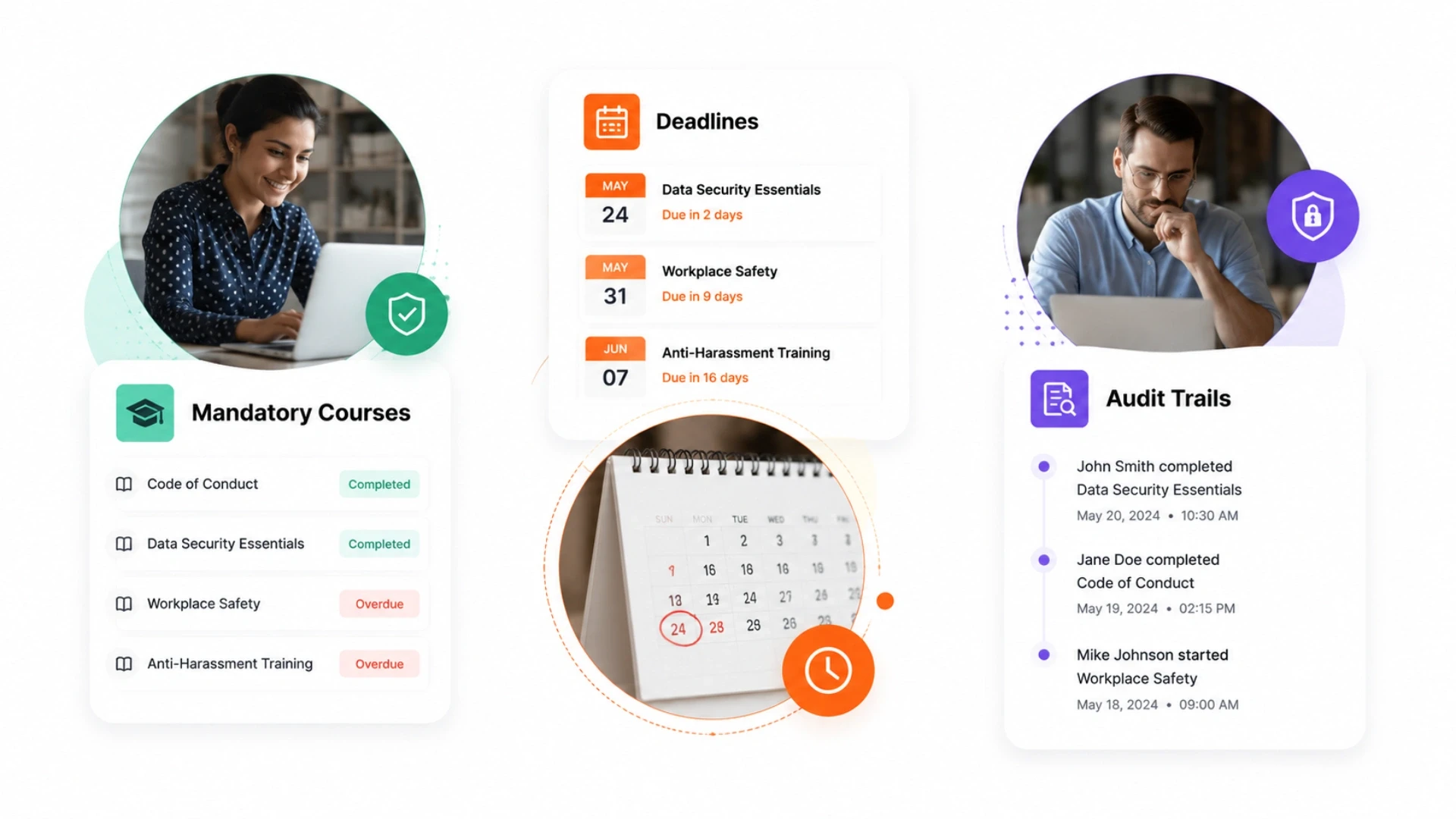
The compliance training engine assigns mandatory courses, enforces deadlines, renews certifications before they lapse, and keeps a tamper-evident record of who completed what and when. Its real job is not delivering training; it is producing defensible proof that training happened.
What features does compliance training need?
Compliance training needs automated assignment by role, deadline and renewal tracking, completion certificates, and an immutable audit trail. The audit trail is the non-negotiable part, because a regulator wants evidence, not good intentions.
Long-lived records also force an architecture decision. Migrating years of historical compliance data into a new system without losing integrity is delicate work, often handled through structured legacy version upgrade and migration services. The transaction-heavy logic of deadlines, renewals, and locks is squarely backend work, frequently built by a dedicated Python development team that can model the rules without race conditions.
Upskilling: closing the skill gap with data
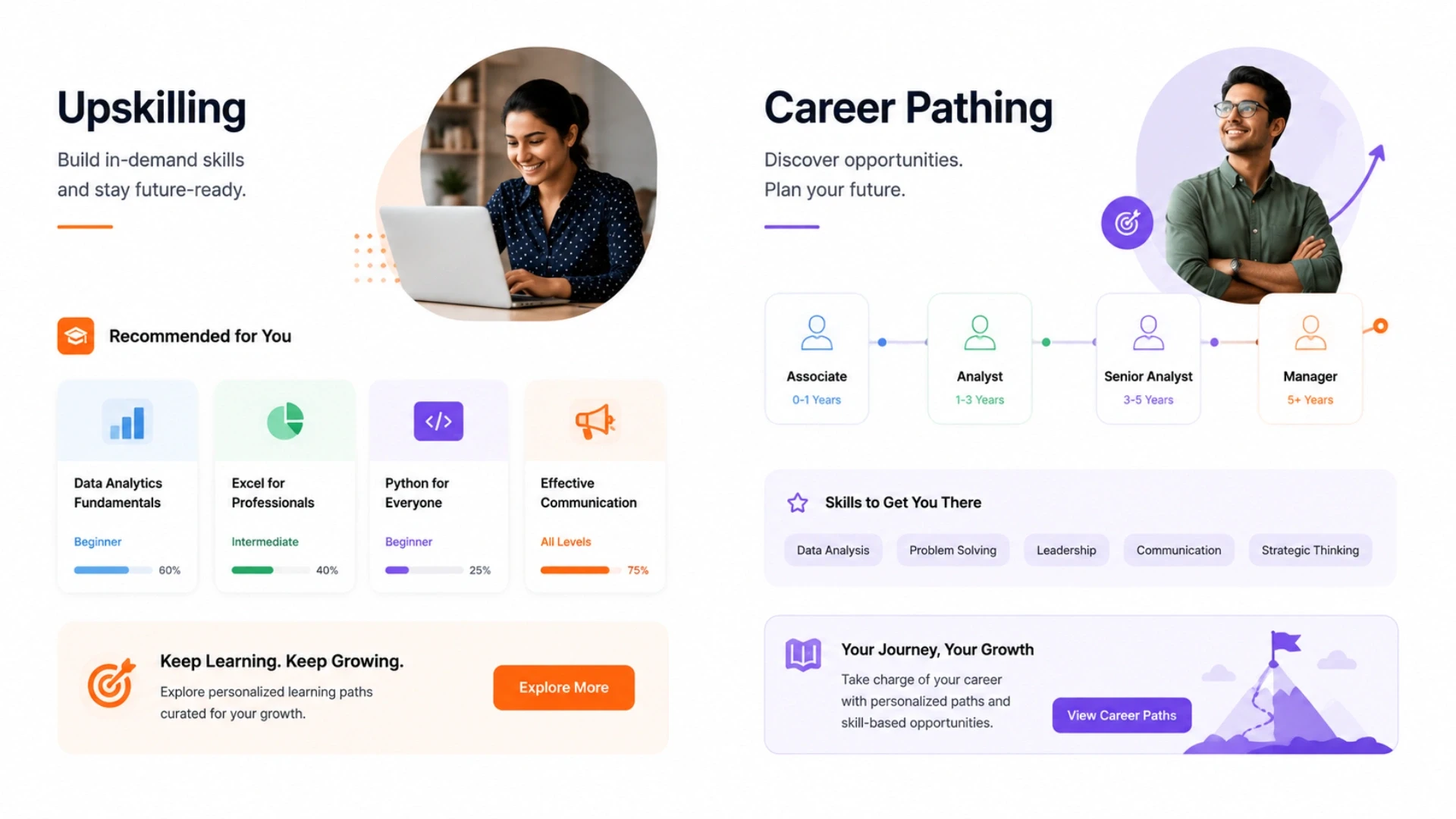
The upskilling layer maps the skills your workforce has against the skills the business needs, then recommends learning to close the difference. A skill gap analysis platform turns vague talk about capability into a measurable map of where the company is strong, exposed, or hiring blind.
The hard part is the skills taxonomy. Skills must be defined consistently, linked to roles, and assessed in a way managers trust, or the gap analysis produces numbers nobody acts on. Get the taxonomy right, and the platform can route the right course to the right person automatically.
Matching people to skills to content at scale is a recommendation problem, which is why the smartest upskilling features are built by an AI development team rather than hard-coded learning paths.
Building the skills model is also a discovery-heavy effort that many companies resource through staff augmentation so internal L&D can focus on the taxonomy while engineers build the engine.
How adaptive recommendation works in practice draws on the same delivery foundations in our guide to building a virtual classroom platform.
Performance tracking: proving learning moved the business
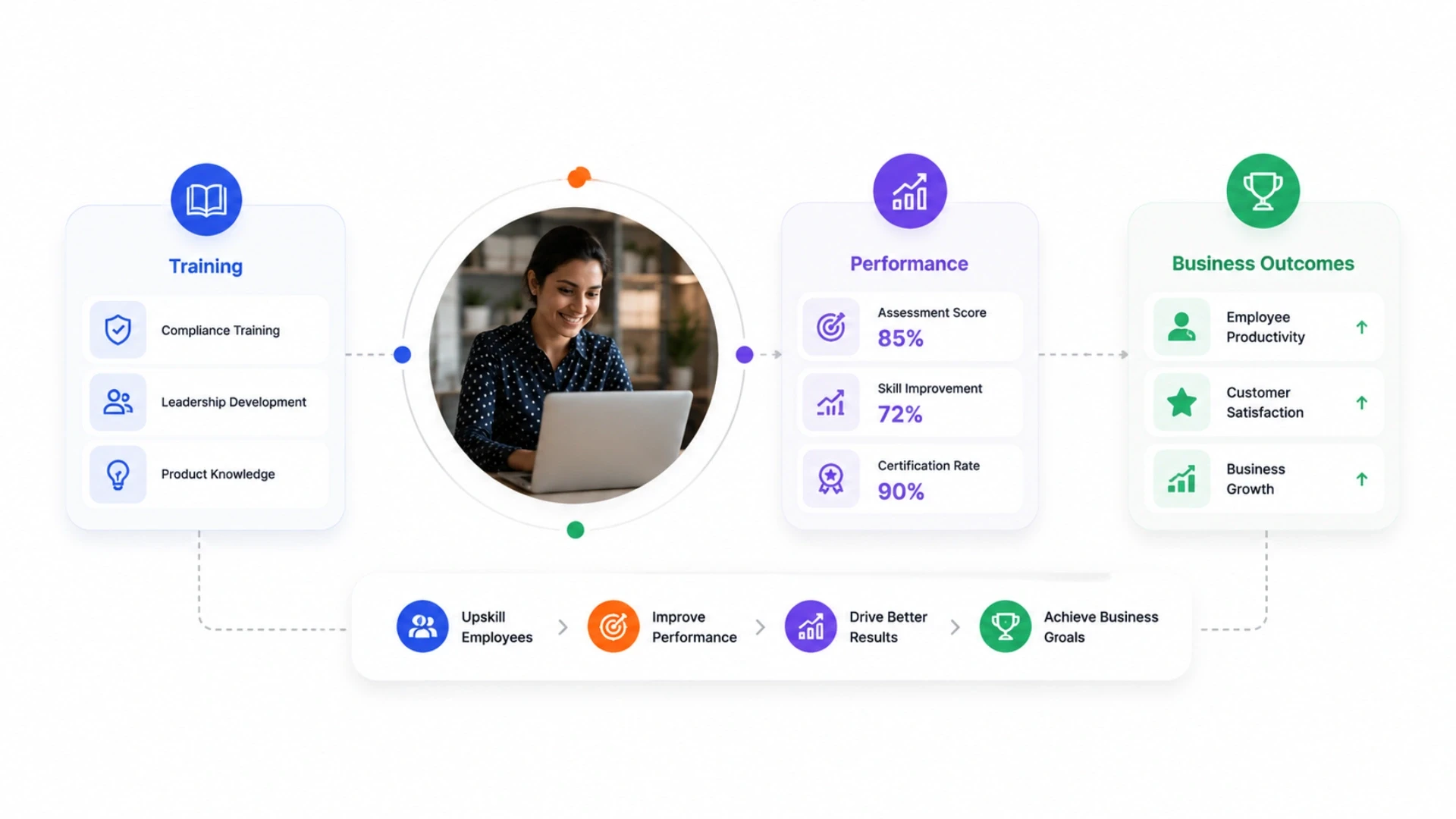
Performance tracking connects learning data to business outcomes, so leadership can see whether training actually changed ramp time, error rates, sales, or retention. This is the job most LMS tools skip, and it is the one that justifies the platform's budget.
The shift is from activity metrics to impact metrics. Course completions and quiz scores measure effort, while linking learning to performance reviews and operational KPIs measures whether the effort mattered. That requires the platform to read from systems beyond learning.
Building reliable analytics on top of messy multi-source data is specialist work, often delivered through structured software development outsourcing so the dashboards are accurate enough for leadership to trust.
The reporting layer also has to stay fast as data grows, which is the kind of performance engineering a senior Laravel development team handles when dashboards start to slow down. Cost and stack tradeoffs for analytics-heavy builds connect to the economics in our Laravel developer hiring and cost guide, a useful reference when you scope the reporting layer.
The integration layer: HRIS, SSO, and standards
A corporate learning platform is only as useful as the systems it connects to. It must sync with your HRIS for employee data, single sign-on for access, and content standards like SCORM and xAPI so existing courses still run. Integration is not a final step; it is the backbone the platform sits on.
HRIS sync is the most important link. When the platform reads roles, departments, and start dates directly from the HR system, onboarding and compliance assignments happen automatically, and nobody maintains a second copy of the org chart.
The mobile side matters too, because much corporate learning now happens on a phone between meetings, which is why a React Native development team is often part of the build for microlearning and push reminders.
Connecting many systems cleanly is its own discipline, and companies frequently scope it with experienced MERN stack development engineers who have wired learning platforms into enterprise stacks before.
Stack, architecture, and what it costs
A custom corporate learning platform typically costs between USD 50,000 and USD 250,000 for a first production release, driven by how many of the four jobs you build, how many systems you integrate, and your compliance scope. Working with experienced teams that hire MEAN stack developers can help accelerate development while maintaining scalability and performance. The architecture should be modular, so you ship onboarding and compliance first and add upskilling and analytics later.
How much does a corporate learning platform cost?
Corporate learning platform development costs vary significantly by region, team structure, and feature complexity. Businesses that partner with experienced development teams in India can often reduce development costs by 30% to 50% compared to the US, UK, and Western Europe while maintaining enterprise-grade quality. Most organisations launch with an onboarding and compliance MVP, then add upskilling, analytics, and integrations in later phases to accelerate time to market and spread investment over time.
Release Scope | Typical Timeline | Indicative Cost (India / UK / Europe / US) |
MVP: Onboarding + Compliance | 3–5 months | $30k–$70k / £60k–£120k / €70k–€140k / $50k–$100k |
Add Upskilling + Analytics | 6–9 months | $70k–$140k / £120k–£220k / €140k–€250k / $100k–$180k |
Full Platform + Integrations | 10+ months | $140k–$250k+ / £220k–£400k+ / €250k–€450k+ / $180k–$250k+ |
Location is the major cost lever. Building with a verified team in India runs at roughly USD 25 to 49 per hour, against USD 120 or more for comparable Western agencies- the source of the up to 40% cost savings on equivalent scope, and a common reason companies hire dedicated developers for employee training builds. Keeping continuity across phases is cheaper than rebuilding context each time, which is why a dedicated development team usually beats piecemeal contracting on long L&D programs.
Want a realistic cost and timeline for your build?
Acquaint Softtech scopes your corporate learning platform against your actual modules and integrations, then deploys engineers at USD 25 to 49 per hour, up to 40% below comparable Western agency rates. Book a call for a phased cost and timeline.
Case Study: An Education Portal, Built and Validated
An online education company's learning and administration portal taken from concept to a live, validated product.
What the Client Needed
An informative portal for learners to browse and register for courses
A custom administrative section to manage learners, courses, and content
Integration of Zoom, Stripe payments, and Accredible certificates
What Acquaint Delivered
Database architecture and a custom content management system
Course configuration, registration, and a flexible payment gateway
Built on Django, Python, and PostgreSQL, tested through to launch
The relevance to corporate L&D is direct: a learning portal with registration, payments, content management, and an admin layer, delivered on schedule and rated top marks. The same engineering standard applies to every corporate platform built by our learning software product team.
A phased rollout: from pilot to company-wide
The safest way to launch a corporate learning platform is in phases, not a company-wide switch on day one. Start with one job and one group, prove it works, then expand, so you protect adoption and catch problems while they are small.
A typical sequence runs in four steps: a discovery workshop to map jobs and integrations, an MVP covering onboarding and compliance for one department, a measured pilot, then a staged rollout across the company as each module proves out. Engineers deploy within 48 hours of the brief, and work runs in two-week sprints with a 95% on-time delivery rate. For organisations that want to launch faster under their own brand, leveraging a white label software development approach can significantly reduce development time while maintaining full ownership of the platform experience.
Phasing also keeps the budget honest. You fund the next module only after the last one shows value, which turns a large platform investment into a series of smaller, defensible decisions.
Build your corporate learning platform with a verified team
From onboarding to performance analytics, Acquaint Softtech builds L&D platforms that companies run their workforce on. Join the teams who scaled with a Clutch Premier Verified partner and deploy your first engineer within 48 hours.
Frequently Asked Questions
-
What is a corporate learning platform?
A corporate learning platform is software that manages onboarding, compliance, upskilling, and performance tracking for a company's workforce in one connected system. It goes beyond a basic LMS by tying every course to a business outcome and to the HR systems you already run.
-
What is onboarding automation?
Onboarding automation assigns the right tasks and courses to a new hire based on their role and start date, then tracks completion with no manual chasing. It turns a checklist in someone's inbox into a workflow the platform runs on its own.
-
What features does compliance training need?
It needs automated assignment by role, deadline and renewal tracking, certificates, and an immutable audit trail. The audit trail is essential because regulators such as OSHA require provable records of who was trained and when.
-
How much does a corporate learning platform cost?
A custom platform typically costs USD 50,000 to USD 250,000 for a first release, depending on scope, integrations, and compliance needs. Building with a verified team in India can cut that by up to 40% against comparable Western agency rates.
-
Should we build or buy a corporate LMS?
Buy when your training is standard and a vendor's workflow fits; build when onboarding, compliance, or skills logic is specific to your business. Most mid-to-large companies end up with a hybrid: build the core, integrate the rest.
-
How long does it take to build one?
An MVP covering onboarding and compliance usually takes three to five months, while a full platform with upskilling, analytics, and integrations runs ten months or more. Phasing the build lets most companies go live within the first few months.
-
Does it integrate with our HR system?
Yes. A well-built platform syncs with your HRIS, single sign-on, and content standards like SCORM and xAPI, so employee data, access, and existing courses all flow without duplicate maintenance.
-
How does Acquaint Softtech build L&D platforms?
Acquaint Softtech starts with a discovery workshop, deploys a dedicated engineer within 48 hours, and ships in two-week sprints at a 95% on-time rate. The company is Clutch Premier Verified with a 4.9/5 rating from 61 verified reviews.
I lead technology and client success at Acquaint Softtech with one goal in mind. Deliver work that feels personal, reliable, and worthy of long term trust. I stay close to both our clients and our developers to make sure every project moves with clarity, quality, and accountability.
Table of Contents
Get Started with Acquaint Softtech
- 13+ Years Delivering Software Excellence
- 1300+ Projects Delivered With Precision
- Official Laravel & Laravel News Partner
- Official Statamic Partner
Related Blog
The Complete Guide to EdTech Software Development in 2026
Complete guide to EdTech software development in 2026. LMS architecture, virtual classroom tech stack, AI tutoring system design, MVP timeline, and cost.

Acquaint Softtech
May 4, 2026
How Learning Management Systems Work
An LMS is not a video library with a login screen. It is a structured system that owns enrollment, progress, assessment, and certification in one traceable architecture. Teams that treat it as a file folder spend 12 months rebuilding what should have been designed correctly in week one. This guide shows exactly how each layer works, and what it actually costs to build.
Manish Patel
May 13, 2026
Building a Virtual Classroom Platform: Video, Whiteboard, Breakout Rooms, and Attendance Tracking
A virtual classroom is not a Zoom call with a class roster. It is a purpose-built live learning environment where video, whiteboard, breakout rooms, session recording, and attendance verification are engineered to work together as a single platform. Teams that build each feature independently spend 8 to 14 months in integration loops. Teams that design the architecture correctly from the start ship in 4 to 6 months. This guide shows you how.
Manish Patel
May 20, 2026India (Head Office)
203/204, Shapath-II, Near Silver Leaf Hotel, Opp. Rajpath Club, SG Highway, Ahmedabad-380054, Gujarat
USA
7838 Camino Cielo St, Highland, CA 92346
UK
The Powerhouse, 21 Woodthorpe Road, Ashford, England, TW15 2RP
New Zealand
42 Exler Place, Avondale, Auckland 0600, New Zealand
Canada
141 Skyview Bay NE , Calgary, Alberta, T3N 2K6