

Custom Laravel Application vs Off-the-Shelf SaaS: Build vs Buy 2026
The build vs buy decision costs companies more when they get it wrong than almost any other technical choice. Here are the 7 questions that map your situation to the right answer with real 2026 numbers.

Manish Patel
As COO of Acquaint Softtech, a software development partner with 200+ Laravel builds delivered over 13 years, I work with companies navigating the build vs buy decision regularly. The stakes are high. Companies that build when they should buy spend $80,000 to $200,000 on custom software that a $400/month SaaS platform would have covered. Companies that buy when they should build find themselves paying 3x the SaaS cost annually to work around a platform ceiling that a custom application would never have hit. This guide gives you the 7 questions that produce the right answer for your specific situation.

- Founders deciding between building a custom product and adopting an existing SaaS platform
- CTOs evaluating whether to replace a SaaS subscription with a custom Laravel application
- Product managers building the internal case for a custom build when off-the-shelf seems sufficient
- Companies currently paying high SaaS fees and wondering whether custom development would cost less overall
The build vs buy framing suggests a binary choice. In practice, most product decisions exists on a spectrum. At one end: pure adoption of an off-the-shelf SaaS product with no customisation. At the other: a fully custom application built from scratch with no commercial dependencies. Between these: hybrid approaches where a commercial platform provides the foundation and custom development extends it. The right answer is usually one of these three, not always the extremes.
For teams leaning toward building custom, the Laravel SaaS architecture guide covers the structural decisions that determine whether a custom Laravel product scales to the tenant volumes and billing complexity the business will eventually need. The architecture decisions made in month one of a custom build constrain every subsequent sprint.
When Buy Wins: The Case for Off-the-Shelf SaaS
Off-the-shelf SaaS wins in specific, identifiable situations. Understanding these clearly prevents the most common build vs buy error: building custom for a use case that a $200 per month platform handles better.
Your requirements match 80% or more of the platform's capability
The 80% match threshold is the critical test. If a platform covers the core workflow and you are only missing peripheral features, the platform is almost certainly the right choice. The customisation required for the missing 20% is usually cheaper than building the 80% you already have.
Your differentiation is not in the software
If your business model differentiates on service quality, brand, relationships, or domain expertise rather than the software itself, a SaaS platform is infrastructure. You do not need to build your own payment infrastructure. You do not need to build your CRM if your business model is not the CRM. Buy the infrastructure; build the differentiation.
Speed to market is more important than long-term cost
A SaaS platform is operational on day one. A custom build takes 4 to 12 months. If the commercial opportunity requires speed and the window is narrow, the SaaS approach captures the opportunity while the custom build would miss it. The total cost comparison changes completely when the opportunity cost of delay is factored in.
Your team does not have the capacity to own custom software
Custom software requires ongoing maintenance, upgrades, and development. If your team does not have the capacity to manage a development function, the hidden cost of custom software includes the cost of building that function. A SaaS platform transfers this responsibility to the vendor.
When Build Wins: The Case for Custom Laravel
Custom Laravel development wins when the business model depends on software that a SaaS platform cannot replicate. Acquaint Softtech's Laravel development service is specifically structured for these situations: companies building a product where the software is the competitive advantage, not the infrastructure. Here are the signals that indicate custom is the right answer.
Your software is the product, not the infrastructure |
If customers pay for access to your software itself, the software must do something the market has not already built. An off-the-shelf platform by definition does what someone else built it to do. If your differentiation is in the software behaviour, you need to build the software. |
The SaaS platform cannot model your data the way your business requires |
Platform data models are designed for the most common use case. If your business has a data structure, workflow, or relationship model that does not fit the platform's schema, every interaction with the platform becomes a workaround. Workarounds compound. After 18 months of workarounds, the maintenance cost often exceeds what a custom build would have cost. |
The platform ceiling will be hit within the product roadmap |
Every SaaS platform has a ceiling: features it does not support, integrations it cannot accommodate, customisations it will not allow. If your 12-month roadmap includes items that are beyond the platform's capability, starting on the platform means migrating off it at the worst possible time: when you have active users, production data, and no headroom to absorb the disruption. |
The per-seat or usage cost exceeds the custom build cost at your target scale |
SaaS pricing models that work at 50 users become expensive at 500 and prohibitive at 5,000. Calculate the 3-year SaaS cost at your target scale. Compare it to the cost of a custom build plus 3 years of maintenance. For products that will scale to a large user base, the crossover point where custom becomes cheaper than SaaS frequently arrives within 18 to 30 months. |
The 7-Question Decision Framework
Run your situation through these 7 question in order. The pattern of answers maps to a clear recommendation. Answering honestly, particularly on the first three, is what makes this framework useful.
1. Does an off-the-shelf platform cover 80% or more of your core workflow? |
Buy (off-the-shelf): Yes: buy is viable, evaluate seriously. |
Build (custom): No: buy will require heavy customisation, evaluate total customisation cost before deciding. |
Verdict: If no, customisation cost + licence cost often exceeds custom build cost within 24 months. |
2. Is your software the product your customers are paying for? |
Buy (off-the-shelf): No: infrastructure, buy is usually right. |
Build (custom): Yes: the software IS the competitive advantage, build is almost always required. |
Verdict: If yes, an off-the-shelf platform means building your competitive advantage on someone else's constraints. |
3. Will your roadmap hit the platform ceiling within 12 months? |
Buy (off-the-shelf): No: platform ceiling not a near-term constraint. |
Build (custom): Yes: you will be migrating off the platform mid-growth, which is the worst time to do it. |
Verdict: Migrating off a SaaS platform when you have active users costs 3 to 5x what starting on a custom build would have. |
4. What is the 3-year SaaS cost at your target user scale? |
Buy (off-the-shelf): Under $30K/year: buy is almost certainly more cost-efficient. |
Build (custom): Over $60K/year at target scale: custom build deserves a serious cost comparison. |
Verdict: At $100K+ per year SaaS cost, most custom Laravel builds pay back within 18 to 24 months. |
5. Do you have the capacity to own ongoing software development? |
Buy (off-the-shelf): No development function: SaaS removes this requirement. |
Build (custom): Development function exists or can be built: custom is viable. |
Verdict: Custom software without a development function creates a maintenance liability, not an asset. |
6. How important is speed to market versus long-term cost optimisation? |
Buy (off-the-shelf): Speed is critical, window is short: buy gets to market faster. |
Build (custom): Speed is secondary to long-term differentiation: build is better long-term. |
Verdict: A SaaS platform is day-one operational. A custom build is 4 to 12 months. The right choice depends on the window. |
7. Does your data model fit the platform schema? |
Buy (off-the-shelf): Yes, standard workflow: platform schema is sufficient. |
Build (custom): No, bespoke data structures: the workarounds compound and become the primary maintenance cost. |
Verdict: Data model mismatch is the most common reason companies migrate off SaaS platforms 18 months after adoption. |
Not Sure Where Your Situation Lands on the Build vs Buy Decision?
Share a brief description of what you are building, your current SaaS spend if applicable, and your 12-month product roadmap. I will tell you which side of the decision the data points toward and what the cost comparison looks like. This conversation takes 20 minutes.
Cost Comparison: Custom Laravel vs SaaS in 2026
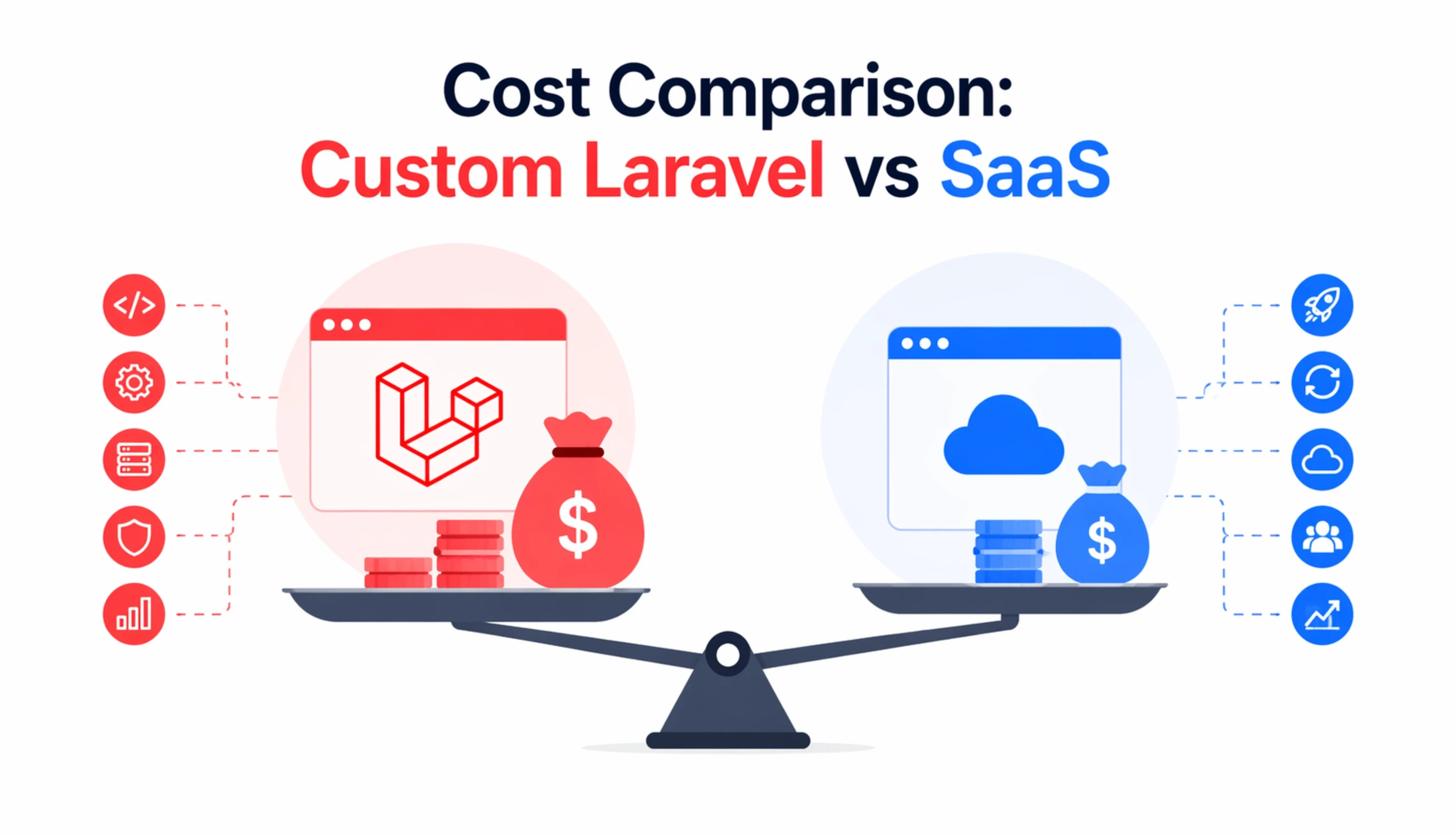
The cost comparison requires a 3-year view to be meaningful. Year 1 almost always favours SaaS. Year 3 depends on scale and customisation requirements.
Cost dimension | SaaS platform vs Custom Laravel (Acquaint Softtech) |
Year 1 investment | SaaS: $2,400 to $24,000 licence. Custom: $40,000 to $120,000 build cost. |
Year 2 to 3 cost | SaaS: scales with users, often $15K to $80K/yr at growth stage. Custom: $12K to $24K/yr maintenance. |
3-year total (1K users) | SaaS: $50K to $200K depending on platform. Custom: $70K to $190K all-in. |
3-year total (10K users) | SaaS: $150K to $600K+. Custom: $80K to $210K (maintenance flat, build cost amortised). |
Feature ceiling | SaaS: hit at 12 to 24 months for complex products. Custom: none. |
Data ownership | SaaS: depends on terms. Custom: 100% client-owned from first commit. |
Switching cost | SaaS: migration at worst time (active users, live data). Custom: none. |
The full Laravel development cost breakdown by project type and scale is in the Laravel development cost guide. For the economic case that makes Laravel the dominant framework for custom SaaS builds, the reasons businesses choose Laravel covers the ecosystem maturity, talent availability, and total cost of ownership argument in detail.
Want the Cost Comparison for Your Specific Product and Scale?
Share your product description, target user count, and current SaaS spend if applicable. Acquaint Softtech will produce a 3-year cost comparison between a custom Laravel build and the relevant SaaS alternatives within 48 hours. No commitment required before you see the numbers.
The Hybrid Approach: When Neither Extreme Is Right
Most build vs buy decisions does not need to be resolved at either extreme. The hybrid approach, adopting a commercial platform as the foundation and building custom extensions on top, is often the right answer when the platform covers 70 to 80% of requirements and the remaining 20 to 30% is stable and well-defined enough to build reliably.
Platform as foundation, Laravel as extension layer | Some SaaS platforms have robust APIs that allow custom code to extend functionality without breaking the platform update path. Laravel can integrate with these APIs to build the bespoke workflow or data model the platform cannot provide natively. This approach captures the platform's speed to market while building the differentiation layer as custom code. |
SaaS for standard workflows, custom for differentiated ones | A company with a standard CRM workflow and a bespoke quoting model can use Salesforce or HubSpot for the standard CRM function and a custom Laravel application for the quoting engine. The two systems integrate via API. Each does what it does best. |
Start on platform, migrate when the ceiling is hit | For early-stage companies, starting on a SaaS platform to validate product-market fit and migrating to a custom build once scale justifies the investment is a valid strategy. The risk is that the migration arrives at the worst time. Mitigate this by designing for migration from day one: keep data structured in a way that exports cleanly and document the workflows the custom build will need to replicate. |
For the team structure question during a custom Laravel build, our dedicated development teams provide the sustained delivery structure that custom products require. And before selecting any Laravel development partner for a custom build, the Laravel vendor vetting checklist covers the 15 verification steps that separate genuine Laravel expertise from agencies who list the framework without demonstrating it.
Decided to Build? Here Is What Engaging Acquaint Softtech Looks Like for a Custom Laravel Product.
As an Official Laravel Partner, Acquaint Softtech has delivered 200+ Laravel products across SaaS, marketplace, and enterprise categories. Share your product brief and we will send a proposed team structure, architecture recommendation, and cost range within 48 hours. No commitment before you see the plan.
Frequently Asked Questions
-
What is the difference between build vs buy in software?
Build means commissioning custom software development, usually on a framework like Laravel, where the application is built specifically for your business requirements. Buy means adopting an existing commercial SaaS platform that covers the workflow you need. The decision determines long-term cost, capability ceiling, and competitive differentiation.
-
When does it make sense to build custom software instead of using a SaaS tool?
Custom software is the right choice when your software is the product your customers pay for, when the SaaS platform data model cannot represent your business's data structure, or when the 3-year SaaS cost at your target scale exceeds the custom build and maintenance cost. The crossover point for most growth-stage products with 1,000+ users arrives between 18 and 30 months.
-
How do I calculate whether building custom is cheaper than a SaaS subscription?
Calculate the 3-year SaaS cost at your target user count, including per-seat pricing, add-on fees, and integration costs. Compare against: custom build cost plus 3 years of maintenance at 15 to 20% of build cost annually. At user scales over 500, custom frequently wins on the 3-year number. Acquaint Softtech produces this comparison for specific products within 48 hours.
-
How do I avoid hitting the SaaS platform ceiling mid-growth?
Map your 12-month product roadmap against the platform's documented capabilities before committing. Identify the first roadmap item the platform cannot support and calculate when you will need it. If that date is within 18 months, start the custom build now rather than migrating under growth pressure. Design your data model to export cleanly from day one as a migration insurance policy.
-
How much does a custom Laravel application cost in 2026?
An MVP-level Laravel application costs $40,000 to $80,000 with an offshore partner such as Acquaint Softtech. A full-featured SaaS platform with multi-tenancy, subscription billing, and a self-service onboarding flow costs $80,000 to $150,000. These rates are 40 to 65% lower than equivalent US or UK agency rates for the same specification.
-
How long does it take to build a custom Laravel application?
An MVP with core features typically takes 8 to 16 weeks with a dedicated team of 2 to 3 developers. A full-featured SaaS platform with billing, multi-tenancy, and admin functions takes 16 to 32 weeks. Timeline accuracy depends heavily on how well-defined the requirements are at the start of development, which is why a discovery phase before the build is strongly recommended.
-
Is Laravel better than a no-code platform for building a SaaS product?
No-code platforms such as Bubble or Webflow are appropriate for validating product-market fit quickly with minimal investment, typically under $5,000. Laravel is appropriate when the product has validated demand and requires a performance, scalability, or customisation level that no-code platforms cannot reach. Most successful no-code prototypes are rebuilt in Laravel or a similar framework within 12 to 18 months of launch as scale and feature complexity outgrow the platform.
I lead technology and client success at Acquaint Softtech with one goal in mind. Deliver work that feels personal, reliable, and worthy of long term trust. I stay close to both our clients and our developers to make sure every project moves with clarity, quality, and accountability.
Table of Contents
Get Started with Acquaint Softtech
- 13+ Years Delivering Software Excellence
- 1300+ Projects Delivered With Precision
- Official Laravel & Laravel News Partner
- Official Statamic Partner
Related Reading
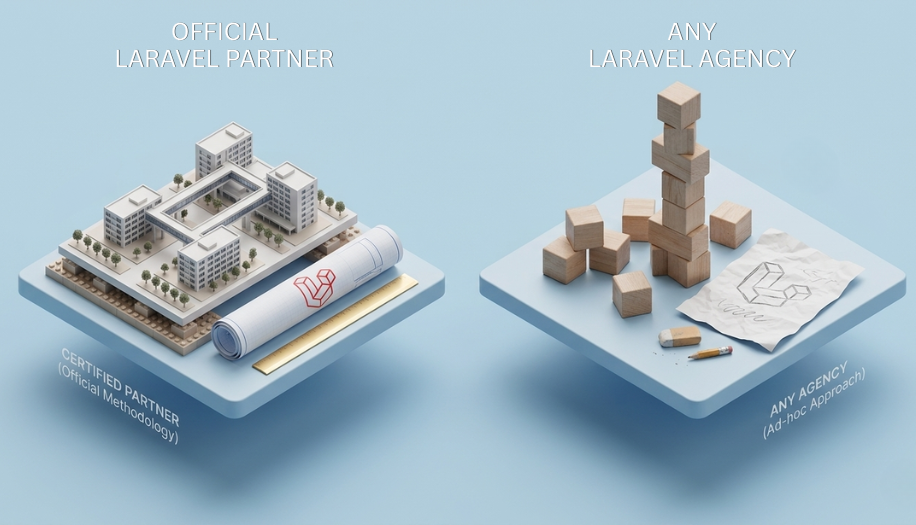
Laravel Partner vs Any Laravel Agency
Any agency can say they do Laravel. Only a handful are Official Laravel Partners. Here is what the certification actually means, what it requires, and how to verify it takes 30 seconds.

Acquaint Softtech
March 14, 2026
Laravel Version Upgrade Cost in 2026: What to Budget When Moving From v9, v10, or v11 to v12
A Laravel upgrade that would have cost $8K three months ago can cost $26K when a security event forces it. Here is what makes upgrade cost grow and how to budget correctly before it becomes urgent.

Ahmed Ginani
April 3, 2026
Why Businesses Choose Laravel for Scalable Applications
Over 1.5M websites run on Laravel. See why companies trust Laravel development services for scalable SaaS, enterprise modernization, API integrations, and long-term maintainability.

Mukesh Ram
March 2, 2026India (Head Office)
203/204, Shapath-II, Near Silver Leaf Hotel, Opp. Rajpath Club, SG Highway, Ahmedabad-380054, Gujarat
USA
7838 Camino Cielo St, Highland, CA 92346
UK
The Powerhouse, 21 Woodthorpe Road, Ashford, England, TW15 2RP
New Zealand
42 Exler Place, Avondale, Auckland 0600, New Zealand
Canada
141 Skyview Bay NE , Calgary, Alberta, T3N 2K6