

Designing Python Backends for Long-Term Growth
Design a Python backend that scales with your team and product over years. 2026 patterns for evolutionary architecture, technical debt, and modular growth.

Acquaint Softtech
Introduction: The Architecture Decisions That Compound for Years
Most Python backends are designed for the next quarter, not the next five years. The MVP ships, the company finds product-market fit, the team grows from 3 engineers to 30, and somewhere around month 18 the leadership team realises that the codebase that helped them succeed is now the thing slowing them down. New features take longer to ship. Refactoring is too risky. Onboarding takes three months. The architecture that was perfect at engineer 5 is suffocating at engineer 30.
The cost of getting this wrong is real and quantifiable. According to a 2026 technical debt analysis citing the CAST Highlight State of Software Quality report, AI-generated code flooding repositories has slashed developer velocity by 45% on average, while NASA studies adapted for modern stacks correlate cyclomatic complexity above 10 with 4x higher defect density. Long-term backend design is not about avoiding all complexity. It is about ensuring that complexity stays bounded, observable, and refactorable as the system grows.
This playbook covers how to design a Python backend that scales smoothly across team size, product complexity, and time horizon. It is written for CTOs, founders, and senior engineers building greenfield systems with multi-year horizons, or refactoring existing systems whose growth curve has flattened. Every recommendation below is grounded in production patterns from teams shipping real software, not architectural diagrams from books.
If you are still building the team that will execute the architecture, the complete guide to hiring Python developers in 2026 sets the wider hiring context. The patterns below assume you have engineers who can implement them with discipline.
The Five Forces That Shape Long-Term Backend Design
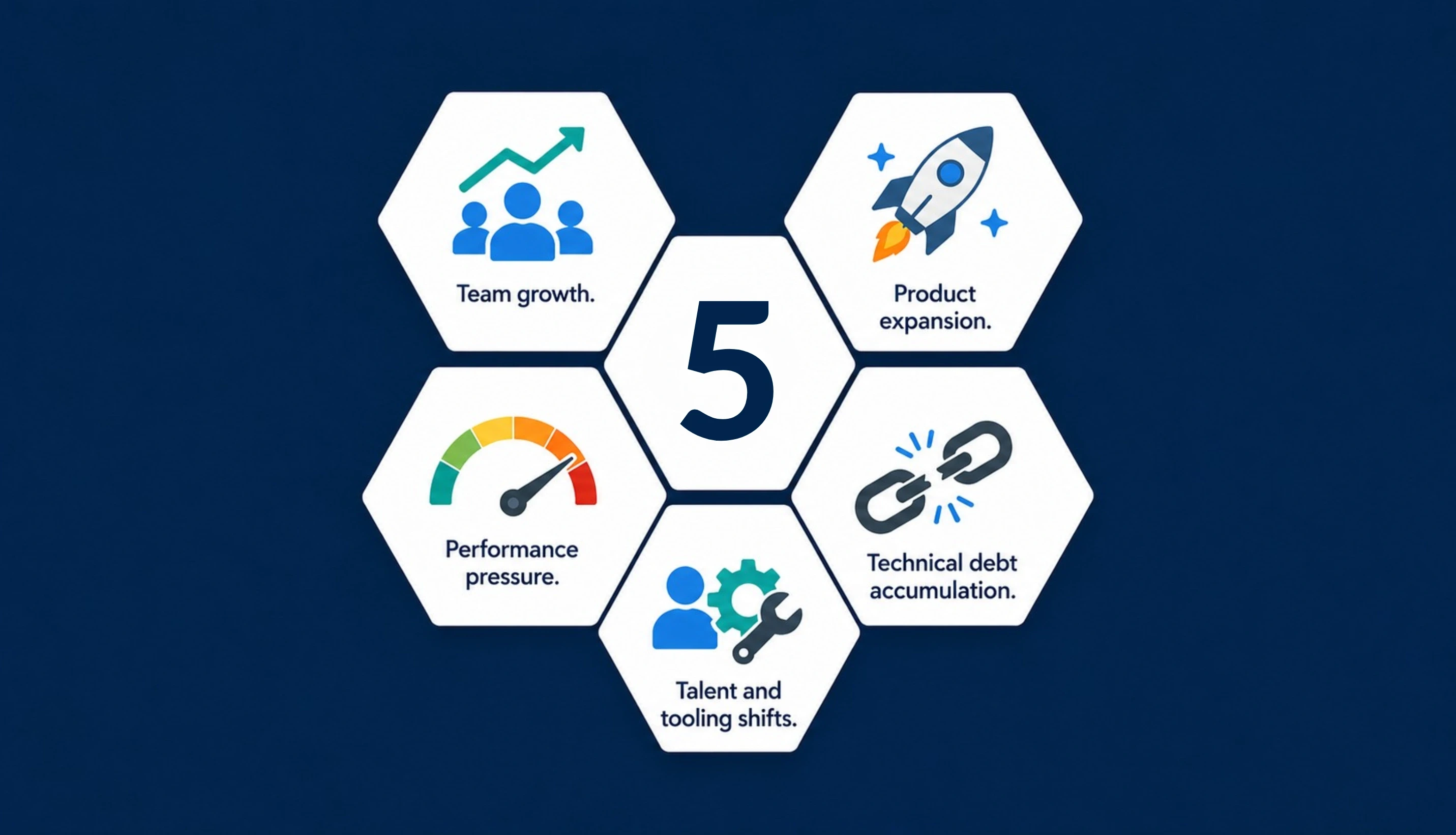
Long-term Python architecture is not about picking the right framework today. It is about designing for forces that will compound over the next 24 to 60 months. Five forces consistently determine whether a backend ages well or becomes a liability.
Team growth. A backend optimised for 3 engineers fails at 30. Module boundaries, code ownership, and review processes that work today must scale 10x without rewrites.
Product expansion. New features add scope, not just code. The question is whether the architecture absorbs new product surfaces or fights them. Bolt-ons accumulate. Designed extension points scale.
Performance pressure. 100 users tolerate 500ms latency. 100,000 users do not. The architecture must let you optimise hot paths without rewriting cold ones.
Technical debt accumulation. Every shortcut taken today is a tax paid tomorrow. Long-term design includes the explicit budget for paying down debt as it emerges.
Talent and tooling shifts. The Python ecosystem in 2030 will look different from 2026. Architecture that locks you into specific libraries or patterns ages worse than architecture that isolates these dependencies.
For the foundational architectural patterns that absorb these forces, the guide on Python development architecture and frameworks walks through the design patterns each framework supports across the full lifecycle of a growing product.
Principle 1: Design for Modularity Before You Need It
The single highest-impact decision in long-term Python backend design is enforcing module boundaries from day one. Not microservices, not over-engineered DDD layers, but clear modules with well-defined interfaces and minimal cross-coupling. Modularity is the architectural property that lets a backend evolve without rewrites.
The Modular Monolith Pattern
In 2026, the consensus answer for new Python products is the modular monolith. A single deployable application with internally enforced module boundaries: each business domain (billing, identity, content, analytics) lives in its own module, exports a public interface, and depends only on other modules through that interface. The deployment unit is one. The internal structure is many.
Table : Module Boundary Discipline for Long-Term Python Backends
Discipline | What It Looks Like | What Breaks Without It |
|---|---|---|
Public interfaces only | Modules export functions or service classes, not internals | Modules grow tangled coupling |
No circular imports | A imports from B, B never imports from A | Refactoring becomes nearly impossible |
Domain-aligned boundaries | billing/, identity/, content/ | Tech-aligned boundaries (controllers/, models/) |
Per-module ownership | Named team for each module | Code becomes shared mediocrity |
Import linting in CI | Automated rules block bad dependencies | Boundaries decay silently over time |
The modular monolith does not prevent you from extracting microservices later. It makes that extraction far cheaper when the time comes. A module with a clean interface and no leaky internals can become a service in weeks. A tangled module that has been growing internal coupling for two years cannot.
Principle 2: Manage Technical Debt as Explicit Engineering Budget
Technical debt is not avoidable in any real product. It is manageable, and the teams that manage it well treat it as an explicit budget item. According to a peer-reviewed study of technical debt remediation in the Apache Python ecosystem published in Wiley's Journal of Software, most repayment effort across long-running Python projects goes into four categories: testing, documentation, complexity reduction, and duplication removal. Identifying the same four categories in your own codebase is the start of a real debt-management discipline.
The Four Debt Categories Every Python Team Must Track
Test debt. Missing tests, flaky tests, slow test suites. Every code change becomes riskier without coverage. Track test coverage by module and refuse to merge new code below the project minimum.
Documentation debt. Missing README files, undocumented APIs, outdated runbooks. New engineers spend weeks reading code that should have been a 10-minute document.
Complexity debt. Functions with cyclomatic complexity above 10. Cohesion that has degraded over time. Use Python Lizard or similar tools to measure quarterly and refactor the worst offenders.
Duplication debt. Copy-pasted business logic that drifts into bugs. Five places to update when one rule changes. DRY is not aesthetic. It is debt prevention.
The 20% Rule
Successful long-term Python teams allocate roughly 20% of every sprint to debt repayment, indefinitely. Not 'when we have time'. Every sprint. Without that explicit budget, debt accumulates at the rate of new feature delivery, and the system slows under its own weight. The teams that ship fastest at year 3 are the ones that paid down debt consistently from year 1.
Principle 3: Choose Frameworks Based on Maintainability, Not Trendiness
Framework selection is one of the few decisions that genuinely compounds over years. Once shipped, the framework is hard to change without significant rewriting cost. A 2026 startup architecture analysis on Meduzzen puts the wisdom plainly: framework selection should align with your team's skillset and product complexity rather than industry hype, because a Django monolith maintained by three experienced engineers consistently outperforms a poorly architected Flask microservices deployment. The right framework is the one your team can maintain with discipline, not the one that wins benchmark threads.
The 2026 Long-Term Framework Decision
Table : Framework Choice for Long-Term Python Backend Design
Use Case | Recommended Framework | Long-Term Argument |
|---|---|---|
Full web platform with admin | Django + Django REST Framework | Mature, stable LTS path, batteries included |
API-first product, async heavy | FastAPI + Pydantic | Modern, async-native, type-safe contracts |
Data engineering pipelines | Django or FastAPI + Airflow | Workflow tooling integration |
ML model serving | FastAPI + Pydantic | Async, low overhead, AI ecosystem fit |
Lightweight microservice | Flask or FastAPI | Minimal surface area, low dep count |
Mixed monolith with ML hot paths | Django primary + FastAPI sidecars | Best of both, common in production |
The framework you pick at the MVP is the framework you will likely run for the next 5 to 10 years. Both Django and FastAPI have long-term support paths, mature ecosystems, and large hireable talent pools. Picking either is defensible. Picking based on a benchmark or a Hacker News thread is not.
Need Senior Python Engineers Who Design for Multi-Year Horizons?
Acquaint Softtech provides senior Python engineers with hands-on experience in modular monolith design, technical debt management, framework migration, and architecture audits across Django, FastAPI, and Flask production systems. Profiles in 24 hours. Onboarding in 48.
Principle 4: Build Observability Before You Need It
A backend without observability is a black box. The first time you discover a bottleneck should not be when 100,000 users hit it simultaneously. Observability is not optional past 10,000 users in 2026. It is the diagnostic layer that turns a vague slowdown into a fixable specific issue, and it must be built into the architecture from the beginning, not bolted on after the first incident.
The Five Layers of Long-Term Backend Observability
Structured logging. JSON logs with request IDs, user IDs, and trace IDs. Centralised in CloudWatch, ELK, or Loki. Plain text print statements do not scale operationally.
Application performance monitoring. Sentry, Datadog, or New Relic for traces, slow transactions, and error tracking. Catch problems before users do.
Database query monitoring. pg_stat_statements for PostgreSQL, slow query log for MySQL. Review weekly. The top 10 slowest queries are usually 80% of database load.
Real user monitoring. Track p50, p95, p99 latency from the user's perspective. p99 is what causes complaints, not p50.
Business metric instrumentation. Code-level counters tied to business events (signups, conversions, orders). Engineering and product see the same numbers.
Principle 5: Plan for the Migration That Will Definitely Come
Every backend that runs long enough hits a migration. Database technology changes. A framework version goes end-of-life. A core dependency gets deprecated. The architecture that ages well is the one that anticipates these migrations rather than fighting them when they arrive. Long-term design is migration-aware design.
Three Migrations Every Python Backend Will Eventually Face
Major Python version upgrades. Python 3.x to 3.y, every 12 to 24 months. Async ecosystem keeps moving. Pin Python version explicitly, run pre-release versions in CI, and never let your runtime drift more than two minor versions behind current.
Database scaling or migration. Single PostgreSQL primary to read replicas, then to sharding, then potentially to a different engine for specific workloads. Use database-agnostic ORM patterns where reasonable, abstract behind repositories, and keep schema migrations declarative.
Framework or library deprecations. SQLAlchemy 1.x to 2.x. Django LTS to next LTS. FastAPI minor version changes that affect dependency resolution. Build a quarterly dependency audit into the team's calendar.
The Repository Pattern for Migration Insurance
The single most valuable pattern for migration-readiness is the repository pattern. Database access goes through a repository interface that exposes domain operations (create_user, find_orders_by_status), never raw ORM calls scattered through the codebase. When the database technology changes, the repository implementation changes. The 95% of code above the repository does not.
Long-Term Backend Design Is a Team Question, Not Just a Code Question
The architecture that lasts is the architecture the team can operate. A brilliant design that one senior engineer holds in their head will degrade the moment that engineer leaves. Long-term design accounts for the people who will run the system across multiple team transitions, not just the people who built it.
Three Team Decisions That Compound Over Years
Code ownership boundaries align with module boundaries. CODEOWNERS files in GitHub or GitLab enforce that the right team approves changes to their domain. Without enforced ownership, modules decay into shared mediocrity.
Documentation as a deliverable, not an afterthought. Architecture decision records (ADRs), runbooks for every production system, and onboarding guides for every module. Treat docs as code: required for merge, reviewed in pull requests.
Hiring for long-term thinkers, not feature-shippers. The most expensive hires are engineers who optimise for the next sprint at the cost of the next year. Senior judgment about debt, modularity, and observability is what compounds.
For the engagement model framework that surrounds long-term hiring decisions, the Python hiring models comparison breaks down staff augmentation, dedicated team, and outsourcing across the trade-offs that determine multi-year delivery quality.
Anti-Patterns That Look Sensible Today and Punish You for Years
Some architecture choices feel right at the time and become liabilities at scale. The patterns below are the ones experienced architects catch and growing teams ship without realising.
Premature microservices. Splitting a small monolith into 12 services at 5,000 users multiplies operational cost without solving any real bottleneck. Stay monolithic until a specific service has a clear scale ceiling that the monolith cannot handle.
Database as integration layer. Two services reading and writing the same tables creates implicit coupling that survives every refactor. Each service owns its data. Cross-service communication happens through APIs or events, not shared schemas.
Vendor lock-in by accident. Tightly coupling to a specific cloud's proprietary services (DynamoDB, Cosmos DB, Cloud Run-specific features) without an abstraction layer. Migration cost grows quietly until it becomes prohibitive.
Over-clever abstractions. Three layers of inheritance, custom metaclasses, decorator stacks four deep. Cleverness that the original author understands and the next five engineers do not. Boring code is long-term code.
Skipping observability until problems hit. Observability added during incidents is observability added too late. Build it into the first deployment, not the third post-mortem.
These anti-patterns map closely to the warning signs covered in the guide on red flags when outsourcing Python development, which catalogs the predictable failure modes that drive expensive Python rebuild cycles.
When to Refactor and When to Live With What You Have
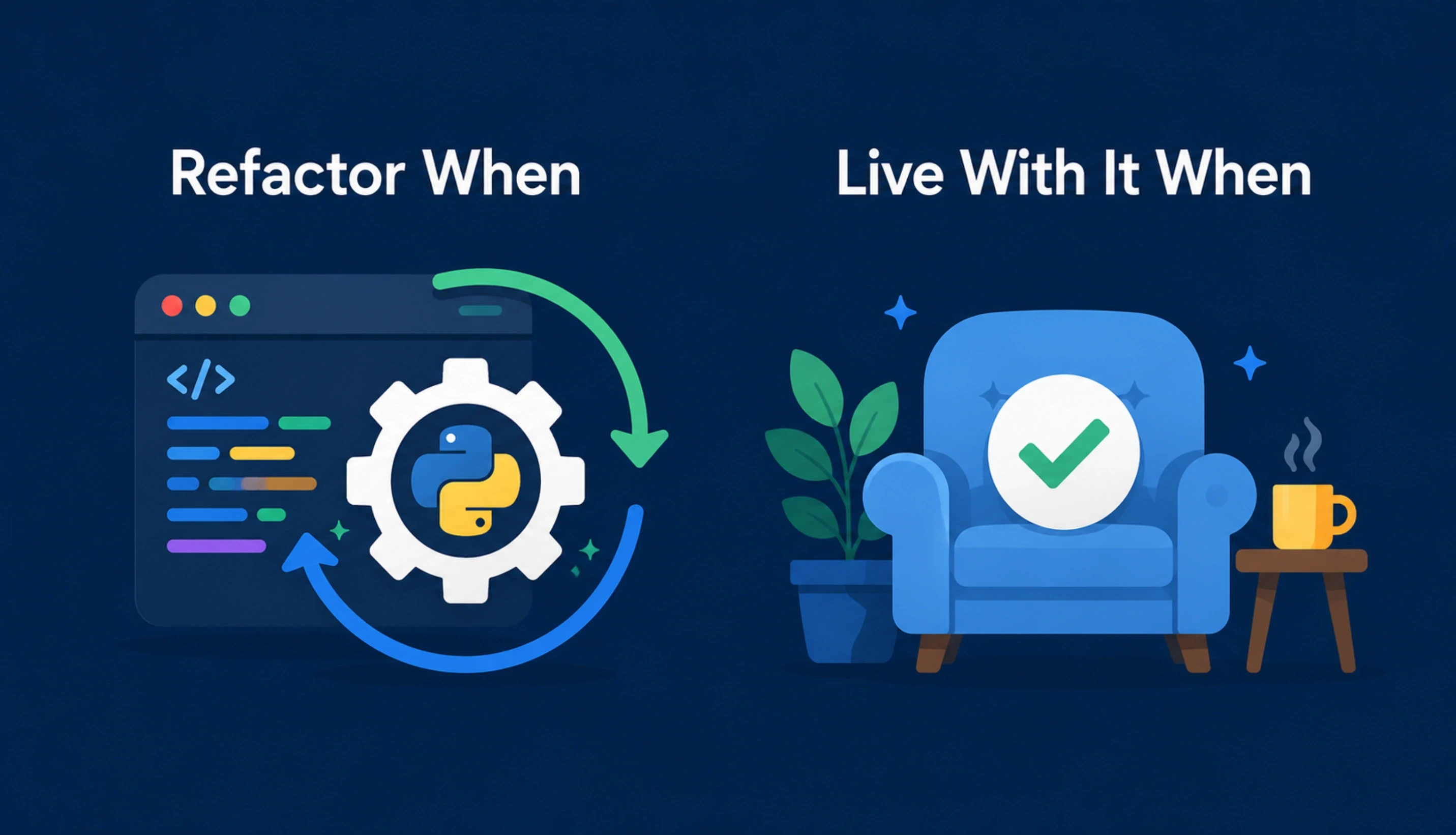
Not every architectural problem deserves a refactor. Some debt is cheap to live with. Some is catastrophic to ignore. Distinguishing the two is one of the most valuable judgement calls a senior engineer or CTO makes.
Refactor When
The same area gets bug fixes more than three times in a quarter.
New features in that area take 3x longer than equivalent features elsewhere.
Onboarding new engineers spend disproportionate time understanding it.
Performance bottlenecks in that area are blocking product roadmap.
The code is so coupled to a single library that the library cannot be upgraded.
Live With It When
It is ugly but stable, well-tested, and rarely changed.
Refactoring would touch 20+ files for a 10% gain.
The team's velocity is not constrained by it.
It is in a path that is genuinely going to be deprecated within 12 months.
How Acquaint Softtech Builds Python Backends That Age Well
Acquaint Softtech is a Python development and IT staff augmentation company based in Ahmedabad, India, with 1,300+ software projects delivered globally across healthcare, FinTech, SaaS, EdTech, and enterprise platforms. Our long-term backend engagements follow the architectural framework described in the complete guide to hiring Python developers, and our senior engineers have shipped Django and FastAPI systems running successfully across multi-year horizons.
Senior Python engineers with multi-year backend depth. Hands-on with modular monolith design, technical debt management, repository patterns, observability stacks, and major version migration playbooks.
Architecture audit experience. Production codebases between 50K and 1M+ lines reviewed for debt categories, module boundaries, and migration risk. Written remediation plans with sequenced effort estimates.
Healthcare and FinTech compliance experience. GDPR-compliant Python platform delivered for BIANALISI, Italy's largest diagnostics group, processing patient records with audit-grade query logging across multi-year operations.
Transparent pricing from $20/hour. Dedicated Python engineering teams from $3,200/month per engineer. Architecture audits and long-term roadmap reviews from $5,000.
For the budget reality of running a Python backend across multi-year horizons, particularly for mid-sized organisations balancing scale and cost, the analysis on Python development cost for mid-sized businesses walks through engagement model economics in detail.
To bring senior Python engineers onto your long-term backend project quickly, you can hire Python developers with profiles shared in 24 hours and a defined onboarding plan within 48.
The Bottom Line
Long-term Python backend design is not about choosing the perfect framework or the latest pattern. It is about discipline applied consistently across years: enforcing module boundaries, paying down debt every sprint, choosing technology your team can maintain, building observability before you need it, and planning for the migrations that will definitely come. None of these are exotic. All of them are the difference between a backend that ages well and one that becomes the team's biggest constraint.
The teams that ship fastest at year five are not the teams that picked the trendiest stack at year one. They are the teams that picked a defensible stack and then ran it with discipline. The architecture compounds in your favour when you respect it. It punishes you when you do not. Pick patterns you can defend, write code your replacement can read, and build the system that the team operating in 2031 will thank you for in 2026.
Building a Python Backend That Will Run for 5+ Years?
Book a free 30-minute architecture review. We will look at your design choices, identify the three highest-impact long-term risks, and give you a written remediation plan with sequenced priorities. No sales pitch. Just senior engineers who have built and operated Python backends across multi-year horizons.
Frequently Asked Questions
-
What is the most important architectural decision for long-term Python backend design?
Module boundaries. A clearly modular Python backend can absorb almost any future change with localised refactors, while a tangled one resists every change. Pick domain-aligned modules over technology-aligned ones (billing/, identity/, content/ instead of controllers/, models/, services/), enforce public interfaces between them, and use import linting in CI to keep the boundaries from decaying as the team grows.
-
Should I start with a monolith or microservices for a new Python product?
Modular monolith, almost always. A single deployable application with internally enforced module boundaries gives you most of the benefits of microservices without the operational complexity. You can extract specific modules into services later when one of them genuinely needs independent scaling, deployment, or team boundary. Premature microservices is one of the most predictable architectural mistakes in modern Python development.
-
How much technical debt is acceptable in a growing Python codebase?
There is no zero. Acceptable debt is debt you have measured, named, and budgeted to repay. Mature teams allocate around 20% of every sprint to debt repayment indefinitely, track debt across testing, documentation, complexity, and duplication categories, and refuse to merge new code that increases debt without an explicit plan to address it. Unmeasured debt is the dangerous kind.
-
When should I refactor an existing Python backend versus living with it?
Refactor when the code is actively slowing the team: same area getting fixes more than three times in a quarter, new features taking 3x longer than equivalent features elsewhere, onboarding engineers spending disproportionate time on it, or a library that cannot be upgraded because of coupling. Live with it when it is ugly but stable, rarely changed, well-tested, and not blocking velocity. Cosmetic refactors that touch 20+ files for a 10% gain rarely earn their cost.
-
Django or FastAPI for a Python backend with a 5-year horizon?
Django for full web platforms with admin interfaces, content management, complex domain logic, and teams that benefit from batteries-included tooling. FastAPI for API-first products, async-heavy workloads, and ML model serving where typed contracts matter. Many production stacks run both: Django for the main application and FastAPI for high-performance microservices on the edge. Both have long-term support paths and mature ecosystems.
-
How do I prevent vendor lock-in in long-term Python architecture?
Abstract cloud-specific services behind interfaces from day one. If you use S3, do not let boto3 calls leak across the codebase: wrap them in a storage interface so a future migration to GCS or Azure Blob touches one file, not 50. Same applies to managed databases, queue services, and AI APIs. The abstraction cost is small. The migration optionality is large.
-
How do I make a Python backend resilient to team turnover?
Three things that compound. Documentation as a contractual deliverable: every module has a README, every production system has a runbook, every architectural decision has a written ADR. Code ownership enforced through CODEOWNERS so the team responsible is always clear. Hiring for long-term thinkers who optimise for the next year, not just the next sprint. The architecture that survives turnover is the architecture the team can operate without the people who built it.
We’re Acquaint Softtech, your technology growth partner. Whether you're building a SaaS product, modernizing enterprise software, or hiring vetted remote developers, we’re built for flexibility and speed. Our official partnerships with Laravel, Statamic, and Bagisto reflect our commitment to excellence, not limitation. We work across stacks, time zones, and industries to bring your tech vision to life.
Table of Contents
Get Started with Acquaint Softtech
- 13+ Years Delivering Software Excellence
- 1300+ Projects Delivered With Precision
- Official Laravel & Laravel News Partner
- Official Statamic Partner
Related Blog
How to Hire Python Developers Without Getting Burned: A Practical Checklist
Avoid costly hiring mistakes with this practical checklist on how to hire Python developers in 2026. Compare rates, vetting steps, engagement models, red flags, and more.
Acquaint Softtech
March 30, 2026
Total Cost of Ownership in Python Development Projects: The Full Financial Picture
The build cost is just the beginning. This guide breaks down the complete TCO of Python development projects across every lifecycle phase, with real benchmarks, a calculation framework, and 2026 data.
Acquaint Softtech
March 23, 2026
Python Developer Hourly Rate: What You're Actually Paying For
Python developer rates range $20-$150+/hr in 2026. See what experience, specialisation & hidden costs actually determine the price. Save 40% with vetted offshore talent.
Acquaint Softtech
March 9, 2026India (Head Office)
203/204, Shapath-II, Near Silver Leaf Hotel, Opp. Rajpath Club, SG Highway, Ahmedabad-380054, Gujarat
USA
7838 Camino Cielo St, Highland, CA 92346
UK
The Powerhouse, 21 Woodthorpe Road, Ashford, England, TW15 2RP
New Zealand
42 Exler Place, Avondale, Auckland 0600, New Zealand
Canada
141 Skyview Bay NE , Calgary, Alberta, T3N 2K6
Your Project. Our Expertise. Let’s Connect.
Get in touch with our team to discuss your goals and start your journey with vetted developers in 48 hours.