

Django Version Upgrade Strategy From 3.x to 5.x Without Breaking Production
How to upgrade Django from 3.x to 5.x without breaking production in 2026. LTS-to-LTS hop strategy, automated tooling, breaking changes, and real timeline.

Acquaint Softtech
Introduction: Django 4.2 LTS Just Ended, and Most Teams Are Behind
If your Django application is still on a 3.x release in 2026, the conversation is no longer about whether to upgrade. It is about how quickly you can get to a supported version without breaking the production system that the business depends on. The Django release calendar is brutal in retrospect: every major version is supported for roughly three years, every LTS for four, and the deprecation cycles compound. A team that sat on Django 3.2 thinking they had plenty of time discovered, sometime around the start of 2026, that they were three major versions behind, with security patches no longer arriving, third-party packages dropping their version, and an upgrade that should have taken six weeks now looking like a six-month project. This guide is for the teams in that position, and for the teams determined not to be there next time.
The numbers as of mid-2026 make the urgency explicit. According to a Django end-of-life analysis published by TuxCare in April 2026, Django 4.2 LTS officially reached end of life on April 7, 2026, meaning teams still running 4.2 are no longer receiving upstream security patches. The same analysis is blunt about the older versions: Django 3.2, 4.0, 4.1, 5.0, and 5.1 are all already end of life. The supported options today are Django 5.2 LTS, supported until April 2028, and Django 6.0, supported until April 2027. For any production application running an unsupported Django version, the security exposure compounds every quarter the upgrade is deferred, and the gap between your version and the supported one only gets larger.
This guide walks through how to upgrade Django from a 3.x release to 5.x (specifically 5.2 LTS, the current long-term support version) without breaking production. It covers the LTS-to-LTS hop strategy that consistently works, the automated tooling that handles most of the mechanical changes, the breaking changes that hit production hardest, and the staffing model that delivers the upgrade without halting feature work. It is written for engineering leaders, senior Django developers, and CTOs sitting on a Django 3.x codebase that needs to move and want a realistic playbook for getting there safely.
If you are also evaluating who should execute the upgrade work, the complete guide to hiring Python developers in 2026 sets the wider context. A Django version upgrade specifically requires senior engineers with multi-version Django experience and discipline around testing and migration rollout, which is a different profile from greenfield Django development.
The Django LTS Reality in 2026
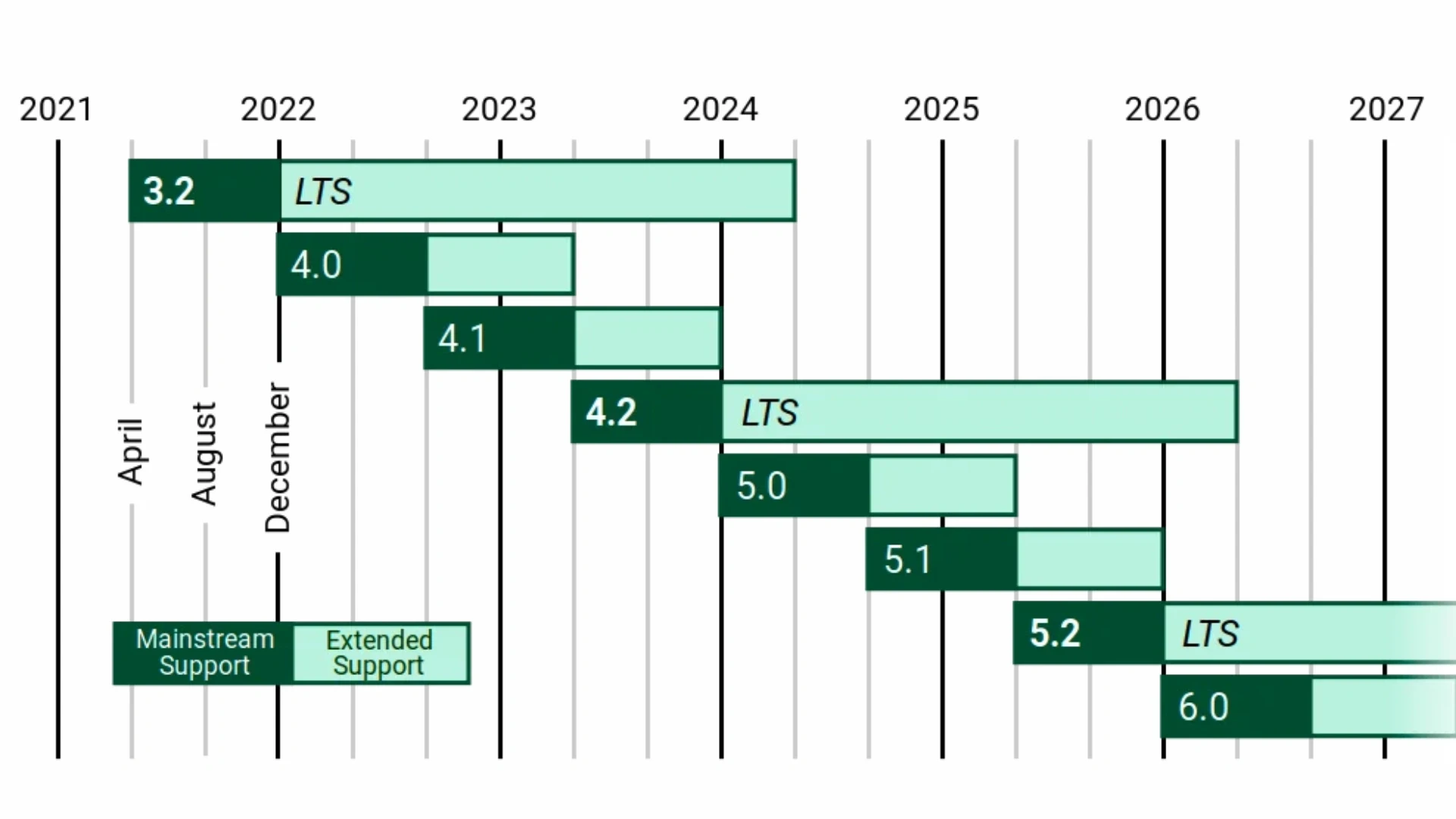
Django's release cadence is the part most teams underestimate. The framework ships a new feature release roughly every eight months, with every fourth release designated as long-term support. LTS releases get three years of security updates, non-LTS releases get roughly 16 months of bug fixes and only the first eight months of feature updates. Knowing exactly where each version sits is the foundation of any sensible upgrade plan.
Django Version Support Status (Mid 2026)
Django Version | Release | Status (Mid 2026) |
|---|---|---|
3.2 LTS | April 2021 | End of life (April 2024) |
4.0 | December 2021 | End of life |
4.1 | August 2022 | End of life |
4.2 LTS | April 2023 | End of life (April 7, 2026) |
5.0 | December 2023 | End of life |
5.1 | August 2024 | End of life |
5.2 LTS | April 2025 | Supported until April 2028 |
6.0 | December 2025 | Supported until April 2027 |
What This Calendar Means in Practice
Anything below 5.2 is unsupported. As of mid-2026, every Django release older than 5.2 LTS is end of life and receives no security patches. Running 3.x or 4.x in production is a compliance and security exposure that grows every quarter.
5.2 LTS is the safe destination. With official support until April 2028, Django 5.2 LTS gives you roughly two years of upstream support after upgrade. This is the right target for most enterprise teams, ahead of Django 6.0 which is non-LTS.
Upgrade season comes every two years. Once on 5.2 LTS, the next required upgrade is the next LTS (expected around Django 6.2 in April 2027). Treating Django upgrades as a recurring engineering capability, not a one-time project, prevents the kind of multi-version backlog that forces emergency upgrades.
Multi-version jumps multiply risk. Each Django version introduces breaking changes and removes deprecated APIs. Jumping from 3.2 directly to 5.2 crosses several deprecation cycles at once, which is exactly why most experienced teams hop LTS to LTS instead of attempting the full leap in one move.
The LTS-to-LTS Hop Strategy: Why You Should Not Jump 3.2 to 5.2 Directly
The size of the codebase determines whether a multi-version jump is even feasible. According to a 2025 enterprise Django migration analysis by HeroDevs, migration complexity is heavily influenced by application size and scope: small Django projects of 10,000 to 30,000 lines of code (typical for internal tools with limited dependencies) face manageable upgrade work, while large Django projects of 100,000+ lines (multi-app monoliths with enterprise features and many third-party packages) see every breaking change multiply across more code paths to refactor, more dependencies to validate, and more test suites to maintain. The same analysis recommends the staged approach for enterprises specifically: Django 3.2 to 4.2 LTS first, then 4.2 to 5.2 LTS later, rather than attempting the direct jump.
Why the LTS-to-LTS Hop Wins
Each hop crosses fewer deprecation cycles. Django removes deprecated APIs between major versions. Going 3.2 to 4.2 crosses one LTS-to-LTS deprecation cycle. Going 3.2 to 5.2 crosses two. Each cycle adds breaking changes you have to handle, and they compound.
Third-party packages support LTS versions more reliably. Most major Django packages explicitly support the current LTS and one previous. A 3.2 to 4.2 hop almost always has package support available. A 3.2 to 5.2 jump frequently encounters packages that skipped support for an intermediate version.
Each LTS sits in production for months between hops. Hopping to 4.2 LTS, stabilizing in production for a quarter, then hopping to 5.2 LTS is two contained migrations instead of one massive one. Each migration is testable, reversible, and shippable on its own schedule.
The team learns the upgrade pattern early. The first hop teaches your team how Django upgrades work in your codebase. The second hop applies that learning. Doing both at once means learning under maximum pressure with no practice, which is the worst possible time to learn anything.
When a Direct 3.x to 5.x Jump Might Be Defensible
Very small codebases (under 20,000 lines). If the application is small enough to upgrade in a few weeks, a direct jump can be faster than two staged hops. The complexity multiplier that hurts large codebases does not apply at small scale.
Limited third-party dependencies. If your project uses very few third-party Django packages, the compatibility risk that drives the LTS-to-LTS hop is reduced. Audit your dependencies first to confirm this assumption holds.
Hard deadline preventing two upgrade cycles. If a compliance or security audit forces a supported Django version within a tight window, a direct jump with intensive testing may be the only option. Treat this as an emergency, not a chosen strategy.
Sitting on Django 3.x or 4.x in Production?
Acquaint Softtech has executed Django version upgrades from 3.x through 5.x for production codebases without halting feature delivery. Senior Django engineers with multi-version experience, the LTS-to-LTS hop methodology, and disciplined testing to catch breaking changes before production. Profiles in 24 hours. Onboarding in 48.
The Step-by-Step Django Upgrade Playbook

The mechanical part of a Django upgrade is largely automatable. The strategic part (which dependencies to upgrade, how to structure dual-version compatibility, how to test for regression) is what requires senior judgment. The playbook below covers the phases that consistently work for production codebases, with the tooling that automates the mechanical work.
Django 3.x to 5.x Upgrade Playbook by Phase
Phase | Typical Duration | Key Activities |
|---|---|---|
1. Audit and baseline | 1 to 2 weeks | Pin dependencies, audit packages, expand test coverage |
2. Upgrade Python first | 1 to 2 weeks | Move to Python 3.10+ before touching Django |
3. Run django-upgrade tool | 1 to 2 weeks | Automated fixes for deprecations syntax changes |
4. Upgrade to 4.2 LTS | 3 to 8 weeks | First LTS hop, stabilize in production |
5. Run automated tools again | 1 to 2 weeks | Apply 5.x fixes via django-upgrade |
6. Upgrade to 5.2 LTS | 3 to 8 weeks | Second LTS hop, stabilize in production |
7. Modernize toward 5.x idioms | Ongoing | Adopt new patterns post-upgrade |
The Tooling That Makes the Mechanical Work Tractable
django-upgrade by Adam Chainz. A command-line tool that rewrites files in place, applying fixers to avoid deprecation warnings on a target Django version. Run it with --target-version pointed at your destination, review the diff, and run your tests. This handles most syntactic deprecation work automatically.
django-codemod by Bruno Alla. An alternative auto-upgrade tool with a more complete set of fixers, particularly useful for the url to path/re_path conversion that affects hundreds of route definitions in typical Django projects.
pip-check and pip-audit. Dependency analysis. pip-check identifies packages that have not been updated for newer Django versions, and pip-audit catches known security vulnerabilities in the current dependency graph.
pytest with coverage. Expand test coverage before starting the upgrade. The single most reliable predictor of upgrade pain is poor test coverage on the current version, because every breaking change becomes a discovery rather than a planned change.
Django's check management command. Built-in. Run python manage.py check --deploy on every intermediate state to catch deprecation warnings and configuration issues that would otherwise surface in production.
The Dual-Version Compatibility Pattern
The most reliable upgrade pattern is to make your code compatible with both your current Django version and the target version simultaneously, deploy that dual-compatible code to production, verify it works, and then switch the Django version. This means the final cutover is a single setting change rather than a code change, which makes rollback trivial if something goes wrong. Combined with feature flags for behavior that legitimately differs between versions, dual-version compatibility is what turns a Django upgrade from a scary one-shot event into a controlled, reversible deployment.
The broader Django architectural patterns that the post-upgrade codebase can adopt are covered in the Python development architecture and frameworks guide, which walks through the modern Django patterns (async views, native database connection pooling, composite primary keys, modern middleware) that become available once your application is on 5.x.
The Breaking Changes That Hit Production Hardest
Most Django breaking changes are handled mechanically by django-upgrade or django-codemod. A handful are not, and those are the ones that consistently cause production incidents during upgrades. Knowing them in advance, writing tests that exercise the affected behavior, and reviewing your codebase specifically for these patterns is the difference between an upgrade that ships cleanly and one that introduces silent bugs.
url() removed in favor of path() and re_path(). Django 4.0 removed the legacy url() function. Code with hundreds of url() calls must convert every one to path() or re_path(). django-codemod automates this well, but the conversion changes how URL parameters are typed (path uses path converters; re_path uses regex), and the team needs to verify URL routing behavior end to end.
pytz removal in favor of zoneinfo. Django 5.0 dropped pytz as a hard requirement in favor of Python's standard zoneinfo. If your code uses pytz directly, it must migrate. The USE_DEPRECATED_PYTZ setting bridges this temporarily but should not be a destination.
Middleware pattern changes. The legacy process_request and process_response middleware pattern is fully replaced by the callable middleware pattern in modern Django. Custom middleware written against the old pattern needs to be rewritten, which automated tools handle partially but not completely.
Database backend changes. Django 5.2 raised PostgreSQL minimum to 14 and changed MySQL's default character set to utf8mb4. If you are on older PostgreSQL or MySQL, the database upgrade must precede or accompany the Django upgrade. The Oracle backend gained connection pooling, which can break custom connection management if you had any.
Model and migration changes. unique_together was deprecated in favor of UniqueConstraint. Composite primary keys arrived in 5.2. Naive migration of these on large production tables (millions of rows) can lock tables and cause downtime. State-aware migration strategies using SeparateDatabaseAndState and RunSQL are required for zero-downtime upgrades.
Third-party package compatibility. Major packages like Django REST Framework, Django Channels, Wagtail, and Celery typically support the current LTS and one previous. Some smaller packages skip versions or go unmaintained, which is the most common upgrade blocker and the reason the dependency audit in Phase 1 is non-negotiable.
The decision to stay on Django through these upgrades, versus moving to FastAPI or Flask for specific services, is itself worth thinking through during a major upgrade cycle. The Django vs FastAPI vs Flask comparison guide walks through when each framework is the right answer, which is useful context for teams considering whether a Django upgrade is the best use of the engineering investment or whether a partial migration to async-native FastAPI makes more sense for specific service boundaries.
How Acquaint Softtech Approaches Django Version Upgrades
Acquaint Softtech is a Python and Django development partner based in Ahmedabad, India, with 1,300+ projects delivered globally, including Django version upgrades for enterprise clients across healthcare, FinTech, SaaS, EdTech, and eCommerce. Our upgrade approach follows the framework in the complete guide to hiring Python developers, with senior Django engineers experienced across versions 3.x, 4.x, 5.x, and the disciplined testing and dual-version compatibility patterns that production upgrades specifically require.
Senior Django engineers with multi-version production experience. Hands-on with django-upgrade, django-codemod, dual-version compatibility patterns, state-aware migrations for zero-downtime database changes, and the subtle behavioral differences across versions that determine whether an upgrade ships cleanly or introduces silent bugs.
LTS-to-LTS hop methodology as the default. Two contained upgrade cycles with production stabilization between them, rather than a single high-risk multi-version jump. Each hop is testable, reversible, and shippable on its own schedule.
Zero-downtime database migration discipline. State-aware migrations using SeparateDatabaseAndState and RunSQL, with explicit strategies for index rebuilds, constraint changes, and large-table operations that would otherwise lock production tables.
Transparent pricing from $20/hour. Dedicated Python and Django engineering teams from $3,200/month per engineer, roughly 40% less than equivalent US in-house hiring, with full IP assignment and NDA from day one and a free replacement guarantee.
The same incremental modernization methodology applies across other framework upgrades. For comparison, the analysis on Laravel application modernization walks through how the staged-hop pattern delivers PHP framework upgrades without disrupting feature work, with lessons that mirror the Django LTS-to-LTS approach.
To get senior Django engineers with version-upgrade experience onto your assessment quickly, you can hire Python developers with profiles shared in 24 hours and a defined onboarding plan within 48.
The Bottom Line
Upgrading Django from 3.x to 5.x in 2026 is no longer optional, but it does not require breaking production or freezing feature work. The LTS-to-LTS hop methodology (3.2 to 4.2, stabilize, 4.2 to 5.2, stabilize) consistently ships cleanly because each hop crosses fewer deprecation cycles than a direct jump, third-party packages support LTS-to-LTS transitions more reliably, and each intermediate LTS gives the team practice with the upgrade pattern. The mechanical work is largely automated by django-upgrade and django-codemod. The strategic work (dependency audit, dual-version compatibility, state-aware migrations, breaking-change review) is what requires senior Django engineers who have done this work before.
The risks that derail Django upgrades are predictable. Starting without comprehensive test coverage, jumping multiple major versions in one move, underestimating third-party package compatibility, running naive migrations on large production tables, and treating the upgrade as a one-shot event rather than a deployable dual-version state all show up consistently in projects that struggle. Avoid them, and a 6 to 8 month phased upgrade delivers a Django 5.2 LTS codebase, restored security posture, access to async views and modern Django patterns, and feature delivery that never stopped. Django 4.2 LTS just hit end of life in April 2026. The upgrade can no longer wait, and the playbook to do it without breaking production is now mature enough that there is no longer a credible reason to defer.
Need a Realistic Plan to Get Django Current?
Book a free 30-minute Django upgrade assessment. Tell us your current Django version, codebase size, and dependency profile, and we will give you an honest answer: how to phase the upgrade, what the realistic timeline is, where the breaking changes will hit hardest, and how to keep feature delivery moving throughout. No sales pitch. Just senior Django engineers who have run version upgrades end to end.
Frequently Asked Questions
-
Is it still safe to run Django 3.x or 4.x in production in 2026?
No. Django 4.2 LTS reached end of life on April 7, 2026, and every Django release older than 5.2 LTS is now unsupported, including 3.2 LTS (EOL April 2024), 4.0, 4.1, 5.0, and 5.1. Running an unsupported Django version means no upstream security patches, growing exposure to known CVEs, and increasing third-party package incompatibility. For any application touching customer data, financial transactions, or regulated information, this is a compliance and security risk that grows every quarter.
-
Should I upgrade Django 3.2 directly to 5.2, or hop through 4.2 first?
Hop through 4.2 LTS for almost every production codebase. Each hop crosses fewer deprecation cycles, third-party packages support LTS-to-LTS upgrades more reliably, and each intermediate LTS can stabilize in production between hops. A direct 3.2 to 5.2 jump is only defensible for very small codebases under 20,000 lines, projects with very few third-party dependencies, or hard compliance deadlines that prevent two upgrade cycles. For most enterprise teams, the LTS-to-LTS hop is the methodology that consistently ships cleanly.
-
How long does a Django version upgrade take?
For a typical enterprise codebase of 50,000 to 100,000 lines, plan 3 to 4 months per LTS hop including dependency audit, automated tool runs, test coverage expansion, dual-version compatibility work, production rollout, and stabilization. A full 3.2 to 5.2 upgrade via the LTS-to-LTS hop method runs 6 to 8 months end to end. Large codebases of 100,000+ lines or projects with many third-party dependencies extend these ranges. Feature work continues throughout with the dual-version compatibility pattern.
-
What tools should I use for a Django upgrade?
django-upgrade by Adam Chainz handles most syntactic deprecations automatically. django-codemod by Bruno Alla is the alternative with more complete fixers, especially useful for url() to path() conversion. pip-check and pip-audit handle dependency analysis. pytest with coverage is essential for catching breaking changes before production. Django's own python manage.py check --deploy command surfaces deprecation warnings at every intermediate state. The automated tools handle the mechanical 70 to 80% of the work; the remaining 20 to 30% requires senior judgment.
-
What breaks most often during a Django 3.x to 5.x upgrade?
Six categories of breaking changes hit production hardest: url() removed in favor of path() and re_path() (Django 4.0), pytz removed in favor of zoneinfo (Django 5.0), legacy middleware pattern fully replaced by callable middleware, database backend changes (PostgreSQL 14+ required, MySQL utf8mb4 default), model changes like unique_together to UniqueConstraint that can lock production tables during migration, and third-party package incompatibilities. Audit dependencies in Phase 1 to catch the third-party issues before starting code work.
-
How do I upgrade Django without taking the production system down?
The dual-version compatibility pattern: make your code work on both your current Django version and the target version simultaneously, deploy that dual-compatible code to production, verify it runs correctly, and then switch the Django version in a single setting change. This makes rollback trivial if anything goes wrong. Combined with state-aware database migrations (SeparateDatabaseAndState plus RunSQL) for schema changes on large tables, this pattern delivers zero-downtime upgrades even for high-traffic applications.
We’re Acquaint Softtech, your technology growth partner. Whether you're building a SaaS product, modernizing enterprise software, or hiring vetted remote developers, we’re built for flexibility and speed. Our official partnerships with Laravel, Statamic, and Bagisto reflect our commitment to excellence, not limitation. We work across stacks, time zones, and industries to bring your tech vision to life.
Table of Contents
Get Started with Acquaint Softtech
- 13+ Years Delivering Software Excellence
- 1300+ Projects Delivered With Precision
- Official Laravel & Laravel News Partner
- Official Statamic Partner
Related Blog
How to Hire Python Developers Without Getting Burned: A Practical Checklist
Avoid costly hiring mistakes with this practical checklist on how to hire Python developers in 2026. Compare rates, vetting steps, engagement models, red flags, and more.
Acquaint Softtech
March 30, 2026
Total Cost of Ownership in Python Development Projects: The Full Financial Picture
The build cost is just the beginning. This guide breaks down the complete TCO of Python development projects across every lifecycle phase, with real benchmarks, a calculation framework, and 2026 data.
Acquaint Softtech
March 23, 2026
Python Developer Hourly Rate: What You're Actually Paying For
Python developer rates range $20-$150+/hr in 2026. See what experience, specialisation & hidden costs actually determine the price. Save 40% with vetted offshore talent.
Acquaint Softtech
March 9, 2026India (Head Office)
203/204, Shapath-II, Near Silver Leaf Hotel, Opp. Rajpath Club, SG Highway, Ahmedabad-380054, Gujarat
USA
7838 Camino Cielo St, Highland, CA 92346
UK
The Powerhouse, 21 Woodthorpe Road, Ashford, England, TW15 2RP
New Zealand
42 Exler Place, Avondale, Auckland 0600, New Zealand
Canada
141 Skyview Bay NE , Calgary, Alberta, T3N 2K6
Your Project. Our Expertise. Let’s Connect.
Get in touch with our team to discuss your goals and start your journey with vetted developers in 48 hours.