

Django vs FastAPI vs Flask: Choosing the Right Python Framework for Your Product
FastAPI hits 20,000 RPS. Django ships admin panels in hours. Flask lets you build exactly what you need. This guide breaks down Django vs FastAPI vs Flask with real 2026 benchmarks, a 15-dimension comparison, and a 12-scenario decision matrix.

Acquaint Softtech
Who This Guide Is For
This is for CTOs, technical leads, and product managers who are making a framework decision for a new Python product or evaluating whether to migrate an existing one. It assumes you know Python exists and need to choose between these three frameworks with production consequences.
It is also useful for teams hiring Python developers and needing to specify which framework expertise matters for their role. For the full hiring framework, see the complete guide to hiring Python developers.
Why This Decision Matters More Than Most Teams Realise
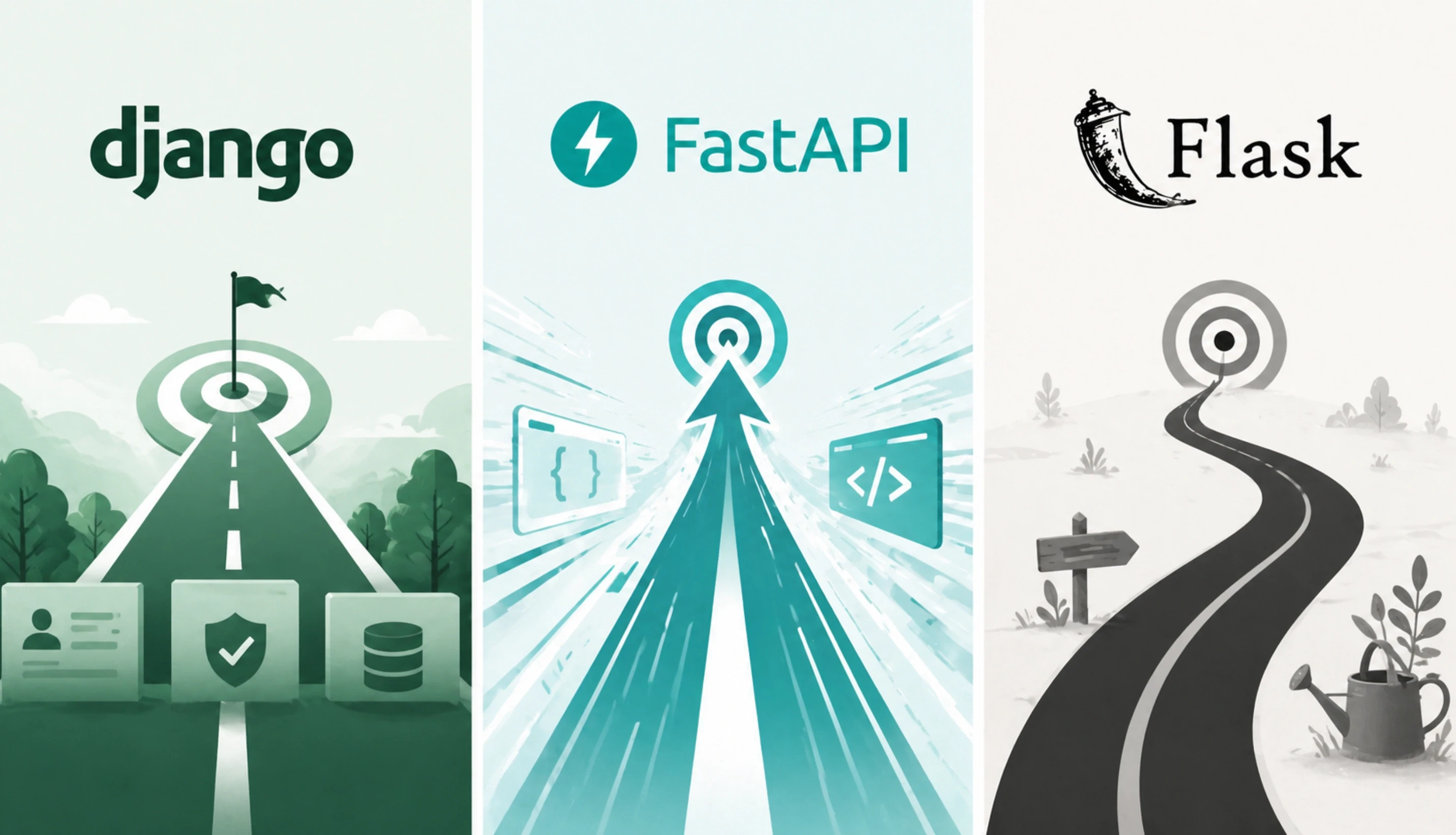
Framework choice is not just a technical decision. It is a product decision. The framework you start with shapes your architecture, determines what your team can build quickly, and defines what migrations will cost you in 18 months if you chose wrong.
According to the 2025 JetBrains Python Developers Survey, FastAPI adoption grew 40% year-over-year with 38% of Python developers now using it for API development. Django remains the framework of choice for full-stack web applications. Flask, despite being older, retains a strong position for lightweight and flexible builds.
The deeper architecture context, including how each framework fits into larger Python system design patterns, is covered in the Python development architecture and frameworks guide. This blog focuses on the product-level decision: which framework, for which type of product, in 2026.
The one rule before reading furtherThere is no best framework. There is only the framework that best fits what you are building, who is building it, and what the system needs to do in 24 months. Every section in this guide is designed to help you apply that logic to your specific situation, not to declare a winner. |
The 30-Second Summary
If you are in a hurry, here is the decision in three sentences.
Choose FastAPI:
if your product is API-first, needs to handle high concurrency, serves AI or ML predictions, or is being built as a microservice. FastAPI hits 15,000 to 20,000 requests per second on simple endpoints and brings automatic API documentation and native type safety with zero extra code.
Choose Django :
if your product is a full web application that needs user authentication, an admin panel, complex database relationships, and a team that can move fast using built-in tools rather than assembling pieces themselves.
Choose Flask:
if you want total control over every component, your project is small or a prototype, you have strong preferences about which libraries to use, or you need a minimal wrapper around a specific function rather than a full application framework.
Framework Profiles: What Each One Actually Is
Before comparing them, it helps to understand what problem each framework was designed to solve and who it was built for. Picking a framework without understanding its design intent is how teams end up with the wrong tool.
FastAPI
Born: 2018, by Sebastián Ramírez
Best for: High-performance APIs, microservices, AI/ML serving, real-time systems
Strengths
Native async/await support from the ground up via ASGI
Auto-generated OpenAPI and Swagger documentation from type hints
Pydantic validation built in: no separate request parsing layer required
Handles 15,000–20,000 RPS on simple endpoints (Uvicorn + ASGI)
WebSocket support is native, not a plugin
Type safety enforced by the framework, not optional
Fastest-growing Python framework on GitHub since 2020
Limitations
No built-in ORM: must choose and configure SQLAlchemy or Tortoise
No admin panel: requires third-party solutions
Async programming knowledge required: blocking a FastAPI event loop is a silent killer
Younger ecosystem: fewer third-party integrations than Django or Flask
Avoid if: Your team has no async Python experience or your product is content-heavy with lots of admin workflows
Django
Born: 2005, by Adrian Holovaty and Simon Willison
Best for: Full web applications, SaaS platforms, dashboards, content sites, internal tools
Strengths
Built-in ORM with migrations: no separate database layer to configure
Django Admin: functional admin panel generated from models in minutes
Built-in authentication, permissions, and session management
Django REST Framework (DRF) adds powerful API capabilities on top
Most mature Python web framework: 20+ years of production use
Strong security defaults: CSRF, SQL injection, XSS protection built-in
Fastest onboarding for teams unfamiliar with assembling stack components
Limitations
Sync-first by default: async support added in 3.1 but not deeply integrated throughout
Heaviest cold-start of the three: not ideal for serverless or Lambda deployments
Opinionated structure: teams wanting full control will fight the framework
DRF adds verbosity: serializers and viewsets are powerful but require more code than FastAPI
Avoid if: Your product is primarily an API with no admin or content management needs
Flask
Born: 2010, by Armin Ronacher Best for: Prototypes, MVPs, internal tools, small APIs, developers who know exactly what stack they want
Strengths
Smallest core of the three: only what you need, nothing you do not
Easy to learn: fastest ramp-up for teams new to Python web development
Maximum flexibility: choose every ORM, auth library, and testing tool yourself
Flask 3.0 (2023) added better async support while keeping the lightweight feel
Light memory footprint: 50–60MB under load, good for resource-constrained deployments
Large community and extensive documentation built over 15 years
Limitations
No built-in ORM, no admin panel, no auth: all must be added and maintained separately
Without async extensions, struggles under high concurrency
Lower raw performance than FastAPI: 344 req/s with DB vs FastAPI's 440 req/s
More decision fatigue: flexibility is a cost when teams lack strong architectural opinions
Avoid if: Your product requires high concurrency or a team without strong architectural opinions to build it
Performance in 2026: Real Numbers, Not Hello World
Most framework benchmarks test a single JSON response with no database. That is not a production system. The numbers below come from 2026 TechEmpower-referenced benchmarks and real-world developer testing with actual database calls, which is what your product will do.
Without database (framework overhead only)
FastAPI: 15,000 to 20,000 RPS with Uvicorn ASGI
Django (ASGI mode): up to 3,000 RPS on simple views
Flask: 800 to 1,200 RPS in standard sync WSGI mode
With database (real-world API workload)
FastAPI: ~440 req/s, ~11ms average latency
Flask: ~344 req/s, ~14ms average latency
Django: comparable to Flask on simple views; higher overhead with full middleware stack
What the performance data actually means for your productFlask serving ML predictions was migrated to FastAPI in one documented case, going from 500 req/s to 3,200 req/s. That gap matters for AI serving and real-time APIs. For a standard SaaS CRUD application at under 1,000 daily active users, all three frameworks perform adequately and framework choice should be driven by developer experience and product requirements, not performance. |
15-Dimension Comparison Table
Use this table when evaluating frameworks for a specific project. Green cells are FastAPI, dark green is Django, and grey is Flask.
Dimension | FastAPI | Django | Flask |
Architecture | ASGI, async-first, Starlette-based | WSGI/ASGI hybrid, sync-first | WSGI (sync), ASGI optional |
Performance (no DB) | 15,000-20,000 RPS | 2,000-3,000 RPS | 800-1,200 RPS |
Performance (with DB, real) | ~440 req/s, ~11ms latency | Comparable to FastAPI | ~344 req/s, ~14ms latency |
Auto API docs | Yes (OpenAPI/Swagger built-in) | No (manual) | No (manual) |
Built-in ORM | No (SQLAlchemy/Tortoise) | Yes (Django ORM) | No (bring your own) |
Admin panel | No | Yes (Django Admin) | No |
Type safety | Native (Pydantic required) | Optional | Optional |
Learning curve | Medium (async required) | Steep (full framework) | Easy |
Auth & permissions | Bring your own | Built-in | Bring your own |
Background tasks | Native async + Celery | Celery (separate) | Celery (separate) |
WebSocket support | Native | Django Channels (add-on) | Flask-SocketIO (add-on) |
AI/ML suitability | Excellent (async, type-safe) | Good (with DRF) | Good (lightweight serving) |
Ideal team size | Small to large API teams | Mid to large full-stack teams | Solo to small teams |
Maturity | 2018 (newer ecosystem) | 2005 (most mature) | 2010 (mature) |
GitHub stars (2026) | 75,000+ (fastest growing) | 79,000+ | 67,000+ |
For how these framework differences affect the type of developer you need to hire, the guide on questions to ask before hiring Python developers includes framework-specific technical screening questions.
When to Use Each Framework
FastAPI is the right choice when:
Your product revolves around serving data via REST API, especially at high throughput
You are integrating with or serving machine learning models in production
Your architecture requires multiple concurrent external API calls (third-party services, payment gateways, data sources)
You need auto-generated API documentation that stays in sync with your code automatically
You are building microservices where each service has a narrow, well-defined responsibility
Your team is comfortable with async Python and type hints, or is prepared to learn them
Django is the right choice when:
Your product needs user management, role-based permissions, and session handling from day one
You are building admin-heavy SaaS where internal teams need to manage data without custom tooling
Your team wants to ship fast using conventions rather than assembling a stack from scratch
Your database has complex relationships that benefit from Django's powerful ORM and migrations
Security and compliance are priorities: Django's built-in protections are battle-tested over 20 years
Your team includes developers with existing Django expertise
Flask is the right choice when:
You are building a prototype or MVP that needs to ship in days, not weeks
Your product is a small internal tool or script wrapper that does not justify a full framework
You have strong existing preferences about every component in your stack and want zero framework opinions imposed
Your team is learning Python web development and needs the simplest possible starting point
You are building a very specific, constrained service where Flask's minimal core is genuinely sufficient
Real-World Product Types and Which Framework Fits
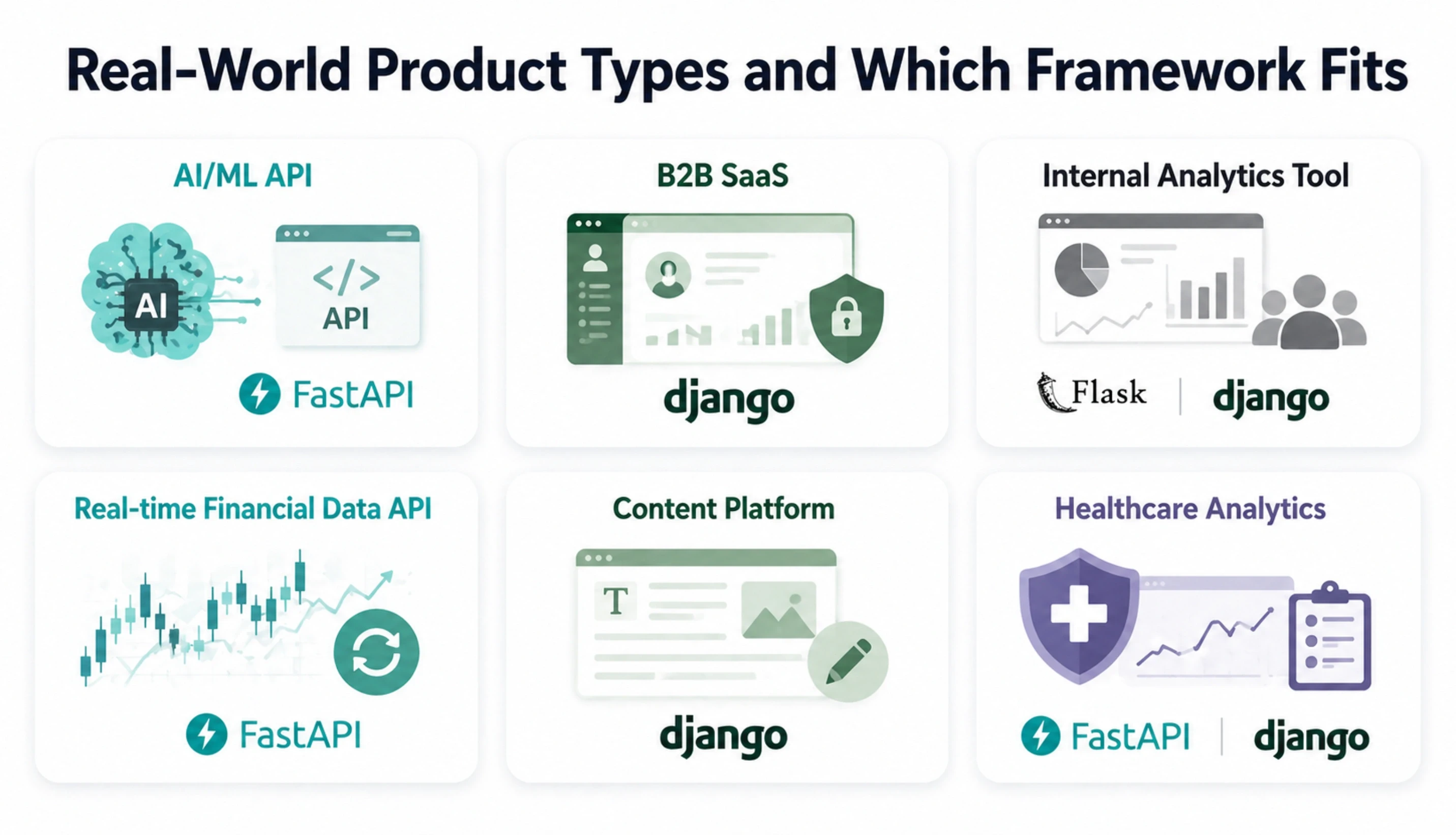
AI/ML API serving platform
FastAPI. Native async handles concurrent prediction requests. Pydantic enforces input/output schema. Auto-docs make it easy for frontend teams to integrate without backend involvement.
B2B SaaS with user roles and admin dashboard
Django. The admin panel, ORM, and auth system save weeks of build time. DRF or django-ninja handles the API layer. The convention-over-configuration approach keeps a growing team aligned.
Internal analytics tool for a 5-person team
Flask or Django. Flask if the team has strong architecture opinions and wants minimal overhead. Django if they want to move fast with built-in tooling and do not need high throughput.
Real-time financial data API
FastAPI. WebSocket support is native. Async event loop handles concurrent market data streams. Pydantic enforces strict data typing on financial objects.
Content platform or editorial system
Django. The admin panel functions as a built-in CMS. The ORM handles content relationships elegantly. Django's template system supports server-rendered pages without a separate frontend framework.
Healthcare analytics pipeline
FastAPI for the API layer (strict typing matches HL7 and FHIR schema requirements), Django if you need a full application with patient management and audit logging. For how Python fits healthcare analytics specifically, the Python healthcare analytics case study provides a real production example.
12-Scenario Decision Matrix: Match Your Situation to a Framework
Run through these 12 scenarios against your product. The pattern of answers will tell you which framework fits. If scenarios split between two frameworks, lean toward the one that owns the higher-priority scenarios for your product.
Your Situation | Primary Pick | Alternative |
I am building a high-traffic REST API with concurrent requests | FastAPI | FastAPI |
I need user auth, admin panel, and content management built-in | Django | Django |
I am building a quick MVP or internal tool in under 2 weeks | Flask | Flask |
My product serves AI model predictions via API | FastAPI | FastAPI |
I have a team with strong Django experience | Django | Django |
I need WebSocket or real-time data streaming | FastAPI | FastAPI |
I am building a SaaS with complex user roles and permissions | Django | Django |
I need maximum control over every library I use | Flask | Flask |
My team is new to Python and async programming | Django | Flask |
I am building microservices with separate concerns per service | FastAPI | FastAPI |
I need a CMS or content-heavy website | Django | Django |
I want automatic API documentation with zero extra code | FastAPI | FastAPI |
Framework selection also affects which hiring model you need. A FastAPI specialist has different skills from a Django full-stack developer. The Python hiring models comparison covers how to align your team structure with your framework choice.
Every developer we place is vetted on production scenarios, not toy examples
Named developer committed in 48 hours. Starting at $20/hr. To review profiles and start the evaluation.
Migration: What Happens When You Chose the Wrong Framework
Framework migrations are expensive, which is why the decision matters. But they do happen, and some paths are more viable than others.
Flask to FastAPI
Most viable migration. FastAPI's route decorator syntax is similar enough to Flask that individual endpoints can be migrated incrementally. SQLAlchemy works with both. A documented Flask to FastAPI migration produced a 6x throughput improvement in one production case. Recommended approach: migrate endpoint by endpoint behind a proxy, not all at once.
Django to FastAPI (monolith to microservices)
High cost and high reward. You lose the Django ORM, admin, and auth layers entirely. Teams usually keep Django for the admin-heavy parts and migrate API services to FastAPI. Do not do a full migration unless the performance or architecture case is overwhelming. Django Ninja (FastAPI-like syntax on Django) is often a better intermediate step.
Flask to Django
Common for teams that outgrew Flask's flexibility. The main cost is adopting Django's ORM and learning its conventions after building without them. If you have an existing SQLAlchemy schema, the migration requires rewriting models. Expect 2 to 4 sprints depending on codebase size.
Never migrate lightly
Before committing to any framework migration, model the total cost including developer time, testing, and the regression risk. The Python development cost breakdown provides a framework for estimating the true cost of technical decisions like this.
How Framework Choice Affects Who You Need to Hire
The framework you choose determines what expertise your developers need. A FastAPI specialist and a Django developer have meaningful skill overlap but are not interchangeable in practice.
Hiring for FastAPI projects
Look for Python developers who can explain async/await, understand event loop blocking risks, have worked with Pydantic in production, and can configure SQLAlchemy or Tortoise without guidance. The async experience requirement is the most commonly misrepresented skill in FastAPI hiring. The Python developer hiring checklist includes FastAPI-specific vetting questions.
Hiring for Django projects
Prioritise developers with ORM experience on complex schemas, familiarity with DRF serializers and viewsets, understanding of Django's middleware and signal system, and experience with Django's migration framework on live databases. Generic Python developers often underestimate how much Django-specific knowledge matters in production.
Hiring for Flask projects
The risk in Flask hiring is developers who treat Flask's flexibility as a licence to not make architectural decisions. Hire Flask developers who have strong opinions about how to structure a Flask application and have done it at least once in production. A Flask developer without architectural discipline produces unmaintainable codebases very quickly.
For the full framework-specific interview questions, see the guide on questions to ask before hiring Python developers.
Acquaint Softtech's Framework Expertise
Acquaint Softtech is a Python development and IT staff augmentation company based in Ahmedabad, India, with 1,300+ projects delivered globally. Our Python developers have production experience across all three frameworks.
FastAPI: Production API development, ML model serving, microservices architecture, real-time data pipelines
Django: Full-stack SaaS, multi-tenant platforms, admin-heavy dashboards, DRF and django-ninja API development
Flask: Lightweight services, rapid prototyping, specialised internal tools, legacy system integration
The Bottom Line
FastAPI for APIs. Django for full applications. Flask for controlled minimalism. These are not preferences. They are the design intents of the frameworks, confirmed by 2026 production usage patterns.
The decision matrix and comparison table in this guide give you the structured criteria to apply this logic to your specific product. Do not choose a framework because it is trending. Choose the one that matches what you are building and who is building it.
For the deeper architecture context behind these decisions, the Python development architecture and frameworks guide is the full reference.
Need a Python Developer Who Knows the Framework That Fits Your Product?
Acquaint Softtech provides vetted Django, FastAPI, and Flask developers who have built production systems, not tutorials. Named developer. Full NDA. Starting at $20/hr. Onboard in 48 hours.
Frequently Asked Questions
-
Which Python framework is the fastest in 2026?
FastAPI. It hits 15,000 to 20,000 RPS on simple endpoints using Uvicorn ASGI. In real-world tests with actual database calls, FastAPI manages around 440 req/s at 11ms latency vs Flask's 344 req/s at 14ms. The gap is real but matters most for high-traffic APIs. For a standard SaaS under 50,000 daily requests, all three are fast enough.
-
Is Django still relevant in 2026 or is FastAPI replacing it?
Django is not being replaced. FastAPI replaced Django for pure API work, but Django's strengths are its admin panel, ORM, auth system, and full-stack conventions. These are not things FastAPI provides at all. In 2026, most large Python shops use both: FastAPI for APIs and microservices, Django for the admin-heavy application layer.
-
Can I use Django and FastAPI together?
Yes, and many production systems do. A common pattern: Django manages the admin, user accounts, and database via its ORM; FastAPI handles the high-traffic API layer, sometimes reading from the same database. They run as separate services. This is a mature architecture pattern, not a workaround.
-
Is Flask still worth learning in 2026?
Yes, for specific use cases. Flask remains the cleanest choice for simple services, prototypes, and situations where you want full control over your stack. It is not the best choice for high-throughput APIs or full applications. Learning Flask also builds foundational Python web knowledge that makes Django and FastAPI easier to understand.
-
How long does it take to learn FastAPI if I know Flask?
The route syntax is similar enough that most Flask developers feel comfortable in FastAPI within one to two weeks. The real learning curve is async Python. If your Flask code was fully synchronous, plan for three to four weeks to understand async/await patterns well enough to avoid silent event loop blocking bugs.
-
Which framework should a startup use for their first Python product?
It depends on what the product does. If the product is primarily an API or ML-powered service, start with FastAPI. If it is a full web application with users, roles, and admin workflows, start with Django.
-
Does framework choice affect how much my Python development costs?
Yes, in two ways. First, Django developers command slightly higher rates than Flask developers because Django expertise is deeper. FastAPI specialists are increasingly in demand and rate towards the higher end of the Python range.
We’re Acquaint Softtech, your technology growth partner. Whether you're building a SaaS product, modernizing enterprise software, or hiring vetted remote developers, we’re built for flexibility and speed. Our official partnerships with Laravel, Statamic, and Bagisto reflect our commitment to excellence, not limitation. We work across stacks, time zones, and industries to bring your tech vision to life.
Table of Contents
Get Started with Acquaint Softtech
- 13+ Years Delivering Software Excellence
- 1300+ Projects Delivered With Precision
- Official Laravel & Laravel News Partner
- Official Statamic Partner
Related Blog
When Is Python Development Too Expensive? Pricing Red Flags That Signal a Bad Vendor
Not all expensive Python development is justified. This guide identifies the exact pricing red flags that signal a bad vendor, with real benchmarks, warning signs, and what fair Python pricing actually looks like in 2026.
Acquaint Softtech
March 26, 2026
How to Hire Python Developers Without Getting Burned: A Practical Checklist
Avoid costly hiring mistakes with this practical checklist on how to hire Python developers in 2026. Compare rates, vetting steps, engagement models, red flags, and more.
Acquaint Softtech
March 30, 2026
Total Cost of Ownership in Python Development Projects: The Full Financial Picture
The build cost is just the beginning. This guide breaks down the complete TCO of Python development projects across every lifecycle phase, with real benchmarks, a calculation framework, and 2026 data.
Acquaint Softtech
March 23, 2026India (Head Office)
203/204, Shapath-II, Near Silver Leaf Hotel, Opp. Rajpath Club, SG Highway, Ahmedabad-380054, Gujarat
USA
7838 Camino Cielo St, Highland, CA 92346
UK
The Powerhouse, 21 Woodthorpe Road, Ashford, England, TW15 2RP
New Zealand
42 Exler Place, Avondale, Auckland 0600, New Zealand
Canada
141 Skyview Bay NE , Calgary, Alberta, T3N 2K6
Your Project. Our Expertise. Let’s Connect.
Get in touch with our team to discuss your goals and start your journey with vetted developers in 48 hours.