

What Is Embedded Finance and Why Every App Is Adding Financial Services
Embedded finance is the integration of financial services, such as payments, lending, insurance, and banking, directly into non-financial applications. When Uber charges you automatically after a ride, Shopify offers a merchant a business loan inside its dashboard, or an e-commerce store lets you split a purchase into instalments at checkout, that is embedded finance in action.

Sanjay Prajapati

- You are a SaaS founder or product owner exploring embedded finance features like payments lending or banking
- You want to understand embedded finance and its technical architecture before making decisions
- You are evaluating Banking as a Service providers and need clarity on compliance and regulations
- You are comparing high cost Western agencies for embedded finance development
- You need to scale an engineering team quickly without long hiring cycles
Introduction: Financial Services Have Moved Inside the Apps You Already Use
Embedded finance is when financial services are built directly into non-financial apps, such as ride fares collected automatically, loans offered inside accounting tools, or insurance added during travel booking. Instead of sending users to banks or separate apps, financial features appear exactly where they are needed within the user journey. In 2026, this is becoming a major software trend as payments, lending, and insurance are increasingly embedded into everyday digital experiences.
According to Mordor Intelligence, the global embedded finance market reached $155.96 billion in 2026 and is projected to reach $454.48 billion by 2031 at a CAGR of 23.84%. That growth is being driven by merchants and software vendors embedding financial functionality to keep users inside their platforms, rapid Banking-as-a-Service deployments, and open banking frameworks that standardise data sharing across Europe, the UK, India, and North America.
This article explains what is embedded finance in plain terms, how the technology works, what the five main types look like in production, how to build them, and what an embedded finance development project actually costs in 2026. It is written for founders, product owners, and engineering teams making real build decisions, not for people who just want a definition.
The team behind this guide has delivered embedded finance and fintech software development across 60+ financial software projects. With 1,300+ projects delivered, 70+ engineers, and a 4.9/5 Clutch rating from 50+ verified reviews, Acquaint Softtech has the track record that embedded finance builds require.
What Is Embedded Finance: Definition and How It Works
Embedded finance is the integration of licensed financial services, such as payments, lending, insurance, and banking, into non-financial digital platforms via APIs. The term non-financial is the crucial qualifier. A bank offering a mobile app is not embedded finance. A payroll software platform that automatically pays employees at the end of each shift is. A property management app that collects rent through a built-in payment layer is. A gig economy platform that sends instant earnings to a driver's digital wallet is.
The financial capability is embedded into a product that already has a primary, non-financial purpose. The user completes a financial transaction without leaving the platform they are already using and often without knowing that a licensed financial institution is powering the transaction behind the scenes.
The three-layer infrastructure behind embedded finance
Layer | Who Provides It | What It Does |
BaaS provider | Licensed bank or regulated FinTech (Solarisbank, Railsr, Unit, RazorpayX) | Holds the financial licence, processes transactions, manages regulatory compliance for the financial product |
API and SDK | BaaS provider or payment processor (Stripe, Adyen, Razorpay, Marqeta) | Technical interface that connects the non-financial platform to the licensed infrastructure via REST API calls |
Platform product layer | The non-financial company: SaaS, e-commerce, mobility, HR, PropTech | User interface and product experience; the financial service appears as a native feature of the platform |
From the user's perspective, nothing changes. They are still inside the platform they trust. The financial transaction happens invisibly. From the platform's perspective, a single API call to the BaaS provider opens an account, issues a card, disburses a loan, or processes a payment. The platform earns a revenue share from the financial product without holding a banking licence itself.
Acquaint Softtech's Laravel developers have built embedded payment and financial workflow integrations for clients across Ireland, Sweden, Cyprus, Germany, Poland, and India. Laravel's event-driven architecture and robust API abstraction layer make it well-suited to the webhook-heavy, state-machine-dependent nature of embedded financial flows.
Five Types of Embedded Finance With Real Examples
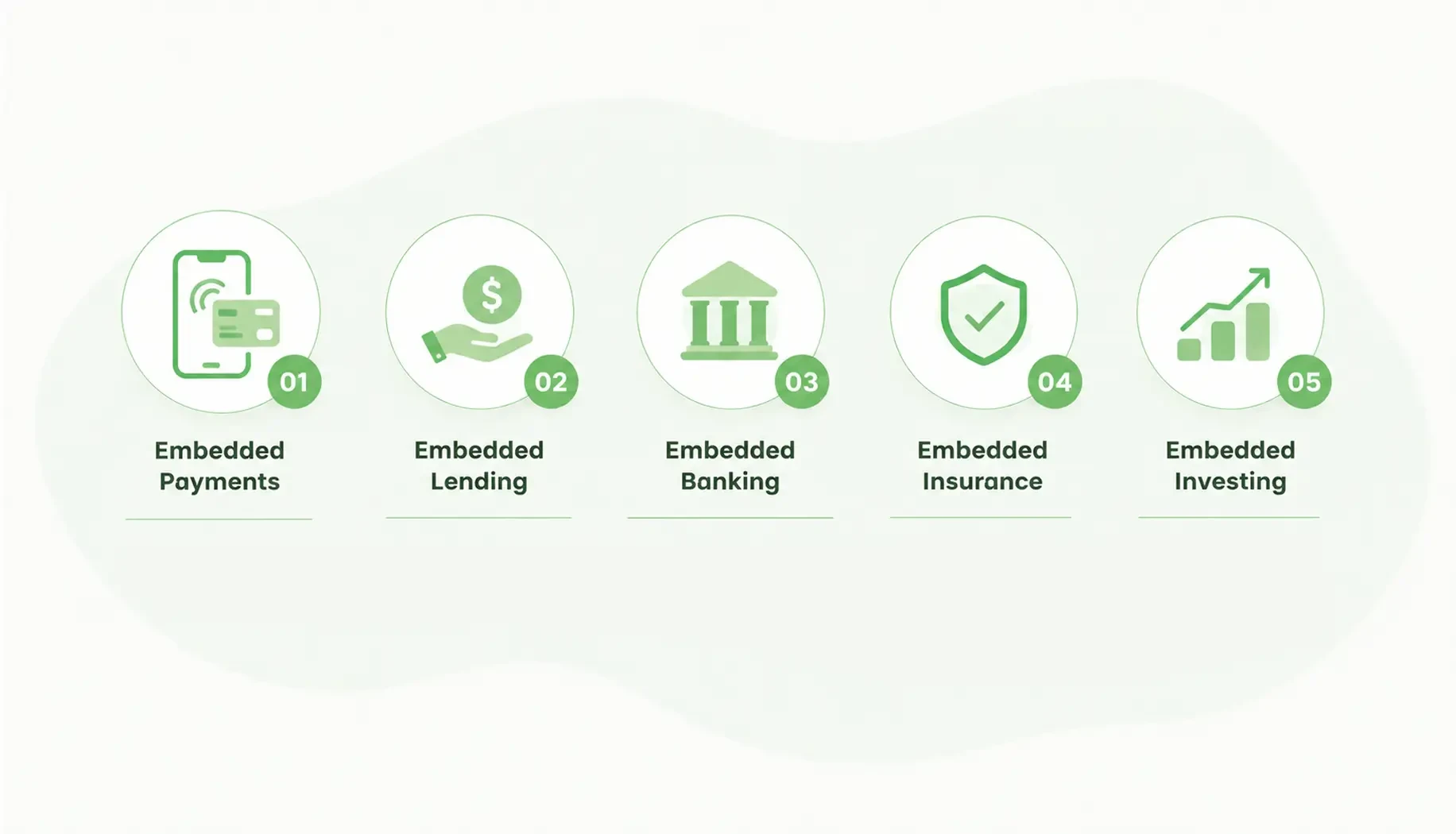
Embedded finance is not a single product. It covers five distinct categories, each with different technical architecture, regulatory requirements, and business model implications. Understanding which category your product belongs to is the first decision in any embedded finance project.
Type | What It Does | Real-World Example |
Embedded Payments | Handles payments inside the platform without external checkout | Uber auto-charges fare at trip end |
Embedded Lending | Offers credit or BNPL at point of need | Shopify Capital provides in-dashboard loans |
Embedded Banking | Provides accounts or wallets via BaaS | Shopify Balance offers merchant banking inside platform |
Embedded Insurance | Adds insurance at purchase moment | Booking.com offers travel insurance at checkout |
Embedded Investing | Enables investing inside non-finance apps | Grab offers investment products in its super-app |
Embedded payments: the starting point for most platforms
Embedded payments are where most non-financial platforms begin, and they account for the largest segment of the embedded finance market in 2026, with a 28% revenue share according to Grand View Research. The integration ranges from a Stripe SDK that eliminates the redirect to an external payment page, to a full payment orchestration layer that routes transactions across multiple payment rails based on geography, currency, and cost. The most important architectural decision at this stage is whether to use hosted payment fields that keep card data entirely within the processor's PCI-DSS scope, or to build a custom payment UI that requires the platform's own compliance programme.
For most platforms building embedded payments for the first time, the first option is the correct default. In more complex implementations, companies often rely on experienced full-stack teams such as hire MERN stack developers to build scalable payment flows and integration layers. Acquaint Softtech's software product development services always begin with a compliance architecture review before any payment code is written.
Embedded lending: the highest commercial value
Embedded lending, which includes BNPL, merchant cash advances, and instant credit offers at checkout, carries the highest revenue potential of any embedded finance type. It is also the most regulated. Any platform offering credit must either partner with a licensed lender and act as a credit broker, or hold its own consumer credit licence in each jurisdiction.
The embedded lending market alone is valued at $9.25 billion in 2026 and is expected to reach $34.73 billion by 2033 at a CAGR of 20.8%, according to Coherent Market Insights. E-commerce marketplaces integrating point-of-sale credit consistently report mid-teen conversion rate improvements because users who can spread the cost of a purchase are more likely to complete it.
For the technical architecture behind embedded lending, the cluster guide Building Embedded Lending Into E-Commerce Platforms: BNPL and Micro-Loans covers the origination API flow, credit decisioning integration, and regulatory wrapper in detail.
Ready to add embedded finance to your platform?
Acquaint Softtech has delivered 60+ financial software projects including embedded payments, BaaS integrations, and lending features for clients in Ireland, Sweden, Cyprus, Germany, India, and the UK. 4.9/5 Clutch. Team deployed in 48 hours.
Why Every App Is Adding Financial Services in 2026
The growth of embedded finance is not driven by technology alone. It is driven by a straightforward commercial logic: financial services are among the highest-margin features any non-financial platform can add, the infrastructure to integrate them has become accessible to any engineering team through APIs, and users now expect financial features to appear inside the products they already use.
Three commercial reasons platforms are embedding finance
Reason | What It Means | Evidence From the Market |
New revenue streams | Platforms earn fees, interest, and premiums beyond core product revenue | Shopify financial services have outperformed software revenue in some quarters |
Improved retention | Financial features lock users into the ecosystem | Embedded banking platforms show 2–3x lower churn |
Higher conversion | Credit at checkout reduces purchase friction | Embedded lending can increase conversion by 20–30% |
The embedded finance revenue models
Non-financial platforms earn from embedded finance in three main ways. Interchange revenue comes from card transactions where the platform earns a percentage of the interchange fee the merchant pays, typically 0.2 to 1.5% depending on card type and geography. Interest and fee sharing works when a platform refers users to a BaaS lending partner and earns a referral fee or a share of the interest margin on originated loans. Insurance premium sharing gives the platform 10 to 30% of the premium paid when embedded insurance is sold at a relevant transaction point.
The embedded finance benefits for businesses extend beyond direct revenue. Data enrichment is one of the most underestimated advantages: every financial transaction that runs through a platform's embedded layer generates proprietary behavioural data that improves product recommendations, credit decisioning, and customer segmentation.
$454.48 billion by 2031
The embedded finance market growing at 23.84% CAGR from $155.96 billion in 2026, driven by Asia-Pacific adoption at 25.72% CAGR and enterprise B2B segment growth at 26.25% CAGR. Source: Mordor Intelligence, February 2026.
The key embedded finance trends in 2026 shaping platform decisions include the expansion of vertical SaaS into financial services, open banking mandates across Europe under PSD2 and FIDA, India's UPI infrastructure creating new embedded payment rails at scale, and the EU AI Act creating demand for compliant AI-powered credit decisioning systems. Understanding these embedded finance trends 2026 is essential context for any product roadmap that includes financial features, because each trend shifts both the opportunity and the required compliance posture.
Acquaint Softtech's virtual CTO services help product teams identify which embedded finance features offer the highest ROI for their specific platform type before any engineering investment is made, producing a prioritised embedded finance roadmap in a structured two-week discovery engagement.
Embedded Finance vs Open Banking vs BaaS: The Key Differences
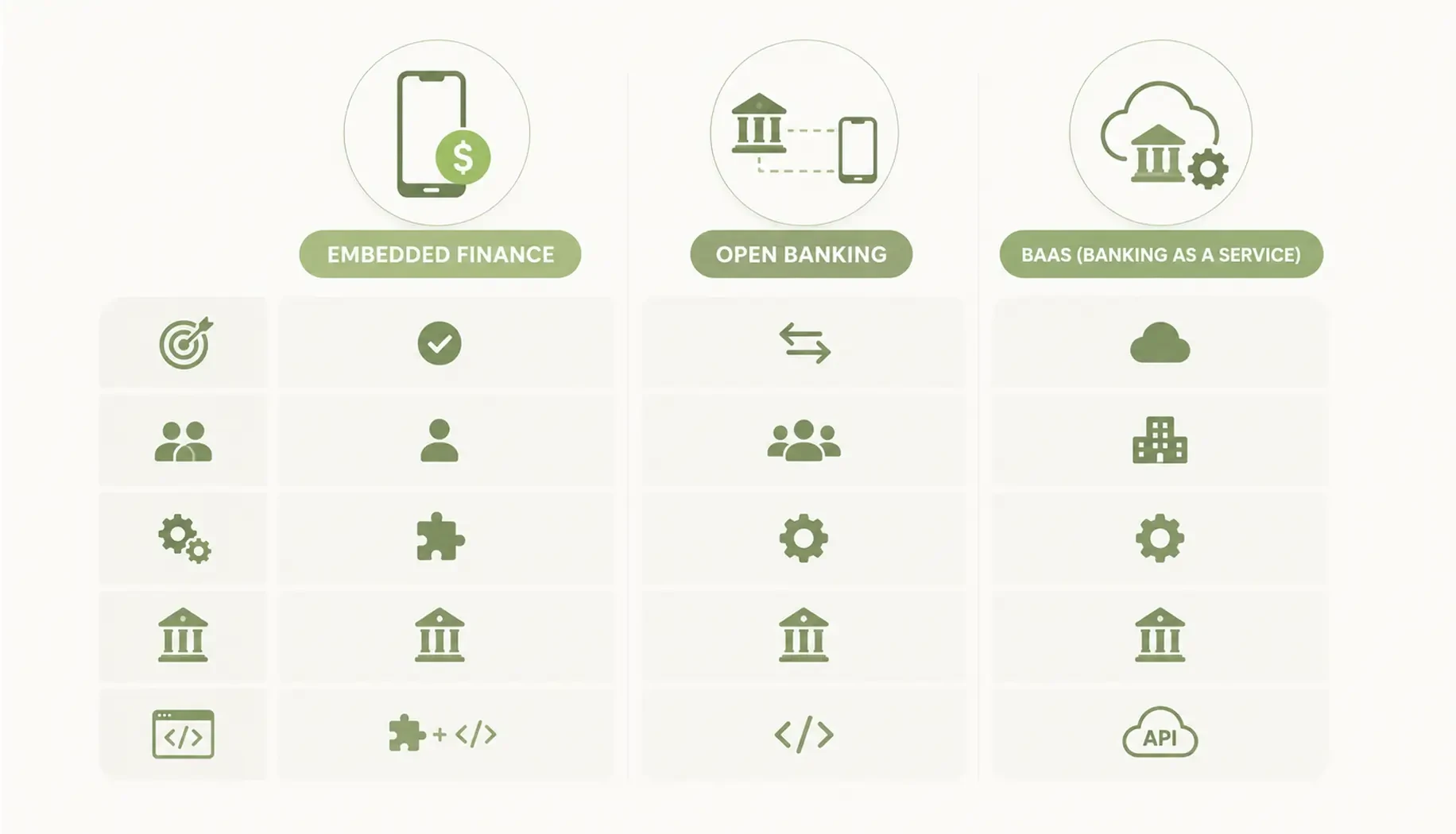
Three terms are regularly confused in embedded finance discussions. Understanding the distinction between them prevents costly architectural mistakes, because each describes a different layer of the infrastructure and requires different decisions from engineering teams.
Concept | What It Is | Who Controls It |
Embedded Finance | Financial services built inside non-financial platforms via APIs | Non-financial companies (SaaS, e-commerce, apps) |
Open Banking | Regulated system for banks to share data via APIs | Regulators (EU PSD2, UK FCA, India RBI, US CFPB) |
Banking-as-a-Service (BaaS) | Banks provide financial infrastructure via APIs | Licensed banks and fintech providers |
The relationship between the three is hierarchical. Open banking is the regulated plumbing that defines how financial data can be accessed and shared. BaaS is the infrastructure layer that provides licensed banking capabilities as programmable APIs. Embedded finance is the product experience that the end user interacts with, built on top of BaaS infrastructure and often using open banking data flows. In many implementations, the application layer is built using modern full-stack technologies such as MEAN stack, often delivered by teams like hire mean stack developers to ensure scalable and modular financial product architecture.
A platform can build embedded finance using BaaS without ever touching open banking. It can use open banking data, such as bank account balances and transaction history, to power embedded lending decisions without issuing a card or holding customer funds. Or it can combine all three: using open banking to read a user's financial history, BaaS to originate a loan based on that data, and an embedded finance interface to present the loan offer inside its own product.
Which model does your product need?
If You Want To… | You Need… | Regulatory Obligation |
Accept payments inside your app | Payment API (Stripe, Adyen, Razorpay) | PCI-DSS compliance, tokenisation |
Offer BNPL or loans at checkout | BaaS lending partner | Credit lending licence (FCA/NBFC etc.) |
Read bank account data | Open banking API (Plaid, TrueLayer) | PSD2 / Account Aggregator compliance |
Issue cards or wallets | BaaS provider (Marqeta, Solarisbank) | E-money licence or BIN sponsorship |
Offer insurance at checkout | Embedded insurance API | Insurance distribution licence |
Compliance and Regulation: What Applies to Your Embedded Finance Product

Embedded finance does not remove regulatory obligation. It redistributes it. Most platforms operate under the licences of their BaaS or payment partner, taking on the role of a distributor or agent. But distributing a regulated financial service still creates compliance obligations for the platform, even when it holds no financial licence itself.
Financial Service | Regulatory Framework | Key Platform Obligation |
Embedded payments | PCI-DSS, PSD2 | Tokenise card data, apply SCA for EU/UK payments |
Embedded lending | EU CCD, FCA CONC, RBI NBFC | Credit disclosures, licensing or broker role compliance |
Embedded banking (wallets) | E-Money regs, GDPR | Safeguard funds, ensure data consent compliance |
Embedded insurance | IDD (EU), FCA ICOBS | Disclose commissions, ensure product suitability |
AI credit decisioning | EU AI Act (2026) | Explainability, risk documentation, human oversight |
Acquaint Softtech's software product development services include a compliance architecture review as the first deliverable in every embedded finance engagement. The review maps applicable regulations to technical controls before any code is written, producing a documented compliance checklist that governs the entire development sprint sequence.
Building embedded finance with compliance from day one?
Acquaint Softtech's compliance-first sprint methodology has delivered 60+ fintech and embedded finance projects that pass regulatory review without costly rework. $25 to $49 per hour. 95% on-time delivery. 4.9/5 Clutch.
Embedded Finance Features: What You Need to Build

The embedded finance features list for a production implementation goes well beyond a single API call. Each financial service type has a set of required features that determine whether the integration is production-ready or a prototype that will fail at scale.
Embedded payments: required features
Hosted payment fields or a certified tokenisation flow that keeps raw card data outside your system and your PCI-DSS scope.
Idempotency keys on every payment write operation so that a network timeout and retry cannot create a duplicate charge.
Webhook receiver with idempotent event handling for payment confirmation, refund, and dispute events.
Reconciliation job that matches your internal transaction records against the payment processor's settlement data daily.
Refund and chargeback workflow with status tracking and customer notification.
Multi-currency support with real-time FX rate conversion for platforms serving users across Europe, Asia, and the Americas.
Embedded lending: required features
Loan origination API call to the BaaS partner that passes verified KYC data and a credit decision request.
Credit decisioning integration: either the BaaS partner's own scoring model or a connection to a credit bureau API (Experian, CIBIL, Equifax) for bureau-based decisioning.
Pre-contractual disclosure screen showing APR, total cost of credit, and right of withdrawal, required by law in the EU, UK, and many US states before the user signs.
E-signature collection for the loan agreement, using DocuSign, HelloSign, or a native signing module.
Disbursement API call that releases funds to the user's account after a completed KYC check and signed agreement.
Repayment schedule and automatic debit mandate management, with failed repayment retry logic and arrears notification workflow.
Embedded banking: required features
Account provisioning API call to the BaaS partner that creates a regulated account in the user's name with the partner institution.
KYC and identity verification flow using document OCR and biometric liveness check before any account is opened.
Fund safeguarding confirmation: the BaaS partner must confirm that customer funds are held in a segregated, protected account.
Card issuance API for platforms issuing branded debit cards through a card programme provider such as Marqeta or Solarisbank.
Transaction notification system delivering real-time balance and transaction alerts to the user via push notification and email.
Every embedded finance type also requires an audit log that records every financial event, every user action on a financial feature, and every system event in an immutable, tamper-evident format. This is not optional. It is a legal requirement under PCI-DSS, GDPR, and every financial services regulatory framework. Acquaint Softtech's Python developers and Laravel developers for hire have built compliance-grade audit logging systems for embedded finance clients across Europe and India.
For the SDK architecture that makes these features plug-and-play across multiple platforms, see Embedded Finance SDK Development: Building Plug-and-Play Financial Modules which covers how to package financial features as reusable SDK components.
How to Build Embedded Finance: Tech Stack and Architecture
The embedded finance development guide every engineering team needs begins with one principle: compliance architecture decisions must be made before application architecture decisions. Choosing the right embedded finance tech stack is the second decision, not the first. The data model, the infrastructure choices, and the API design must all be shaped by the regulatory requirements for the financial services being integrated. Retrofitting compliance into a system not designed for it is the most expensive mistake in embedded finance development. In most cases, teams also rely on specialized infrastructure support such as DevOps expertise, for example hire devops developers, to ensure secure, scalable, and compliant deployment of financial systems from the start.
Recommended tech stack for embedded finance in 2026
Component | Stack | Why |
API backend | Laravel / Node.js | Handles financial workflows + BaaS integration |
AI/ML | Python (FastAPI) | Credit scoring and fraud detection |
Mobile app | React Native | Single codebase for iOS & Android |
Database | PostgreSQL | Secure, ACID-compliant financial data |
Queue | AWS SQS / Redis | Processes payments and webhooks reliably |
Secrets | AWS KMS / Vault | Secure API keys with encryption |
The six-step embedded finance build sequence
Compliance and regulatory scoping (Week 1 to 2): Map every applicable regulatory framework before any code is written. Identify the BaaS provider required, the data processing agreements needed, and the specific technical controls mandated by PCI-DSS, GDPR, or the relevant financial services regulation.
BaaS provider selection and API credential setup (Week 2 to 3): Choose the BaaS partner for your geography and use case. Obtain sandbox credentials. Review the provider's data processing agreement and confirm PCI scope participation before any integration code begins.
Security and compliance architecture design (Week 3 to 4): Design the encryption layer, key management approach, RBAC model, and audit log schema before building any financial feature. These decisions constrain all subsequent technical choices.
Core API integration (Month 2 to 3): Implement the payment, lending, or banking API integration with idempotency, webhook handling, and reconciliation from day one. Not as a later phase, but as the foundation of the first sprint.
Compliance QA and penetration testing (Month 3 to 4): Run a structured audit against PCI-DSS or the applicable framework. Commission a third-party penetration test of the production-equivalent environment. Resolve all findings before launch.
Deployment and post-launch monitoring (Month 4+): Sign all vendor data processing agreements before go-live. Activate real-time monitoring for anomalous transaction patterns and unauthorised access attempts. Confirm reconciliation is running and catching discrepancies.
Acquaint Softtech's discovery workshop services produce the compliance architecture document, BaaS provider recommendation, and technical requirements specification in a structured two-week engagement. Teams that skip this step spend an average of 35% more on remediation than teams that complete it first.
Acquaint Softtech's React Native developers have built the mobile-facing layer of embedded finance products for clients including Hybopay Finance (Dublin) and FLIQA Payments (Slovenia), delivering iOS and Android from one shared codebase with payment compliance logic built into the shared layer.
Embedded Finance Development Costs in 2026
Embedded finance development cost depends on three variables: the type of financial service being integrated, the complexity of the BaaS API, and the compliance scope of the product in its target markets. The following ranges are drawn from Acquaint Softtech's own project portfolio.
Feature Type | Timeline | Typical Cost (USD) |
Basic embedded payments (Stripe or Razorpay SDK integration) | 4 to 8 weeks | $15,000 to $40,000 |
Embedded BNPL at checkout (via Klarna, Affirm, or BaaS partner API) | 6 to 12 weeks | $30,000 to $80,000 |
Embedded digital wallet with stored value and P2P transfer | 3 to 5 months | $50,000 to $120,000 |
Embedded banking with branded accounts and debit card via BaaS | 4 to 8 months | $80,000 to $200,000 |
Embedded lending with origination, decisioning, and disbursement | 4 to 9 months | $80,000 to $250,000 |
Embedded insurance distribution integration at checkout | 4 to 10 weeks | $20,000 to $60,000 |
Full embedded finance platform with multiple service types | 8 to 18 months | $200,000 to $600,000 and above |
Development Region | Senior Developer Day Rate | Notes |
USA and Canada | $800 to $1,500 per day | Highest cost; local specialists |
Western Europe (UK, Germany, Netherlands) | $600 to $1,100 per day | Strong PSD2 and FCA expertise native to region |
Eastern Europe (Poland, Romania) | $350 to $650 per day | Strong talent pool; medium cost |
India, Tier 1 (Clutch-verified, PCI-trained) | $180 to $350 per day | Best value for equivalent compliance quality |
As an embedded finance development company India, Acquaint Softtech delivers embedded finance builds at $25 to $49 per hour, publicly verified on Clutch. That represents up to 40% savings versus Western agency rates, with 95% on-time sprint delivery and a 24-plus month average team tenure across fintech and embedded finance engagements.
For the gig economy variant of embedded finance cost planning, see Embedded Finance for Gig Economy Platforms: Instant Payouts and Micro-Insurance which covers the cost and architecture considerations specific to instant payout and earned wage access features for workforce platforms.
Why Acquaint Softtech for Embedded Finance Development
Building embedded finance requires engineers who understand BaaS provider APIs, idempotent transaction architecture, compliance obligations for financial services distribution, and audit logging requirements at the infrastructure level. This is not standard web development work; it typically requires specialists who have built regulated financial systems before, which is why many teams hire experienced talent through dedicated AI and ML engineering resources such as Hire AI ML Engineers. General web developers often do not make the right architectural decisions in these areas without direct experience in financial software delivery.
When you hire developers for embedded finance from Acquaint Softtech, you get engineers who have personally delivered payment infrastructure for FLIQA Payments in Slovenia, regulatory compliance systems for MAP FinTech in Cyprus, AI document intelligence for Hybopay Finance in Dublin, and neo-bank backend modernisation for XOALA in Sweden. Every project listed on the Acquaint Softtech Clutch profile is independently verified, with the client contactable.
Acquaint Softtech's staff augmentation model places embedded finance engineers directly inside your existing team workflow. Your Jira, your Slack, your sprint cadence. For agencies building custom embedded finance solutions for their own clients, the white label software development model delivers fully attributable code and compliance documentation under your brand.
Common Pitfalls and How to Avoid Them
Choose the BaaS provider after defining the use case, not before.
BaaS providers specialise. Solarisbank is strongest for European card programmes. Unit is optimised for US business banking. RazorpayX serves India. Selecting a provider before mapping your product's geographic scope, user type, and regulatory requirements locks you into a product model that may not fit your needs for 12 to 18 months.
Document every financial data flow before writing any integration code.
Most embedded finance compliance failures come from undocumented data flows. If you cannot produce a diagram showing exactly where every piece of user financial data is stored, how it is encrypted, and who can access it, you cannot satisfy GDPR, PCI-DSS, or your BaaS partner's onboarding compliance requirements. This document must exist before development begins.
Do not rely on the BaaS provider to cover all compliance obligations.
Your BaaS partner covers regulatory compliance for the financial products they issue under their licence. They do not cover your platform's obligations under financial promotion rules, consumer duty requirements, data protection law, or suitability assessments for the users you serve. Read the FCA's financial promotions guidance and your jurisdiction's consumer protection requirements before launching any embedded financial feature.
Build idempotency into every financial write operation from day one.
A payment API call that times out and is retried without an idempotency key will charge the user twice or disburse a loan twice. In any high-volume embedded finance system, this happens dozens of times per day due to network conditions alone. Every financial write operation must carry a unique idempotency key that is stored before the operation is attempted and checked before processing any retry.
Launch reconciliation before you launch the financial feature.
Reconciliation, matching your internal transaction records against the BaaS provider's settlement data, is not a post-launch addition. It is the mechanism that catches discrepancies before they become financial losses or audit findings. A discrepancy discovered two months after launch takes ten times longer to investigate and resolve than one caught on the second day of operation.
Your dedicated embedded finance team deploys in 48 hours.
Clutch Premier Verified. 4.9/5 from 50+ reviews. $25 to $49 per hour. Official Laravel Partner. 1,300+ projects since 2013. Clients across UK, USA, Europe, India, and Australia.
Frequently Asked Questions
-
What is embedded finance?
Embedded finance is the integration of financial services like payments, lending, insurance, and banking directly inside non-financial apps using APIs. It removes the need to redirect users to banks, making financial actions part of the core product experience (e.g., Uber payments, BNPL at checkout, in-app wallets).
-
What features does embedded finance need?
Core features depend on service type but generally include payment processing APIs, KYC verification, webhook handling, credit decisioning, loan or wallet management, and secure audit logs to track all financial transactions.
-
How long does embedded finance development take?
Simple payment systems take 4–8 weeks, BNPL takes 6–12 weeks, embedded lending or banking takes 4–9 months, and full multi-service platforms take 8–18 months including compliance setup and BaaS integration.
-
How much does embedded finance cost to build?
FinTech Solution Type
Estimated Cost
Basic Payment System
$15K–$40K
Buy Now Pay Later (BNPL) Platform
$30K–$80K
Lending or Banking System
$80K–$250K
Full Scale FinTech Platform
$200K–$600K+
-
What is the best tech stack for embedded finance?
Typical stack includes Laravel/Node.js for backend APIs, Python (FastAPI) for AI and fraud detection, React Native for apps, PostgreSQL for secure data, AWS SQS for queues, and AWS KMS/Vault for security and compliance.
-
What is the difference between embedded finance and open banking?
Embedded finance is the product layer where financial services are built into apps. Open banking is the regulatory framework that allows banks to share data via APIs. Open banking enables embedded finance, but embedded finance can also work through BaaS without directly using open banking.
-
Is embedded finance regulated?
Yes. Payments require PCI-DSS and PSD2 compliance, lending requires credit licensing, banking falls under e-money rules, and all systems must follow GDPR, financial promotion laws, and local consumer protection regulations depending on the region.
I am Sanjay Parjapati, a developer at heart and a Head of business by work. My journey started with coding and helped me grow towards becoming a head of business which led me to focus on dual skills, i.e. technical know-hows and the business know-hows. My journey of 10+ years has helped me grow immensely from a professional viewpoint.
Table of Contents
Get Started with Acquaint Softtech
- 13+ Years Delivering Software Excellence
- 1300+ Projects Delivered With Precision
- Official Laravel & Laravel News Partner
- Official Statamic Partner
Related Blog
.webp "The Complete Guide to FinTech Software Development in 2026")
The Complete Guide to FinTech Software Development in 2026
Complete guide to fintech software development 2026: all five verticals, compliance architecture, real build sequences, AI capabilities, and fintech development cost, from 1,300+ delivered projects.

Acquaint Softtech
May 6, 2026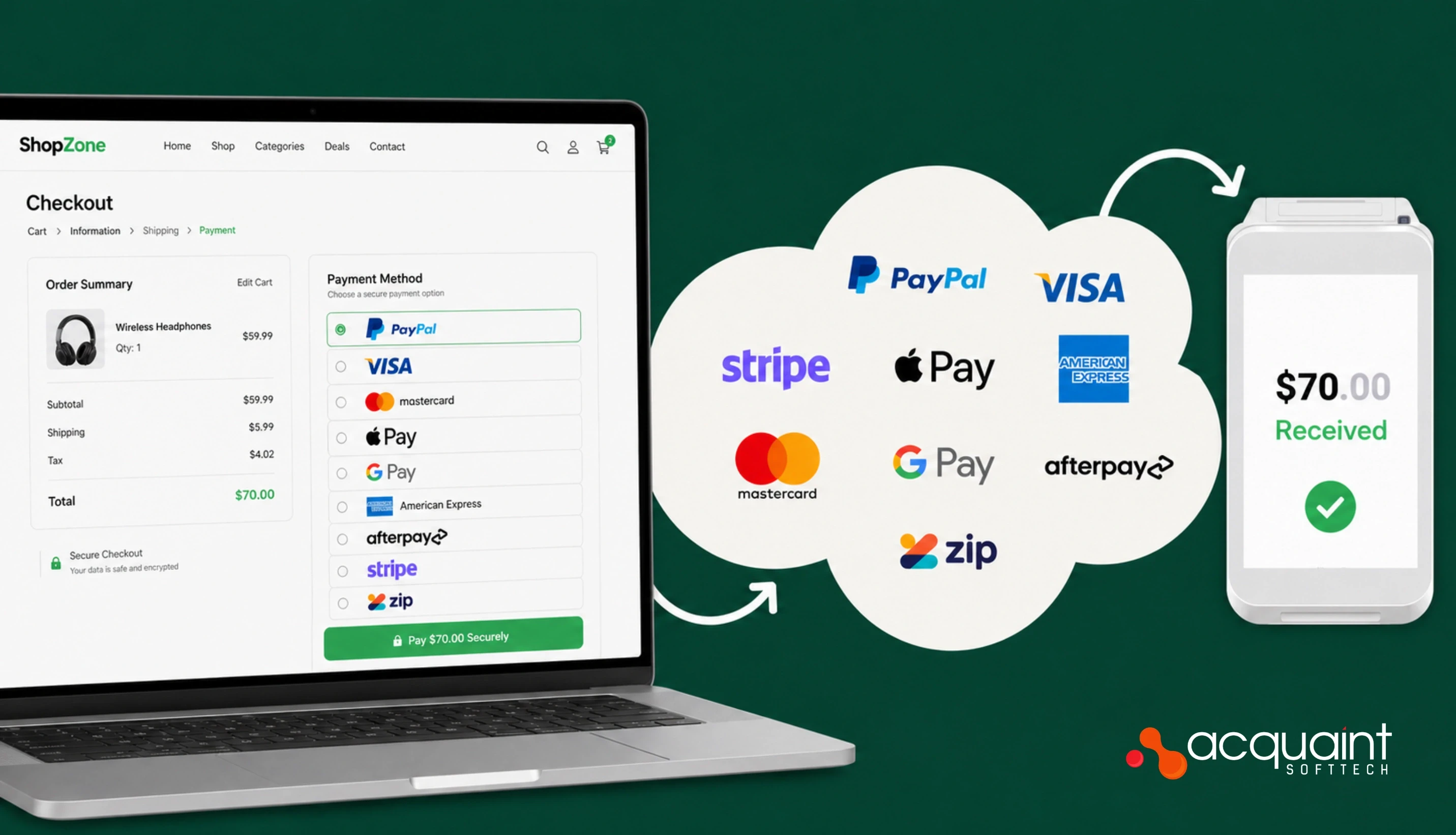
How Payment Gateways Work: Transaction Flow, APIs, and Settlement Explained
A payment gateway is not a checkout button. It is a 7-step transaction pipeline that authenticates, routes, scores, and settles every card payment in under 2 seconds. Here is exactly how it works.

Ahmed Ginani
May 11, 2026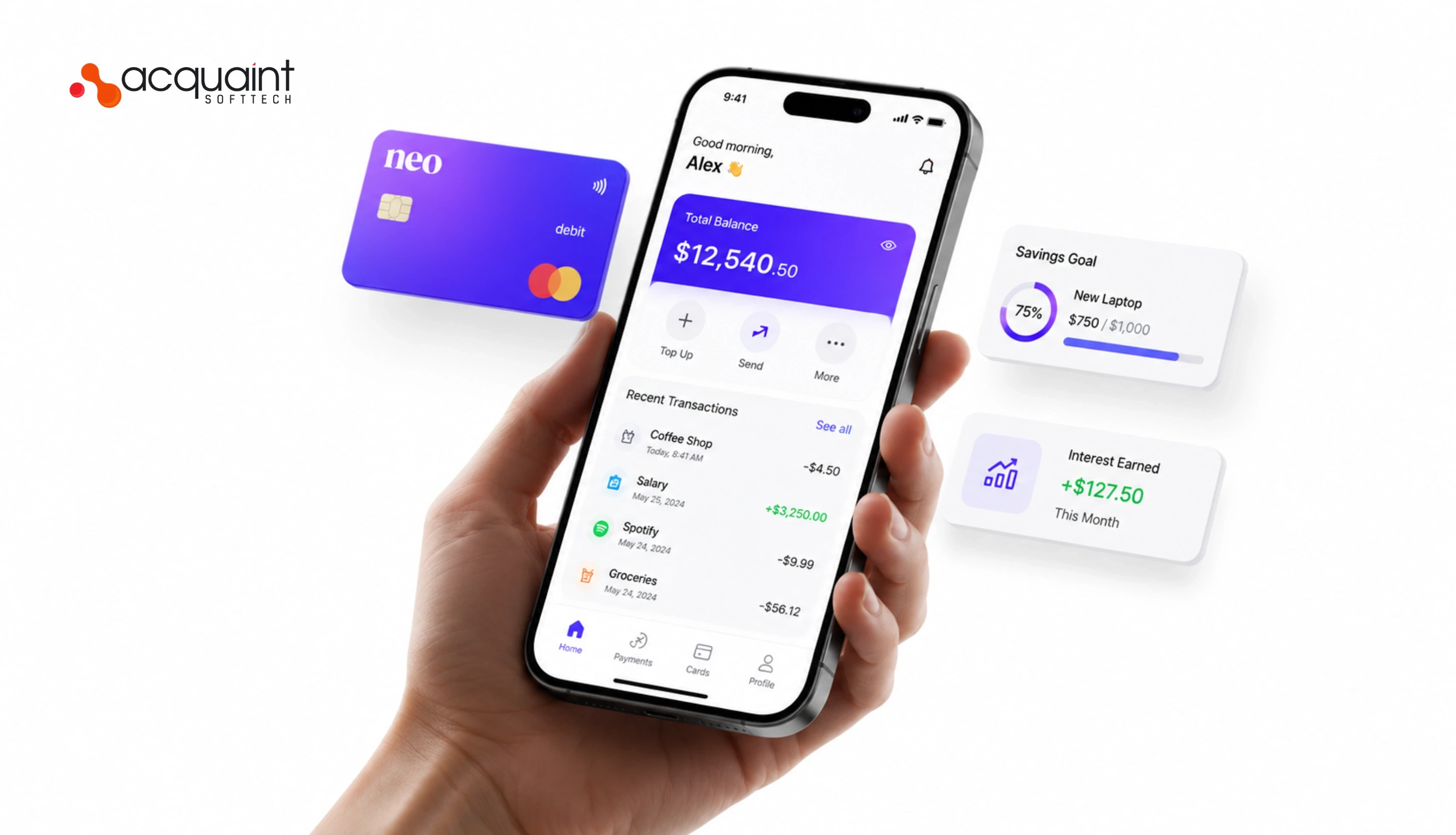
How to Build a Neo Bank: Licensing, Architecture, KYC AML, and Launch Roadmap
Building a neo-bank in 2026 starts with one decision that determines everything else: BaaS consumer or direct licence. This guide covers both paths, licensing, ledger design, KYC/AML, feature roadmap, tech stack, and real cost data.

Manish Patel
May 18, 2026India (Head Office)
203/204, Shapath-II, Near Silver Leaf Hotel, Opp. Rajpath Club, SG Highway, Ahmedabad-380054, Gujarat
USA
7838 Camino Cielo St, Highland, CA 92346
UK
The Powerhouse, 21 Woodthorpe Road, Ashford, England, TW15 2RP
New Zealand
42 Exler Place, Avondale, Auckland 0600, New Zealand
Canada
141 Skyview Bay NE , Calgary, Alberta, T3N 2K6