

How Order Management Systems Work: Order Lifecycle, Routing, and Multi-Channel Fulfillment
An order management system (OMS) works by managing the full life of an order, from the moment a customer buys to the moment the parcel arrives, across every sales channel. It captures and validates each order, reserves inventory, decides which location should fulfill it through routing rules, releases it to the warehouse, and tracks it to delivery and returns. The OMS is the control layer that keeps online, marketplace, and in-store orders synchronized against one real-time view of stock.

Manish Patel

- You sell on more than one channel and orders get fulfilled from the wrong place.
- You are scoping a custom OMS and need to understand the lifecycle and routing first.
- You sell across the USA, UK, Europe, UAE, or India and need multi-region fulfillment.
- You are deciding between an off-the-shelf OMS and a custom build.
- You oversell stock because your channels do not share one inventory view.
You just sold the same last unit to three different customers;
It happens in the time it takes to refresh a page. A product shows one unit left. A shopper buys it on your website, another buys it on Amazon, and a third grabs it in your store, all within the same minute. Your systems each thought the stock was theirs. Now two of those customers get an apology email, a refund, and a reason to never come back, while your team scrambles to explain what went wrong. This is the daily reality of selling across channels without a system that sees them as one, and it is exactly the problem a custom software product development team builds an order management system to solve.
The cost is not just the oversold unit. It is the orders routed to the wrong warehouse, the split shipments that double your parcel cost, the expedited freight you pay because a closer location had stock you could not see, and the hours your team burns coordinating fulfillment by hand. The numbers are real: businesses processing as few as 75 orders a day across multiple sources can lose three or more hours daily just on manual routing decisions, while documented OMS implementations show payback in under six months and three-year returns above 167 percent.
As Manhattan Associates notes, the OMS has become the bridge between the order a customer places and its successful fulfillment. For operators across the USA, UK, Europe, UAE, and India, every extra channel and warehouse multiplies the decisions, and the manual model breaks.
This article explains how an order management system actually works, following an order through its full lifecycle, the routing logic that decides where it ships from, and the multi-channel fulfillment that keeps every channel honest. It is part of the guide to Logistics and Supply Chain Software Development, drawing on platforms Acquaint Softtech has shipped as an Official Laravel Partner with 1,300+ projects, 70+ in-house engineers, and a 4.9/5 Clutch rating from 50+ verified clients.
What an order management system is
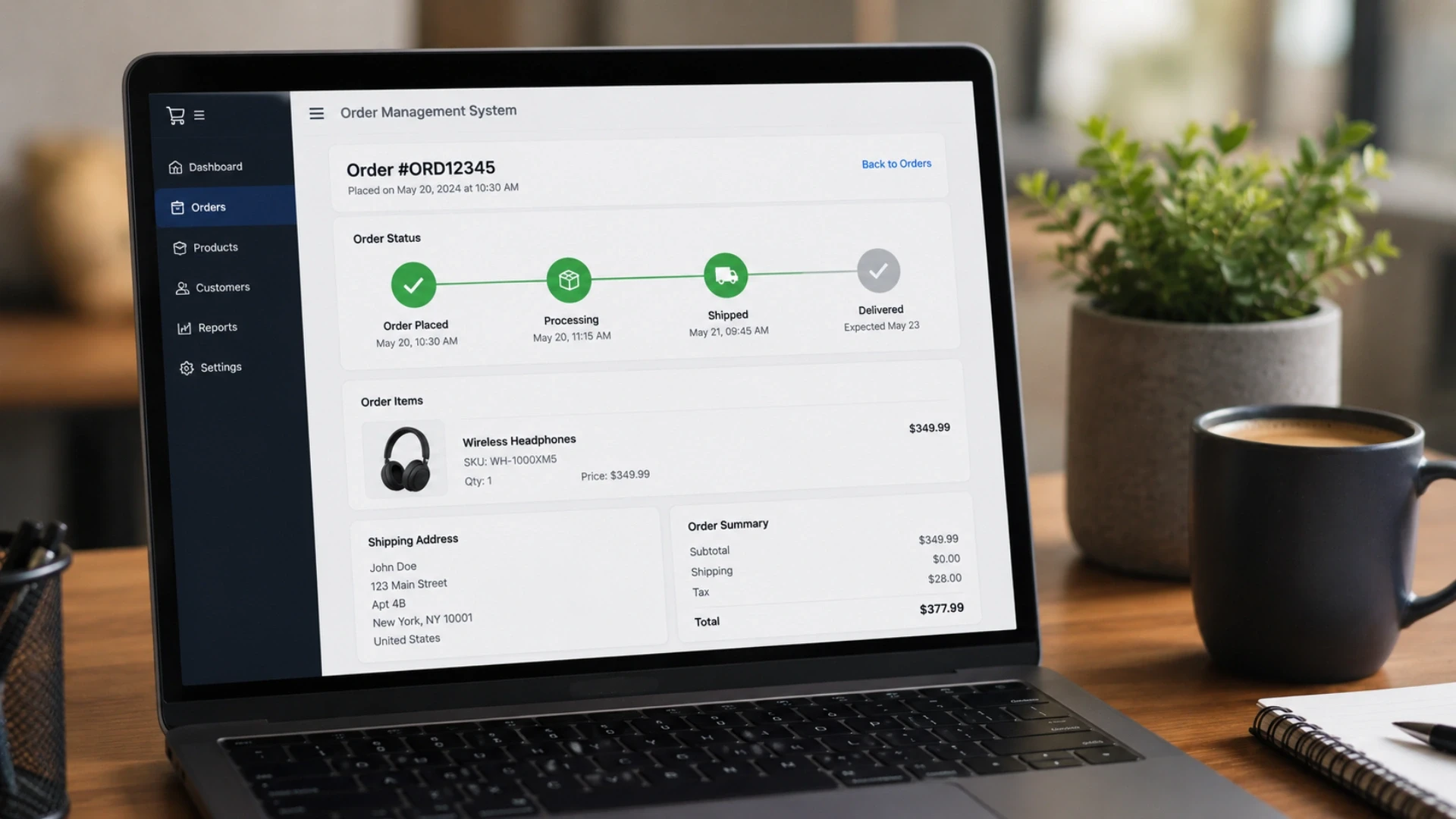
An order management system is software that captures, tracks, and coordinates every customer order from purchase to delivery and returns, across all sales channels, against one real-time view of inventory. It is the control layer that sits between your storefronts and your warehouses, deciding what happens to each order after checkout.
The distinction that trips people up is OMS versus order processing. Processing handles the basic mechanics of payment and shipment. Order management covers the entire journey, keeping orders synchronized across channels and preventing the breakdowns, oversells, mis-ships, and split shipments, that turn customers into complaints.
Acquaint Softtech's Laravel developers build the order capture, state management, and inventory-sync core of an OMS.
The full commerce platform and dashboards around it are built by the software product development team. How the OMS hands orders to the warehouse floor is covered in our published guide on how warehouse management systems work.
The order lifecycle, stage by stage

The order lifecycle is the sequence every order passes through inside the OMS, from capture to delivery. Each stage is a state with its own rules, and the OMS moves the order forward only when the conditions of the current stage are met. Understanding these stages is the foundation of any OMS build, whether you are developing a custom platform or leveraging a white label software development approach to accelerate implementation and reduce time to market.
Stage | What happens |
Order capture | Order ingested from web, marketplace, phone, or store |
Validation | Payment cleared, address checked, fraud screened |
Inventory allocation | Specific units reserved against one stock view |
Routing | Best fulfillment location and carrier selected |
Fulfillment | Released to warehouse for pick, pack, and ship |
Delivery and returns | Tracked to the door, then returns handled |
Validation matters more than it looks. Catching a failed payment or a fake address before fulfillment saves the entire cost of shipping an order that should never have shipped. Each transition is a state change that the OMS records, which is why a custom OMS is built around a clear order state machine.
Acquaint Softtech's Laravel developers build the order state machine and validation rules. The customer-facing order tracking views are built by our MERN stack developers. How the final delivery stage works is covered in our published guide on how last mile delivery software works.
How order routing decides where to fulfill
Order routing is the logic that decides which location fulfills each order, and which carrier ships it, based on rules you set once. Instead of a person checking inventory and shipping cost for every order, the OMS applies the rules automatically the instant an order is validated.
Most systems support a combination of routing rules. Channel-based routing sends all orders from one channel to one location. Location-based routing picks the fulfillment center nearest the customer to cut shipping time and cost. Stock-availability routing falls through to the next location when the primary is out. Building these intelligent routing capabilities often requires experienced development teams, which is why many businesses choose to hire MEAN stack developers from Acquaint Softtech to create scalable and high performance order management solutions. The best systems weigh service-level deadlines, cutoff times, and cost constraints together before releasing the order.
Routing rule | What it does |
Channel-based | All orders from one channel go to one location |
Location-based | Routes to the nearest location with stock |
Stock-availability | Falls through to the next location when one is out |
Cost and SLA | Weighs zone, surcharge, and delivery deadline together |
Acquaint Softtech's Laravel developers build the configurable routing engine and rule editor. Carrier selection logic is built by the backend development team. How carrier and rate selection works downstream is covered in our article guide on how transportation management systems work.
Overselling across channels? Build an OMS that sees all of them as one.
Acquaint Softtech builds order management, routing, and multi-channel fulfillment platforms for clients across the USA, UK, Europe, UAE, and India. Your first dedicated OMS engineer deploys within 48 hours of brief.
How multi-channel fulfillment stays in sync

Multi-channel fulfillment works by pooling inventory from every location into one shared, real-time view, so an order from any channel draws from the same accurate stock count. This is what prevents the oversell: when a unit sells anywhere, every channel knows instantly.
Beyond sync, multi-channel fulfillment supports the patterns modern buyers expect: ship-from-store, buy-online-pick-up-in-store (BOPIS), backorder and pre-order queues with accurate available-to-promise counts, and per-channel rules such as Amazon packaging requirements or wholesale 24-hour processing. The OMS enforces all of this consistently so each channel behaves correctly without a human in the loop. Businesses looking to extend these capabilities into mobile commerce can also hire React Native developers to build high performance cross-platform apps that integrate seamlessly with their order management ecosystem.
Acquaint Softtech's Laravel developers build the real-time inventory sync across channels. The channel integrations to Shopify, Amazon, and marketplaces are built by our MERN stack developers.
Order orchestration: the logic layer above the OMS
Order orchestration is the automated decision layer that determines what happens to each order, including routing, carrier selection, allocation, and exception handling, without requiring a person to make every decision. An OMS manages order data and workflow, while orchestration adds the intelligence that connects surrounding systems. For businesses scaling complex logistics operations, leveraging Virtual CTO services can help design and optimize these interconnected workflows, ensuring greater efficiency, visibility, and automation across the supply chain.
This distinction is the defining theme of 2026. Most operations already have a WMS, carrier integrations, and an OMS, yet orders still route to the wrong place and exceptions still need manual fixes. The gap is the logic between the tools. Every added warehouse or 3PL node multiplies routing decisions, so orchestration, not more systems, is what separates operations that scale from those that strain.
Acquaint Softtech's AI development services build the orchestration and exception-handling logic that connects your stack. The decision engine and rules are built by our Python developers.
OMS vs WMS vs ERP: the real difference
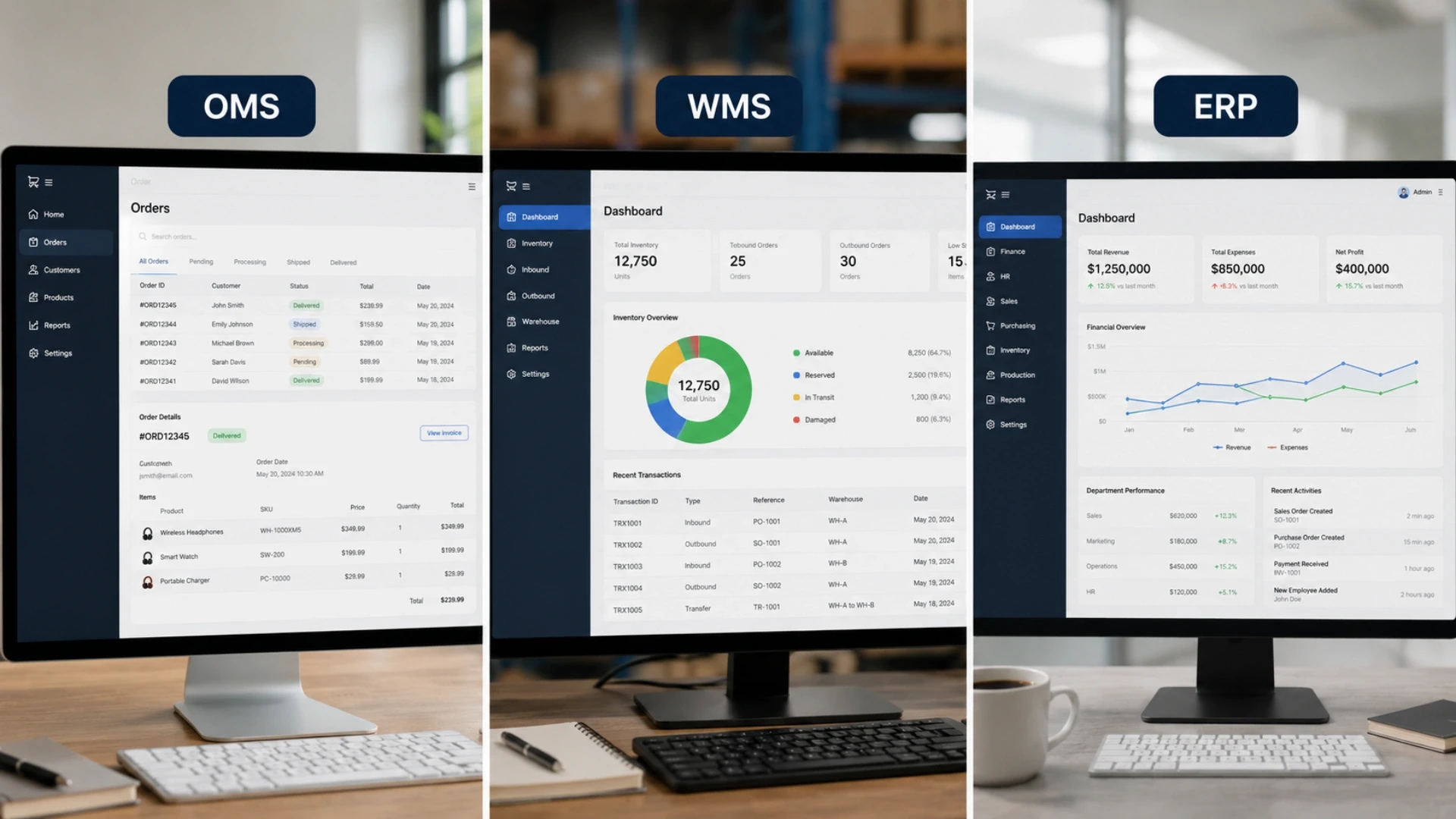
These three are constantly confused, and the confusion drives wrong purchases. Here is the distinction in plain terms.
System | What it controls |
OMS | Decides where and how each order is fulfilled, across channels |
WMS | Executes the physical warehouse work: pick, pack, ship |
ERP | Runs the whole business: orders, finance, procurement |
The simplest way to remember it: the OMS decides where an order should be fulfilled, the WMS executes the picking and packing once the order arrives at a location, and the ERP is the financial system of record around both. They are complementary. Most omnichannel retailers run an OMS and a WMS together, with the ERP behind them.
Acquaint Softtech's Laravel developers build the OMS layer and its handoff to the WMS. End-to-end integration across all three is led by the software development outsourcing team.
How an OMS connects to channels, WMS, and carriers
An OMS is only useful when connected to the systems around it: the sales channels that feed it orders, the WMS that fulfills them, the carriers that ship them, and the ERP that records the money. The integration layer is where most OMS projects succeed or fail. Many businesses choose to hire DevOps developers to build and manage reliable integration pipelines, automate deployments, and ensure seamless data flow across these interconnected systems.
The flow is clear: channels push orders in, the OMS validates, allocates, and routes, then releases to the chosen node's WMS for pick and pack, and shipment and tracking events sync back to the OMS for customer updates. 3PL connections vary, some via API, some via EDI, so confirming what each integration actually covers, order transmission, fulfillment confirmation, tracking sync, returns, is essential before you build.
Acquaint Softtech's Laravel developers build the channel, WMS, and carrier integrations. The integration map is produced first through our discovery workshop services, before any code is written.
Case study: a multi-country order and fulfillment platform
The clearest proof of how order management works is a real multi-country build. This engagement, verified on Clutch, shows order capture, routing, and cross-site fulfillment operating across four countries in one connected system.
Case Study: A 4-Country Order and Fulfillment Coordination Platform
Custom manufacturer routing custom orders across a UK factory, US showrooms, a Brooklyn warehouse, and a Poland finishing facility
The Challenge
• Orders from showrooms and channels tracked manually across four countries
• No single view of which order should be made or fulfilled where
• Order details and routing decisions lost in long email chains
• No automatic handoff between the factory, finishing site, and warehouse
What Acquaint Softtech Built
A single order platform capturing every custom order and routing it to the right site
Centralized order and product data shared across all four locations
Automated handoff of each order through build, finishing, and dispatch
One dashboard tracking order status across the whole network
Measured Outcomes
Orders routed automatically
When a showroom logged a custom order, it flowed straight to the right factory and finishing site with every detail, replacing email back-and-forth.
Status visible everywhere
Each team saw the live status of every order across all four countries, so nothing fell between the gaps during handoff
What makes this instructive is the routing: a custom order captured at one site carried full detail to the right factory and finishing facility automatically, with live status visible to every team, exactly the lifecycle and routing logic from Sections 02 and 03 applied to a real multi-country operation.
Acquaint Softtech's software product development team specializes in this kind of multi-site order coordination platform. For complex multi-region builds, the dedicated software development teams model keeps the same engineers on the platform for the full lifecycle.
Selling across borders? Build an OMS that routes every order correctly.
Acquaint Softtech builds multi-region, multi-channel OMS platforms for clients across the USA, UK, Europe, UAE, and India at $25 to $49 per hour, up to 40 percent below Western agency rates, with 95 percent on-time sprint delivery.
Build vs buy, and what custom OMS development costs in 2026
Off-the-shelf OMS platforms work for standard, single-region ecommerce. They strain where the operation is specific: unusual routing rules, B2B and B2C in one system, custom 3PL connections, or multi-country tax and marketplace constraints. When those drive the business, a custom build wins, and integration costs are often what eat the ROI of a packaged suite.
Dimension | Off-the-shelf OMS | Custom OMS (Acquaint Softtech) |
Time to live | Weeks to a few months | 3 to 9 months for a full build |
Cost model | Per-order or per-seat fees, forever | One-time build; you own the asset |
Routing fit | Preset rules you adapt to | Built around your exact routing logic |
Multi-region | Often limited or costly add-on | Built for your tax and channel rules |
On cost: custom OMS development typically ranges from about $70,000 for a focused MVP covering capture, allocation, and routing, to $500,000 or more for a full multi-channel, multi-region platform with orchestration, driven by channel count and integration depth. A Clutch-verified India-based team delivers the same engineering quality as a Western agency at up to 40 percent lower cost. Teams extending an existing platform can add a vetted engineer through staff augmentation services within 48 hours.
Those starting lean can ship capture, allocation, and routing first, then add channels through Laravel development. For the regional rate context behind the cost gap, see our published guide on Python development cost by industry.
Join 200+ companies that fixed their fulfillment with Acquaint Softtech.
1,300+ projects. 70+ engineers. 4.9/5 Clutch rating from 50+ verified clients. Clutch Premier Verified. Official Laravel Partner. Your first OMS engineer deploys within 48 hours of brief.
Frequently asked questions
-
What does an OMS do?
An OMS captures, validates, allocates, routes, fulfills, and tracks every customer order across all sales channels against one real-time inventory view. It is the control layer that decides what happens to an order after checkout, preventing overselling, mis-ships, and split shipments.
-
How does order routing work?
Order routing applies rules you set once to decide which location fulfills each order and which carrier ships it. Common rules are channel-based, location-based (nearest with stock), and stock-availability fallback, with the best systems weighing cost and delivery deadlines together.
-
What is multi-channel fulfillment?
Multi-channel fulfillment pools inventory from every location into one real-time view so orders from any channel draw on the same accurate stock. It supports ship-from-store, BOPIS, backorder queues, and per-channel rules, keeping web, marketplace, and store orders in sync.
-
How much does an OMS cost?
Custom OMS development runs from about $70,000 for an MVP covering capture, allocation, and routing, to $500,000 or more for a full multi-channel platform. Off-the-shelf adds per-order or per-seat fees. A Clutch-verified India team delivers custom builds at up to 40 percent lower cost.
-
What is the difference between an OMS and a WMS?
S&OP is the medium-term plan balancing demand and supply over months. S&OE is the short-term execution layer that adjusts production, logistics, and inventory in real time to keep that plan on track when something changes next week.
-
What is order orchestration?
Order orchestration is the automated decision layer that determines routing, carrier selection, allocation, and exception handling without manual input. An OMS manages order data and workflow; orchestration adds the logic that connects the systems around it intelligently.
-
When does a business need an OMS?
A business needs an OMS once it sells across multiple channels or fulfills from multiple locations and starts losing time to manual routing, or losing sales to overselling. A common trigger is around 75 orders a day across several sources, when manual coordination breaks down.
-
How does Acquaint Softtech build an OMS?
Acquaint Softtech starts with a discovery workshop mapping channels, routing rules, and integrations, then builds the order state machine, routing engine, and channel sync in 2-week sprints. The first engineer deploys within 48 hours. Verified 4.9/5 on Clutch.
I lead technology and client success at Acquaint Softtech with one goal in mind. Deliver work that feels personal, reliable, and worthy of long term trust. I stay close to both our clients and our developers to make sure every project moves with clarity, quality, and accountability.
Table of Contents
Get Started with Acquaint Softtech
- 13+ Years Delivering Software Excellence
- 1300+ Projects Delivered With Precision
- Official Laravel & Laravel News Partner
- Official Statamic Partner
Related Blog
The Complete Guide to Logistics & Supply Chain Software Development in 2026
Logistics and supply chain software development in 2026 is not a single discipline. It is six distinct product categories, each with its own integration burden, operational perimeter, and cost curve.

Acquaint Softtech
May 1, 2026
How Warehouse Management Systems Work: Architecture, Modules, and Data Flow Explained
A Warehouse Management System is not a spreadsheet with barcode readers attached. It is a structured operational platform that owns inventory location, pick sequence, worker task allocation, and carrier handoff in one controlled environment.
Manish Patel
May 8, 2026
Transportation Management Systems: Carrier Selection, Rate Shopping & Load Optimization
A Transportation Management System is not a tracking map with extra buttons. It is a structured freight operations platform that owns carrier selection, rate negotiation, load planning, dispatch, and proof-of-delivery capture in one governed workflow.
Manish Patel
May 18, 2026India (Head Office)
203/204, Shapath-II, Near Silver Leaf Hotel, Opp. Rajpath Club, SG Highway, Ahmedabad-380054, Gujarat
USA
7838 Camino Cielo St, Highland, CA 92346
UK
The Powerhouse, 21 Woodthorpe Road, Ashford, England, TW15 2RP
New Zealand
42 Exler Place, Avondale, Auckland 0600, New Zealand
Canada
141 Skyview Bay NE , Calgary, Alberta, T3N 2K6