

Python Development Cost by Industry: Healthcare vs FinTech vs SaaS vs eCommerce vs Logistics
Python development cost by industry in 2026. Compare healthcare, FinTech, SaaS, eCommerce, and logistics, and see why compliance drives the price difference.

Acquaint Softtech
Introduction: Why the Same Python Project Costs Wildly Different Amounts
Two companies ask for what sounds like the same thing: a Python web platform with user accounts, a dashboard, and a payment flow. One is an eCommerce store. The other is a healthcare diagnostics company. The eCommerce build comes in around $60,000. The healthcare build comes in around $120,000. The founders compare notes, and the eCommerce founder assumes the healthcare company got overcharged. They did not. The two projects look similar on the surface and are completely different underneath, because the industry determines the compliance burden, the integration complexity, the data sensitivity, and the seniority of the engineers required. Industry is one of the single biggest drivers of Python development cost, and understanding why is the difference between budgeting accurately and being blindsided mid-build.
The cost differences between industries are large and well documented. According to a 2026 custom software cost benchmark by Keyhole Software, based on over 200 verified projects, healthcare software typically runs $75,000 to $250,000 or more depending on HIPAA compliance, EHR integration, and patient data security; FinTech platforms run $90,000 to $300,000 or more for payment processing, fraud detection, and regulatory compliance; and logistics and supply chain systems run $50,000 to $250,000 or more for route optimization, inventory tracking, and API integrations. The same Python language, the same frameworks, and dramatically different price tags, driven almost entirely by what the industry demands.
This guide breaks down Python development cost across five major industries: healthcare, FinTech, SaaS, eCommerce, and logistics. It explains why the cost varies so much, gives the real 2026 ranges for each, unpacks the compliance premium that drives most of the difference, and shows how to control cost in any industry. It is written for founders, CTOs, and decision-makers budgeting a Python project who need to understand what their specific industry actually costs before any vendor conversation begins.
If you are also choosing how to staff the build, the complete guide to hiring Python developers in 2026 sets the wider context on engagement models and rates, which interact with industry to determine the final number you pay.
Why Python Development Cost Varies So Much by Industry
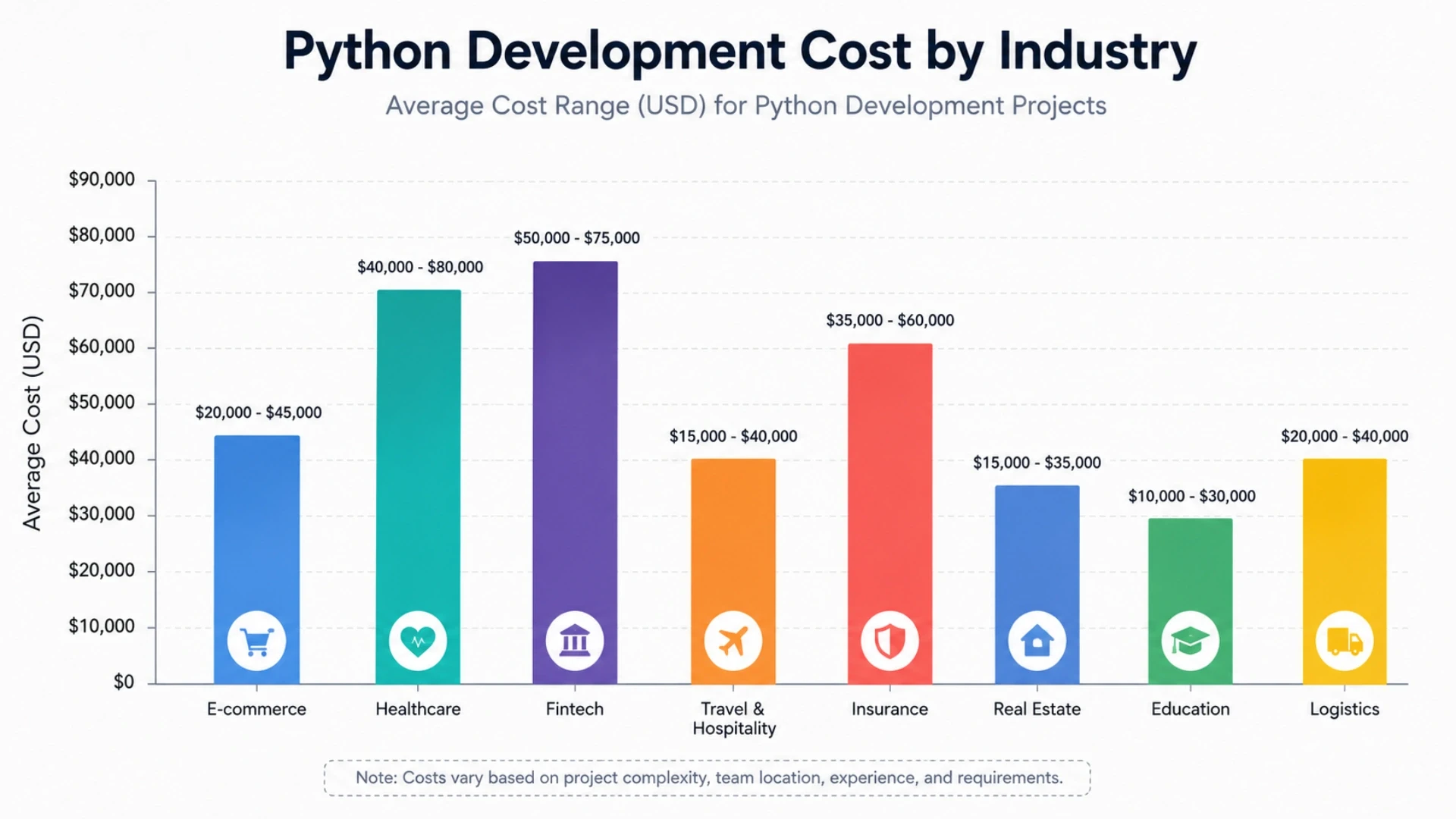
The cost difference between a healthcare Python platform and an eCommerce one is not arbitrary, and it is not a vendor padding the invoice. It comes from four concrete factors that scale up or down depending on the industry. Understanding these four factors lets you predict roughly where your own project will land before you ever request a quote.
The Four Factors That Drive Industry Cost Differences
Compliance burden. HIPAA in healthcare, PCI-DSS in FinTech, GDPR for any EU personal data, SOC 2 for B2B SaaS. Compliance is architectural, touching the data model, access control, audit logging, and testing. It is the single largest industry cost driver and the one most often underestimated.
Data sensitivity and security. A healthcare platform handling patient records or a FinTech system moving money requires security hardening, encryption everywhere, and audit-grade logging that an eCommerce product catalogue simply does not. Higher sensitivity means higher engineering cost.
Integration complexity. Healthcare integrates with EHR and FHIR systems. FinTech integrates with payment processors and banking rails. Logistics integrates with carrier APIs and warehouse systems. The number and difficulty of required integrations varies enormously by industry.
Engineer seniority required. Regulated and complex industries require senior engineers with domain-specific knowledge, who command a 20 to 40% premium over general backend developers. A FinTech compliance specialist or a healthcare data engineer costs meaningfully more than a generalist, and that premium reflects genuine scarce capability.
The Industry-by-Industry Python Cost Breakdown
The table below maps the typical Python development cost for a production-grade platform across the five industries, along with the defining cost driver in each. These ranges assume a vetted offshore development partner. US or UK agency rates run roughly two to five times higher for equivalent scope.
Table: Python Development Cost by Industry (2026, Production Platform)
Industry | Typical Cost Range | Primary Cost Driver |
|---|---|---|
Healthcare | $75,000 to $250,000+ | HIPAA/GDPR, EHR/FHIR, audit logging |
FinTech | $90,000 to $300,000+ | PCI-DSS, fraud detection, ledger integrity |
SaaS | $50,000 to $200,000+ | Multi-tenancy, subscription billing, scale |
eCommerce | $30,000 to $150,000+ | Payments, inventory, marketplace logic |
Logistics | $50,000 to $250,000+ | Carrier APIs, real-time pipelines, optimization |
Reading the Ranges by Industry
Healthcare is the compliance-heaviest. HIPAA and GDPR, EHR integration (Epic, Cerner, Athenahealth), de-identification, and audit logging on every data access push healthcare to a high floor. A single EHR integration alone can cost $50,000 to $150,000. Healthcare software typically costs 30 to 50% more than comparable non-regulated applications.
FinTech is the highest ceiling. PCI-DSS compliance, fraud detection, double-entry ledger integrity, and the seniority required to handle money correctly make FinTech the most expensive industry at the top end. Financial services Python developers earn a median meaningfully above the overall average.
SaaS cost is driven by scale architecture. Multi-tenancy, subscription billing, and the architecture to scale from hundreds to hundreds of thousands of subscribers drive SaaS cost. SOC 2 Type II adds a significant compliance layer for B2B SaaS serving enterprise clients.
eCommerce has the lowest floor. A conventional eCommerce build is the least regulated of the five, so it has the most accessible entry point. Cost climbs with marketplace complexity, multi-vendor logic, and multi-region payments, but a standard store starts lower than any regulated industry.
Logistics cost is integration-driven. Logistics is less about compliance and more about integration volume: carrier APIs, warehouse systems, customs platforms, and real-time event pipelines. The cost scales with how many external systems the platform must orchestrate.
These industry ranges sit on top of the project-type costs that apply everywhere. The full breakdown of what Python costs by project type, from automation scripts to AI/ML platforms, with the location and engagement-model variables that move the number, is in the analysis on what a Python development project actually costs by type, which complements this industry view with a project-type view.
Want an Accurate Cost Estimate for Your Industry?
Acquaint Softtech has delivered 1,300+ Python projects across healthcare, FinTech, SaaS, eCommerce, and logistics, so our estimates reflect the real compliance and integration cost of your specific industry, not a generic ballpark. Senior engineers with domain knowledge, transparent proposals broken down by role and phase, and pricing from $20/hour. Profiles in 24 hours. Onboarding in 48.
The Compliance Premium That Explains Most of the Difference
If one factor explains the cost gap between industries, it is compliance. According to a 2026 software development cost analysis by TechAhead, the practical rule is that if your project exists in a regulated industry, you should add 20 to 35% to your base development cost estimate as a compliance premium. The same analysis notes that SOC 2 Type II certification for a SaaS platform requires a formal audit process that can take six to nine months and cost $30,000 to $100,000 in its first year, before any development work is counted. Compliance is not a line item. It is a multiplier on the entire build, and it is the reason regulated industries cost what they do.
What the Compliance Premium Actually Pays For
Table : What Drives the Compliance Premium by Industry
Industry | Key Frameworks | Premium Range |
|---|---|---|
Healthcare | HIPAA, GDPR, HL7/FHIR | 30 to 50% over baseline |
FinTech | PCI-DSS, SOC 2, KYC/AML | 20 to 35% over baseline |
SaaS (B2B) | SOC 2 Type II, GDPR | 20 to 35% over baseline |
eCommerce | PCI-DSS (via processor), GDPR | 10 to 20% over baseline |
Logistics | Customs/trade, data privacy | 10 to 20% over baseline |
The Hidden Cost of Skipping Compliance
The most expensive mistake in a regulated industry is treating compliance as something to add later. A Python FinTech or healthcare MVP built without compliance architecture because it was not budgeted yet must retrofit that architecture before it can be used commercially, and retrofit compliance work consistently costs two to three times what designing it in from the start would have, because it requires touching code across every layer of an application that was never built with compliance in mind. This is also why a suspiciously cheap quote in a regulated industry is a red flag: a vendor who quotes the same price for a regulated and an unregulated product of comparable scope is usually not designing the compliance in at all.
The full explanation of how to read a quote in a regulated industry, including why the compliance premium is legitimate and which pricing signals indicate a vendor cutting corners, is in the analysis on when Python development is too expensive and the pricing red flags to watch, which shows why the cheapest regulated-industry quote is often the most expensive option in the long run.
How to Control Python Development Cost in Any Industry
Industry sets the floor, but it does not set the final number. Within any industry, the decisions you make about scope, sequencing, staffing, and architecture move the cost substantially. The levers below apply whether you are building healthcare, FinTech, SaaS, eCommerce, or logistics.
Design compliance in from day one. The single biggest cost-control lever in a regulated industry. Designing compliance into the architecture from the first sprint avoids the 2 to 3x retrofit cost, and it is non-negotiable for healthcare and FinTech.
Start with an MVP, expand by phase. Launch with core features, then add capability based on real feedback. A telehealth MVP costs far less than a full platform, and phasing spreads the investment while validating the product. Use existing platforms (Stripe for payments, Twilio for video) rather than building infrastructure from scratch.
Choose the right location and engagement model. Production-level Python skill costs $100 to $150+ per hour in the US or Western Europe, $40 to $80 in Eastern Europe, and $20 to $45 from vetted offshore teams in India. The same compliance-experienced developer can cost 40 to 60% less depending on location, with no quality gap when the team is properly vetted.
Hire domain experience, not just Python experience. A developer who has shipped in your industry prevents the failures that cost exponentially more than the rate difference. Paying the domain premium is cheaper than paying for the failures a generalist will not anticipate.
Invest in proper discovery. Projects starting without a documented scope and discovery phase add 20 to 40% in rework cost. A small upfront investment in discovery is the cheapest insurance against the largest cost overrun.
For the minimum-budget floors by project type and the compliance minimums that do not compress regardless of how lean the build is, the analysis on the minimum budget required to start a Python development project in 2026 gives the matrix to identify your realistic floor before any vendor conversation begins.
How Acquaint Softtech Prices Python Across Industries
Acquaint Softtech is a Python development and IT staff augmentation company based in Ahmedabad, India, with 1,300+ Python projects delivered globally across healthcare, FinTech, SaaS, eCommerce, and logistics. Production-grade AI and ML capability, FinTech compliance experience, and enterprise data engineering expertise are all available within the India offshore market at 40 to 60% of the equivalent US cost, as detailed in the breakdown of Python development cost for mid-sized businesses, which covers the full cost picture across engagement models and industries.
Domain-experienced engineers across five major industries. Healthcare (GDPR-compliant diagnostics for BIANALISI, Italy's largest diagnostics group), FinTech (PCI-aligned transaction systems), SaaS (multi-tenant platforms), eCommerce (custom marketplaces), and logistics (carrier API pipelines), each with the compliance and integration knowledge the industry requires.
Compliance designed in, never retrofitted. HIPAA, GDPR, PCI-DSS, and SOC 2 patterns built into the architecture from day one, which avoids the 2 to 3x retrofit cost and is why our regulated-industry estimates reflect the real compliance burden honestly.
Transparent proposals by role and phase. Every proposal is broken down by role, phase, and deliverable, so you see exactly what the compliance and integration work costs rather than a single opaque number. IP assignment and NDA take effect before any requirements are shared.
Transparent pricing from $20/hour. Dedicated Python engineering teams from $3,200/month per engineer, roughly 40% less than equivalent US in-house hiring. Fixed-price projects from $5,000. Industry-specific architecture audits from $5,000.
To get senior Python engineers with real depth in your specific industry onto your project quickly, you can hire Python developers with profiles shared in 24 hours and a defined onboarding plan within 48.
Budgeting a Python Project in Your Industry?
Book a free 30-minute cost consultation. Tell us your industry and what you are building, and we will give you a straight estimate that reflects the real compliance, integration, and seniority cost of your specific sector, broken down by role and phase. No sales pitch. Just senior engineers who have priced and built across healthcare, FinTech, SaaS, eCommerce, and logistics.
The Bottom Line
Python development cost varies dramatically by industry because industry determines the compliance burden, the data sensitivity, the integration complexity, and the engineer seniority required. Healthcare ($75,000 to $250,000+) and FinTech ($90,000 to $300,000+) sit at the top because of HIPAA, PCI-DSS, and the architecture money and patient data demand. SaaS and logistics fall in the middle, driven by scale architecture and integration volume respectively. eCommerce has the lowest regulated floor. The compliance premium of 20 to 35%, rising to 30 to 50% in healthcare, explains most of the gap, and it is a real cost, not a vendor markup.
The companies that budget Python well are the ones that understand their industry's cost drivers before they request a quote, design compliance in from day one rather than retrofitting it at 2 to 3 times the cost, and choose a staffing model that gives them domain-experienced engineers without paying US in-house rates. A cheap quote in a regulated industry is the most expensive option on the table. An honest quote that reflects the real compliance and integration cost of your specific industry is the foundation of a project that ships, passes review, and can actually be used commercially. Know your industry's number before anyone quotes you, and you will never be blindsided mid-build.
Budgeting a Python Project in Your Industry?
Book a free 30-minute cost consultation. Tell us your industry and what you are building, and we will give you a straight estimate that reflects the real compliance, integration, and seniority cost of your specific sector, broken down by role and phase. No sales pitch. Just senior engineers who have priced and built across healthcare, FinTech, SaaS, eCommerce, and logistics.
Frequently Asked Questions
-
Why does Python development cost more in some industries than others?
Four factors drive the difference: compliance burden (HIPAA, PCI-DSS, GDPR, SOC 2), data sensitivity and security requirements, integration complexity, and the seniority of engineers required. A healthcare or FinTech platform carries heavy compliance and security demands that an eCommerce store does not, which is why the same-looking project can cost twice as much in a regulated industry. Compliance alone typically adds 20 to 35% to the base cost, and healthcare specifically often costs 30 to 50% more than comparable non-regulated software.
-
Which industry has the most expensive Python development?
Industry
Typical Cost Range
Why It Costs More
FinTech
$90,000 to $300,000+
PCI DSS compliance, fraud detection, secure ledger systems, and advanced financial engineering
Healthcare
$75,000 to $250,000+
HIPAA compliance, EHR integrations, and audit grade data handling
eCommerce
Lower compared to regulated industries
Fewer compliance and regulatory requirements
-
How much is the compliance premium for a regulated Python project?
Compliance Area
Impact on Cost & Timeline
Regulated Industry Premium
Adds 20% to 35% to overall development cost
Healthcare Software
Typically costs 30% to 50% more than non regulated platforms
SOC 2 Type II Certification
Takes 6 to 9 months and costs $30,000 to $100,000 in the first year
FinTech & Healthcare Minimum Compliance Cost
Usually starts around $40,000 to $60,000 regardless of feature scope
-
Is eCommerce really cheaper to build in Python than healthcare or FinTech?
Yes, for a conventional build. A standard eCommerce store is the least regulated of the major industries, with PCI-DSS typically handled by tokenizing cards through a payment processor like Stripe so the platform never touches raw card data. This keeps the compliance burden far lighter than healthcare or FinTech. Cost climbs with marketplace complexity, multi-vendor logic, and multi-region payments, but a standard eCommerce platform starts at a lower floor (around $30,000) than any heavily regulated industry.
-
Can I reduce Python development cost without cutting compliance?
Yes, through several legitimate levers. Design compliance in from day one to avoid the 2 to 3x retrofit cost. Start with an MVP and expand by phase rather than building everything upfront. Use existing platforms (Stripe for payments, Twilio for video, a managed EHR connector) instead of building infrastructure from scratch. Choose a vetted offshore partner where the same compliance-experienced developer costs 40 to 60% less than US in-house with no quality gap. What you should never cut is the compliance architecture itself, because retrofitting it costs far more than designing it in.
-
Why is a cheap quote in healthcare or FinTech a warning sign?
Because compliance architecture is a real, non-negotiable cost, so a quote that matches an unregulated project of similar scope usually means the vendor is not building the compliance in at all. They will deliver an application that demos well and then cannot be used commercially in a regulated industry, at which point you pay 2 to 3 times the original savings to retrofit the compliance. A vendor quoting 20 to 35% above a generic web application in a regulated industry is reflecting the real cost honestly, not overcharging.
-
Does developer location affect industry Python cost as much as compliance?
Location and compliance are the two biggest cost drivers, and they compound. The same production-level, compliance-experienced Python skill costs $100 to $150+ per hour in the US or Western Europe, $40 to $80 in Eastern Europe, and $20 to $45 from vetted offshore teams in India. A regulated healthcare or FinTech build is expensive everywhere, but choosing a vetted offshore partner can reduce the total by 40 to 60% versus US in-house while keeping the same compliance credentials, which often matters more to the final number than the industry premium itself.
We’re Acquaint Softtech, your technology growth partner. Whether you're building a SaaS product, modernizing enterprise software, or hiring vetted remote developers, we’re built for flexibility and speed. Our official partnerships with Laravel, Statamic, and Bagisto reflect our commitment to excellence, not limitation. We work across stacks, time zones, and industries to bring your tech vision to life.
Table of Contents
Get Started with Acquaint Softtech
- 13+ Years Delivering Software Excellence
- 1300+ Projects Delivered With Precision
- Official Laravel & Laravel News Partner
- Official Statamic Partner
Related Blog

How to Hire Python Developers Without Getting Burned: A Practical Checklist
Avoid costly hiring mistakes with this practical checklist on how to hire Python developers in 2026. Compare rates, vetting steps, engagement models, red flags, and more.
Acquaint Softtech
March 30, 2026
Total Cost of Ownership in Python Development Projects: The Full Financial Picture
The build cost is just the beginning. This guide breaks down the complete TCO of Python development projects across every lifecycle phase, with real benchmarks, a calculation framework, and 2026 data.
Acquaint Softtech
March 23, 2026
Python Developer Hourly Rate: What You're Actually Paying For
Python developer rates range $20-$150+/hr in 2026. See what experience, specialisation & hidden costs actually determine the price. Save 40% with vetted offshore talent.
Acquaint Softtech
March 9, 2026India (Head Office)
203/204, Shapath-II, Near Silver Leaf Hotel, Opp. Rajpath Club, SG Highway, Ahmedabad-380054, Gujarat
USA
7838 Camino Cielo St, Highland, CA 92346
UK
The Powerhouse, 21 Woodthorpe Road, Ashford, England, TW15 2RP
New Zealand
42 Exler Place, Avondale, Auckland 0600, New Zealand
Canada
141 Skyview Bay NE , Calgary, Alberta, T3N 2K6
Your Project. Our Expertise. Let’s Connect.
Get in touch with our team to discuss your goals and start your journey with vetted developers in 48 hours.