

How to Build an Online Marketplace: Multi-Vendor Architecture, Revenue Models, and Platform Design
Building an online marketplace means creating a platform where many independent vendors sell to many buyers, while the operator owns the infrastructure and earns from each transaction.

Manish Patel

- You want to launch a multi-vendor marketplace and need to understand the build.
- You are deciding between a niche MVP and a full custom platform.
- You need to choose a revenue model: commission, subscription, listing, or ads.
- You want to know how split payments and vendor payouts actually work.
- You operate in the USA, UK, Europe, UAE, or India and plan to scale a platform.
Introduction
The marketplace model is winning, and most founders underestimate the build.
The most valuable e-commerce companies are marketplaces, not stores. Amazon, Etsy, and Airbnb own no inventory; they build the infrastructure connecting sellers with buyers and earn a share of every transaction that flows through. That structural edge is why the top 100 marketplaces generated nearly 3.6 trillion dollars in gross merchandise value in 2025, and why multi-vendor platforms now account for more than half of all global e-commerce sales.
The trap founders fall into is treating a marketplace as a store with extra sellers. It is not, and Acquaint Softtech builds these multi-actor platforms within its software product development practice. A marketplace adds seller onboarding, per-vendor dashboards, split payments routing money to many parties, dispute handling, and the cold-start problem of needing buyers and sellers at once. Each is a distinct engineering challenge that breaks platforms when rushed.
The momentum is real and worth quantifying. According to Statista's global e-commerce forecast, the market is projected to reach 8.1 trillion dollars by 2026, with multi-vendor platforms capturing a disproportionate share of that growth.
Mobile drives roughly 73 percent of marketplace traffic in 2026, which makes a mobile-first build non-negotiable. Buyers increasingly favor platforms with broader selection and competitive pricing, exactly what the marketplace model delivers at scale.
As a CIO at Acquaint Softtech, walks through the architecture, modules, revenue models, payments, and cost. It expands on our Complete Guide to E-Commerce and D2C Software Development in 2026. It draws on Acquaint Softtech's record of 1,300+ projects across 20+ industries in 13+ years, including a custom Amazon-style marketplace detailed later, backed by a 4.9/5 rating from 50+ verified Clutch reviews and a first engineer deployed within 48 hours.
What an online marketplace really is, and how it differs from a store

An online marketplace development is a platform where many independent sellers list products to many buyers through one shared system, while the operator provides the infrastructure and earns from transactions rather than from owning the goods.
This differs fundamentally from a single-vendor store, where one company owns the inventory, sets prices, and fulfills every order. In a marketplace, the operator's product is the platform itself: discovery, trust, payment routing, and vendor tools. The operational complexity is far higher, but so is the revenue ceiling, which is why the model scales once it reaches critical mass. Acquaint Softtech's software product development team maps these two-sided dynamics before choosing any technology to hire MEAN stack developers.
Start in a niche, then expand
The model rewards focus over breadth early on. The most successful marketplaces start in a single niche with clear seller demand, prove the model with a small group, and only then expand into adjacent categories.
The team documents how to validate a marketplace niche with ten sellers and ten buyers before building, a discipline that separates platforms surviving year one. The framework choices are covered in our Best Frameworks for E-Commerce Website Development guide. Founders who need engineering leadership without a full-time hire can add senior talent through Acquaint Softtech's staff augmentation services within 48 hours of a brief.
Multi-vendor architecture, layer by layer
A multi-vendor marketplace sits on the same layered foundation as any custom commerce platform, but adds critical layers that handle the many-to-many relationship between sellers and buyers across one unified system.
On top of the commerce engine, the architecture must add a vendor management layer, a seller-buyer matching layer, a multi-party payment layer, and a trust-and-safety layer for reviews, disputes, and verification. Each vendor runs a sub-store inside the platform. For scaling this kind of system efficiently, you can also leverage expert teams through Hire AI ML Engineers to strengthen the AI and machine learning capabilities behind matching, trust scoring, and automation layers.
The decision that matters most at scale is how data is isolated and routed between vendors without bottlenecks. Acquaint Softtech's product development team builds API-first designs that scale each component independently.
The marketplace tech stack
The stack mirrors a modern commerce build with marketplace reinforcement: a React or Next.js frontend, a Laravel or Node.js backend, PostgreSQL for relational integrity, Elasticsearch for matching, and a payment provider with native split-payment support.
The React-based vendor and buyer interfaces sitting on this architecture are built by Acquaint Softtech's MERN stack developers, ensuring both sides get a fast, mobile-first experience that keeps them transacting. How these layers come together for a real store is covered in our article Why Develop Your E-Commerce Store With Laravel Bagisto guide on catalog and storefront architecture.
The core modules every marketplace needs

Where a single-vendor store needs about seven core modules, a marketplace needs those plus a layer of vendor-specific systems. Vendor onboarding automation alone can reduce operational costs by around 60 percent in a platform's first year. The marketplace adds vendor onboarding with identity and tax verification, a per-seller dashboard, a commission and payout engine, a review and rating system that builds trust, and a dispute resolution workflow for transactions that go wrong.
The seller dashboard deserves real engineering attention, since a clunky one drives vendors away fast. Acquaint Softtech’s software product team, specializing in white label software development, builds dashboards scoped strictly to each vendor’s own store and earnings.
Search and matching make or break a marketplace
A marketplace with thousands of products across hundreds of vendors lives or dies on how quickly a buyer finds the right item. This needs a tuned search engine with faceted filtering, returning results in well under a second.
The AI and behavioral matching behind intelligent search and recommendation is led by Acquaint Softtech's Python developers, who surface the most relevant products at the moment a buyer is ready to act. How the full module set fits into a complete store is covered in the E-Commerce Development Company Services, which outlines the module-by-module build approach.
Planning a multi-vendor marketplace?
Acquaint Softtech designs and builds custom marketplaces with vendor dashboards, split payments, and search-and-matching for clients across the USA, UK, Europe, UAE, and India. Your first engineer deploys within 48 hours.
Marketplace revenue models that actually work

How a marketplace makes money is the single most important business decision a founder makes, because the revenue model shapes the pricing, the features, and the entire relationship with vendors on the platform.
The most proven model is commission, taking a percentage of every transaction, which aligns platform income with vendor success and needs no upfront cost from sellers. The engine must calculate, deduct, and route commission automatically on every order.
Beyond commission, strong marketplaces layer subscriptions, listing fees, and sponsored placements to diversify income. Acquaint Softtech's software product development team builds the revenue engine to be flexible so new models switch on without re-architecture.
Start simple, layer later
The practical advice is to start with one simple model, usually commission, and add layers only once the marketplace has enough traffic and trust, since charging vendors too much too early scares away the sellers a young platform needs.
Teams that need to build these revenue and payout systems quickly can scale through Acquaint Softtech's staff augmentation, which deploys vetted engineers into the build within 48 hours.
Split payments and vendor payouts, the hardest part to get right
The most technically demanding part of a marketplace is moving money correctly, because one buyer checkout often splits payment across multiple vendors, deducts commission, handles taxes, and schedules payouts to each seller.
This needs split-payment infrastructure, typically built on Stripe Connect, that takes one buyer payment and distributes it across sellers and the platform automatically, with a full audit trail for reconciliation against the order system.
Providers handle the heavy compliance, but integrating them is still serious engineering. Acquaint Softtech's Laravel developers build the payment backbone, managing KYC, held funds, payout schedules, and multi-vendor refunds.
Payments must follow your regions
A platform spanning the USA, UK, Europe, the UAE, and India needs different gateways, currencies, and compliance frameworks running in parallel. Getting this right from day one avoids a painful re-architecture when the platform expands internationally.
The multi-gateway, multi-currency architecture is handled by Acquaint Softtech's software development outsourcing team on fully managed builds, keeping every vendor's earnings accurate and payouts on schedule.
Marketplace development cost and timeline by region

The cost of building a marketplace reflects its complexity, and the range is wide because a niche MVP is a very different project from an enterprise platform serving thousands of vendors across multiple regions.
Benchmarks place a basic MVP at 15,000 to 35,000 dollars, a full multi-vendor platform with dashboards, split payments, and search at 80,000 to 200,000 dollars, and enterprise builds higher. Acquaint delivers at 25 to 49 dollars per hour.
The smartest approach is phased delivery, launching a niche MVP first and scaling once validated. Acquaint Softtech's software product team runs this in two-week sprints with a 95 percent on-time delivery record.
Timeline by scope
A niche MVP typically takes three to four months to launch, a full platform six to ten months, and enterprise builds longer depending on integrations and regions served. Parallel sprint streams compress these timelines significantly.
For teams that want a fully managed build rather than an augmented one, Acquaint Softtech's software development outsourcing runs the entire marketplace project end to end with milestone-based delivery.
Solving the cold-start problem and building trust on both sides

The hardest non-technical problem is the cold-start dilemma: buyers will not come without sellers, and sellers will not join without buyers. This deadlock has killed more marketplaces than any engineering failure.
It is usually solved by seeding one side first, recruiting committed sellers in a tight niche and giving them enough visibility that the first buyers follow, then using that early traction to attract more sellers in a compounding loop.
Trust is the other foundation. Acquaint Softtech's software product development team engineers verified reviews, seller-buyer matching, KYC, transparent disputes, and secure payment holding that convince both sides to transact with strangers.
Engineer for reliability from day one
A platform that crashes during a traffic spike or loses payout data destroys months of trust in a single incident. A marketplace must be built for reliability and scale with auto-scaling, monitoring, and data integrity guarantees.
The cloud infrastructure that keeps a marketplace stable from its first ten vendors to its first ten thousand is built by Acquaint Softtech's DevOps engineers, making reliability a competitive advantage.
Case study: a custom multi-vendor marketplace, delivered
The clearest way to understand marketplace engineering is a real platform that shipped. This engagement shows custom architecture solving a problem no template could handle: an Amazon-style marketplace supporting both B2B and B2C sales.
Case Study: A Custom Amazon-Style Multi-Vendor Marketplace
A B2B and B2C marketplace letting multiple independent vendors set up shop, with per-vendor storefront design and a central admin layer.
What the Client Needed
• A marketplace similar to Amazon for multiple independent vendors
• Support for both B2B and B2C sales within a single platform
• Per-vendor control over the UI and UX of each store
What Acquaint Delivered
→ A secure custom marketplace with custom product pages and an API data layer
→ A vendor option to select the UI/UX design of their own store
→ A feature-rich admin dashboard to manage products, users, and vendor stores
→ Dual B2B and B2C transaction logic built around the client's model
Why this is the strongest proof: per-vendor storefront design, dual B2B and B2C selling, and a centralized API-driven admin layer are exactly the capabilities a template marketplace cannot offer. The platform was engineered around the client's business model from the ground up.
Read the full case study and all verified reviews.
What makes this the strongest proof is that every capability the client needed- multiple vendors, dual B2B and B2C selling, per-vendor storefront customization, and centralized admin control, forces a custom build over an off-the-shelf platform.
The platform was engineered from the ground up around how the business operates, exactly what Acquaint Softtech's software product development team delivers on every marketplace engagement, with the architecture serving both sides of the market.
Clients who want the same engineers to stay as the marketplace scales choose Acquaint Softtech's dedicated development team model, which keeps institutional knowledge with the people who built it. A second custom build is documented in our Tarakon Records case study, a niche platform with an integrated e-commerce store and fan-engagement features.
Want a marketplace built around your business model, not a template?
Acquaint Softtech builds and scales custom multi-vendor marketplaces for clients across the USA, UK, Europe, UAE, and India at $25 to $49 per hour, up to 40 percent below Western agency rates, with 95 percent on-time sprint delivery.
How to get started and what the first 48 hours look like
Getting started with Acquaint Softtech is deliberately simple and low-risk: a free consultation, a discovery workshop that scopes the platform and validates the model, then your first engineer deployed within 48 hours of brief.
There is no drawn-out procurement cycle, and everything is covered by an NDA from the very first conversation, so sensitive business and vendor data is protected from the start of the engagement.
The discovery phase matters most, since rushing it predicts scope creep. Acquaint Softtech's software product development team documents the marketplace type, personas, revenue model, and MVP scope into a clear architecture blueprint.
Sprints keep you in control
From there, the build runs in two-week agile sprints with regular demos, so you see working software early and stay in control of scope, budget, and direction rather than waiting months for a big-bang reveal.
Acquaint Softtech e-commerce team
A marketplace is the most demanding thing you can build in e-commerce, because you are not running one store; you are running the infrastructure that hundreds of stores depend on, and the money you move belongs to other people. That is why we never treat a marketplace as a store with sellers bolted on. We start by understanding both sides of your market and engineer the vendor tools, payments, and trust systems around that reality. Build the platform around how your market works, and both sides keep coming back.
The Acquaint Softtech E-Commerce Development Team | Serving clients across the USA, UK, Europe, UAE, and India
Join 200+ companies that chose Acquaint Softtech as their development partner.
1,300+ projects. 70+ engineers. 4.9/5 Clutch rating from 50+ verified clients. Official Laravel Partner. Your first engineer deploys within 48 hours of the brief and stays for the full build.
Frequently asked questions
-
How do you build an online marketplace?
Build a marketplace by validating a niche with real sellers and buyers, then engineering the core layers: a commerce engine, vendor onboarding and dashboards, a search-and-matching system, split payments, and a revenue model. Start with a focused MVP, prove both sides transact, then scale.
-
What is a marketplace business model?
A marketplace business model is one where the operator builds a platform connecting many sellers with many buyers and earns from transactions rather than owning inventory. The most common stream is commission on each sale, often layered with subscription fees, listing fees, and sponsored placements.
-
What is multi-vendor architecture?
Multi-vendor architecture is the structure that lets many sellers operate inside one platform, each with their own listings, orders, and payouts, while buyers see a unified experience. It adds vendor management, seller-buyer matching, and multi-party payment layers on top of a standard commerce engine.
-
How much does marketplace development cost?
Build Type
Cost Range (USD)
Region Range
MVP Platform
$15,000 – $40,000
India / UK / EU / US
Multi-vendor Platform
$70,000 – $220,000
India / UK / EU / US
Enterprise Build
$150,000 – $300,000+
India / UK / EU / US
-
How do marketplace payments work?
Marketplace payments use split-payment infrastructure, often Stripe Connect, that takes one buyer payment and distributes it across multiple sellers and the platform's commission, with seller KYC, scheduled payouts, and reconciliation. This is the most demanding part and is where rushed builds break.
-
What is the cold-start problem in a marketplace?
The cold-start problem is the chicken-and-egg challenge that buyers will not join without sellers, and sellers will not join without buyers. It is usually solved by seeding one side first, recruiting committed sellers in a tight niche, then compounding the loop as buyers follow.
-
Custom development or a platform for a marketplace?
Use a no-code platform to validate quickly if your needs are standard. Choose custom development when you need per-vendor storefront control, B2B and B2C in one system, complex commission rules, or multi-region payments. Most serious marketplaces move to custom as they scale.
-
How fast can Acquaint start my marketplace project?
Your first engineer deploys within 48 hours of brief. The path is a free consultation, a discovery workshop that scopes the platform and validates the model, then kickoff in two-week agile sprints with regular demos so you stay in control of scope and budget.
I lead technology and client success at Acquaint Softtech with one goal in mind. Deliver work that feels personal, reliable, and worthy of long term trust. I stay close to both our clients and our developers to make sure every project moves with clarity, quality, and accountability.
Table of Contents
Get Started with Acquaint Softtech
- 13+ Years Delivering Software Excellence
- 1300+ Projects Delivered With Precision
- Official Laravel & Laravel News Partner
- Official Statamic Partner
Related Blog
.webp "The Complete Guide to E-Commerce & D2C Software Development in 2026")
The Complete Guide to E-Commerce & D2C Software Development in 2026
Custom e-commerce software is not a more expensive version of Shopify. It is an entirely different accountability and ownership structure, with different economics and a different ceiling on what your platform can do. This guide explains every architecture type, every cost variable, and every decision checkpoint so you build the right thing in 2026.

Acquaint Softtech
May 6, 2026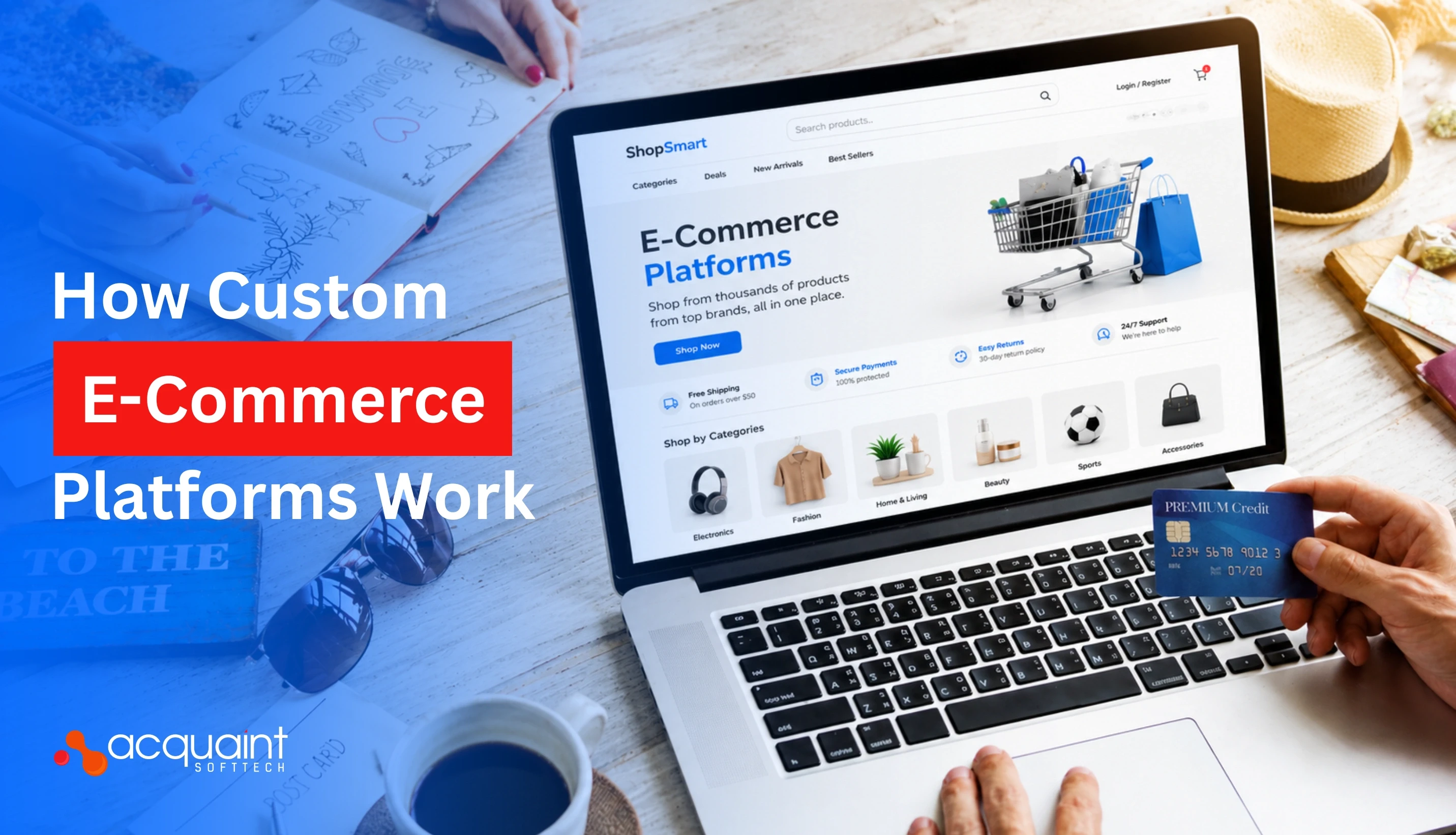
How Custom E-Commerce Platforms Work: Architecture, Modules, and When to Build One
A custom e-commerce platform is not a bigger Shopify plan. It is a purpose-built commerce engine where every module answers to your business logic, not a vendor's roadmap. This article explains exactly how one is architected, what it contains, and the 5 operational signals that tell you when building your own beats, staying on SaaS.
Manish Patel
May 12, 2026.webp "Headless Commerce Explained: Decoupled Architecture for Modern E-Commerce Development")
Headless Commerce Explained: Decoupled Architecture for Modern E-Commerce Development
Headless commerce is not a technology upgrade. It is a structural decision that separates the commerce engine from the storefront entirely. Done right, it gives you deployment freedom, channel flexibility, and a performance ceiling that no monolithic SaaS platform can match. Done wrong, it creates distributed systems complexity that your team is not ready for. This article tells you exactly which situation you are in.