

What Cross-Border Startups Must Solve in Pan-European WMS
To scale a logistics startup in Europe, you need more than code. You need a Pan-European Warehouse Management Platform built on a resilient, AI-ready tech stack

Manish Patel
Introduction: The Great European Logistics Puzzle
Europe sells the dream of a unified market: one currency (mostly the euro), open borders, and seamless trade. But if you're a logistics startup building a pan-European warehouse management system, reality hits fast. Building on it means dealing with different tax rules, different compliance laws, and different delivery expectations.
Consider it similar to organizing a game of football where the pitch changes size every 10 yards, the referee speaks three different languages, and the ball periodically disappears into a tax-induced black hole. That is essentially what building a warehouse management system feels like for most startups today.
This article provides in-depth insights into the challenges cross-border logistics startups face when building pan-European warehouse management platforms.
Why Europe Is a Different Beast for Logistics Startups

The European Union is 27 interconnected micro-markets with their own tax systems, labor laws, delivery SLAs, and customer expectations. Besides which, there are also the markets in the European countries that are not a part of the European Union.
According to the European Commission, cross-border eCommerce in Europe is growing at a rate of 15%+ annually. The value of the European eCommerce market in 2024 was 765.6 billion euros. Needless to say, the operational complexity is the #1 barrier.
The warehouse management platforms are no longer just software; it's your operational backbone. The perfect WMS is every CEO's dream, one that shows inventory in Berlin, Lyon, and Warsaw in real-time. It is also one that can handle multiple currencies, is multilingual, and is prepared for the multi-tax reality of the Eurozone.
The main scaling pain points for all businesses include localization vs. centralization, time-to-market, and operational risk.
Create a Warehouse Management System Tailored for Europe
Your WMS isn’t failing because of code. It’s failing because it wasn’t designed for Europe. Let’s re-architect your system for cross-border scalability.
Cross-Border Logistics For Startups
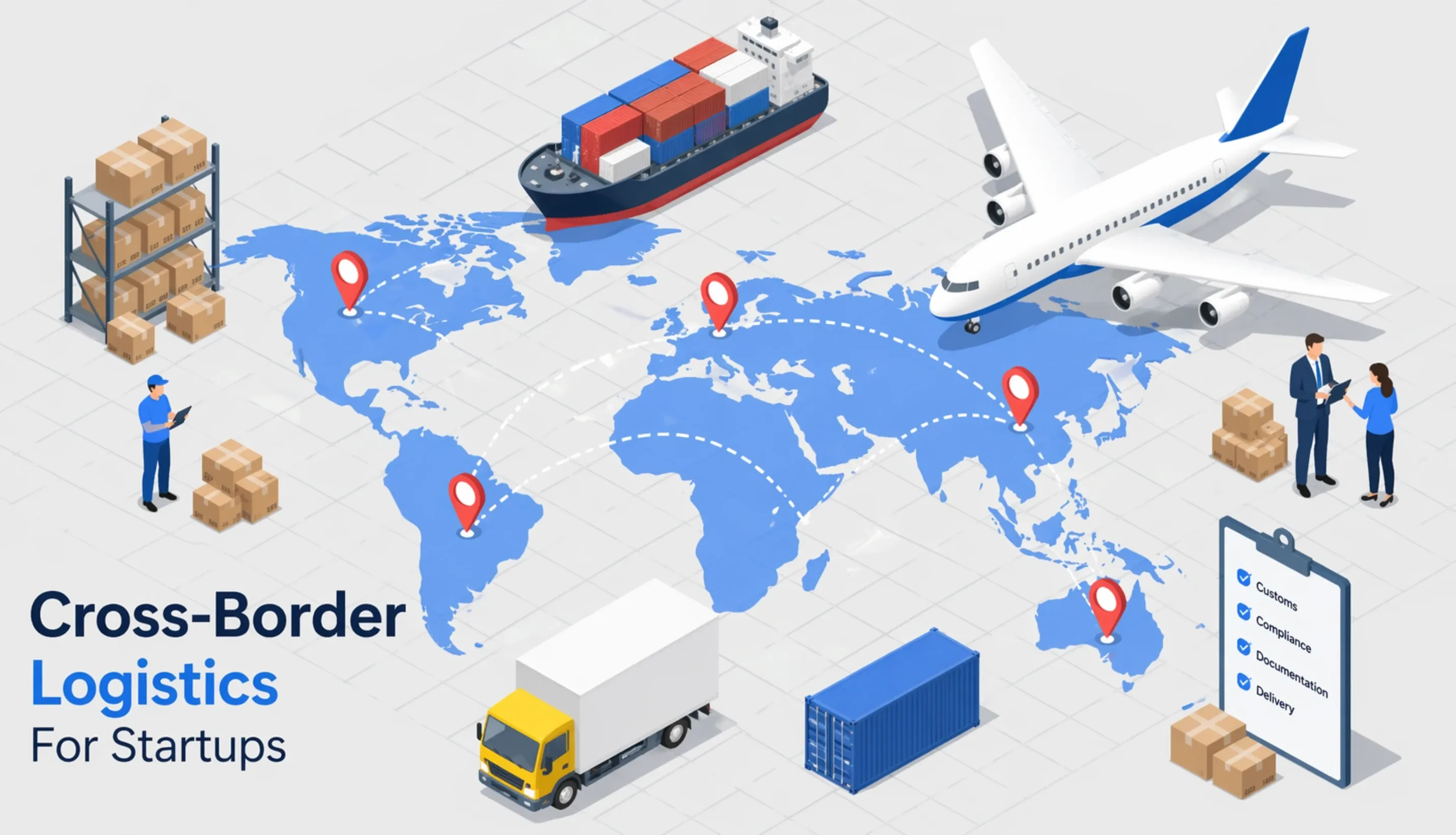
Operating a logistics startup in Europe is less like a straight sprint and more like a high-stakes hurdles race. To achieve true pan-European scale, your warehouse management system must act as a digital diplomat, translating complex regional variables into a unified operational language.
Below are the critical factors that separate market leaders from those stuck at the border:
The Compliance Puzzle: GDPR, VAT & Customs:
Compliance in Europe is a moving target. Beyond standard data privacy, a cross-border WMS must automate the calculation of varying VAT rates and generate customs documentation for non-EU territories such as the UK and Switzerland. Failure here doesn't just mean a delay; it means heavy fines and a tarnished reputation. Acquaint Softtech builds systems that integrate real-time regulatory updates, ensuring your "paperwork" is always digital-first and bulletproof.
Real-Time Inventory Across Borders: The Latency Problem:
When a customer in Paris orders a product stored in Warsaw, a 5-second lag in inventory synchronization can result in double-selling. Latency issues are real when managing distributed databases. We solve this by implementing edge computing and vector databases, ensuring inventory levels are updated in milliseconds across the entire continent and maintaining a "single source of truth" for your C-suite dashboard.
Multi-Warehouse Orchestration: The Control Tower Model:
You need a "Control Tower" view, a centralized hub that orchestrates movement across fragmented nodes. This model allows CEOs to see not just where stock is but where it should be based on predictive demand. By adopting a microservices architecture, we ensure each warehouse operates with local autonomy while remaining perfectly synced with the central command, enabling seamless resource reallocation during peak seasons.
Integration Chaos: Carriers, APIs & Legacy Systems:
Europe’s carrier landscape is a patchwork of giants like DHL and hyper-local couriers in the Baltics. The "Integration Chaos" arises when these entities use incompatible legacy protocols.
Our approach involves building a robust Middleware Layer that standardizes these diverse data streams into a single API. This allows you to onboard a new regional carrier in days rather than months, drastically reducing your time-to-market.
AI & Automation: The Competitive Edge:
In 2026, AI is no longer a luxury; it’s the engine. Using Agentic AI, your WMS can autonomously route shipments to avoid strikes, weather disruptions, or border bottlenecks. By analyzing historical data, the system predicts "empty mile" risks and suggests co-loading opportunities.
This level of automation directly impacts your ROI by slashing operational overhead and maximizing the utility of every square meter of warehouse space.
The Real Problem: Europe Is Not One Market:
The biggest mistake a founder can make is treating Europe as a monolith. From the "last-mile" nuances in Italy to the strict labor laws in Germany, the market is deeply fragmented.
Your software must be hyper-localized, supporting multiple languages, currencies, and regional shipping preferences while maintaining a unified backend. We design for this diversity, ensuring your platform feels "local" in every country it touches.
Data Sovereignty and GDPR: More Than Just a Checklist:
Data sovereignty means ensuring European data stays on European soil, even when your development team is global. As CIO, I ensure our Laravel-based solutions use localized cloud clusters (like AWS Frankfurt or Azure Paris).
This isn't just about avoiding a "Checklist" fine; it’s about building trust with European enterprise clients who prioritize data privacy as a core value of their brand identity.
Integration or Isolation? The API-First Mandate
An isolated WMS is a dead WMS. Our API-First Mandate ensures that your software is a "good neighbor" in the tech ecosystem. Whether connecting to ERPs like SAP, eCommerce giants like Magento, or local accounting software, our modular API design prevents vendor lock-in.
This flexibility allows your startup to pivot or scale services without rewriting the core codebase, protecting your long-term investment.
VAT and Customs Process Automation:
Manual customs entries are a relic of the past. For cross-border logistics, we implement automated customs gateways that generate EORI-compliant documentation instantly. By integrating with national tax databases, the WMS calculates the exact VAT for "distance selling" thresholds in real-time.
This reduces human error on the warehouse floor, ensuring trucks spend their time on the road rather than sitting at a border checkpoint.
Multi-Carrier API Orchestration:
Shipping from Madrid to Berlin is different than shipping from Madrid to Lisbon. Multi-Carrier Orchestration enables your system to automatically select the best carrier for each route based on cost, speed, and reliability. We build intelligent routing engines that compare carrier APIs in real-time, providing your customers with the most efficient shipping options while protecting your margins from fluctuating carrier rates.
Returns Management at Scale:
In Europe, the "Right to Return" is a powerful consumer force. A pan-European WMS must handle reverse logistics as efficiently as forward shipping. This involves managing local return hubs, automated "Grade-A/B" restocking assessments, and instant refund triggers.
We build specialized returns modules that turn a potential cost center into a loyalty builder, ensuring returned items are back in the "Available to Sell" column as quickly as possible.
Real-World Examples: What Europe’s Logistics Leaders Got Right
Zalando (Germany):
Zalando's automated fulfillment center in Erfurt processes over 500,000 orders daily using robotic arms and conveyor networks exclusively dedicated to sales logistics (Source: Market Data Forecast, 2025). Their WMS is the invisible orchestrator behind every single one of those movements. The lesson: at scale, your WMS is not a tool. It is the operating system of your business.
Amazon (UK):
Amazon announced plans to build four new fulfillment centers and additional delivery stations in the UK as part of a £40 billion investment program spanning 2025 to 2027 (Source: Clarion Partners, 2025). Their investment thesis is built on unified platform logic: one WMS, multiple geographies, and local compliance embedded at the infrastructure level.
Temu (Pan-European):
Temu's strategic move to fulfill 80% of European orders via six in-country warehouses by December 2024 cut delivery lead times from weeks to days (Source: Mordor Intelligence, 2025). This was not a warehousing decision. It was a software architecture decision: distributed fulfillment controlled by a centralized WMS.
DB Schenker (Germany):
In January 2025, DB Schenker unveiled an AI-driven logistics solution incorporating automated warehouse management, real-time performance monitoring, and predictive supply chain alerts (Source: GM Insights, 2025). Predictive, not reactive. That is the standard being set.
Overcome Cross-Border Challenges By Outsourcing to Experts
Scaling across Europe isn’t about adding more warehouses. It’s about adding intelligence to your system. That’s where the right tech partner like Acquaint Softtech makes the difference.
The Acquaint Softtech Approach: Build Smart, Scale Fast
Hiring 70+ in-house IT professionals in Europe is expensive, slow, and not practical. This is where the IT staff augmentation model becomes a game-changer. At Acquaint Softtech, we provide the "heart" (our developers) to bring your project to life.
We don't just "hand over" developers. I personally ensure the bridge between our team and your vision is rock solid. We treat your project as if it were our own.
Every logistics founder I have worked with came in thinking they needed developers. What they actually needed was a development partner who understood the business problem well enough to push back on the technical decisions.
When you hire remote developers from Acquaint Softtech, you gain access to highly skilled developers and top-notch resources. Here are a few reasons why businesses prefer us:
Zero Recruitment Risk: We’ve already vetted the experts.
Staff Augmentation: Senior engineers who slot into your existing team within days, not months
Scalability: Need five Laravel experts for three months? Done.
Global Presence: With offices in the UK, USA, and India, we provide 24/7 development cycles.
Dedicated WMS Development Team: A full-stack team embedded in your roadmap, owning delivery end-to-end
Fixed-Scope MVP Build: A de-risked first version with defined scope, timelines, and milestones
Reviews: A 4.9/5.0 Clutch rating with over 40 reviews.
We have built logistics solutions, fleet management systems, and field service platforms for clients across the UK, Germany, the Netherlands, and the broader EU market.
Headquartered in Ahmedabad with offices across the USA, UK, New Zealand, and Canada, we combine 13+ years of expertise with a Laravel partnership status. Recognized by TrueFirms for IT staff augmentation in 2025 and top-rated on Clutch with 5/5, we solve exactly your pain points.
Whether you need a full custom pan-European warehouse management system or skilled developers to augment your team, we act as the bridge. Developers stay motivated; clients receive better-than-expected results. No long hiring cycles, no surprise costs, just reliable execution.
Moving Beyond the Border
Building a Pan-European WMS isn't a coding challenge; it's a business transformation. It requires a partner who understands the technical nuances of Laravel, the security demands of the EU, and the business goals of a CEO.
The road to 2026 is paved with data. Let's make sure your platform has the engine to drive it. Cross-border logistics startups that master Pan-European Warehouse Management Platforms turn regulatory complexity into speed, labor shortages into automation, and cost pressures into margin gains. The 2026 customs changes make action urgent.
As CIO, I have watched many founders hesitate and lose momentum. Do not let that happen to you. Contact Acquaint Softtech today. Let us build, or accelerate, the platform that powers your European expansion.
Build a WMS that understands borders, compliance, and scale from day one
Europe doesn’t reward simple systems; it rewards smart ones. Partner with a team like Acquaint Softtech that has engineered cross-border-ready platforms. Let’s build your Pan-European WMS the right way.
Remote and in-house teams were once separated by a simple factor: location. In 2026, that distinction is outdated. The real differences now lie in speed, scalability, cost efficiency, and access to specialized talent.
Let’s break things down:
Access to Talent:
In-House: Limited to local hires; competition is fierce, especially in tech hubs.
Remote: Global hiring means you get access to niche specialists who would never relocate.
Stat: Gartner reports that 71% of companies in 2026 hire remotely to access skills unavailable locally.
Cost Structure:
In-House: Salary + benefits + office space + hardware + training = predictable but high.
Remote: Pay only for talent and productivity; no overhead.
Speed of Hiring:
In-House: 30–90 days
Remote: 48–72 hours if you work with the right outsourcing partner.
Productivity Patterns:
Contrary to old assumptions, remote developers often outperform in-house teams. Remote teams scale instantly; in-house teams scale slowly.
This distinction is why so many CEOs now choose hybrid or fully remote models backed by outsourcing partners like Acquaint Softtech. We provide our clients the option to either outsource their software development requirements or opt for IT staff augmentation.
Here is a table that stacks several metrics that paint a better picture, allowing businesses to make a more informed decision.
Aspect | In-House Developers | Remote Developers (Outsourced) | Winner in 2026? |
Cost | $200K–$300K/year per dev (Glassdoor 2025 | $40K–$80K/year equivalent (Upwork 2025) | Remote saves 60–70% |
Scalability | Rigid; hiring lags 3–6 months (LinkedIn 2025) | Elastic; ramp up in weeks | Remote - agile scaling |
Productivity | 22% innovation boost (McKinsey 2025) | 13% gain via focus (Gartner 2025) | Tie — context matters |
Talent Pool | Local 10–20% skilled (Deloitte 2025) | Global 80% access | Remote — diversity wins |
Turnover | Local 10–20% skilled (Deloitte 2025) | 32% with strong mgmt (FlexJobs 2025) | Remote — retention edge |
Security | High control, low breach risk | 15% higher risk if unmanaged (Forrester 2025) | In-House—unless vetted |
The Verdict
Remote vs. in-house development is no longer a binary decision. In 2026, the smarter question is, "How can I build a development system that helps my business grow faster?"
Remote teams offer speed, scale, and cost efficiency.
In-house teams offer culture, collaboration, and control.
Hybrid offers balance.
And outsourcing partners like Acquaint Softtech offer end-to-end reliability with global expertise.
If you want to build a high-performance engineering engine in 2026, you need more than developers.
You need the right model.
You need the right partner.
You need the right ecosystem.
And that’s where we come in. At Acquaint Softtech, we don’t just provide code; we provide solutions, partnerships, and a pathway to your success. We specialize in remote outsourcing, offering vetted developers with AI support. We've helped over 500 clients scale, from startups to enterprises.
Hire remote developers from Acquaint Softtech. Let’s connect and discuss because in 2026, the real question isn't whether to go remote or in-house, but rather, how wisely will you build your future?
Frequently Asked Questions
-
Why is building a Pan-European WMS more complex than a standard system?
A Pan-European WMS must handle diverse tax systems, compliance laws, and logistics expectations across multiple countries. Unlike a single-market system, it requires real-time synchronization, multilingual support, and multi-currency handling. The complexity comes from managing fragmented markets under a unified operational framework.
-
How does VAT and customs automation impact cross-border logistics?
Automating VAT calculations and customs documentation reduces manual errors and delays at borders. It ensures compliance with varying regulations across EU and non-EU countries like the UK and Switzerland. This not only speeds up delivery but also prevents fines and operational disruptions.
-
What role does real-time inventory management play in Europe?
Real-time inventory visibility is critical to prevent issues like double-selling and stock mismatches. With warehouses spread across countries, even slight latency can cause major fulfillment errors. Advanced solutions like edge computing ensure millisecond-level updates and a single source of truth.
-
Why is an API-first approach essential for logistics startups?
An API-first architecture allows seamless integration with carriers, ERPs, and eCommerce platforms. It helps startups avoid vendor lock-in and adapt quickly to new partners or markets. This flexibility is crucial in Europe’s fragmented logistics ecosystem with diverse technologies.
-
How can AI improve warehouse management in cross-border operations?
AI enhances efficiency by predicting demand, optimizing routes, and avoiding disruptions like strikes or weather issues. It also helps reduce empty miles and improve warehouse utilization. In modern WMS platforms, AI acts as a decision-making engine that boosts ROI and operational agility.
I lead technology and client success at Acquaint Softtech with one goal in mind. Deliver work that feels personal, reliable, and worthy of long term trust. I stay close to both our clients and our developers to make sure every project moves with clarity, quality, and accountability.
Table of Contents
Get Started with Acquaint Softtech
- 13+ Years Delivering Software Excellence
- 1300+ Projects Delivered With Precision
- Official Laravel & Laravel News Partner
- Official Statamic Partner
Related Blog

Super Apps: How Can IT Staff Augmentation Services help?
Super Apps combine multiple services like messaging, payments, and food delivery into one platform, enhancing user convenience and engagement. Learn how IT staff augmentation can help build these efficient apps.

Mukesh Ram
July 18, 2024
Hire Remote Developers: The Right Choice for Startup Success
Discover why hiring remote developers or a dedicated remote team is the smartest decision for startups. Learn how to scale quickly, save costs, and access top talent globally.

Acquaint Softtech
September 16, 2025
Hire Remote Developers or an Entire Development Team: The Complete Guide
Hiring remote developers means engaging a developer or a dedicated development team from a software company, usually in another country, to build your website or app without setting up an in-house team. It is beneficial because it gives instant access to skilled experts, cuts costs (often up to 60%), speeds time to market, and scales up or down easily.
Mukesh Ram
February 22, 2023India (Head Office)
203/204, Shapath-II, Near Silver Leaf Hotel, Opp. Rajpath Club, SG Highway, Ahmedabad-380054, Gujarat
USA
7838 Camino Cielo St, Highland, CA 92346
UK
The Powerhouse, 21 Woodthorpe Road, Ashford, England, TW15 2RP
New Zealand
42 Exler Place, Avondale, Auckland 0600, New Zealand
Canada
141 Skyview Bay NE , Calgary, Alberta, T3N 2K6
Your Project. Our Expertise. Let’s Connect.
Get in touch with our team to discuss your goals and start your journey with vetted developers in 48 hours.