

How to Vet a Python Developer Before You Hire: Technical Signals That Actually Matter
How to vet a Python developer in 2026: the technical signals that actually predict production quality, interview framework, and red flags to reject on the spot.

Mukesh Ram
Introduction: Why Most Python Vetting Misses the Point
Most Python vetting processes measure the wrong things. Whiteboard binary search trees from memory. LeetCode timing puzzles. Generic "tell me about a challenging project" questions. These signals correlate weakly with actual production quality. The signals that actually predict production quality are the ones most interviewers do not know how to ask about: data structure choice under real constraints, code review specificity, production debugging discipline, current-version Python fluency, and AI-assisted development judgment. As W. Edwards Deming observed, "You can't manage what you don't measure." In Python hiring, if you measure the wrong signals, you hire developers who pass interviews but underperform in production. The framework below aligns with the broader hiring guidance in the complete guide to hiring Python developers in 2026.
The signal shift is documented and accelerating. According to the 2026 Python developer interview analysis by KORE1, 2026-era interview loops evaluate whether candidates choose the right data structure for a real problem rather than whether they can implement a heap from scratch, and code review responses like "I look for bugs and style issues" now differentiate the developers who do not get offers from the ones who do. Python 3.10 is the minimum expected version, with 3.11 and 3.12 preferred: candidates still writing 3.8-style Union[str, None] instead of str | None signal they have not kept current. This guide walks through the 8 technical signals that actually predict production Python quality, what 2026 vetting looks like versus 2024, seniority-tier expectations, red flags to reject on the spot, and the multi-stage framework that consistently surfaces the developers who ship well in production.
The 8 Technical Signals That Actually Predict Production Quality

Not all interview signals are equal. Some correlate weakly with production performance; a few correlate strongly. The 8 signals below are the ones that consistently distinguish Python developers who ship well from developers who interview well.
The 8 Technical Signals That Actually Predict Python Production Quality
# | Signal | What to Assess |
|---|---|---|
1 | Data structure choice under real constraints | Right structure for the problem |
2 | Code review specificity | Test coverage of behavior, error handling depth |
3 | Production debugging discipline | Real incident stories with rollback steps. |
4 | Current-version Python fluency | 3.10+ syntax, pattern matching. |
5 | AI-assisted development judgment | Validates AI-generated code. |
6 | System design under constraint | Trade-off reasoning, not memorized architectures |
7 | Framework depth in production context | Django/FastAPI/Flask real-world patterns |
8 | Communication and code explanation | Clear reasoning, teaches junior engineers |
Why These 8 Signals Actually Matter
Data structure choice under real constraints beats implementation from memory. KORE1's 2026 analysis: "A 2024-era loop might ask you to implement a binary search tree from memory. A 2026-era loop is more likely to give you a real problem and evaluate whether you choose the right data structure to solve it efficiently." Python's heapq module exists; knowing when to reach for it is the skill.
Code review specificity is the fastest culture fit signal. The senior Python developers who get offers walk through what they look for in code review: whether test coverage actually tests behavior and not just line count, whether error handling is defensive or lazy, whether the PR should have been split into two. The candidates who say "I look for bugs and style issues" do not get hired.
Production debugging stories reveal how they actually work. Ask for a real incident story. The senior candidate describes the exact rollback steps, the post-mortem outcome, and the CI check they added afterward. The mid-level candidate describes the fix without the systemic response. The junior candidate cannot recall the details.
Current-version Python fluency reveals whether they have stayed current. Python 3.10 minimum, 3.11 and 3.12 preferred. Structural pattern matching (match/case, 3.10), exception groups (3.11), and per-interpreter GIL work (3.12) are fair game for senior interviews. Candidates writing Python 3.8-style code signal they have stopped learning.
AI-assisted development judgment is now a required competency. 2026 Python developers use GitHub Copilot, Claude Code, Cursor, and AI code review tools. The signal is not whether they use AI but how they validate AI-generated code, when they override AI suggestions, and how they integrate AI-assisted decisions into human-driven architectural reasoning.
System design under constraint reveals architectural judgment. Give a real scenario with trade-offs: "Design a system to process 10 million events per day with strict latency requirements and a limited budget." Watch how they navigate constraints. Memorized architectures produce generic answers; real judgment produces context-specific reasoning.
Framework depth in production context beats tutorial familiarity. Django ORM query optimization at scale, FastAPI async patterns under load, Flask blueprint composition for large teams. Ask about specific production challenges they have solved with these frameworks, not what the framework does theoretically.
Communication quality predicts team fit. Can they teach the concept to a junior engineer? Can they explain the reasoning to a non-technical stakeholder? Can they push back on a bad requirement without becoming defensive? These are not soft skills; they are the technical skills of shipping software with teams.
The specific interview framework covering the multi-stage assessment questions that separate production-ready Python developers from tutorial-level familiarity, including exact question templates for each seniority tier, is covered in Python developer cost, which walks through the specific evaluation questions that predict production performance.
What 2026 Python Vetting Looks Like (vs 2024)
.webp "What 2026 Python Vetting Looks Like (vs 2024)")
The Python interview loop has shifted materially in the past 18 months. According to the June 2026 hiring signal analysis by The Long Commit, CodeSignal data shows detected cheating and fraud attempt rates in proctored technical assessments rose from 16% in 2024 to 35% in 2025 (entry-level assessments jumped from 15% to 40%). Meanwhile, a May 2026 longitudinal study by Vella and Blincoe found 82% of engineers report spending less time writing code, describing a broader shift from creation to what they call "supervisory engineering: directing, evaluating, and correcting AI output." 2026 Python interviews that only measure artifact creation are behind the job. The signals that matter are how Python developers direct AI-assisted work, verify AI output, and integrate AI decisions into human-driven architectural reasoning.
2024-Era vs 2026-Era Python Interview Shifts
Element | 2024-Era Approach | 2026-Era Approach |
|---|---|---|
Coding challenge focus | Implement algorithm from memory | Choose right data structure for problem |
Behavioral round position | Separate soft-skills filter | Integrated with technical evaluation |
AI tool usage in interview | Prohibited or ignored | Observed and assessed |
Python version expected | 3.8 or 3.9 acceptable | 3.10 minimum, 3.11-3.12 preferred |
Take-home assignments | Small algorithmic tasks | Real production scenarios with trade-offs |
Code review discussion | Optional soft signal | Required technical signal |
Production incident stories | Nice-to-have context | Primary evaluation signal |
Contract vs full-time bar | Different rigor levels | Same or nearly-same rigor |
As Peter Drucker observed: "The greatest danger in times of turbulence is not the turbulence; it is to act with yesterday's logic." Applied to Python vetting, the greatest danger in 2026 is running 2024-era interview loops for developers who will work in a 2026 production environment. The Python developer joining your team next month will spend most of their day directing AI-assisted development, not writing code from scratch. Vetting that only measures scratch-code production produces false negatives (rejecting strong AI-era developers) and false positives (hiring developers who cannot direct AI tools effectively).
The complete framework for hiring vetted Python developers through structured processes that align with 2026 realities, including the specific approach that produces 48-hour engagement start with pre-vetted profiles, is covered in the monthly retainer vs project-based pricing guide vetting framework, which walks through the 5 vetting depth criteria that distinguish serious Python engagements from marketplace shortcuts.
Skip the Vetting Overhead: Pre-Vetted Python Profiles in 24 Hours
Every Acquaint Softtech Python developer completes a multi-stage vetting process before client match: framework depth, production debugging capability, code review specificity, current-version fluency, and communication quality. You interview only pre-filtered senior talent, not marketplace variance. Profiles in 24 hours, sprint-ready in 48.
Junior vs Mid vs Senior: What to Expect at Each Level
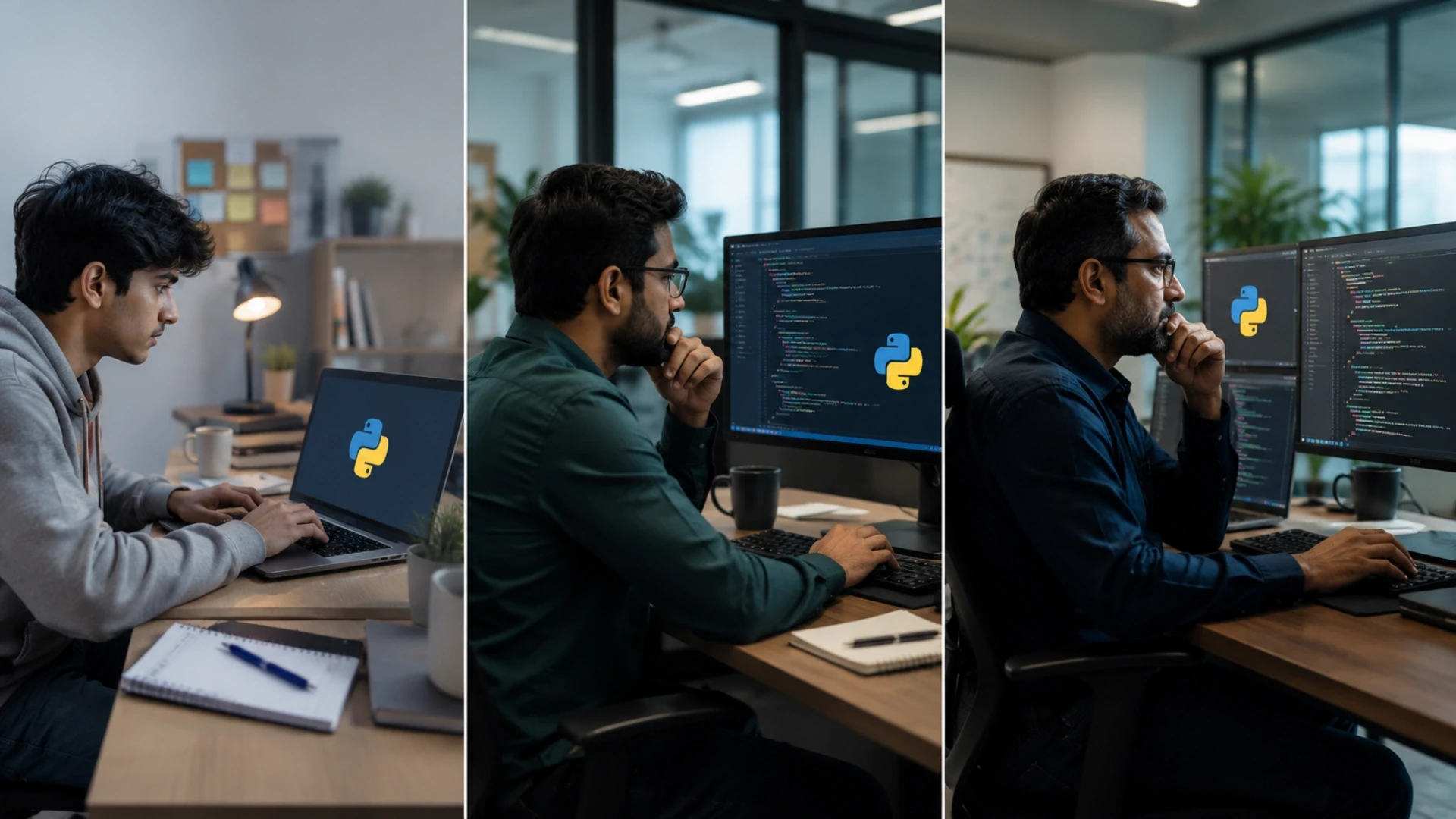
Signal calibration changes by seniority tier. A junior Python developer showing senior signals is a red flag (over-promised experience). A senior Python developer showing junior signals is a hire-blocker. The tier expectations below help calibrate what to expect at each level.
Python Developer Signal Expectations by Seniority Tier
Signal | Junior (0-2 yrs) | Mid (2-5 yrs) | Senior (5+ yrs) |
|---|---|---|---|
Data structure choice | Follows patterns | Chooses correctly | Optimizes trade-offs |
Code review specificity | Style-focused | Behavior + design | Systemic quality patterns |
Production debugging | Follows runbook | Diagnoses independently | Prevents recurrence |
Python version fluency | 3.9-3.10 | 3.10-3.11 | 3.11-3.12 |
AI tool judgment | Uses AI, minimal validation | Validates AI output | Directs AI development |
System design | Follows patterns | Adapts to constraints | Designs from first principles |
Framework depth | Tutorial fluency | Production patterns | Framework internals |
Communication | Explains own code | Explains architecture | Teaches and mentors |
How to Use Tier Calibration
Junior developers should show learning velocity, not senior signals. A junior developer claiming senior-level system design experience is either misrepresenting or has been given titles without responsibility. Look for signs of active learning: recent technical writing, contribution history to open source, curiosity about production edge cases.
Mid-level developers should show independent production judgment. Can they diagnose a production issue without runbook guidance? Can they choose the right framework pattern without asking? Can they push back on a bad requirement with specific technical reasoning? Mid-level is where independent judgment develops.
Senior developers should show teaching and design ownership. Can they teach mid-level developers effectively? Can they design systems from first principles under real constraints? Can they own architectural decisions across multi-quarter engagements? Senior is where the multiplier effects emerge.
Compensation should align to tier, not to negotiation skill. Senior Python developers are worth 2 to 3x junior compensation because their production judgment prevents the mistakes that junior developers make and require rework. Underpaying senior developers or overpaying junior developers both distort the team economics.
Red Flags: Interview Signals That Should End the Conversation

Some interview signals should immediately end the vetting process. Recognizing these red flags saves the cost of hiring developers who will underperform in production.
The 8 Interview Red Flags That Predict Production Failure
Cannot describe a real production incident from their experience. Every mid-level or senior Python developer with genuine production experience has real incident stories: what broke, how they diagnosed it, what they fixed, what they learned. Candidates who cannot produce specific incidents lack production experience regardless of what their resume claims.
Vague code review answers like 'I look for bugs and style issues'. KORE1's 2026 analysis: this response distinguishes the developers who do not get offers. Specific answers about test coverage of behavior, error handling depth, PR splitting judgment, and how to deliver feedback to junior developers signal actual code review discipline.
Python version fluency stuck at 3.8 or 3.9. A senior candidate writing Union[str, None] instead of str | None signals they have not kept current. Structural pattern matching, exception groups, and per-interpreter GIL work should be at least conversationally familiar to senior candidates.
Framework claims without production examples. "I know Django" versus "I built and scaled a multi-tenant Django platform to 100,000 users through query optimization and read replicas." The specific production example distinguishes genuine expertise from tutorial fluency.
Zero AI-assisted development experience or ideology against it. In 2026, avoiding AI development tools is a productivity choice that indicates missing skills or inflexibility. The signal is not that candidates use AI; it is that they use it judiciously with validation and override reasoning.
Cannot explain their code to a non-technical stakeholder. Communication quality is technical skill in team engineering. A developer who cannot explain their architectural decisions to product managers, executives, or clients will produce isolated code that does not align with business needs.
Defensive or arrogant response to technical pushback. Give the candidate a reasonable technical critique of their approach and watch how they respond. Developers who become defensive or arrogant will damage team dynamics. Developers who engage with the critique thoughtfully will improve team code quality.
Cheating signals in proctored assessments. CodeSignal detected cheating rose from 16% (2024) to 35% (2025) in proctored assessments per The Long Commit's June 2026 analysis. If assessments used, treat integrity signals seriously. Cheating in interviews predicts cheating on production dependencies.
As Warren Buffett observed: "It's better to hang out with people better than you." Applied to Python hiring, hiring developers who show these red flags degrades the team over time. The cost of a bad Python hire compounds across every code review, every architectural decision, and every incident response. The cost of thorough vetting is small compared to the cost of hiring around red flags because "the candidate seemed nice" or "we needed someone quickly."
The Multi-Stage Vetting Framework Acquaint Softtech Uses
Every Acquaint Softtech Python developer completes a multi-stage vetting process before any client match. This framework was calibrated across 1,300+ Python projects to reliably surface the developers who ship well in production, not just the developers who interview well.
The 5-Stage Acquaint Softtech Python Vetting Process
Stage 1: Framework depth screening. Django, FastAPI, Flask, Celery, async Python patterns evaluated through production-scenario questions. Candidates must demonstrate specific production examples, not tutorial fluency. Framework internals discussion for senior candidates.
Stage 2: Production debugging assessment. Real production incident stories required. Candidates walk through diagnosis, rollback, fix, post-mortem, and prevention. Evaluators score for specificity, systemic thinking, and learning integration.
Stage 3: Code review specificity evaluation. Candidates review a real pull request with intentional issues (test coverage gaps, error handling weaknesses, design smells) and articulate their review approach. Evaluators score for depth versus surface-level style focus.
Stage 4: System design under constraint. Real scenario with trade-offs: scale, latency, budget, team size, timeline. Candidates walk through design reasoning with articulated trade-offs. Evaluators score for constraint awareness, not textbook architecture reproduction.
Stage 5: Communication and teaching assessment. Candidates explain a complex Python concept to a non-technical evaluator, then to a junior developer evaluator. Score for clarity, patience, teaching quality, and adaptation to audience.
The complete comparison of vetted agency versus marketplace freelancer approaches to Python developer sourcing, including why vetting depth is not optional for engagements over 3 months, is covered in hidden costs of hiring a Python freelancer vs a dedicated agency, which walks through the specific quality signals that distinguish vetted agency talent from marketplace variance
The Bottom Line
Vetting a Python developer before hiring is a signal-selection problem, not a rigor problem. Most vetting processes measure the wrong things (algorithm implementation from memory, whiteboard trees, tutorial framework fluency) and produce false positives that materialize as production underperformance 3 to 6 months into engagements. The 8 signals that actually predict production Python quality (data structure choice under real constraints, code review specificity, production debugging discipline, current-version Python fluency, AI-assisted development judgment, system design under constraint, framework depth in production context, communication quality) are the signals that correlate strongly with the developers who ship well.
The pragmatic 2026 approach is to apply multi-stage vetting (5 stages, 8-12 hours per senior candidate), calibrate signal expectations by seniority tier (junior shows learning velocity, mid shows independent judgment, senior shows teaching and first-principles design), watch for the 8 interview red flags that predict production failure, and update the interview loop for 2026 realities (AI-assisted development judgment, current-version Python fluency, contract-vs-full-time interview rigor convergence).
Turn Python Vetting From Overhead Into Confidence
Book a free 30-minute vetting consultation with Acquaint Softtech. Share your hiring pipeline, current interview loop, and specific Python vetting concerns, and we will walk through the 8-signal framework applied to your engagement. Get pre-vetted Python developer profiles within 24 hours instead of running multi-week interview loops.
Frequently Asked Questions
-
How do you vet a Python developer before hiring?
Apply the 5-stage framework: framework depth screening (Django/FastAPI/Flask production examples), production debugging assessment (real incident stories with rollback + post-mortem), code review specificity (test coverage of behavior, error handling depth), system design under constraint (trade-off reasoning), and communication assessment (teaching to junior + non-technical audiences).
-
What Python version should candidates be fluent in for 2026 hiring?
Python 3.10 minimum, 3.11 and 3.12 preferred. Candidates still writing Python 3.8-style Union[str, None] instead of str | None signal they have not kept current. Structural pattern matching (3.10), exception groups (3.11), and per-interpreter GIL work (3.12) are fair game for senior interviews.
-
What are the top red flags in Python developer interviews?
Cannot describe a real production incident from experience, vague code review answers like "I look for bugs and style issues," framework claims without production examples, zero AI-assisted development experience or ideology against it, and defensive response to technical pushback. Any two of these red flags together typically warrant ending the interview process.
-
How much time should Python vetting take?
Rigorous multi-stage vetting takes 8-12 hours across evaluators for senior candidates, 4-6 hours for mid-level, 2-3 hours for junior roles. Compressing below 4 hours per candidate produces high false-positive rates (hiring developers who cannot deliver). Vetting rigor and hiring quality correlate strongly across engagement outcomes.
-
Should Python developers use AI coding tools during interviews?
Yes, when observed and assessed. In 2026, avoiding AI tools signals inflexibility. What matters is how candidates validate AI-generated code, when they override suggestions, and how they integrate AI-assisted decisions into architectural reasoning. The signal is judgment, not tool usage per se.
-
How do I evaluate senior vs junior Python developer signals?
Junior developers should show learning velocity (recent technical writing, curiosity about edge cases). Mid-level should show independent production judgment (diagnosis without runbook, framework selection without asking). Senior should show teaching capability and first-principles design under real constraints. A junior claiming senior-level system design is a red flag; a senior showing junior-level debugging is a hire-blocker.
I love to make a difference. Thus, I started Acquaint Softtech with the vision of making developers easily accessible and affordable to all. Me and my beloved team have been fulfilling this vision for over 15 years now and will continue to get even bigger and better.
Table of Contents
Get Started with Acquaint Softtech
- 13+ Years Delivering Software Excellence
- 1300+ Projects Delivered With Precision
- Official Laravel & Laravel News Partner
- Official Statamic Partner
Related Blog
How to Hire Python Developers Without Getting Burned: A Practical Checklist
Avoid costly hiring mistakes with this practical checklist on how to hire Python developers in 2026. Compare rates, vetting steps, engagement models, red flags, and more.

Acquaint Softtech
March 30, 2026
Total Cost of Ownership in Python Development Projects: The Full Financial Picture
The build cost is just the beginning. This guide breaks down the complete TCO of Python development projects across every lifecycle phase, with real benchmarks, a calculation framework, and 2026 data.
Acquaint Softtech
March 23, 2026
Top Python Development Companies in 2026
This curated list of the Top Python Development Companies in 2026 helps founders, CTOs, and product leaders find expert teams delivering high-performance, scalable, AI-ready Python applications across SaaS, FinTech, and data-driven platforms. Python now controls roughly 26% of the TIOBE Index, holding the #1 spot ahead of C and Java, with over 70% of machine learning engineers relying on it as their primary language.
But finding the right Python development company is the hard part. Hundreds of agencies claim Python expertise, yet only a few combine real framework depth, reliable communication, and production-grade delivery. We reviewed verified Clutch data, pricing, and client outcomes to rank the top firms where you can confidently hire Python developers for your 2026 roadmap.

Zubair Pateljiwala
May 20, 2026India (Head Office)
203/204, Shapath-II, Near Silver Leaf Hotel, Opp. Rajpath Club, SG Highway, Ahmedabad-380054, Gujarat
USA
7838 Camino Cielo St, Highland, CA 92346
UK
The Powerhouse, 21 Woodthorpe Road, Ashford, England, TW15 2RP
New Zealand
42 Exler Place, Avondale, Auckland 0600, New Zealand
Canada
141 Skyview Bay NE , Calgary, Alberta, T3N 2K6
Your Project. Our Expertise. Let’s Connect.
Get in touch with our team to discuss your goals and start your journey with vetted developers in 48 hours.