

InsurTech Technical Architecture: APIs, Microservices, Event Streaming, and Cloud Deployment
InsurTech technical architecture is the structural design of an insurance platform: how its services are split, how they communicate, and where they run. A modern architecture uses an API-first design, microservices split along insurance domains, an event-streaming backbone such as Apache Kafka for real-time data flow, and cloud-native deployment on AWS, Azure, or GCP with Kubernetes. The four decisions that define it are the API contract, the service boundaries, the event backbone, and the cloud foundation.

Manish Patel
As a CIO at Acquaint Softtech, working with software product development, I often see insurance platforms struggle when real-world load hits. A surge in claims during events like coastal storms can expose weak architecture, causing tightly coupled systems to slow down, fail, or crash when they are needed most.
In many cases, the issue is not code but design. Monolithic systems, slow integrations, and lack of proper APIs make scaling difficult and block new product launches. In modern insurance, resilience and scalability depend on building the right architecture from the start, not fixing it later.

- You are architecting an InsurTech platform and must choose between monolith and microservices.
- You are scaling, and your services break each other every time you ship a change.
- You need real-time data flow across policy, billing, claims, and partner systems.
- You are choosing between AWS, Azure, and GCP for a regulated insurance workload.
- You want an architecture that passes audits and survives a catastrophe-driven traffic spike.
Acquaint Softtech's software product development build these decisions in from the first sprint, and the broader engineering context lives in the complete guide to InsurTech software development in 2026. For the backend and data engineering these architectures depend on, the Python developers team builds the services, pipelines, and APIs.
This article covers the four decisions that define an InsurTech architecture, the API contract, the service boundaries, the event backbone, and the cloud foundation, then resilience, modernisation, and cost. It is written for the engineering leader or founder who never wants their platform to be the thing that cracks when the storm hits.
The Four Decisions That Define InsurTech Architecture

Most architecture failures trace back to four decisions made early and rarely reconsidered: how the platform exposes its capabilities as APIs, how it splits into services, how those services communicate, and where and how they run.
Get these right and the platform scales, integrates, and survives load. Get them wrong and every later problem, the cascading outage, the slow integration, the blocked product launch, follows from them. These four decisions are the spine of insurtech technical architecture.
What is insurtech architecture?
InsurTech architecture is the structural design of an insurance technology platform: the arrangement of its software components, how they communicate, and how they are deployed and operated. A modern one is API-first, so every capability is accessible through clean interfaces; built from microservices split along insurance domains like policy, billing, and claims; connected by an event-streaming backbone for real-time data flow; and deployed cloud-native on AWS, Azure, or GCP with container orchestration. This contrasts with the legacy insurance monolith, a single large application on a mainframe or single server that is hard to change, scale, or integrate.
Acquaint Softtech designs these four decisions together, because they interlock: the API contract shapes the service boundaries, which shape the events, which shape the deployment. The engagement model is described in the dedicated software development team's service, where architects with insurance domain experience own the design end to end rather than treating architecture as an afterthought.
The data layer underneath all four decisions must be designed for both real-time access and audit. Acquaint Softtech's backend development services build the data and service foundation that lets policy, billing, and claims share a consistent model while remaining independently deployable.
For teams that want the architecture mapped before building, the discovery workshop service produces a service decomposition, an event catalogue, an API contract draft, and a cloud topology in four to six weeks. That blueprint is what prevents the expensive re-architecture that follows the first outage.
Decision 1: The API Contract and API-First Design

The first decision is to treat the API as the product. API-first design means every capability like quote, bind, endorse, and claim is defined as a clean, versioned API before implementation, enabling the same service to be reused across broker portals, mobile apps, and partner integrations, making onboarding much faster.
In insurance ecosystems where speed and integration matter, having strong engineering teams is key, and many companies rely on experienced developers such as hire MEAN stack developers to build and scale these API-first platforms efficiently.
Why does API-first design matter for insurers?
Insurance now operates as a connected ecosystem where API-first design enables seamless integration with partners, carriers, and data providers through stable interfaces. Legacy systems can also be modernised using API wrappers without full rewrites, while contract-first design ensures consistent requests, responses, and versioning. This approach keeps integrations stable and scalable as systems evolve.
An API gateway sits in front of the services to handle authentication, rate limiting, and routing, the controls a regulated platform needs at its edge. Acquaint Softtech's hire Python developers team builds the gateway and the service APIs behind it, enforcing security and quota policy in one consistent layer.
The way clean APIs enable embedded and partner distribution is explored in the InsurTech software development guide, which shows how an API-first core lets a carrier reach customers through many channels without rebuilding its quoting logic for each.
Worried your platform will crack under a claims surge?
Acquaint Softtech has shipped 1,300+ projects in 13+ years and deploys a dedicated architecture team within 48 hours of a brief. Book a call, and we will review your architecture for the next storm first.
Decision 2: Microservices or Monolith
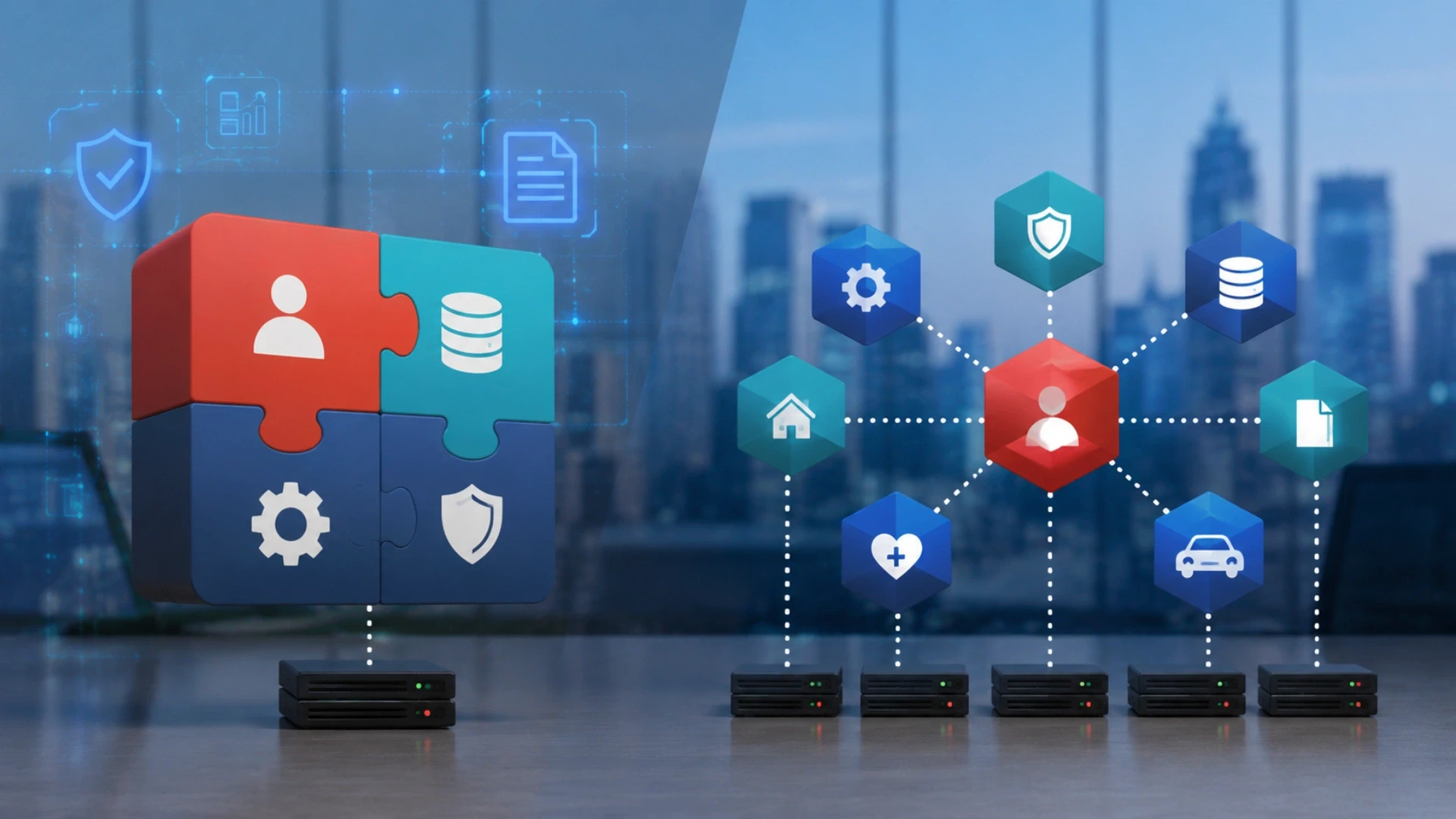
The second decision is how to split the platform into services, and it is the one teams agonise over most. A monolith is one deployable application; microservices split the platform into independently deployable services, each owning a domain. For insurance, the right answer is usually a set of microservices split along insurance domains, because policy, billing, claims, and underwriting change at different rates and must scale independently, but the split must be done carefully, since badly drawn boundaries create more pain than a monolith ever did.
Microservices or monolith for insurers?
Microservices are the preferred approach for most serious insurance platforms, but only when service boundaries align with business domains like Policy, Billing, Claims, and Fraud. These services can be independently built, deployed, and scaled, even using different technologies, such as Java for core policy systems and Python for fraud analytics due to its ML strength. This setup allows insurers to scale specific areas during spikes, like claims surge, without affecting the rest of the system, and deploy updates faster with less risk.
However, over-splitting or incorrect boundaries can create a distributed monolith, where tightly coupled services and shared dependencies negate the benefits of microservices. For early-stage products, a modular monolith is often more practical before gradually evolving into microservices as complexity grows.
Teams building such scalable architectures often rely on experienced full-stack engineers like hiring MERN stack developers to ensure clean, production-ready system design.
Approach | Best For | Main Risk |
Modular monolith | Early-stage, small team, one product | Hard to scale parts independently later |
Domain microservices | Scaling carriers, multiple lines | Wrong boundaries create coupling |
Distributed monolith | Nobody, it is an anti-pattern | Worst of both, avoid it |
Microservices plus events | Real-time, high-variance load | Operational and skills complexity |
Insurance systems are split into domain-based services like policy, billing, claims, underwriting, and fraud so each can scale and deploy independently without tight coupling. This domain-driven approach ensures clear ownership and avoids shared-database failures. It enables stable, scalable architecture where changes in one service do not impact others.
For early-stage products, Acquaint Softtech often recommends a modular monolith first, then a measured split as the product proves itself, an approach explained in the minimum budget required to start a Python development project guide, which frames how to balance architecture ambition against early-stage budget.
Decision 3: The Event-Streaming Backbone
The third decision is how services communicate, and the modern answer for insurance is event streaming. Instead of services calling each other directly and synchronously, which is what makes failures cascade, they publish and consume events through a streaming backbone such as Apache Kafka. When the Policy Service publishes a PolicyBound event, the Billing, Claims, and Notification services each react independently.
This decoupling is what lets one service fail without taking the others down, and what makes real-time insurance possible. For teams implementing such distributed systems at scale, experienced backend support like hiring Laravel developers can help accelerate reliable event-driven development.
What is event streaming in insurance?
Event streaming lets services send events like “policy created” or “claim filed” into a shared log that other systems read in real time. Tools like Kafka, Kinesis, and Event Hubs power this in modern insurance systems, enabling instant quote and bind, telematics-based pricing, fraud detection, and automated payouts. Its biggest strength is resilience. If one service goes down, events are still stored and processed later, so no data is lost, and operations continue smoothly. Acquaint Softtech builds this real-time backbone using Kafka or cloud-native streaming tools with reliable, repeatable processing so insurance platforms stay fast, connected, and fault-tolerant.
Event-driven systems fail in distributed ways, so resilience patterns, circuit breakers, retries, and timeouts must be built in. Acquaint Softtech's hire DevOps developers team builds these patterns and the observability to detect a failing consumer before it becomes an outage. How the event backbone connects underwriting, claims, and fraud in real time is detailed in the insurance claims automation guide, which shows an event-driven claims pipeline where each stage reacts to events from the one before it.
Architecture Example: Event Streaming at Insurance Scale with Kafka
Client:
Large-scale insurance and InsurTech platforms operating across policy, claims, billing, and partner integrations, including enterprise insurers managing high-volume real-time transactions.
Challenge:
Traditional insurance systems struggled with slow batch processing, tightly coupled integrations, and legacy databases that could not support real-time decision-making. As data sources grew (policy updates, claims, fraud signals, customer notifications), systems became fragile and difficult to scale, especially during peak loads or system failures.
Approach:
A shift was made to an event-driven architecture using Kafka as the central event streaming backbone.
Every key action (policy update, claim submission, payment, fraud signal) is published as an event
Events are stored in a central event log acting as the system’s “source of truth in motion”
Independent microservices consume the same event stream for different purposes like analytics, fraud detection, notifications, and reporting
Legacy integrations are decoupled, removing direct system-to-system dependencies
Real-time streaming ETL replaces overnight batch processing
Results:
The architecture enabled real-time data flow across the entire insurance ecosystem. Systems became more resilient because failure in one service did not break the entire workflow. Scaling became easier since new services could simply subscribe to existing event streams without redesigning core systems.
Why It Matters for InsurTech:
In modern InsurTech, speed and reliability are critical. Event-driven systems allow carriers and platforms to process claims faster, detect fraud earlier, and improve customer experience in real time. Unlike legacy insurance systems, new InsurTechs can adopt this architecture from day one without needing to untangle old infrastructure.
Key Insight:
The event log is not just infrastructure; it becomes the nervous system of the insurance platform. Once built correctly, every policy and claim becomes a real-time signal that powers the entire ecosystem simultaneously.
Still moving data with overnight batch jobs?
Acquaint Softtech builds event-driven insurance platforms at up to 40% less than Western agencies, with a 95% sprint delivery rate. Book a call and get an event-streaming architecture for your platform in one session.
Decision 4: The Cloud Foundation and Deployment

The fourth decision is where and how the platform runs. Cloud-native deployment on AWS, Azure, or GCP, with Kubernetes orchestrating containerised services, is now the default for InsurTech, because it delivers the elastic scaling a catastrophe-driven traffic spike demands and the managed services that shrink operational burden.
The choice of provider and topology, single cloud, hybrid, or multi-cloud, is shaped by the insurer's regulatory obligations, existing stack, and where its engineering skills concentrate.
Which cloud is best for an insurance platform: AWS, Azure, or GCP?
All three can run a compliant insurance platform; the right choice depends on context. AWS offers the broadest service catalogue and the most mature ecosystem, a safe default. Azure holds the most compliance certifications and integrates deeply with Microsoft estates, making it ideal for regulated insurers already using Microsoft tools. For teams building scalable insurance applications, experienced backend support like hiring Django developers can also help accelerate secure implementation.
GCP leads in data analytics and machine learning and offers the strongest managed Kubernetes, which suits AI-heavy insurance workloads. Many insurers go hybrid, keeping sensitive policyholder data on private infrastructure while running scalable workloads in the public cloud, or multi-cloud to avoid lock-in, with Kubernetes as the common orchestration layer across providers. Pricing parity is close in 2026, so operational discipline and fit matter more than list price.
Cloud | Strength for Insurance | Best Fit |
AWS | Broadest services, mature ecosystem | Default choice, most workloads |
Azure | Most compliance certifications | Microsoft-centric regulated insurers |
GCP | Best Kubernetes, data and ML | AI-heavy insurance workloads |
Hybrid | Sensitive data on private infra | Strict data-residency requirements |
Multi-cloud | Avoids vendor lock-in | Large insurers spreading risk |
Acquaint Softtech deploys insurance platforms cloud-native with Kubernetes orchestration and Infrastructure as Code, so the platform scales automatically under load and every environment is reproducible. This is delivered through the hire DevOps developers team, which builds the container, orchestration, and auto-scaling layer for the chosen cloud. Provider choice should follow the workload and the compliance surface, not fashion.
Acquaint Softtech's software development outsourcing model provides architects who evaluate AWS, Azure, and GCP against the insurer's actual regulatory and technical needs rather than defaulting to one.
For insurers that need senior leadership to own the cloud and architecture strategy, Acquaint Softtech's virtual CTO services provide fractional CTO engagement to set the cloud topology, provider choice, and deployment model before the build scales.
Resilience, Security, and Compliance by Design
An insurance platform must stay up when it matters most and prove it is secure at all times. Resilience and security are not features added late; they are properties of the architecture. The same decisions that make a platform scalable, decoupled services, event streaming, cloud-native deployment also make it resilient, and the security and compliance controls insurance demands must be woven through every layer rather than bolted to the edge.
How do you make an insurance platform resilient and secure?
Resilience in insurance systems comes from designing for failure using circuit breakers, retries, timeouts, and event logs, along with multi-region deployment to ensure uptime. Security follows a zero-trust model with encryption, authentication, API gateways, and DevSecOps practices. This architecture also supports compliance with standards like NAIC, GDPR, HIPAA, and SOC 2 by building auditability and controls into the system.
The compliance controls that ride on this architecture, audit logging, access control, and encryption connect to the wider regulatory picture. Acquaint Softtech's software product development practice builds these controls into the service and data layers so an audit is a documentation exercise, not a scramble.
How this architecture satisfies the specific insurance frameworks is detailed in the guide to what staff augmentation is, which describes how Acquaint Softtech adds the specialist DevSecOps and compliance engineers a regulated platform needs.
Modernising a Legacy Insurance Monolith
Most established insurers are not starting greenfield; they are running a legacy monolith, often on a mainframe, that cannot meet modern demands but cannot be switched off either. The reliable path is incremental modernisation: wrap the legacy core in APIs, stand up new microservices around it, route traffic gradually to the new services, and migrate domain by domain until the monolith can retire. A big-bang rewrite of an insurance core is one of the highest-risk projects in software, and it usually fails.
How do you modernise a legacy insurance system?
Through the strangler fig pattern combined with API wrapping. First, an API gateway and API wrapping expose the legacy core's functions to modern digital channels, so new frontends can be built without touching the old backend. Then new capabilities are built as microservices that gradually take over functionality, with the event backbone keeping old and new in sync.
Domain by domain, traffic moves to the new services until the legacy system handles nothing critical and can be decommissioned. This gradual approach extends the value of existing legacy investments while modernising around them, and it keeps the in-force business running throughout, which a big-bang cutover cannot guarantee.
Acquaint Softtech runs modernisation as a phased strangler fig programme, wrapping the legacy core in APIs and migrating domains incrementally while the business stays live. The version upgrade and migration services team specialises in this approach, which avoids the catastrophic risk of a single cutover.
Connecting old and new through the event backbone and Change Data Capture is the technical heart of a safe migration. Acquaint Softtech's backend development services build the CDC pipelines and integration layer that keep the legacy core and the new microservices consistent during the transition.
Migrating decades of policy and claims data accurately is the part that most often fails. Acquaint Softtech's database development team runs the extraction, cleansing, and reconciliation as a dedicated workstream so migrated data matches the source of record before any service goes live on it.
Cost, Timeline, and Architecture Sequencing

Architecture cost is mostly the cost of building the platform well from the start versus rebuilding it after it cracks, and the second is always higher. The figures below reflect offshore delivery with senior architects and engineers, the model Acquaint Softtech uses across its 1,300+ project portfolio.
The sequencing rule is to make the four foundational decisions deliberately at the start, then build outward, because changing them later means re-architecting, not refactoring.
Scope | Estimated Cost (USD) | Timeline |
Architecture and API design (the four decisions) | $60,000 to $160,000 | 2 to 5 months |
Core microservices on the event backbone | $200,000 to $500,000 | 8 to 16 months |
Cloud foundation and Kubernetes setup | $80,000 to $200,000 | 3 to 7 months |
Resilience, security, and compliance layer | $90,000 to $220,000 | 4 to 8 months |
Legacy monolith modernisation (strangler fig) | $300,000 to $1,200,000 | 12 to 30 months |
Full cloud-native InsurTech platform | $500,000 to $2,000,000 | 14 to 30 months |
The key architecture decisions, API contracts, service boundaries, event backbone, and cloud foundation should be made early and together before major development starts, because they shape everything that follows. Building a monolith first and fixing architecture later usually leads to higher costs, slower systems, and expensive rebuilds after failures rather than preventing them.
Acquaint Softtech’s offshore model can reduce costs by up to 40% compared to US, UK, or Australian agencies, with project managers and QA included in every engagement at no extra charge.
Agencies that want to deliver cloud-native insurance architecture to their own clients use Acquaint Softtech's white label software development, which provides the architecture and engineering depth under the agency's branding with full NDA coverage.
Keeping the architecture healthy as the platform grows, refactoring boundaries, upgrading the event backbone, and tuning the cloud requires ongoing capacity. Acquaint Softtech's support and maintenance services provide the continuous engineering to keep the architecture sound rather than letting it decay back toward a monolith.
Join 200+ technology companies that have scaled with Acquaint Softtech.
Cloud-native InsurTech architectures delivered at up to 40% less than Western agencies, with a 4.9/5 rating from 50+ verified Clutch reviews. Book a call and leave with the four decisions mapped for your platform, no obligation.
Frequently Asked Questions
-
What is insurtech in the insurance industry?
Insurtech uses digital technologies like AI, big data, and automation to improve insurance efficiency, reduce costs, and enhance customer experience across underwriting, claims, and distribution. It helps traditional insurers modernise legacy systems and compete with digital-first players.
-
What is insurtech architecture?
Insurtech architecture is the system design of insurance platforms using API-first microservices, event streaming, and cloud-native infrastructure to ensure scalability, resilience, and real-time processing. It allows insurers to build flexible systems that can evolve without full rewrites.
-
How does insurtech impact the insurance industry?
Insurtech improves speed, personalization, and efficiency by automating underwriting, claims, and customer service while reducing operational costs through data-driven decision-making. It also enables insurers to launch new products faster.
-
What is AI used for in insurance?
AI is used for underwriting risk scoring, automated claims processing, fraud detection, and 24/7 customer service using chatbots and predictive analytics. It also helps insurers improve decision accuracy using real-time data.
-
How do insurers use machine learning?
Machine learning helps insurers predict claim probability, set dynamic pricing, and analyse structured and unstructured data like telematics, images, and medical records. This leads to more accurate risk assessment and pricing models.
-
What is event streaming in insurance?
Event streaming (like Kafka) lets insurance systems share real-time data between services, enabling instant quote updates, fraud detection, and resilient claim processing. It ensures systems continue working even if one service temporarily fails.
-
Microservices vs monolith in insurance systems?
Microservices are preferred for scaling insurers because they separate policy, billing, and claims systems. Monoliths suit early-stage products but often fail at scale due to tight coupling. The right choice depends on business maturity and growth stage.
-
Why do insurance systems fail under load?
They fail due to tightly coupled architecture where one service overload causes cascading failures, especially during claim surges or peak traffic events. Proper decoupling can prevent system-wide outages.
-
How much does insurtech architecture cost?
A full cloud-native insurtech platform costs $500,000 to $2M over 14–30 months, including APIs, microservices, and cloud infrastructure. Offshore delivery can reduce costs by up to 40%. Upfront investment is cheaper than re-architecture later.
-
How is AI transforming insurance operations?
AI automates underwriting, speeds up claims by 50–75%, reduces costs by ~20%, and improves fraud detection and customer experience through predictive and conversational systems. It is becoming a core driver of competitive advantage in insurance.
I lead technology and client success at Acquaint Softtech with one goal in mind. Deliver work that feels personal, reliable, and worthy of long term trust. I stay close to both our clients and our developers to make sure every project moves with clarity, quality, and accountability.
Table of Contents
Get Started with Acquaint Softtech
- 13+ Years Delivering Software Excellence
- 1300+ Projects Delivered With Precision
- Official Laravel & Laravel News Partner
- Official Statamic Partner
Related Blog
.webp "The Complete Guide to InsurTech Software Development in 2026")
The Complete Guide to InsurTech Software Development in 2026
InsurTech software is not a fintech variant with policy fields. It is a policy-centric, regulator-accountable platform that runs quote, bind, issue, endorse, pay, and report as one system.

Acquaint Softtech
May 5, 2026
Modern Core Insurance Platform Development: Policy Admin, Billing, Claims, and Distribution
A core insurance platform is not four separate systems patched together with APIs. It is one shared data model where policy administration, billing, claims, and distribution each own a defined domain and fire events that the others consume. Teams that build four separate systems discover the gap at the worst possible moment: renewal time, first major claim, or regulator audit.
Manish Patel
May 14, 2026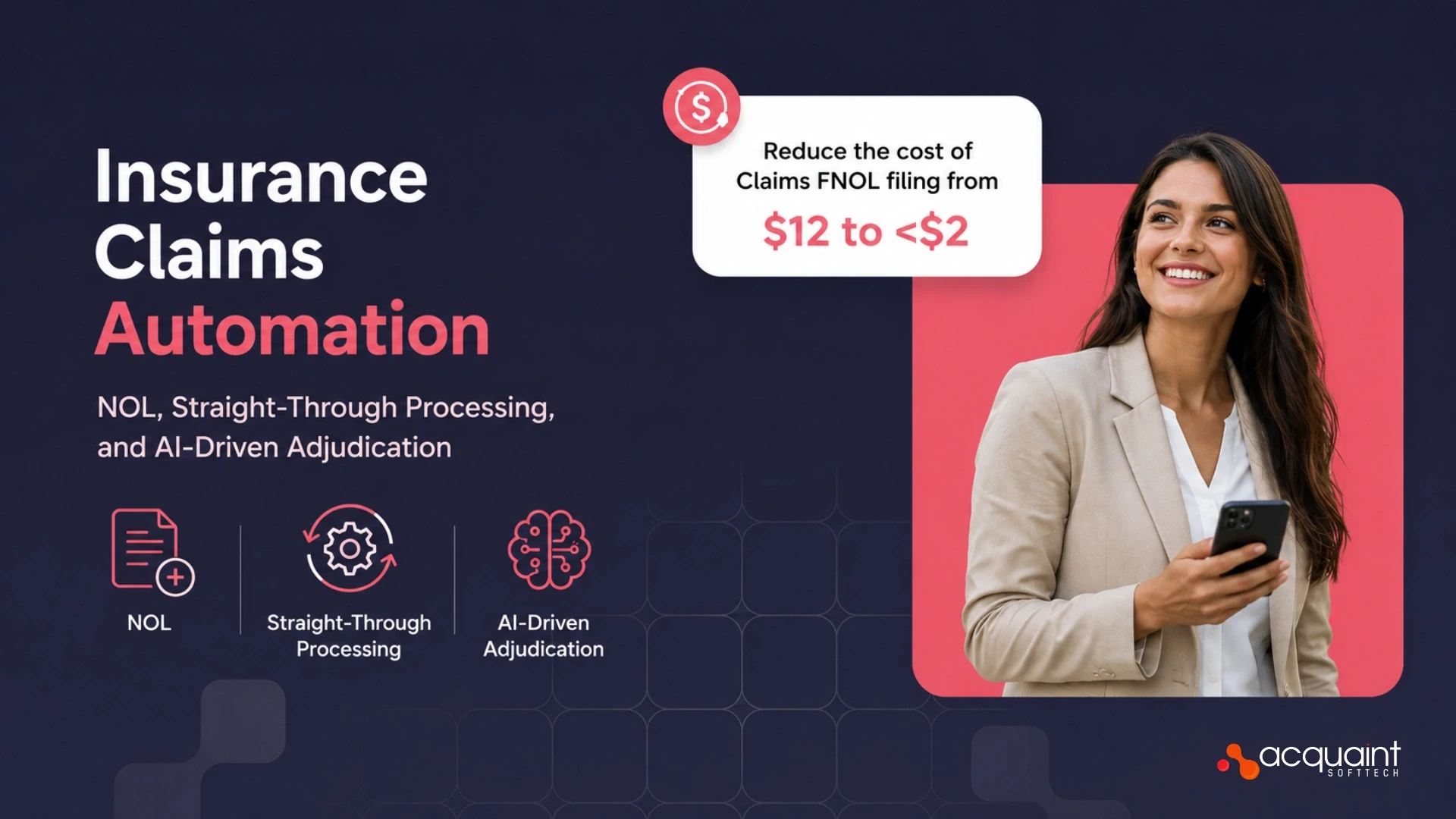
Insurance Claims Automation: FNOL, Straight-Through Processing, and AI-Driven Adjudication
AI-driven claims automation reduces claim processing costs from $15–$22 to $3–$5 and cuts turnaround time from 14 days to under 24 hours. Explore the complete 2026 claims automation architecture, from FNOL intake to AI fraud detection and adjudication.
Manish Patel
May 21, 2026India (Head Office)
203/204, Shapath-II, Near Silver Leaf Hotel, Opp. Rajpath Club, SG Highway, Ahmedabad-380054, Gujarat
USA
7838 Camino Cielo St, Highland, CA 92346
UK
The Powerhouse, 21 Woodthorpe Road, Ashford, England, TW15 2RP
New Zealand
42 Exler Place, Avondale, Auckland 0600, New Zealand
Canada
141 Skyview Bay NE , Calgary, Alberta, T3N 2K6