

Laboratory Information System Development: From Sample to Report
A Laboratory Information System (LIS) manages lab samples from order to verified results. It integrates with lab systems, meets CLIA and CAP compliance, and typically costs $80,000–$500,000.

Manish Patel
What if you could collect driving data directly from a customer's vehicle without installing any hardware? As Head of Technology and Client Success at Acquaint Softtech, a software product development partner, I have seen native OEM integrations transform connected insurance by replacing telematics devices with secure, real-time vehicle data. The challenge is not accessing the data. It is managing the different APIs, authentication methods, and integration requirements of every automaker.
They are the infrastructure that makes accurate, auditable, scalable diagnostic medicine possible. Understanding how to build laboratory software that meets clinical, regulatory, and operational requirements simultaneously is the prerequisite for any successful LIS engagement.

- You are building a custom LIS for a clinical or reference laboratory.
- Your lab runs on paper logs and spreadsheets and needs to digitise.
- You need to understand ASTM, HL7, and CLIA before scoping your build.
- You want verified cost data before presenting a LIS budget to your board.
- You are evaluating a custom build versus an off-the-shelf LIS system.
The global laboratory informatics market is projected to reach $8.7 billion by 2029 at a CAGR of 10.4 per cent (2024). CLIA (Clinical Laboratory Improvement Amendments) requires all clinical laboratories performing testing on human specimens for diagnosis, prevention, or treatment to meet federal quality standards.
This article explains the complete LIS development landscape: the specimen lifecycle a LIS manages, the LIS versus LIMS distinction that determines architecture, core modules, instrument interfacing protocols, the full integration map, CLIA and HIPAA compliance architecture, tech stack, a real case study from Acquaint Softtech's HealthTech delivery portfolio, and verified cost data. For the full healthcare software development context across all eight product types, start with the guide to healthcare software development.
What Is a Laboratory Information System and Why Custom Builds Happen

Laboratory information system development is software that manages the entire laboratory workflow, from sample registration and test processing to result verification and report delivery. It also maintains secure audit logs of every action, helping laboratories meet compliance and inspection requirements. Laboratory software trends 2026 show that cloud-native, API-first LIS platforms have become the standard, replacing older on-premise systems.
CLIA compliance requires laboratories to maintain records, quality controls, and inspections, making an LIS essential for scalable operations. Many organisations accelerate implementation through white label software development solutions that reduce time to market while supporting compliance and customisation.
Custom LIS development happens when a laboratory's workflows, instrument mix, speciality testing menu, or outreach model does not fit off-the-shelf systems. Anatomic pathology labs, molecular diagnostics labs, fertility clinics, and multi-location diagnostic chains consistently find that commercial LIS products require expensive configuration and vendor lock-in before they support the lab's specific workflows.
Acquaint Softtech's virtual CTO services include a build-versus-buy analysis as the first deliverable for all LIS engagements, mapping the lab's specific requirements against commercial LIS capabilities before any development is scoped.
The Specimen Lifecycle: What a LIS Manages From Order to Report
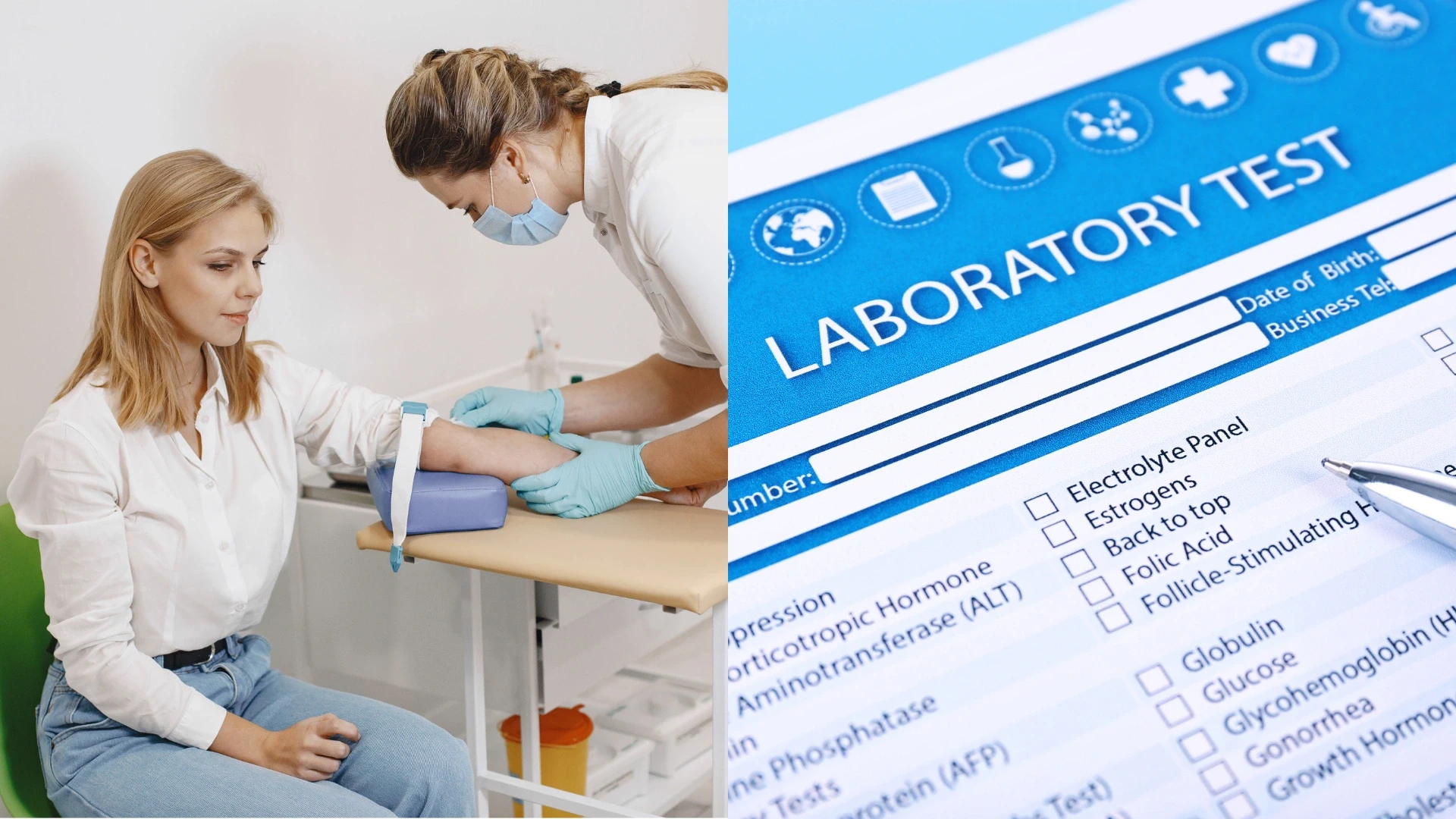
The specimen lifecycle is the central narrative of any LIS. Every module in the system exists to support one stage of this lifecycle. Understanding the lifecycle before designing the architecture is the prerequisite for building a LIS that clinical users will actually adopt.
The Clinical Specimen Lifecycle: What a LIS Manages at Every Stage
Order Receipt: The LIS receives a test order from the ordering physician, either electronically via HL7 ORM message from the EHR, or manually entered by front-desk staff. The order includes patient demographics, test codes (CPT or LOINC), specimen type, and ordering provider NPI.
Specimen Accession: A unique accession number is assigned to the specimen at receipt. A barcode label is printed. The specimen's chain of custody begins: collection time, collector ID, receipt time, and condition (haemolysis, insufficient volume, wrong tube) are recorded.
Specimen Processing and Routing: The LIS routes the specimen to the correct department (chemistry, haematology, microbiology, anatomic pathology) and instrument based on the test ordered. For samples requiring multiple tests, aliquotting instructions are generated.
Instrument Interfacing: The analyser receives the sample and runs the test. Results are transmitted back to the LIS via ASTM E1394 or HL7 v2 interface. The LIS matches results to the correct patient and order using the accession number.
Quality Control and Delta Check: The LIS applies Westgard QC rules to the result. If QC fails, the result is flagged and held. Delta check logic compares the current result with the patient's previous result for the same test and flags implausible changes for review.
Result Verification: A trained technologist or pathologist reviews the result, any QC flags, and the delta check. They verify the result or initiate a repeat or reflex test. Verification is a user-attributed, timestamped action in the audit trail.
Critical Value Notification: Results outside the critical value range trigger an immediate notification to the ordering physician. The LIS records the notification time, the notified provider, and the response, all required by CLIA and CAP for critical value management.
Report Delivery: The verified, signed report is transmitted to the EHR via HL7 ORU message, to the patient portal via FHIR R4 DiagnosticReport resource, and to the billing system for charge capture.
Every stage above generates audit data that CLIA and CAP inspectors review. A LIS that cannot produce a complete, timestamped audit trail for every specimen from order to report is not a compliant laboratory information system. This is why audit trail architecture must be designed in Stage 1 of the development process, not added after the system is built.
Acquaint Softtech's Laravel developers implement the audit trail as a write-only, tamper-evident store from the first sprint of every LIS engagement. The audit trail schema is designed before the specimen data model, because the audit trail determines what must be captured at every data write event throughout the lifecycle.
LIS vs LIMS: The Distinction That Determines Your Architecture
Laboratory information system versus laboratory information management system is the first classification decision in any laboratory software project. Getting it wrong has a documented cost: laboratories that procure a LIMS for clinical diagnostic purposes incur 40 per cent higher customisation costs during implementation because outpatient reporting modules and HIPAA-compliant data structures are not native to LIMS systems (Astrix, March 2026).
Dimension | LIS (Clinical) | LIMS (Research or Manufacturing) |
Primary orientation | Patient-centric | Sample-centric |
Core mission | Diagnose and treat patients | Manage research samples or QC testing |
Regulatory framework | CLIA, CAP, HIPAA, 21st Century Cures Act | GMP, ISO 17025, EPA, FDA 21 CFR Part 11 |
Result delivery | Physicians and patients (HIPAA-regulated) | Internal researchers or QC managers |
Instrument interfacing | ASTM E1394, HL7 v2, essential | Optional or minimal |
EHR integration | Bidirectional, mandatory for clinical use | Not required |
Critical value management | Mandated by CLIA for patient safety | Not applicable |
If your laboratory focuses on patient diagnosis and treatment, a LIS is the right choice. For research, environmental, or industrial testing, a LIMS is more suitable. Organisations that need scalable laboratory software often choose to hire MEAN stack developers to build secure, integration-ready platforms. For research environments, LIMS Development for Research Labs covers 21 CFR Part 11 compliance and chain-of-custody requirements.
Core Modules Every Clinical LIS Must Include
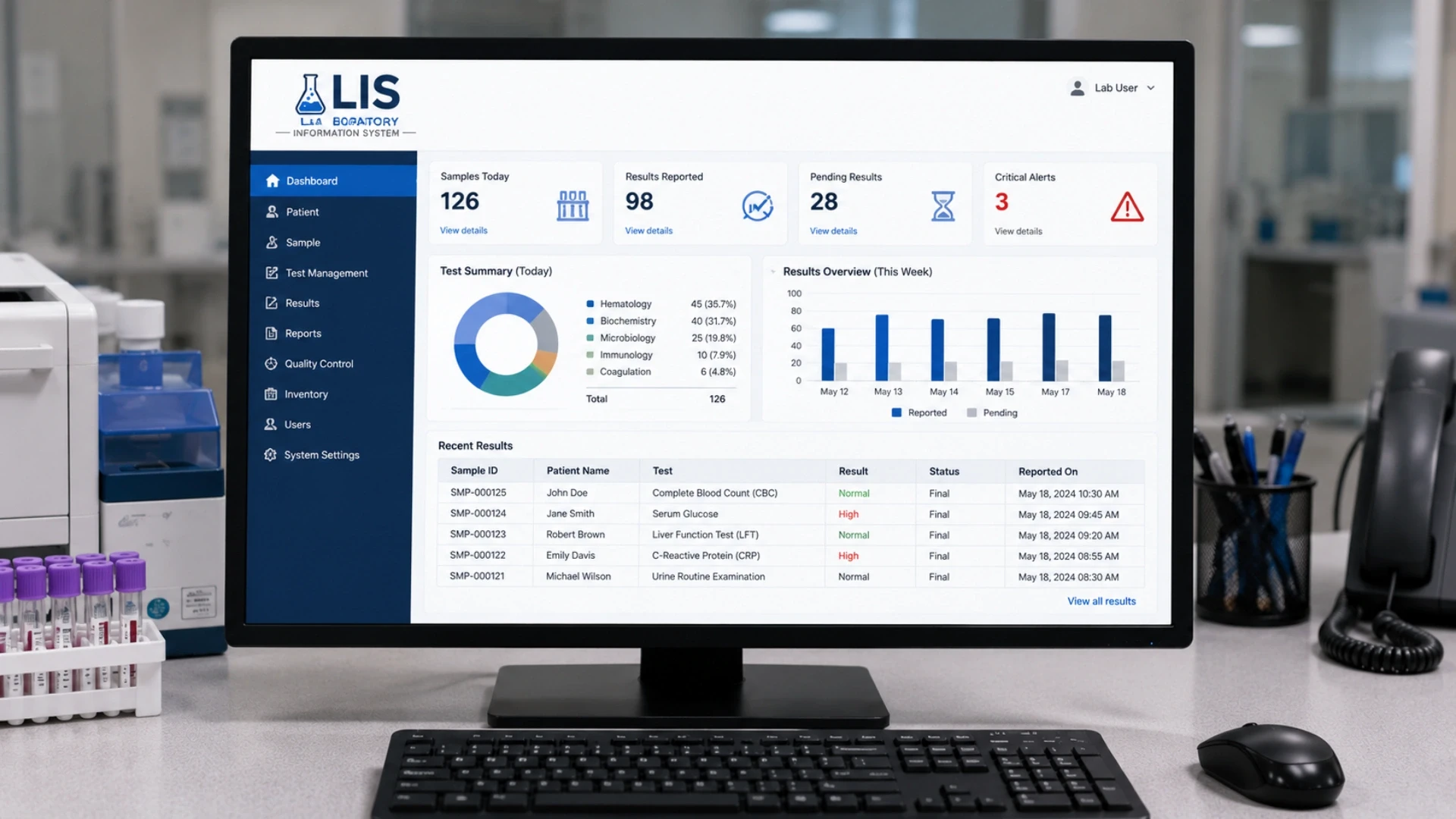
Laboratory software key features checklist for a clinical LIS: every module below exists to support a specific stage of the specimen lifecycle. Phase 1 includes the modules without which the core clinical workflow cannot operate. Phase 2 extends and enhances the core.
Module | Core Function | Phase |
Order management | Receive HL7 ORM orders from EHRs, manual order entry, test catalogue management | Phase 1, essential |
Specimen accession | Unique accession number, barcode label printing, chain-of-custody initiation, specimen condition recording | Phase 1, essential |
Instrument interfacing | ASTM E1394 and HL7 v2 bidirectional interfaces to lab analysers | Phase 1, essential |
QC management | Westgard rules engine, Levey-Jennings charts, QC lot management, failed QC hold workflow | Phase 1, essential |
Result verification | Technologist or pathologist sign-out with user-attributed timestamp and electronic signature | Phase 1, essential |
Critical value management | Auto-flagging of critical results, physician notification workflow, notification acknowledgement log | Phase 1, essential |
Report generation and delivery | HL7 ORU to EHR, FHIR R4 DiagnosticReport to patient portal, PDF report generation | Phase 1, essential |
Billing and charge capture | CPT code extraction, charge generation, billing system interface | Phase 2 for most builds |
Reflex and delta-check logic | Automatic additional test ordering when trigger criteria are met; previous-result comparison | Phase 2, adds after core is stable |
Analytics and TAT dashboard | Turnaround time monitoring, workload analytics, department KPI dashboard | Phase 2, build on real data |
The most common LIS Phase 1 scoping error is including billing and analytics in the first release. Both require the specimen workflow to be running and generating real data before they can be designed correctly. Launch the 7 Phase 1 modules, run the system for 30 days of real specimens, then scope billing and analytics.
Acquaint Softtech's discovery workshop services produce a phased LIS module plan in the first week of every laboratory engagement, mapping Phase 1 versus Phase 2 scope based on the lab's test volume, instrument mix, and regulatory obligations before any development is budgeted.
Lab Instrument Interfacing: ASTM, HL7, and the Analyser Connection
Laboratory software architecture and tech stack decisions begin with instrument interfacing. Every clinical chemistry analyser, haematology analyser, coagulation system, and immunoassay platform in the laboratory must transmit results to the LIS directly, eliminating manual transcription of instrument readouts. The interfacing protocol determines the engineering approach.
The three dominant LIS-to-instrument interface protocols
Protocol | Standard | Instruments and Context |
ASTM E1394 | Legacy standard for most clinical chemistry | Siemens, Beckman Coulter, Abbott Architect, Sysmex haematology, the majority of existing clinical lab instruments use ASTM |
HL7 v2 (ORM/ORU) | Increasingly used for newer instruments and result delivery | Modern immunoassay platforms, molecular diagnostics, and result delivery to EHR systems |
Proprietary TCP/IP | Manufacturer-specific | Newer high-throughput platforms from Roche, Ortho, and others require a manufacturer SDK or reverse engineering |
The critical distinction between a pre-built interface and a custom interface build: a LIS vendor with a pre-built, validated interface driver for a specific analyser model requires 1 to 2 weeks of setup during go-live. A custom interface build for an unsupported instrument requires 3 to 6 months and high additional cost.
Before scoping any LIS build, the team must inventory every analyser in the laboratory with its manufacturer, model, and current interfacing protocol, and confirm whether a pre-built driver exists for each.
Key Insight
The interface library is the most underestimated cost driver in LIS development. Each new analyser family that requires a custom ASTM or HL7 interface adds $10,000 to $40,000 and 4 to 12 weeks of dedicated interface engineering time. Labs with 10 or more different analyser types from multiple manufacturers consistently discover this cost after contract signing, not before.
Acquaint Softtech's Python developers build the ASTM and HL7 v2 interface layer using Mirth Connect as the integration engine. Mirth Connect is the clinical standard for HL7 and ASTM interface management, handling message parsing, transformation, error handling, and retry logic for failed transmissions. All interface connections use TLS 1.3 for HIPAA-compliant data transmission.
LIS Integration Map: EHR, Billing, Pathology, and Patient Portal
A clinical LIS is one of the most integration-intensive healthcare systems. It must exchange data bidirectionally with the hospital EHR, the billing system, the pathology imaging system, and the patient portal simultaneously. Each integration is a compliance surface and a development cost that must be scoped explicitly before development begins.
Integration | Protocol | Purpose |
EHR/HIS | HL7 v2, FHIR R4 | Exchange orders and test results |
Patient Portal | FHIR R4, SMART on FHIR | Provide patient access to results |
Billing System | CPT, HIPAA X12 | Claims processing and payments |
PACS Imaging | DICOM, HL7 | Transfer pathology images and reports |
Reference Labs | HL7 ORM/ORU | Send orders and receive results |
Public Health Reporting | State APIs, HL7 | Report notifiable diseases |
Clinical Coding | LOINC, SNOMED CT | Standardise test and result data |
The EHR integration is the most critical and the most frequently underestimated. A bidirectional HL7 ORM and ORU interface with a major EHR vendor adds $20,000 to $60,000 and 6 to 14 weeks of dedicated interface engineering. Each additional EHR vendor or clinic system that sends orders to the LIS adds a similar amount.
CLIA, CAP, and HIPAA: The Compliance Architecture for a Clinical LIS
Every LIS that processes patient specimens in the USA must comply with CLIA, CAP, and HIPAA requirements. These regulations govern laboratory operations, quality standards, and patient data protection, making them mandatory for clinical laboratories. To build compliant and scalable laboratory software, many healthcare organisations choose to hire MERN stack developers with experience in healthcare compliance, secure data handling, and interoperable healthcare systems.
CLIA requirements that directly affect LIS architecture
Quality control records: the LIS must store QC data for each test run, each reagent lot, and each instrument in a format that can be retrieved and reviewed by inspectors — typically retained for at least 2 years
Proficiency testing tracking: results from external proficiency testing programmes must be documented with the same analyst, reagent lot, and instrument used for patient testing
Test result retention: patient test records must be retained for a minimum of 2 years (10 years for certain histopathology records)
Critical value reporting documentation: every critical value notification must be logged with the time of result, time of notification, notified provider, and acknowledgement response
Personnel authorisation: only CLIA-qualified personnel may authorise result release. The LIS must enforce this through role-based access control tied to personnel qualification records
HIPAA technical safeguards for a clinical LIS
AES-256 encryption at rest for all patient test records, QC data linked to patient specimens, and report files
TLS 1.3 for all PHI in transit: instrument-to-LIS, LIS-to-EHR, LIS-to-patient-portal, and LIS-to-billing-system connections
Role-based access control separating phlebotomist (accession only), technologist (verify and release), pathologist (sign-out and amend), and billing staff (charge capture only) access
Tamper-evident audit log retaining every PHI access and modification event for six years
BAAs executed with all PHI-touching vendors: cloud infrastructure provider, instrument interface middleware vendor, EHR integration platform, and the LIS development firm
Acquaint Softtech's DevOps engineers configure HIPAA-eligible cloud infrastructure (AWS or Azure) for all LIS builds as a standard first-sprint deliverable, before any application code is written.
Tech Stack for LIS Development in 2026
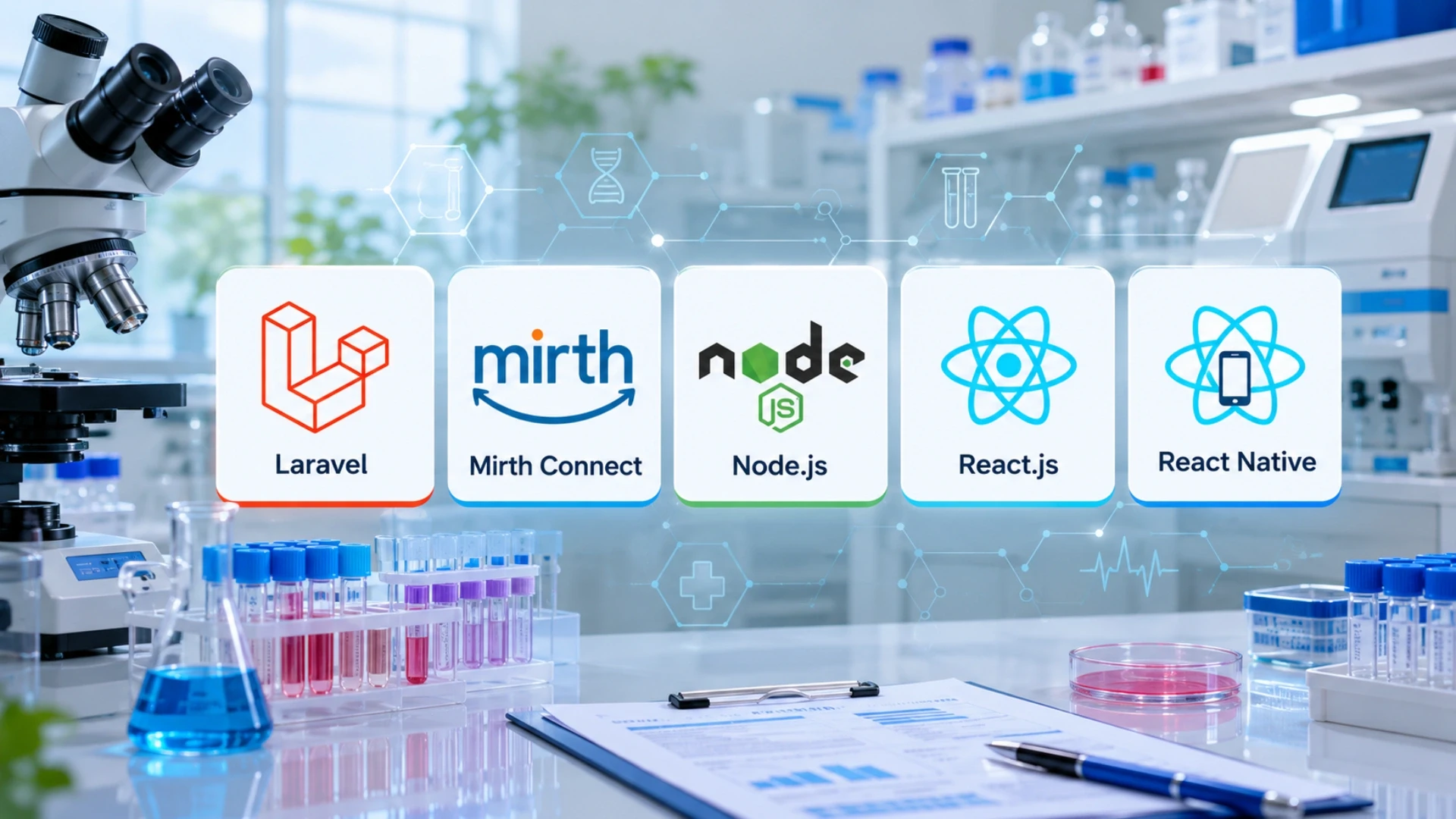
What is the best tech stack for laboratory software in 2026? The LIS tech stack is shaped by three constraints: the need for bidirectional instrument interfacing via ASTM and HL7 v2, CLIA and HIPAA compliance architecture requirements, and the high-volume data pipeline that processes concurrent results from multiple analysers without data loss or result misattribution.
Layer | Technology | Purpose |
Backend API | Laravel | Secure APIs, RBAC, audit trails |
Interface Engine | Mirth Connect | HL7/ASTM instrument integration |
Real-Time Pipeline | Node.js | Live result processing and updates |
Frontend | React.js | Laboratory worklists and result verification |
Mobile App | React Native | Specimen collection and barcode scanning |
Database | PostgreSQL + AES-256 | Secure patient and specimen data storage |
FHIR Server | HAPI FHIR / Azure FHIR | EHR and patient portal integration |
Cloud Infrastructure | AWS HIPAA-Eligible Services | Secure hosting, storage, and audit logging |
Mirth Connect is the non-negotiable choice for the instrument interface layer. It is the clinical laboratory standard for a reason: it has pre-built drivers for Siemens, Beckman Coulter, Abbott, Sysmex, and Roche instruments, reducing custom interface engineering time by 60 to 80 per cent for labs with standard analyser configurations.
Acquaint Softtech's dedicated software development teams include a dedicated interface engineer for all LIS projects. This engineer manages the Mirth Connect configuration, instrument driver setup, and interface validation testing with the lab's existing analyser fleet before the LIS goes live on patient specimens.
Case Study: Clinical Analytics Platform for BIANALISI SPA, Italy
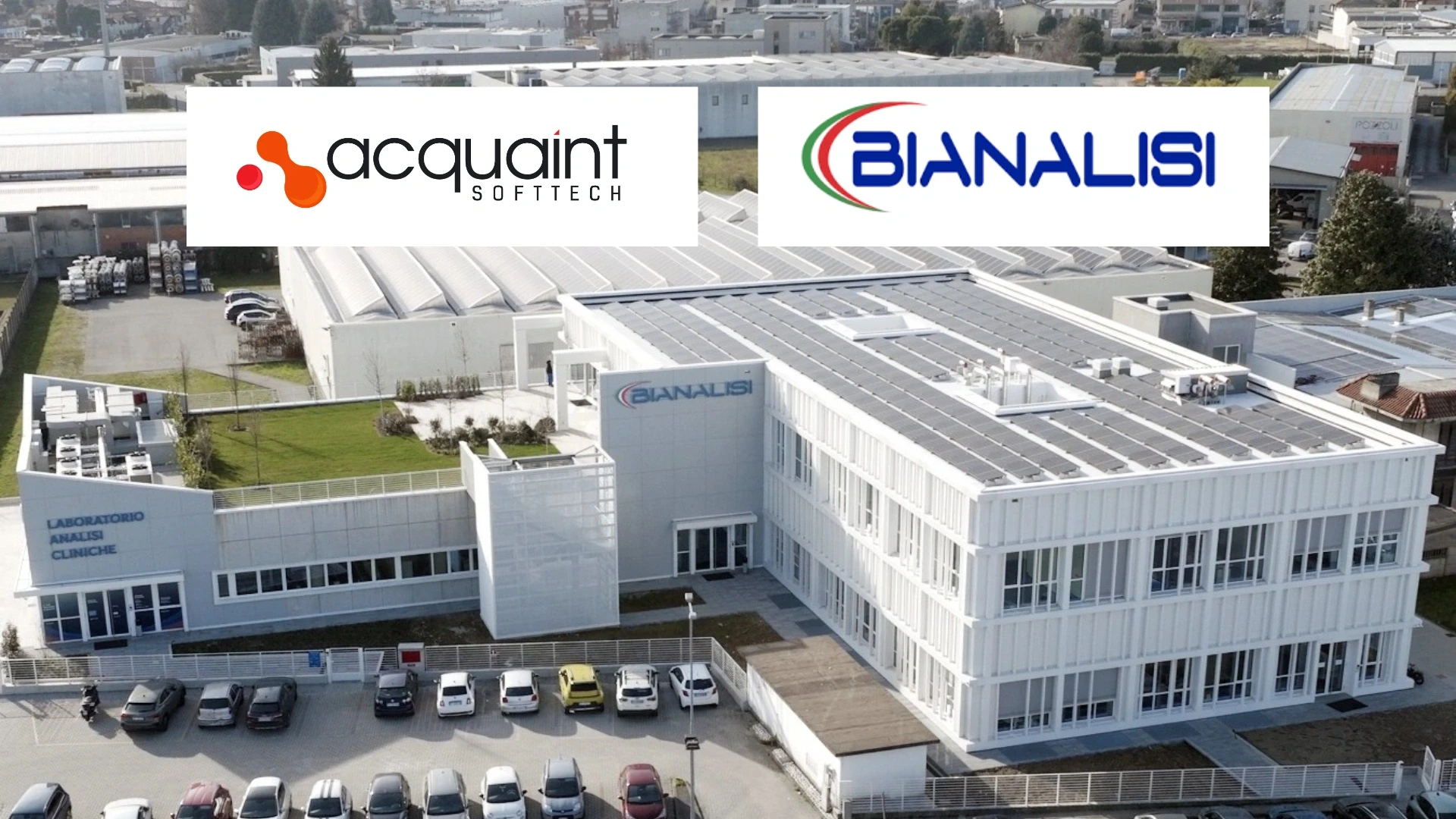
The following is drawn from a verified Clutch client review submitted February 22, 2026. All outcomes are client-reported and publicly verifiable.
Client: BIANALISI SPA, Italy's largest integrated diagnostics group (1,001 to 5,000 employees)
Reviewer: Giovanni Gianolli, CEO, BIANALISI SPA
Project: Clinical Data Analysis and Predictive Health Intelligence Platform — connecting laboratory, diagnostic imaging, and outpatient data across multiple regional facilities
Technology: Python (pandas, scikit-learn, FastAPI), PostgreSQL, React.js dashboard, European-compliant cloud infrastructure
Duration: April to November 2025: 7 months, every milestone delivered on schedule
Clutch Rating: 5.0 out of 5.0 across Overall, Quality, Schedule, and Cost | Verified: February 22, 2026
The laboratory data integration challenge
BIANALISI SPA is Italy's largest integrated diagnostics group. Their challenge was structurally identical to the core LIS integration problem: laboratory test results, diagnostic imaging data, and outpatient service records existed in separate facility-level systems across multiple regional locations. Regional medical directors had no visibility into cross-facility diagnostic trends. Clinical supervisors could not identify cohort-level risk patterns without weeks of manual data extraction.
Acquaint Softtech built a cross-facility clinical data integration and predictive analytics platform that addressed key challenges in multi-facility LIS development, including integrating diverse clinical data sources, maintaining GDPR-compliant handling of partially anonymised datasets, and delivering role-based access for different clinical users. The project also leveraged expertise from Acquaint Softtech's hire AI/ML engineers team to support predictive analytics and intelligent clinical data processing.
Verified clinical outcomes
Clinical directors identified clusters of abnormal diagnostic trends within the same reporting cycle, previously only visible after monthly manual audits across facility-level systems
A supervisor identified an unusual spike in related laboratory indicators within a patient cohort and initiated immediate review, rather than waiting for periodic analysis
Cross-facility trend analysis consolidated from multiple manual extraction processes into a single operational dashboard, materially reducing report preparation time
Every project milestone delivered on schedule despite mid-project regulatory clarifications requiring scope adjustments
"Their technical maturity in handling large, partially anonymised datasets while preserving clinical signal integrity was evident. They understood that healthcare analytics is not purely mathematical; it is contextual. They delivered analytics that were trusted, not just technically correct." - Giovanni Gianolli, CEO, BIANALISI SPA | Clutch Verified Review, February 22, 2026 | 5.0 out of 5.0
Laboratory software development company India: fixed-scope LIS proposal in 2 weeks.
Acquaint Softtech's discovery workshop delivers a phased LIS module plan, instrument interface inventory, compliance architecture, and fixed-scope development proposal in 2 weeks. 50 or more verified Clutch reviews. $25 to $49/hour. 95 per cent on-time sprint delivery.
Laboratory Software Development Cost in 2026
Laboratory software development cost 2026 varies based on the number of modules, instrument integrations, EHR connectivity, and compliance requirements.
LIS Tier | Estimated Cost | Timeline |
Basic LIS | $80K–$180K | 5–9 months |
Mid-Tier LIS | $180K–$350K | 9–15 months |
Enterprise LIS | $350K–$800K+ | 14–24 months |
What LIS projects consistently underestimate
Instrument interface engineering per analyser family: each analyser model requiring a custom ASTM or HL7 interface adds $10,000 to $40,000 and 4 to 12 weeks. Labs with diverse analyser fleets discover this cost after contract signing.
EHR integration per vendor: each bidirectional HL7 ORM/ORU integration with a major EHR adds $20,000 to $60,000 and 6 to 14 weeks independently of the core LIS build.
Data migration from paper logs or legacy systems: mapping historical QC records, test catalogues, and patient result history to the new LIS schema adds $15,000 to $50,000 and 4 to 8 weeks.
CLIA inspection preparation documentation: producing the policy documents, procedure manuals, and validation reports required for CLIA inspection adds 6 to 10 weeks of compliance engineering time.
Custom laboratory software development services at Acquaint Softtech deliver at $25 to $49 per hour (Clutch-verified), representing 40 per cent average cost savings versus Western agency rates. Hire developers for laboratory software through the staff augmentation model for flexible team scaling across intensive instrument interface engineering phases.
Frequently Asked Questions
-
What features should laboratory software include?
Laboratory software should include order management, specimen tracking, instrument integration, quality control management, result verification, critical value alerts, and automated report delivery to EHRs and patient portals.
-
How much does laboratory software development cost in 2026?
Laboratory software development costs range from $80,000 to $180,000 for a basic LIS, $180,000 to $350,000 for a mid-tier system, and $350,000 to $800,000+ for an enterprise multi-facility platform.
-
How long does it take to build a Laboratory Information System (LIS)?
A basic LIS takes 5 to 9 months, a mid-tier LIS requires 9 to 15 months, and an enterprise LIS may take 14 to 24 months, including compliance planning and system architecture.
-
What is the difference between LIS and LIMS?
A LIS (Laboratory Information System) is designed for clinical diagnostics and patient management, while a LIMS (Laboratory Information Management System) focuses on sample tracking for research, manufacturing, and environmental laboratories.
-
What is CLIA compliance in laboratory software?
CLIA compliance ensures laboratories meet federal quality standards for testing human specimens. Laboratory software must support quality control records, audit trails, personnel tracking, and test result retention to help maintain compliance.
-
Why are HL7 and ASTM important in laboratory software?
HL7 and ASTM are industry-standard protocols that enable communication between laboratory analysers, EHR systems, and LIS platforms. They eliminate manual data entry and improve accuracy, efficiency, and compliance.
-
What is the best tech stack for laboratory software development?
A modern LIS typically uses Laravel or .NET for the backend, React.js for web applications, React Native for mobile apps, PostgreSQL for secure data storage, Mirth Connect for HL7 and ASTM integration, and AWS HIPAA-eligible cloud infrastructure.
-
Should I build a custom LIS or buy off-the-shelf laboratory software?
Off-the-shelf LIS solutions work well for standard laboratory workflows. Custom LIS development is ideal for molecular diagnostics, pathology, genetic testing, specialised reporting, or multi-tenant laboratory platforms.
-
What integrations are required for a Laboratory Information System?
A Laboratory Information System should integrate with EHR platforms, laboratory analysers, billing systems, patient portals, HL7 interfaces, FHIR APIs, and quality management systems to streamline operations.
-
Why is laboratory software important for healthcare organisations?
Laboratory software automates specimen management, test processing, result reporting, quality control, and regulatory compliance. It improves laboratory efficiency, reduces errors, and supports faster clinical decision-making.
I lead technology and client success at Acquaint Softtech with one goal in mind. Deliver work that feels personal, reliable, and worthy of long term trust. I stay close to both our clients and our developers to make sure every project moves with clarity, quality, and accountability.
Table of Contents
Get Started with Acquaint Softtech
- 13+ Years Delivering Software Excellence
- 1300+ Projects Delivered With Precision
- Official Laravel & Laravel News Partner
- Official Statamic Partner
Related Blog
The Complete Guide to Healthcare Software Development in 2026
Healthcare software development in 2026 is not a single discipline. It is six distinct product categories, each with its own compliance perimeter, integration burden, and cost curve.

Acquaint Softtech
May 1, 2026
How Telemedicine Apps Work: Architecture, Data Flow, and System Design Explained
A telemedicine app is not a video call with a medical logo. It is a distributed system that moves protected health information between four environments in under 200 milliseconds while staying inside HIPAA boundaries. Here is exactly how it works, layer by layer, with the tech stack, the data flow, and the numbers that matter.
Manish Patel
May 8, 2026
EHR vs EMR: What's the Actual Difference and Which Should You Build
Most people use EHR and EMR interchangeably. They are not the same system. One is a digital filing cabinet for a single practice. The other is a longitudinal health record that follows the patient across their entire care journey. Picking the wrong one costs founders 9 to 14 months of rework. Here is how to choose correctly the first time.

Ahmed Ginani
May 15, 2026India (Head Office)
203/204, Shapath-II, Near Silver Leaf Hotel, Opp. Rajpath Club, SG Highway, Ahmedabad-380054, Gujarat
USA
7838 Camino Cielo St, Highland, CA 92346
UK
The Powerhouse, 21 Woodthorpe Road, Ashford, England, TW15 2RP
New Zealand
42 Exler Place, Avondale, Auckland 0600, New Zealand
Canada
141 Skyview Bay NE , Calgary, Alberta, T3N 2K6