

Legacy System Modernization: Rebuild vs Refactor vs Replace: How to Choose
Every legacy modernization conversation starts the same way: should we rebuild from scratch, refactor what we have, or replace it with something off-the-shelf? Here is the decision framework that makes that choice concrete.

Manish Patel
Every legacy modernization conversation I have as COO of Acquaint Softtech, a software development partner with 1,300+ projects delivered, starts with the same question. Should we rebuild from scratch, refactor what we have, or replace the system with an off-the-shelf product? All three options sound reasonable in a kickoff meeting. All three can be catastrophically wrong in the wrong context. This article gives you the diagnostic that distinguishes them.

- CTOs and technical leads evaluating what to do with a codebase that is actively slowing down delivery
- Founders who have inherited legacy software and are deciding whether to invest in it or replace it
- Product managers trying to build the case for modernization investment to a board that needs a specific number
- Engineering leads who know the system needs work but are not sure which kind of work to prioritise
The word 'legacy' is doing a lot of work in most modernization conversations. It sometimes mean a genuinely outdated technology stack. Sometimes it means a codebase that has accumulated technical debt over years of rapid feature shipping. Sometimes it means a system that was built for a different scale than the one the business now operates at. Each of these is a different problem requiring a different solution.
The specific cost structure for version upgrades and framework migrations is covered in the Laravel version upgrade cost guide. This article covers the higher-level strategic decision that sits above specific upgrade costs: which of the three modernization paths is the right answer for your specific codebase and business situation.
The Three Options: What Each One Actually Means
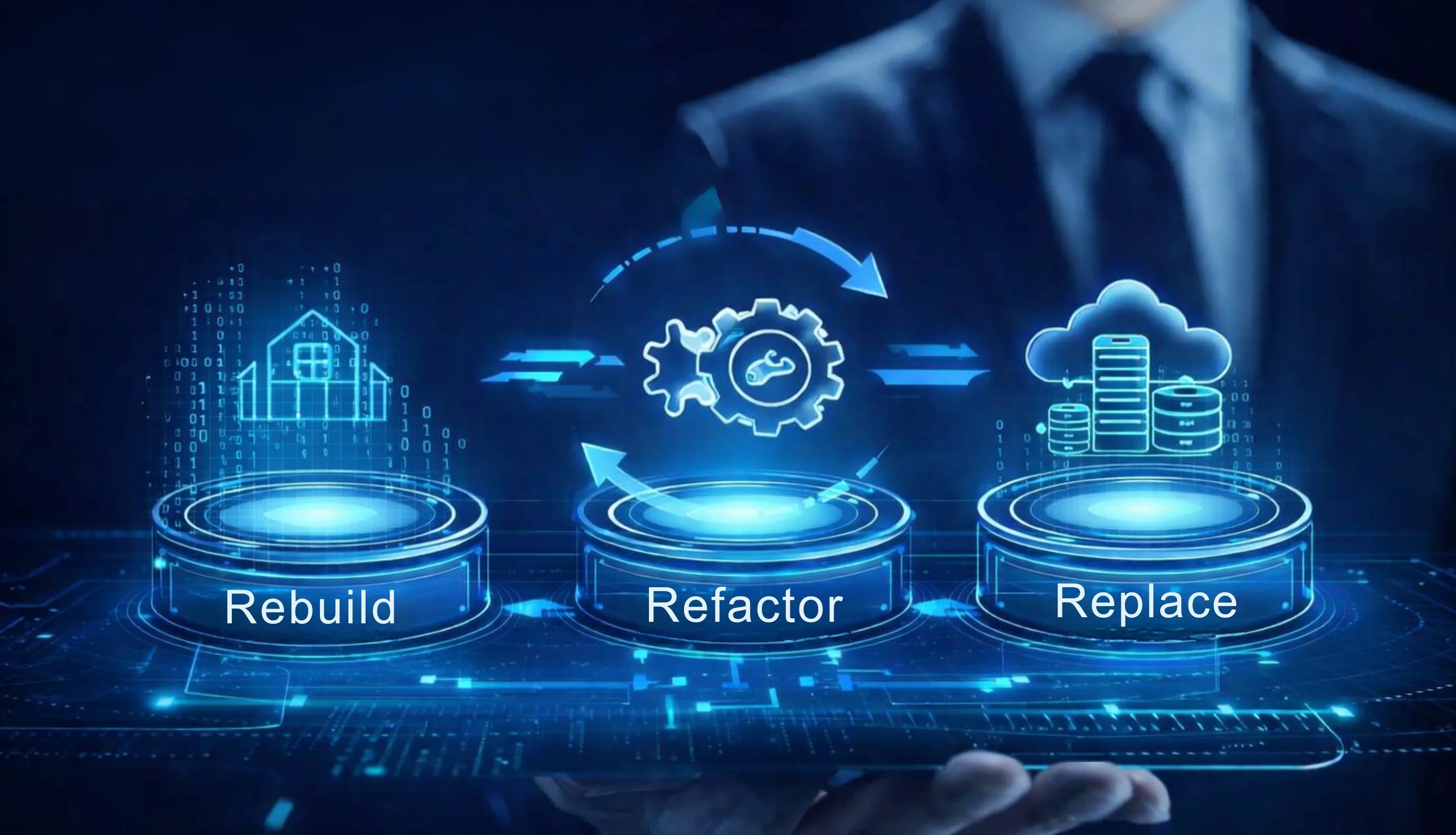
Before the comparison, plain-language definitions. These terms are used loosely enough in vendor conversations that it is worth establishing what each one means in practice.
Refactor
Definition: Improve the structure of existing code without changing its external behaviour. The system does the same things, but the code is cleaner, better organised, more testable, and easier to extend. No features are added or removed. Deployment is continuous: refactoring happens alongside or between feature sprints.
Right when: Refactor is often the right answer when the system's logic is fundamentally sound but the implementation has accumulated debt. It is the wrong answer when the underlying architecture cannot support what the business needs next, no matter how clean the code is.
Replace
Definition: Adopt an existing off-the-shelf product: a SaaS platform, an open-source framework, or a packaged enterprise application: instead of maintaining or rebuilding the custom system. The business logic moves to the new product, with customisation where the product allows it.
Right when: Replace is the right answer when a mature product exists that covers 80% or more of your requirements without heavy customisation. It is wrong when your business logic is sufficiently differentiated that the off-the-shelf product becomes more expensive to customise than to build.
Rebuild
Definition: Start again with a new codebase, informed by everything learned from the existing system. The external behaviour is reproduced but the internal structure is redesigned from scratch for the requirements the business now has.
Right when: Rebuild is the right answer when the existing architecture is so structurally compromised that refactoring would cost as much as rebuilding, or when the technology stack is end-of-life with no viable upgrade path. It is the most expensive and highest-risk option and should not be chosen by elimination.
The Three Options Compared
Side by side, the three options look like this. These are realistic ranges, not optimistic estimates.
Option A: Refactor |
Best for: Codebases with sound business logic but poor structure. Accumulated debt from rapid feature shipping. Systems that need to scale but have a viable architecture path. |
Not ideal for: Systems where the underlying architecture is the constraint. Unsupported technology stacks where no upgrade path exists. |
Cost range: 30 to 60% of equivalent rebuild cost. Ongoing rather than one-time. |
Typical timeline: Continuous. Work happens in sprints alongside feature development. |
Primary risk: Scope creep. Without a defined refactoring target, teams refactor indefinitely without measurable improvement. |
Option B: Replace (Off-the-Shelf) |
Best for: Businesses whose requirements match an existing mature product. Teams who want to stop maintaining custom infrastructure. Standard workflows with limited differentiation. |
Not ideal for: Businesses with highly customised workflows. Products where the differentiation is in the software logic itself. Situations where integration with existing systems is complex. |
Cost range: Product licensing plus migration and integration cost. Typically $15,000 to $80,000 for migration depending on data complexity. |
Typical timeline: 6 to 16 weeks for migration. Product is operational from Day 1. |
Primary risk: Capability ceiling. Off-the-shelf products constrain what you can build as requirements evolve. Switching costs increase over time as data and process embed into the new product. |
Option C: Rebuild |
Best for: End-of-life technology stacks with no upgrade path. Architectures structurally incompatible with current business requirements. Situations where technical debt remediation cost exceeds rebuild cost. |
Not ideal for: Systems that could be saved through refactoring. Situations where the business logic is well-documented and the team is available for a full knowledge transfer. |
Cost range: $40,000 to $200,000+ depending on system complexity. Equivalent to building the product from scratch with existing knowledge. |
Typical timeline: 4 to 18 months. The existing system must remain operational throughout. |
Primary risk: The big rewrite problem: rebuilds routinely take 2 to 3 times their initial estimate. Without disciplined scope management, the rebuild scope expands to include improvements that were not in the original system. |
Not Sure Which Option Your Codebase Needs? Let Us Run the Diagnostic.
We assess legacy systems across four dimensions: architecture health, technology stack viability, business logic portability, and cost-to-remediate versus cost-to-rebuild. The assessment takes 48 hours and produces a specific recommendation with cost ranges for each path. Most teams find the decision significantly clearer after seeing the numbers.
The 6-Question Diagnostic
Answer these six questions about your current system. The pattern of answers maps to a specific path.
1. Is the underlying technology stack still supported and upgradeable?
Yes = refactor is viable. No (end-of-life, no upgrade path) = rebuild is likely required. The technology stack question is the first filter because no amount of refactoring saves a system running on a stack with no future.
2. Does a mature off-the-shelf product exist that covers at least 80% of your requirements?
Yes = replacement should be evaluated seriously before either refactor or rebuild. No = replacement will cost more in customisation than the alternatives. Most businesses overestimate how well off-the-shelf products fit their workflows.
3. What is the ratio of time spent maintaining the system versus building new features?
Under 20% maintenance: refactor is likely sufficient. 20 to 40%: refactor with a clear target or rebuild should be evaluated. Over 40%: the maintenance burden has become the primary cost of the system. Rebuild or replace is worth a serious cost comparison.
4. Is the business logic in the system well-documented and transferable?
Yes = rebuild is feasible if the architecture warrants it. No = rebuild risk is significantly higher because undocumented business logic must be rediscovered during development, which extends timeline and cost unpredictably.
5. Is the system's architecture fundamentally incompatible with the requirements of the next 3 years?
Yes = refactoring buys time but not a solution. The rebuild cost is inevitable; doing it now versus in 18 months is a cost-timing question, not a cost-avoidance question. No = refactor first, reassess in 12 months.
6. What is the cost estimate for full remediation of known technical debt versus a clean rebuild?
This is the financial test. If technical debt remediation through refactoring costs 60% or more of a rebuild estimate, the rebuild case is strong. Below 40% of rebuild cost, refactoring is almost always the right first step.
The pattern of answers across these six questions almost always produce a clear direction. A system that fails questions 1 and 5 and passes questions 2 and 4 is a rebuild case. A system that passes question 1, has a 25% maintenance overhead, and has no viable off-the-shelf replacement is a refactor case. The diagnostic replaces the gut-feel conversation with a structured one.
When evaluating the vendor who will execute whichever path you choose, apply the same rigour to the vendor selection as to the modernization path. The offshore development due diligence checklist covers the 10 specific checks that separate legitimate modernization vendors from ones who will extend the timeline and the cost of whichever path you choose.
Have the Diagnostic Results? Let Us Map Them to a Cost and Timeline.
Run through the 6 questions above and share your answers with us. We will map them to a specific modernization path recommendation, a cost range for that path, and a realistic timeline. The conversation takes 30 minutes and produces a number you can take to the board.
What Each Path Looks Like in Practice
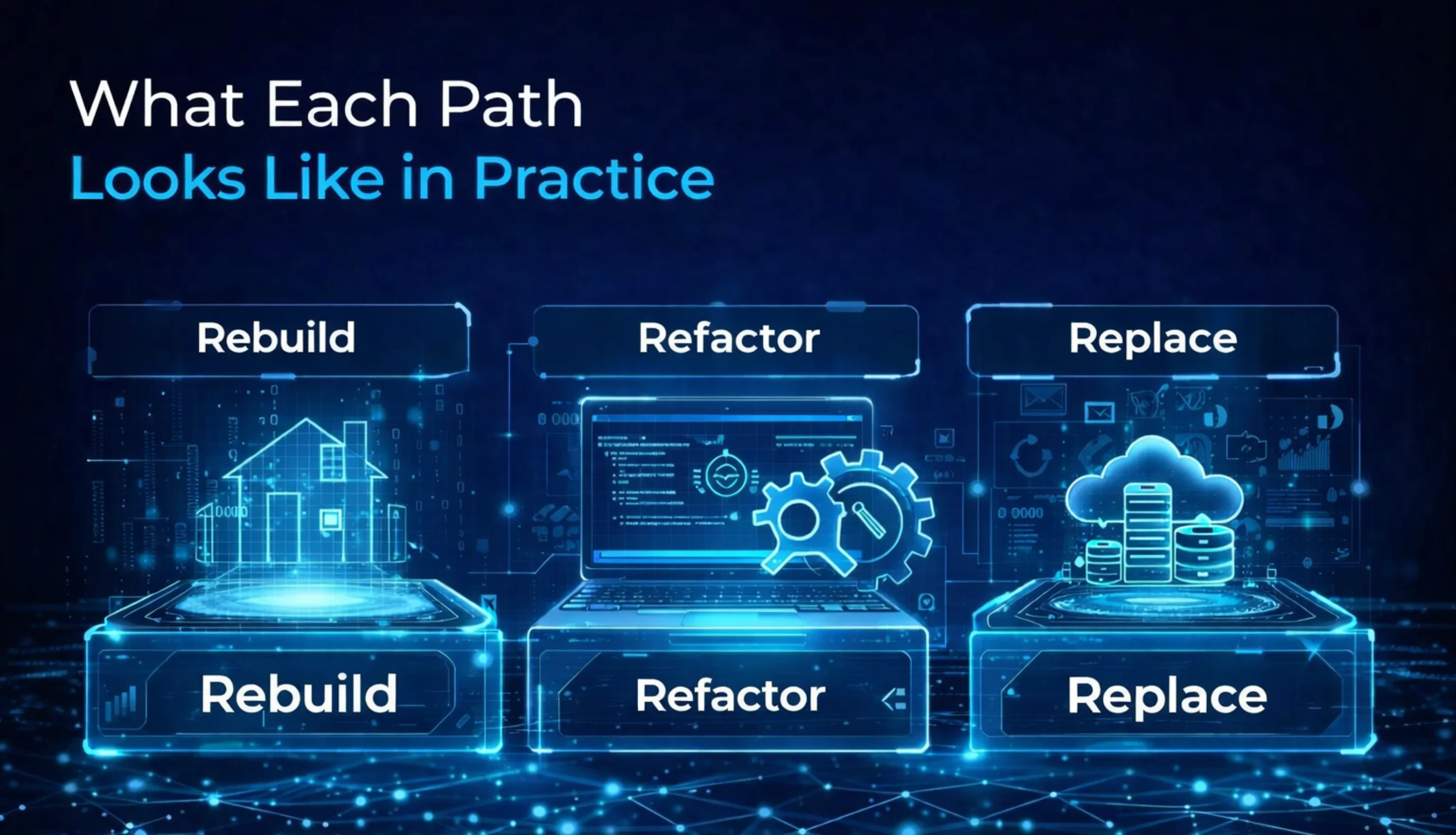
Refactor: The Structured Approach That Avoids Endless Cleanup
Refactoring without a defined target is how refactoring projects turn into 18-month efforts with no clear deliverable. Structured refactoring works differently. The team defines a specific architectural target: for example, extracting business logic from controllers into service classes, adding test coverage to a defined threshold, replacing a deprecated library with a supported alternative: and works toward it in bounded sprints.
The refactoring work happens alongside feature development rather than as a separate project. A typical structured refactoring engagement allocates 20 to 30% of sprint capacity to technical debt reduction while the remaining capacity continues delivering product features. This approach keeps the business moving while the technical foundation improves underneath it.
For systems built on Laravel, structured refactoring often coincides with a version upgrade. The upgrade creates a natural forcing function for reviewing and improving the codebase. The Laravel SaaS architecture guide covers the architectural patterns that make a Laravel codebase more maintainable at scale: the same patterns that a structured refactoring engagement works toward.
Replace: When the Build vs Buy Calculation Favours the Market
Replace is the most underused option in the modernization conversation. Companies often dismiss it because they assume their requirements are too unique for a market product. The honest test is not whether you have unique requirements. The test is whether your unique requirements justify the full ongoing cost of custom software, or whether a market product serving 80% of your needs with custom integrations for the remaining 20% is cheaper and faster.
The replacement path's primary risk is the capability ceiling. Once your workflows are embedded in an off-the-shelf product, the product's roadmap determines what you can build. For companies where the software itself is the competitive differentiator, this ceiling arrives faster than expected. For companies where the software is infrastructure rather than product, replacement is often the most cost-effective modernization path available.
Rebuild: How to Do It Without the Big Rewrite Failure Pattern
The big rewrite failure is the most well-documented disaster in software development. The pattern: a team convinces leadership that the existing system should be thrown away and rebuilt cleanly. The rebuild takes 3 to 5 times the estimated time. The existing system deteriorates while the rebuild is in progress because maintenance resources have been redirected. The rebuild ships with its own set of bugs and missing features because the full complexity of the original system was underestimated.
Rebuilds that succeed share a structure: they are done incrementally, with the new system running alongside the old one, replacing modules one at a time. The strangler fig pattern: gradually replacing parts of the old system with new implementations while keeping the overall system operational: is the approach that consistently produces rebuild success. It requires discipline and a well-structured codebase target, but it eliminates the catastrophic risk of a full cutover.
For rebuilds that involve moving to a new framework, a dedicated development team structure is usually the right engagement model. The rebuild requires sustained, contextually deep development work over 4 to 12 months. Individual augmented developers cycling through the engagement do not build the institutional knowledge of the old system that the rebuild requires.
Technology Stack Considerations for 2026
The technology stack running the legacy system is a significant input to the modernization decision. Here is the honest assessment for the most common legacy stacks we encounter. For the case for Laravel as the destination framework for modernization projects, the reasons businesses choose Laravel covers the ecosystem maturity, talent availability, and long-term maintenance case in detail.
PHP 5.x / Laravel 5.x or 6.x | Both are end-of-life. PHP 5.x has been unsupported since December 2018. Laravel 5.x reached end of life in September 2021. A system running on either of these has a security exposure that is not addressable through refactoring. The upgrade path to current versions (PHP 8.3, Laravel 11 or 12) is well-documented but requires structured execution. This is a version upgrade engagement, not a full rebuild, for most systems. |
Legacy WordPress with heavy customisation | Refactor within WordPress is rarely the right answer for heavily customised installations. The WordPress architecture does not support the kind of structural separation that makes refactoring durable. Replace with a market product if requirements are standard. Rebuild on Laravel if the business logic is differentiated. The cost structure for both paths is covered in our WordPress migration analysis. |
Custom PHP without a framework | Without a framework's architectural constraints, custom PHP applications accumulate idiosyncratic patterns that make refactoring expensive because every part of the system requires individual assessment. Rebuild on a structured framework (Laravel being the most defensible choice for PHP-origin systems) is usually the more cost-effective long-term path for systems over 5 years old. |
Node.js / JavaScript (legacy) | JavaScript codebases have a shorter half-life of dependency compatibility than Laravel. Dependency rot: packages going unmaintained, breaking changes in major package versions: is more prevalent in the Node ecosystem. Assessment should include a full dependency audit before choosing a path. Refactor if the dependency surface is manageable. Rebuild if the dependency rot is structural. |
How to Build the Internal Case for Modernization Investment
The technical team almost always knows the right answer before the board conversation. The challenge is presenting it with numbers that justify the investment. Here is the framework that consistently produces a clear business case.
The four numbers that make the modernization case
- 1. Current maintenance cost: hours per sprint × fully-loaded developer rate × sprints per year. This is what the technical debt is costing you annually in developer time.
- 2. Opportunity cost: features not built because capacity was consumed by maintenance. Estimate the value of one quarter's delayed feature delivery.
- 3. Modernization cost: the specific estimate for whichever path the diagnostic points to. Use ranges from this article as initial benchmarks, then get vendor quotes for specifics.
- 4. Post-modernization maintenance cost: what the same team could do with the capacity reclaimed from technical debt management.
The business case is simple: if (1 + 2) over 3 years exceeds (3 + residual 4 over 3 years),
modernization investment pays for itself. For most systems with a maintenance overhead above 25%,
this calculation favours modernization within 18 to 24 months.
For the engagement structure during the modernization, the in-house vs staff augmentation comparison covers which team model fits which modernization path. Refactoring works well with individual augmented developers added to an existing team. Rebuilds almost always benefit from a dedicated team structure with sustained context across the project lifetime.
If the modernization also involves a vendor transition: moving from the team that built the legacy system to a new team for the modernization: the vendor.
Ready to Turn the Diagnostic Into a Modernization Plan?
Share your answers to the 6 diagnostic questions and a brief description of the system. We will assess the path, estimate the cost range, and recommend a team structure for the engagement. Most assessments return within 48 hours. No commitment required before you see the numbers.
Frequently Asked Questions
-
How do I know if my legacy system needs to be rebuilt or just refactored?
Run question 1 (technology stack viability) and question 5 (architectural compatibility with future requirements) from the diagnostic above. If the stack is end-of-life or the architecture cannot support your 3-year roadmap regardless of how clean the code is, refactoring is at best a delay of the inevitable. If neither of those is true, structured refactoring is almost always the cheaper and lower-risk first step.
-
What is the average cost of a legacy system rebuild in 2026?
For a medium-complexity business application with 5 to 8 years of accumulated development, a full rebuild typically runs $60,000 to $150,000 with an offshore partner and $150,000 to $400,000 with a US or UK agency. The range is wide because the primary cost driver is undocumented business logic: systems with good documentation rebuild faster and cheaper than systems where the logic must be rediscovered. Getting a specific estimate requires a codebase assessment before any number is meaningful.
-
Can I refactor a legacy system while still shipping features?
Yes, and this is the recommended approach. Dedicating 20 to 30% of sprint capacity to structured refactoring while maintaining 70 to 80% for feature delivery keeps the business moving while the technical foundation improves. The alternative: pausing feature development for a dedicated refactoring sprint: typically loses executive support within 4 to 6 weeks when stakeholders see no visible product progress. Continuous refactoring embedded in feature sprints is more sustainable and produces better outcomes over a 6 to 12 month horizon.
-
How long does a full legacy system rebuild typically take?
For a medium-complexity application, 4 to 9 months using the incremental strangler fig approach. Full cutover rebuilds take longer and carry significantly more risk. The timeline is most reliably predicted after a codebase assessment that documents the scope of business logic to be rebuilt, the integration surface, and the data migration complexity. Estimates made before this assessment are guesses, not plans.
-
What is the strangler fig pattern and why does it matter for rebuilds?
The strangler fig pattern is an approach to incrementally replacing a legacy system by building new functionality alongside the old system and gradually redirecting traffic until the old system can be decommissioned. It eliminates the single biggest risk of a rebuild: the big bang cutover. Instead of replacing everything at once, individual components are replaced one at a time, each one tested in production before the next is started. Systems rebuilt using this approach have a dramatically lower failure rate than those rebuilt as full replacements.
-
When does replacing with an off-the-shelf product make more sense than rebuilding?
When a mature product exists that covers at least 80% of your requirements, and your remaining 20% can be handled through configuration, integration, or extensions rather than core code changes. The calculation shifts toward custom software when your business logic is your competitive advantage, when integration complexity is high, or when the off-the-shelf product's capability ceiling is visible from where you are today. The replace path is most appropriate for internal tools, standard business processes, and systems where the value is in the workflow rather than the implementation.
-
How do I prevent the modernization project from going over time and budget?
Three practices matter most. First, scope the modernization target specifically before any development starts: what does done look like, how will you measure it, and what is explicitly out of scope. Second, use the incremental approach for rebuilds rather than the full replacement approach. Third, maintain executive visibility into progress against the modernization target with monthly reporting on technical debt reduction metrics, not just feature delivery. Modernization projects that lose executive visibility lose budget before they finish.
I lead technology and client success at Acquaint Softtech with one goal in mind. Deliver work that feels personal, reliable, and worthy of long term trust. I stay close to both our clients and our developers to make sure every project moves with clarity, quality, and accountability.
Table of Contents
Get Started with Acquaint Softtech
- 13+ Years Delivering Software Excellence
- 1300+ Projects Delivered With Precision
- Official Laravel & Laravel News Partner
- Official Statamic Partner
Related Reading

Staff Augmentation Pricing Models Explained: Monthly Retainer vs Hourly vs Project-Based
Most clients pick a staff augmentation pricing model based on the rate. That is the wrong variable. The pricing model determines your vendor's incentives, your budget predictability, and who carries the risk when delivery slips.

Mukesh Ram
April 4, 2026
Staff Augmentation vs Upwork vs Agency: Real Cost Breakdown for CTOs in 2026
Staff augmentation, Upwork, or a dev agency? The real cost difference in 2026 is bigger than most CTOs expect. Here are the actual numbers with zero fluff.

Acquaint Softtech
March 8, 2026.webp "Building Cross-Platform Mobile Apps with Laravel and NativePHP AIR")
Building Cross-Platform Mobile Apps with Laravel and NativePHP AIR
NativePHP AIR lets Laravel developers build native iOS and Android apps from a single PHP codebase, enabling teams to build offline-first, cross-platform mobile apps.
Manish Patel
April 16, 2026India (Head Office)
203/204, Shapath-II, Near Silver Leaf Hotel, Opp. Rajpath Club, SG Highway, Ahmedabad-380054, Gujarat
USA
7838 Camino Cielo St, Highland, CA 92346
UK
The Powerhouse, 21 Woodthorpe Road, Ashford, England, TW15 2RP
New Zealand
42 Exler Place, Avondale, Auckland 0600, New Zealand
Canada
141 Skyview Bay NE , Calgary, Alberta, T3N 2K6