

Life Insurance Platform Development: Digital Onboarding, Underwriting AI, and Policy Servicing
Life insurance platform development is the building of software that takes a customer from a digital application to decades of policy servicing. It has three phases: digital onboarding that captures an application in minutes, accelerated underwriting AI that decides without a medical exam, and a policy servicing system that manages the contract for its full term. Custom life platforms typically cost $300,000 to $1.5M and must handle a relationship that can last 30 years or more.

Manish Patel
As a CIO at Acquaint Softtech, I often explore AI Development Services to see how intelligent systems can strengthen long term insurance platforms. The Longest Relationship in Insurance. A life insurance policy is not a product you sell once; it’s a decades-long promise you quietly carry.
A customer may buy a 30-year term policy and then disappear from your system for years, only returning at life’s most critical moments like a claim, beneficiary update, or policy change. In that silent gap, the platform still has to stay accurate, compliant, and instantly ready to act.
Yet many legacy systems struggle with this long lifecycle, slow onboarding, paper-heavy underwriting, and painful servicing where even small changes become support tickets. Meanwhile, digital-first carriers are issuing policies in minutes and using AI-driven underwriting at scale. The gap is no longer operational; it’s architectural.

- You run a life carrier, and your legacy policy system blocks every product launch and rate change.
- You are launching a digital-first life insurer and need a platform from application to servicing.
- You want accelerated underwriting that decides in minutes without a medical exam.
- You need a policy servicing system built for a contract that lasts decades, not a year.
- You are scoping a life insurance build and need to know cost, timeline, and what to build first.
Acquaint Softtech's software development services structure life platform builds around that full arc, and the broader engineering context lives in the complete guide to InsurTech software development in 2026.
This article breaks a life insurance platform into its three phases onboarding, underwriting, and the long servicing tail and shows how to build each for a relationship measured in decades. It is written for the carrier or founder who knows the three-week application is killing conversion and wants the platform that turns it into ten minutes.
The Three Phases of a Life Insurance Platform
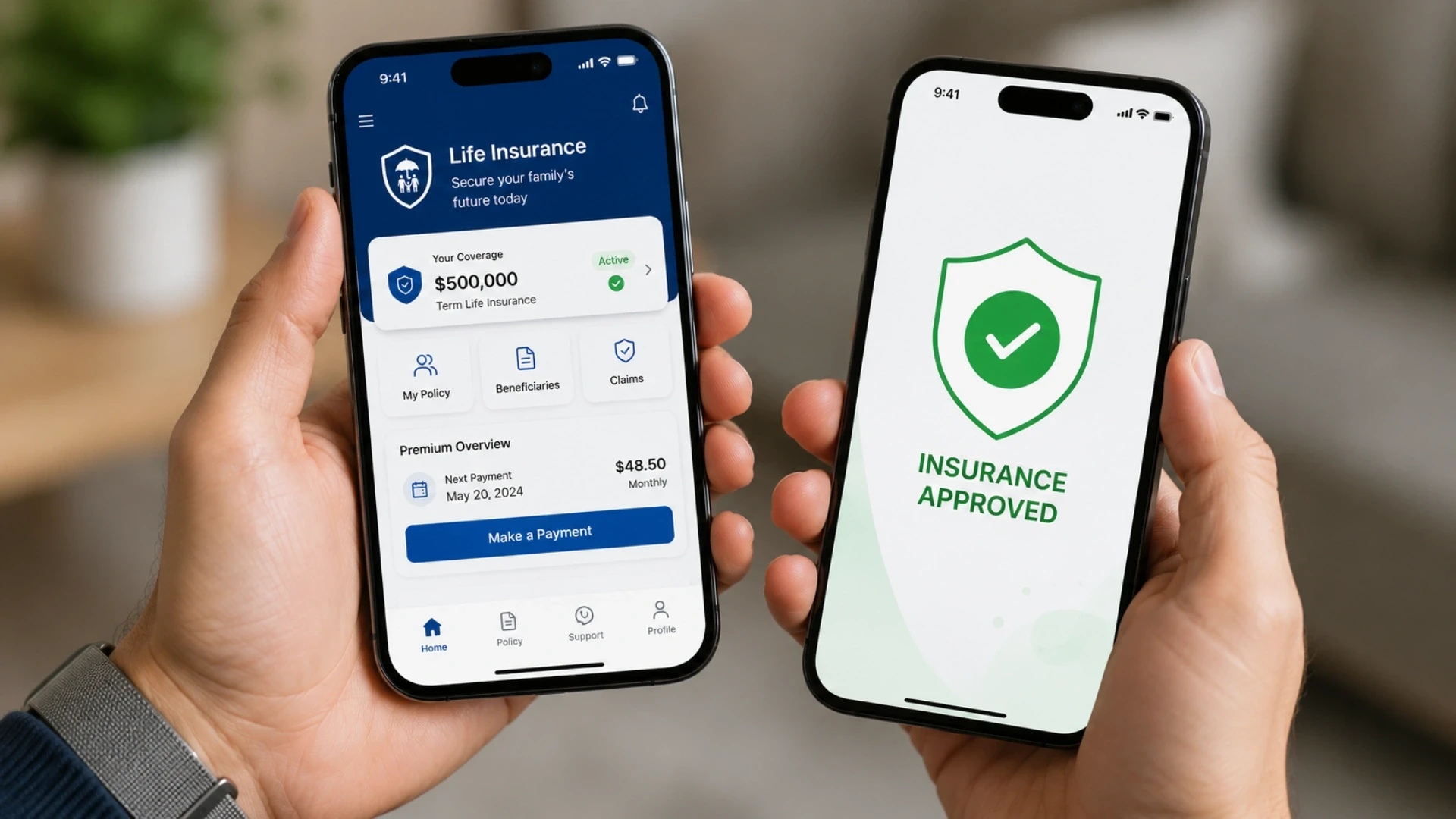
A life insurance platform spans three phases that demand very different engineering. Onboarding is a high-conversion, minutes-long digital experience optimised for the moment of purchase. Underwriting is a data-intensive decision engine that must price risk accurately and explain itself to regulators.
Policy servicing is a decades-long system of record that has to stay correct and compliant through every life event. Building all three to the same standard, and connecting them through one policyholder record, is what separates a digital life insurer from a digitised paper process.
What is digital life insurance?
Digital life insurance is coverage sold, underwritten, and serviced primarily through software rather than agents and paper. The applicant completes an online application in minutes, an accelerated underwriting engine decides using data instead of a medical exam, and the policy is issued and managed through a digital portal. Ethos, Ladder, and the now-closed Haven Life popularised this model. The defining feature is speed without sacrificing actuarial discipline: the same risk assessment a fully underwritten policy would get, delivered in minutes through data.
Acquaint Softtech builds the three phases on one shared policyholder record, so the data captured at onboarding flows into underwriting and persists through decades of servicing. The engagement model is described in the dedicated software development team's service, where engineers with life-insurance domain experience own the platform across its full lifespan. The phases must share clean internal APIs so the onboarding app, the underwriting engine, and the servicing portal all read one truth.
Acquaint Softtech's backend development services build the data and API layer that keeps a policy consistent from the day it is sold to the day it pays out, often thirty years later. For teams that want to map the architecture before committing budget, the discovery workshop service produces a three-phase data model, an underwriting data plan, and a servicing roadmap in four to six weeks. In life insurance, designing the long servicing tail upfront is what prevents the most expensive mistake: a great onboarding flow bolted onto a servicing system that cannot carry the policy.
Phase 1: Digital Onboarding and Application
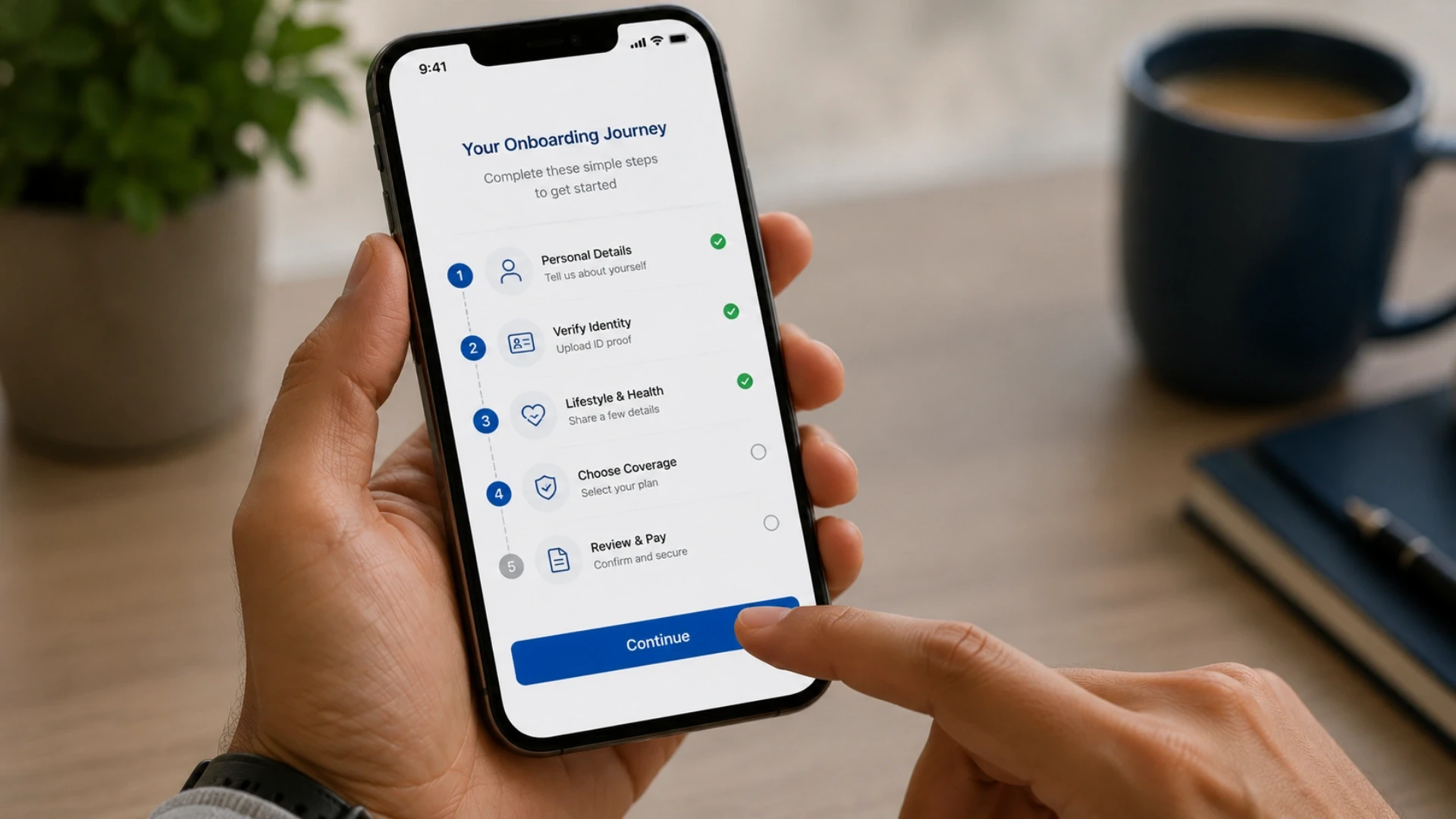
Digital onboarding is where the life insurance relationship is won or lost. The applicant arrives anxious about a topic nobody enjoys, and every extra field, every confusing question, every delay is a reason to abandon. The goal is a guided application that captures everything underwriting needs in the fewest possible steps, gives a quote upfront, and feels less like a medical interrogation than a few minutes of simple questions. Ethos lets eligible applicants complete the whole thing in about ten minutes.
How does digital life insurance onboarding work?
The applicant answers a dynamic questionnaire that adapts to their responses, asking follow-up questions only when needed. The platform shows a personalised quote upfront and explains how health information affects price, building the transparency that converts.
Behind the scenes, it begins pulling third-party data, prescription history, medical claims, and driving records to pre-fill and verify rather than asking the applicant to supply everything. The best onboarding flows feel short because the platform is doing the data work the applicant used to do by hand and by mail.
Acquaint Softtech builds the onboarding experience as a dynamic, conversion-optimised flow that adapts questions in real time and shows a quote before asking for commitment. The applicant-facing web and mobile experience is built by the MERN stack development team, delivering a fast, responsive application that works as well on a phone as on a desktop.
Identity verification, e-signature, and document capture are built into the flow so the application completes without leaving the experience. Acquaint Softtech's Python development team builds the integrations to identity and e-signature providers and the document-processing services that turn uploaded evidence into structured data.
The conversion discipline of a great digital onboarding flow draws on the same product engineering described in the augmented vs non-augmented development guide, which explains how AI-assisted, data-driven iteration improves user-facing products like an insurance application.
TURN THREE WEEKS INTO TEN MINUTES
Every day your application takes a customer lost to a digital competitor. Acquaint Softtech has shipped 1,300+ projects in 13+ years and deploys a dedicated life-insurance team within 48 hours. Book a call, and we will map your fastest path to digital onboarding.
Phase 2: Accelerated Underwriting AI
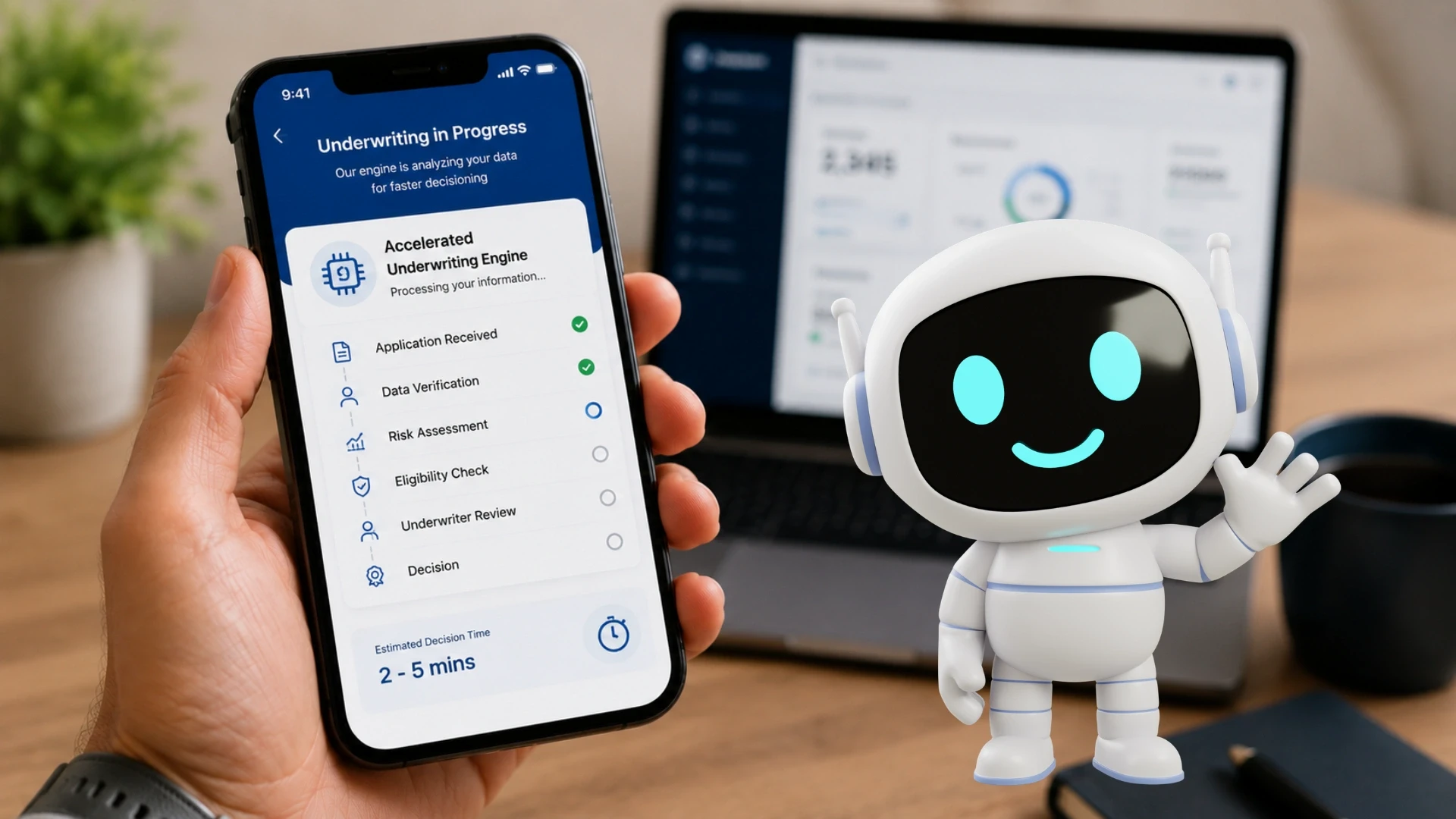
Accelerated underwriting is the engine that lets a life insurer decide in minutes what used to take weeks. Instead of ordering a medical exam and waiting for results, the platform assembles a risk picture from data the applicant has consented to share, scores it, and issues an instant decision for the majority of applicants. This is the single biggest lever on both conversion and cost in digital life insurance, and it is where AI delivers the clearest return.
What is accelerated underwriting in life insurance?
Accelerated underwriting waives the traditional medical exam for eligible applicants and decides using data instead. The engine integrates prescription history, medical claims billing, lab history, predictive financial data, driving records, and prior life insurance history into one risk profile, then applies underwriting rules and a risk model to issue a decision.
Carriers now approve face amounts as high as $5 million this way, up from the small policies accelerated underwriting once handled. The model must be explainable, because a declined or rated applicant has a right to understand why.
Data Source | What It Reveals | Role in the Decision |
Prescription history | Conditions and medications | Primary health risk signal |
Medical claims billing | Diagnoses and procedures | Confirms and extends Rx data |
Lab and clinical history | Test results over time | Refines mortality risk |
Driving records (MVR) | Risk-taking behaviour | Behavioural risk indicator |
Prior life insurance history | Past applications and decisions | Anti-selection and fraud check |
Acquaint Softtech builds the accelerated underwriting engine to integrate these data sources into one risk profile and issue an explainable decision in real time. The data integration and the risk model are delivered through the development services, which own the connections to prescription, claims, and MVR data and the model that scores them.
Explainability and post-issue audit are not optional, because regulators and reinsurers both scrutinise accelerated underwriting. Acquaint Softtech's hire AI and ML engineers service provides the engineers who build the explanation logging and the post-issue audit pipeline that, as at Ethos, feeds human reviews back into the model to keep accuracy improving.
The deeper discipline of explainable, regulator-ready life underwriting models is covered in the modern insurance underwriting guide, which details the accelerated underwriting architecture that powers digital life insurance.
Phase 3: Policy Servicing for the Long Term

Policy servicing is often underestimated, yet it defines a life insurer’s reputation over decades. It manages ongoing changes like premium payments, beneficiary updates, loans, conversions, lapses, reinstatements, and ultimately claims when life events occur. If this layer fails, the customer experience fails at the most critical moment. That’s why insurers invest in scalable engineering teams, including MEAN stack developers, to build reliable and flexible servicing systems that can support policies throughout their entire lifecycle.
What does a life insurance policy servicing system manage?
A life insurance servicing system manages the entire in-force lifecycle of a policy, premium billing, grace periods, beneficiary and ownership changes, address and payment updates, policy loans, conversions, reinstatements, and finally the death claim. Since policies can last 30+ years, it must maintain a complete, auditable history and enforce original contract terms even for long-retired products, while making self-service the standard expectation.
Acquaint Softtech builds this as a durable system of record with modern self-service portals, where its MERN stack team enables users to handle updates in minutes instead of support tickets, and its Python development team ensures versioned rules and product logic remain accurate across the full policy lifespan.
Keeping a decades-long servicing platform current as regulations and products evolve requires an ongoing engineering partner. Acquaint Softtech's support and maintenance services provide the continuous capacity to maintain and extend the servicing system across the full life of the in-force book.
BUILD FOR THE WHOLE POLICY LIFE
A great application means nothing if servicing fails the beneficiary 30 years later. Acquaint Softtech builds life platforms at up to 40% less than Western agencies, with a 95% sprint delivery rate. Book a call and get a full-lifecycle architecture in one session.
The Life Insurance Data and Integration Layer
A digital life platform is only as good as the data it can reach. Accelerated underwriting depends on fast, reliable access to prescription, medical-claims, lab, and driving data; servicing depends on payment and identity systems; distribution depends on carrier and reinsurer connections. The integration layer that connects all of these is the quiet infrastructure that determines whether the ten-minute application is actually possible.
Ethos processes up to 250,000 data points per application through 40,000 rules, which is only feasible on a robust, well-architected data layer. This is where experienced engineering capability matters, including teams that offer Laravel development services to build scalable, secure backend systems that keep data flowing reliably across the platform.
What data integrations does a life platform need?
On the underwriting side, it needs connections to prescription-history aggregators, the MIB, medical-claims billing data, lab networks, and motor vehicle records. On the operations side, it needs payment processors for premium collection, identity-verification and e-signature providers, and document-processing services. On the distribution side, it needs carrier and reinsurer integrations so risk can be placed and bound. Each integration is a dependency that must be reliable, monitored, and gracefully degradable, because an underwriting decision should not fail because one data source is briefly unavailable.
Acquaint Softtech builds the integration layer with resilient connectors and fallback logic, so a temporary outage in one data source degrades gracefully rather than blocking a decision. This integration engineering is delivered through the software development outsourcing model, which provides the dedicated engineers to build and maintain connections too numerous for a small internal team.
Moving and processing this volume of sensitive data securely is a core engineering concern. Acquaint Softtech's backend development services build the data pipelines that bring underwriting signals together at the scale Ethos-style instant decisions require, with the encryption and access controls that protect them.
Budgeting an integration-heavy, data-intensive platform realistically is covered in the minimum budget required to start a Python development project guide, which gives a framework for estimating the engineering behind a life platform before committing.
Compliance, Suitability, and Beneficiary Protection
Life insurance is regulated to protect people at their most vulnerable, and a life platform must encode that protection in its architecture. Suitability rules ensure a product fits the customer's needs and means. Anti-money-laundering checks guard the financial system. Beneficiary designations must be legally sound and durable for decades. And privacy law governs the sensitive health and financial data the platform handles. None of this is paperwork to add at the end; it is structural, and getting it wrong carries both regulatory penalties and real human harm.
What compliance does a life insurance platform need?
It needs suitability and needs-analysis logic so a customer is not sold an unsuitable product, anti-money-laundering and know-your-customer checks at onboarding, accurate and durable beneficiary designation with the legal formalities each jurisdiction requires, and strict privacy and data-protection controls over health and financial information.
In the US, that means state insurance regulation and privacy law; in the UK the FCA's Consumer Duty applies; across markets the platform must prove suitability and fair treatment. The system must maintain an audit trail that can demonstrate compliance years after a policy was sold.
Acquaint Softtech builds suitability, KYC, and beneficiary logic into the platform from the first sprint, so compliance is enforced by the architecture rather than checked manually. This regulatory engineering is part of the dedicated software development team’s delivery, staffed by engineers experienced in regulated financial software.
The infrastructure controls that protect sensitive policyholder data- encryption, access control, and audit logging- are built by the DevOps engineering team, configuring the secure, monitored environment that a life platform's decades of personal data demand.
For carriers that need senior technical leadership to own the compliance and security architecture across the whole platform, Acquaint Softtech's virtual CTO services provide fractional CTO engagement to set the regulatory and security strategy before development scales.
Modernising a Legacy Life Platform
Most life carriers are not building from scratch; they are trapped in legacy systems that consume up to 75 per cent of the IT budget and block every product launch. Many run multiple policy administration systems accumulated through mergers, each with its own data model and undocumented business rules. Modernising this safely, without disrupting in-force policies that people are depending on, is one of the hardest problems in insurance technology, and it cannot be done as a single big-bang cutover.
How do you modernise a legacy life insurance system?
Modernising a life insurance core is best done using the strangler fig approach, where new digital onboarding runs alongside the legacy system while new business moves to modern infrastructure. Existing policies are migrated gradually in controlled, fully reconciled phases to avoid disruption. Since billing changes impact policy status, claims, and renewals, a phased migration is the safest approach and can deliver up to 40% productivity gains.
Acquaint Softtech runs life platform modernisation as a phased strangler fig programme, capturing new business on modern systems first while the legacy book is migrated in reconciled tranches. The version upgrade and migration services team specialises in this incremental approach that keeps every in-force policy serviceable throughout.
Migrating decades of policy data accurately is the part that most often fails. Acquaint Softtech's database development team runs the extraction, cleansing, and reconciliation as a dedicated workstream, so migrated policies match the source of record exactly before any of them go live on the new platform.
The broader principle of building a unified insurance core rather than maintaining stitched-together legacy systems is covered in the InsurTech software development guide, which applies the one-data-model approach to life and annuity platforms.
Cost, Timeline, and Build Sequencing
.webp "Cost, Timeline, and Build Sequencing")
Life insurance platform cost scales with the phases built, the product types supported, the depth of accelerated underwriting, and whether the build is greenfield or a legacy modernisation. The figures below reflect offshore delivery with senior insurance-domain engineers, the model Acquaint Softtech uses across its 1,300+ project portfolio. In life insurance, the sequencing rule is unusual: build the underwriting engine and the long-term servicing foundation before polishing the application.
Scope | Estimated Cost (USD) | Timeline |
Digital onboarding and application | $120,000 to $280,000 | 5 to 9 months |
Accelerated underwriting engine | $150,000 to $350,000 | 6 to 12 months |
Policy servicing and admin system | $250,000 to $600,000 | 9 to 16 months |
Data and integration layer | $90,000 to $220,000 | 4 to 8 months |
Compliance and beneficiary layer | $70,000 to $160,000 | 4 to 7 months |
Full life insurance platform | $650,000 to $1,800,000 | 16 to 30 months |
The right sequence starts with the underwriting engine and the servicing data model, because a policy decision and a thirty-year record are the hardest things to get right and the most expensive to fix later. The onboarding application comes next, built around the underwriting engine, then the self-service portal and the deeper integrations. Building a polished application before the underwriting engine and servicing foundation exist is the most common mistake, because it produces a fast sale the platform cannot actually underwrite or service correctly.
Acquaint Softtech's offshore model reduces these figures by up to 40 per cent versus equivalent US, UK, or Australian agencies, with a project manager and QA engineer included in every engagement rather than billed separately.
Carriers adding a digital channel to an existing book rather than building greenfield use Acquaint Softtech's software product development practice to layer modern onboarding and underwriting onto the current platform incrementally, keeping the in-force business running throughout.
The case for scaling a life-platform team with senior engineers through a flexible model rather than slow permanent hiring is set out in the guide to what staff augmentation is, which describes how Acquaint Softtech staffs long-running, compliance-heavy platform builds.
READY TO BUILD
Join 200+ technology companies that have scaled with Acquaint Softtech. Life insurance platforms delivered at up to 40% less than Western agencies, with a 4.9/5 rating from 50+ verified Clutch reviews. Book a call and leave with a sequenced, full-lifecycle build plan, no obligation.
Frequently Asked Questions
-
What is digital life insurance?
Digital life insurance is a fully online model where coverage is applied for, underwritten, and issued through software instead of agents or paper. Companies like Ethos and Ladder use accelerated underwriting to approve policies in minutes using data instead of medical exams. It focuses on speed, simplicity, and automated decision-making.
-
How does Ethos work?
Ethos Life works by allowing users to apply online in about 10–15 minutes. It uses accelerated underwriting that analyses health, prescription, and lifestyle data to make instant decisions. Most applicants receive immediate approval without a medical exam.
-
What is accelerated underwriting in life insurance?
Accelerated underwriting is a process that evaluates applicants using data instead of requiring medical exams. It uses sources like prescription history, medical claims, and public records. This allows insurers to issue coverage faster while still managing risk accurately.
-
How do you build a life insurance platform?
A life insurance platform is built in three parts: digital onboarding, an underwriting engine, and a policy servicing system. Onboarding captures applications, underwriting decides risk using data, and servicing manages long-term policy operations. All systems must work on a single policyholder record.
-
How much does a life insurance platform cost?
A full digital life insurance platform typically costs between $650,000 and $1.8 million. It includes onboarding, underwriting, and policy servicing systems. Offshore development can reduce costs by up to 40%.
-
What is policy servicing in life insurance?
Policy servicing manages a life insurance policy after it is issued, sometimes for 30 years or more. It handles beneficiary changes, claims, and policy updates. It is critical for ensuring long-term customer trust and correct payouts.
-
What is digital onboarding in life insurance?
Digital onboarding is the online application process where users apply for coverage in minutes. It replaces paper forms and agent-led processes. Most modern platforms complete onboarding in about 10 minutes.
-
Why is Ethos popular?
Ethos is popular because it removes medical exams and offers fast, fully digital life insurance approvals. It uses data-driven underwriting to simplify the application process. This makes life insurance more accessible and faster to purchase.
-
How do insurers assess risk in life insurance?
Insurers assess risk using age, health data, prescription history, lifestyle information, and medical records. This helps determine eligibility and pricing. Advanced systems use automated underwriting models for faster and more accurate decisions.
-
How can legacy life insurance systems be modernised?
Legacy systems can be modernised using the strangler fig pattern. New onboarding and underwriting systems are built alongside existing systems and gradually replace them. This avoids disruption while upgrading core insurance operations.
I lead technology and client success at Acquaint Softtech with one goal in mind. Deliver work that feels personal, reliable, and worthy of long term trust. I stay close to both our clients and our developers to make sure every project moves with clarity, quality, and accountability.
Table of Contents
Get Started with Acquaint Softtech
- 13+ Years Delivering Software Excellence
- 1300+ Projects Delivered With Precision
- Official Laravel & Laravel News Partner
- Official Statamic Partner
Related Blog
.webp "The Complete Guide to InsurTech Software Development in 2026")
The Complete Guide to InsurTech Software Development in 2026
InsurTech software is not a fintech variant with policy fields. It is a policy-centric, regulator-accountable platform that runs quote, bind, issue, endorse, pay, and report as one system.

Acquaint Softtech
May 5, 2026
Modern Insurance Underwriting: AI-Driven Risk Assessment, Automated Decisions, and Continuous Underwriting
Modern insurance underwriting uses AI and machine learning to evaluate applicant risk, automate accept-or-decline decisions, and continuously monitor policyholder risk after policy binding. Automated systems process 500 to 1,500 data variables in seconds, reduce quote cycle time from days to under three minutes, and achieve 90-99% accuracy on low-complexity risks. Carriers deploying AI underwriting report 3-6 point loss ratio improvements within the first year.
Manish Patel
June 2, 2026
Insurance Claims Automation: FNOL, Straight-Through Processing, and AI-Driven Adjudication
AI-driven claims automation reduces claim processing costs from $15–$22 to $3–$5 and cuts turnaround time from 14 days to under 24 hours. Explore the complete 2026 claims automation architecture, from FNOL intake to AI fraud detection and adjudication.
Manish Patel
May 21, 2026India (Head Office)
203/204, Shapath-II, Near Silver Leaf Hotel, Opp. Rajpath Club, SG Highway, Ahmedabad-380054, Gujarat
USA
7838 Camino Cielo St, Highland, CA 92346
UK
The Powerhouse, 21 Woodthorpe Road, Ashford, England, TW15 2RP
New Zealand
42 Exler Place, Avondale, Auckland 0600, New Zealand
Canada
141 Skyview Bay NE , Calgary, Alberta, T3N 2K6