

On-Premise Python to AWS or GCP What Engineering Teams Get Wrong
Moving Python apps from on-premise to AWS or GCP in 2026? Six mistakes engineering teams make, the real costs nobody discusses, and the right approach.

Acquaint Softtech
Introduction: The Cloud Migration That Doubled the Bill
Every engineering team that has migrated a Python application from on-premise infrastructure to AWS or GCP has a story they tell at the next conference. Usually it goes something like this. The team spent six months convincing leadership that cloud would cut infrastructure costs and improve agility. They lifted and shifted the existing application into the cloud. Two months after cutover, the cloud bill came in. It was higher than the on-premise bill it replaced. By month four, it was double. Engineering started firefighting cost issues instead of building features. Leadership started asking pointed questions about the original business case. By month six, somebody was quietly calculating what it would cost to move some workloads back to on-premise. This is not a rare story. It is one of the most common outcomes of cloud migration in 2026, and it is almost always preventable.
The data on cloud migration failure is sobering and increasingly well documented. According to an April 2026 analysis of why cloud migration projects still fail, a 2026 FinOps Foundation survey found that 64% of enterprises identified cloud cost forecasting as their primary operational challenge, while 31% admitted they lacked real-time visibility into usage patterns across departments. The Uptime Institute's 2025 enterprise infrastructure survey revealed that 38% of failed migration projects encountered unanticipated dependency conflicts during testing phases. The same analysis is blunt about the underlying problem: lift-and-shift frequently transfers existing inefficiencies into a consumption-based billing model, so monolithic applications designed for fixed infrastructure generate unpredictable costs in elastic environments. Migration becomes relocation without transformation.
This guide is the brutal honesty version of the cloud migration conversation. It covers the six things engineering teams consistently get wrong when moving on-premise Python applications to AWS or GCP, the real cost picture that vendor pitches do not include, the strategic framework that distinguishes successful migrations from expensive relocations, the Python-specific pitfalls that catch even experienced cloud teams, and how to staff and structure the work so the migration actually delivers the benefits the business case promised.
If you are also building the team that will execute the migration, the complete guide to hiring Python developers sets the wider context. Cloud migration specifically requires engineers with both Python production depth and cloud platform expertise, a combination that is meaningfully more senior and harder to hire than either skill alone.
The Six Things Engineering Teams Consistently Get Wrong
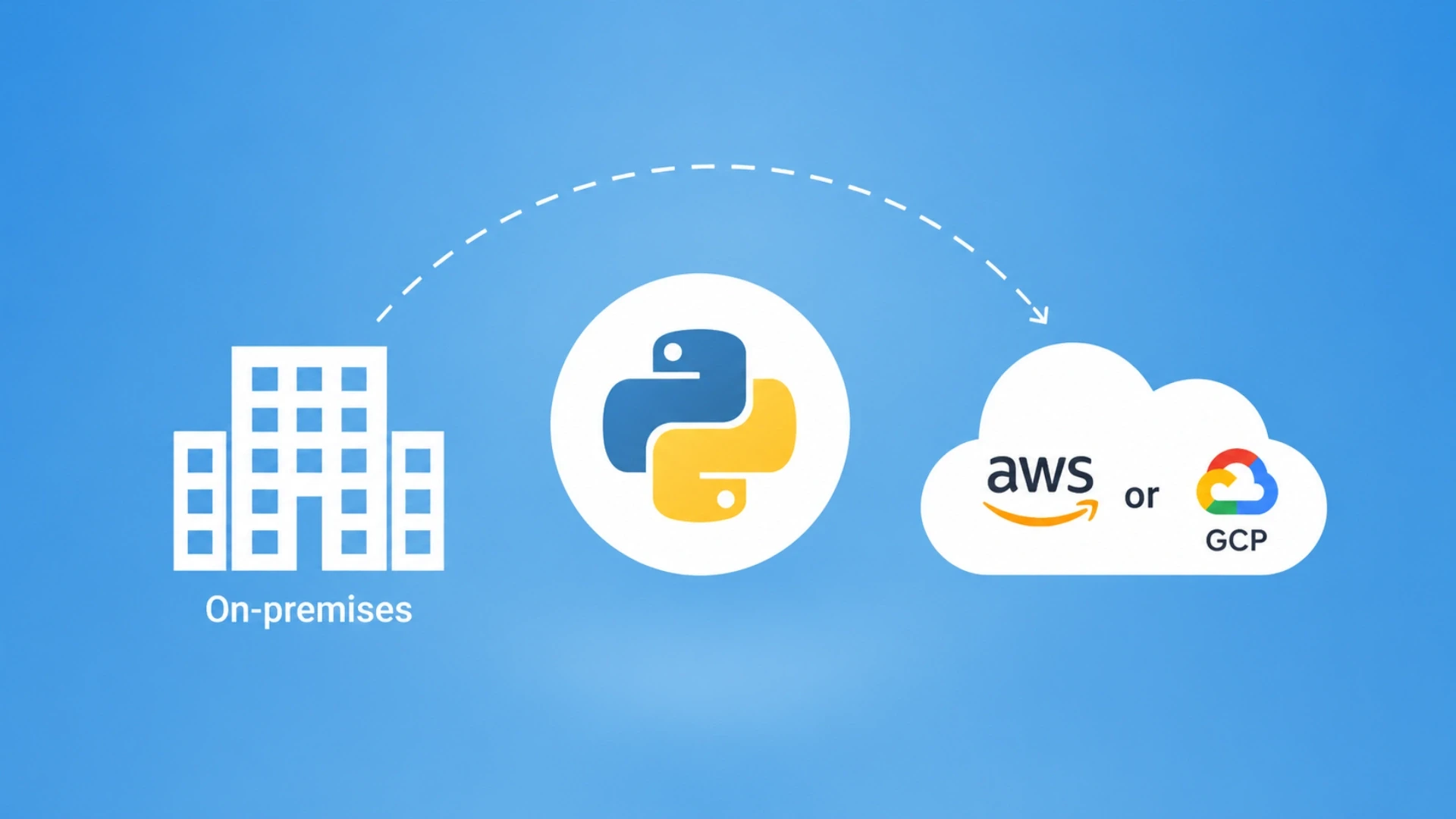
Across the failure post-mortems and the migration audits, six mistakes appear so consistently that they have become predictable. Recognizing them in your own planning is the most cost-effective form of risk management available, because each one of them costs significantly more to fix after the migration than to address during planning.
Mistake 1: Treating Migration as a Technical Project
Cloud migration is a financial transformation as much as a technical one. The on-premise model is capital expenditure with predictable operational costs; the cloud model is metered consumption with variable bills. Teams that approach migration as a technical project alone, without FinOps discipline, cost governance, and a clear ownership model for cloud spend, consistently end up with bills that surprise everyone. The first non-engineering hire on most successful cloud migrations is a cloud cost owner, not another engineer.
Mistake 2: Lift-and-Shift Without Refactoring
Lift-and-shift is fast but produces 40% higher ongoing costs than refactored applications. Monolithic Python applications designed for fixed infrastructure generate unpredictable costs in elastic environments because they were never built for the cloud's consumption model. Idle worker processes, oversized instances, and continuous polling patterns that were free on-premise become recurring cloud charges.
The decision to refactor or lift-and-shift is a strategic choice, not a default. Sometimes lift-and-shift is right (compliance deadlines, data center exit, validated time pressure). Sometimes refactor is right (long-term application, clear cost optimization upside). Choosing lift-and-shift by default to move fast is the most common cause of the doubled-cloud-bill story.
Mistake 3: Underestimating Data Egress and Hidden Costs
Data egress fees account for 6 to 12% of total migration costs and are the most underestimated line item. Moving data out of a cloud (or between regions, between availability zones, or between cloud services) costs money. Teams that did not include egress in the original budget routinely discover it as a 5- to 6-figure annual surprise.
Network costs change shape completely. On-premise, network within the data center is effectively free. In the cloud, traffic between services in different VPCs, between availability zones, or between regions costs money. Architectures that worked on-premise generate unexpected charges when deployed without redesign.
Mistake 4: Single-Cloud Lock-In Without Strategy
72% of enterprises express concern about vendor lock-in. 58% continue building predominantly in a single provider anyway. Using AWS-native or GCP-native services everywhere by convenience produces lock-in that limits future flexibility. Strategic lock-in (using a database service, managed Kubernetes, or specific ML capabilities because they are genuinely better) is defensible. Accidental lock-in across every service is the pattern to avoid.
Mistake 5: Skipping Dependency Mapping
38% of failed migration projects encountered unanticipated dependency conflicts during testing. Without comprehensive mapping of application relationships before migration, complexity emerges mid-project rather than during planning. Application A turns out to depend on a shared file system, Application B needs LDAP, Application C calls a legacy mainframe through a VPN. Each surprise extends timeline and budget.
Mistake 6: No Skin in the Game for Cost Governance
Without cost ownership at the team level, engineers optimize for their own velocity, not for the bill. Mature cloud organizations attribute every cloud cost to a team or product owner, surface those costs daily, and tie cost optimization to engineering performance. Teams without this discipline produce the textbook outcome: a cloud bill that grows faster than revenue, with no clear owner of the problem.
The Real Cost Picture Nobody Tells You About
The actual cost of a cloud migration is consistently larger than the initial estimates suggest. According to a March 2026 cloud migration statistics analysis by MedhaCloud, the average migration cost for a mid-market company (100 to 999 employees) is roughly $280,000 including services, tooling, and first-year cloud costs, while enterprise migrations of 5,000+ users average $1.2 million to $4.5 million depending on complexity. Data transfer (egress) fees account for 6 to 12% of total migration costs, a line item many organizations underestimate. Application refactoring represents 34% of total migration spend when organizations modernize rather than simply lift-and-shift. AWS is the primary target for 41% of new cloud workloads, followed by Azure at 36% and Google Cloud at 16%, which explains why most enterprise Python migrations end up on AWS or GCP rather than smaller cloud providers.
Real Cloud Migration Cost Picture (2026)
Cost Category | Share or Range | What It Covers |
|---|---|---|
Total mid-market migration | $280K average | Services, tooling, first-year cloud cost |
Total enterprise migration | $1.2M to $4.5M | Same, scaled to 5,000+ user organizations |
Application refactoring | 34% of total spend | Code changes for cloud-native patterns |
Data egress fees | 6 to 12% of total | Cross-region, cross-cloud, exit traffic |
Lift-and-shift ongoing cost | +40% vs refactored | Hidden penalty for skipping refactor |
FinOps and cost governance | 5 to 10% ongoing | The function that prevents bill explosions |
These cloud migration costs sit alongside the broader Python engineering investment, and understanding both is essential for accurate budgeting. The Python development cost for mid-sized businesses analysis walks through how engagement model and engineer location interact with cloud migration scope, including why offshore staffing at 40 to 60% less than US in-house cost can fund the FinOps and refactoring work that prevents the cost-explosion outcome.
Planning a Python Cloud Migration That Will Not Blow Up the Bill?
Acquaint Softtech provides senior Python engineers with hands-on AWS and GCP migration experience for production applications. Strangler fig migration patterns, FinOps-aware refactoring, dependency mapping, and the discipline to keep the cloud bill predictable through cutover and beyond. Profiles in 24 hours. Onboarding in 48.
The Right Approach: Strategy Before Tactics
Successful cloud migrations apply a strategic framework before they choose any specific cloud service. The most useful framework is the 7 Rs (sometimes 6 Rs), a vendor-neutral set of migration strategies that helps teams match the right approach to each application in their portfolio. Different applications in the same migration program should be moving with different strategies, because they have different value, complexity, and longevity profiles. Treating every application the same is one of the structural reasons migrations stall.
The 7 Rs Migration Strategy Framework and When Each Fits
Strategy | What It Means | When It Fits |
|---|---|---|
Retire | Decommission the application | Used rarely or replaced by SaaS |
Retain | Keep on-premise for now | Compliance or cost makes migration uneconomical |
Rehost (lift-and-shift) | Move with minimal changes | Hard deadline, short-lived application |
Replatform | Minor optimizations during move | Move to managed database or container service |
Repurchase | Switch to a SaaS equivalent | Off-the-shelf alternative covers the need |
Refactor | Significant code changes for cloud-native | Long-lived application, clear ROI on changes |
Rearchitect | Redesign architecture (microservices, serverless) | Strategic application worth the investment |
How to Apply the Framework Without Overthinking It
Portfolio assessment before any migration. Inventory every Python application, score each by business value, complexity, and longevity. The mapping of applications to R strategies emerges naturally from this assessment. Skipping this step is why migrations turn into the doubled-bill story.
Most applications fit two or three strategies, not all seven. Resist the temptation to use every framework category. A typical migration mixes Retire (10 to 20% of apps), Rehost (30 to 50%), Replatform (20 to 40%), and Refactor (10 to 20%), with Rearchitect reserved for genuinely strategic applications.
Run a small wave first. Pick 3 to 5 lower-risk applications, migrate them through the full pipeline, learn the actual cost and timeline patterns for your team and cloud provider, then plan the larger waves with those numbers. Skipping the pilot wave is how budget estimates become wishful thinking.
Build the FinOps function before the second wave. By the time you have migrated 5 to 10 applications, you should have a cost ownership model, automated tagging, daily cost surfacing, and an explicit team owning cloud spend. Without this, scale of migration produces scale of bill surprise.
The architectural decisions made during a cloud migration set the technical foundation for everything that comes after. The Python development architecture and frameworks guide walks through the modern Django, FastAPI, async, and database patterns that make Python applications behave well in cloud-native environments, which is the difference between an application that benefits from elasticity and one that drives unpredictable cloud bills.
The Python-Specific Cloud Migration Pitfalls
Generic cloud migration advice misses the Python-specific failure modes that consistently surface when on-premise Python applications meet AWS or GCP. The pitfalls below are the ones experienced Python cloud migrations have learned to anticipate, and they are easy to plan around once you know they exist.
Worker processes that idle expensively. Celery, Gunicorn, and uWSGI worker patterns designed for fixed on-premise capacity often keep workers running 24/7. On a metered cloud, that is a cost that did not exist on-premise. Autoscaling worker pools based on queue depth or request volume cuts these costs substantially, but it requires application-level changes most teams forget to budget for.
PostgreSQL or MySQL on raw EC2 / Compute Engine instead of managed services. Self-managed databases on cloud VMs cost more than RDS, Aurora, or Cloud SQL once you include the operator time to manage them properly. Move to managed database services during the migration, not as a follow-up project. Replatforming the database during cutover is significantly cheaper than doing it later.
Long-running Python tasks that fight serverless billing. AWS Lambda and Cloud Run have execution time limits and per-invocation pricing models that suit short-lived workloads. Long-running Python jobs, heavy ETL pipelines, and ML training loops do not. Forcing them into serverless because the architecture diagram looked nice is a common cost trap. Use ECS, Cloud Run for longer requests, or managed container services instead.
Logging volume that explodes the observability bill. Python applications often log generously, which was free on-premise. CloudWatch, Stackdriver, and managed log services charge for log volume. Without sanitization, sampling, and structured logging discipline, the observability bill quietly exceeds the compute bill.
Cross-AZ database calls eating margin. On-premise, network calls within the data center are free. On AWS and GCP, traffic between availability zones is charged. Python applications making many small database calls per request (the N+1 query problem) generate unexpected cross-AZ charges once moved to the cloud, especially in high-availability deployments.
Hardcoded paths and assumptions about the environment. Python applications written for on-premise often hardcode file system paths, network locations, and configuration sources that do not exist in the cloud. Inventory these before migration. The cost of finding them at cutover is significantly higher than the cost of refactoring them in advance.
The scalable architecture patterns that make Python applications behave well under cloud's elasticity, and prevent the cost-explosion outcomes described above, are covered in detail in the analysis on how to build a scalable Python backend that handles 100,000 users, which is essential reading before moving any production Python application to AWS or GCP.
How Acquaint Softtech Approaches Python Cloud Migration
Acquaint Softtech is a Python development and IT staff augmentation company based in Ahmedabad, India, with 1,300+ Python projects delivered globally, including on-premise to AWS and GCP migrations for production applications. Our cloud migration approach follows the framework in the complete guide to hiring Python developers, with senior engineers experienced in both Python production architecture and cloud platform engineering, which is the combination that distinguishes a migration that delivers from one that doubles the bill.
Portfolio assessment before any cloud touch. Our first deliverable on a cloud migration engagement is an honest application inventory with R-strategy mapping, dependency analysis, cost modeling, and a recommended phased plan. We will tell you which applications should not move at all, which should be retired, and which need refactoring before they will pay back in the cloud.
FinOps-aware refactoring during migration. We surface and address the worker-process, logging-volume, cross-AZ, and database-pattern issues that cause cloud bills to balloon, addressing them during migration rather than after cutover when fixes are far more expensive.
Senior engineers fluent in both Python and cloud. Cloud migration specifically requires engineers who understand both stacks at production depth. Generic cloud migrators miss the Python-specific pitfalls. Generic Python developers miss the cloud cost traps. Our engineers carry both, with documented experience across AWS and GCP for healthcare, FinTech, SaaS, and enterprise platforms.
Transparent pricing from $20/hour. Dedicated Python and cloud engineering teams from $3,200/month per engineer, roughly 40% less than equivalent US in-house hiring, with full IP assignment and NDA from day one and a free replacement guarantee on dedicated engagements.
The engagement model matters specifically for cloud migrations, where continuity across the multi-quarter migration timeline determines whether the project survives team transitions. The analysis on Python staff augmentation vs dedicated team vs outsourcing walks through which model fits a cloud migration specifically and why dedicated teams almost always outperform other models for this work.
To get senior Python engineers with AWS and GCP migration experience onto your assessment quickly, you can hire Python developers with profiles shared in 24 hours and a defined onboarding plan within 48.
The Bottom Line
Moving on-premise Python applications to AWS or GCP delivers the agility, elasticity, and managed services the business case promised only when the engineering team avoids the six predictable mistakes that consistently turn cloud migrations into the doubled-cloud-bill story. Treat migration as a financial transformation, not just a technical project. Choose lift-and-shift versus refactor strategically rather than by default. Budget data egress and the Python-specific cost traps (worker idling, self-managed databases, long-running jobs in serverless, logging volume, cross-AZ calls). Map dependencies before migration, not during testing when 38% of failures surface. Plan vendor lock-in deliberately, not by accident. Establish FinOps and cost ownership before the second wave, not after the bill surprise.
The companies that get cloud migration right are the ones that resist the urge to start with technology decisions and instead start with portfolio assessment, R-strategy mapping, and a small pilot wave that surfaces the real cost and timeline patterns for their stack. They staff the work with senior engineers fluent in both Python production architecture and cloud platform engineering, because the migration that succeeds requires both, and the migration that fails usually had one without the other. Done right, the cloud migration delivers the cost predictability, deployment velocity, and managed-service leverage the business case promised. Done wrong, it produces the story everyone tells at the next conference about the migration that doubled the bill. The difference is preparation, discipline, and refusing to treat the cloud as a destination rather than a different operating model.
Avoiding the Doubled-Cloud-Bill Story?
Book a free 30-minute cloud migration assessment. Tell us your Python application portfolio, target cloud (AWS or GCP), and timeline pressure, and we will give you an honest answer: which applications should move, which should not, what the realistic cost is, and where the Python-specific cost traps live in your stack. No sales pitch. Just senior engineers who have run AWS and GCP migrations for production Python systems.
Frequently Asked Questions
-
Why do so many on-premise Python cloud migrations cost more than expected?
Six recurring reasons. Treating migration as a technical project without FinOps discipline. Lift-and-shift without refactoring (which produces 40% higher ongoing costs than refactored applications). Underestimating data egress (6 to 12% of total costs). Accidental single-cloud lock-in without strategy. Skipping dependency mapping (which surfaces 38% of failures during testing rather than planning). And no team-level cost ownership, so engineers optimize for velocity instead of the bill. Each one is preventable in planning but expensive to fix after migration.
-
Should I lift-and-shift or refactor my Python application during cloud migration?
It depends on the application's value and longevity. Lift-and-shift is faster and right when there is a hard deadline, the application is short-lived, or you must exit a data center quickly. But it produces 40% higher ongoing cloud costs than refactored applications because monolithic patterns designed for fixed infrastructure generate unpredictable bills in elastic environments. Refactor when the application is long-lived and the cost optimization payoff justifies the upfront investment, which is usually 34% of total migration spend when organizations choose to refactor.
-
How much should I budget for a Python cloud migration?
For a mid-market company (100 to 999 employees), plan around $280,000 average including services, tooling, and first-year cloud costs. Enterprise migrations of 5,000+ users typically run $1.2 million to $4.5 million depending on complexity and application count. Application refactoring is roughly 34% of total spend when organizations modernize during migration. Data egress fees are 6 to 12% of total, consistently underestimated. Reserve an additional 10 to 20% contingency for the dependency surprises that surface during testing, which 38% of failed migrations encountered.
-
What is the 7 Rs framework and how do I apply it?
The 7 Rs are seven cloud migration strategies: Retire (decommission), Retain (keep on-premise), Rehost (lift-and-shift), Replatform (minor optimizations), Repurchase (switch to SaaS), Refactor (significant code changes), and Rearchitect (full redesign). The framework is applied by inventorying every application, scoring each by business value, complexity, and longevity, and matching each to a strategy. A typical migration mixes Retire (10 to 20%), Rehost (30 to 50%), Replatform (20 to 40%), and Refactor (10 to 20%), with Rearchitect reserved for strategic applications worth the investment.
-
What Python-specific issues catch teams off guard during cloud migration?
Six recurring pitfalls. Celery and Gunicorn worker pools that idle expensively on metered cloud. Self-managed PostgreSQL on raw VMs instead of RDS, Aurora, or Cloud SQL. Long-running Python jobs forced into serverless billing models that do not fit. Logging volume that explodes observability bills because Python apps log generously. Cross-AZ database calls (N+1 queries amplified by cloud network charges). And hardcoded paths or environmental assumptions that break in the cloud. Each is easy to plan around if you know to look for it.
-
AWS or GCP for a Python application?
Both are mature, production-grade choices for Python workloads. AWS is the primary target for 41% of new cloud workloads versus GCP at 16%, which means broader ecosystem, more third-party integrations, and a deeper talent pool. GCP wins for ML-heavy Python workloads (BigQuery, Vertex AI, native TensorFlow support) and often has cleaner pricing on specific services. For most enterprise Python applications, AWS is the safer default unless you have a specific reason (existing Google Workspace integration, specific ML capability needs, or pricing on a particular service) that pulls you toward GCP.
We’re Acquaint Softtech, your technology growth partner. Whether you're building a SaaS product, modernizing enterprise software, or hiring vetted remote developers, we’re built for flexibility and speed. Our official partnerships with Laravel, Statamic, and Bagisto reflect our commitment to excellence, not limitation. We work across stacks, time zones, and industries to bring your tech vision to life.
Table of Contents
Get Started with Acquaint Softtech
- 13+ Years Delivering Software Excellence
- 1300+ Projects Delivered With Precision
- Official Laravel & Laravel News Partner
- Official Statamic Partner
Related Blog
How to Hire Python Developers Without Getting Burned: A Practical Checklist
Avoid costly hiring mistakes with this practical checklist on how to hire Python developers in 2026. Compare rates, vetting steps, engagement models, red flags, and more.
Acquaint Softtech
March 30, 2026
Total Cost of Ownership in Python Development Projects: The Full Financial Picture
The build cost is just the beginning. This guide breaks down the complete TCO of Python development projects across every lifecycle phase, with real benchmarks, a calculation framework, and 2026 data.
Acquaint Softtech
March 23, 2026
Python Developer Hourly Rate: What You're Actually Paying For
Python developer rates range $20-$150+/hr in 2026. See what experience, specialisation & hidden costs actually determine the price. Save 40% with vetted offshore talent.
Acquaint Softtech
March 9, 2026India (Head Office)
203/204, Shapath-II, Near Silver Leaf Hotel, Opp. Rajpath Club, SG Highway, Ahmedabad-380054, Gujarat
USA
7838 Camino Cielo St, Highland, CA 92346
UK
The Powerhouse, 21 Woodthorpe Road, Ashford, England, TW15 2RP
New Zealand
42 Exler Place, Avondale, Auckland 0600, New Zealand
Canada
141 Skyview Bay NE , Calgary, Alberta, T3N 2K6
Your Project. Our Expertise. Let’s Connect.
Get in touch with our team to discuss your goals and start your journey with vetted developers in 48 hours.