

Online Course Marketplace: Instructor Onboarding & Course Discovery
An online course marketplace connects instructors with learners and earns revenue from course sales. It manages course publishing, discovery, and automated revenue sharing at scale.

Manish Patel
What if the real challenge of building a platform like Udemy is not streaming videos, but creating a marketplace that connects instructors and learners at scale? As Head of Technology and Client Success at Acquaint Softtech, I have seen how successful learning platforms rely on robust software product development services to build scalable marketplaces, not just course players. The challenge is not delivering video content. It is designing a two-sided platform that drives engagement, transactions, and long-term growth.
It is also a regulated consumer business. A marketplace that publishes course reviews must comply with the FTC, whose final rule banning fake reviews and testimonials took effect in October 2024 and carries civil penalties for violations, so trust features are a legal matter, not just a product one.

- You are a founder planning a course marketplace like Udemy.
- You need instructors and learners on one platform, not just courses.
- You are deciding how to split revenue with your instructors.
- You want discovery that surfaces the right course to each learner.
- You need a clear cost and timeline before you raise or build.
This article covers the marketplace economics, the instructor and learner sides, revenue sharing, discovery, and real cost figures. It sits under our complete EdTech software development guide, which frames the wider learning technology landscape.
Acquaint Softtech has delivered 1,300+ software projects across 20+ industries in 13+ years, with a team of 70+ in-house engineers. Clients across the USA, UK, Europe, Australia, New Zealand, and India deploy their first dedicated engineer within 48 hours of the brief.
How a course marketplace differs from a normal LMS

A course marketplace differs from an LMS in one fundamental way: ownership of supply. An LMS hosts content that one organization controls, while an online course marketplace opens the catalog to independent instructors who create, price, and own their courses, with the platform acting as the matchmaker and payment layer between many sellers and many buyers.
How do you build an online course marketplace?
You build it as a marketplace, not a content site: an instructor side that lets sellers publish and earn, a learner side that helps buyers discover and purchase, and a transaction engine that handles payments and revenue splits between them. The hard parts are the matching and the money, not the video playback.
Because both sides evolve independently, the architecture has to stay modular from day one, which is the kind of structure experienced MERN stack development teams design before writing feature code.
Getting the model right before the build starts is exactly what a discovery workshop is for, since a marketplace built like a single-tenant LMS rarely scales to thousands of independent instructors.
How the underlying course-delivery engine works, and where a marketplace extends it, is covered in our guide on how learning management systems work, useful background before you scope the catalog.
The two-sided marketplace problem: solving cold start
Every course marketplace faces the same chicken-and-egg problem at launch: instructors will not publish without learners, and learners will not come without courses. Solving this cold start is the single biggest reason marketplaces succeed or stall, and it shapes what you build first.
The proven answer is to seed one side deliberately. Most marketplaces recruit a small group of quality instructors first, often in one niche, then drive learners to that focused catalog rather than launching empty and broad. The platform earns trust in a category before it expands.
Building the supply side quickly without a permanent team is why early-stage marketplaces often add delivery through staff augmentation to ship the instructor portal while founders focus on recruiting creators. Phasing the build to match the seeding strategy keeps spend sane, which many founders manage through structured software development outsourcing rather than hiring ahead of revenue.
The build-versus-configure tradeoffs for the learning layer underneath are explored in our guide to developing virtual classroom and e-learning software, which applies the same logic.
Instructor onboarding: turning experts into sellers

The instructor onboarding platform is the supply engine of the marketplace: it turns a subject expert into a publishing, earning seller. A good instructor portal handles sign-up, identity and payout setup, course building tools, pricing controls, and a dashboard that shows enrollments and earnings clearly.
What does instructor onboarding involve?
Instructor onboarding involves verifying the instructor, collecting payout and tax details, giving them tools to build and price a course, and walking them to their first publish. The faster an instructor reaches their first sale, the more likely they are to stay and create more.
The instructor dashboard is heavy on business logic, payouts, taxes, refunds, and analytics, which is the kind of work a senior Laravel development team handles cleanly so earnings always reconcile.
Marketplaces scaling their creator base often hire dedicated developers specifically for the instructor side, because instructor portal design accumulates edge cases that reward continuity.
Building an online course marketplace?
Acquaint Softtech designs and builds two-sided course marketplaces, from instructor onboarding to discovery and automated revenue sharing, for platform founders across the USA, UK, Europe, Australia, New Zealand, and India. Your first engineer deploys within 48 hours of the brief.
Course creation, hosting, and quality control
The course layer covers how instructors build courses, how video and materials are stored and streamed, and how the platform keeps quality high enough that learners trust the catalog. On a marketplace, quality control is not optional, because one bad course damages the whole platform's reputation, not just one instructor's.
Video is the heaviest technical piece. Courses need reliable upload, transcoding into multiple resolutions, secure streaming that resists piracy, and fast playback worldwide, which usually means a content delivery network and a media pipeline rather than raw file hosting.
The transcoding and processing pipeline is backend-intensive, which is why media-heavy marketplaces are often built with a dedicated Python development team that can handle queues and large files reliably.
Most course consumption now happens on phones, so a React Native development team is typically part of the build to deliver smooth mobile playback and offline downloads.
The streaming and content mechanics here build on the same foundations covered in our guide on how learning management systems work, which explains content tracking in depth.
Course discovery: search, ranking, and recommendations

Course discovery is how learners find the right course among thousands, and it directly drives sales. A strong discovery layer combines search, category browsing, ranking signals like ratings and enrollments, and personalized recommendations, so the catalog feels curated rather than overwhelming.
Ranking is where marketplaces win or lose. The course discovery algorithm decides which courses surface first, balancing relevance, quality, recency, and conversion, and it has to be fair enough that good new instructors can break through, not just established ones. Personalized recommendations at scale are a machine learning problem, which is why the smartest discovery features are built by an AI development team rather than hard-coded category lists.
The search and ranking infrastructure must stay fast as the catalog grows, the kind of scalable architecture experienced MERN stack development engineers design for high-traffic platforms.
Revenue sharing: how the money splits

Revenue sharing is the economic core of a course marketplace: the rules that decide how each sale is split between the instructor and the platform. The model you choose shapes who you attract, how much they trust you, and whether the marketplace is sustainable.
What revenue sharing model do course marketplaces use?
Most marketplaces pay instructors more when the instructor brought the sale and less when the platform did. The model rewards creators for marketing while letting the platform fund its own acquisition costs.
Udemy is the reference example. According to its published instructor revenue share terms, instructors keep 97% of sales they drive through their own coupon or referral link, and 37% of organic sales the platform generates, with a separate pool for its subscription product.
Translating a model like that into code is real engineering, because revenue split calculation has to handle coupons, refunds, taxes, currency, and co-instructors without ever miscounting, which is squarely the work of a senior Laravel development team. Automated payouts add another layer of complexity, often built by a dedicated Python development team so instructors are paid on schedule across many countries and methods.
How payment and payout flows are engineered is connected to the cost and stack tradeoffs in our Laravel developer hiring and cost guide, a useful reference when you scope the money layer.
Ratings, reviews, and marketplace trust
Ratings and reviews are how a marketplace earns buyer confidence at scale, because a learner decides whether to buy based on what other learners said. Trust is the marketplace's real inventory, and protecting it from fake reviews and low-quality courses is a core platform job.
Detecting fake reviews and abusive ratings at scale is a pattern problem, increasingly handled by an AI development team that can flag suspicious activity faster than manual moderation. Trust and moderation features evolve constantly, which is why marketplaces keep a dedicated development team on the platform rather than treating moderation as a one-time build. The trust mechanics for learner-facing platforms connect to our guide on developing virtual classroom and e-learning software, which covers user-facing quality patterns.
Tech stack and architecture for scale
A course marketplace needs a scalable architecture with fast search, secure payments, and reliable video delivery. Many businesses choose the MEAN stack for its flexibility and performance, making it a smart option to hire MEAN stack developers for building and scaling modern learning marketplaces. The platform should also support independent development of instructor and learner features.
A JavaScript-based stack is a common fit for marketplaces because it scales well across the catalog, dashboard, and API layers, which is why many founders build with MERN stack development engineers from the start. Long-lived platforms reward keeping the same engineers across releases, so a dedicated development team usually beats rotating contractors once the marketplace is live. How architecture choices play out across learning platforms is illustrated in our guide to building a virtual classroom platform, which covers scale and delivery together.
Cost and timeline to build a marketplace like Udemy

A custom online course marketplace typically costs between USD 50,000 and USD 350,000 to build, depending on how much of the instructor, discovery, payout, and mobile layers you include in the first release. The payment and revenue-sharing logic is what pushes a marketplace above a simple course site on cost.
How much does it cost to build a course marketplace?
It scales with scope. An MVP with instructor onboarding, course hosting, and checkout is far cheaper than a full platform with a discovery algorithm, automated payouts, and mobile apps, and phasing the build lets founders launch lean and add as the marketplace grows.
The market context explains the investment. The MOOC and online course market was valued at USD 31.74 billion in 2025 and is projected to reach USD 43.46 billion in 2026 and USD 209.13 billion by 2031, representing a 36.92% CAGR, according to Mordor Intelligence.
More than 220 million learners have enrolled in at least one online course, making scalable marketplace infrastructure increasingly important. Freemium and subscription models continue to lead adoption, which is why payout flexibility and monetization options matter from the first release.
Release Scope | Timeline | India vs US/UK/EU Cost |
MVP: Instructor Onboarding + Checkout | 4–6 months | India: $50k–$100k US/UK/EU: $90k–$250k |
Growth: Discovery + Revenue Sharing | 7–10 months | India: $100k–$200k US/UK/EU: $180k–$500k |
Scale: Mobile Apps + AI + Multi-Currency | 11+ months | India: $200k–$350k+ US/UK/EU: $400k–$1M+ |
Location is one of the biggest cost drivers. Development rates in India typically range from USD 25–49 per hour, compared with USD 120–200+ per hour in the United States, USD 90–180 per hour in the United Kingdom, and USD 80–160 per hour across much of Europe. This cost difference is a key reason many founders choose to build online course marketplaces with experienced Indian development teams while maintaining enterprise-grade quality and scalability.
Want a realistic cost and timeline for your build?
Acquaint Softtech scopes your course marketplace against your actual instructor, discovery, and payout needs, then deploys engineers at USD 25 to 49 per hour, up to 40% below comparable Western agency rates. Book a call for a phased cost and timeline.
Case Study: An Education Portal, Built and Validated
What the Client Needed
A digital learning environment that could support enrollment and course delivery
Administrative tools to reduce manual work and streamline operations
A reliable way to connect live classes, payments, and certifications
What Acquaint Delivered
Engineered a custom platform using Django, Python, and PostgreSQL
Created workflows that simplified learner onboarding and administration
Connected essential learning services into a unified experience
Delivered a stable, launch-ready solution tailored to the client's needs
The relevance to a course marketplace is direct: registration, payments, content management, and an admin layer are the same building blocks, scaled to many instructors. The same engineering standard applies to every marketplace built by our learning software product team. Founders who want the same engineers across discovery, payouts, and mobile choose a dedicated development team model, keeping platform knowledge in place as the marketplace scales.
Going live: seeding supply and demand
Launching a marketplace is not flipping a switch; it is seeding both sides until they sustain each other. The safest path is to recruit a focused group of instructors, fill one category well, then bring in learners, so the catalog never looks empty on day one.
A typical sequence runs in four steps: a discovery workshop to map the instructor and learner journeys, an MVP covering onboarding and checkout, a seeded pilot in one niche, then a staged public launch as supply and demand grow together.
Pacing the build to the seeding plan keeps cost aligned with traction. Many founders start with staff augmentation and later expand through white label software development as the marketplace gains traction, allowing teams to scale efficiently while maintaining brand ownership. Phasing also keeps the budget honest, because you fund the next layer discovery, payouts, or mobile only after the previous one shows real instructor and learner activity.
Build your course marketplace with a verified team
From instructor onboarding to discovery and automated revenue sharing, Acquaint Softtech builds marketplaces founders launch and scale on. Join the teams who built with a Clutch Premier Verified partner and deploy your first engineer within 48 hours.
Frequently Asked Questions
-
How do you build an online course marketplace?
You build three connected parts: an instructor side to publish and earn, a learner side to discover and buy, and a transaction engine that splits revenue between them. The hard work is in matching and payments, not video playback.
-
What revenue sharing model do course marketplaces use?
Most pay instructors more for sales they drive and less for sales the platform generates. Udemy, for example, gives instructors 97% on their own coupon or referral sales and 37% on organic marketplace sales.
-
What does instructor onboarding involve?
It involves verifying the instructor, collecting payout and tax details, providing course-building and pricing tools, and guiding them to their first publish. The faster they reach a first sale, the more likely they are to keep creating.
-
How much does it cost to build a course marketplace?
A custom marketplace typically costs USD 50,000 to USD 350,000, depending on how much of the discovery, payout, and mobile layers you include. Building with a verified team in India can cut that by up to 40% against Western agency rates.
-
How do you solve the cold-start problem?
You seed one side first, usually recruiting a small group of quality instructors in a single niche, then driving learners to that focused catalog. The platform earns trust in one category before expanding.
-
How does course discovery work?
Discovery combines search, category browsing, ranking signals like ratings and enrollments, and personalized recommendations. A good discovery algorithm surfaces the right course while still giving strong new instructors a chance to be found.
-
How long does it take to build a marketplace like Udemy?
An MVP with instructor onboarding, hosting, and checkout usually takes four to six months, while a full platform with discovery, payouts, and mobile apps runs eleven months or more. Phasing the build lets founders launch lean and grow.
-
How does Acquaint Softtech build course marketplaces?
Acquaint Softtech starts with a discovery workshop, deploys a dedicated engineer within 48 hours, and ships in two-week sprints at a 95% on-time rate. The company is Clutch Premier Verified with a 4.9/5 rating from 50+ verified reviews.
I lead technology and client success at Acquaint Softtech with one goal in mind. Deliver work that feels personal, reliable, and worthy of long term trust. I stay close to both our clients and our developers to make sure every project moves with clarity, quality, and accountability.
Table of Contents
Get Started with Acquaint Softtech
- 13+ Years Delivering Software Excellence
- 1300+ Projects Delivered With Precision
- Official Laravel & Laravel News Partner
- Official Statamic Partner
Related Blog

The Complete Guide to EdTech Software Development in 2026
Complete guide to EdTech software development in 2026. LMS architecture, virtual classroom tech stack, AI tutoring system design, MVP timeline, and cost.

Acquaint Softtech
May 4, 2026
How Learning Management Systems Work
An LMS is not a video library with a login screen. It is a structured system that owns enrollment, progress, assessment, and certification in one traceable architecture. Teams that treat it as a file folder spend 12 months rebuilding what should have been designed correctly in week one. This guide shows exactly how each layer works, and what it actually costs to build.
Manish Patel
May 13, 2026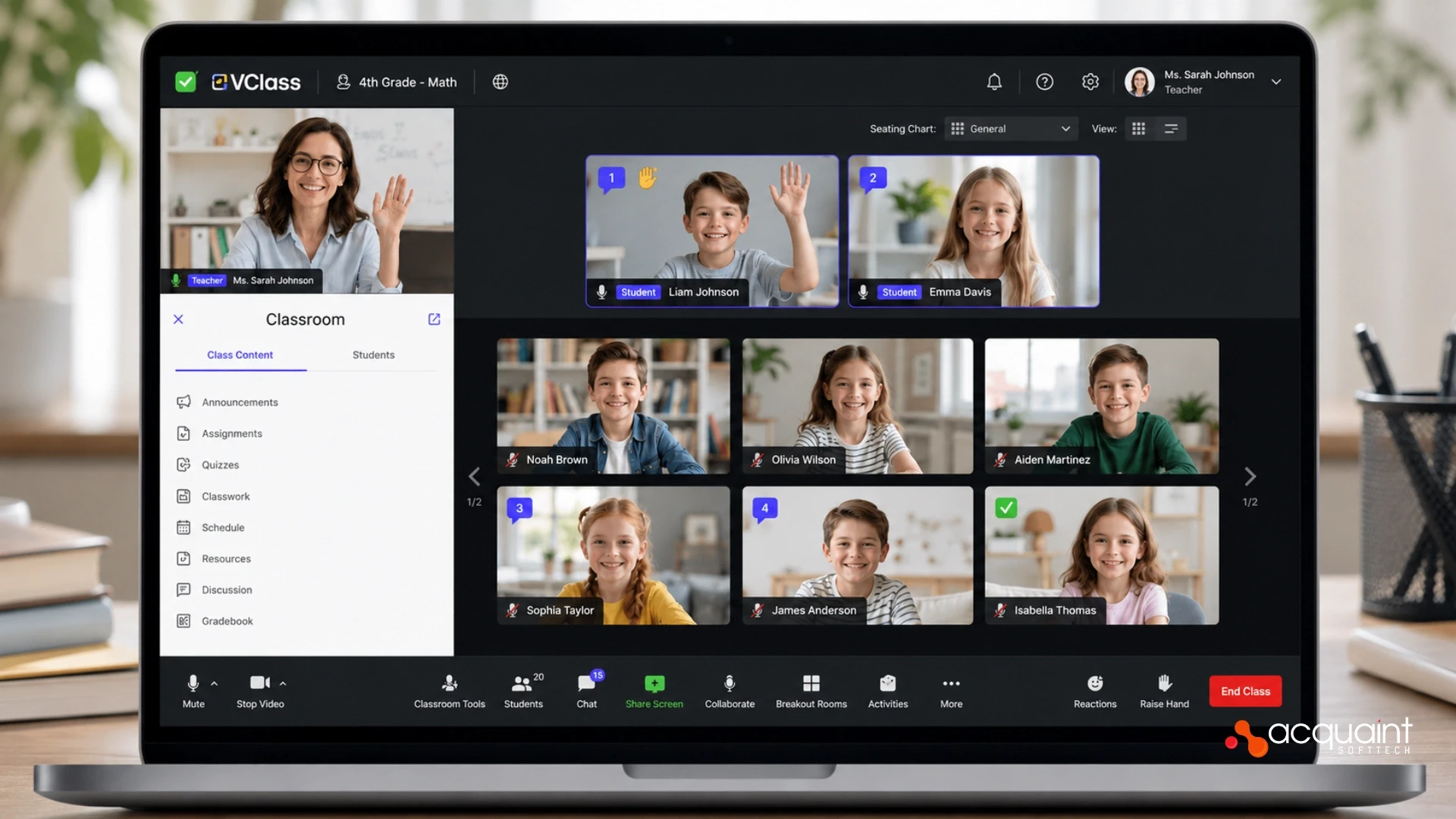
Building a Virtual Classroom Platform: Video, Whiteboard, Breakout Rooms, and Attendance Tracking
A virtual classroom is not a Zoom call with a class roster. It is a purpose-built live learning environment where video, whiteboard, breakout rooms, session recording, and attendance verification are engineered to work together as a single platform. Teams that build each feature independently spend 8 to 14 months in integration loops. Teams that design the architecture correctly from the start ship in 4 to 6 months. This guide shows you how.
Manish Patel
May 20, 2026India (Head Office)
203/204, Shapath-II, Near Silver Leaf Hotel, Opp. Rajpath Club, SG Highway, Ahmedabad-380054, Gujarat
USA
7838 Camino Cielo St, Highland, CA 92346
UK
The Powerhouse, 21 Woodthorpe Road, Ashford, England, TW15 2RP
New Zealand
42 Exler Place, Avondale, Auckland 0600, New Zealand
Canada
141 Skyview Bay NE , Calgary, Alberta, T3N 2K6