

How Early Architecture Decisions Impact Python Scalability
How early Python architecture decisions impact scalability for years. Real 2026 data, the architecture debt curve, and decisions you must get right early.

Acquaint Softtech
Introduction: The Decisions You Make at Week 6 Define Your Year Three
Most Python backends fail to scale not because of one bad decision at the moment of failure, but because of a chain of small architectural choices made in the first three months of development. The database engine. The ORM pattern. Whether async was treated as opt-in or default. How service boundaries were drawn. Where state lives. Each decision felt minor at the time. By month 18, they have compounded into the thing slowing the team down. By month 36, they are the reason a rewrite is on the roadmap.
The financial scale of getting this wrong is well documented. According to a 2026 analysis of the architecture debt curve citing Gartner and McKinsey research, the global cost of technical debt exceeds $1.52 trillion, with poorly structured architectures among the primary contributors. McKinsey research adds that the cost of technical debt accounts for 20 to 40% of the entire value of a company's technology estate, and organisations spend between 10 and 20% of their technology time servicing it. The cost is not abstract. It is invoiced every sprint that the architecture fights the team instead of supporting them.
This guide covers the early architectural decisions that most directly determine Python scalability over multi-year horizons. It is written for CTOs, founders, and senior engineers building greenfield Python systems, or auditing existing systems whose growth trajectory has stalled in ways that look unrelated to the original design but trace back to it. Every decision below is one that compounds. Some compound in your favour. Others compound into the wall your team eventually hits.
If you are still building the team that will make these decisions, the complete guide to hiring Python developers in 2026 sets the wider hiring context. The architectural patterns below assume you have engineers with the depth to apply them with discipline.
The Architecture Debt Curve: Why Early Shortcuts Become Exponential Costs
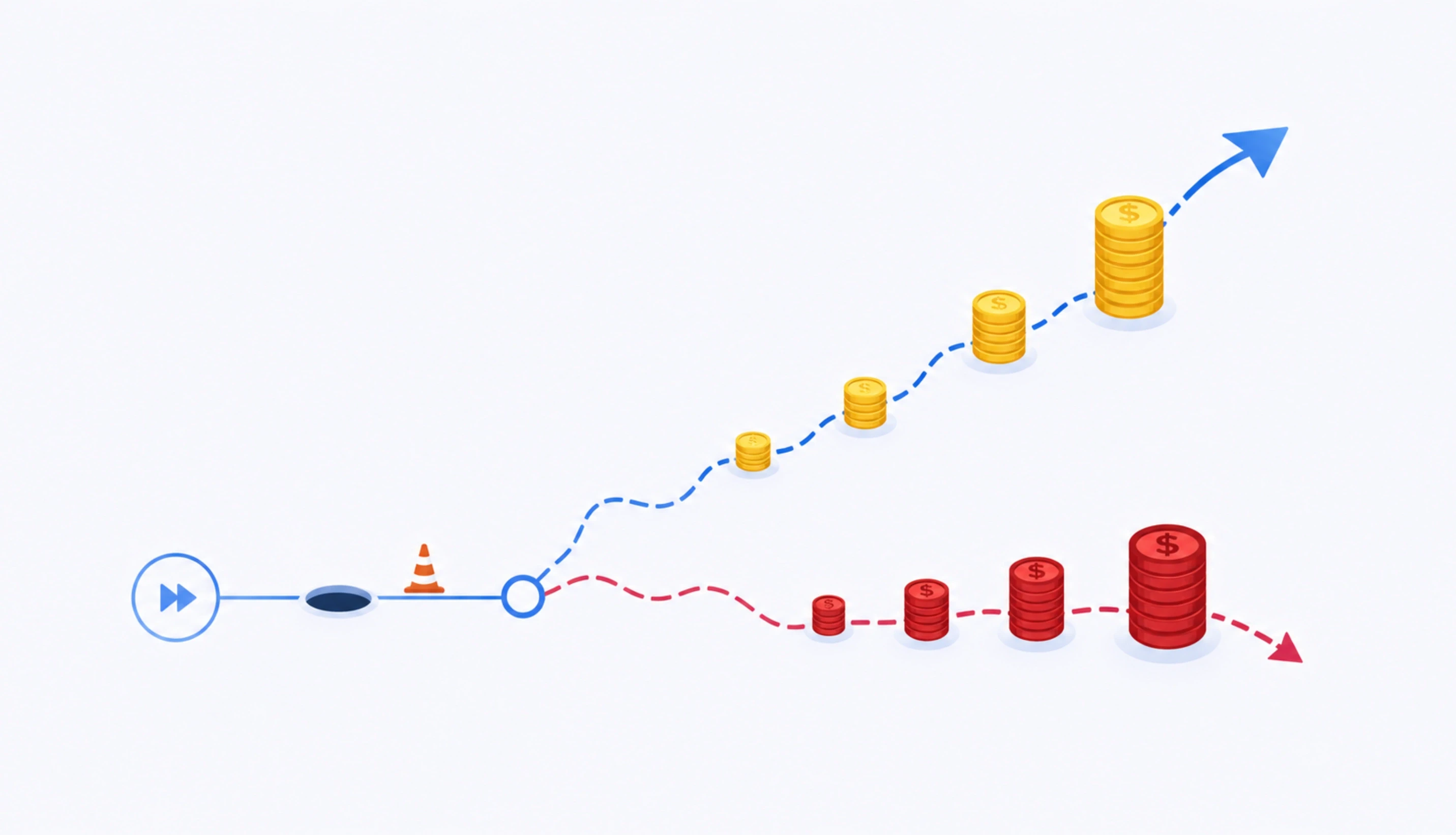
Architecture debt has a recognisable trajectory. The shortcuts taken in the first 6 months feel cheap because the cost is invisible. They become noticeable around month 12 to 18 as feature velocity starts to drop. By month 24 to 36, the team hits an inflection point where the cost of fixing the original decisions has grown faster than the cost of working around them, and the option of a focused refactor is replaced by the prospect of a full rewrite.
The economics of when to fix architecture problems are unforgiving. Scalability research summarised by AppStudio in 2026 cites IBM Systems Sciences Institute data showing that the cost to fix an architectural error after product release is 4 to 5 times higher than catching it during design, and up to 100 times higher than catching it at the requirements stage. The same research cites McKinsey data that up to 60% of IT spend at some organisations is consumed maintaining systems that were not designed for their current operational demands. The earlier the decision is made, the cheaper it is to make correctly.
Table : The Architecture Debt Curve for Python Backends
Phase | Months | Symptoms | Remediation Cost |
|---|---|---|---|
Honeymoon | 0 to 6 | Everything ships fast, no friction | Near zero, decisions still reversible |
Friction | 6 to 18 | Some refactoring, slowing velocity | Low, targeted refactors possible |
Inflection | 18 to 36 | Cross-team coordination on every change | High, multi-quarter program |
Crisis | 36+ | Rewrites discussed, hiring grinds | Catastrophic, full rewrites common |
For the foundational scalability practices that prevent the worst phases of the debt curve, the analysis on best practices for an enhanced and scalable system architecture covers load balancing, asynchronous processing, vertical vs horizontal scaling, and the discipline that keeps Python systems on the safe side of the inflection point.
Decision 1: Database Engine and Access Pattern
The database is the most consequential early architectural choice for Python scalability. It outlives every other decision. The framework can change. The deployment platform can change. The cloud provider can change. The database stays, because data migrations are some of the most expensive engineering projects any team will ever attempt. Choose well at week one, and the database compounds in your favour. Choose poorly, and it becomes the constraint that defines every future decision.
The 2026 Default for Most Python Backends
PostgreSQL for transactional workloads. Mature, ACID-compliant, scales to billions of rows with replication and partitioning. The default for any new Python product unless a specific reason argues otherwise.
Redis for hot data and queues. Sessions, real-time state, rate limits, queue backends. Not a primary store, but indispensable as the second-tier database.
Specialised stores when measurement justifies. ClickHouse for analytics. Elasticsearch for search. S3 plus Parquet for cold archival. Each one adds operational cost, so each one should earn its place.
The Decisions That Lock You In Quietly
ORM choice. Django ORM, SQLAlchemy, Tortoise, raw SQL. The choice shapes every query for years. Pick based on team familiarity and the framework you committed to, not on what is trendy.
Migration tooling. Alembic, Django migrations, Yoyo. Whichever you pick on day one is the tool you will run for the next 5+ years.
Connection pooling pattern. PgBouncer in transaction pooling mode is the boring correct answer at any meaningful scale. Skipping this layer at week 6 means hitting a hard connection wall at year 2.
Read replica readiness. Even if you do not need replicas today, write code that does not assume a single database. Database routing patterns added later require touching every query.
Decision 2: Framework and Architectural Style
Framework choice is the second-most consequential early decision. Like database choice, it is hard to reverse. Unlike database choice, it is rarely the source of catastrophic scaling failures, because both Django and FastAPI have proven they can scale to large user bases when operated with discipline. The mistake is not picking the wrong framework. The mistake is picking the right framework and then ignoring the architectural patterns the framework supports.
The Honest 2026 Framework Decision
Table 2: Framework Choice and Long-Term Scalability Implications
Framework | Best Fit | Long-Term Scalability Note |
|---|---|---|
Django | Full web platform, admin, batteries-included | Proven at Instagram and Pinterest scale |
FastAPI | API-first, async-heavy, ML serving | Modern, async-native, type-safe contracts |
Flask | Lightweight microservice, internal tools | Needs more careful architecture for scale |
Hybrid Django + FastAPI | Main app + ML/hot-path services | Common production pattern in 2026 |
The scalability question is not which framework benchmarks fastest in isolation. It is which framework lets your team enforce the patterns that genuinely matter: modular boundaries, async where I/O dominates, type-safe contracts at service edges, and disciplined dependency management as the codebase grows. All three frameworks support these patterns. The difference is what you have to write yourself.
Decision 3: Modular Boundaries Drawn at Week One
The single highest-impact decision for long-term Python scalability is enforcing clear module boundaries from the first commit. Not microservices, not over-engineered DDD layers, but clear modules with well-defined interfaces and minimal cross-coupling. Modularity is the architectural property that lets a Python backend evolve over years without rewrites. The teams that do this well at week one can absorb almost any future change with localised refactors. The teams that do not pay for it in every subsequent year.
The Pattern That Works
Domain-aligned modules, not technology-aligned. Organise around business domains (billing/, identity/, content/) rather than technical concerns (controllers/, models/, services/). Business logic ages slower than technical structure.
Each module exports a public interface. Other modules call only through the public functions or service classes. They never reach into internal implementation. Enforce with import linters.
No circular imports between modules. A imports from B. B never imports from A. Circular dependencies make refactoring nearly impossible and are the strongest predictor of long-term architecture decay.
Per-module code ownership. Even at 5 engineers, name an owner per module in a CODEOWNERS file. The discipline scales with the team.
For the broader architectural foundation behind these patterns, the guide on Python development architecture and frameworks walks through how modular boundaries fit into a complete Python backend design across Django, FastAPI, and Flask.
Decision 4: Async-First or Async-Reluctant
Whether your Python backend treats async as the default or as opt-in is an architectural decision, not a feature decision. It compounds across thousands of code paths over years. Choose async-first at week one and the entire codebase aligns with the event loop. Choose sync-first and every later async addition becomes a localised exception that the rest of the code does not know how to interact with cleanly.
When Async-First Is the Right Default
API-heavy backends where I/O dominates. Most modern SaaS, ML serving, and aggregation layers. FastAPI with Uvicorn is the natural fit.
High concurrency targets from day one. 5,000+ concurrent users projected within 12 months. Async architecture absorbs this scale without horizontal scale.
Many external service dependencies. Backends that call 3+ downstream APIs per request benefit dramatically from async fan-out patterns.
When Sync-First Is Still Defensible
CPU-heavy workloads. If the backend mainly does image processing, ML inference, or compute loops, async adds complexity without benefit. Process-based parallelism is the right model.
Internal tools with low concurrency. Internal dashboards serving 50 employees do not need async architecture, and they pay an operational complexity tax for adopting it.
Django ecosystem where async support is partial. Django's async ORM and middleware support has matured significantly, but if your team is deeply embedded in sync Django patterns, gradual adoption is more pragmatic than rewriting.
Need Senior Python Engineers Who Get Architecture Right Early?
Acquaint Softtech provides senior Python engineers with hands-on production experience in Django plus PostgreSQL stacks, FastAPI microservices, async architecture, modular monolith design, and the architectural patterns that compound favourably over multi-year horizons. Profiles in 24 hours. Onboarding in 48.
Decision 5: Whether to Decompose Into Services Early
Premature microservices is one of the most predictable architectural mistakes in modern Python development. It feels sophisticated. It looks good in architecture diagrams. It multiplies operational complexity by 10x while solving no real scaling problem the team has yet encountered. A 2026 analysis of architectural technical debt citing Gartner research reports that by 2026, 80% of technical debt will be architectural technical debt, a significant portion of which comes from teams adopting distributed architectures before their organisations were ready to operate them.
The 2026 Default for New Python Products
Modular monolith. A single deployable application with internally enforced module boundaries. Each business domain lives in its own module with a clean public interface. The deployment unit is one. The internal structure is many. Extract a module into a service later when measurement shows a specific scaling, deployment, or team coordination problem that the monolith cannot solve.
If your team has already decided that microservices are the right path forward, the microservices architecture scalability guide walks through the patterns that make distributed Python systems scale cleanly: per-service ownership, event-driven communication, and the operational discipline that distinguishes successful microservices from distributed monoliths.
Decision 6: Where State Lives and How It Is Cached
Stateless application servers behind a load balancer are the foundation of every Python backend that scales horizontally. The early decision is whether each request can be served by any worker process without depending on local state. If yes, adding capacity becomes a matter of spinning up another instance. If no, the architecture is stuck on vertical scaling, and the team will be untangling state assumptions for years.
The State Decisions That Compound
Sessions in Redis, not local memory. Any worker can handle any request. Sessions in local memory force sticky load balancing, which is a workaround masquerading as a feature.
File uploads to S3 or equivalent, not local disk. Local disk is single-server state. Object storage works across any worker, any region.
Background jobs in queues, not threads. Celery, RQ, or Dramatiq absorb work in worker processes that can be scaled independently. In-process threads tie work to specific instances.
Caching layer at the application level. Redis or Memcached cache between application and database. Decide on this at week one even if cache misses still hit the database, because adding cache later changes how every endpoint thinks about freshness.
Decision 7: Build Observability Before You Need It
Observability is the diagnostic layer that turns vague slowdowns into fixable specific issues. It must be built into the architecture from the first deployment, not bolted on after the first incident. The first time you discover a bottleneck should not be when 100,000 users hit it simultaneously. Without observability, the team operates blind. With it, the architecture becomes self-explaining.
Five Observability Layers That Pay Off From Day One
Structured logging with request IDs. JSON logs with request, user, and trace IDs centralised in CloudWatch, ELK, or Loki. Plain text print statements do not scale operationally.
Application performance monitoring. Sentry for errors, Datadog or New Relic for traces. Catch problems before users do.
Database query monitoring. pg_stat_statements for PostgreSQL. Review the top 10 slowest queries weekly. They usually account for 80% of database load.
Real user p50, p95, p99 dashboards. p99 catches the tail latency that p50 hides. p99 is what users complain about.
Worker queue depth metrics. Flower for Celery, Prometheus metrics on RQ. A growing queue is the early warning that worker capacity is undersized.
Decision 8: Reversibility as an Architectural Property
The most underrated property of long-term architecture is reversibility. Not every decision needs to be perfect at week one. Some decisions need to be cheap to undo. A team that picks the wrong cache layer but can replace it in a sprint is in a stronger position than a team that picks the right cache layer with a 6-month migration cost to ever change it.
The Patterns That Preserve Reversibility
Repository pattern for data access. Application code calls a repository interface (create_user, find_orders_by_status). The repository implementation can change without touching the 95% of code above it.
Cloud-agnostic abstractions for vendor services. Wrap boto3 in a storage interface. Wrap SQS or Pub/Sub in a queue interface. Migration to another cloud touches the wrapper, not 50 files.
Feature flags for behavioural changes. New behaviour ships behind a flag. If wrong, the rollback is a config change, not a deploy.
Versioned API contracts. Breaking API changes ship as new versions, not modifications. Old clients keep working while new ones migrate.
The Early Mistakes That Hurt Python Scalability the Most
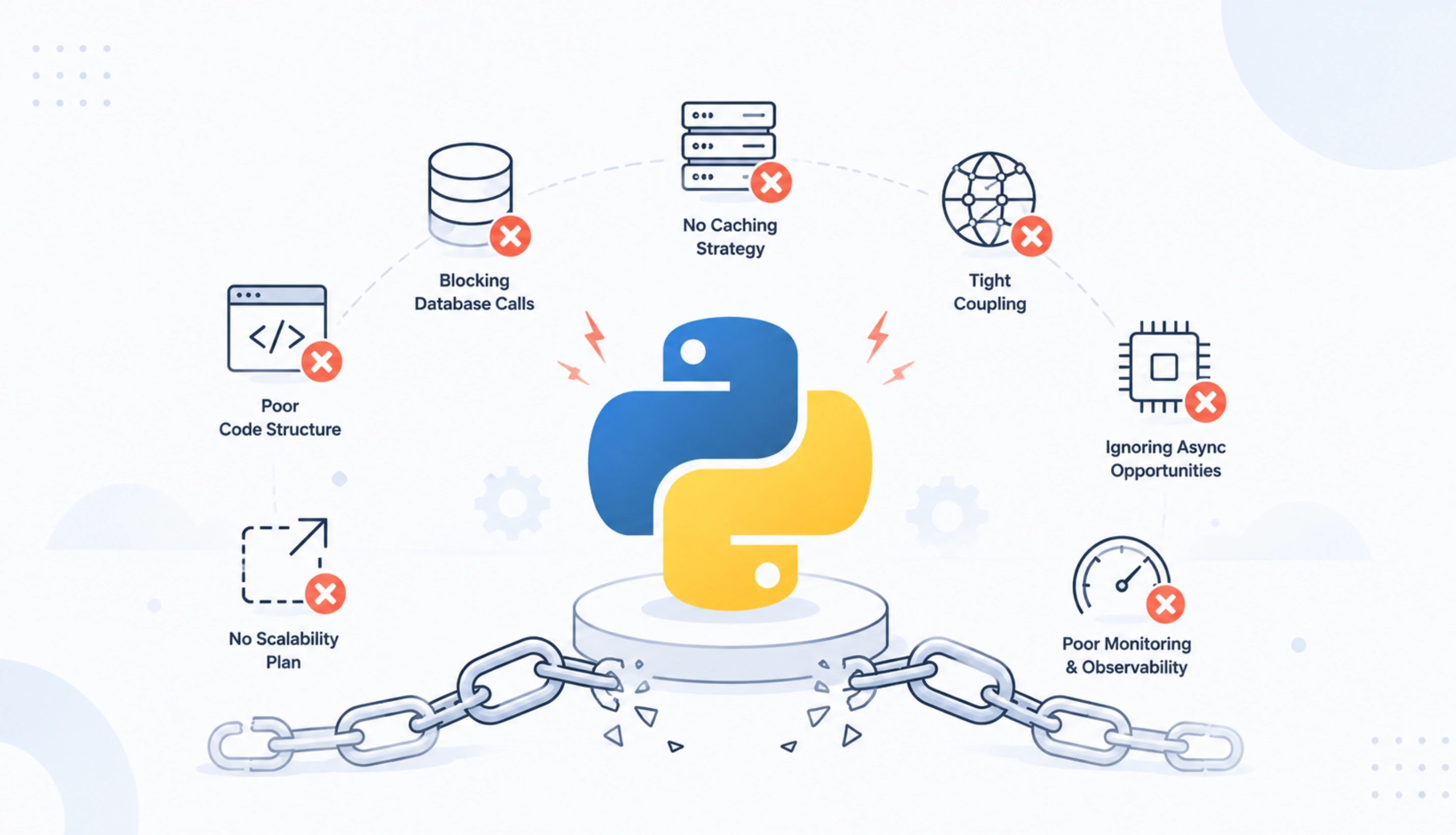
Across hundreds of Python backends operating at scale, the early architectural mistakes are remarkably consistent. They are predictable, which means they are also preventable. Five mistakes appear in the majority of post-mortems on Python systems that hit scaling walls.
Skipping PgBouncer at week one. Looks fine at low traffic. Becomes a hard wall around 5,000 concurrent requests when PostgreSQL hits its connection limit. Adding PgBouncer later is straightforward. The cost is in the months spent debugging weird timeout patterns before realising the database connection layer is the bottleneck.
Synchronous ORM calls inside async endpoints. Looks like async code. Blocks the event loop. Reduces throughput by 80%+ silently. Most 'FastAPI is slow' complaints trace back here.
Stateful workers requiring sticky sessions. Looks like a small implementation detail. Locks you out of standard load balancing patterns and prevents straightforward horizontal scaling.
Tightly coupling to a single cloud's proprietary services. DynamoDB-specific queries scattered through the codebase. Lambda-specific handlers. Migration cost grows quietly until it becomes prohibitive.
Drawing service boundaries by team, not by domain. Two teams ship two services that share half their domain logic. The shared code lives nowhere clean, gets duplicated, and drifts into bugs.
For real-world examples of how Python and other backends have scaled successfully versus catastrophically, with the architectural patterns that distinguished each, the case study analysis on real-life examples of failed vs successful scalability in microservice architecture walks through the specific decisions that determined outcomes at Netflix, Spotify, and others.
The Week-One Decision Checklist for Python Scalability
Use this checklist before writing the first production line of Python code. Each item is a decision that compounds for years. Getting them right at week one costs an afternoon. Getting them wrong costs quarters of rework.
Table : Week-One Architectural Decisions for Long-Term Python Scalability
Decision | Correct Default for Most Teams | Cost to Reverse Later |
|---|---|---|
Database engine | PostgreSQL | Catastrophic (6+ month migration) |
Application framework | FastAPI or Django (team fit) | Major (6 to 12 month rebuild) |
Modular boundaries | Domain-aligned modules from day 1 | High (months to untangle) |
Async-first or sync-first | Async for I/O heavy, sync for CPU | High (rewrite endpoints) |
Stateless workers | Yes, sessions in Redis | Medium (workaround sticky sessions) |
Connection pooling | PgBouncer transaction mode | Low (drop-in addition) |
Background work | Celery, RQ, or Dramatiq | Low to medium (extract from threads) |
Observability | Sentry plus structured logs plus APM | Low (add later, but lose history) |
Cloud abstractions | Wrapper interfaces for vendor APIs | High (untangle scattered calls) |
Code ownership | CODEOWNERS file from week 1 | Low (add later, but boundaries already decayed) |
Hiring Engineers Who Get Early Decisions Right
Early architectural decisions are made by senior engineers, not by frameworks. A team without architectural depth at the start will make the same mistakes the framework documentation warns about, regardless of which framework they pick. Senior judgement at week one prevents the rewrites at year three.
What to Look For When Hiring for Early-Stage Python Architecture
Has shipped a Python backend that scaled past 100,000 users. Direct experience with the inflection points, not just theoretical knowledge of patterns.
Can describe an architectural decision they got wrong and what it cost. Engineers who have made mistakes and learned from them produce better early architecture than engineers who have only read about scalability.
Knows when not to use a pattern, not just when to use one. Senior judgement is more about restraint than enthusiasm. Premature microservices, premature caching, premature optimisation are all signals of inexperience.
Has direct experience with PgBouncer, Redis cluster, and async patterns. These are the technologies that separate Python backends that scale from ones that do not. Direct production experience beats coursework every time.
For the budget reality of bringing this level of senior architecture experience onto a team, particularly for mid-sized organisations balancing scale and cost, the analysis on Python development cost for mid-sized businesses walks through engagement model economics in detail.
How Acquaint Softtech Approaches Early Architecture Decisions
Acquaint Softtech is a Python development and IT staff augmentation company based in Ahmedabad, India, with 1,300+ software projects delivered globally across healthcare, FinTech, SaaS, EdTech, and enterprise platforms. Our Python backend engagements follow the architectural framework described in the complete guide to hiring Python developers, and our senior engineers have made the early decisions covered in this guide across production systems running successfully from year one through year five and beyond.
Senior Python engineers with early-architecture depth. Hands-on with PostgreSQL plus PgBouncer setups from day one, FastAPI async architecture, Celery worker pipelines, Redis caching strategy, and modular monolith design.
Architecture audit and remediation experience. Production codebases reviewed for the eight decisions covered above, with written remediation plans and sequenced effort estimates for codebases between 50K and 1M+ lines.
Healthcare and FinTech compliance experience. GDPR-compliant Python platform delivered for BIANALISI, Italy's largest diagnostics group, processing patient records with audit-grade query logging across multi-year operations.
Transparent pricing from $20/hour. Dedicated Python engineering teams from $3,200/month per engineer. Architecture audits and long-term roadmap reviews from $5,000.
To bring senior Python engineers onto your architectural decisions before they compound, you can hire Python developers with profiles shared in 24 hours and a defined onboarding plan within 48.
The Bottom Line
The decisions you make in the first six weeks of a Python backend define what is possible for the next five years. Pick PostgreSQL with PgBouncer. Pick a framework your team can maintain with discipline. Draw modular boundaries by business domain. Decide async-first or sync-first explicitly. Keep workers stateless. Plan for the cache before you deploy it. Build observability from the first deployment. Preserve reversibility through abstractions and repositories.
None of these are exotic. All of them compound over years. The teams that ship the best Python backends in 2026 are not the ones with the cleverest architectural diagrams. They are the ones who made disciplined, well-understood decisions at week one and held them with rigour while the system grew. The architecture compounds in your favour when you respect it early. It punishes you for the rest of the product's life when you do not.
Making Architectural Decisions for a New Python Backend?
Book a free 30-minute architecture review. We will look at your project requirements, identify the three highest-impact early decisions ahead of you, and give you a written framework to evaluate each. No sales pitch. Just senior engineers who have made these decisions across multi-year horizons.
Frequently Asked Questions
-
Which early architectural decision has the biggest impact on Python scalability?
The database choice and access pattern, by a wide margin. PostgreSQL with PgBouncer connection pooling and a clean ORM layer scales to billions of rows and tens of thousands of RPS when operated with discipline. Skipping PgBouncer or scattering raw SQL across the codebase creates the kind of debt that becomes catastrophic to fix later. The framework and language matter less than how the application accesses the database.
-
Can I fix early architectural mistakes later if I get them wrong?
Some, yes. Others, almost never. Adding PgBouncer at year 2 is straightforward. Migrating from MongoDB to PostgreSQL at year 3 is a multi-quarter project that often kills the product roadmap. Adding async patterns to a sync-first codebase at year 2 is a major refactor. The earlier you make the right decision, the cheaper it is to keep right. IBM research shows the cost of fixing architectural errors after release is 4 to 5 times higher than during design, and up to 100 times higher than at requirements stage.
-
Should I start with microservices for a new Python product?
Almost certainly not. The 2026 consensus answer for new Python products is the modular monolith with clear domain boundaries. Microservices solve specific organisational problems (independent deployment per team, divergent scaling profiles per service) that small teams do not yet have. Adopting microservices early multiplies operational cost without earning the benefits. Extract specific modules into services later when measurement justifies it.
-
Is FastAPI or Django the better choice for long-term Python scalability?
Both scale comfortably to large user bases when operated with discipline. FastAPI is the better default for API-first products, async-heavy workloads, and ML model serving. Django is the better default for full web platforms with admin interfaces, content management, and batteries-included tooling. Many production stacks run both: Django for the main application and FastAPI for high-performance microservices on the edge. The framework matters less than the architectural discipline applied around it.
-
When should I add caching to a Python backend?
Make the decision at week one, even if you do not deploy a cache layer immediately. Architecturally, decide whether your endpoints have a caching layer between application and database, and design code that assumes one exists. Adding cache later changes how every endpoint thinks about freshness, and retrofitting cache invalidation across an existing codebase is one of the most common sources of subtle data correctness bugs in scaled Python systems.
-
How much does fixing an early architectural mistake actually cost?
IBM Systems Sciences Institute data shows the cost ratio. Catching at requirements: $1. Catching at design: $5. Catching at implementation: $10. Catching after release: $100. McKinsey research adds that up to 60% of IT spend at some organisations goes to maintaining systems not designed for current operational demands. The financial case for getting early decisions right at week one is overwhelming, even when the team is moving fast under pressure to ship.
-
How do I decide whether to bring in a senior architect for early decisions?
For any Python backend with a projected horizon over 18 months, yes. The cost of a 2-week architecture review with a senior engineer is typically $10,000 to $20,000. The cost of fixing the decisions they would have caught is 10x to 100x that. The math works out in favour of senior architectural input on any project where the codebase will outlive the founding team's gut judgement, which is essentially every product with real customers and a real growth trajectory.
We’re Acquaint Softtech, your technology growth partner. Whether you're building a SaaS product, modernizing enterprise software, or hiring vetted remote developers, we’re built for flexibility and speed. Our official partnerships with Laravel, Statamic, and Bagisto reflect our commitment to excellence, not limitation. We work across stacks, time zones, and industries to bring your tech vision to life.
Table of Contents
Get Started with Acquaint Softtech
- 13+ Years Delivering Software Excellence
- 1300+ Projects Delivered With Precision
- Official Laravel & Laravel News Partner
- Official Statamic Partner
Related Blog

How to Hire Python Developers Without Getting Burned: A Practical Checklist
Avoid costly hiring mistakes with this practical checklist on how to hire Python developers in 2026. Compare rates, vetting steps, engagement models, red flags, and more.
Acquaint Softtech
March 30, 2026
Total Cost of Ownership in Python Development Projects: The Full Financial Picture
The build cost is just the beginning. This guide breaks down the complete TCO of Python development projects across every lifecycle phase, with real benchmarks, a calculation framework, and 2026 data.
Acquaint Softtech
March 23, 2026
Python Developer Hourly Rate: What You're Actually Paying For
Python developer rates range $20-$150+/hr in 2026. See what experience, specialisation & hidden costs actually determine the price. Save 40% with vetted offshore talent.
Acquaint Softtech
March 9, 2026India (Head Office)
203/204, Shapath-II, Near Silver Leaf Hotel, Opp. Rajpath Club, SG Highway, Ahmedabad-380054, Gujarat
USA
7838 Camino Cielo St, Highland, CA 92346
UK
The Powerhouse, 21 Woodthorpe Road, Ashford, England, TW15 2RP
New Zealand
42 Exler Place, Avondale, Auckland 0600, New Zealand
Canada
141 Skyview Bay NE , Calgary, Alberta, T3N 2K6
Your Project. Our Expertise. Let’s Connect.
Get in touch with our team to discuss your goals and start your journey with vetted developers in 48 hours.