

Python for EdTech How We Delivered a Full Web Platform for an E-Learning Company
How we built a full Python web platform for an e-learning company. Real architecture, multi-role workflows, video delivery, and the lessons that translate.

Acquaint Softtech
Introduction: The Architecture Decisions That Decide Whether You Reach 100,000 Users
Most EdTech case studies are interchangeable. A screenshot of a course catalogue. A vague mention of 'scaling' without numbers. A list of features that could have come from any LMS template. The actual engineering decisions, the constraints that shaped the architecture, and the things the team learned the hard way are nowhere on the page. This is a different kind of write-up. It walks through how Acquaint Softtech delivered a complete Python web platform for an e-learning company, what made the build genuinely demanding, and the lessons that translate to anyone building an EdTech product on Python in 2026.
The context for this engagement is a category that has moved from optional to essential. According to a 2026 EdTech market analysis published by Grand View Research, the global education technology market was valued at USD 187.01 billion in 2025 and is projected to reach USD 213.20 billion in 2026 and USD 437.54 billion by 2033 at a 10.8% CAGR. The K-12 sector alone holds 38.9% of the market share, while the cloud deployment segment is forecast to grow at the fastest CAGR of 15.9%. EdTech is no longer a category that tolerates amateur engineering. The platforms that survive at this scale are the ones built with the same architectural discipline as a serious SaaS product.
This case study is written for EdTech founders, product leaders, and engineering decision-makers who are either planning an e-learning platform or trying to understand what serious Python EdTech engineering looks like in practice. The architecture, decisions, and outcomes below are real. The lessons are transferable to any e-learning, training, or upskilling product where multi-role workflows, content delivery, and learning analytics need to coexist on a single stack.
If you are still building the team that will execute an EdTech platform, the complete guide to hiring Python developers in 2026 sets the wider hiring context. EdTech engineering combines product depth, content infrastructure, and analytics maturity, so the seniority bar tends to be higher than most other domains.
The Client and the Real Engineering Problem
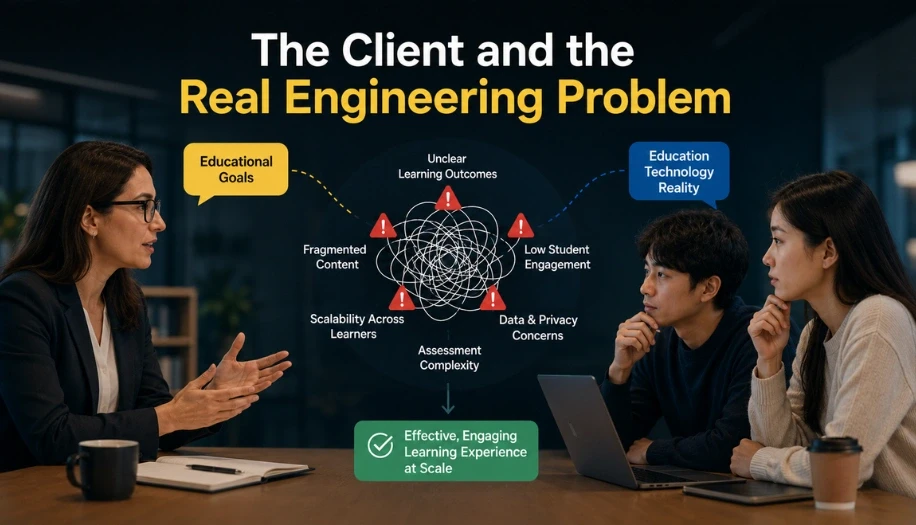
The client was an e-learning company looking to launch a full web platform for delivering structured courses to learners across multiple geographies, supporting instructors who needed to publish and manage content, and giving administrators the ability to oversee enrolments, billing, and reporting. The product was not a quick LMS rip-off. It needed to support live cohorts, on-demand video, assessments, learner progress tracking, certificate generation, and a payments flow that integrated with multiple regional providers.
The Constraints That Made This Engagement Demanding
Three distinct user roles with different workflows. Learners, instructors, and administrators each had their own data, permissions, and primary actions. The platform needed clean role-based access from week one, not retrofitted later.
Video delivery without burning the budget. Self-hosting video is expensive and operationally complex. Using a managed provider (Mux, Cloudflare Stream, Vimeo OTT) introduces integration work and per-minute cost questions. The decision affected unit economics permanently.
Assessments and progress tracking that survives growth. Quiz responses, completion percentages, and time-on-content data accumulate faster than most teams expect. The schema choices made on day one determined whether analytics queries would still run in under a second at 50,000 learners.
Payments across multiple regions. Different currencies, different tax regimes, different payment provider preferences. A single Stripe integration was not enough. The architecture had to abstract payment provider behind a clean interface.
Operational stability for live cohorts. If a live cohort starts at 7 PM IST with 800 learners joining, the platform cannot have an outage at 6:55 PM. Predictable performance was an architectural requirement, not a feature.
The Architecture We Built and Why Each Decision Mattered
Before settling on the architecture, the team studied the scale benchmarks the category was moving toward. According to a 2026 eLearning statistics review citing global market data and Coursera growth figures, the global eLearning market is expected to hit USD 203.81 billion in 2026 with 1.1 billion users forecasted by 2029, and Coursera alone added 7 million users in a single quarter (142M to 148M). India is growing fastest at a 25.76% CAGR. The architectural takeaway was that user growth in EdTech can outrun the team's ability to refactor under pressure, so the platform had to be designed to absorb 10x growth without rework.
The Stack and Why It Was Chosen
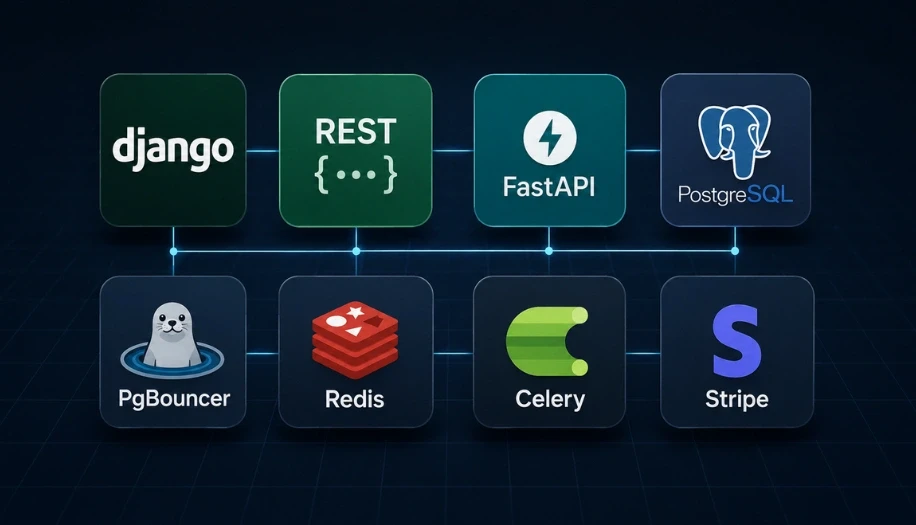
Table : Python Stack for the E-Learning Platform
Layer | Technology | Why It Was Chosen |
|---|---|---|
Web framework | Django + Django REST Framework | Multi-role admin, ORM, auth out of the box |
High-throughput APIs | FastAPI for analytics endpoints | Async-native, faster on query-heavy paths |
Database | PostgreSQL + PgBouncer | Strong relational model for course hierarchies |
Cache and queues | Redis | Sessions, quiz state, rate limiting, Celery broker |
Background work | Celery + Redis | Email, certificate generation, progress recalculation |
Video delivery | Managed CDN provider (HLS streaming) | Adaptive bitrate, signed URLs, cost predictability |
Payments | Provider-abstracted layer (Stripe, regional gateways) | Multi-region support without vendor lock |
Observability | Sentry, structured logs, APM | Tenant and user-slice diagnostics from day one |
The Five Architectural Decisions That Defined the Outcome
Django was the right primary framework. The platform had heavy multi-role workflows, admin dashboards, complex permissions, and an ORM-friendly course hierarchy. Django's batteries-included approach removed weeks of boilerplate that would have come with a leaner framework.
FastAPI sat alongside Django for analytics endpoints. Progress dashboards, instructor analytics, and learner cohort views were query-heavy and benefited from async I/O. The two frameworks shared a PostgreSQL database, with Django owning writes and FastAPI handling read-optimised analytics paths.
Video stayed on a managed provider, not self-hosted. Adaptive bitrate streaming, signed URL access control, and global CDN performance are non-trivial to operate. A managed provider with per-minute pricing produced better unit economics than the team rebuilding the same capability.
Payments were abstracted behind a clean interface from week one. A single PaymentGateway interface with Stripe and regional implementations meant adding a new region was a 2-day task, not a 6-week refactor. This decision paid for itself the first time the client expanded into a new market.
Background work moved aggressively to Celery. Certificate generation, email notifications, progress recalculation, instructor digest reports, payment reconciliation. Anything over 200 milliseconds went to a worker. The synchronous request path stayed under 250ms p95.
The architectural reasoning above sits inside a broader framework selection logic covered in the Python development architecture and frameworks guide, which walks through how Django, FastAPI, and Flask each fit different product profiles, and why a hybrid Django plus FastAPI stack has become the 2026 default for content-heavy platforms with API-driven analytics layers.
Need Senior Python Engineers Who Have Built E-Learning Platforms?
Acquaint Softtech provides senior Python engineers with hands-on production experience in Django plus FastAPI hybrid stacks, multi-role EdTech workflows, managed video delivery integration, abstracted payments for multi-region rollout, Celery worker pipelines, and the operational discipline that keeps live cohort platforms stable under load. Profiles in 24 hours. Onboarding in 48.
The Outcome and Six Lessons That Translate to Any Python EdTech Build
The platform launched, supported live cohort delivery without outages during peak enrolment windows, integrated multiple regional payment providers without architectural rework, and scaled learner analytics dashboards across thousands of concurrent course participants. The instructor experience and administrative reporting both kept performance characteristics that the client measured as production-grade. But the more useful part of this engagement is not what happened to one client. It is which architectural decisions consistently produced good outcomes and would do so again on the next EdTech build.
Multi-role design starts with permissions, not screens. Most EdTech platforms drift into broken permissions because engineers built role-specific screens before defining a clean permissions model. Define the role-permission matrix first. Build screens against the matrix. Refuse shortcuts that bypass it.
Managed video is cheaper than rebuilt video. Self-hosting video looks attractive at small scale and becomes a budget catastrophe at growth scale. The per-minute pricing of a managed provider always wins against the operational cost of HLS encoding, CDN distribution, and adaptive bitrate handling done in-house.
Schema decisions on learner data compound for years. Course progress, quiz responses, and time-on-content data grow faster than other tables. Index for the queries you actually run (instructor dashboard, learner progress view, cohort completion report) rather than the queries that look natural.
Payments must be abstracted from day one. The first time the client expands to a new region or adds a regional payment method, an abstracted PaymentGateway interface saves a quarter of engineering time. Scattered Stripe-specific code costs that quarter back.
Live cohort performance is a separate problem from on-demand performance. Synchronous joins of 800 learners at the same time stress different parts of the architecture than the same 800 learners watching on-demand content across 24 hours. Plan capacity for both.
Analytics is an engineering investment, not a dashboard feature. Learner analytics, instructor performance metrics, and completion reports rely on schema choices and async pipelines that take time to design correctly. Cutting corners here produces dashboards that work at launch and time out at year two.
For more architectural lessons drawn from Python case studies across production systems, including the patterns that distinguish successful product platforms from failed ones, the analysis on backend architecture lessons from real Python case studies walks through how Instagram, Spotify, Netflix, and other production Python stacks approached the same discipline questions.
Why the Dedicated Team Model Was the Right Choice
EdTech platform builds rarely succeed on staff augmentation or fixed-price contracts. The product roadmap evolves continuously based on learner behaviour, instructor feedback, and regional expansion decisions. A dedicated team that accumulates domain context over multi-quarter horizons produces consistently better outcomes than a rotating team or a scope-locked engagement. The Acquaint engagement model for EdTech is a dedicated team of senior Python engineers embedded in the client's workflow, with continuity that lets the team learn the actual e-learning domain rather than just deliver feature tickets.
For more case studies covering how SaaS-style platforms across industries solved similar architectural questions and the business outcomes their choices produced, the analysis on learning to build successful SaaS applications with case studies walks through cross-industry implementation patterns and the trade-offs that determined real outcomes.
How Acquaint Softtech Approaches Python EdTech Engagements
Acquaint Softtech is a Python development and IT staff augmentation company based in Ahmedabad, India, with 1,300+ software projects delivered globally across healthcare, FinTech, SaaS, EdTech, and enterprise platforms. Our EdTech engagements follow the architectural framework described in the complete guide to hiring Python developers, with senior Python engineers experienced in multi-role product builds, managed video integration, payment provider abstraction, and the operational discipline that live cohort platforms require.
Senior Python engineers with EdTech product depth. Hands-on with Django plus FastAPI hybrid stacks, complex role-based permissions, managed video providers (Mux, Cloudflare Stream, Vimeo OTT), Celery worker pipelines, and PostgreSQL plus PgBouncer scaling for learner analytics workloads.
Multi-region payment integration experience. Stripe, Razorpay, regional gateways for India, Europe, and Southeast Asia, integrated through clean provider abstractions that support market expansion without rework.
Healthcare and FinTech compliance experience that translates to EdTech. GDPR-compliant Python platforms delivered for European clients, with the audit-grade discipline that EdTech products increasingly demand for K-12 learner data, COPPA-related child safety, and institutional contracts.
Transparent pricing from $20/hour. Dedicated Python engineering teams from $3,200/month per engineer. EdTech architecture audits and platform roadmap reviews from $5,000.
For a broader view of cross-industry delivery patterns and the trade-offs that determined real client outcomes across healthcare, FinTech, EdTech, and SaaS engagements, see the Acquaint Softtech case studies portfolio, which catalogues engagements across regulated and non-regulated domains.
For the budget reality of building a Python EdTech platform with the architectural patterns above, the analysis on minimum budget required to start a Python development project in 2026 walks through the verified 2026 cost ranges by project type, engagement model, and feature scope, and covers the realistic floors for a multi-role e-learning product.
The Bottom Line
Python is genuinely suited to EdTech at any scale a real product is likely to reach. The architectural choices that determine whether an e-learning platform launches successfully and scales smoothly are not exotic. Use Django for the main application layer. Use FastAPI for analytics. Put PostgreSQL behind PgBouncer. Move work over 200 milliseconds to Celery. Use a managed video provider. Abstract payments from day one. Design role-based permissions before screens. Build observability before you need it.
None of these are clever. All of them are the difference between an EdTech platform that supports a thriving e-learning business and one that breaks during the first live cohort. The teams that ship the best Python EdTech products in 2026 are not the ones with the cleverest architecture diagrams. They are the ones who made disciplined, well-understood decisions early and held them through the operational pressure of real learners using the platform every day.
Stuck Between Growth Stages on Your Python SaaS?
Book a free 30-minute SaaS architecture review. We will look at your current architecture, your subscriber growth trajectory, and the constraints showing up in your operational dashboards, and give you a written remediation plan with sequenced priorities. No sales pitch. Just senior engineers who have shipped Python SaaS platforms across the full 0 to 100,000 subscriber arc.
Frequently Asked Questions
-
Why is Python a good choice for an EdTech web platform?
Python combines the deepest ecosystem for data analytics, ML, and content workflows with mature frameworks (Django and FastAPI) that ship multi-role web platforms quickly. The hiring pool is wide enough to staff multi-quarter EdTech engagements without bottlenecks, and the ecosystem covers everything an e-learning platform actually needs: ORM-heavy course models, analytics pipelines, payment integrations, video provider SDKs, and AI features when they get added.
-
Should an e-learning platform self-host video or use a managed provider?
Use a managed provider in almost every case. Mux, Cloudflare Stream, and Vimeo OTT handle adaptive bitrate streaming, signed URL access control, global CDN distribution, and HLS encoding for predictable per-minute pricing. Self-hosting looks cheaper at low scale and becomes a budget catastrophe at growth scale because the operational cost of running video infrastructure exceeds the managed provider fees for most products.
-
Django or FastAPI for a new EdTech platform in 2026?
Django for the main application layer because its batteries-included approach handles multi-role admin, ORM, auth, and content management cleanly. FastAPI for analytics endpoints, instructor dashboards, and any async-heavy work. Many production EdTech stacks run both against a shared PostgreSQL database, with Django owning writes and FastAPI handling read-optimised analytics paths. Pure FastAPI works for API-first EdTech products. Pure Django works for content-heavy ones. The hybrid pattern handles most cases best.
-
How long does it take to build a real Python EdTech web platform?
A serious multi-role e-learning platform with video delivery, payments, assessments, and learner analytics typically requires 4 to 8 months for the first production release, with subsequent quarters adding cohort features, mobile clients, and regional expansion. Compressed timelines reliably produce EdTech platforms that demo well and break on the first live cohort. Treating the build as a multi-quarter program is the engagement model that consistently works.
-
How much does a Python EdTech web platform cost to build?
A lean Python EdTech MVP with subscription billing and basic multi-role workflows typically starts at $25,000 to $45,000 with an offshore partner. A more complete platform with video integration, assessments, and multi-region payments runs $50,000 to $120,000. Enterprise-grade EdTech with institutional contracts, compliance certifications (COPPA, GDPR, FERPA-equivalent), and advanced analytics pushes the range to $150,000 and above. The variable is feature scope, not the underlying Python stack.
-
How do I handle live cohorts at scale on a Python EdTech platform?
Live cohorts stress different parts of the architecture than on-demand content. Use Redis-backed presence tracking, push notifications through a queue (Celery or similar), and offload session state from application servers so any worker can serve any participant. Plan database capacity for the synchronous spike when a cohort starts, not just the steady-state load. Most live cohort outages trace back to database connection exhaustion at the start of the session.
-
What engagement model works best for building an EdTech web platform?
A dedicated team is almost always the right answer for a multi-quarter EdTech build. The product roadmap evolves continuously based on learner behaviour, instructor feedback, and regional expansion decisions, and fixed-price contracts anchor the team to assumptions that will not survive the first 1,000 learners. A 6 to 10 engineer dedicated team is the typical pattern for serious EdTech engagements through the first 12 to 18 months.
We’re Acquaint Softtech, your technology growth partner. Whether you're building a SaaS product, modernizing enterprise software, or hiring vetted remote developers, we’re built for flexibility and speed. Our official partnerships with Laravel, Statamic, and Bagisto reflect our commitment to excellence, not limitation. We work across stacks, time zones, and industries to bring your tech vision to life.
Table of Contents
Get Started with Acquaint Softtech
- 13+ Years Delivering Software Excellence
- 1300+ Projects Delivered With Precision
- Official Laravel & Laravel News Partner
- Official Statamic Partner
Related Blog

How to Hire Python Developers Without Getting Burned: A Practical Checklist
Avoid costly hiring mistakes with this practical checklist on how to hire Python developers in 2026. Compare rates, vetting steps, engagement models, red flags, and more.
Acquaint Softtech
March 30, 2026
Total Cost of Ownership in Python Development Projects: The Full Financial Picture
The build cost is just the beginning. This guide breaks down the complete TCO of Python development projects across every lifecycle phase, with real benchmarks, a calculation framework, and 2026 data.
Acquaint Softtech
March 23, 2026
Python Developer Hourly Rate: What You're Actually Paying For
Python developer rates range $20-$150+/hr in 2026. See what experience, specialisation & hidden costs actually determine the price. Save 40% with vetted offshore talent.
Acquaint Softtech
March 9, 2026India (Head Office)
203/204, Shapath-II, Near Silver Leaf Hotel, Opp. Rajpath Club, SG Highway, Ahmedabad-380054, Gujarat
USA
7838 Camino Cielo St, Highland, CA 92346
UK
The Powerhouse, 21 Woodthorpe Road, Ashford, England, TW15 2RP
New Zealand
42 Exler Place, Avondale, Auckland 0600, New Zealand
Canada
141 Skyview Bay NE , Calgary, Alberta, T3N 2K6
Your Project. Our Expertise. Let’s Connect.
Get in touch with our team to discuss your goals and start your journey with vetted developers in 48 hours.