

Strategic Guide To Remote vs. In-house Developers in 2026
This article helps CEOs compare remote and in-house developers in 2026 by breaking down costs, performance, culture, risk, and scalability.

Manish Patel
Introduction
Hey there, fellow tech trailblazers navigating the wild west of software development! Picture this: You're the captain of a ship called "Innovation," sailing through stormy seas of tight deadlines, budget constraints, and talent shortages.
What would you do in this situation? Hire a crew that lives on board (in-house developers)? Or do you outsource to the Navy SEALs (remote developers) who are specially trained to keep the pirate ship (hackers) at bay?
This is an important decision that can make or break your project in 2026. The debate on hiring in-house developers vs. outsourcing software requirements has been around for a long time.
Although with the exponential growth of AI, 2026 is likely to be the year this debate finally comes to an end, with remote developer hiring finishing on top.
That said, the rise of AI has introduced yet another option: AI-powered development. Is this an option for businesses, or do we still need highly skilled developers? With the high level of risks in the form of lack of flexibility, creativity, and security, we still do need skilled developers at the wheel.
This is a practical guide to help you decide the best strategy for your business by providing the pros and cons of remote vs. in-house developers. It also provides an alternative hybrid option.
Rethink Hiring Strategy in the AI Era
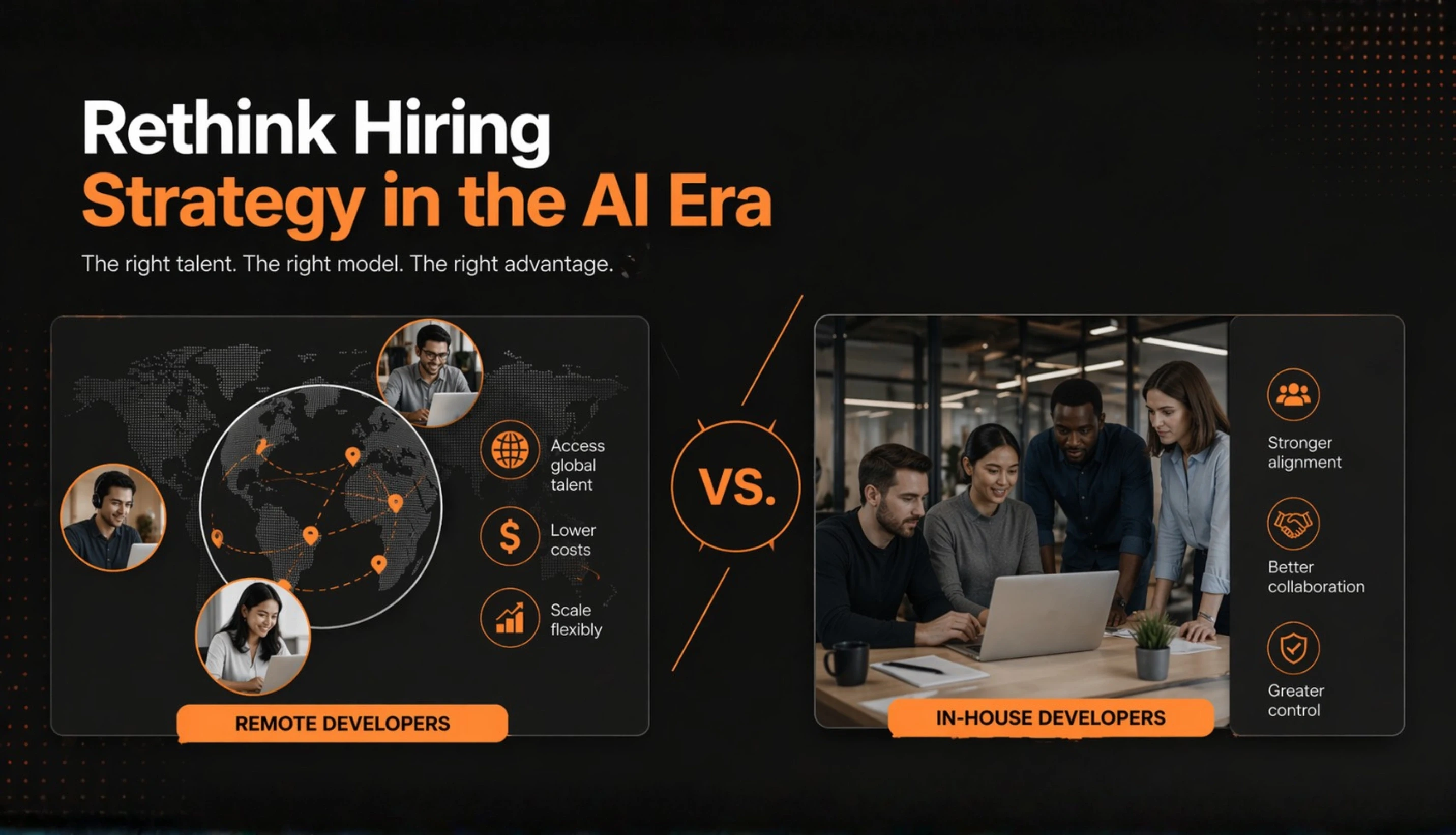
In 2026, your competitive edge is not your office. It’s your global talent pool. AI didn't just change the tech stack, it altered the talent equation. Hence, businesses need to factor the AI element into the hiring process since it is no longer sufficient to be an expert on technologies like Laravel or Python.
It is also essential for developers to have skills to take advantage of what AI has to offer. Businesses require:
Faster execution
Clean, auditable code
Continuous delivery
Predictable quality
24/7 progress
AI amplifies competent developers but exposes weak ones. This is why businesses in 2026 are shifting love toward remote models, because the global talent pool allows them to:
Hire AI-literate developers
Work with teams who use AI-driven code reviews
Access engineers fluent in automation, CI/CD, DevOps, and security
When you hire in-house only, your team’s capabilities grow as fast as your local hiring market. When you hire remotely, your capabilities grow as fast as the global tech industry. And that is a massive strategic difference
Rethink your hiring strategy for the AI era before your competitors do
The rules of talent, speed, and scalability have changed - and CEOs who adapt now will lead the next decade. Consult the experts at Acquaint Softtech and build a remote team engineered for performance, security, and growth. Your next breakthrough starts with the right developers.
In-House Developers - The Home-Team Hustle
Despite the shift to remote work, in-house teams still have advantages, especially for enterprise environments. In fact, it is not uncommon for large firms to have a dedicated in-house team of IT professionals.
There’s an undeniable appeal to having your development team under one roof. The immediate collaboration, the impromptu whiteboard sessions, the shared lunch breaks that foster camaraderie — these are tangible benefits that contribute to a strong team culture and, often, faster communication cycles.
Some other benefits include strong cultural alignment, greater perceived control, and enhanced security. However, there is a downside to that. It comes with a high cost structure and a very slow hiring process, often making it hard to gain access to specialized skills.
On the other hand, there is a risk of knowledge silos, limited skill diversity, and less exposure. Not to mention businesses often have to deal with higher overhead costs, slower scaling, and the risk of stagnation.
Remote Developers - The Global Power Play
In 2026, it is safe to say that remote teams have matured. What was once considered "experimental" is now the global norm. It offers a plethora of benefits that are hard for businesses to ignore.
The long list of benefits includes access to global talent, massive cost savings, and instant scalability. The added advantage is the time zone boon and a higher retention rate.
There are downsides to every option, and outsourcing software requirements also has several disadvantages. This includes communication challenges with no F2F communication and the security risk. That said, outsourcing to a professional software outsourcing company like Acquaint Softtech helps fix this.
This is often achieved with the help of professional tools, ensuring appropriate coding practices, and enforcing an NDA.
“Flexibility is key to innovation — and remote work unlocks it at scale.” - Satya Nadella
IT Staff Augmentation - The Best of Both Worlds

Staff augmentation is a flexible outsourcing model where companies hire remote developers or technical specialists from an external engineering partner to extend their in-house team without the long-term commitments, overhead costs, or hiring delays of traditional employment.
Instead of outsourcing an entire project, businesses bring in skilled remote developers who work directly under their internal leadership, follow their processes, and integrate into their existing workflows as if they were part of the core team.
You Retain Full Control — Just Like an In-House Team:
With staff augmentation, extended developers work as an integrated part of your internal team. It feels like an in-house team, just without hiring headaches, long recruitment cycles, or overhead costs.
You manage priorities, tasks, and communication.
They use your tools, follow your processes, and align with your culture.
Your leadership maintains complete architectural and product direction.
You Get Outsourcing-Level Scalability & Speed:
When deadlines tighten or product scope expands, augmented developers give you the kind of scalability pure in-house hiring can’t offer. Companies choose this model because scaling becomes a business decision, not an HR challenge.
Add developers within days, not months.
Scale up for sprints, launches, or high-demand cycles.
Scale down when the workload normalizes, without layoffs or HR issues.
Access to Specialized Talent On Demand:
With staff augmentation, you are not limited by geography or your local hiring market. It has the potential to meet the demands of a Laravel expert today, React developers tomorrow, and AI engineers next quarter. You can tap into:
Senior specialists
Multi-stack engineers
Industry-specific experts
Developers trained on emerging technologies
Lower Risk, Higher Reliability:
Traditional outsourcing can sometimes feel “detached,” while in-house teams can become bottlenecked by limited bandwidth. Staff augmentation solves both problems:
Your core team handles strategy, product vision, and architecture.
Augmented engineers handle execution with reliability and oversight.
There are no knowledge silos because the work happens inside your ecosystem.
Maximum Efficiency With Optimal Resource Allocation:
Your internal developers stay focused on high-value work:
Architecture
Product planning
Roadmapping
Innovation
Stakeholder alignment
Meanwhile, augmented engineers handle:
Feature development
Frontend & backend engineering
QA & automation testing
Integrations
Maintenance
Documentation
The result?
Your team stays strategic. Your delivery stays fast. Your costs stay controlled.
Head-to-Head: Remote vs. In-House in the 2026 Arena
Remote and in-house teams were once separated by a simple factor: location. In 2026, that distinction is outdated. The real differences now lie in speed, scalability, cost efficiency, and access to specialized talent.
Let’s break things down:
Access to Talent:
In-House: Limited to local hires; competition is fierce, especially in tech hubs.
Remote: Global hiring means you get access to niche specialists who would never relocate.
Stat: Gartner reports that 71% of companies in 2026 hire remotely to access skills unavailable locally.
Cost Structure:
In-House: Salary + benefits + office space + hardware + training = predictable but high.
Remote: Pay only for talent and productivity; no overhead.
Speed of Hiring:
In-House: 30–90 days
Remote: 48–72 hours if you work with the right outsourcing partner.
Productivity Patterns:
Contrary to old assumptions, remote developers often outperform in-house teams. Remote teams scale instantly; in-house teams scale slowly.
This distinction is why so many CEOs now choose hybrid or fully remote models backed by outsourcing partners like Acquaint Softtech. We provide our clients the option to either outsource their software development requirements or opt for IT staff augmentation.
Here is a table that stacks several metrics that paint a better picture, allowing businesses to make a more informed decision.
Aspect | In-House Developers | Remote Developers (Outsourced) | Winner in 2026? |
Cost | $200K–$300K/year per dev (Glassdoor 2025 | $40K–$80K/year equivalent (Upwork 2025) | Remote saves 60–70% |
Scalability | Rigid; hiring lags 3–6 months (LinkedIn 2025) | Elastic; ramp up in weeks | Remote - agile scaling |
Productivity | 22% innovation boost (McKinsey 2025) | 13% gain via focus (Gartner 2025) | Tie — context matters |
Talent Pool | Local 10–20% skilled (Deloitte 2025) | Global 80% access | Remote — diversity wins |
Turnover | Local 10–20% skilled (Deloitte 2025) | 32% with strong mgmt (FlexJobs 2025) | Remote — retention edge |
Security | High control, low breach risk | 15% higher risk if unmanaged (Forrester 2025) | In-House—unless vetted |
The Verdict
Remote vs. in-house development is no longer a binary decision. In 2026, the smarter question is, "How can I build a development system that helps my business grow faster?"
Remote teams offer speed, scale, and cost efficiency.
In-house teams offer culture, collaboration, and control.
Hybrid offers balance.
And outsourcing partners like Acquaint Softtech offer end-to-end reliability with global expertise.
If you want to build a high-performance engineering engine in 2026, you need more than developers.
You need the right model.
You need the right partner.
You need the right ecosystem.
And that’s where we come in. At Acquaint Softtech, we don’t just provide code; we provide solutions, partnerships, and a pathway to your success. We specialize in remote outsourcing, offering vetted developers with AI support. We've helped over 500 clients scale, from startups to enterprises.
Hire remote developers from Acquaint Softtech. Let’s connect and discuss because in 2026, the real question isn't whether to go remote or in-house, but rather, how wisely will you build your future?
Ready to outsource your software requirements without the stress?
Build faster, scale smarter, and stay ahead with a remote development team you can trust. Hire remote developers from Acquaint Softtech and turn your roadmap into real, measurable results. Your project deserves experts — let’s build it right.
Frequently Asked Questions
-
Is it better to hire remote or in-house developers in 2026?
It depends on your goals. Remote developers offer higher scalability, better access to talent, and lower costs, while in-house developers offer stronger cultural alignment and control. Many CEOs now use a hybrid model.
-
Why are remote developers becoming more popular?
Because they offer global expertise, lower overhead costs, faster hiring, and 24/7 delivery cycles, critical advantages in a competitive tech landscape.
-
What are the hidden costs of in-house development?
Office expenses, insurance, equipment, high retention costs, local salary competition, and training, all of which are eliminated or reduced with remote or outsourced teams.
-
Are remote developers as productive as in-house teams?
Yes, often more. With AI-driven tracking, async collaboration tools, clear processes, and time-zone advantages, remote teams have shown higher throughput in many 2025–2026 reports.
-
Why choose an outsourcing company like Acquaint Softtech?
You get vetted developers, mature processes, security protocols, predictable pricing, and a team that scales instantly, without the hiring headaches.
I lead technology and client success at Acquaint Softtech with one goal in mind. Deliver work that feels personal, reliable, and worthy of long term trust. I stay close to both our clients and our developers to make sure every project moves with clarity, quality, and accountability.
Table of Contents
Get Started with Acquaint Softtech
- 13+ Years Delivering Software Excellence
- 1300+ Projects Delivered With Precision
- Official Laravel & Laravel News Partner
- Official Statamic Partner
Related Blog

Super Apps: How Can IT Staff Augmentation Services help?
Super Apps combine multiple services like messaging, payments, and food delivery into one platform, enhancing user convenience and engagement. Learn how IT staff augmentation can help build these efficient apps.

Mukesh Ram
July 18, 2024
Hire Remote Developers: The Right Choice for Startup Success
Discover why hiring remote developers or a dedicated remote team is the smartest decision for startups. Learn how to scale quickly, save costs, and access top talent globally.

Acquaint Softtech
September 16, 2025
Hire Remote Developers or an Entire Development Team: The Complete Guide
Hiring remote developers means engaging a developer or a dedicated development team from a software company, usually in another country, to build your website or app without setting up an in-house team. It is beneficial because it gives instant access to skilled experts, cuts costs (often up to 60%), speeds time to market, and scales up or down easily.
Mukesh Ram
February 22, 2023India (Head Office)
203/204, Shapath-II, Near Silver Leaf Hotel, Opp. Rajpath Club, SG Highway, Ahmedabad-380054, Gujarat
USA
7838 Camino Cielo St, Highland, CA 92346
UK
The Powerhouse, 21 Woodthorpe Road, Ashford, England, TW15 2RP
New Zealand
42 Exler Place, Avondale, Auckland 0600, New Zealand
Canada
141 Skyview Bay NE , Calgary, Alberta, T3N 2K6
Your Project. Our Expertise. Let’s Connect.
Get in touch with our team to discuss your goals and start your journey with vetted developers in 48 hours.