

School Management System Development: Admissions, Attendance, Grades, and Parent Communication
A school management system is software that runs a school's core operations, admissions, attendance, grades, fees, timetabling, and parent communication, from one connected platform. It replaces scattered registers and spreadsheets with a single source of truth, automates reporting, and gives administrators, teachers, and parents secure role-based access to the records they need.

Manish Patel

- You run technology or product at a K-12 school, school chain, or EdTech company and need to digitize school administration.
- You are replacing spreadsheets, paper registers, or a rigid legacy tool that no longer fits how your school works.
- You want to understand the core modules of a school ERP before you scope a build or sign a vendor.
- You need a realistic picture of school management software cost, timeline, and what to build first.
- You care about student data privacy and want a system that handles records the right way from day one.
One platform should run the whole school, not five disconnected tools
Ask any school administrator where a student's record actually lives, and the honest answer is usually everywhere and nowhere. Admissions sit in one form tool, attendance in a register, grades in a teacher's spreadsheet, fees in accounting software, and parent updates in a messaging app nobody fully controls.
That fragmentation is expensive. Staff rekeys the same data three times, report cards take weeks, parents call the office for answers the system should already provide, and at audit time nobody can produce a clean trail. A real school management system exists to end that, and building one well starts with our custom school management software development practice rather than another point tool bolted onto the pile.
There is a compliance reason to take the platform seriously too. In the United States, the records a school keeps, grades, attendance, demographics, and disciplinary notes, are legally classified as student education records under FERPA, which means the way your software stores, shares, and exposes them is a legal question, not just a product one.
As a CIO at Acquaint Softtech, walks through how each module of a school administration software platform is engineered, what to build first, and what it costs. It expands on our complete guide to edTech software development, which sets the broader context for every learning and administration platform in this space.
It draws on Acquaint Softtech's record of 1,300+ projects across 20+ industries in 13+ years, a 70+ engineer in-house team, and education builds delivered for clients who deploy their first developer within 48 hours of brief, backed by a 4.9/5 rating from 61 verified Clutch reviews.
What a school management system actually is

A school management system, often called school ERP software, is a single platform that digitizes the administrative and academic operations of a school: enrollment, student records, attendance, grades, fees, timetabling, transport, and communication. Each module writes to one shared database, so a fact entered once is correct everywhere.
The mistake schools make is treating it as a website with a login. It is closer to an enterprise resource planning system shaped for education, where the student record is the spine and every module hangs off it. Understanding that data model is the difference between a tool people tolerate and one they rely on, which is why scoping starts with a structured product discovery workshop before any screen is designed.
There is also a vocabulary trap worth clearing up early. A student information system is the records core of the platform, while school administration software is the wider operational layer around it, and a learning management system handles teaching and coursework. A complete build usually needs all three to talk to each other, and getting that architecture right is the job of an experienced school ERP engineering team.
System of record, not a system of forms
Treat the platform as the school's system of record and the design decisions get clearer. Roles, permissions, and audit logging stop being features you add later and become the foundation you build on. How a records-first architecture is engineered is covered in our guide to how learning management systems work, which shares the same data-model discipline.
The core modules every school ERP needs
Every school ERP is built from the same core modules: a student information system for records, admissions and enrollment, attendance, a grade book and report cards, fee management, timetabling, and parent communication. Advanced builds add transport, library, exams, and an analytics dashboard on top of that base.
The trap is trying to ship all of them at once. A platform that does five modules well beats one that does fifteen badly, and the right first release is usually records, attendance, grades, and communication, the four that touch a parent or teacher every single day. Sequencing this scope is what our school software development outsourcing engagements handle in the first planning sprint.
To make scope decisions concrete, it helps to see the platform as five layers rather than a flat list of features. Each layer depends on the one beneath it, which tells you what has to be built first.
Layer | What it does | Build order |
Records | Student information system, demographics, profiles | First |
Operations | Admissions, attendance, fees, timetable | Second |
Academic | Grade book, exams, report cards | Third |
Communication | Parent app, notices, alerts | Fourth |
Intelligence | Dashboards, analytics, forecasting | Last |
This five layer blueprint is the model Acquaint Softtech uses to plan school builds, because it forces the records layer to be solid before anything reads from it. The dashboards and portals that sit on top are typically delivered by a MERN stack dashboard team once the underlying data is trustworthy.
How the same module thinking applies across the wider education stack is covered in our, complete EdTech software development guide, which maps modules to platform types.
Inside the admissions and enrollment module

The admissions module turns a paper-and-email enrollment process into a guided online flow: application form, document upload, eligibility checks, fee payment, seat allocation, and an admission decision, all tracked in one pipeline. Good admissions module design treats each applicant as a record from the first click, not from the day they enroll.
Done well, this is the highest-leverage module in the platform, because it is where parents form their first impression and where staff lose the most time. A clean flow captures structured data once, validates it, collects payment, and drops the new student straight into the student information system with no rekeying. Building that end-to-end pipeline is core work for a dedicated school software development team.
Two design choices decide whether admissions scales. First, configurable forms, because every school asks different questions and a hard-coded form ages badly. Second, a stage-based pipeline with clear ownership, so an application never stalls silently. Schools running a seasonal admissions rush often add temporary delivery capacity through staff augmentation to hit the intake window.
Online payment and document handling
Application fees, document verification, and offer letters all live inside this module, which means payment gateways and secure file storage are part of the spec from day one. How online registration and payment flows are engineered is covered in our guide to developing virtual classroom and e-learning software, which walks through the same gateway and storage patterns.
Digitizing your school's admissions and records?
Acquaint Softtech designs and builds school management systems, from the student information system to the parent app, for education clients across the USA, UK, Europe, Australia, New Zealand, and India. Your first engineer deploys within 48 hours of brief.
Designing the attendance tracking system
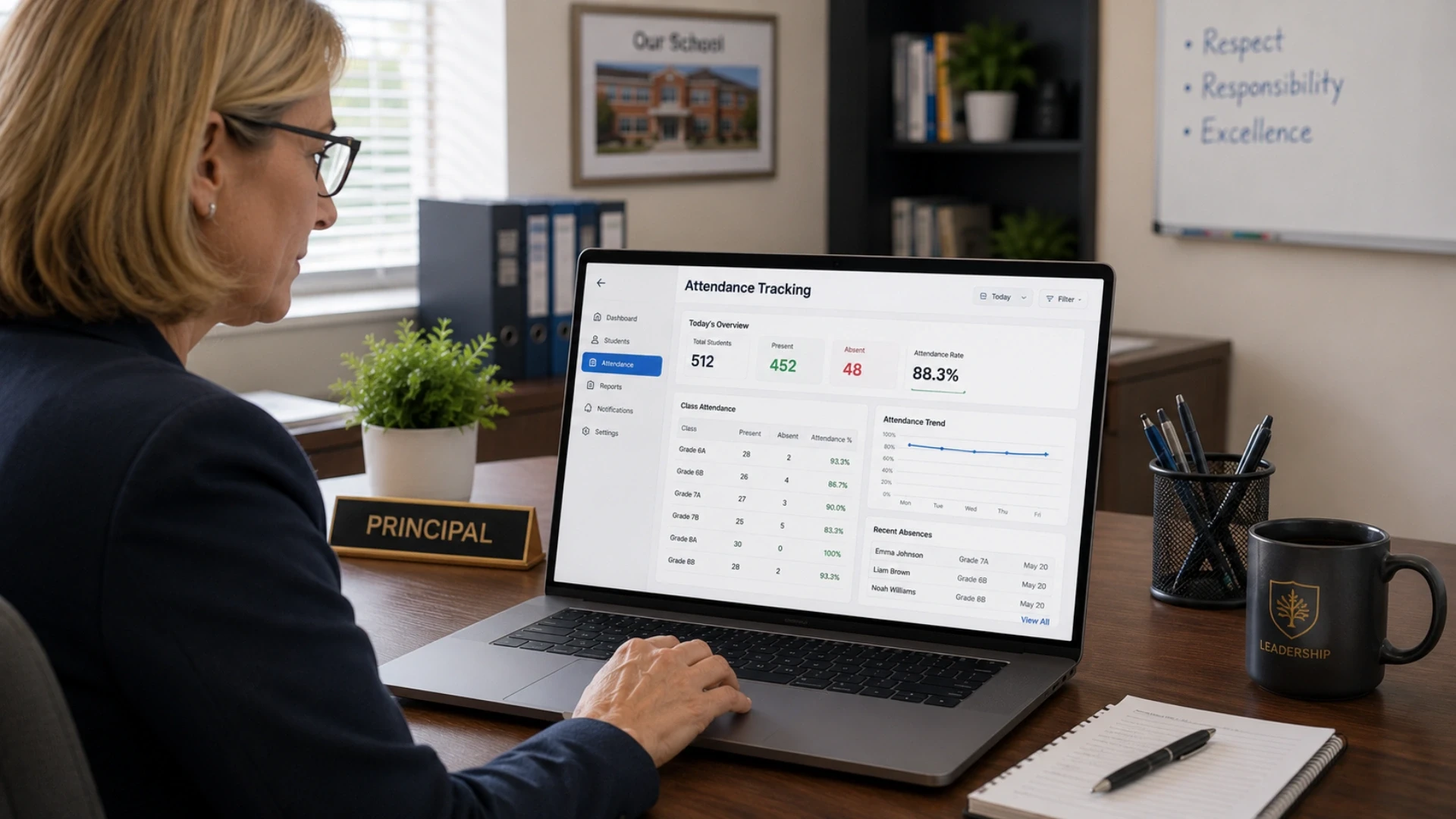
An attendance tracking system records who is present, when, and where, then rolls that data up into daily, subject-wise, and term reports for staff and parents. Sound attendance tracking architecture supports multiple capture methods, biometric, RFID, QR code, or a simple teacher app, all writing to one attendance record per student per period.
The engineering challenge is not capturing a single mark; it is doing it reliably for thousands of students every period without conflicts or duplicates. That means an idempotent write model, offline tolerance for patchy school wifi, and a clear rule for who can edit a mark after the fact. Designing that backend is squarely the work of a Laravel backend engineering team.
Capture method matters less than the data model behind it. Biometric and facial methods are increasingly handled by computer vision, and teams adding that capability lean on an AI and computer vision development team rather than building it from scratch. The unpublished cluster guide
Digital Attendance Management: RFID, Biometric, QR Code, and App-Based Check-In for Schools will go deeper on each capture method.
From marks to meaningful alerts
Raw attendance becomes valuable when it triggers something: a parent alert after an unexplained absence, a flag for a student trending toward chronic absenteeism, a clean report at audit time. Tying attendance to live class participation is covered in our guide to building a virtual classroom platform, which handles presence in synchronous sessions.
The grade book and report card engine
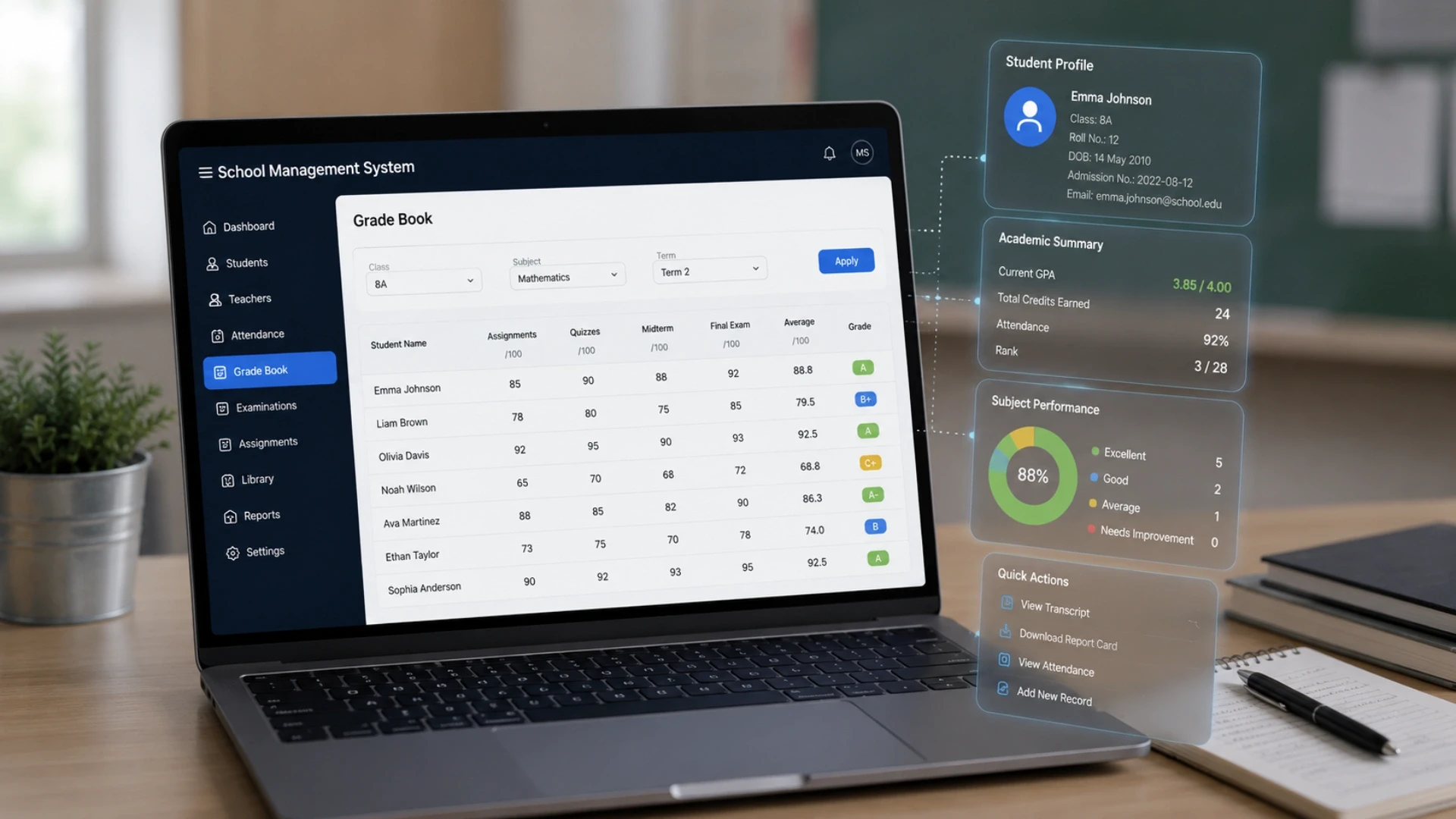
The grade book and report card engine captures marks, applies a school's grading scheme, computes aggregates and rankings, and generates report cards on demand. A flexible grade reporting system supports different schemes per grade level, weighted components, and locked-down finalization so a published result cannot be quietly changed.
This module is where schools feel the most pain with generic tools, because grading rules are deeply local. One school uses letter grades, another percentages, another a competency rubric, and many run hybrids that change by subject. A configurable grading engine, rather than a fixed formula, is what separates a system teachers trust from one they work around. That configurability is a deliberate custom software product development decision, not an afterthought.
Report card generation is its own subsystem: templating, batch PDF generation, digital signatures, and a parent-facing view that matches the printed copy exactly. Schools can also use a PDF QR code to give parents or students quick access to digital report cards, certificates, or other downloadable school documents from printed materials. A MERN stack development team usually delivers the teacher-facing entry screens and dashboards that feed it, because grade entry has to be fast and forgiving.
Why finalization and audit trails matter
Because grades are formal education records, every change needs a who, what, and when. Build the audit trail into the grade book from the start and you satisfy both school policy and privacy law in one stroke. The same assessment-engine discipline is covered in our published explainer on how learning management systems work.
Parent communication and the mobile layer
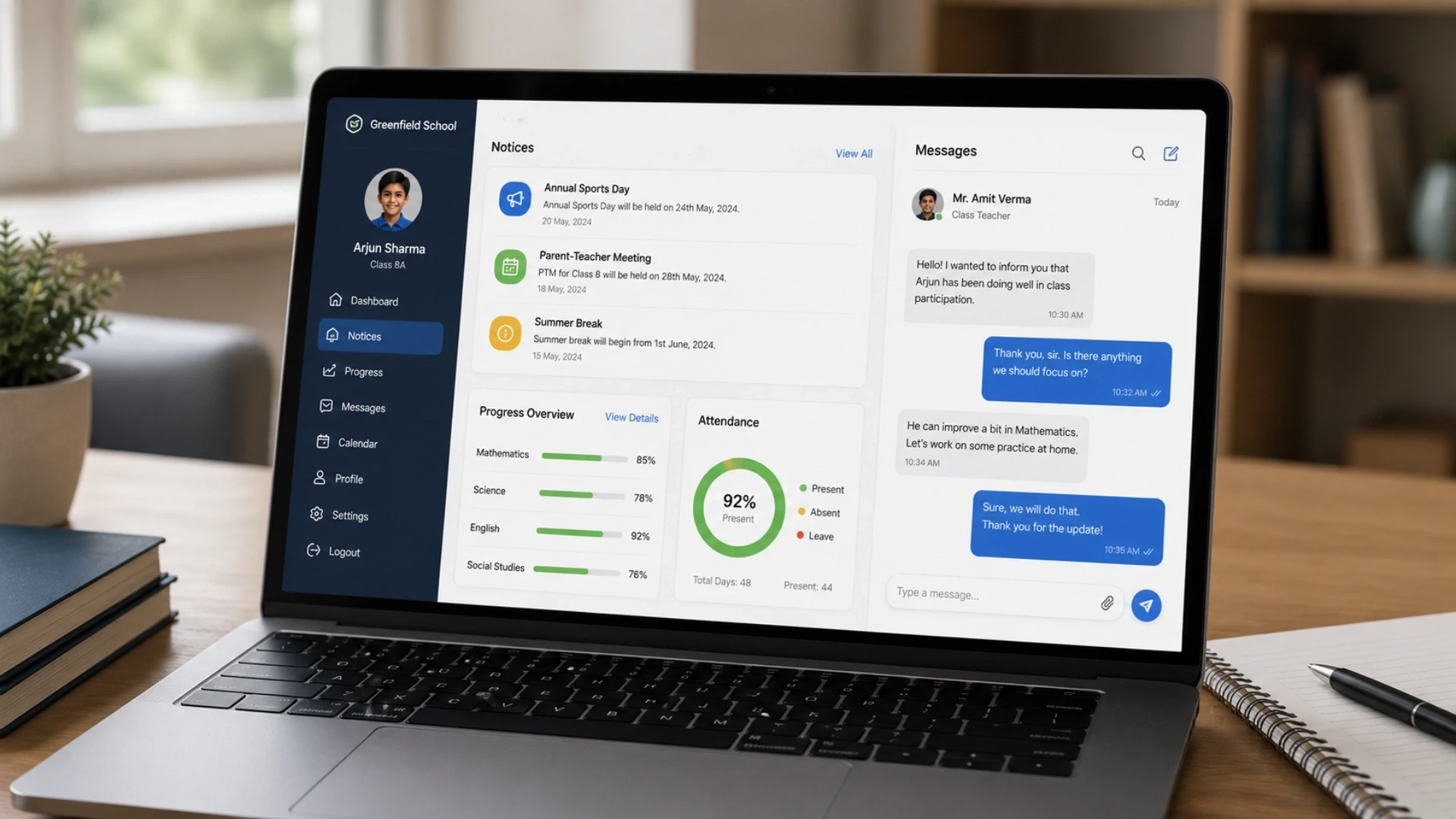
The communication layer pushes the right information to the right parent at the right time: attendance alerts, grade updates, fee reminders, homework, announcements, and meeting scheduling, mostly through a mobile app. Because parents live on their phones, the parent portal is usually a native or cross-platform app rather than a web page they rarely open.
This is the module that decides whether parents perceive the school as modern or not, and it is the one most likely to fail quietly. Notifications that arrive late, in the wrong language, or for the wrong child erode trust fast. A reliable notification pipeline with delivery tracking and per-parent preferences is the real product here. Building the app side is the domain of a React Native mobile app team.
Scope the app around three roles from the start: parent, student, and teacher, each seeing only what their role allows. Many schools begin with a parent-only app and expand, and that staged delivery is well suited to a dedicated team of remote developers that stays through each release. The unpublished cluster guide
One app, three audiences
A single school mobile app serving parents, students, and teachers reduces cost and confusion, provided permissions are airtight. How real-time, low-latency communication is engineered is covered in our guide to building a virtual classroom platform, which shares the same messaging foundations.
A note from the Acquaint Softtech education team
We have watched schools run on five disconnected tools while staff rekeys the same student data three times and parents call the office for answers the software should already have. A school management system is not a website with a login; it is the school's system of record, and the student belongs at the center of it. Build the records layer right, treat privacy as architecture, ship the four modules people touch every day, and grow from there. Get that foundation correct and everything else, grades, fees, transport, analytics- slots in cleanly. - Manish Patel and the Acquaint Softtech Education Team
Student data privacy, FERPA, and security
A school management system holds some of the most sensitive data a family ever shares, so privacy and security are design requirements, not add-ons. In the US, grades, attendance, and demographics are education records governed by FERPA; younger students bring COPPA into scope; the EU adds GDPR; and India adds the DPDP Act.
The practical implication is that role-based access control, encryption at rest and in transit, audit logging, and data-retention rules belong in the architecture from the first sprint. Retrofitting them later is slow, expensive, and risky. For schools serving children under 13, the FTC's six-step COPPA compliance plan is a practical checklist for the consent, notice, and data-deletion controls your software must enforce.
Security work here is detailed and unglamorous: field-level permissions, secure document storage, breach monitoring, and safe data migration from whatever legacy system the school is leaving. That backend hardening is typically led by a Python and data engineering team, working alongside a legacy data migration team.
Privacy as a selling point
Schools increasingly choose vendors on data protection, not just features, so a platform that can show clean access logs and a defensible retention policy wins deals. How student data protection and compliance fit a full build is covered in the guide to developing e-learning and education software.
School management software cost and timeline

School management software cost depends on module count and customization, not student numbers. A focused first release covering records, admissions, attendance, grades, and a parent app typically runs from 25,000 to 70,000 dollars, while a full ERP with transport, library, exams, and analytics climbs higher. With Acquaint Softtech, these land up to 40 percent below Western agency rates.
The largest cost lever is scope discipline, the same five-layer sequencing from earlier. Build the records and operations layers first, get them in real use, then add academic and intelligence layers once the data is trusted. Schools that try to launch everything at once pay twice: once to build, once to rework. Controlling that scope is what makes a custom school system build in India cost-effective rather than open-ended.
Timelines follow the same logic. A first usable release is realistic in 10 to 16 weeks of focused sprints, with later modules layered on afterward. Teams that need to hire developers for a school ERP without a long recruitment cycle use IT staff augmentation to add vetted engineers fast, or a dedicated development team for the full build.
Scope | Indicative range | Timeline |
Core release (4 modules) | $25k to $45k | 10 to 16 weeks |
Extended ERP (8 modules) | $45k to $70k | 16 to 24 weeks |
Full platform + mobile + AI | $70k and up | 24 weeks and up |
How module-by-module budgeting works in practice, including hiring models, is covered in our Laravel developer hiring and cost guide, which shares real 2026 rates.
Want a cost plan for your school platform?
Acquaint Softtech scopes, builds, and maintains school management systems for education clients worldwide at $25 to $49 per hour, up to 40 percent below Western agency rates, with a 95 percent on-time sprint delivery rate.
Case study: a verified education platform build
The clearest proof that disciplined education builds work is a client who got a working, validated platform on schedule. This engagement, verified on Clutch with a 5.0 rating, shows an education portal taken from requirements to a live product handling courses, registration, payments, and administration.
Case Study: An Education Portal, Built and Validated
An online education company's learning and administration portal taken from concept to a live, validated product. | Verified on Clutch (5.0/5)
What the Client Needed
• An informative portal for students to browse and register for courses
• A custom administrative section to manage students, courses, and content
• Integration of Zoom, Stripe payments, and Accredible certificates
What Acquaint Delivered
→ Database architecture and a custom content management system
→ Course configuration, registration, and a flexible payment gateway
→ Built on Django, Python, and PostgreSQL, tested through to launch
“They delivered a high-quality project and provided top-notch support.”
Students could browse and register for courses without friction, the admin team managed everything from one console, and the engagement was rated 5.0 across quality, schedule, and cost by the company's Director.
What makes this strong proof is the outcome: a real education platform with registration, payments, and an administration layer, delivered on schedule and rated top marks. The same standard applies to every school management build by our education software product team. Schools that want the same engineers to stay through every module release choose a dedicated development team model, keeping platform knowledge in place as the system grows.
How to get started in the first 48 hours
Getting started is built for school and EdTech teams: a free consultation, a discovery workshop that scopes the modules and data model, then your first engineer deployed within 48 hours of brief, with no long procurement cycle. Everything is under an NDA from the first conversation.
The discovery phase is where a wish list becomes a plan. Mapping the student record, the role model, and the first four modules before any code is written is the single highest-return step in the project, and it is the purpose of our workshop services.
From there, the build runs in two-week sprints with working software at the end of each, so administrators see the system take shape and can adjust scope early. Teams that need to scale capacity mid-build add engineers through IT staff augmentation services without restarting the hiring clock.
Build records first, then grow
Start with the records and operations layers, get them into daily use, then layer on academics, communication, and analytics. How this fits the whole education technology landscape is covered in our complete guide to EdTech software development in 2026.
Build a school platform your staff and parents actually trust.
1,300+ projects. 70+ in-house engineers. 4.9/5 Clutch from 61 verified clients. Official Laravel Partner. Your first engineer deploys within 48 hours of brief and stays from the first module through full rollout.
Frequently Asked Questions
-
What is a school management system?
A school management system is software that helps schools manage admissions, student records, attendance, grades, fees, and parent communication from one platform. It improves efficiency by centralizing all school operations in a single system.
-
What are the core modules of a school ERP?
The core modules of a school ERP include student records, admissions, attendance, grades, fee management, timetables, and parent communication. Advanced systems may also include transport, library, examination, and analytics modules.
-
How much does it cost to build a school management system?
A basic school management system typically costs between $25,000 and $70,000, while a fully customized ERP costs more depending on features and integrations. The final cost mainly depends on project complexity and customization requirements.
-
How long does it take to build a school management system?
A basic school management system can usually be built in 10 to 16 weeks, while a complete ERP may take 24 weeks or more. Development timelines vary based on the number of modules and custom features required.
-
How do you digitize school administration?
Schools can digitize administration by moving admissions, student records, attendance, fees, and academic processes to a digital platform. This reduces manual work and improves data accuracy across departments.
-
Is it better to build a custom school management system or buy off-the-shelf software?
Off-the-shelf software is faster to deploy, while a custom school management system provides greater flexibility and scalability. A custom solution can be tailored to match a school's unique workflows and requirements.
-
How do you keep student data secure and FERPA compliant?
Student data can be secured through role-based access control, encryption, audit logs, and secure storage practices. These measures help schools protect sensitive information and meet FERPA compliance requirements.
-
How does Acquaint Softtech build school management systems?
Acquaint Softtech builds school management systems using a discovery phase, agile development, and two-week sprint cycles. This approach ensures faster delivery, regular updates, and a solution tailored to the school's needs.
I lead technology and client success at Acquaint Softtech with one goal in mind. Deliver work that feels personal, reliable, and worthy of long term trust. I stay close to both our clients and our developers to make sure every project moves with clarity, quality, and accountability.
Table of Contents
Get Started with Acquaint Softtech
- 13+ Years Delivering Software Excellence
- 1300+ Projects Delivered With Precision
- Official Laravel & Laravel News Partner
- Official Statamic Partner
Related Blog

The Complete Guide to EdTech Software Development in 2026
Complete guide to EdTech software development in 2026. LMS architecture, virtual classroom tech stack, AI tutoring system design, MVP timeline, and cost.

Acquaint Softtech
May 4, 2026
How Learning Management Systems Work
An LMS is not a video library with a login screen. It is a structured system that owns enrollment, progress, assessment, and certification in one traceable architecture. Teams that treat it as a file folder spend 12 months rebuilding what should have been designed correctly in week one. This guide shows exactly how each layer works, and what it actually costs to build.
Manish Patel
May 13, 2026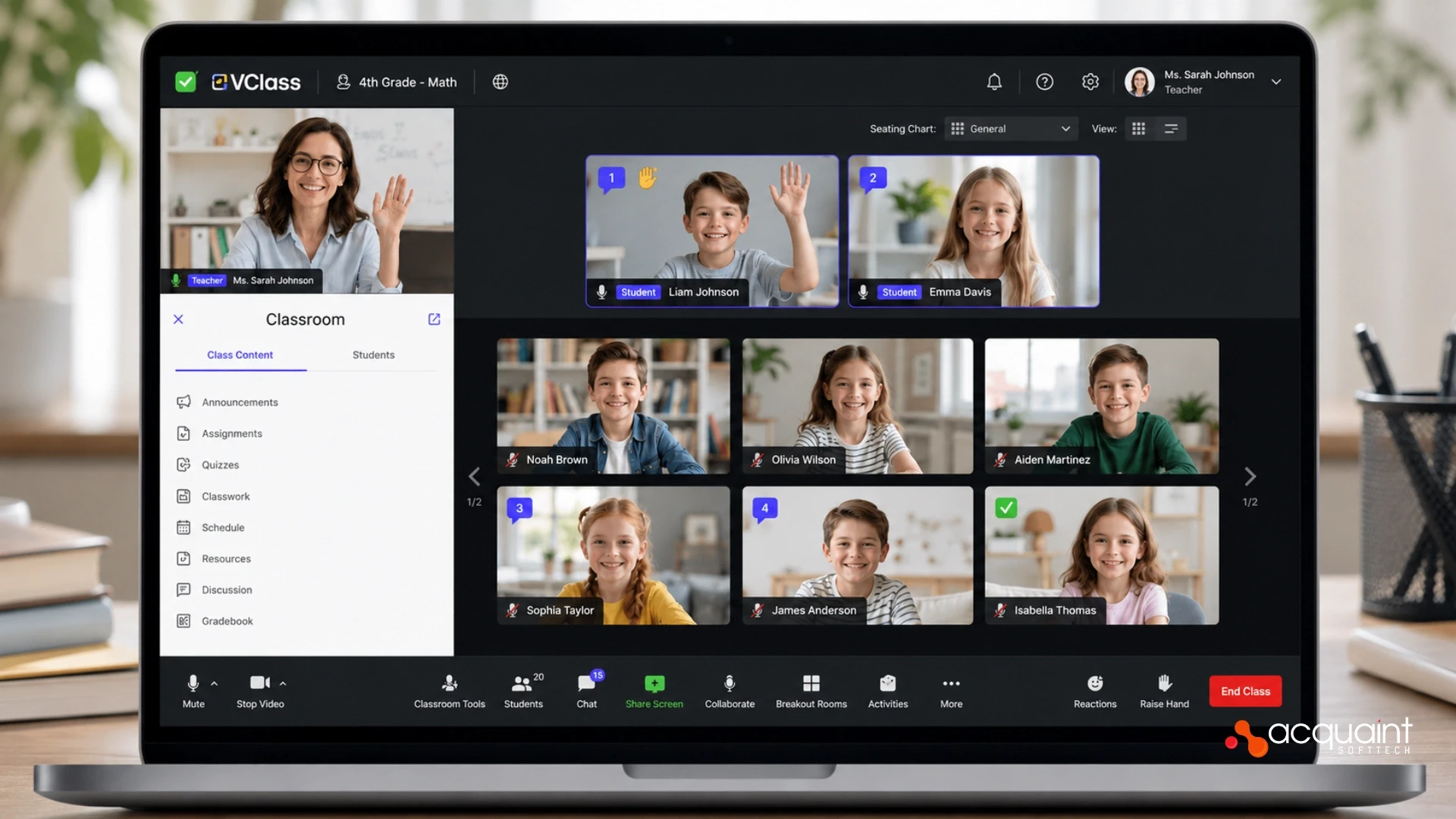
Building a Virtual Classroom Platform: Video, Whiteboard, Breakout Rooms, and Attendance Tracking
A virtual classroom is not a Zoom call with a class roster. It is a purpose-built live learning environment where video, whiteboard, breakout rooms, session recording, and attendance verification are engineered to work together as a single platform. Teams that build each feature independently spend 8 to 14 months in integration loops. Teams that design the architecture correctly from the start ship in 4 to 6 months. This guide shows you how.
Manish Patel
May 20, 2026India (Head Office)
203/204, Shapath-II, Near Silver Leaf Hotel, Opp. Rajpath Club, SG Highway, Ahmedabad-380054, Gujarat
USA
7838 Camino Cielo St, Highland, CA 92346
UK
The Powerhouse, 21 Woodthorpe Road, Ashford, England, TW15 2RP
New Zealand
42 Exler Place, Avondale, Auckland 0600, New Zealand
Canada
141 Skyview Bay NE , Calgary, Alberta, T3N 2K6