

What Is a Software Discovery Phase, What Does It Cost, and Why Skipping It Fails
Companies that skip the software discovery phase spend 40 to 60% more on development. Here is what the phase includes, what it costs, and what skipping it actually costs you.

Mukesh Ram
After 13 years and 1,300+ projects at Acquaint Softtech, a software development partner, the pattern is consistent: companies that invest in a structured discovery phase before development begins overspend on development at a rate 40 to 60% lower than companies that skip it. The discovery phase is not a premium service or an optional extra. It is the investment that makes every other investment in the project more accurate and less wasteful.

- Founders preparing to commission software development for the first time
- CTOs who have been through a development project that went significantly over budget
- Product managers building the case internally for a discovery investment before the main build
- Technical leads evaluating whether a discovery phase is justified for their current project scope
The most common objection to the discovery phase is timing. Founders and product leads want to start building. Every week in discovery feel like a week of delay. The data consistently shows the opposite: a 3 to 4 week discovery phase produces a development timeline that is 20 to 35% shorter than the same project started without one, because the rework cycles that consume time in the development phase are addressed before development begins.
The discovery phase is also the step that turns a brief into a buildable specification. The software development brief framework covers the 7 sections that produce a complete brief. A good brief is the input to discovery. A discovery phase turns that brief into architecture decisions, scope boundaries, technology recommendations, and a realistic cost estimate with a defensible range.
What a Software Discovery Phase Actually Includes
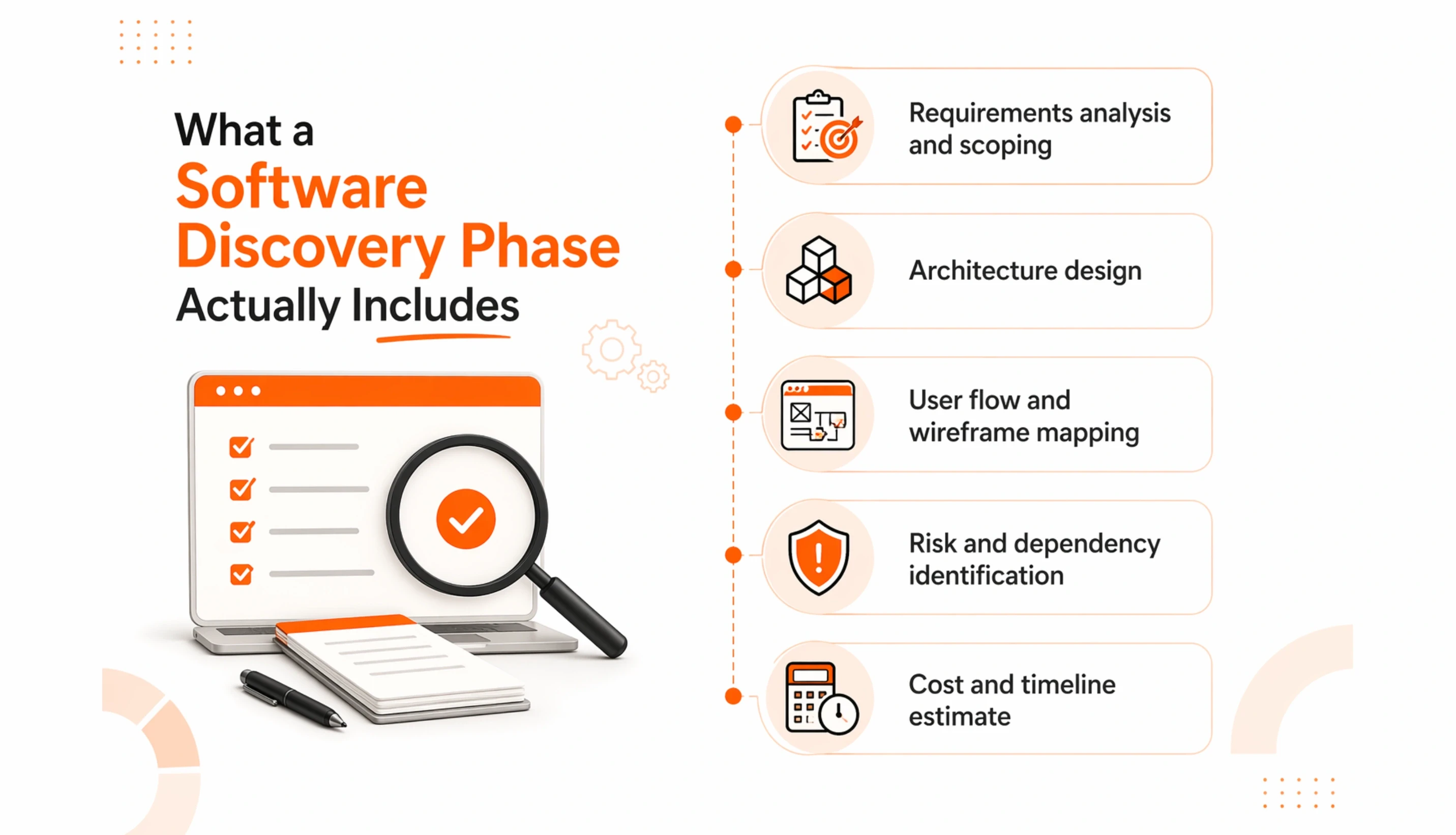
The label 'discovery phase' is applied to a range of activities by different vendors. Here is what a structured discovery phase at Acquaint Softtech includes and what each component produces.
Requirements analysis and scoping |
The team reviews the client brief and interviews product stakeholders to establish what the system must do, what it must not do, and what the priority order is for delivery. Output: a scoped feature list with acceptance criteria for each priority-1 item. |
Architecture design |
The technical lead proposes the system architecture: technology stack, data model, integration points, authentication approach, and deployment architecture. The client reviews and approves before any development code is written. Output: a documented architecture decision record. |
User flow and wireframe mapping |
Key user journeys are mapped as flows and low-fidelity wireframes. This step surfaces UX assumptions that often cause rework in the development phase. Output: user flow diagrams and wireframes for all primary journeys. |
Risk and dependency identification |
The team identifies third-party dependencies, regulatory requirements, integration risks, and scope items that could expand unexpectedly. Each risk is rated by probability and impact. Output: a risk register with mitigation recommendations. |
Cost and timeline estimate |
With scope, architecture, and risks defined, the team produces a development cost estimate with a high and low range. The range width is a measure of remaining scope uncertainty. Output: a defensible cost estimate with explicit assumptions. |
Acquaint Softtech's discovery workshop service covers all five components above in a structured 2 to 4 week engagement. The output is a complete discovery pack: scoped feature list, architecture decision record, wireframes for primary flows, risk register, and a cost estimate with assumptions. This pack is sufficient to go out to multiple vendors for comparable development quotes, or to begin development immediately with Acquaint Softtech as the delivery partner.
Ready to Start With Discovery Before Development? Here Is What It Looks Like.
Acquaint Softtech's discovery workshops run 2 to 4 weeks depending on project complexity. You receive: a scoped feature list, architecture proposal, wireframes for primary flows, risk register, and a development cost estimate. The investment is 5 to 10% of your total development budget. The return is a 40 to 60% reduction in development overspend.
What a Discovery Phase Costs in 2026
Discovery phase investment is typically calculated as a percentage of the total development budget. The ranges below reflect Acquaint Softtech's standard discovery workshop pricing for common project types.
Project type | Typical dev budget | Discovery investment | Discovery timeline |
MVP or first product | $30K to $80K | $2,500 to $5,000 | 2 weeks |
SaaS platform (full featured) | $80K to $200K | $6,000 to $15,000 | 3 to 4 weeks |
Enterprise application | $150K to $500K+ | $12,000 to $30,000 | 4 to 6 weeks |
Internal tool or integration | $15K to $50K | $1,500 to $4,000 | 1 to 2 weeks |
What the discovery investment prevents Architecture rework: the most expensive mid-project problem. Typically $15,000 to $60,000 to fix. Scope misalignment: building the wrong features. Typically 20 to 35% of development budget wasted. Timeline overrun: most projects without discovery run 30 to 50% over initial timeline estimates. Vendor comparison apples to oranges: without a scoped spec, vendor quotes are not comparable.
The discovery investment of 5 to 10% of budget prevents overspend of 40 to 60% of budget. This is not a marketing statistic. It is the pattern across 1,300+ projects at Acquaint Softtech. |
For projects where internal technical leadership is not available to lead the discovery process, Acquaint Softtech's virtual CTO services provide the architecture and strategy function during discovery and can remain engaged as a technical advisor through the development phase. This combination, virtual CTO for discovery and a dedicated team for development, covers both the strategy and delivery layers without the full-time hire.
Not Sure What Discovery Would Cost for Your Specific Project?
Send me a brief description of what you are building and the approximate total development budget you are working with. I will tell you what the discovery investment looks like for your project type and what the output would include. This conversation takes 15 minutes.
Why Skipping the Discovery Phase Fails
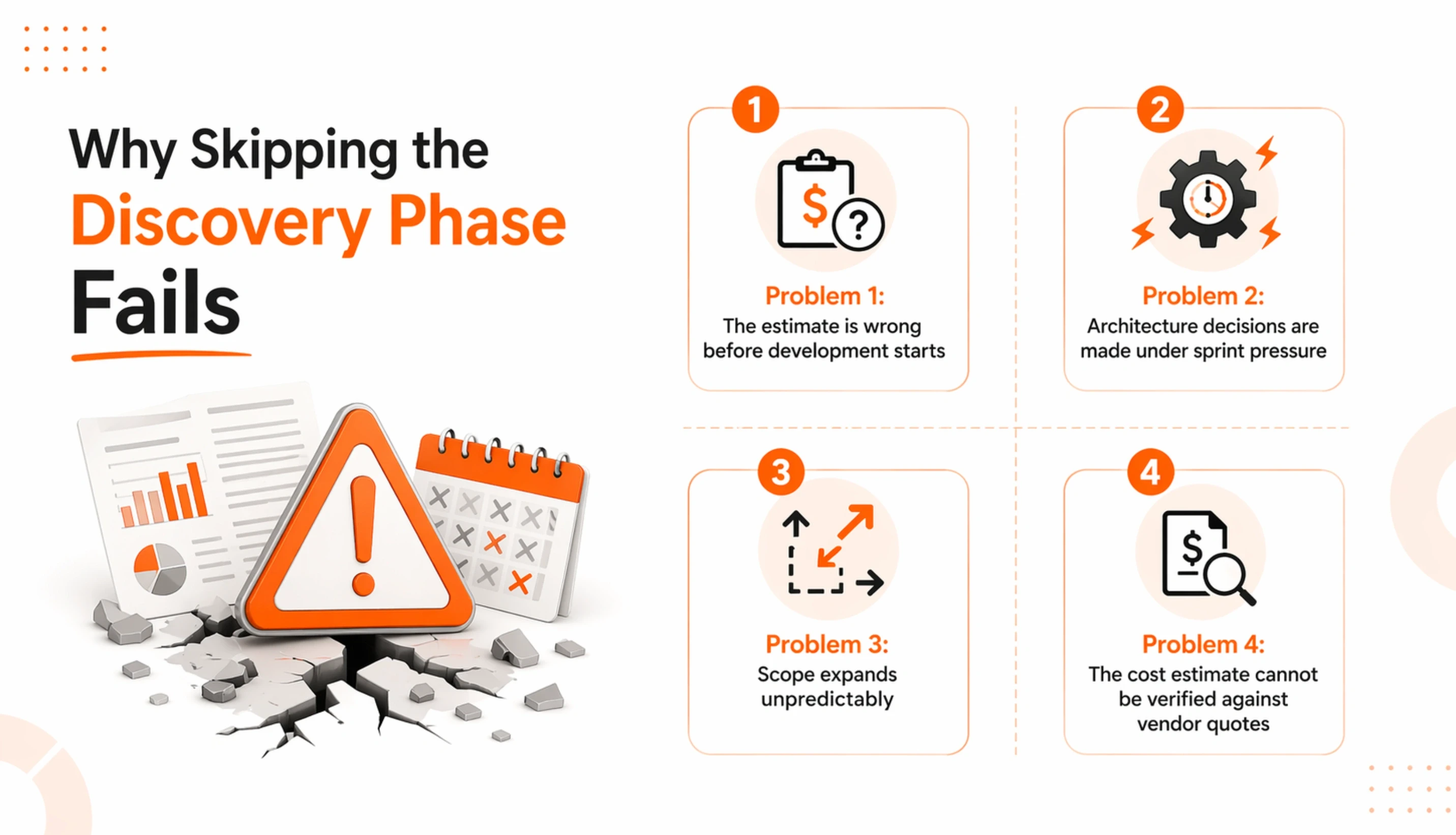
The companies that skip discovery almost always do so for the same reason: they believe starting development faster produces faster results. The data does not support this. What skipping discovery actually produces are four specific, expensive problems that appear in development rather than before it.
Problem 1: The estimate is wrong before development starts |
Without a discovery phase, the development cost estimate is based on a brief rather than a specification. Briefs leave architecture decisions, scope boundaries, and integration requirements undefined. Vendors price these unknowns with a contingency. When the contingency runs out and the unknowns materialise, the client pays for them as change requests. A project quoted at $60,000 without discovery commonly runs to $90,000 to $100,000 by the time it ships. |
Problem 2: Architecture decisions are made under sprint pressure |
Without a documented architecture decision record, the developer on the first sprint makes the architecture choices that will constrain every subsequent sprint. These decisions, made quickly to get development moving, often cannot be reversed without rebuilding significant parts of the system. Acquaint Softtech has inherited multiple projects where the architecture decisions made in the first two sprints cost more to undo than the entire original discovery phase would have cost. |
Problem 3: Scope expands unpredictably |
Without a scoped feature list with explicit out-of-scope items, scope expansion is frictionless. Every stakeholder conversation generates new requirements. Each new requirement is a change request. Without a defined scope baseline, the client cannot distinguish between a legitimate addition and a cost that should have been in the original estimate. Projects without a discovery scope baseline commonly expand to 140 to 180% of their original feature estimate. |
Problem 4: The cost estimate cannot be verified against vendor quotes |
Without a specification, vendor quotes are not comparable. One vendor prices against their narrow interpretation of the brief. Another prices against a generous interpretation. The $40,000 quote and the $95,000 quote are not quoting the same product. The client cannot tell which is accurate. A discovery phase produces a specification that multiple vendors can quote against, making the quotes comparable and the decision evidence-based. |
For projects planning to outsource development after discovery, the SaaS product outsourcing guide covers the governance structure that keeps the development phase on track once discovery produces the specification. And for the team structure decision, our software product development service covers the full product engineering model from discovery through launch.
What Discovery Looks Like Week by Week at Acquaint Softtech
The following is the standard discovery workshop structure for a medium-complexity SaaS product. The specific duration and deliverable set adjusts based on project scope. This is what client should expect at each stage.
Week 1: Requirements and stakeholder sessions | 2 to 3 structured sessions with product owners, technical leads, and key stakeholders. Requirements are documented as user stories with acceptance criteria. Conflicting priorities are surfaced and resolved. Output: prioritised feature list with acceptance criteria for all priority-1 and priority-2 items. |
Week 1 to 2: Architecture design | Technical lead designs the system architecture based on requirements. Options are presented with trade-offs for client review. The client approves the architecture before wireframing begins. Output: architecture decision record with stack selection, data model outline, and integration map. |
Week 2 to 3: User flow and wireframe production | Primary user journeys are mapped as flows. Low-fidelity wireframes are produced for all primary screens. These are not design deliverables. They are specification tools that reveal UX assumptions before they become development rework. Output: user flow diagrams and wireframes for 100% of primary journeys. |
Week 3 to 4: Risk assessment and cost estimation | The team identifies risks, rates them, and documents mitigations. The cost estimate is built from the architecture and scoped feature list. Assumptions are documented explicitly. Output: risk register and cost estimate with high and low ranges. |
For ongoing development after discovery, Acquaint Softtech's dedicated development teams provide the sustained delivery structure. The discovery pack becomes the onboarding document: the architecture decision record, scoped feature list, and wireframes give the development team the context to reach full sprint velocity significantly faster than teams starting without a discovery phase.
For teams deciding which pricing model to use for the development phase after discovery, the engagement pricing models guide covers when monthly retainers, time-and-materials, and fixed-price contracts each make sense. A well-scoped discovery output makes the fixed-price model viable, since the scope uncertainty that makes fixed-price risky has been largely eliminated.
Ready to Start With Discovery? Acquaint Softtech Runs 2 to 4 Week Discovery Workshops.
You receive a complete discovery pack: scoped feature list, architecture decision record, wireframes for primary flows, risk register, and a development cost estimate with assumptions. The pack is yours to use with any vendor or to begin development with Acquaint Softtech directly. Tell me what you are building.
Frequently Asked Questions
-
What is included in a software discovery phase?
A structured discovery phase includes: requirements analysis and scoping, architecture design, user flow and wireframe mapping, risk and dependency identification, and a cost and timeline estimate. Each component produces a specific deliverable. Together they produce a specification complete enough to compare vendor quotes and begin development with confidence.
-
Why do software projects fail without a discovery phase?
Without discovery, architecture decisions are made under sprint pressure rather than before development begins, scope boundaries are undefined so requirements expand unpredictably, and the cost estimate is based on a brief rather than a specification. The compounding cost of these three conditions typically adds 40 to 60% to the total development budget.
-
How do I convince a board or finance team to invest in discovery?
Present the maths: discovery at 5 to 10% of budget reduces development overspend by 40 to 60%. On a $100,000 development budget, $7,000 in discovery prevents $40,000 to $60,000 in overspend. Add the secondary argument: without discovery, vendor quotes are not comparable, which means the selection decision is based on incomplete information.
-
How do I run a software discovery phase without an internal technical lead?
Engage a vendor or technical advisor to lead the discovery. Acquaint Softtech's virtual CTO service provides the architecture and strategy function for discovery without a full-time hire. Alternatively, the discovery workshop service covers all five components with Acquaint Softtech as the technical lead throughout the engagement.
-
How long does a software discovery phase take?
For most business software projects, 2 to 4 weeks. Simpler projects such as internal tools or MVPs typically complete in 1 to 2 weeks. Complex enterprise or multi-integration platforms may require 4 to 6 weeks. The timeline depends primarily on stakeholder availability for requirements sessions and the number of third-party integrations that need to be mapped.
-
How much should a software discovery phase cost?
Discovery investment is typically 5 to 10% of the total development budget. For an MVP with a $50,000 development budget, discovery runs $2,500 to $5,000. For a full SaaS platform at $150,000, discovery runs $8,000 to $15,000. Acquaint Softtech's discovery workshop pricing is within this range for all standard project types.
-
Is a discovery phase the same as a proof of concept?
No. A discovery phase produces a specification: architecture decisions, scoped features, wireframes, risk register, and a cost estimate. A proof of concept produces working code that validates a technical assumption. Discovery comes before development and informs it. A proof of concept is a form of early development that tests feasibility. Some projects need both; most projects need discovery and do not need a proof of concept.
I love to make a difference. Thus, I started Acquaint Softtech with the vision of making developers easily accessible and affordable to all. Me and my beloved team have been fulfilling this vision for over 15 years now and will continue to get even bigger and better.
Table of Contents
Get Started with Acquaint Softtech
- 13+ Years Delivering Software Excellence
- 1300+ Projects Delivered With Precision
- Official Laravel & Laravel News Partner
- Official Statamic Partner
Related Reading
Fixed Price vs Time and Material vs Dedicated Team
Fixed price, time and material, dedicated team. Every software development engagement is one of these three. Choosing the wrong one costs more than choosing the right vendor at the wrong rate.

Manish Patel
April 27, 2026
Statamic vs WordPress 2026: Which CMS Should Your Business Use?
WordPress powers 43% of the web. Statamic is the CMS that the other 57% of developers wish they had used. Here is the full comparison for 2026 and the situations where each one is the right answer.

Ahmed Ginani
April 27, 2026
How to Outsource SaaS Product Development Without Losing Control
The fear of losing control is the main reason founders delay outsourcing SaaS development by 6 to 12 months. Here are the 6 mechanisms that keep you in charge of product direction while a vendor manages delivery.
Mukesh Ram
April 20, 2026India (Head Office)
203/204, Shapath-II, Near Silver Leaf Hotel, Opp. Rajpath Club, SG Highway, Ahmedabad-380054, Gujarat
USA
7838 Camino Cielo St, Highland, CA 92346
UK
The Powerhouse, 21 Woodthorpe Road, Ashford, England, TW15 2RP
New Zealand
42 Exler Place, Avondale, Auckland 0600, New Zealand
Canada
141 Skyview Bay NE , Calgary, Alberta, T3N 2K6