

Fixed Price vs Time and Material vs Dedicated Team
Fixed price, time and material, dedicated team. Every software development engagement is one of these three. Choosing the wrong one costs more than choosing the right vendor at the wrong rate.

Manish Patel
Which Engagement Model Is Right for Your Project?
As COO of Acquaint Softtech, a software development partner with 1,300+ projects across 13 years, I have structured engagements across all three of the major contracting models. The model decision matters more than most companies realise. Choosing the wrong model for your project stage adds cost, friction, and misaligned incentives that persist throughout the engagement. This article maps each model to the situations where it works and where it does not.

- Founders and CTOs comparing vendor proposals and trying to understand why rates differ so much
- Product managers scoping an engagement and not sure which model to specify in the brief
- Engineering leads who have been on a fixed-price project that went over budget and want to understand why
- Finance leaders evaluating development spend and looking for the model with the most predictable total cost
Most conversations about engagement models get stuck on the rate. The model decision is more important than the rate. A fixed-price contract at $80/hr with a 40% scope contingency costs more than a time-and-materials engagement at $90/hr when the scope is well-defined and delivered accurately. The model determines the vendor incentive structure, the risk allocation, and how scope change are handled. Getting the model wrong for your situation creates friction that rate negotiation cannot fix.
The staff augmentation pricing models guide covers the specific pricing mechanics behind each model. This article covers the strategic question: which model fits your project stage, your team structure, and your risk tolerance.
The Three Models: Plain-Language Definitions
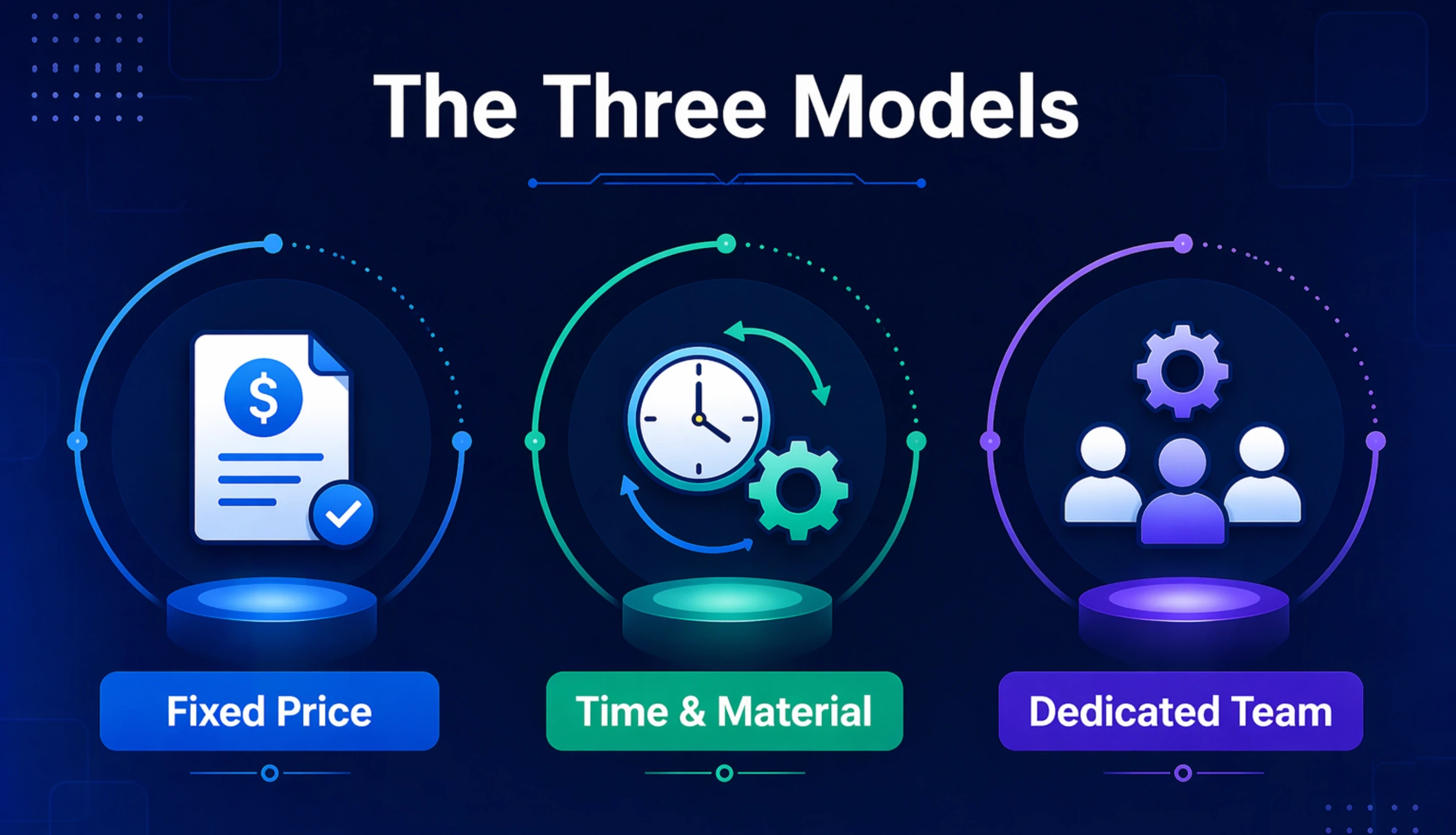
Before comparing them, a clear definition of what each one actually means in practice.
Model A: Fixed Price
Best for: Well-defined, stable scope. One-time deliverables. Projects where requirements will not change. |
Not for: Evolving requirements. Ongoing product development. Any project where what needs to be built will change after work begins. |
Cost structure: Single agreed total. Scope changes trigger formal change orders. Vendor builds a contingency into the price. |
Primary risk: Scope creep: requirements that expand past the contract generate expensive change requests. Under-scoped contingency: vendor loses money and cuts corners. |
Client control: High on deliverable, low on process. You define what, vendor defines how and when. |
Model B: Time and Materials (T&M)
Best for: Unclear or evolving scope. Research-heavy projects. Prototyping and discovery phases. |
Not for: Budget-sensitive projects where cost predictability is critical. Long-term engagements where a retainer is more efficient. |
Cost structure: Hourly or daily rate. Invoice reflects actual time worked. Budget is an estimate, not a ceiling. |
Primary risk: Budget overrun: without strong scope management, T&M engagements drift. Management overhead: client must monitor hours actively. |
Client control: High. Client directs work hour by hour. Vendor has no incentive to be efficient. |
Model C: Dedicated Team (Monthly Retainer)
Best for: Ongoing product development. SaaS platforms. Engagements over 3 months where institutional knowledge compounds in value. |
Not for: One-time deliverables. Short, clearly-scoped projects where the ramp-up cost of a team is not justified. |
Cost structure: Fixed monthly rate for full-time developer capacity. Rate is predictable. Output varies by sprint priorities. |
Primary risk: Misuse: paying retainer rates for work that could be scoped as a fixed project. Low initial output if onboarding is not structured. |
Client control: High. Client sets sprint priorities. Vendor manages team execution. |
The Acquaint Softtech dedicated software development teams model operates as a monthly retainer. The client owns product direction and sprint priorities. Acquaint Softtech manages team composition, performance, and continuity. This structure is specifically designed for SaaS products and ongoing development programmes where institutional knowledge compounds over time.
Not Sure Which Model Fits Your Project? Let Us Map It.
Tell me your project scope, team structure, and how defined your requirements are. I will tell you which of the three models fits your situation and what the engagement structure looks like. This conversation takes 15 minutes.
Side-by-Side Comparison
The key dimensions that determine which model fits your situation.
Dimension | Fixed Price | Time and Materials | Dedicated Team |
Who defines scope | Client defines fully before start | Client defines progressively | Client defines per sprint |
Budget predictability | High (total agreed upfront) | Low (estimate only) | High (monthly rate fixed) |
Scope flexibility | Low (changes = change orders) | High (any change accommodated) | High (sprint priorities shift freely) |
Vendor incentive | Deliver scope within budget | Bill hours | Retain client relationship |
Best project duration | Under 3 months | 1 to 4 months | 3 months to multi-year |
Management overhead | Low (deliverable defined) | High (hours must be monitored) | Low (sprint direction only) |
Risk holder | Split (scope: client, delivery: vendor) | Client (cost overrun risk) | Vendor (team performance risk) |
Right when | Scope is 100% defined | Scope is uncertain or early-stage | Product needs sustained development |
The 4 Questions That Map Your Situation to the Right Model
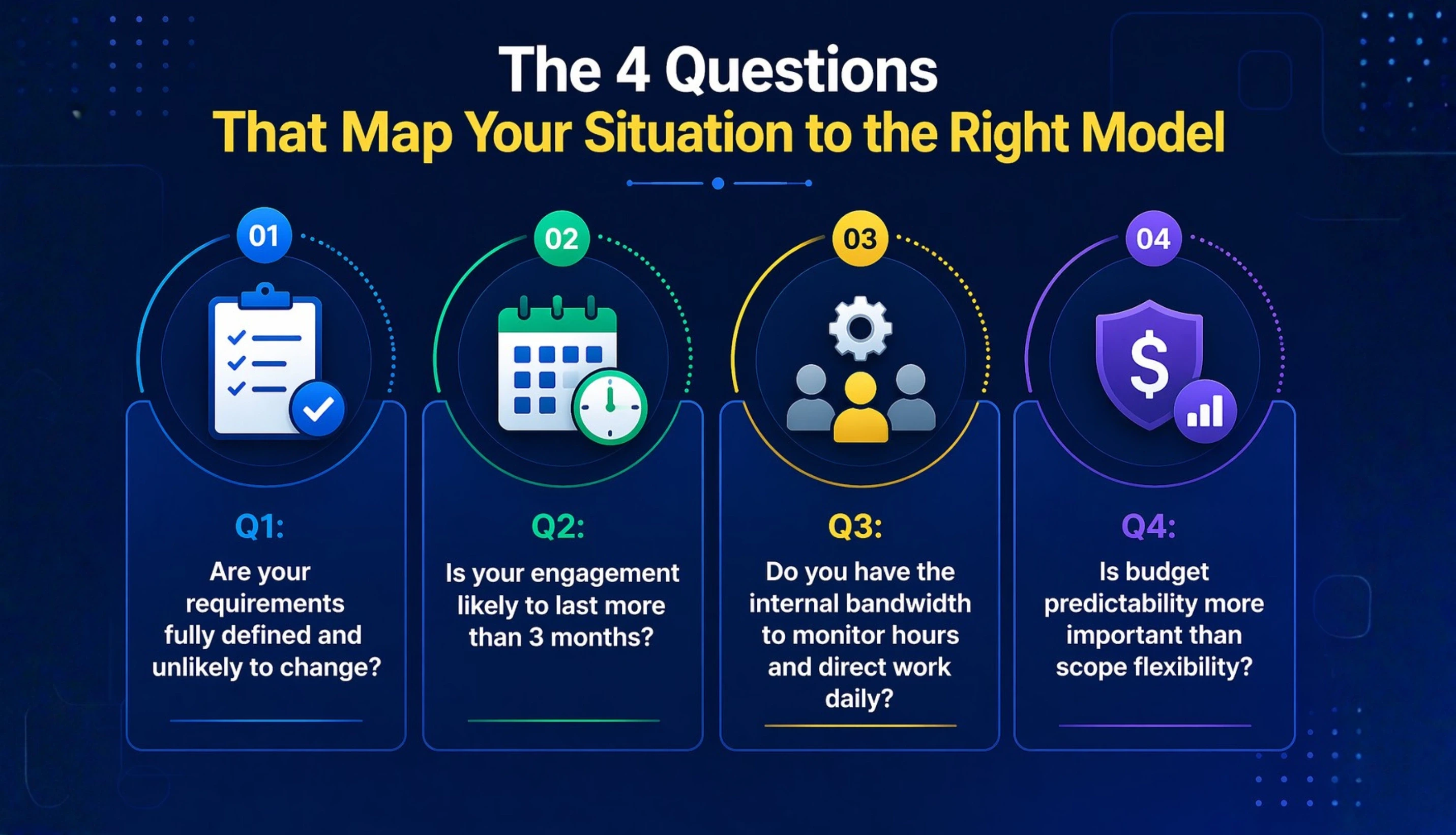
Answering these 4 questions in order produce a clear model recommendation for most projects. Edge cases exist, but for 90% of software development engagements, this framework resolves the choice.
Q1: Are your requirements fully defined and unlikely to change? |
Answer: Yes: fixed price is viable. No: fixed price is not viable. Proceed to Q2. |
This is the first filter. A fixed-price contract on evolving requirements is not a fixed-price contract in practice. It is a variable-price contract with formal change order friction on top. |
Q2: Is your engagement likely to last more than 3 months? |
Answer: Yes: dedicated team. No: consider T&M or fixed price depending on scope clarity. |
The dedicated team model produces its cost advantage through institutional knowledge accumulation. Below 3 months, the onboarding investment does not produce enough compounding return to justify the structure. |
Q3: Do you have the internal bandwidth to monitor hours and direct work daily? |
Answer: Yes: T&M is manageable. No: T&M creates management overhead that erodes the flexibility benefit. |
Time-and-materials gives maximum flexibility but maximum management responsibility. The client must actively direct and audit. Without this bandwidth, T&M drifts. |
Q4: Is budget predictability more important than scope flexibility? |
Answer: Predictability: fixed price or dedicated team. Flexibility: T&M. |
A monthly retainer gives both: fixed monthly cost with flexible sprint priorities. This is why the dedicated team model is the most common structure for ongoing product development. |
Before any engagement model can work, the brief that goes to vendors must be clear enough to produce comparable proposals. The software development brief framework covers the 7 sections that produce accurate proposals regardless of which model the vendor quotes against.
Know Which Model Fits? Here Is What the Engagement Structure Looks Like.
Share your project scope, stage, and which model you are leaning toward. Acquaint Softtech will confirm whether the model fits and send a proposed engagement structure with rates within 48 hours.
The Most Expensive Mistakes in Each Model
Each model has a characteristic failure mode. Knowing which one your situation is vulnerable to is the most useful thing you can take from the model comparison.
Fixed Price: Scope creep without a change order process |
Requirements evolve. They always do. In a fixed-price contract without a clear change order process, the vendor interprets scope narrowly and the client feels they are not getting what they paid for. Every change negotiation erodes the relationship. The fix: define scope in writing before the contract, not in conversation. |
Time and Materials: Budget overrun from insufficient direction |
T&M gives the vendor no incentive to work efficiently. Without strong client direction and weekly hour reviews, T&M engagements exceed budget estimates by 30 to 60%. The fix: weekly budget tracking against progress, not just hour logging. |
Dedicated Team: Retainer used for project work that should be fixed-price |
A dedicated team retainer paid to deliver a one-time feature set is an expensive way to structure a project. The retainer model produces its value over time through accumulated context. Using it for short, defined deliverables pays the ramp-up cost without getting the compounding return. The fix: scope new discrete features as fixed-price add-ons within the retainer structure. |
For verifying that the vendor you choose can actually deliver on whichever model you select, apply the offshore due diligence checklist before signing. And if you are choosing between staff augmentation and a dedicated team as the delivery structure, our staff augmentation model covers how individual augmentation differs from a dedicated team structure.
When to Mix Models
Not every engagement is a single model from start to finish. The most effective structures often combine models across project phases.
Discovery phase: T&M or fixed | A time-boxed discovery phase (typically 2 to 4 weeks) on a T&M or small fixed-price basis clarifies requirements before the main engagement is structured. This prevents fixed-price scope errors and reduces the ramp-up cost of a dedicated team. |
Core development: dedicated team retainer | Once requirements are clear enough to direct sprint priorities, the monthly retainer structure gives the cost predictability and institutional knowledge accumulation that makes ongoing development efficient. |
Discrete features: fixed-price add-ons | New, well-defined feature sets within a retainer engagement can be scoped as fixed-price additions. The dedicated team builds them against a defined scope, with change orders applying only to genuine specification gaps. |
For deciding which specific team structure to use within whichever model you choose, the developer hiring decision tree covers the 12 questions that map your situation to the right structure. And if you are weighing the model choice against an in-house alternative, the in-house vs staff augmentation comparison covers the actual cost numbers side by side.
Ready to Start With the Right Model? Here Is What Engaging Acquaint Softtech Looks Like.
Fixed price, T&M, or dedicated team: Acquaint Softtech structures engagements across all three. Tell me your project scope and stage. I will send a proposed engagement structure and rate within 48 hours. No commitment before you see the terms.
Frequently Asked Questions
-
What is the difference between fixed price and time and material?
Fixed price means you pay an agreed total for a defined deliverable. Time and materials means you pay for actual hours worked, with the final cost depending on how long the work takes. Fixed price shifts delivery risk to the vendor; T&M shifts budget risk to the client.
-
Why do fixed-price software projects go over budget?
Scope creep is the most common cause: requirements evolve after the contract is signed, triggering change orders that add cost. The second cause is under-scoped contingency: the vendor priced too low to win the contract and cuts quality or requests additional budget when delivery pressure hits. Both are preventable with a well-defined scope and a clear change order process before signing.
-
When should I use a fixed-price contract for software development?
Use fixed price only when requirements are fully defined, documented, and unlikely to change during development. It works well for one-time deliverables, API integrations with a clear specification, and MVP builds with a locked feature set. For anything where requirements will evolve, fixed price creates expensive friction at every change.
-
How do I prevent time-and-materials engagements from going over budget?
Set a budget ceiling before the engagement starts and review hours against progress weekly, not monthly. Require the vendor to flag when they are at 70% of the budget estimate so there is time to redirect scope before the ceiling is hit. Active weekly direction is what makes T&M work.
-
Is a dedicated team cheaper than a fixed-price project?
For engagements over 6 months, a dedicated team retainer is typically 15 to 25% cheaper than fixed-price because it eliminates the scope contingency built into every fixed quote. For short, well-defined projects under 3 months, fixed price is usually more cost-efficient because the retainer's ramp-up cost is not recovered.
-
What does a dedicated team engagement cost per month?
At Acquaint Softtech, a dedicated team of 2 developers and a tech lead runs $9,500 to $14,000 per month. A team of 3 developers plus a tech lead runs $13,000 to $20,000 per month. These rates include all employer costs, equipment, and management overhead with no additional charges.
-
Is time and material better than a dedicated team for early-stage products?
For a product still in the requirements discovery phase, T&M is often more appropriate because it accommodates the scope uncertainty that would make a fixed-price contract inaccurate and a dedicated team's ramp-up cost premature. Once requirements are clear enough to direct sprint priorities consistently, the dedicated team retainer produces better value than hourly billing for the same work.
I lead technology and client success at Acquaint Softtech with one goal in mind. Deliver work that feels personal, reliable, and worthy of long term trust. I stay close to both our clients and our developers to make sure every project moves with clarity, quality, and accountability.
Table of Contents
Get Started with Acquaint Softtech
- 13+ Years Delivering Software Excellence
- 1300+ Projects Delivered With Precision
- Official Laravel & Laravel News Partner
- Official Statamic Partner
Related Reading

Why Offshore Development Fails: 7 Most Common Reasons and How to Avoid Each One
Offshore development fails for the same 7 reasons, repeatedly. None of them are about developer quality. All of them are about structure. Here is each one and the specific fix.

Ahmed Ginani
April 22, 2026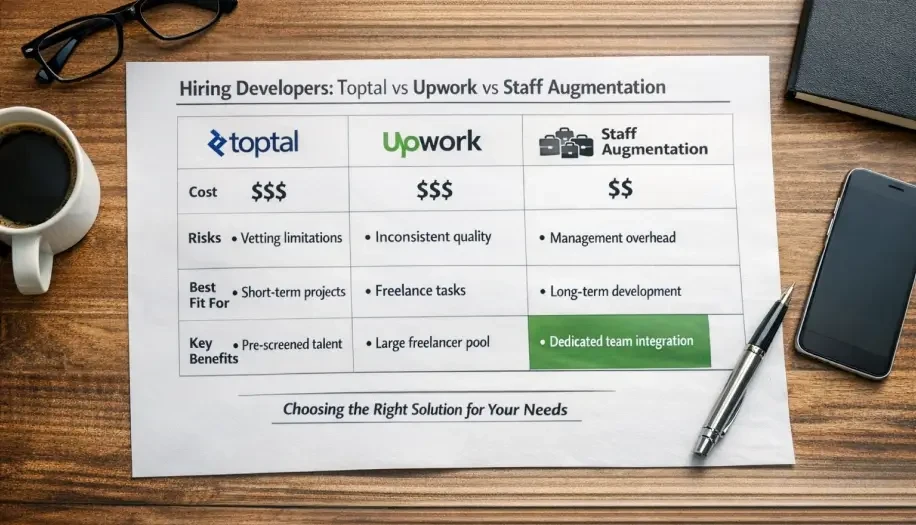
Toptal vs Upwork vs Staff Augmentation: An Honest CTO's Guide for 2026
Toptal, Upwork, and staff augmentation each solve a different problem. This honest vendor-side guide covers what each model actually costs, where each one breaks down, and which fits your situation.

Acquaint Softtech
March 16, 2026
Staff Augmentation vs Upwork vs Agency: Real Cost Breakdown for CTOs in 2026
Staff augmentation, Upwork, or a dev agency? The real cost difference in 2026 is bigger than most CTOs expect. Here are the actual numbers with zero fluff.
Acquaint Softtech
March 8, 2026India (Head Office)
203/204, Shapath-II, Near Silver Leaf Hotel, Opp. Rajpath Club, SG Highway, Ahmedabad-380054, Gujarat
USA
7838 Camino Cielo St, Highland, CA 92346
UK
The Powerhouse, 21 Woodthorpe Road, Ashford, England, TW15 2RP
New Zealand
42 Exler Place, Avondale, Auckland 0600, New Zealand
Canada
141 Skyview Bay NE , Calgary, Alberta, T3N 2K6