

Staff Augmentation Process: 7 Steps From Requirement to Onboarding
The staff augmentation process has seven steps: define the requirement, choose the model and partner, review matched profiles, interview and select, sign the contract and NDA, onboard into your team, and review, scale, or exit. With an experienced partner, a developer can start within 48 hours of confirmation. You manage their daily work; the partner manages employment.

Chirag Daxini
Most people picture staff augmentation as a single moment: you ask for a developer, and a developer appears. In reality, it is a short process with seven distinct steps, and the quality of each step decides whether the developer is productive in week one or still finding their feet in week six. That process is what clients actually buy when they choose our IT staff augmentation services, and it is what this guide walks through, step by step.
So what are the steps in staff augmentation? First, you define the requirement and the outcome you need. Second, you choose the engagement model and a partner. Third, the partner shares matched, pre-vetted profiles. Fourth, you interview and select. Fifth, you sign the contract and NDA. Sixth, the developer is onboarded into your team, tools, and rituals. Seventh, you review progress regularly and decide whether to scale, adjust, or end the engagement.

- You are about to augment your team and want to know exactly what happens, and when.
- You need realistic timelines from first call to a productive developer.
- You want clarity on who manages augmented developers day to day.
- You want to know which contract terms and onboarding steps protect you.
I have seen the same pattern across many engagements. When a client moves quickly through the early steps but skips the details, such as a vague requirement, a rushed contract, or access that arrives late, the delay simply moves downstream and shows up as slow onboarding. When the early steps are done properly, the later ones almost run themselves.
For each step below, you will find what happens, who does what, how long it typically takes, and the mistakes to avoid. At the end, there is a timeline, a clear split of who manages what, and a real engagement that followed this process.
EXPERT INSIGHT "The fastest augmentation engagements are not the ones with the fastest partner. They are the ones where the client has the outcome, the owner, and the access ready before the first profile arrives." Chirag Daxini, Acquaint Softtech |
What a Good Tailor Teaches About the Staff Augmentation Process

Think about how a good tailor makes a suit. They do not start by cutting cloth. They ask what the suit is for, take careful measurements, show you fabrics, and only then begin. There is a trial fitting before the final stitching, small adjustments after it, and the suit still gets altered later if your needs change.
The staff augmentation process follows the same rhythm. The requirement is the measurement: get it wrong and nothing that follows fits. Choosing the partner and reviewing profiles is choosing the fabric. The interview and the trial period are the fitting. Onboarding is the final stitching that turns a skilled stranger into part of your team. And the regular review is the alteration, because no team stays the same shape for long.
The lesson most people learn the hard way is that rushing the measurement saves an hour and costs weeks. The same is true here. The first step is the one most worth slowing down for.
What Are the Steps in Staff Augmentation?
Step | What happens | Typical timing |
Define the requirement | Skills, seniority, outcome, budget | Before first call |
Choose model and partner | Augmentation, dedicated team or other | A few days |
Review matched profiles | Pre-vetted developers shared | Within hours |
Interview and select | Technical and fit interviews | Day 1 |
Contract and NDA | Terms, IP, notice, replacement | Days 1 to 2 |
Onboard | Access, context, first task | Within 48 hours |
Review, scale or exit | Regular reviews against outcomes | 30 days and ongoing |
The detail behind each step follows.
Step One: Define the Requirement and the Outcome

Everything else depends on this step. A clear requirement tells the partner who to send, tells candidates what success looks like, and gives you something concrete to measure later.
What to define
The outcome: what must be true in 90 days, such as a feature shipped or a backlog cleared.
Skills and seniority: the technologies and whether you need someone who can work independently.
Duration and capacity: full-time or part-time, and for how long you expect to need them.
Working hours: the daily overlap you need with your team.
Budget: a realistic monthly or hourly range.
Internal owner: the person who will direct and review the developer's work.
Mistake to avoid
Sending a generic job description. "Senior Python developer" could mean a data engineer, a Django specialist or an AI engineer. One extra sentence about the outcome produces far better matches.
Step Two: Choose the Engagement Model and the Partner
Before choosing a partner, confirm that staff augmentation is the right model. It is the best fit when you have someone to direct the work and need skills or capacity quickly.
Model | Who directs the work | Best for |
Staff augmentation | You | Filling skill gaps quickly |
Dedicated team | You, with partner support | Long-term product work |
Project outsourcing | The partner | Fixed-scope builds |
What to check in a partner
Are developers full-time employees, or freelancers found after you sign?
How quickly can they share profiles, and can you interview before committing?
What happens if a developer is not the right fit or leaves?
What security certifications and IP terms do they offer?
If you need a whole team rather than individuals, with the partner taking on more coordination, consider dedicated software development teams instead.
Step Three: Review Matched Profiles

A good partner already employs vetted developers, so matching takes hours rather than weeks. You should receive a small number of relevant profiles, typically two or three, rather than a long list for you to filter.
What a good profile includes
Years of production experience and the technologies used in real projects.
Examples of similar work, such as the type of product or industry.
Availability, time zone, and working hours.
Communication level, ideally visible in the interview rather than claimed on paper.
Mistake to avoid
Choosing based on the profile alone. Profiles tell you what someone has done; the interview tells you how they think.
Step Four: Interview and Select
Interview every candidate yourself. The partner's vetting checks the baseline; your interview checks fit with your codebase, your team, and your way of working.
What a good interview covers
A production walkthrough: ask them to explain something they built, what went wrong, and what they changed.
A realistic task: a short exercise in your stack, not a puzzle unrelated to the work.
Communication: how clearly they explain decisions and ask questions.
Working style: how they use AI coding tools, handle reviews, and raise blockers.
Use the trial period
Where the partner offers a trial period, give the developer real work in the first week, not reading. Fit becomes visible quickly when the work is real.
Step Five: Sign the Contract and NDA
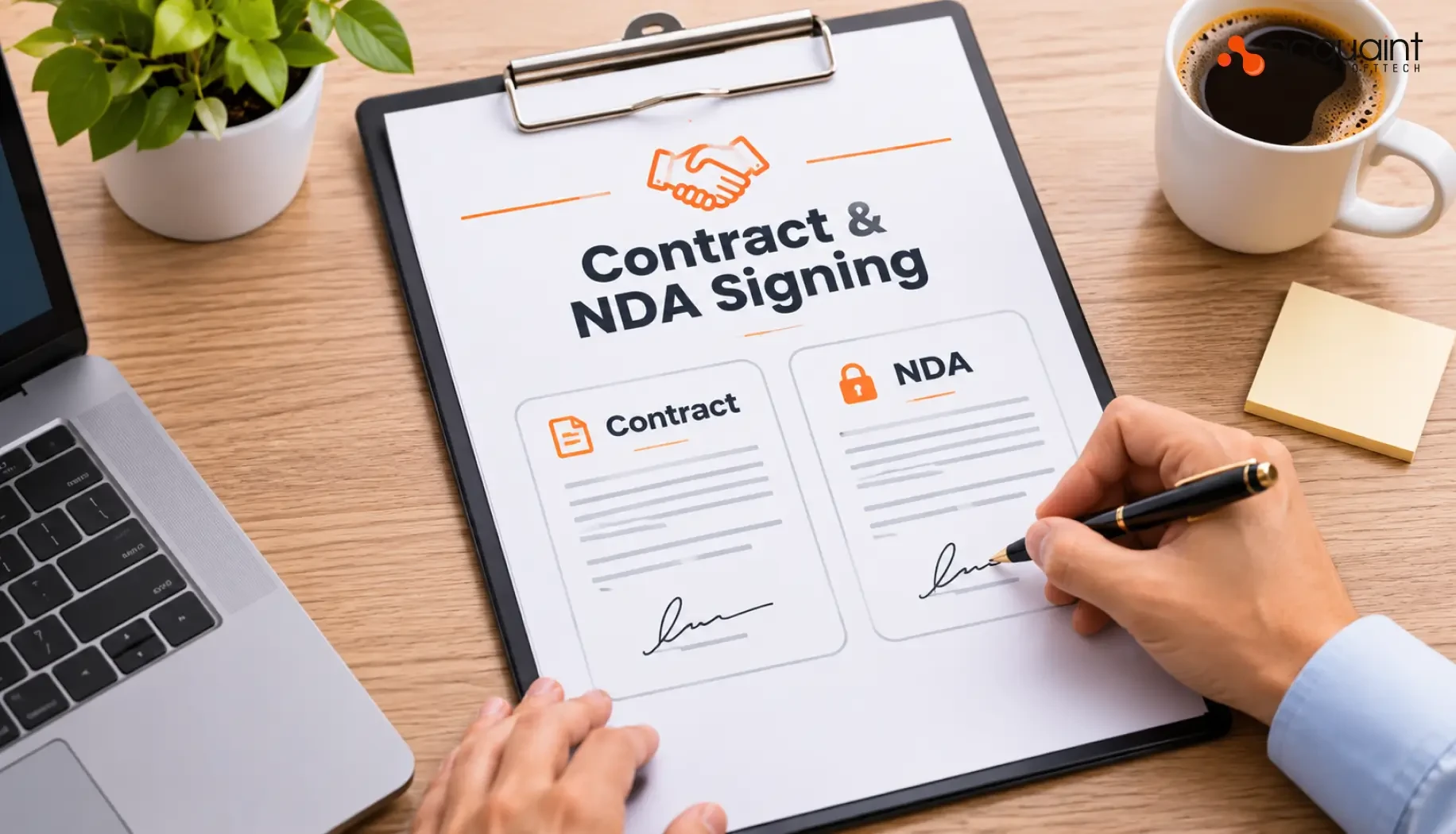
The contract is where most long-term problems are either prevented or created. Keep it simple, but make sure the essentials are covered before any code is shared.
Clause | What it should say |
NDA | Signed before any discussion of your code, data or plans |
IP ownership | All work belongs to you from day one |
Named developer | The person you interviewed is the person who joins |
Replacement | How fast a replacement arrives and what the handover covers |
Notice period | How much notice either side gives to end or change the engagement |
Rates and changes | Fixed rates and a clear process for any change |
For a clause-by-clause checklist, read our guide to staff augmentation contract red flags and the 12 clauses that protect your business.
Step Six: Onboard Into Your Team
Onboarding turns a selected developer into a productive teammate. Done well, a developer commits code in the first week.
Before day one
Repository, environment, tools, and channel access ready.
A short codebase overview, architecture notes, and coding standards.
A small, real first task and a named buddy.
In the first week
Join every standup, planning session and code review.
Pair with the buddy on the first task.
Agree on the daily overlap window and how handoffs work.
Planning the overlap
With India-based developers on standard hours, overlap is typically four to five hours with the UK, three to five with Europe and Australia, and one to three with US Eastern time. Partners usually plan a dedicated overlap window on top of that. Our analysis of why time zone objections to India-based staff augmentation are outdated covers the numbers and how async-first teams make them work.
Step Seven: Review, Scale or Exit

Augmentation is flexible by design, so review it regularly rather than leaving it to run.
At 30 days
Compare progress with the outcome from step one, review delivery metrics such as sprint commitments and escaped defects, and raise any fit concerns with the partner while they are cheap to fix.
Ongoing
Decide whether to scale up, change the mix of skills, or wind down as the roadmap changes. When ending an engagement, give the agreed notice, collect documentation and a handover, and revoke access the same day.
A Staff Augmentation Process Checklist You Can Copy
Use this checklist to make sure nothing falls between the steps. Each line has a clear owner, which is where most delays come from when it is missing.
Checklist item | Owner | When |
90-day outcome written in one or two sentences | Your team | Step 1 |
Internal owner and buddy named | Your team | Step 1 |
Engagement model confirmed | Both | Step 2 |
Two or three matched profiles shared | Partner | Step 3 |
Interview and short realistic task completed | Your team | Step 4 |
NDA, IP, replacement and notice terms signed | Both | Step 5 |
Access, environment and first task ready | Your team | Before day one |
Overlap window and handoff format agreed | Both | Step 6 |
AI tool and data handling rules shared | Your team | Step 6 |
30-day review booked in the calendar | Both | Step 7 |
Book the 30-day review before the developer even starts. It is far easier to keep a review that is already in the calendar than to find time for one when everyone is busy delivering.
Want help working through this checklist?
Send us a rough brief. A senior engineer will help you turn it into a clear 90-day outcome and skill list, so the first profiles you see are the right ones.
Where the Process Usually Breaks Down
Across many engagements, the process tends to fail at the same few points. Knowing them in advance is the easiest way to avoid them.
Between requirement and profiles
When the requirement is vague, the partner sends broadly suitable profiles, interviews take longer, and the final choice is a compromise. The fix is a one-paragraph outcome and a clear list of must-have skills before the first call.
Between selection and contract
Procurement and legal reviews can turn a two-day step into two weeks. If your organisation has standard terms, share them early, or ask the partner for their standard agreement so legal can review it while interviews are happening.
Between contract and day one
This is the most common delay of all. Security approvals, VPN access, and environment setup often depend on teams outside engineering. Start those requests the moment you select a candidate, not when the contract is signed.
After the first month
Once a developer is productive, it is tempting to stop reviewing the engagement. That is when scope drifts, documentation slips, and knowledge stays in one person's head. Keep the monthly review, even when everything seems fine.
At the end
Engagements that end badly usually end suddenly: no handover, access left open, undocumented decisions. Treat exit as a planned step with a checklist, just like onboarding.
How Long Does It Take to Onboard Augmented Developers?
How long does it take to onboard augmented developers? With an experienced partner, a developer can start within 48 hours of a confirmed hire, commit code in the first week and reach close to normal productivity within about a month.
Milestone | Typical timing | What it depends on |
Matched profiles | Within hours | Clarity of the requirement |
Developer starts | Within 48 hours of confirmation | Contract and access speed |
First commit | First week | Environment and first task |
Close to full productivity | About a month | Codebase complexity and context |
By comparison, a traditional hire for the same role often takes 4 to 12 weeks before the person even starts. The biggest delays in augmentation are almost always on the client side: approvals, access, and unclear first tasks.
For a week-by-week breakdown, including warning signs, read what to expect in the first 30 days of a staff augmentation engagement.
Who Manages Augmented Developers Day to Day?
Who manages augmented developers day to day? You do. Your tech lead or product owner directs their work, sets priorities, and reviews their code. The partner manages employment: salary, equipment, HR, compliance, continuity, and replacement.
Responsibility | Your team | The partner |
Daily priorities and tasks | Yes | No |
Code review and standards | Yes | Supports |
Sprint planning and rituals | Yes | No |
Salary, benefits and equipment | No | Yes |
HR, compliance and payroll | No | Yes |
Replacement and continuity | Flags the need | Yes |
Performance feedback | Yes | Acts on it |
This split is what makes staff augmentation different from outsourcing. You keep control of the work; the partner removes the cost and effort of employing people. If you would rather the partner took on more of the day-to-day coordination, a dedicated team model shifts some of that responsibility to the partner's lead.
Need a whole team, not just one developer?
If you would rather have a full squad with its own lead handling daily coordination, a dedicated team may suit you better. We will help you compare both models for your roadmap.
The Process in Practice: A FinTech Engagement
PROOF BOX: FINTECH STAFF AUGMENTATION
|
The client needed to keep shipping features while strengthening fraud prevention, and its internal teams were stretched across features, maintenance and static, rule-based fraud checks. Following the process above, the augmented engineers joined the client's squads rather than working beside them. Read the full FinTech staff augmentation case study.
The client's co-founder and CEO noted that the engineers were capable of working inside a complex fintech architecture, which is what steps one, four, and six are designed to make possible: the right requirement, the right person, and proper integration.
How the Process Works With Acquaint Softtech
Step | How we handle it | Typical timing |
Requirement | A short call to define outcome and skills | Same day |
Profiles | Pre-vetted, in-house engineers | Within hours |
Interview | You interview the named developer | Day 1 |
Contract | NDA first, full IP ownership | Days 1 to 2 |
Onboarding | Checklist for access, context, first task | Within 48 hours |
Continuity | Free replacement with handover | When needed |
Engagements are flexible, with notice periods of two weeks for short-term work and one month for long-term work, and no exit penalties. Developers start at $22 an hour or $3,200 a month, and we have delivered more than 1,300 projects with 70+ in-house engineers.
Before you choose any partner, including us, check the warning signs in our guide to staff augmentation red flags that signal a vendor will underdeliver.
Ready to start the process?
Share your requirements and the outcome you need. We will send matched, pre-vetted profiles within hours, and your chosen developer can start within 48 hours. Free 30-minute consultation.
Frequently Asked Questions
-
What are the steps in staff augmentation?
Define the requirement, choose the model and partner, review profiles, interview, sign the contract and NDA, onboard, then review, scale, or exit.
-
How long does it take to onboard augmented developers?
A developer can start within 48 hours of confirmation, commit code in week one, and reach close to full productivity in about a month.
-
Who manages augmented developers day to day?
You do. Your team directs their work; the partner handles employment, HR, equipment, and replacement.
-
Can I interview augmented developers before hiring?
Yes. You should always interview the named developer who will join your team.
-
What should a staff augmentation contract include?
An NDA, full IP ownership, a named developer, replacement terms, notice periods, and fixed rates with a change process.
-
What happens if an augmented developer is not the right fit?
A good partner replaces them quickly at no extra cost, with a handover so your sprint is not disrupted.
-
How do I end a staff augmentation engagement?
Give the agreed notice, collect documentation and a handover, and revoke the developer's access the same day.
With over 11 years of experience in web application development and project management, I excel in leading cross-functional teams to deliver innovative digital solutions. My expertise spans eCommerce platforms, ERP systems, and JS & PHP-based frameworks, including WordPress, React JS, and Laravel. As a Technical Project Manager, I specialize in strategic planning, system design, and end-to-end project execution, transforming complex ideas into scalable, high-impact applications.
Table of Contents
Get Started with Acquaint Softtech
- 13+ Years Delivering Software Excellence
- 1300+ Projects Delivered With Precision
- Official Laravel & Laravel News Partner
- Official Statamic Partner
Related Blog

Staff Augmentation Contract Red Flags: 12 Clauses That Protect Your Business
Most staff augmentation contracts are missing at least 3 of these 12 clauses. Each missing clause is a specific risk you are carrying without knowing it. Here is what each clause protects you from.

Acquaint Softtech
March 31, 2026
What is Staff Augmentation? Your Ultimate Guide to Driving Business Growth and Success
Staff Augmentation can be your game-changer for scaling operations, reducing hiring costs, and accessing top global talent. Learn how this flexible hiring model boosts business success.
Acquaint Softtech
May 20, 2025
What to Expect in the First 30 Days of a Staff Augmentation Engagement
Most staff augmentation engagements that fail do so in the first 30 days. The onboarding structure determines whether the developer reaches full velocity in week 3 or week 10. Here is exactly what to expect and what to do.

Mukesh Ram
April 30, 2026India (Head Office)
203/204, Shapath-II, Near Silver Leaf Hotel, Opp. Rajpath Club, SG Highway, Ahmedabad-380054, Gujarat
USA
7838 Camino Cielo St, Highland, CA 92346
UK
The Powerhouse, 21 Woodthorpe Road, Ashford, England, TW15 2RP
New Zealand
42 Exler Place, Avondale, Auckland 0600, New Zealand
Canada
141 Skyview Bay NE , Calgary, Alberta, T3N 2K6