

Staff Augmentation vs Managed Services: Cost, Control and Risk Compared
Staff augmentation adds skilled engineers to your team, and you direct their work. Managed services hand a whole function to a provider, who owns delivery against agreed service levels. Staff augmentation usually costs less and gives you more control; managed services cost more but move day-to-day delivery risk to the provider.

Mukesh Ram
Most of us have faced a simple version of this decision without realising it. You need to get somewhere every day. You can hire a driver for your own car, or you can book a car service that promises to pick you up on time, every time. Both get you there. One leaves you in charge of the route; the other leaves the provider in charge of the result. When companies compare our IT staff augmentation services with a managed services contract, they are making exactly that choice.
Here is the difference in one line. With staff augmentation, you add engineers to your own team and you decide what they work on and how. With managed services, you hand a defined function to a provider, such as support, infrastructure or application maintenance, and the provider owns how it gets done, measured by service levels. Staff augmentation is usually cheaper and gives you more control. Managed services cost more but move day-to-day delivery risk off your desk.

- You need more engineering capacity and are weighing staff augmentation against a managed service.
- You want to know which model is cheaper once all costs are counted.
- You need to be clear on who owns delivery, decisions and risk in each model.
- You want a practical way to choose, or to combine the two.
I have run a software company for more than 13 years, and I have seen both models succeed and both models fail. The failures rarely come from the model itself. They come from choosing a model that does not match who should own the work. A product team that hands its roadmap to a managed service loses speed. An operations team that tries to direct augmented engineers without a manager loses sleep.
This guide compares the two models on the three things that matter most: cost, control and risk. It also covers who owns delivery, where dedicated teams and project outsourcing fit, how to choose, and what staff augmentation looks like in a real FinTech engagement.
EXPERT INSIGHT "Do not start by asking which model is cheaper. Ask who should own the outcome. If the answer is your team, augment it. If the answer is someone else, buy a managed service. The cost question gets much easier after that." Mukesh Ram, Founder and CEO, Acquaint Softtech |
What Hiring a Driver Teaches About Staff Augmentation vs Managed Services

A driver follows your route
When you hire a driver for your own car, you choose where to go, which stops to make and how fast you need to get there. The driver brings skill; you bring direction. If you change your mind halfway, you simply say so. That is staff augmentation. The engineers bring skills your team lacks, but your product owner sets priorities, your tech lead reviews the code and your sprint decides what happens next.
A car service promises the arrival, not the route
When you book a car service, you do not tell them which driver to send or which roads to take. You agree on the pickup time, the standard of the car and what happens if they are late. That is a managed service. You agree on outcomes, such as uptime, response times or tickets resolved, and the provider decides how to staff and run the work to meet them.
Each choice has a hidden cost
A driver is cheaper per hour, but you are responsible for the car, the route and the schedule. If you do not know the city, a cheap driver will not save your day. A car service costs more, but someone else worries about the details, and changing plans at short notice usually costs extra. The same trade-off sits at the heart of staff augmentation vs managed services: lower cost and more control on one side, less management effort and more predictability on the other.
What Is the Difference Between Staff Augmentation and Managed Services?

The core difference is what you are buying. With staff augmentation, you buy skilled capacity. With managed services, you buy an outcome.
What is staff augmentation?
Staff augmentation is a hiring model where an external partner provides vetted engineers who join your existing team, follow your processes and work under your direction. You pay for their time, usually monthly or hourly, and you can scale the team up or down as your roadmap changes.
What are managed services?
Managed services is an outsourcing model where a provider takes full responsibility for a defined function, such as IT support, cloud operations, security monitoring or application maintenance. The provider manages its own people and processes and is measured against a service level agreement (SLA). You pay a recurring fee for the outcome, not for individual people.
Staff augmentation vs managed services at a glance
Factor | Staff augmentation | Managed services |
What you buy | Skilled engineers' time | An outcome under an SLA |
Who directs work | Your team | The provider |
Who owns delivery | You | The provider |
Pricing | Hourly or monthly per engineer | Recurring fee per service |
Flexibility | High; change priorities anytime | Lower; changes via contract |
Best for | Product development, skill gaps | Stable, repeatable operations |
Time to start | Days | Weeks, after transition |
Teams often mix these models up with IT outsourcing and software outsourcing. If you want the full picture of how all of them differ, read our guide to IT outsourcing vs software outsourcing vs staff augmentation.
Who Owns Delivery in Each Model?
This is the question that decides everything else. In staff augmentation, you own delivery. In managed services, the provider owns delivery.
In staff augmentation, your team owns the outcome
Augmented engineers work as part of your team. Your product manager decides what gets built, your tech lead decides how, and your definition of done applies. The partner is responsible for the quality, reliability and continuity of the people it provides, for example replacing an engineer who is not a good fit. It is not responsible for whether your release ships on time; you are.
In managed services, the provider owns the outcome
The provider is accountable for meeting the agreed service levels. If an SLA says critical incidents are answered within one hour, it is the provider's job to staff, train and manage the team that makes that happen. You own the relationship, the requirements and the governance, but not the daily execution.
Ownership of code, data and knowledge
Asset | Staff augmentation | Managed services |
Code and IP | Yours from day one | Depends on the contract |
Knowledge | Stays in your team | Sits with the provider |
Tools and repos | Yours | Often the provider's |
This matters most when the engagement ends. With staff augmentation, knowledge lives in your repositories, your documentation and your team. With managed services, you need a planned handover, or you may find that only the provider understands how your systems actually run.
Which Is Cheaper? Staff Augmentation vs Managed Services Cost

For most software development work, staff augmentation is cheaper. You pay for engineers' time without paying for the provider's management layer, SLA guarantees and risk buffer. Managed services cost more per unit of work because the provider prices in the responsibility it takes on, but they can be cheaper overall for stable operations you would otherwise have to staff and manage yourself.
What you pay for in each model
Cost element | Staff augmentation | Managed services |
Engineer time | Yes | Included in fee |
Provider management | Minimal | Yes, built in |
SLA and risk premium | No | Yes |
Your management time | Yes | Lower |
Change requests | Rarely | Often extra |
Staff augmentation cost in practice
With Acquaint Softtech, a full-time augmented engineer costs from $3,200 a month, all-inclusive, and part-time engineers start from $22 an hour. For comparison, our staff augmentation page puts a senior in-house engineer in the US at roughly $10,000 to $15,000 a month once salary and employment costs are included. The saving comes from removing recruitment, overheads and idle time, not from cutting the quality of the engineer.
Managed services cost in practice
Managed services are usually priced as a monthly fee per service, per device, per user or per ticket volume, with tiers tied to service levels. Higher availability targets, round-the-clock coverage and stricter response times all raise the fee. Because the provider carries the risk of missing an SLA, that risk is priced into the contract.
The hidden costs most comparisons miss
Your management time: staff augmentation needs someone on your side to set priorities and review work. If you have no tech lead, factor in that cost.
Change requests: managed service contracts define scope tightly, so new work often means a change order and a new price.
Transition: moving a function into a managed service takes weeks of knowledge transfer, and moving it back out takes just as long.
Vendor lock-in: if the provider owns tools, runbooks and knowledge, switching becomes expensive.
An illustrative example: if you need four engineers to build new product features for a year, staff augmentation at $3,200 a month each costs about $153,600, plus your own lead's time. A managed service is rarely a good fit for that work, because product features change every sprint and an SLA cannot describe them well. Flip the scenario to 24/7 monitoring of a stable platform, and the managed service may be the cheaper and safer option.
Control Compared: Who Decides What Gets Built
Staff augmentation gives you direct control over people, priorities and code. Managed services give you control over outcomes and contract terms, but not over daily execution.
Control in staff augmentation
You choose the engineers, often after interviewing them. You decide what they work on each sprint, how code is reviewed and which tools they use. If priorities change on a Tuesday, the team changes direction on Wednesday. That level of control is why staff augmentation suits product development, where requirements move constantly.
Control in managed services
You control the contract: the scope, the service levels, the reporting and the penalties for missing targets. You do not usually choose individual engineers or how they work. That is a feature, not a bug, for functions where you care about the result rather than the method, such as patching servers or answering support tickets.
The control question to ask yourself
Ask whether your competitive advantage depends on how this work is done. If it does, as with your core product, keep control and augment. If it does not, as with routine infrastructure, buying the outcome frees your team to focus on what does.
Risk Compared: What Can Go Wrong in Each Model

Each model moves risk to a different place. Neither removes it.
Risk | Staff augmentation | Managed services |
Missed delivery | You carry it | Provider carries it, via SLA |
Poor engineer fit | Partner replaces them | Provider manages it |
Knowledge loss | Low if documented | Higher at exit |
Vendor lock-in | Low | Moderate to high |
Scope rigidity | Low | Higher |
Security and access | Your controls apply | Shared responsibility |
Risks in staff augmentation and how to reduce them
The main risk is that you own delivery, so weak internal management shows up quickly. Reduce it with a clear product owner, a tech lead who reviews work, written coding standards and a partner that replaces engineers quickly with a proper handover. Also check that contracts give you full IP ownership and that engineers sign an NDA before they see your code.
Risks in managed services and how to reduce them
The main risks are lock-in, rigid scope and SLAs that measure the wrong thing. A provider can meet every SLA while the business still feels the service is poor. Reduce these risks by defining SLAs around business outcomes, keeping copies of documentation and runbooks, insisting on an exit and transition plan in the contract, and reviewing performance quarterly.
Risk in the age of AI-assisted development
AI coding tools now help engineers write and review code faster, which changes the risk picture in both models. In staff augmentation, you set the rules for how AI tools are used, what code can be shared with them and how AI-generated code is reviewed. In managed services, ask the provider directly how it uses AI, where your code and data go, and who is accountable if AI-generated changes cause an incident.
Where Dedicated Teams and Project Outsourcing Fit
Staff augmentation and managed services sit at two ends of a range. Two other models sit between them, and they are often the right answer.
Model | Who directs work | Best for |
Staff augmentation | You | Filling skill gaps fast |
Dedicated team | You, with partner support | Long-term product work |
Project outsourcing | Partner, to agreed scope | Defined builds |
Managed services | Provider, to SLAs | Ongoing operations |
Dedicated development teams
A dedicated team is a cross-functional group that works only on your product for the long term, usually with a project manager from the partner. You keep control of the roadmap, but you do not have to manage every engineer individually. Our dedicated software development teams suit companies that want augmentation-level control with less day-to-day management.
Project-based software outsourcing
When you want a partner to own delivery of a defined product or feature, from planning to launch, full project outsourcing is closer to the managed services end. Our software development outsourcing model gives you one accountable partner with clear ownership from day one.
Application support and maintenance
For applications that are already live and mostly stable, ongoing support with agreed response times works much like a managed service. Our support and maintenance services cover bug fixes, security patches and performance work, so your core team can stay focused on new features.
How to Choose the Right Model for Your Team

Choose staff augmentation when
You are building or evolving a product and priorities change every sprint.
You have a product owner or tech lead who can direct the work.
You need a specific skill, such as Python, AI or DevOps, quickly.
You want to keep code, knowledge and decisions inside your company.
You want to scale the team up or down without long contracts.
Choose managed services when
The work is repeatable and can be described with clear service levels.
You need round-the-clock coverage you cannot staff internally.
The function is not a source of competitive advantage.
You do not have the internal capacity to manage engineers day to day.
A five-question test
Question | If yes | If no |
Does the work change from sprint to sprint? | Augment | Consider managed |
Do you have someone to direct engineers? | Augment | Dedicated or managed |
Is this work core to your product? | Augment | Managed may fit |
Can success be written as an SLA? | Managed may fit | Augment |
Do you need to start within days? | Augment | Either works |
The hybrid model most growing companies end up using
Many companies use both. They augment their product team to build new features quickly, and hand stable operations, such as monitoring, patching or level-one support, to a managed service. Others start with augmented engineers during a build, then move the finished system into a support arrangement once it stabilises. The trick is to draw a clear line between work you direct and work you buy as an outcome, and to never let one engineer sit in both.
Staff Augmentation in Practice: A FinTech Example
Here is what staff augmentation looks like when it works. A European FinTech investment platform, licensed in Austria and Germany, with more than 7 million users and over 10,000 stocks, ETFs and ETCs, needed to keep shipping customer features while strengthening fraud prevention. Its internal teams were stretched across new features, platform maintenance and fraud checks that relied on static rules. Read the full FinTech staff augmentation case study.
How the augmented team worked
A team of 6 to 10 engineers, investing 1,208 hours, joined the client's product squads as full contributors rather than as a separate vendor team. They improved the portfolio management interface, optimised transaction history and account dashboards, supported secure API integrations between financial systems and the web platform, refactored selected legacy components, and built a fraud detection layer with near real-time risk scoring, anomaly detection, analyst dashboards and automated model retraining.
What it delivered
The client's engineering teams began delivering new platform features more consistently. Portfolio management became more responsive and easier to navigate, support teams reported fewer tickets about transaction visibility, and compliance analysts received alerts with richer behavioural context. The adaptive risk scoring helped reduce unnecessary transaction blocks while still highlighting suspicious activity.
Why staff augmentation, not managed services
This work could not have been written as an SLA. It was product development and fraud modelling inside a complex, regulated architecture, where priorities moved with the business. The client needed to keep control of its roadmap and its code, while adding skills and capacity fast. The client's co-founder and CEO summed it up: our engineers were capable of working inside a complex fintech architecture.
How Acquaint Softtech Delivers IT Staff Augmentation
At Acquaint Softtech, staff augmentation is our core model, and we have shaped it around the risks described in this guide.
What you get | Detail | Why it matters |
Speed | Profiles in hours, start in 48 hours | Fill gaps before deadlines slip |
Pricing | From $3,200/month or $22/hr | Predictable, all-inclusive cost |
Flexibility | 2 weeks to 1 month notice | No exit penalties |
Continuity | Free replacement, same day | No sprint disruption |
Ownership | NDA first, full IP to you | Code and knowledge stay yours |
With more than 1,300 projects delivered and 70+ in-house engineers, our engineers work in your tools, your sprints and your time zone, with 4 to 6 hours of overlap with US Eastern time. Every engineer is a full-time employee of Acquaint Softtech, not a freelancer, and our average client team tenure is more than 24 months.
If you need a specific skill, you can also hire by technology, for example when you hire Python developers for a data or AI project, and scale the team as the roadmap grows.
And if, after a conversation, a managed service or a fixed-scope project fits you better, I would rather tell you that honestly than sell you the wrong model.
Not sure which model fits your team?
Tell us what you are building, who directs the work today and where the gaps are. We will recommend staff augmentation, a dedicated team or another model, with a clear cost estimate. Free 30-minute consultation.
Frequently Asked Questions
-
What is the difference between staff augmentation and managed services?
Staff augmentation adds engineers to your team under your direction. Managed services hand a whole function to a provider, who owns delivery against agreed service levels.
-
Which is cheaper, staff augmentation or managed services?
Staff augmentation is usually cheaper for development work because you pay only for engineers' time. Managed services cost more but include management and SLA guarantees.
-
Who owns delivery in each model?
In staff augmentation, your team owns delivery and decisions. In managed services, the provider owns delivery and is measured against the SLA.
-
Is staff augmentation the same as outsourcing?
No. Outsourcing hands work and its outcome to a vendor. Staff augmentation adds people to your team while you keep control of the work.
-
Can you combine staff augmentation and managed services?
Yes. Many companies augment their product team for new features and use a managed service for stable operations such as monitoring or support.
-
How fast can staff augmentation start?
With Acquaint Softtech, matched profiles arrive within hours and engineers can start within 48 hours of a confirmed hire.
-
Who owns the code in staff augmentation?
You do. With Acquaint Softtech, an NDA is signed before discussions and all code and IP belong to you from day one.
I love to make a difference. Thus, I started Acquaint Softtech with the vision of making developers easily accessible and affordable to all. Me and my beloved team have been fulfilling this vision for over 15 years now and will continue to get even bigger and better.
Table of Contents
Get Started with Acquaint Softtech
- 13+ Years Delivering Software Excellence
- 1300+ Projects Delivered With Precision
- Official Laravel & Laravel News Partner
- Official Statamic Partner
RELATED READING
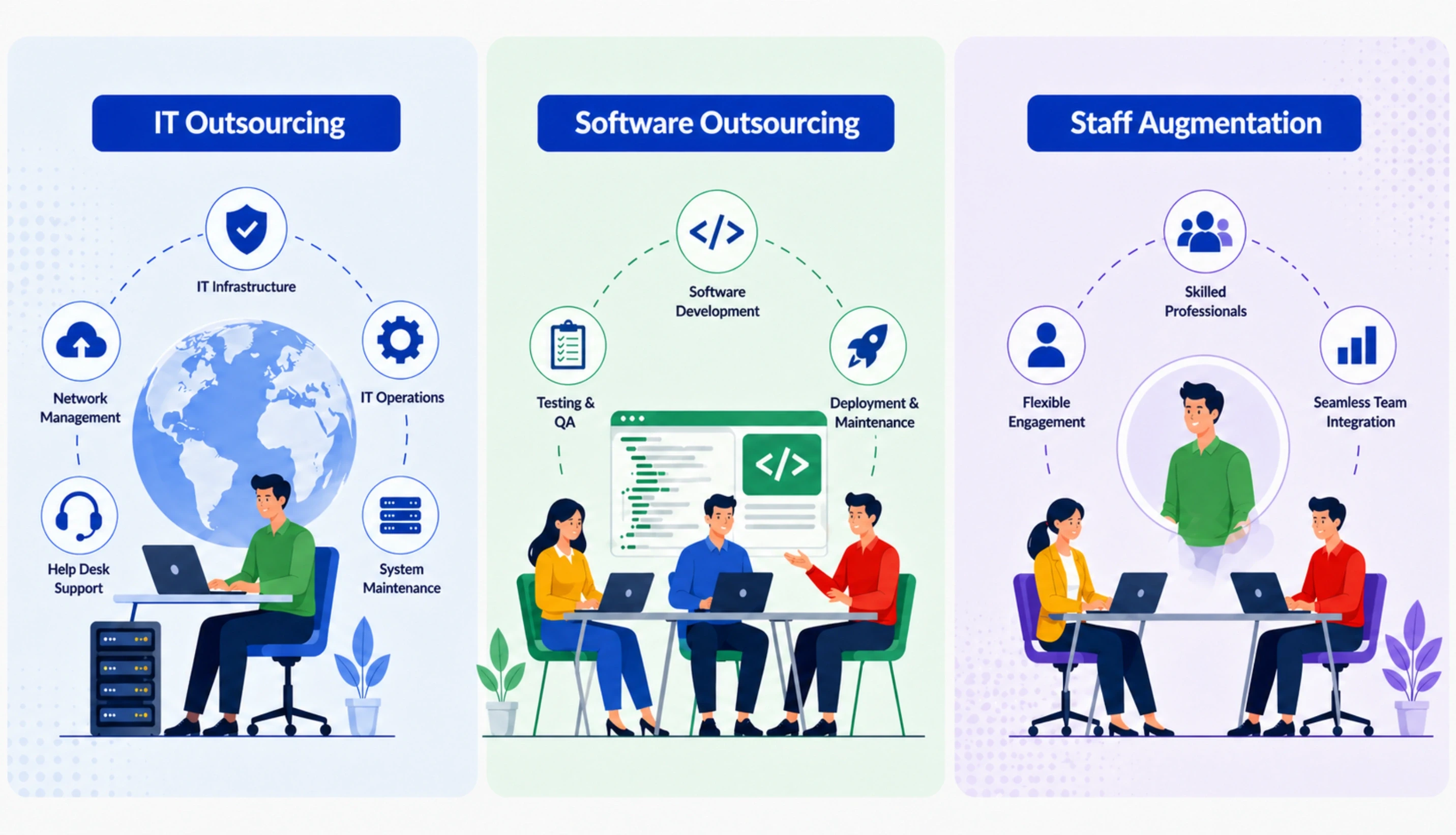
IT Outsourcing vs Software Outsourcing vs Staff Augmentation
IT outsourcing, software outsourcing, and staff augmentation are used interchangeably. They are not the same thing. This plain-English guide explains the difference in under 10 minutes.

Ahmed Ginani
April 29, 2026
Staff Augmentation vs Dedicated Team vs Outsourcing: Which Python Model Is Right for You?
Compare Python staff augmentation, dedicated team, and project outsourcing models. Real 2026 data on cost, control, speed, and IP risk. Find which model fits your project stage.

Acquaint Softtech
April 6, 2026India (Head Office)
203/204, Shapath-II, Near Silver Leaf Hotel, Opp. Rajpath Club, SG Highway, Ahmedabad-380054, Gujarat
USA
7838 Camino Cielo St, Highland, CA 92346
UK
The Powerhouse, 21 Woodthorpe Road, Ashford, England, TW15 2RP
New Zealand
42 Exler Place, Avondale, Auckland 0600, New Zealand
Canada
141 Skyview Bay NE , Calgary, Alberta, T3N 2K6