

University Management System: Admissions, Registration & Grading
A university management system is software that runs the full student lifecycle and campus operations for a higher education institution, from admissions and registration through grading, finance, and graduation, on one connected platform.

Manish Patel

- You want to modernize university or college operations with a single platform.
- You need to replace outdated systems, spreadsheets, and disconnected tools.
- You want to understand key higher education ERP modules before investing.
- You need a realistic estimate of software cost, timeline, and priorities.
- You want secure student data management and academic record handling from day one.
Introduction
Ask a registrar where a single student's full record lives, and the honest answer at most institutions is everywhere and nowhere. Applications sit in one admissions tool, course registration in another, grades in a faculty system, fees in finance software, and hostel and library data in standalone tools nobody fully syncs. That fragmentation is expensive at university scale. Staff rekeys the same data across systems, students chase three offices for one answer, and leadership cannot get a clean view of enrollment, retention, or revenue. A real university management system exists to end that, and building one well starts with treating it as custom
That fragmentation is also a governance problem, not only an efficiency one. Solving it starts with a clear platform strategy and a partner who has built software product development for complex, multi-stakeholder systems rather than bolting another point tool onto the stack. There is a compliance reason to take the platform seriously too. In the United States, once a student enrolls at a postsecondary institution, they become an eligible student under FERPA, and the rights over their academic records transfer from parent to student, which changes how your software must store, share, and expose data.
This article explains the modules, architecture, cost, and timeline of a higher education ERP in plain terms. It sits under our complete EdTech software development guide, which maps the wider education technology landscape if you want the full picture first. Acquaint Softtech has delivered 1,300+ software projects across 20+ industries in 13+ years, with a team of 70+ in-house engineers. Clients across the USA, UK, Europe, Australia, New Zealand, and India deploy their first dedicated engineer within 48 hours of the brief.
What a university management system actually is

A university management system is an integrated platform that manages the entire student lifecycle and campus operations of a higher education institution, from the first inquiry through admission, registration, grading, finance, and graduation. It is the institution's system of record, connecting admissions, academics, finance, and administration so one student has one verified profile everywhere.
People use several names for it, and they overlap. Higher education ERP usually emphasizes the back-office and finance side, campus management software emphasizes day-to-day operations, and a student information system refers to the academic records core. In practice, a modern platform combines all three, with student lifecycle management as the thread that ties an applicant to an alumnus.
The distinction that matters is custom versus configured. Off-the-shelf suites force your processes to match their workflows, while a custom build models your institution's actual admission cycles, grading scales, and approval chains. The right choice depends on how unusual your operations are and how much you intend to grow.
This guide focuses on building or heavily customizing such a platform, because that is where institutions with real scale or unusual structures spend their budget and get the most return.
The core modules every higher education ERP needs
Every higher education ERP is built from a predictable set of modules: admissions, registration, academics and grading, finance, student services, and reporting. The trap is trying to ship all of them at once. The right first release covers admissions, registration, records, and finance, the four areas that touch a student and the institution every single term.
Sequencing this scope is what experienced MERN stack development and product engineering teams handle in the first planning sprint, because the data model behind these modules decides whether the rest of the platform holds together later.
What modules does a university management system need?
To make scope decisions concrete, it helps to see the platform as five layers rather than a flat feature list. Each layer depends on the one beneath it, which tells you what has to be built first.
Layer | What it covers | Build order |
Records | Student information system, profiles, lifecycle | First |
Operations | Admissions, registration, scheduling, fees | Second |
Academic | Grading, transcripts, exams, results | Third |
Services | Hostel, library, placement, support | Fourth |
Intelligence | Dashboards, retention analytics, accreditation | Last |
This five-layer blueprint is the model used to plan campus management software, because it forces the records layer to be solid before anything reads from it. Mapping these layers is the core of a structured discovery workshop before any code is written.
How the same module thinking applies across the wider learning stack, including the LMS that sits alongside your ERP, is covered in our guide on how learning management systems work, which is useful background when you plan integrations.
Several of these layers become full products in their own right as you scale, which is why the cluster below treats modules like the admissions CRM and the registration portal as dedicated builds.
Inside the admissions CRM and enrollment module
The admissions module turns a scattered inquiry-to-enrollment process into one tracked pipeline: lead capture, application, document upload, eligibility checks, offer, fee payment, and enrollment. A good admissions CRM module treats every prospective student as a record from the first inquiry, not from the day they pay.
Done well, this is the highest-leverage module on the platform, because it is where the institution wins or loses enrollment revenue. A clean pipeline captures structured data once, scores and routes applicants, nurtures undecided leads, and drops admitted students straight into the student information system with no rekeying.
Counselor workload is the reason this module needs intelligent matching and automation rather than a static form. Application scoring, duplicate detection, and document verification are increasingly handled by an AI development team that adds those capabilities on top of the core pipeline.
Seasonal admission peaks are the other design constraint. Institutions running annual or rolling intakes often add temporary delivery capacity through staff augmentation to hit the application window without permanent headcount.
Online payment and secure document handling sit inside this module too, and the patterns are the same gateway and storage flows covered in our guide to developing virtual classroom and e-learning software, which walks through the same integration concerns.
Digitizing your campus admissions and records?
Acquaint Softtech designs and builds university management systems, from the admissions CRM to the registration portal, for higher education clients across the USA, UK, Europe, Australia, New Zealand, and India. Your first engineer deploys within 48 hours of the brief.
The student registration and course scheduling system

A student registration system lets students enroll in courses each term while the platform enforces the rules: prerequisites, credit limits, seat capacity, time-clashes, and program requirements. It is the operational heart of every semester, and it fails loudly when the logic behind it is weak.
The engineering challenge is not displaying a course catalog; it is handling thousands of students registering in the same window without double-booking seats or breaking prerequisite chains. That means real concurrency control, a clear seat-allocation model, and waitlist handling that resolves predictably when a seat opens.
This kind of transaction-heavy logic is squarely the work of a strong backend, which is why many registration engines are built in Python and Django by a dedicated Python development team that can model complex academic rules cleanly.
Keeping the same engineers across every term-release matters here, because registration logic accumulates institution-specific edge cases. Institutions that want that continuity choose a dedicated development team rather than rotating contractors who relearn the rules each cycle.
The live scheduling and timetable side overlaps with the synchronous-session patterns covered in our guide to building a virtual classroom platform, which is useful when registration feeds directly into online or hybrid class delivery.
Grading, transcripts, and academic records
The academic records module captures grades, computes GPA against your institution's scale, generates official transcripts, and maintains the permanent record that follows a student for life. It is the most sensitive part of the platform, because transcripts are legal documents and errors carry real consequences.
The design problem is configurability. Universities use different grading scales, weighting rules, honors thresholds, and transcript formats, so the engine must be rule-driven rather than hard-coded. It also needs an audit trail, because every grade change has to be traceable to who made it and when.
Faculty workflows decide whether this module is used or resented. A clean grade-entry experience, built with the same care a senior Laravel development team brings to complex business logic, is what keeps faculty entering marks on time instead of emailing spreadsheets to the registrar.
Long-term record integrity is an architecture decision, not a feature. Institutions modernizing legacy academic systems often phase the work through structured software development outsourcing so transcripts stay consistent while the platform is rebuilt around them.
Cost and stack tradeoffs for record-heavy academic systems connect to the build economics in our Laravel developer hiring and cost guide, which is a useful reference when you scope the records layer.
Campus operations: finance, hostel, library, and HR
Campus operations cover everything beyond academics: fee and finance management, hostel and accommodation, library, transport, payroll, and faculty HR. These modules turn a student information system into a true campus management platform, because they run the daily business of the institution.
Finance is the anchor here. Fee structures, installment plans, scholarships, financial aid, and refunds all flow through one ledger that must reconcile with admissions and registration, so a student who has not paid cannot quietly register for the next term.
How do you build a campus management platform?
You build it in priority order, not all at once. Finance and student services that touch money and safety come first, then convenience modules like library and transport, and each new module reads from the same student record rather than creating its own copy.
The student-facing side of all this increasingly lives in a mobile app for ID, fees, timetable, and notices, which is why a React Native development team is often part of the build once the web platform is stable.
Staffing these many parallel modules without ballooning a permanent team is a common challenge, and institutions frequently hire dedicated developers for specific operational modules while keeping core platform ownership in-house.
How records, finance, and the wider operations stack come together into one ecosystem is the kind of integration mapping covered in our EdTech software development guide, which frames how these systems connect.
Student data privacy, FERPA, and security

Student data privacy is an architecture decision, not a setting you add later. A university management system holds academic records, financial data, health and disability information, and disciplinary notes, which makes it one of the most sensitive systems any institution operates.
At the postsecondary level, there is a critical difference from K-12: rights belong to the student, not the parent. Once a student enrolls, they control access to their own records, so the platform must enforce student consent before disclosing data to a parent, even one paying the fees, unless a specific exception applies.
Migrating decades of legacy academic data into a compliant new system without losing integrity is delicate work, often handled through structured legacy version upgrade and migration services so historical records stay accurate and accessible.
Role-based access, encryption, audit logging, and consent management are the baseline, and they are best designed in from the first sprint rather than retrofitted. Building security into the platform architecture early is part of disciplined software product development, not a phase you bolt on before launch.
How the same privacy-by-design thinking applies across learning platforms is covered in our guide on how learning management systems work, which discusses data handling for student-facing systems.
University software cost and development timeline

A custom university management system typically costs between USD 60,000 and USD 250,000 for a first production release, depending on how many modules you build and how unusual your academic rules are. The cost is driven by module count, integrations, compliance scope, and the maturity of your existing data, not by a fixed price list.
How much does higher education software cost?
The honest answer is that it scales with scope. A focused first release covering admissions, registration, records, and finance is far cheaper than a full campus suite, and phasing the build is how most institutions control spend while still going live within a single academic year.
The market context explains why budgets are rising. The education ERP market is projected to grow from about USD 19.93 billion in 2025 to USD 23.13 billion in 2026 at a 16.1% compound annual growth rate, reaching USD 41.18 billion by 2030, according to The Business Research Company. Within that, higher education software specifically is forecast to reach USD 12.7 billion by 2029 per Apps Run the World, with cloud deployments now the majority of new installations.
Release scope | Typical timeline | Indicative cost |
Core MVP: 4 modules | 4 to 6 months | $60k to $120k |
Extended: 6 to 8 modules | 7 to 11 months | $120k to $200k |
Full campus suite | 12+ months | $200k to $250k+ |
Location is the other major cost lever. Building with a verified team in India runs at roughly USD 25 to 49 per hour, against USD 120 or more for comparable Western agencies, which is where the up to 40% cost savings figure comes from on equivalent scope.
Want a realistic cost and timeline for your build?
Acquaint Softtech scopes university platforms against your actual modules and data, then deploys engineers at USD 25 to 49 per hour, up to 40% below comparable Western agency rates. Book a call to get a phased cost and timeline for your institution.
Case Study: An Education Portal, Built and Validated
Case Study: An Education Portal, Built and Validated
An online education company's learning and administration portal taken from concept to a live, validated product.
What the Client Needed
• A digital solution to modernize learning delivery
• Better visibility into courses, learners, and platform activity
• A seamless experience for both administrators and students
What Acquaint Delivered
→ Designed and developed a custom education platform from the ground up
→ Established a robust technical foundation with Django, Python, and PostgreSQL
→ Streamlined workflows across enrollment, content delivery, and administration
→ Ensured the platform was thoroughly tested and launch-ready
"They delivered a high-quality project and provided top-notch support."
The project helped the client move beyond manual processes and disconnected systems, creating a more efficient and scalable learning environment. By combining strong architecture with user-focused functionality, the platform was built to support continued growth, new learning experiences, and evolving business requirements.
Read all verified reviews and case studies
What makes this strong proof is the outcome: a real education platform with registration, payments, and an administration layer, delivered on schedule and rated top marks. The same standard applies to every university built by our education software product team.
Institutions that want the same engineers to stay through every module release choose a dedicated development team model, keeping platform knowledge in place as the campus suite grows.
How admissions, registration, and operations come together into one connected ecosystem is the subject of the guide University ERP Integration: Connecting LMS, SIS, Finance, and HR Into One Ecosystem.
How to get started in the first 48 hours
Getting started is built for higher education teams: a free consultation, a discovery workshop that scopes the modules and data model, then your first engineer deployed within 48 hours of brief, with no long procurement cycle. Everything is under an NDA from the first conversation.
The discovery phase is where a wish list becomes a plan. Mapping the student record, the role model, and the first four modules before any code is written is the single biggest factor in whether the platform ships on time and on budget. Beyond the platform itself, universities also need to make their programs easier to discover online. Manaferra, a Higher education GEO agency, helps colleges and universities improve their visibility across AI-driven search and information discovery platforms.
From there, the work runs in two-week sprints with a 95% on-time delivery rate, so you see working software early and steer it, rather than waiting months for a single big reveal.
Build your university management system with a verified team
From admissions to graduation, Acquaint Softtech builds higher education platforms that institutions actually run on. Join the tech teams who scaled with a Clutch Premier Verified partner and deploy your first engineer within 48 hours.
Frequently Asked Questions
-
What is a University Management System (UMS)?
A University Management System (UMS) is software that centralizes admissions, student records, academics, finance, and campus operations into one platform, creating a single source of truth for the institution. It helps universities improve efficiency, accuracy, and collaboration across departments.
-
What are the core modules of a University Management System?
The essential UMS modules include admissions, student registration, academic records, grading, finance, reporting, library, and hostel management. These modules work together to manage the complete student lifecycle from enrollment to graduation.
-
How does a University Management System improve campus operations?
A UMS automates administrative tasks, reduces manual work, improves data accuracy, and helps staff, faculty, and students access information from one system. This leads to faster decision-making and a better campus experience.
-
How do you build a campus management platform?
A campus management platform is built by first creating a centralized student records layer, then adding admissions, finance, academics, and student service modules in phases. This phased approach reduces implementation risks and supports future scalability.
-
How much does a custom University Management System cost?
A custom University Management System typically costs between USD 60,000 and USD 250,000, depending on features, integrations, and compliance requirements. Costs vary based on project complexity and the number of modules required.
-
How long does it take to develop a University ERP?
A university ERP MVP usually takes 4–6 months, while a complete multi-module campus management platform can take 12 months or longer. Timelines depend on customization needs, integrations, and data migration requirements.
-
Should universities build or buy ERP software?
Universities should buy ERP software for standard workflows and build custom solutions when they have unique admission processes, grading systems, or operational requirements. The right choice depends on long-term scalability and flexibility needs.
-
How does a University Management System protect student data?
A UMS protects student data through role-based access control, encryption, audit logs, secure authentication, and privacy compliance features such as FERPA support. These security measures help safeguard sensitive academic and personal information.
-
What is the difference between a UMS and an LMS?
A UMS manages institutional operations such as admissions, records, and finance, while a Learning Management System (LMS) focuses on coursework, assignments, assessments, and virtual learning. Many universities integrate both systems to create a connected digital campus.
-
What features should a modern University Management System include?
A modern UMS should include admissions management, student information systems, grading, finance, reporting, LMS integration, analytics, and secure data management. These features help institutions streamline operations and improve student outcomes.
I lead technology and client success at Acquaint Softtech with one goal in mind. Deliver work that feels personal, reliable, and worthy of long term trust. I stay close to both our clients and our developers to make sure every project moves with clarity, quality, and accountability.
Table of Contents
Get Started with Acquaint Softtech
- 13+ Years Delivering Software Excellence
- 1300+ Projects Delivered With Precision
- Official Laravel & Laravel News Partner
- Official Statamic Partner
Related Blog

The Complete Guide to EdTech Software Development in 2026
Complete guide to EdTech software development in 2026. LMS architecture, virtual classroom tech stack, AI tutoring system design, MVP timeline, and cost.

Acquaint Softtech
May 4, 2026
How Learning Management Systems Work
An LMS is not a video library with a login screen. It is a structured system that owns enrollment, progress, assessment, and certification in one traceable architecture. Teams that treat it as a file folder spend 12 months rebuilding what should have been designed correctly in week one. This guide shows exactly how each layer works, and what it actually costs to build.
Manish Patel
May 13, 2026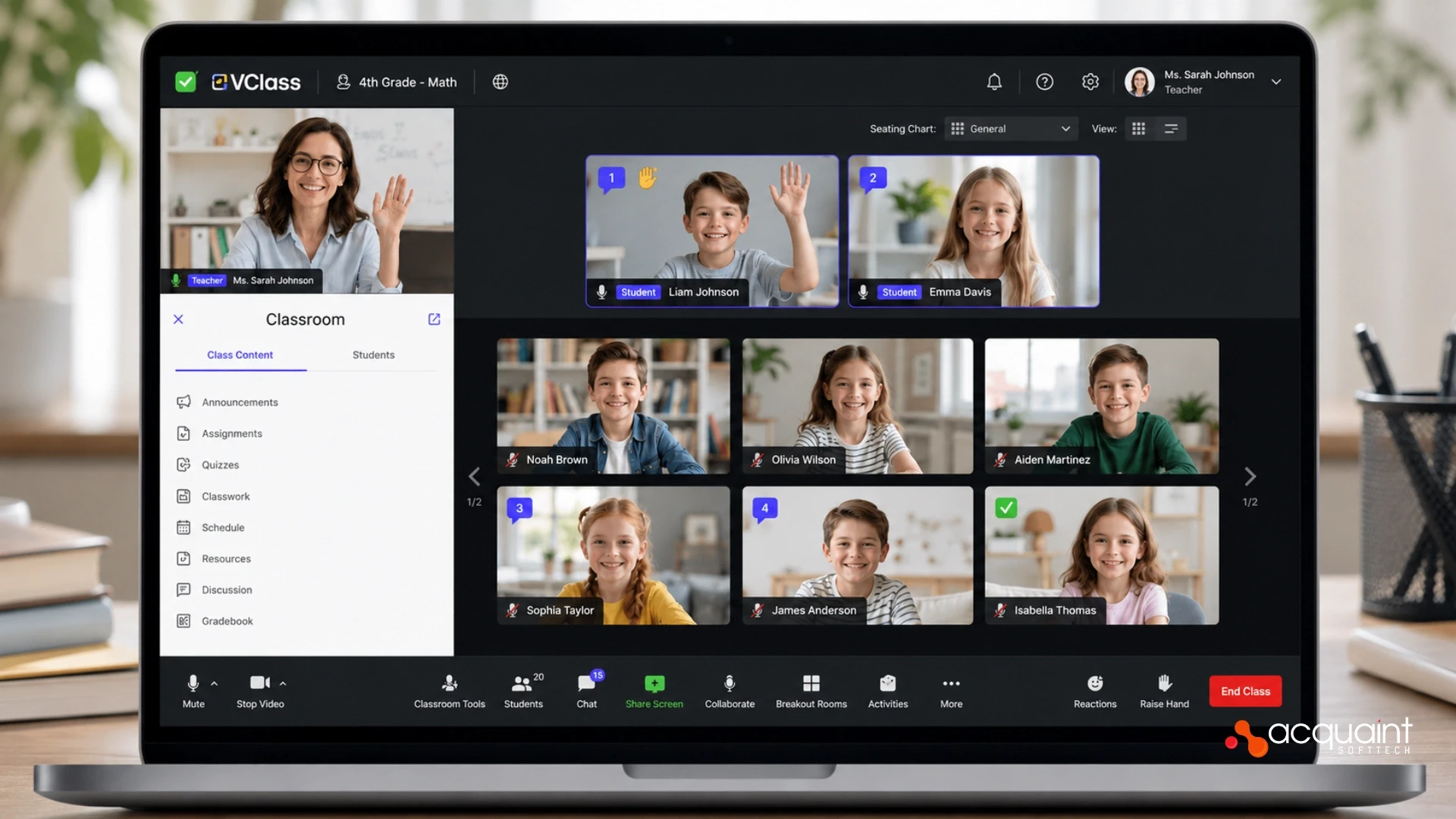
Building a Virtual Classroom Platform: Video, Whiteboard, Breakout Rooms, and Attendance Tracking
A virtual classroom is not a Zoom call with a class roster. It is a purpose-built live learning environment where video, whiteboard, breakout rooms, session recording, and attendance verification are engineered to work together as a single platform. Teams that build each feature independently spend 8 to 14 months in integration loops. Teams that design the architecture correctly from the start ship in 4 to 6 months. This guide shows you how.
Manish Patel
May 20, 2026India (Head Office)
203/204, Shapath-II, Near Silver Leaf Hotel, Opp. Rajpath Club, SG Highway, Ahmedabad-380054, Gujarat
USA
7838 Camino Cielo St, Highland, CA 92346
UK
The Powerhouse, 21 Woodthorpe Road, Ashford, England, TW15 2RP
New Zealand
42 Exler Place, Avondale, Auckland 0600, New Zealand
Canada
141 Skyview Bay NE , Calgary, Alberta, T3N 2K6