
What Is a Dedicated Development Team and How Does It Actually Work?
A dedicated development team is not a bigger staff augmentation engagement. It is a different accountability structure entirely. Here is exactly what it includes, what it costs, and how to know if it is the right model for your product.

Chirag Daxini
As COO of Acquaint Softtech, a software development partner with over 1,300 projects delivered across 13 years, I oversee how our dedicated development teams are structured and managed for every client engagement. The dedicated team model is both the most frequently misunderstood and the most frequently right answer for growing product companies. This article explains what it is, how it works in practice, and the 5 questions that tell you whether it is the right structure for your situation.

- Founders and CTOs evaluating the dedicated development team model for the first time
- Engineering leads who want to understand how a dedicated team differs from individual staff augmentation
- Product companies that have outgrown the freelancer or project outsourcing model and need something more structured
- COOs building a vendor framework for an ongoing software development programme
The term 'dedicated development team' is used loosely across the industry. Some vendors use it to describe a group of individual augmented developers. Others use it to describe a project outsourcing arrangement with a named team. Neither of these is what a properly structured dedicated team model actually means. The defining characteristic is a accountability structure: the vendor owns the team's composition, performance, and continuity, while the client owns the product direction and sprint priorities.
The comparison with individual augmentation and in-house hiring is detailed in the in-house vs staff augmentation breakdown. This article focuses specifically on the dedicated team model: what it includes, how the accountability is structured, and when it produces better outcomes than the alternatives.
What a Dedicated Development Team Actually Is
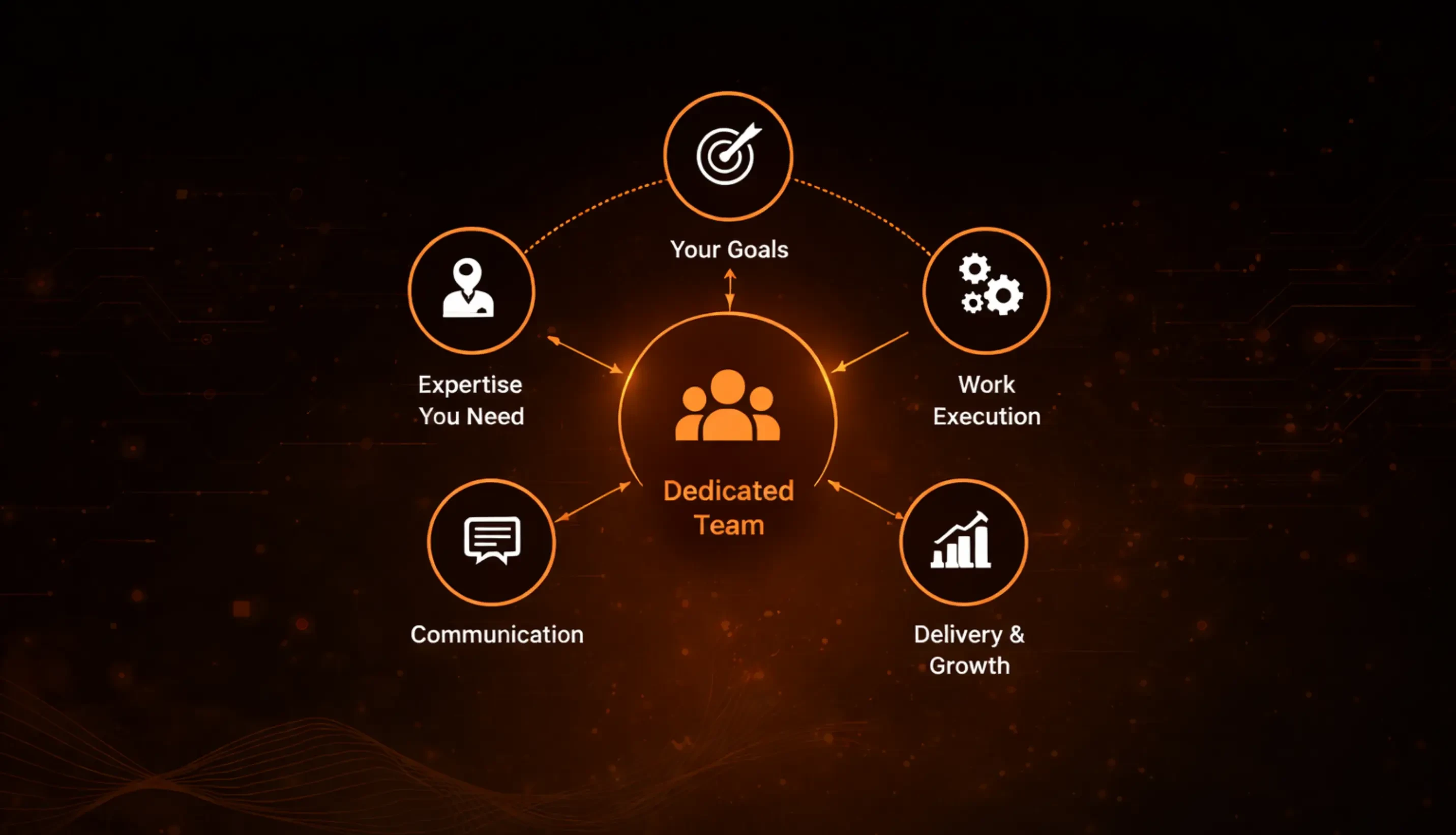
A dedicated development team is a team of developers, and often a technical lead, QA engineer, and project coordinator, who work exclusively on one client's product for the duration of the engagement. The key elements that define the model:
Full-time exclusivity |
Every developer on the team is allocated 100% to your product. They are not shared across client accounts. This is what produces the institutional knowledge accumulation that makes dedicated teams more valuable over time than individual augmented developers. |
Vendor-owned team structure |
The vendor manages the team composition, handles developer HR, performance management, and replacement. The client does not manage the individual developers. The client directs the product through sprint priorities and technical requirements. |
Client-owned product direction |
Sprint priorities, architecture decisions, feature sequencing, and delivery standards are the client's domain. The vendor delivers to those priorities. This is the structural difference from full project outsourcing, where the vendor owns both. |
Continuity commitment |
A dedicated team engagement is structured for duration, typically 6 months minimum and often 12 to 24 months. The continuity allows the team to build product context over time, which compounds into delivery speed and code quality in ways that short engagements cannot replicate. |
Dedicated Team vs Staff Augmentation: The Structural Difference
These two models are frequently confused. The distinction matters because they produce different outcomes in different situations, and choosing the wrong one for your stage creates friction that could have been avoided.
Dimension | Staff Augmentation vs Dedicated Team |
Team management | Staff aug: you manage individual developers day to day. Dedicated team: vendor manages team structure; you direct the product. |
Who absorbs replacement risk | Staff aug: you negotiate replacement with the vendor per person. Dedicated team: vendor handles replacement as part of team continuity commitment. |
Institutional knowledge | Staff aug: knowledge lives in individual developers. Dedicated team: knowledge lives in the team structure and documentation managed by the vendor. |
Engagement length | Staff aug: suitable for 1 to 6 months. Dedicated team: most valuable over 6 to 24 months as context compounds. |
Internal management overhead | Staff aug: 3 to 5 hrs/wk per developer for direction, review, and unblocking. Dedicated team: 1 to 2 hrs/wk per team for sprint priorities and review. |
Best fit | Staff aug: you have strong internal tech leadership and need capacity. Dedicated team: you want delivery accountability managed by the vendor. |
If you have not yet decided which model fits your stage, the staff augmentation model page covers how augmentation works for teams that need capacity with strong internal direction. The dedicated team model works differently: the vendor carries the management layer, which is the right structure when that layer does not exist internally or when building it would consume resources better spent on product.
How a Dedicated Development Team Actually Works: Day by Day
Understanding what the model looks like in practice is easier with a concrete week-by-week description. This is how a well-structured dedicated team engagement operates from the client's side.
Sprint planning (Monday, 1 hour) | The client's product owner or CTO defines sprint priorities with the team lead. The team lead translates priorities into developer task assignments. The client does not assign tasks to individual developers. They define what needs to be built and in what order. |
Daily standups (15 minutes, async or live) | The team lead runs the standup with the developer team. A summary is shared with the client. The client does not attend every standup. They receive the summary and escalate blockers that require product decisions. |
Mid-sprint check-in (Wednesday, 30 minutes) | A mid-sprint sync between the client and the team lead to review progress against commitment and surface any scope or priority changes. Scope changes that affect timeline are flagged here, not at the end of the sprint. |
Sprint review (Friday, 45 minutes) | The team demonstrates completed work. The client reviews and accepts or flags issues. Acceptance criteria are defined at sprint planning, so the review has a clear standard to evaluate against. |
Sprint retrospective (monthly, 30 minutes) | A structured review of what the team delivered against commitment, what the blockers were, and what process changes would improve the next month. The client participates to ensure their priorities are accurately reflected in the process. |
The client interaction pattern above is what produces the low management overhead that makes dedicated team model attractive for companies without strong internal technical leadership. The decision framework for choosing between hiring models covers the 12 questions that map your specific situation to the right structure. If the dedicated team is the right answer, the weekly rhythm above is what that engagement looks like from your side.
What a Dedicated Team Includes: The Full Scope
The composition and included services vary by vendor and engagement tier. Here is what a well-structured dedicated team engagement at Acquaint includes and what the client should expect from any reputable vendor.
Named developers, interviewed and approved before Day 1
Every developer on the team is profiled and available for client interview before the engagement begins. The team that starts is the team the client approved. Substitution requires client notification and a structured knowledge transfer.
Technical lead
For teams of 3 or more developers, a technical lead is included. The tech lead manages sprint task distribution, code review, and quality standards. The client interacts with the tech lead rather than individual developers for task-level management.
QA included or available
Most production-grade dedicated team engagements include a QA function. The QA engineer tests completed features before they enter staging. This removes the quality gate from the client's side and puts it inside the team structure.
IP assignment from Day 1
Every line of code belongs to the client from the moment it is committed. This is a contract term in any legitimate dedicated team engagement, not a negotiation point.
Direct communication access
Slack or Teams access directly with the technical lead and, where appropriate, individual developers. No account manager relay. Communication friction slows delivery.
Performance tracking and vendor accountability
Sprint delivery rate, quality metrics, and SLA tracking are vendor-managed. The client receives regular reporting. Underperformance triggers a defined remediation process.
For the KPI framework that tells you what to measure once a dedicated team is running, the COO guide to managing external dev teams covers the 7 metrics and 8 red flags that keep a dedicated team engagement healthy over a long engagement horizon.
Want to See What an Acquaint Dedicated Team Looks Like?
Tell us your product stage, team size, and what you are building. We will send a proposed team structure with developer profiles within 48 hours. You interview the team before committing. No engagement starts without client approval of every team member.
What Does a Dedicated Development Team Cost in 2026?

The cost of a dedicated development team depends on team composition, seniority level, and whether the engagement is offshore or nearshore. The comparison against in-house hiring is where it real value becomes clear.
Typical team size | 2 developers + tech lead + QA | 3 developers + tech lead + QA | 5 developers + tech lead + QA |
Monthly cost (India-based, offshore) | $9,000 to $14,000/month | $13,000 to $20,000/month | $20,000 to $32,000/month |
Equivalent US in-house cost | $50,000 to $70,000/month | $75,000 to $100,000/month | $120,000 to $160,000/month |
Annual saving vs US in-house | $490,000 to $670,000 | $740,000 to $970,000 | $1,180,000 to $1,530,000 |
Management overhead (client side) | 1 to 2 hrs/wk sprint direction | 1 to 2 hrs/wk sprint direction | 1 to 3 hrs/wk sprint direction |
What the monthly rate includes at Acquaint Softtech
- Developer salaries, employer contributions, and all HR costs: absorbed by vendor.
- Equipment, software licences, and infrastructure: absorbed by vendor.
- Recruitment and vetting costs: absorbed by vendor.
- Technical lead management and code review: included in team structure.
- IP assignment and NDA: included in standard contract.
- Sprint delivery reporting: included as standard.
The rate the client pays is the rate. No additional employer overhead on top.
The 5 Questions That Tell You Whether a Dedicated Team Is Right
Not every engagement suits the dedicated team model. These 5 questions map your situation to the right answer.
1. Do you have internal technical leadership to direct developers day to day? |
Yes = staff augmentation is viable and may be simpler. No = dedicated team removes the management dependency on internal leadership. |
2. Is your development need ongoing for 6 months or more? |
Yes = dedicated team compounds value over time. No = individual augmentation or project-based outsourcing is more appropriate for shorter scope. |
3. Do you want to own product direction but not team management? |
Yes = dedicated team is the right structure. No = full project outsourcing may be more appropriate. |
4. Is team continuity important for your codebase complexity? |
Yes = dedicated team. Developer turnover in complex codebases has compounding costs. A vendor-managed team with continuity commitments protects against this. |
5. Do you have the budget for a sustained team engagement? |
A dedicated team of 3 to 4 people runs $13,000 to $20,000/month. If this is not available, individual augmentation at $3,500 to $6,000/month per developer may be more appropriate for your stage. |
For the assessment of whether any outsourced model is the right fit for your specific situation, the 5-minute staff augmentation self-assessment covers the decision framework that narrows the options before you engage with any vendor. And the developer interview framework gives you the questions to use when evaluating individual developers on a dedicated team before the engagement begins.
Answered Yes to 3 or More of Those Questions? Let Us Build You a Team.
Tell us your product description, stack, and what you need the team to deliver in the first 90 days. We will send a proposed team structure and individual developer profiles within 48 hours. The interview process follows before any commitment is made.
Common Misconceptions About Dedicated Development Teams
These are the assumptions that lead companies to either choose the wrong model or evaluate dedicated teams incorrectly when they evaluate the right one.
Misconception: A dedicated team means you hand over full delivery control |
Reality: The client retains full product direction. Sprint priorities, architecture decisions, and feature sequencing are the client's domain. The vendor manages team structure and delivery execution. The dedicated model is not outsourcing. It is a managed delivery structure under client direction. |
Misconception: Dedicated teams are only for large engagements |
Reality: The minimum viable dedicated team is 2 developers plus a technical lead. This is suitable for early-stage SaaS products, internal tools, and ongoing feature development programmes. The model is not reserved for enterprise scale. |
Misconception: You lose visibility when the vendor manages the team |
Reality: A well-structured dedicated team provides more visibility than individual augmentation, not less. Sprint delivery reporting, weekly summaries, direct tech lead access, and a defined mid-sprint check-in process mean the client always knows what is being built and where it stands. |
Misconception: Dedicated teams are more expensive than augmentation |
Reality: Per-developer, dedicated team rates are comparable to individual augmentation rates. The difference is the included management layer: tech lead, QA, sprint management. When compared against the client's internal management time required for augmentation, the total cost is often lower for dedicated teams. |
For the honest comparison of how dedicated teams, staff augmentation, and platforms like Toptal and Upwork stack up against each other in terms of cost and outcome, the Toptal vs Upwork vs staff augmentation guide covers the full comparison with real numbers. And if you are ready to start evaluating developers for a potential dedicated team, hire remote developers covers how that process works from the first brief to the first sprint.
Ready to See What a Dedicated Team Looks Like for Your Specific Product?
We build dedicated teams from 2 to 15 developers for SaaS products, enterprise applications, and ongoing development programmes. Share your product stage, stack, and what you are building in the next 6 months. We send a team structure and developer profiles within 48 hours. You interview before you commit.
Frequently Asked Questions
-
What is the difference between a dedicated development team and outsourcing?
Outsourcing transfers full delivery responsibility to the vendor. The vendor owns the scope, the process, and the output. The client receives a deliverable. A dedicated development team keeps product direction with the client. The client defines sprint priorities, architecture decisions, and what gets built. The vendor manages the team that builds it. The accountability structure is fundamentally different: in outsourcing you buy an outcome, in a dedicated team you direct a team.
-
How long does it take to set up a dedicated development team?
With a structured vendor, the team can be operational within 2 to 3 weeks from contract signature. The timeline breaks down as: 48 hours to receive developer profiles, 1 week for client interviews and approvals, 1 week for onboarding and setup, first sprint by week 3. The onboarding includes codebase access, documentation review, tooling setup, and a first sprint scoped for context building rather than full feature delivery.
-
Can I replace a developer on a dedicated team if they are not working out?
Yes. A well-structured dedicated team contract includes a replacement clause with defined timelines, typically 48 to 72 hours for a replacement start and a structured knowledge transfer from the exiting developer. The vendor manages the replacement process. The client approves the incoming developer before they join the team. Replacement should not require significant client effort to coordinate.
-
How is a dedicated team different from hiring a development agency?
An agency typically takes a defined scope and delivers to it. You hand over the specification and receive the output. A dedicated team works within your sprint process on your product, building features as you define them. You set the direction every sprint. The team executes. The distinction matters because agencies are appropriate for defined deliverables, while dedicated teams are appropriate for ongoing product development where priorities change and the team needs to maintain institutional knowledge across months.
-
What tech stacks do dedicated teams typically cover?
The stack depends on the vendor's specialisation. At Acquaint, dedicated teams cover Laravel, Python, Django, FastAPI, React, Vue, Node.js, React Native, and full-stack combinations. For Laravel-specific products, our Official Laravel Partner status means every Laravel developer on a dedicated team has passed a framework-specific technical assessment. The stack is defined before the team is assembled; every developer on the team has verified experience in the relevant technologies.
-
What happens to my codebase if the engagement ends?
All code belongs to the client from the moment it is committed, under the IP assignment clause in the standard contract. At engagement end, the vendor produces a handover package: codebase documentation, architecture decision log, environment credentials, and a knowledge transfer session with your incoming team or tech lead. The handover timeline and scope should be specified in the contract before the engagement starts, not negotiated at termination.
-
Is a dedicated team appropriate for a pre-revenue startup?
It depends on the runway and the development scope. For pre-revenue startups with a clear product vision, 6 to 12 months of development scope, and a budget of $10,000 to $15,000 per month, a small dedicated team of 2 developers plus a tech lead can build a production-grade SaaS product significantly faster than a sequence of freelancer engagements. For startups with a tighter budget, individual staff augmentation at $3,500 to $6,000 per developer per month is more appropriate until the product generates enough revenue to support a team structure.
With over 11 years of experience in web application development and project management, I excel in leading cross-functional teams to deliver innovative digital solutions. My expertise spans eCommerce platforms, ERP systems, and JS & PHP-based frameworks, including WordPress, React JS, and Laravel. As a Technical Project Manager, I specialize in strategic planning, system design, and end-to-end project execution, transforming complex ideas into scalable, high-impact applications.
Table of Contents
Get Started with Acquaint Softtech
- 13+ Years Delivering Software Excellence
- 1300+ Projects Delivered With Precision
- Official Laravel & Laravel News Partner
- Official Statamic Partner
Related Reading
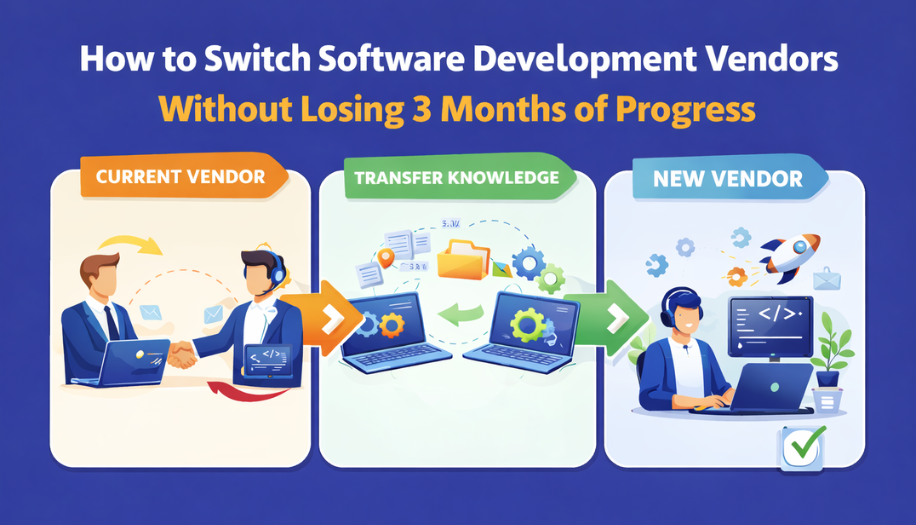
How to Switch Software Development Vendors Without Losing 3 Months of Progress
By the time you decide to switch dev vendors, you have 4 months of budget invested and no appetite for another 3 months of disruption. The structured handover below cuts the transition from 10 weeks to 3.

Ahmed Ginani
April 10, 2026
Offshore Development Due Diligence: 10 Things to Verify Before Signing Any Contract
A client signed with a vendor who had 3 actual developers, stolen case studies, and 4 self-written Clutch reviews. 10 checks that take 2 hours prevent this every time.
Ahmed Ginani
April 13, 2026
Staff Augmentation Pricing Models Explained: Monthly Retainer vs Hourly vs Project-Based
Most clients pick a staff augmentation pricing model based on the rate. That is the wrong variable. The pricing model determines your vendor's incentives, your budget predictability, and who carries the risk when delivery slips.