

Table of Contents
What Is The Queue In Laravel?
Introduction
In Laravel, a queue is a system that moves time-consuming tasks to a background process instead of making users wait for them during a web request.
For example, when a development firm starts getting more clients and the workload increases, handling every task immediately can affect the speed and quality of service. Laravel queues solve a similar problem within an application by handling tasks such as sending verification emails, generating large PDFs, or processing uploaded images in the background.
Instead of making the user wait, the Laravel application packages the task into a Job and places it on a queue. The application can then return a response immediately while a background worker processes the task asynchronously.
This helps keep the application responsive and efficient, even when the workload increases. Using queues effectively is an important part of Laravel development services at Acquaint Softtech.
What Is a Queue In Laravel?
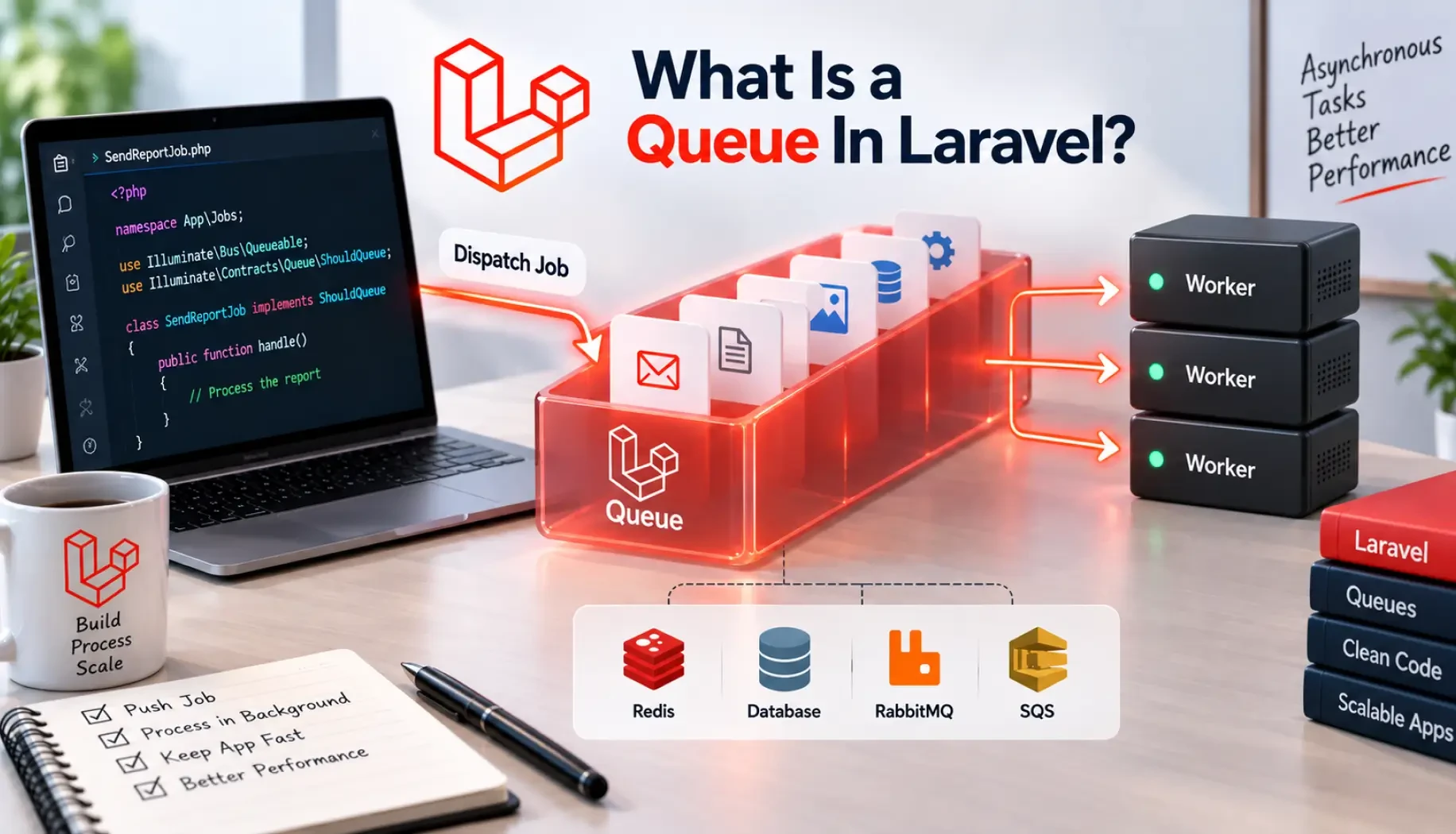
In Laravel, a queue handles time-consuming tasks in the background. By offloading these tasks to a queue, the website or web application can run independently and avoid performance lag due to dependency on one process or resource.
It helps defer tasks such as sending emails, processing images, or performing other resource-intensive operations to be executed asynchronously in the background. When a task is added to the queue, it is placed in a queue driver of your choice, such as a database, Redis, or Beanstalkd, and the queued jobs are then processed by a separate worker process.
The Queue system also supports job chaining, retrying failed jobs, delaying execution, and setting priority levels, all of which help keep pages fast, a theme explored in Laravel performance optimization.
How It Works: Job, Driver, And Worker
Under the hood, the Laravel queue relies on three components working together. The Job is a PHP class (generated with php artisan make:job) containing the logic to run in the background. The queue driver, or connection, is the storage backend where jobs sit until they are processed.
And the Laravel queue worker is a long-running command-line process (php artisan queue:work) that continuously polls the driver, pulls jobs off the stack, and executes them. This asynchronous backend is often what powers responsive Laravel API development at Acquaint Softtech.
Queue Drivers
You choose the driver in config/queue.php. The official Laravel Queues documentation lists them all; the common ones are:
Queue driver | Best for |
sync | Runs jobs instantly in the same process, used for local testing |
database | Stores jobs in a relational database table, great for development |
redis | A fast, in-memory store, recommended for production |
sqs | Amazon's managed queue service (AWS) |
Key Features Of Laravel Queues
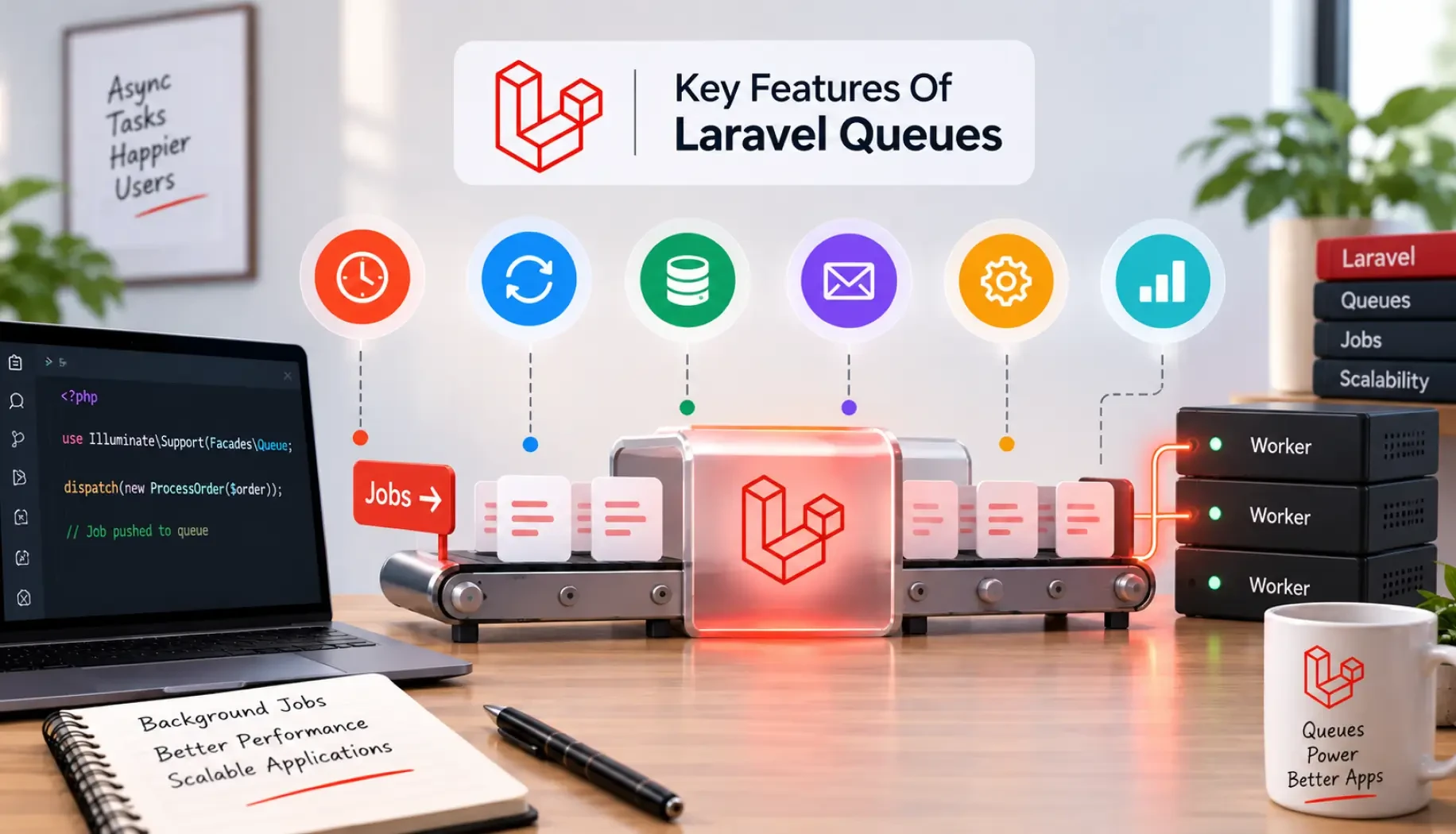
Laravel queues offer enterprise-grade tooling out of the box:
Prioritization: split jobs into high, default, and low stacks so workers clear urgent jobs (like emails) before low-priority ones (like reports).
Delayed dispatching: schedule a job to run after a delay, for example, waiting 10 minutes before a follow-up email.
Job chaining and batching: chain sequential jobs where each runs only if the previous one succeeded, or batch a parallel group and fire one callback when they all finish.
Automatic retries: if a job fails, say an external API is down, Laravel retries it a set number of times before sending it to a failed_jobs table for you to inspect.
For heavy, high-volume workloads, Laravel Horizon adds a dashboard to monitor and tune Redis queues, which is common in Laravel enterprise development at Acquaint Softtech.
How To Implement A Queue In Laravel
Implementing a queue takes five steps: set QUEUE_CONNECTION in your .env file to your chosen driver (for example redis); create a job with php artisan make:job MyJob and define its logic in app/Jobs; add it to the queue by dispatching it with dispatch(new MyJob($data)); process the queue by running php artisan queue:work; and monitor the worker's output in the terminal for progress and errors. Keeping workers running reliably in production is part of Laravel maintenance and support from Acquaint Softtech.
A Quick Code Example
Dispatching a job takes very little code. From a controller, you dispatch it after saving, then return a response immediately:
// Dispatch from a controller |
The class implements ShouldQueue, which tells Laravel to run it on the queue, and the heavy work goes in handle(). This pattern scales cleanly across services, as Laravel microservices and API-first SaaS show.
Make Your Laravel App Fast With Queues
Acquaint Softtech offloads heavy work to background queues so your app stays responsive under load. Book a free 30-minute consultation, no sales pitch, just honest advice.
What Is A Queue, With An Example?
By definition, a queue is a first-in, first-out (FIFO) line: items are added at one end and processed from the other, like people waiting at a checkout. In Laravel, a real example is a user uploading a podcast: the file is saved, a ProcessPodcast job is queued, the user gets an instant response, and a worker transcodes the audio in the background.
It is a common question for developers new to queues on forums like Reddit, and the FIFO idea is the simplest way to picture it.
Is Laravel A Backend Or Frontend?
Laravel is a backend, server-side framework, and queues are a purely backend feature that run on the server, never in the browser. The frontend simply receives the fast response while the queue does the heavy lifting behind the scenes.
How Can I Use RabbitMQ In Laravel?
Laravel does not support RabbitMQ out of the box, but you can add it with a community package (such as vyuldashev/laravel-queue-rabbitmq) that registers RabbitMQ as a queue connection, after which it behaves like any other driver. Setting up message brokers like RabbitMQ or Redis is part of Laravel integration services.
Working With A Laravel Team
Designing jobs, choosing a driver, and running workers reliably takes experience. You can hire Laravel developers from Acquaint Softtech to build a fast, queue-backed application the right way.
Conclusion
And that is how you configure and implement a queue in Laravel. With features like queues, you can keep a website or web application responsive and fast even as demand grows by moving heavy, time-consuming work into the background where it belongs, so users always get a quick response.
India (Head Office)
203/204, Shapath-II, Near Silver Leaf Hotel, Opp. Rajpath Club, SG Highway, Ahmedabad-380054, Gujarat
USA
7838 Camino Cielo St, Highland, CA 92346
UK
The Powerhouse, 21 Woodthorpe Road, Ashford, England, TW15 2RP
New Zealand
42 Exler Place, Avondale, Auckland 0600, New Zealand
Canada
141 Skyview Bay NE , Calgary, Alberta, T3N 2K6