

AI Chatbot vs Voice AI Agent: Which Works Better for Customer Support?
An AI chatbot works better for web, app, and messaging support where answers include links, steps, or records; a voice AI agent works better for phone calls and customers who cannot type. Neither is better overall, and most businesses get the best results running both from one knowledge base.

Chirag Daxini
Choosing between an AI chatbot and a voice AI agent comes down to where your customers already contact you and what they need to get done. A chatbot answers in text on your website, app, or messaging channels, while a voice AI agent talks to customers on the phone. If most of your support happens online, AI chatbot development services are usually the faster first step.

- Your support team is handling more calls, chats, or tickets than it can keep up with.
- You are deciding whether to automate chat, phone support, or both.
- You want to know what each option can and cannot handle before you budget.
- You are a CEO, COO, founder, or support leader in the US, UK, Europe, Australia, or New Zealand.
Both use the same core technology: a large language model that understands questions and answers from your business content. The difference is the channel, and the channel changes the user experience, the engineering effort, and the running cost.
This guide compares the two side by side, explains where each works best, covers costs, and shows why many support teams end up running both from one shared knowledge base, often through RAG development so every answer comes from the same approved content.
What Is an AI Chatbot?
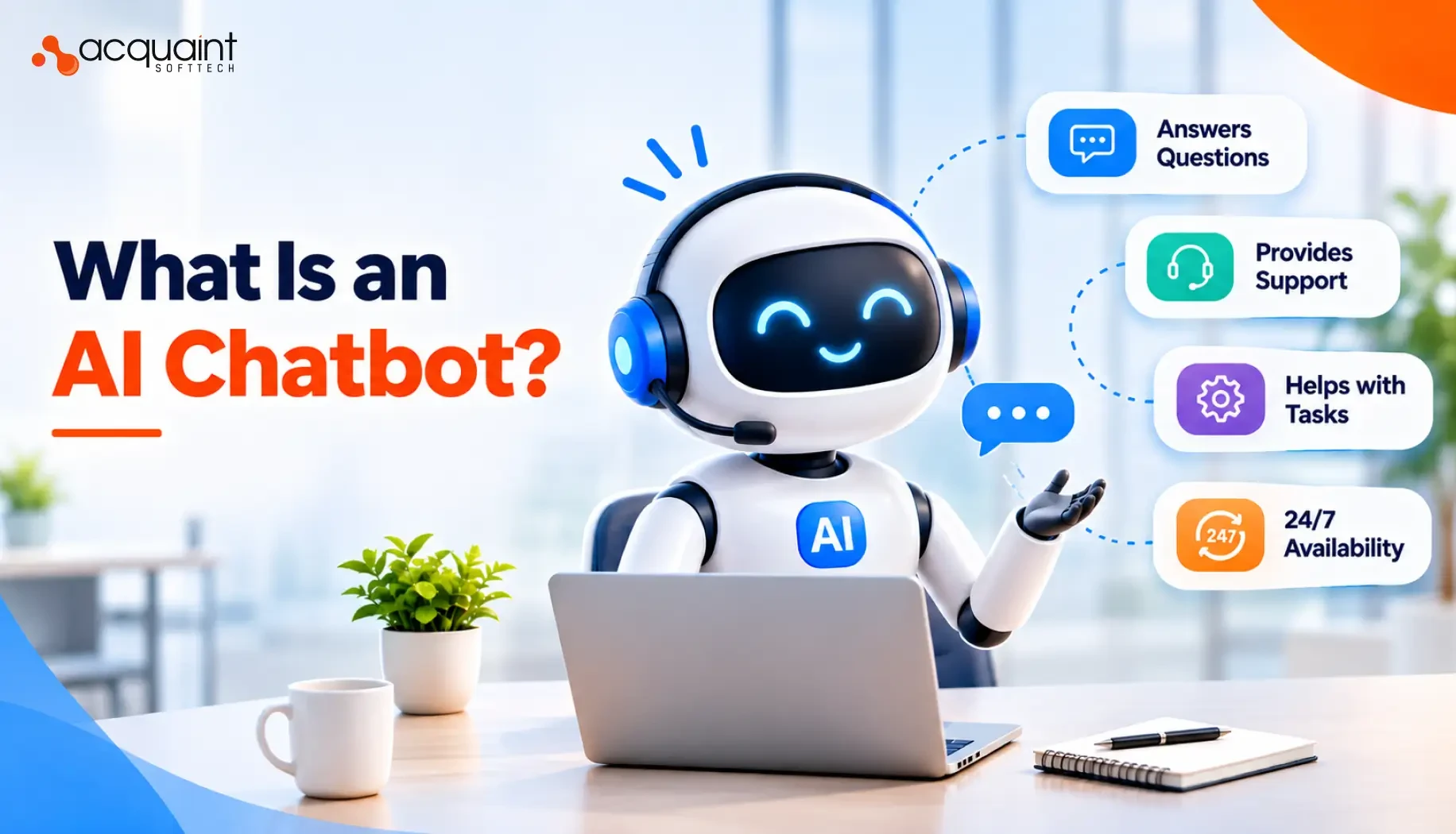
An AI chatbot is software that understands typed questions and replies in text, using a language model and your business content. Modern chatbots go beyond scripted menus: they answer free-text questions, cite sources, and hand over to a human agent when needed.
Common AI Chatbot Examples
Website support assistant: answers product, delivery, and returns questions from your help centre.
In-app helper: guides users through features or account settings inside your product.
Internal knowledge assistant: answers staff questions about policies and processes.
Order and booking assistant: checks status or books appointments through your systems.
When the chatbot must also understand intent, extract details from messages, or classify requests, that work draws on NLP development alongside the chatbot itself.
What Is a Voice AI Agent?
A voice AI agent is an AI system that holds spoken conversations with customers, usually over the phone. It converts speech to text, uses a language model to understand the request and decide the answer, then speaks the reply back in a natural voice.
How a Voice AI Agent Works
Speech-to-text: converts the caller’s words into text in real time.
Language model: understands the request and finds the answer from your knowledge base.
Text-to-speech: speaks the answer back with a natural voice.
Telephony and handover: connects to your phone system and transfers to a human when needed.
A voice agent that books, reschedules, or cancels on a call also needs secure access to your systems, the same way an AI agent development does in chat, with approval rules for anything sensitive.
Chatbot vs Voice Bot: Side-by-Side Comparison
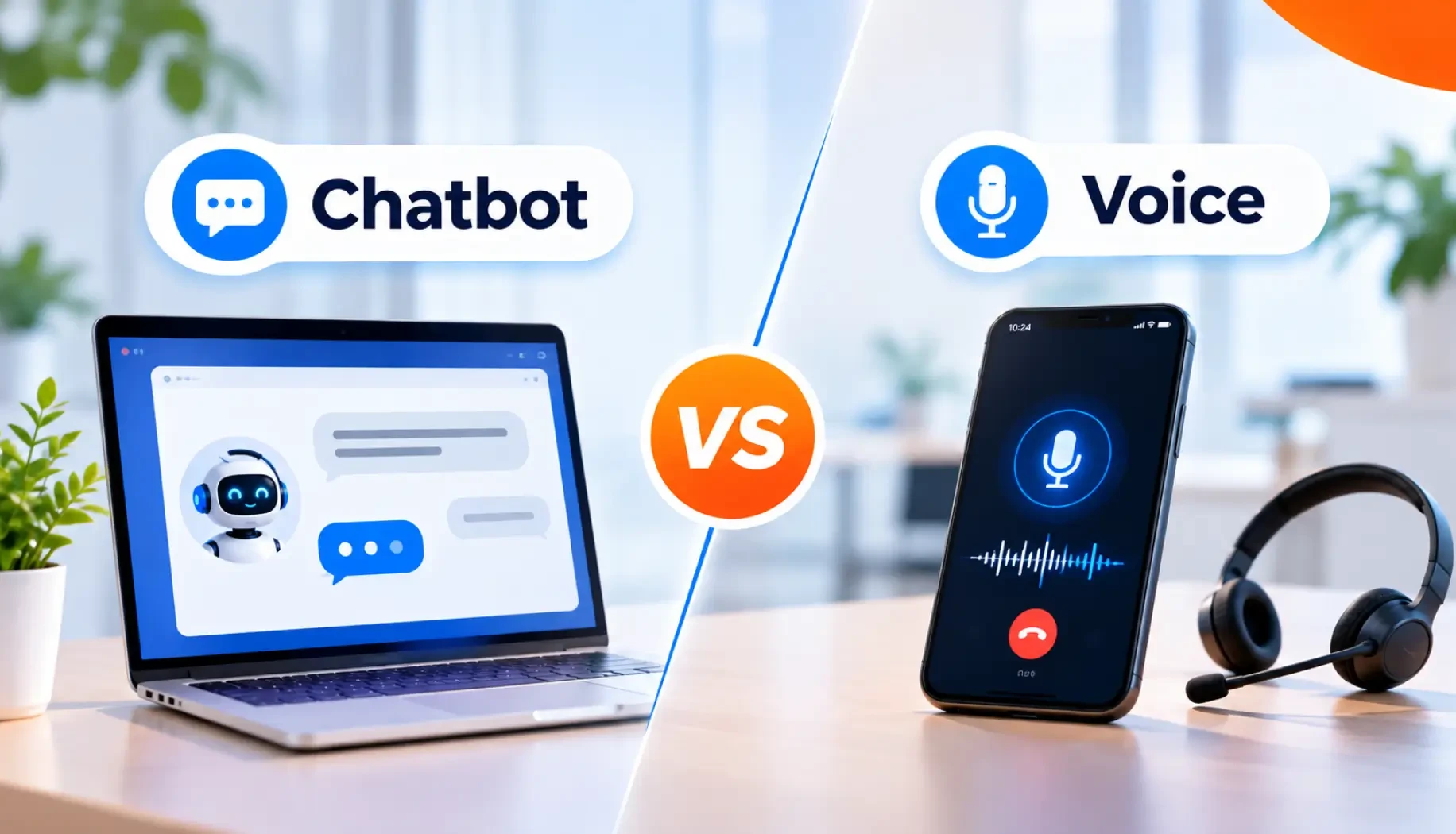
The core intelligence is the same; the channel creates the differences.
Factor | AI chatbot | Voice AI agent |
Channel | Website, app, messaging | Phone calls |
Best for | Links, steps, forms, records | Hands-free, urgent or simple calls |
Response format | Text, links, images | Spoken answers, SMS follow-up |
Speed requirement | A few seconds is fine | Near-instant replies needed |
Written record | Built in | Transcript needed |
Running cost | Lower | Higher (speech and call minutes) |
Engineering effort | Lower | Higher (latency, accents, noise) |
Voice is harder to get right. A caller notices a pause of a couple of seconds; background noise and accents affect speech recognition, and long answers are hard to follow by ear. Chat tolerates slower responses and can show links, lists, and screenshots that voice cannot.
Is a Voice AI Agent Better Than a Chatbot?
A voice AI agent is better than a chatbot when customers call rather than type. Neither is better in general: each wins in different situations.
Situation | Better choice | Why |
Customer calls your phone line | Voice AI agent | Answers without hold time |
Customer is driving or working | Voice AI agent | Hands-free |
Answer needs links or steps | AI chatbot | Easier to follow in text |
Written record is required | AI chatbot | Conversation is saved as text |
Older or less digital customers | Voice AI agent | No typing or app needed |
High volume of simple questions | Both | Same answers on every channel |
Businesses with a busy phone line, such as clinics, home services, travel and utilities, usually see the most value from voice. Our voice AI chatbot development team builds voice agents and chatbots on one knowledge base, so customers get the same answer whichever channel they use.
Can AI Handle Customer Support Calls?
Yes, AI can handle a large share of routine support calls, such as opening hours, order status, appointment booking, simple troubleshooting, and call routing. It should not handle everything.
Good fit for AI: repetitive questions, status checks, bookings, and after-hours calls.
Keep with humans: complaints, complex billing disputes, emotional or vulnerable callers, and high-value sales.
Always available: a clear, fast handover to a human agent with the conversation summary passed along.
Disclosure matters too. New York signed a chatbot law on 28 October 2026 that bars chatbots from claiming to be human, with penalties of up to $25,000 per violation, according to a 30 October 2026 AI news roundup. Telling callers and chat users they are talking to AI should be part of your design from day one.
How Much Does an AI Chatbot or Voice Agent Cost?
An AI chatbot proof of concept costs $12,000 to $20,000, and a production system costs $30,000 to $60,000. Acquaint Softtech publishes the same price bands for voice AI because the knowledge layer is shared.
Engagement | Price | Timeline |
Chatbot or voice proof of concept | $12,000 to $20,000 | 2 to 3 weeks |
Production chatbot or voice system | $30,000 to $60,000 | 8 to 12 weeks |
Dedicated AI engineer | $4,400 per month | Starts within 48 hours |
The main difference is running cost. Voice agents add speech-to-text, text-to-speech, and call-minute charges on top of the model usage both channels share, so ask for a monthly running-cost estimate at your expected call volume. A fixed-price AI proof of concept can test accuracy and cost per conversation on your real questions before you commit.
Not sure whether to start with chat, voice, or both?
Share your top customer questions and your call and chat volumes. We will recommend the right channel mix and give you a build and running-cost range.
Why Most Businesses Use Both
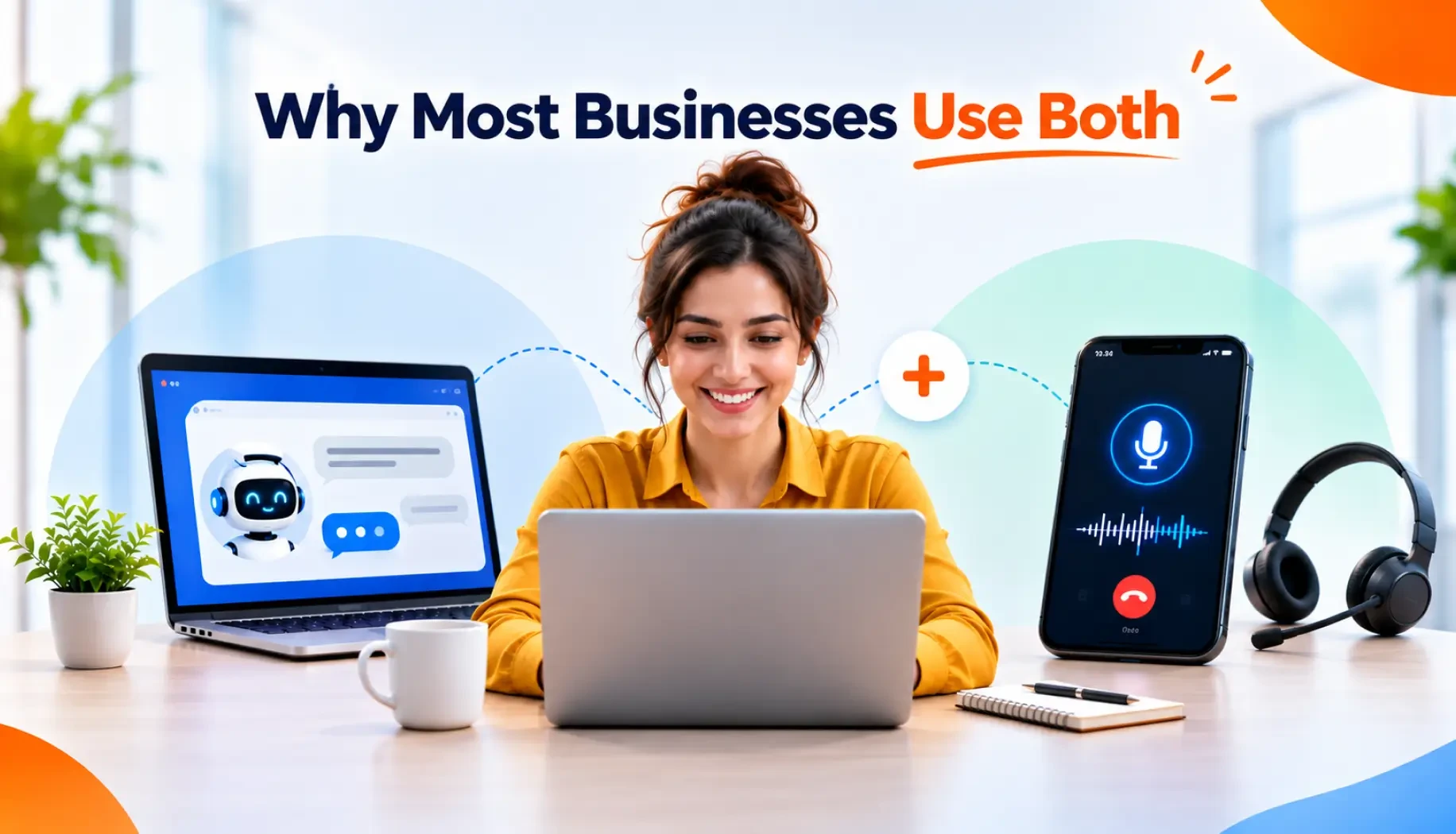
Most businesses do not have to choose. Running a chatbot and a voice agent from one knowledge base means you build and test the content once, keep answers consistent across channels, and share the same handover rules.
One knowledge base: update a policy once, and both channels use it immediately.
Channel handoff: a voice agent can send a link or steps by SMS, and a chat can offer a callback.
Shared analytics: see which questions come in by phone versus chat and improve both.
The usual path is to start with the channel that carries the most volume, prove it on real questions, then add the second channel using the same knowledge layer. Connecting both to your CRM, help desk, and phone system is where AI integration services do most of the work.
Chat-Based AI Support in Practice
DDD Invoices, a Slovenia-based e-invoicing and compliance provider working across 30+ countries, needed staff to get fast, consistent answers to repetitive compliance and integration questions. Acquaint Softtech built a chat-based, retrieval-based internal copilot with role-based access for three teams, described in the AI-powered internal copilot case study.
Text suited this use case because answers referenced country-specific rules and documentation that staff needed to read and reuse. Within weeks of rollout, staff stopped digging through scattered documents and internal back-and-forth dropped.
Ready to automate customer support with AI?
Start with a 2- to 3-week proof of concept for chat or voice on your own content, with fixed pricing, an NDA signed first, and full IP ownership.
Frequently Asked Questions
-
Is a voice AI agent better than a chatbot?
Only for phone-based support. Chatbots are better for web, app, and messaging support where answers include links or steps.
-
How much does an AI chatbot cost?
A proof of concept costs $12,000 to $20,000 and a production chatbot $30,000 to $60,000, plus monthly usage costs.
-
Can AI handle customer support calls?
Yes, for routine calls such as status checks, bookings, and FAQs, with a fast handover to humans for complex or sensitive calls.
-
What is a voice AI agent?
An AI system that holds spoken conversations, combining speech recognition, a language model, and text-to-speech.
-
What is the difference between a chatbot and a voice bot?
A chatbot works in text on websites, apps, and messaging; a voice bot works in speech, usually on phone calls.
With over 11 years of experience in web application development and project management, I excel in leading cross-functional teams to deliver innovative digital solutions. My expertise spans eCommerce platforms, ERP systems, and JS & PHP-based frameworks, including WordPress, React JS, and Laravel. As a Technical Project Manager, I specialize in strategic planning, system design, and end-to-end project execution, transforming complex ideas into scalable, high-impact applications.
Table of Contents
Get Started with Acquaint Softtech
- 13+ Years Delivering Software Excellence
- 1300+ Projects Delivered With Precision
- Official Laravel & Laravel News Partner
- Official Statamic Partner
Related Blog
AI Development Cost in 2027: Pricing by Project Type, Team Size and Region
AI development costs $10,000 to $40,000 for a single AI feature, $25,000 to $250,000 for chatbots, predictive models, and AI agents, and $250,000 to $1 million or more for enterprise AI platforms. Budget in stages: a proof of concept first, then an MVP or production release, then running costs.

Mukesh Ram
November 3, 2026
AI in On-Demand Apps: Matching, Pricing, Fraud Detection, and Predictive Analytics
AI in on-demand apps powers four high-value functions: matching customers with the best provider, setting dynamic prices from real-time demand, detecting fraud as it happens, and predicting demand, ETAs, and churn. It works by training machine-learning models on platform data, then serving their predictions live inside the app.

Manish Patel
July 21, 2026
AI and Machine Learning in Logistics: Demand Prediction, Route Optimization, and Anomaly Detection
AI and machine learning in logistics use historical and real-time data to predict demand, optimize delivery routes, and detect supply chain anomalies before they become costly problems. These technologies help businesses reduce costs, improve efficiency, and make faster, data-driven decisions.
Manish Patel
June 11, 2026India (Head Office)
203/204, Shapath-II, Near Silver Leaf Hotel, Opp. Rajpath Club, SG Highway, Ahmedabad-380054, Gujarat
USA
7838 Camino Cielo St, Highland, CA 92346
UK
The Powerhouse, 21 Woodthorpe Road, Ashford, England, TW15 2RP
New Zealand
42 Exler Place, Avondale, Auckland 0600, New Zealand
Canada
141 Skyview Bay NE , Calgary, Alberta, T3N 2K6