

AI and Machine Learning in Logistics: Demand Prediction, Route Optimization, and Anomaly Detection
AI and machine learning in logistics use historical and real-time data to predict demand, optimize delivery routes, and detect supply chain anomalies before they become costly problems. These technologies help businesses reduce costs, improve efficiency, and make faster, data-driven decisions.

Manish Patel

- You run a logistics or supply chain operation and want to know where AI actually pays off.
- You are scoping an AI or ML project and need to understand the models before you build.
- You operate across the USA, UK, Europe, UAE, or India and need forecasts that handle real-world variables.
- You are deciding between an off-the-shelf AI tool and a custom ML build.
- You have data sitting unused and want to turn it into demand, routing, or risk decisions.
Your competitors are not working harder; they are predicting better;
Two logistics companies run the same routes, the same trucks, and the same products. One overstocks a warehouse before a demand drop, sends half-empty trucks down congested roads, and finds out about a cold-chain failure when the customer rejects the shipment. The other forecasts the dip, reroutes around the traffic in real time, and catches the temperature spike while the goods are still saveable. The difference is not effort. It is that the second company put its data to work with AI, exactly what an AI development services team is built to deliver.
The cost of staying reactive is now measurable, and it is large. Traditional forecasting methods lead to chronic overstocking or stockouts, while AI-powered forecasting can cut prediction errors by 30 to 50 percent. AI-optimized routing lowers fuel consumption by more than 15 percent a year, and predictive maintenance cuts repair costs by 20 to 30 percent. The market has noticed: the automated machine learning supply chain market, valued at $4.92 billion in 2025, is forecast to grow at nearly 38.52% a year through 2034. For operators across the USA, UK, Europe, UAE, and India, the gap between predictive and reactive widens every quarter.
This article explains where AI machine learning logistics, focused on the three highest-value applications: demand prediction, route optimization, and anomaly detection. It covers the models, the data they need, and how to implement them, so you can separate real opportunity from hype before you invest. It is part of the complete guide to logistics and supply chain software development, drawing on platforms Acquaint Softtech has shipped as an Official Laravel Partner with 1,300+ projects, 70+ in-house engineers, and a 4.9/5 Clutch rating from 50+ verified clients.
Where AI actually delivers value in logistics
AI delivers value in logistics wherever a decision depends on predicting an uncertain future from data. The highest-return applications are demand prediction, route optimization, anomaly detection, and predictive maintenance, because each replaces a slow human guess with a fast, data-grounded recommendation.
The key is to start where the data is richest, and the decision is most repeated. Forecasting next week's order volume, planning tomorrow's routes, and flagging today's unusual shipments are made hundreds of times over, so even a small accuracy gain compounds quickly. Vague ambitions like becoming an AI-first company fail; specific, measurable use cases succeed.
Acquaint Softtech's AI development services team scopes the highest-ROI use case first rather than boiling the ocean. The data engineering and model work are delivered by our Python developers who specialize in production ML. For how these models plug into transport execution, see our guide on how transportation management systems work.
How AI demand prediction works
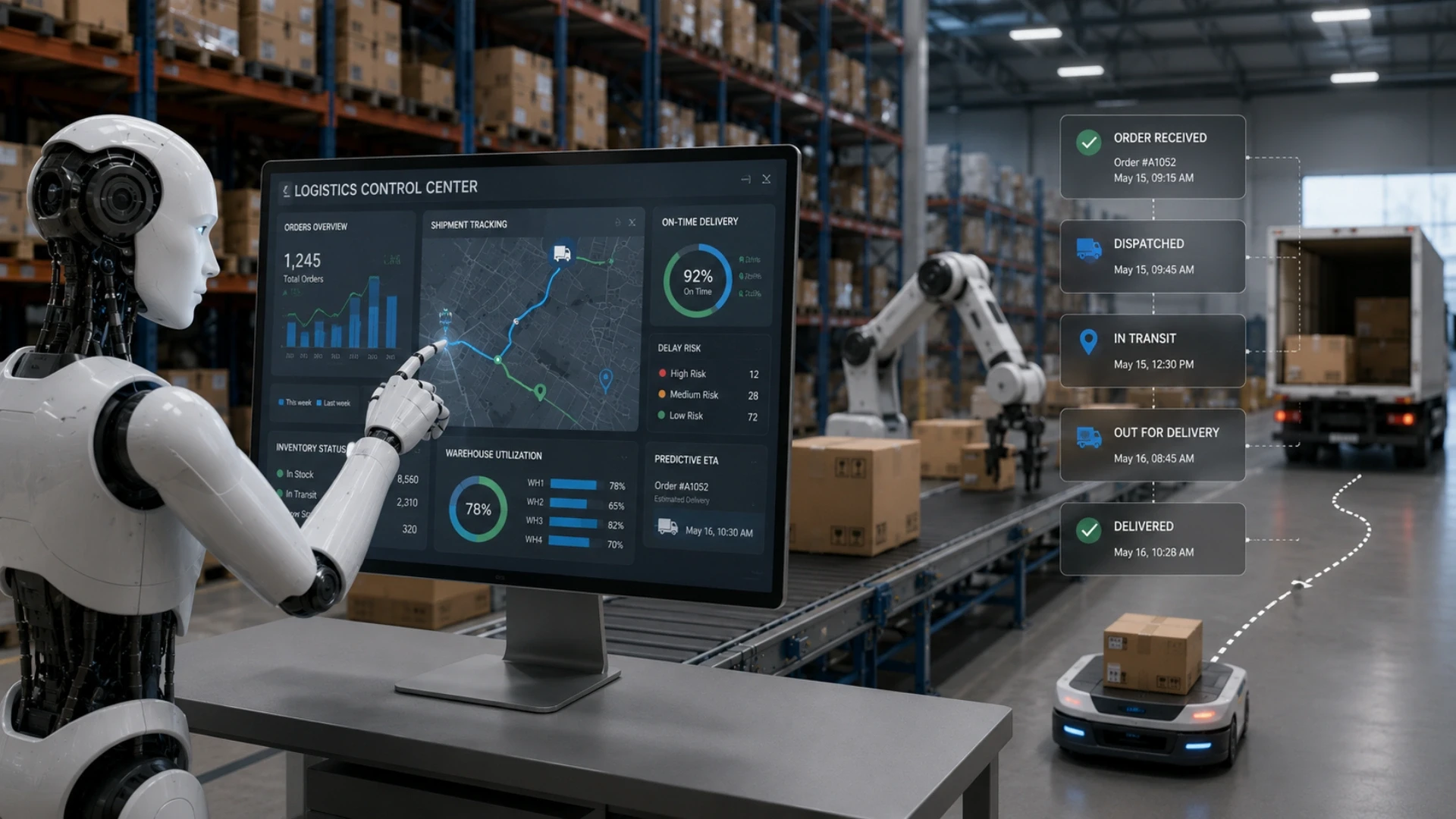
AI demand prediction works by training models on historical sales and combining them with real world signals such as seasonality, promotions, weather, and economic indicators to forecast future order volume far more accurately than spreadsheet based methods. Businesses often partner with experienced teams or choose to hire MERN stack developers to build scalable AI powered forecasting solutions. Better forecasts help align inventory with actual demand, reducing both overstock and stockouts.
The strongest results come from an ensemble: the system tests several models per product and combines the best for each. One UK cold-chain operator reported a 10 to 12 percent improvement in forecast accuracy after deploying AI trained on sensor and footfall data, which translated into a 5 percent cut in perishable waste. The forecast then drives reorder points and safety-stock levels automatically.
Acquaint Softtech's Python developers build the forecasting pipeline and feature engineering. The model deployment and retraining infrastructure are handled by our DevOps engineers. How forecasts connect to physical stock is explained in our guide on how warehouse management systems work.
The best ML models for logistics, and when to use each
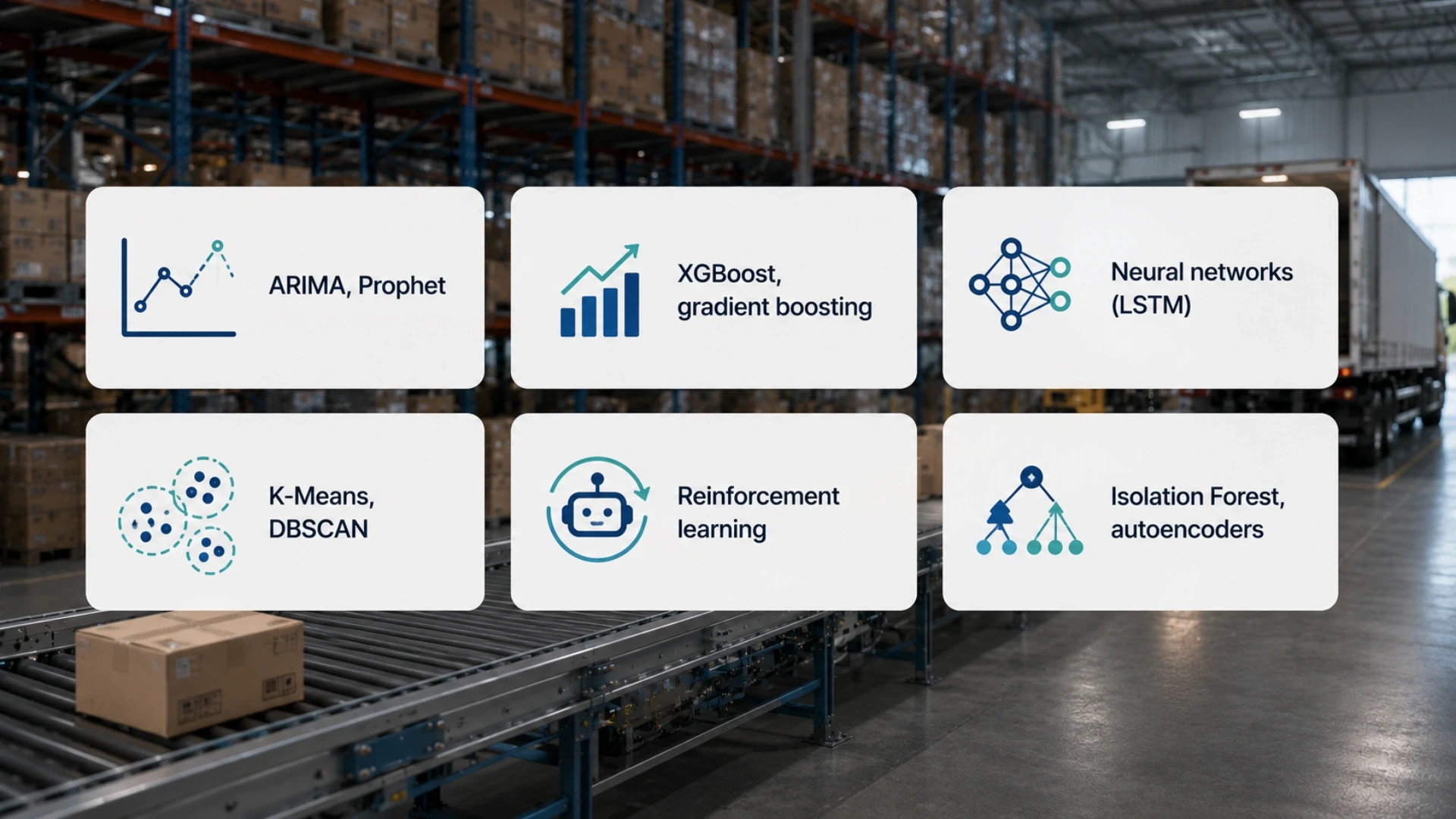
There is no single best model for logistics. The right choice depends on the problem: forecasting, optimization, or detection. The table below maps the most-used models to the job they do best.
Model | Best used for |
ARIMA, Prophet | Time-series demand forecasting with clear seasonality |
XGBoost, gradient boosting | Demand and ETA prediction with many mixed features |
Neural networks (LSTM) | Complex demand patterns and long sequences |
K-Means, DBSCAN | Clustering stops and zones for route grouping |
Reinforcement learning | Dynamic, real-time route and dispatch decisions |
Isolation Forest, autoencoders | Anomaly and fraud detection in shipment data |
In practice, robust 2026 systems combine models rather than relying on one. Neural combinatorial and reinforcement-learning solvers are used as components inside hybrid approaches, with metaheuristics and constraint programming, because explainability and reliability still matter to operators.
Acquaint Softtech's development services team selects and validates the model mix against your real data. Production training and serving are built by our Python developers. On choosing the right approach instead of over-engineering, see our guide on custom application vs off-the-shelf SaaS.
Have logistics data but no models? Turn it into demand, routing, and risk decisions.
Acquaint Softtech builds custom demand-forecasting, route-optimization, and anomaly-detection systems for clients across the USA, UK, Europe, UAE, and India. Your first dedicated ML engineer deploys within 48 hours of brief.
How AI optimizes delivery routes
AI optimizes routes by evaluating traffic, weather, delivery windows, vehicle capacity, and driver constraints together, then producing the lowest-cost set of routes, and re-planning them in real time as conditions change. Unlike static planning, AI routing is closed-loop: it adjusts mid-execution when a road closes or a new order arrives. Businesses often accelerate the development of such intelligent logistics platforms by leveraging dedicated teams and expertise through services like hiring MEAN Stack developers from Acquaint Softtech, helping reduce development time while ensuring scalable and real-time route optimization capabilities.
A modern AI routing system combines a data ingestion layer pulling from TMS, telematics, and traffic feeds, a state store holding the live picture of vehicles and orders, prediction services for ETAs and dwell times, and an optimization engine that does both batch planning and incremental re-optimization. DHL reported AI dynamic routing cut fuel costs by 15 percent and urban delivery times by 12 percent.
Acquaint Softtech's Python developers build the optimization engine and real-time re-routing logic. The live dispatch and driver apps are built by our React Native developers.
How anomaly detection protects the supply chain
Anomaly detection works by learning what normal looks like across thousands of data points, then flagging anything that deviates: a delayed shipment, a temperature spike in a cold chain, an unusual fuel transaction, or a route deviation. It is an early-warning system that lets teams intervene before a small problem compounds into a costly one.
The value is in speed and reach. AI scans traffic, weather, port congestion, and shipment data continuously, catching issues no human could monitor at scale. Businesses that choose to hire AI/ML engineers can build intelligent monitoring systems that detect problems in real time. When a container's temperature drifts out of range or a vehicle leaves its planned route, the system flags it instantly so coordinators can reroute, replace, or recalibrate before delays cascade. It also strengthens security by spotting fraud and unauthorized access.
Acquaint Softtech's AI development services team builds the detection models and alerting rules.
The real-time data pipeline behind detection is built by our DevOps engineers. How anomaly signals feed vehicle and fleet decisions is covered in our guide on how fleet management systems work.
The data foundation AI needs to work

Every AI capability in logistics depends on a foundation of accurate, real-time data. A sophisticated model connected to incomplete data will underperform a simpler model with clean, comprehensive inputs. Integration depth, not algorithm cleverness, is usually the real differentiator.
The common blocker is fragmented data silos and inconsistent formats across TMS, WMS, ERP, telematics, and e-commerce systems. Without clean, integrated data, predictions become unreliable and the whole project stalls. Fixing the data layer first is not glamorous, but it is what separates AI projects that ship from those that quietly die in a proof of concept.
Acquaint Softtech's backend development company team builds the data integration and pipelines that feed the models.
The architecture is mapped first through our discovery workshop services, before any model work begins. Why a clean foundation lowers total cost is explained in our guide on how to reduce software development costs without reducing quality.
How to implement AI in logistics, step by step
Implementing AI in logistics works best as a staged process, not a big-bang launch. Each step de-risks the next, and the first working model funds the rest.
Pick one measurable use case with rich data, such as demand forecasting for your top SKUs.
Audit and integrate the data that use case needs, cleaning silos and standardizing formats.
Build a proof of concept, testing several models and validating against held-out real data.
Deploy the model behind an API, integrate it into the operations workflow, and measure against the old way.
Monitor accuracy, retrain on new data, and expand to the next use case once the first proves out.
Acquaint Softtech's AI development services team runs this staged process from proof of concept to production. Teams without in-house ML can run the full build through software development outsourcing. For why a tightly scoped start beats a sprawling one, see our guide on legacy system modernization: rebuild, refactor, or replace.
Case study: a multi-country operations platform
The clearest proof of AI-driven logistics is a real build that put scheduling and routing intelligence into daily operations. This engagement, verified on Clutch, shows data-driven assignment and route optimization handling real demand surges.
Case Study: Intelligent Scheduling and Routing for a Field Operation
The Challenge:
• Technicians and vehicles assigned to jobs manually, with no optimization
• Routes planned by hand, causing avoidable travel between jobs
• No way to match the nearest, best-skilled resource to each job
• Demand surges during weather events overwhelmed manual dispatch
What Acquaint Softtech Built
→ A data-driven scheduling engine that assigns jobs by location and skill
→ Automated route optimization to minimize travel between assignments
→ Real-time recalculation as new jobs and field conditions arrived
→ A dispatch dashboard giving managers live visibility and control
Measured Outcomes
Less wasted travel
Optimized routing and scheduling significantly reduced unnecessary travel between jobs.
Held up under surges
The system kept dispatch fast and orderly even during weather-driven demand spikes that previously overwhelmed manual planning
"Their ability to understand the complexity of our operations stood out. They set clear milestones, were responsive to our requests, and the automated scheduling significantly reduced unnecessary travel for our technicians." - CEO, US Service Provider
What makes this instructive is that the value came from applied optimization, not a science project: the system assigned the right resource to each job and re-planned routes automatically, holding up even when weather drove demand spikes that broke manual dispatch. Acquaint Softtech's development services team, including dedicated Laravel experts available through Hire Laravel Developers, specializes in turning operational data into this kind of working intelligence.
For complex multi-region builds, the dedicated software development teams model keeps the same engineers on the platform for the full lifecycle. A comparable real-time routing architecture is documented in our guide on how transportation management systems work.
Ready to move from reactive to predictive? Build AI on your own data.
Acquaint Softtech builds custom logistics AI for clients across the USA, UK, Europe, UAE, and India at $25 to $49 per hour, up to 40 percent below Western agency rates, with 95 percent on-time sprint delivery.
Build vs buy, and what custom logistics AI costs in 2026
Off-the-shelf AI tools work when your problem is generic and your data fits their model. They fall short when your demand patterns, routing rules, or risk signals are specific to your operation, or when your data lives in systems the tool cannot reach. When the edge comes from your own data, a custom build wins.
Dimension | Off-the-shelf AI tool | Custom logistics AI |
Fit to your data | Generic models, limited inputs | Trained on your exact data and signals |
Cost model | Per-seat or per-prediction fees, forever | One-time build; you own the models |
Integration | Limited to supported systems | Connects to your TMS, WMS, ERP, telematics |
Explainability | Often a black box | Built for the transparency operators need |
On cost: a focused logistics AI proof of concept typically starts around $40,000 to $80,000, with full production platforms covering forecasting, routing, and detection running to $300,000 or more, driven by data readiness, model count, and integration depth. A Clutch-verified India-based team delivers the same engineering quality as a Western agency at up to 40 percent lower cost.
Teams extending an existing platform can add a vetted ML engineer through staff augmentation services within 48 hours. Those building end to end can run it through development outsourcing. For the regional rate context behind the AI logistics solution cost gap, see our guide on Python development cost by industry.
Join 200+ companies that turned data into decisions with Acquaint Softtech.
1,300+ projects. 70+ engineers. 4.9/5 Clutch rating from 50+ verified clients. Clutch Premier Verified. Official Laravel Partner. Your first AI engineer deploys within 48 hours of brief.
Frequently asked questions
-
How is AI used in logistics?
AI is used for demand forecasting, route optimization, anomaly detection, predictive maintenance, and warehouse automation. It learns patterns from historical and real-time data to predict outcomes and recommend the best action, turning a reactive operation into a predictive one.
-
What are the best ML models for logistics?
There is no single best model. ARIMA and Prophet suit time-series demand, XGBoost handles mixed-feature prediction, neural networks capture complex patterns, K-Means and DBSCAN cluster routes, reinforcement learning drives dynamic dispatch, and Isolation Forest detects anomalies. Strong systems combine several.
-
How does AI optimize routes?
AI optimizes routes by weighing traffic, weather, delivery windows, and vehicle capacity together, then producing the lowest-cost route plan and re-planning it in real time as conditions change. DHL reported AI routing cut fuel cost by 15 percent and urban delivery time by 12 percent.
-
What is anomaly detection in supply chain?
Anomaly detection is AI that learns normal supply chain behavior and flags deviations, such as a delayed shipment, a cold-chain temperature spike, a fuel-card irregularity, or a route deviation. It acts as an early-warning system so teams fix issues before they cascade.
-
How accurate is AI demand forecasting?
AI demand forecasting typically cuts prediction errors by 30 to 50 percent versus traditional methods. Accuracy depends on data quality and history. One UK cold-chain operator improved forecast accuracy 10 to 12 percent and cut perishable waste 5 percent after deploying AI models.
-
How much does AI in logistics cost?
Solution Scope
Estimated Cost
Proof of Concept (PoC)
$40,000 – $80,000
Production Platform (Forecasting, Routing & Detection)
$300,000+
Actual costs vary based on AI complexity, integrations, data volume, compliance requirements, and deployment scale.
-
Do I need a lot of data to start with AI?
You need clean, relevant data more than huge data. A focused use case like forecasting top SKUs can start with a couple of years of history. Fixing data silos and formats first matters more than volume, since a clean foundation beats a clever model on messy data.
-
How does Acquaint Softtech build logistics AI?
Acquaint Softtech starts with one measurable use case, audits and integrates the data, builds a proof of concept testing several models, then deploys behind an API and expands. The first engineer deploys within 48 hours. Verified 4.9/5 on Clutch.
I lead technology and client success at Acquaint Softtech with one goal in mind. Deliver work that feels personal, reliable, and worthy of long term trust. I stay close to both our clients and our developers to make sure every project moves with clarity, quality, and accountability.
Table of Contents
Get Started with Acquaint Softtech
- 13+ Years Delivering Software Excellence
- 1300+ Projects Delivered With Precision
- Official Laravel & Laravel News Partner
- Official Statamic Partner
Related Blog
How Warehouse Management Systems Work: Architecture, Modules, and Data Flow Explained
A Warehouse Management System is not a spreadsheet with barcode readers attached. It is a structured operational platform that owns inventory location, pick sequence, worker task allocation, and carrier handoff in one controlled environment.
Manish Patel
May 8, 2026
The Complete Guide to Logistics & Supply Chain Software Development in 2026
Logistics and supply chain software development in 2026 is not a single discipline. It is six distinct product categories, each with its own integration burden, operational perimeter, and cost curve.

Acquaint Softtech
May 1, 2026
Transportation Management Systems: Carrier Selection, Rate Shopping & Load Optimization
A Transportation Management System is not a tracking map with extra buttons. It is a structured freight operations platform that owns carrier selection, rate negotiation, load planning, dispatch, and proof-of-delivery capture in one governed workflow.
Manish Patel
May 18, 2026India (Head Office)
203/204, Shapath-II, Near Silver Leaf Hotel, Opp. Rajpath Club, SG Highway, Ahmedabad-380054, Gujarat
USA
7838 Camino Cielo St, Highland, CA 92346
UK
The Powerhouse, 21 Woodthorpe Road, Ashford, England, TW15 2RP
New Zealand
42 Exler Place, Avondale, Auckland 0600, New Zealand
Canada
141 Skyview Bay NE , Calgary, Alberta, T3N 2K6