

AI Engineer vs ML Engineer: Skills, Salary and Which One to Hire
An AI engineer builds products on top of existing AI models, such as chatbots, copilots, and agents. An ML engineer builds, trains, and maintains custom models on your own data. Hire an AI engineer for LLM features and an ML engineer for predictions, scoring, or recommendations from your data.

Chirag Daxini
The AI engineer vs ML engineer question matters because the two roles solve different problems. AI engineers turn existing models, especially large language models, into working product features. ML engineers build and run the custom models behind predictions and recommendations. Hiring the wrong one adds months to an AI project, which is why we match the role to the problem before teams hire AI/ML engineers.

- You are planning an AI feature or product and are unsure which specialist to hire.
- You want to compare AI engineer and ML engineer skills and salaries.
- You are weighing a local hire against a remote AI or ML engineer.
- You are a CTO, founder or product leader in the US, UK, Europe, Australia, or New Zealand.
Job titles in AI are still loose, and many job posts use the two terms interchangeably. This guide uses the definitions most teams now work with in practice, and explains where the roles overlap.
You will find a side-by-side comparison, the skills to look for, current US salary data, and a simple way to decide which role your project needs.
What Is the Difference Between an AI Engineer and an ML Engineer?
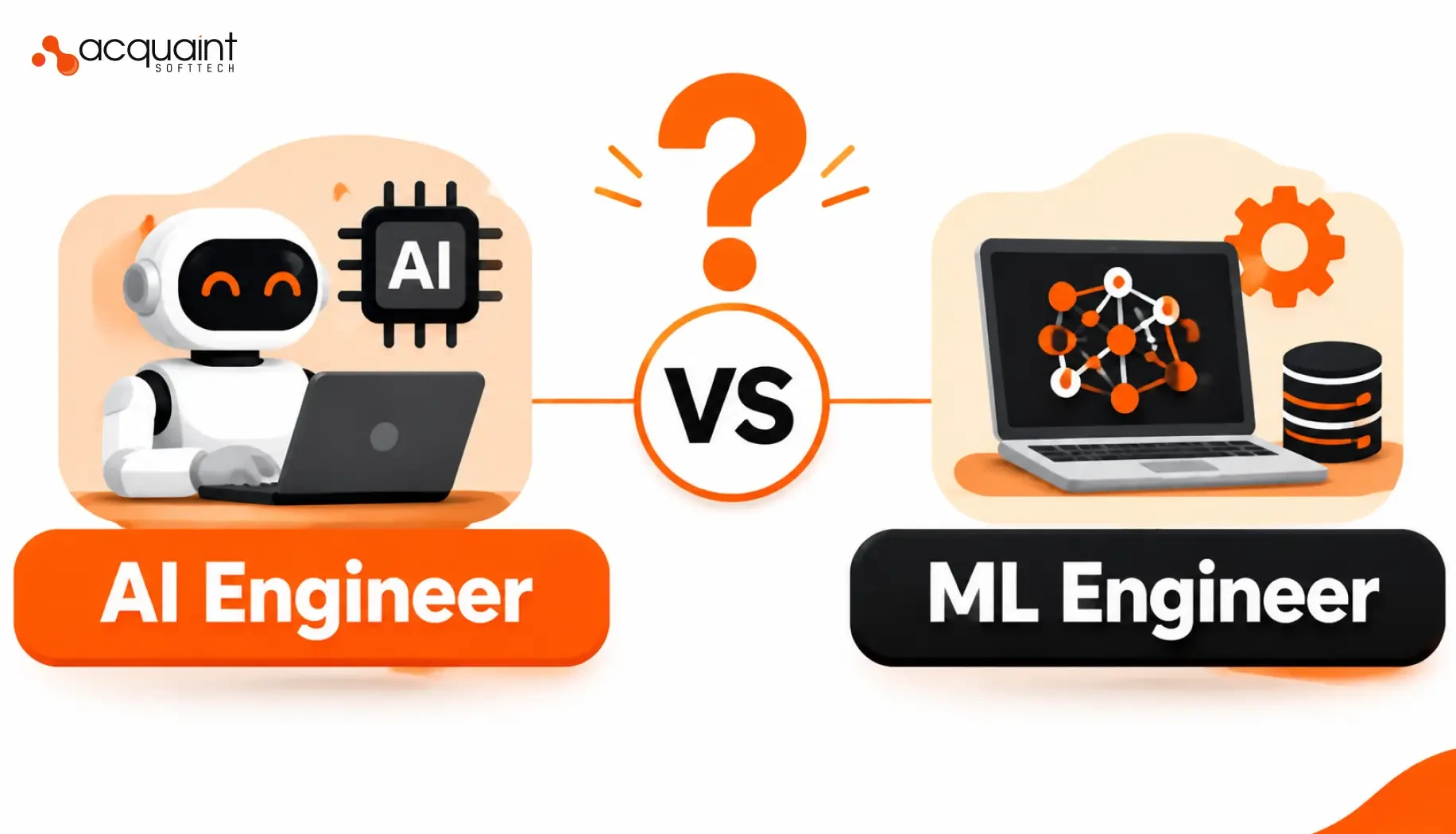
The main difference is what each engineer builds. An AI engineer builds applications that use existing AI models, connecting them to your data, systems, and users. An ML engineer builds the models themselves: preparing data, training, testing, deploying, and retraining them.
Put simply, an AI engineer is closer to a software engineer who specialises in AI, while an ML engineer is closer to a data scientist who specialises in production systems. Both write code, and on small teams one person often covers parts of both roles.
AI Engineer vs ML Engineer: Side-by-Side Comparison
Factor | AI engineer | ML engineer |
Main focus | AI-powered product features | Custom models on your data |
Typical models | Pre-trained LLMs and APIs | Models trained in-house |
Typical work | Chatbots, RAG, agents, copilots | Forecasting, scoring, recommendations |
Data need | Documents and business data for context | Large, labelled historical data |
Closest to | Software engineering | Data science |
Time to first result | Often weeks | Often months |
What Does an AI Engineer Do?

An AI engineer designs, builds, and maintains features that use AI models inside real products. Most of the work is integration and reliability rather than model training.
Connecting large language models to applications through APIs.
Building retrieval-augmented generation (RAG) so answers come from your own documents.
Designing AI agents that call tools and complete multi-step tasks.
Writing and testing prompts, guardrails, and output checks.
Evaluating accuracy, cost, and latency, and monitoring them in production.
Typical projects include support chatbots, internal knowledge assistants, document processing, and AI copilots inside SaaS products. Our AI development services cover this kind of work, from proof of concept to production.
What Does an ML Engineer Do?
An ML engineer builds, deploys, and maintains machine learning models trained on your data. The work centres on data quality, model performance and keeping models accurate over time.
Building data pipelines and engineering features from raw data.
Training, tuning and validating models.
Deploying models as reliable services.
Monitoring for drift and retraining when accuracy drops (MLOps).
Typical projects include demand forecasting, fraud detection, risk scoring, churn prediction, and recommendation engines. Our machine learning development services cover the full cycle, from feasibility to monitoring and retraining.
AI Engineer Skills vs ML Engineer Skills

Skill area | AI engineer | ML engineer |
Programming | Python, plus web back-end skills | Python, SQL |
Core AI skills | LLM APIs, RAG, agents, prompt design | Statistics, model training, tuning |
Data skills | Vector search, embeddings | Data pipelines, feature engineering |
Production skills | APIs, evaluation, guardrails | MLOps, monitoring, retraining |
Math depth | Moderate | High |
Python is the common language for both roles. If your AI work also needs data pipelines, APIs or back-end services, you can hire Python developers to support your AI or ML engineer at a lower rate.
Soft Skills for Both Roles
Explaining model limits and risks to non-technical stakeholders.
Breaking a vague AI idea into a testable first version.
Measuring results against a clear business metric
AI Engineer Salary vs ML Engineer Salary in 2026
In the US, AI engineers and ML engineers both earn well above the median for software developers. Recent 2026 data from a major US tech salary platform puts the average base salary at about $185,000 for AI engineers and about $162,000 for ML engineers, with average total compensation of about $211,000 to $212,000 for both.
Role or option | Typical annual cost | Source |
AI engineer (US, average base) | About $185,000 | US tech salary data, 2026 |
ML engineer (US, average base) | About $162,000 | US tech salary data, 2026 |
Computer and information research scientist (US median) | $140,300 | US Bureau of Labor Statistics, May 2025 |
Dedicated remote AI/ML engineer | 52,800(4,400 a month) | Acquaint Softtech pricing |
The US Bureau of Labor Statistics does not track AI engineers or ML engineers as separate occupations. Its closest category, computer and information research scientists, had a median annual wage of $140,300 in May 2025 and is projected to grow 22% from 2025 to 2035.
Remote AI/ML Engineer Cost
A remote AI or ML engineer costs much less than a US hire. Through Acquaint Softtech, part-time AI/ML engineers start at $30 an hour, and a full-time dedicated engineer costs $4,400 a month for 176 hours, with a one-week trial on dedicated hires.
Not sure whether you need an AI or ML engineer?
Describe your AI use case. We will recommend the right role, and engineers can start within 48 hours after you interview them.
Which One Should You Hire for Your AI Project?

Hire an AI engineer when the value comes from a language model working with your content. Hire an ML engineer when the value comes from patterns in your own historical data.
Your project | Hire | Why |
Customer support chatbot | AI engineer | Built on LLMs and your documents |
Internal knowledge assistant (RAG) | AI engineer | Retrieval and LLM integration |
AI agent that automates workflows | AI engineer | Tool use and orchestration |
Demand or sales forecasting | ML engineer | Trained on historical data |
Fraud detection or risk scoring | ML engineer | Custom models and monitoring |
Product recommendations | ML engineer | Behaviour data and ranking models |
AI product with both | Both, or one of each over time | Start with the first release’s need |
What If You Can Only Hire One?
Start with the role that unlocks your first release. Most companies adding AI to an existing product begin with an AI engineer, because LLM-based features can reach users quickly. Companies whose advantage lies in proprietary data, such as fintech or e-commerce platforms, often start with an ML engineer.
Questions to Ask Before You Hire
Does the feature need to generate text or answer questions, or predict a number or label?
Do you have enough clean, labelled historical data to train a model?
How will you measure success, and who will monitor the model after launch?
AI and ML Work in Practice
AI Engineering: Report Automation for Ailleron
Ailleron, a banking technology company, worked with Acquaint Softtech on an AI-driven workflow product. Its chairman reports that the work saves about 200 hours a week and cut report creation time from four days to one, as quoted on our AI development pages.
Machine Learning: Recommendation Engine for Kandy
For Kandy, an e-commerce business, our team built a product recommendation engine, the kind of custom model an ML engineer owns. The project is listed on our machine learning development page as improving customer engagement, average order value, and repeat purchases.
Ready to add AI to your product?
Start with a free 30-minute call. We will scope the right role, timeline, and budget, and you can interview engineers before they start.
Frequently Asked Questions
-
What is the difference between an AI engineer and an ML engineer?
An AI engineer builds product features on existing AI models; an ML engineer builds and maintains custom models trained on your data.
-
How much does an AI engineer earn?
In the US, recent 2026 data puts the average base salary at about $185,000. A remote AI/ML engineer through Acquaint Softtech costs $4,400 a month.
-
Which one should I hire for my AI project?
An AI engineer for chatbots, RAG, and agents; an ML engineer for forecasting, scoring and recommendations.
-
Is an ML engineer the same as a data scientist?
No. Data scientists focus on analysis and experiments; ML engineers turn models into reliable production systems.
-
Can one person do both roles?
On small projects, yes. As AI features grow, most teams separate the roles.
With over 11 years of experience in web application development and project management, I excel in leading cross-functional teams to deliver innovative digital solutions. My expertise spans eCommerce platforms, ERP systems, and JS & PHP-based frameworks, including WordPress, React JS, and Laravel. As a Technical Project Manager, I specialize in strategic planning, system design, and end-to-end project execution, transforming complex ideas into scalable, high-impact applications.
Table of Contents
Get Started with Acquaint Softtech
- 13+ Years Delivering Software Excellence
- 1300+ Projects Delivered With Precision
- Official Laravel & Laravel News Partner
- Official Statamic Partner
Related Blog

AI Development Cost in 2027: Pricing by Project Type, Team Size and Region
AI development costs $10,000 to $40,000 for a single AI feature, $25,000 to $250,000 for chatbots, predictive models, and AI agents, and $250,000 to $1 million or more for enterprise AI platforms. Budget in stages: a proof of concept first, then an MVP or production release, then running costs.

Mukesh Ram
November 3, 2026
Adding AI to Your SaaS: Build, Buy, or Wrap OpenAI
Adding AI to a SaaS product means embedding intelligent features such as semantic search, content generation, document Q&A, or smart automation. There are three paths: build your own model from scratch, buy a ready-made AI tool or platform, or wrap a hosted model API like OpenAI, Anthropic, or Gemini behind your own service layer. For almost every SaaS team in 2026, wrapping a hosted API is the right starting point: it ships fastest, costs the least upfront, and avoids the multi-million-dollar expense of training a model. Building from scratch is reserved for the rare cases where AI is the core product itself.

Ahmed Ginani
November 2, 2026
AI in On-Demand Apps: Matching, Pricing, Fraud Detection, and Predictive Analytics
AI in on-demand apps powers four high-value functions: matching customers with the best provider, setting dynamic prices from real-time demand, detecting fraud as it happens, and predicting demand, ETAs, and churn. It works by training machine-learning models on platform data, then serving their predictions live inside the app.

Manish Patel
July 21, 2026India (Head Office)
203/204, Shapath-II, Near Silver Leaf Hotel, Opp. Rajpath Club, SG Highway, Ahmedabad-380054, Gujarat
USA
7838 Camino Cielo St, Highland, CA 92346
UK
The Powerhouse, 21 Woodthorpe Road, Ashford, England, TW15 2RP
New Zealand
42 Exler Place, Avondale, Auckland 0600, New Zealand
Canada
141 Skyview Bay NE , Calgary, Alberta, T3N 2K6