

AI-Native Laravel Development: How Laravel Lets You Ship AI-Ready SaaS Without Rebuilding Your Stack
Laravel became AI-native in 2025 to 2026 with three first-party packages: the AI SDK, Boost, and MCP. Here is how a Laravel-native team adds secure, multi-tenant AI features in days, not months, with a Clutch-verified case study.

Kalpesh Rajora
As a Project Manager at Acquaint Softtech, an Official Laravel Partner recognized by Laravel's creator Taylor Otwell, I see the same line in almost every SaaS roadmap this year: add AI. Buyers now expect a chat assistant that knows their data, a search that understands meaning, and automation that drafts and summarizes. What was a nice-to-have last year is table stakes today.
The honest answer most teams miss is that you do not need a separate Python team or a new stack to deliver it. Laravel itself became AI-native, and our AI Development Services team builds on exactly that foundation. This article gives you the real picture: what that means, how you build an AI feature with it, a project we delivered, and what it costs.

- CTOs and product leads whose customers now expect AI features (chat, smart search, summaries) in the SaaS
- Teams wiring up AI calls by hand and hitting hallucinations, messy code, and rising token bills
- Founders unsure whether to add AI inside Laravel or build a separate service
- Companies that want AI which is secure, multi-tenant, and cost-aware from the first line
- Teams that want to ship AI in days, not rebuild the whole stack first
The AI decision is not only a technical choice. It affects your security posture, your token cost, how quickly a feature reaches customers, and whether one tenant's data can ever surface in another's answer. Reaching for hand-built wrappers around an AI provider works in a demo and then hurts in production.
The better path is to add AI on the same stack that already owns your users, billing, and permissions. To bring in experienced hands, many teams hire Laravel developers with AI integration experience from day one, or hire AI/ML engineers who have shipped production AI rather than proofs of concept.
What AI-Native Laravel Actually Means
AI-native means the framework ships official, maintained AI tools, so you build on a supported foundation instead of gluing third-party pieces together. Laravel now has three first-party packages, and each does a different job. Here is the whole landscape in one table.
Package | What it does | When you need it |
Laravel AI SDK | Build AI features in your app: agents, tools, memory, and streaming, all in PHP. | You are adding chat, search, or automation to your product. |
Laravel Boost | Helps AI coding agents write correct Laravel code via a Laravel-aware MCP server and 17,000+ vectorized docs. | You want developers to ship faster with fewer AI mistakes. |
Laravel MCP | Exposes your app to outside AI clients (Claude, ChatGPT, Cursor) with OAuth and Sanctum security. | You want users to reach your product from inside their AI tools. |
The one-line way to remember it: the AI SDK builds AI into your app, Boost helps AI build your app, and MCP lets outside AI reach your app. Most SaaS teams start with the AI SDK plus Boost. You do not need all three at once. Install what you need, when you need it. If you would rather build a focused AI feature as a product in its own right, Software Product Development covers the full team and process; for how AI fits a system built to scale as you grow, a Discovery Workshop maps the data, permissions, and cost guardrails before you build.
Not Sure Which Packages Your SaaS Needs? Ask a Laravel + AI Engineer.
Tell us your product and the AI feature you have in mind. A vetted Laravel and AI engineer will tell you which packages fit and what the build looks like. This conversation takes 15 minutes.
How to Build an AI Feature Into Your Laravel SaaS
Here is the practical shape of an AI feature done well, using a support assistant that answers from your customer's own documents.
Step 1: Store your knowledge as vectors
You turn documents into embeddings, which are number representations of meaning, and store them so the app can find passages by meaning rather than exact words. This is the same vector-search idea our team presented at Laracon India 2026, and it is what makes an assistant answer from your data instead of guessing.
Step 2: Build the feature with the Laravel AI SDK
You define an agent in PHP, give it a small set of tools (search the documents, look up an order, create a ticket), and let it answer. Keeping the toolset small matters: Laravel's own guidance warns that exposing too many tools at once causes context bloat and higher token costs, so each agent gets only the tools its job needs. When the model work gets heavy, you can hire developers to build a dedicated service your Laravel app calls, while your core product stays in Laravel.
Step 3: Run AI on the queue, and scope it per tenant
Instead of calling the model inside the web request, the AI SDK can queue the job, so a slow answer never blocks the user or times out the page. This is the same queue Laravel already uses for email and background jobs. The agent only ever searches the current tenant's data, using the permissions your Laravel app already enforces. That per-tenant scoping is the safety the hand-built approach usually misses.
Weighing What to Build? Get a Free AI Opportunity Map.
Tell us about your product and the AI feature you have in mind. A Laravel and AI engineer sends you a one-page map: which features fit the AI SDK, what needs a dedicated model service, the data and permission work involved, and a rough effort estimate for each.
Proof point: our BIANALISI predictive platform shipped in 7 months, every milestone on schedule, verified 5.0 on Clutch.
Real Case Study: A Clutch-Verified Predictive Intelligence Platform
AI-native is easiest to understand through a real build. This is a verified project from our portfolio, and it follows the exact pattern AI-ready SaaS uses: an application backend that owns data and permissions, a dedicated AI service for the heavy work, and a clean dashboard on top, with compliance designed in from day one.
Project detail | Predictive Health Intelligence Platform |
Client | BIANALISI SPA, Italy's largest integrated diagnostics group (1,001 to 5,000 employees). |
Stack | Python (pandas, scikit-learn, FastAPI) for the AI and data layer, PostgreSQL, a React dashboard, European-compliant cloud, role-based API access. |
Timeline | April to November 2025, 7 months, every milestone delivered on schedule. |
Verified result | 5.0 out of 5.0 Clutch rating across Overall, Quality, Schedule, and Cost (verified February 2026). |
BIANALISI runs diagnostics across many regional facilities. Their clinical data, laboratory results, diagnostic imaging, and outpatient services lived in separate systems that did not talk to each other. Leadership could not get a single trustworthy view across facilities, and there was no way to turn scattered data into forward-looking insight. In a regulated healthcare setting, any solution also had to meet strict European data rules from the first line of code.
We started from the business question and designed the architecture and compliance around it. We unified the data into a governed PostgreSQL foundation with role-based API access, so every request respected who was allowed to see what. We built the predictive layer in Python with pandas and scikit-learn, served through FastAPI, and kept it cleanly separate from the data and access layer. Then we delivered it on European-compliant cloud infrastructure with a React dashboard that made the intelligence usable for clinical and operational teams.
What changed for the client
Fragmented lab, imaging, and outpatient data unified into one trustworthy, cross-facility view.
A working predictive health intelligence layer, turning historical data into forward-looking insight.
Strict European data compliance and role-based access enforced on every request from day one.
All milestones delivered on schedule across a 7-month engagement.
A verified 5.0 out of 5.0 Clutch rating across Overall, Quality, Schedule, and Cost.
The lesson for a Laravel SaaS is direct. You do not choose between Laravel and AI. Your Laravel app becomes the orchestrator that owns users, data, and permissions, and it either runs the AI feature itself through the AI SDK or calls a dedicated model service when the work demands it.
That separation is the same shape the AI SDK now lets you build inside a Laravel app for most features. To run a build like this end-to-end against a fixed scope, development outsourcing delivers the full team; many companies also strengthen delivery by hiring AI developers to scale AI-powered apps across modern web ecosystems.
AI-Native SaaS Architecture: Secure, Multi-Tenant, Cost-Aware
Three things separate an AI feature that survives production from a demo that does not, and all three play to Laravel's strengths.
Security and isolation
Laravel MCP secures external AI access with OAuth 2.1 through Passport and token auth through Sanctum, the same patterns you already trust. Inside the app, the AI only ever sees data the current user is allowed to see, because it runs through Laravel's existing authorization.
In a multi-tenant SaaS, that per-tenant scoping is the line between a helpful assistant and a data breach. Keeping these controls healthy as the product grows is part of Support and Maintenance, so AI features stay safe long after launch.
Cost control
AI bills grow when every call sends too much context or exposes too many tools. Scoping each agent to a small toolset, caching where you can, and metering usage per tenant keeps costs predictable. Laravel's per-tenant rate limiting and usage-event patterns, already used for billing, apply directly to AI calls.
Reliability
AI calls belong on the queue, not in the web request, so slow model responses never time out a page. Monitoring per tenant, request rate, error rate, and token volume lets you catch a runaway feature before it affects everyone.
If your app is on an older Laravel version, Version Upgrade Services get you onto a release that supports the first-party AI packages, and Virtual CTO Services provide senior direction for adopting AI tooling across the org.
Cost, Timeline, and Engagement: Real 2026 Numbers
A focused AI feature on an existing Laravel app, for example a document-aware assistant or semantic search, is usually a 2-to-4 week build with a small team, because the framework now provides the AI building blocks. A larger platform with a dedicated model service, like the predictive intelligence project above, runs over several months on clear milestones.
Build type | Timeline | Engagement |
Focused AI feature (assistant, semantic search) | 2 to 4 weeks on an existing Laravel app | Small team, start with one feature and expand |
AI platform with dedicated model service | Several months on milestones | Full team, fixed scope or dedicated team |
Add AI + Laravel hands to your team | Engineer ready in 48 hours | From $22/hour or $3,200/month, matched in 24 hours |
Start small on purpose. One well-chosen AI feature, shipped cleanly and scoped per tenant, teaches you more about your customers and your costs than a six-month plan written before anything is live.
To add senior AI and Laravel hands only for the build, Hire Remote Developers puts a vetted team on it within 48 hours; to keep one team owning both the Laravel and AI sides over time, Software Dedicated Teams gives you clear ownership; and for ongoing model work after launch, Hire AI Engineers keep your AI improving.
Ready to Add AI to Your Laravel SaaS the Right Way? Start in 48 Hours.
Book a 30-minute call with a Laravel and AI engineer. You walk away with a clear plan: the first feature to ship, whether it runs in Laravel or needs a model service, the data and security work involved, a timeline, and a fixed price.
From $22/hour or $3,200/month · Matched in 24 hours · Engineer ready in 48 hours
How Acquaint Softtech solved it
We started from the business question and designed the architecture and compliance around it, which is the pattern that most reliably predicts success across our portfolio. We unified the data into a governed PostgreSQL foundation with role-based API access, so every request respected who was allowed to see what.
We built the predictive layer in Python with pandas and scikit-learn, served through FastAPI, and kept it cleanly separate from the data and access layer. And we delivered it on European-compliant cloud infrastructure with a React dashboard that made the intelligence usable for clinical and operational teams.
That separation, a governed backend that owns data and permissions, a dedicated model service, and a usable dashboard, is the same shape the Laravel AI SDK now lets you build inside a Laravel app for most features. To scope a build like this for your product, AI development starts exactly where we started here: with the real business question.
THE RESULTS │ What changed for the client
Fragmented lab, imaging, and outpatient data unified into one trustworthy, cross-facility view.
A working predictive health intelligence layer, turning historical data into forward-looking insight.
Strict European data compliance and role-based access enforced on every request from day one.
All milestones delivered on schedule across a 7-month engagement.
A verified 5.0 out of 5.0 Clutch rating across Overall, Quality, Schedule, and Cost.
The lesson for a Laravel SaaS is direct. You do not choose between Laravel and AI. Your Laravel app becomes the orchestrator that owns users, data, and permissions, and it either runs the AI feature itself through the AI SDK or calls a dedicated model service when the work demands it. The hard parts, data governance, access control, and delivering on time, are the same parts we delivered here.
For the team to run a build like this end-to-end, Software Development Outsourcing delivers against a fixed scope. More verified outcomes across fintech, real estate, and SaaS are in our Laravel project case studies.
Why Acquaint Softtech for AI-Native Laravel
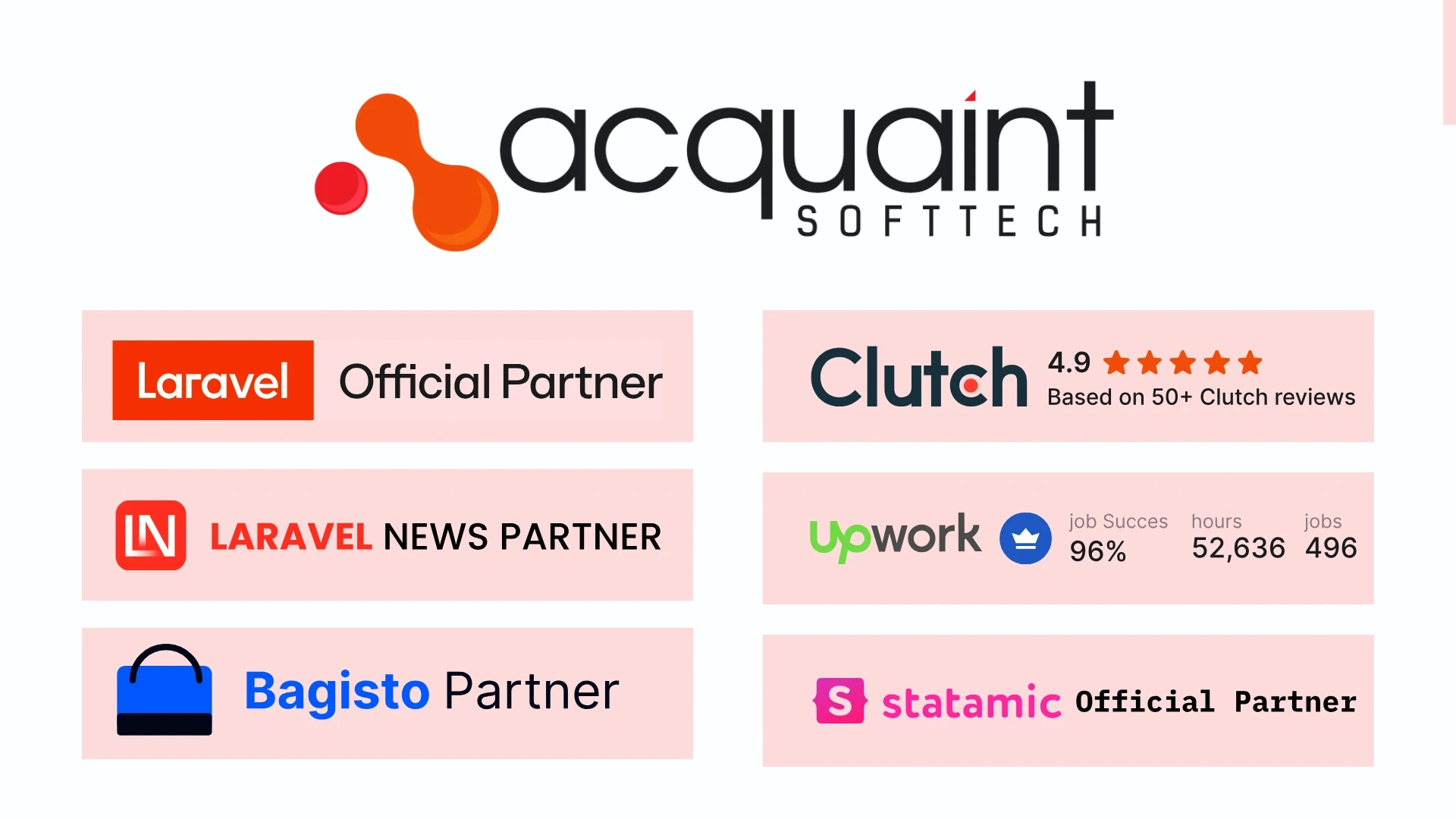
AI-native Laravel is new, so experience counts more than usual. We are an Official Laravel Partner, listed and verified on the Laravel partner directory and recognized by Taylor Otwell, with a separate partnership with Laravel News. Our team presented on how vector databases work at Laracon India 2026, the exact foundation of AI search and assistants.
We have delivered 200+ Laravel projects in 13+ years with 70+ in-house engineers, plus production AI like the BIANALISI predictive platform above, and our AI-ready Laravel developers are on board in 48 hours. Deep Laravel roots and shipped AI delivery on the same team is rare; most agencies have one or the other, and AI-native work needs both.
Frequently Asked Questions
-
What does AI-native Laravel mean?
It means Laravel ships official, maintained AI packages, the AI SDK, Boost, and MCP, so you build AI on a supported foundation instead of gluing third-party tools together. Your existing Laravel app becomes the AI-ready platform.
-
Do I need Python to add AI to a Laravel app?
For most product features, no. The Laravel AI SDK provides agents, tools, memory, and streaming in PHP. You add a Python or other model service only for heavy custom work, and your Laravel app orchestrates it.
-
What is the difference between the AI SDK, Boost, and MCP?
The AI SDK builds AI features into your app, Boost helps AI coding agents write correct Laravel code while you develop, and MCP exposes your app to outside AI clients like Claude and ChatGPT. Most teams start with the AI SDK and Boost.
-
How do I keep AI features secure and multi-tenant?
Run AI through Laravel's existing authorization so it only reads the current tenant's data, secure external AI access with OAuth or Sanctum via Laravel MCP, and meter and rate-limit AI calls per tenant.
-
Will adding AI slow down my app?
Not if AI work runs on Laravel's queue instead of inside the web request. The AI SDK supports queued AI jobs, so slow model responses never block users or time out pages.
-
How long does it take to add an AI feature?
A focused feature, such as an assistant or semantic search, usually takes 2 to 4 weeks on an existing Laravel app. Larger AI platforms with custom models run on a longer milestone plan.
-
Why choose Acquaint Softtech for AI-native Laravel?
We are an Official Laravel Partner recognized by Taylor Otwell, presented on vector databases at Laracon India 2026, and shipped a Clutch-verified 5.0 predictive intelligence platform, with AI-ready engineers onboarding in 48 hours.
I am Kalpesh Rajora, a Project Manager at Acquaint Softtech with 8+ years of experience leading Laravel and full-stack delivery teams. I specialise in sprint planning, client communication, and shipping complex software projects on time across distributed teams. I write about the delivery side of software: how projects are scoped, where timelines slip, and what keeps remote teams aligned.
Table of Contents
Get Started with Acquaint Softtech
- 13+ Years Delivering Software Excellence
- 1300+ Projects Delivered With Precision
- Official Laravel & Laravel News Partner
- Official Statamic Partner
Related Reading
Laravel Performance Optimization: How to Scale a Laravel App for Real Business Traffic
Laravel performance optimization is the work of finding and removing the bottlenecks that make an app slow under traffic, then architecting it to scale. The biggest single win is almost always eliminating N+1 queries and adding indexes, which cuts response times by 80 to 95%. Measure first, fix the biggest bottleneck first, and never rewrite when a targeted fix will do.
Kalpesh Rajora
July 2, 2026
How Laravel 13 Helps Developers Build Faster PHP Enterprise Applications in 2026
Laravel 13 (Released March 17, 2026) redefines modern PHP by making AI, modern syntax, standardized APIs, and passwordless security first-party, while keeping upgrades painless: No upgrade-breaking changes and about a ten-minute move from Laravel 12. That combination removes the last reasons enterprises hesitated to standardize on PHP.
Kalpesh Rajora
July 1, 2026.webp "How Laravel Deployment Turns Slow, Risky Releases Into 5-Minute Deploys")
How Laravel Deployment Turns Slow, Risky Releases Into 5-Minute Deploys
Laravel deployment improves scalability and team productivity through automated, zero-downtime pipelines on managed infrastructure like Laravel Cloud, cutting release time from 45 minutes to under 5 and freeing up 20–35 engineer hours monthly.
Kalpesh Rajora
June 24, 2026India (Head Office)
203/204, Shapath-II, Near Silver Leaf Hotel, Opp. Rajpath Club, SG Highway, Ahmedabad-380054, Gujarat
USA
7838 Camino Cielo St, Highland, CA 92346
UK
The Powerhouse, 21 Woodthorpe Road, Ashford, England, TW15 2RP
New Zealand
42 Exler Place, Avondale, Auckland 0600, New Zealand
Canada
141 Skyview Bay NE , Calgary, Alberta, T3N 2K6