

AI Readiness Assessment: 12-Point Checklist Before You Start an AI Project
An AI readiness assessment checks whether your business has a clear use case, usable data, connectable systems, the right people, governance, and budget before you start an AI project. It usually takes 2 to 4 weeks and ends with ranked use cases and a phased AI implementation roadmap.

Chirag Daxini
Most AI projects that stall do not fail on the model. They fail because the data was not ready, the use case was vague, or nobody owned the result. An AI readiness assessment catches those gaps before you spend on a build, and it is the first step in our AI consulting services.

- Leadership wants AI, but nobody agrees where to start.
- You are unsure whether your data and systems can support AI.
- You need a roadmap and business case before a budget is approved.
- You are a CEO, CTO, COO, founder, or operations leader in the US, UK, Europe, Australia, or New Zealand.
This guide gives you a 12-point checklist you can run yourself, a simple scoring method, and a phased AI implementation roadmap that shows what to do next at each score.
Use it before you talk to vendors. A business that knows its readiness score gets better proposals, clearer quotes, and a faster path through AI development services when it is ready to build.
What Is an AI Readiness Assessment?
An AI readiness assessment is a structured review of your business problems, data, systems, people, governance, and budget to decide whether an AI project can succeed, which use case to start with, and what must be fixed first.
Assessment area | Key question | Output |
Strategy | Which problem is worth solving with AI? | Ranked use cases |
Data | Is the data available, clean, and allowed? | Data readiness report |
Technology | Can AI connect to our systems securely? | Target architecture |
People | Who will build, own, and use it? | Skills gap plan |
Governance | What are the privacy and risk rules? | Governance plan |
Economics | What will it cost and return? | Business case and roadmap |
Why AI Readiness Matters in 2026
Adoption is rising fast, but so are the gaps. UK government research published on 29 October 2026 found that 32% of UK businesses now use at least one AI technology, double the 16% reported in 2025.
The same research shows why readiness matters: limited AI skills affected 67% of businesses that had adopted AI, and 65% of non-adopters cited the lack of a clear business case or proven return. Concerns about accuracy and bias were reported by 56% of adopters.
In the US, a 2 November 2026 update to an AI adoption tracker based on Census Bureau survey data put AI use at 24.6% of establishments, nearing 50% in the information, professional services and finance sectors.
The 12-Point AI Readiness Checklist
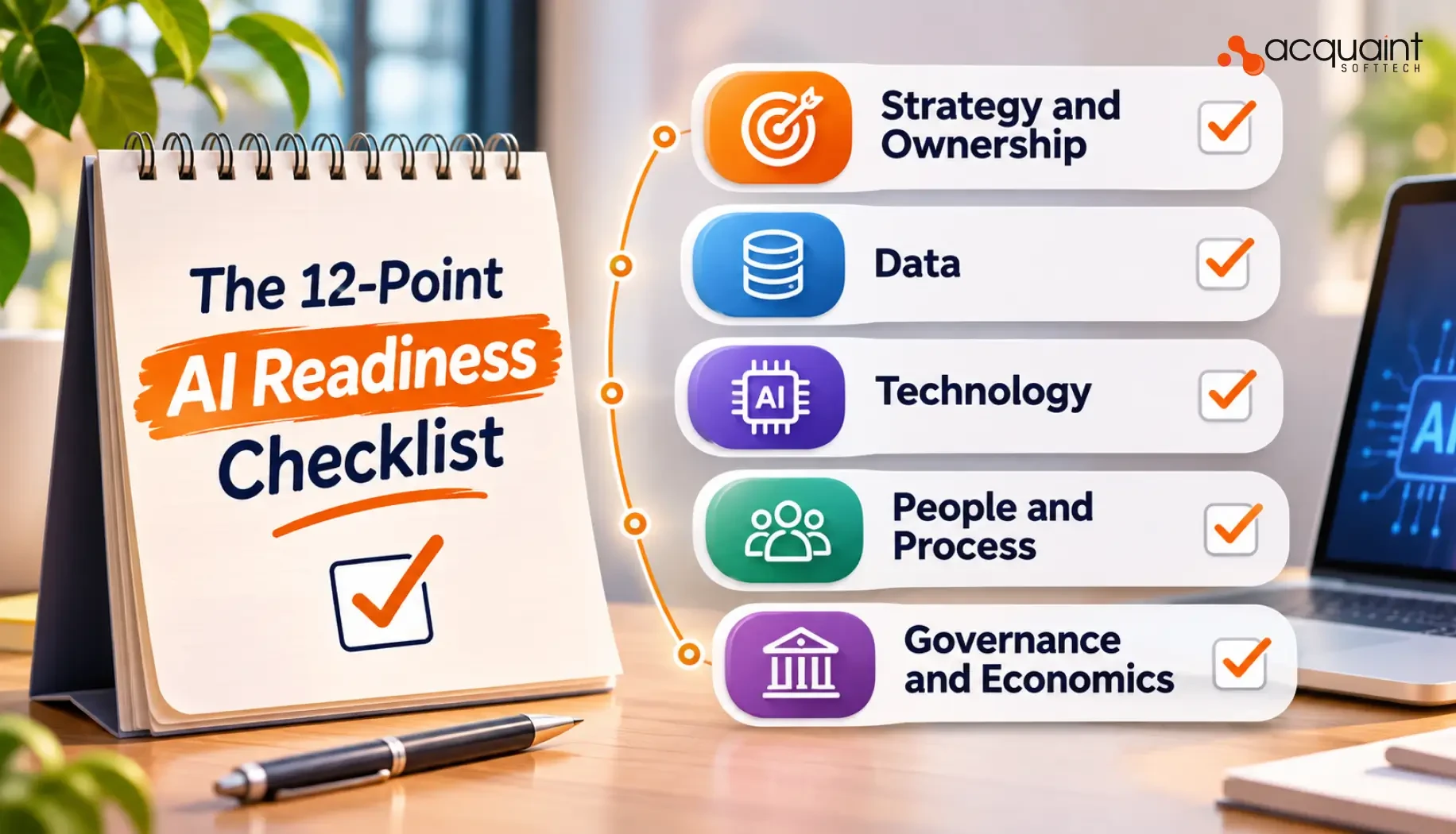
Work through each point for one specific use case. For every item, note the evidence you have, not what you hope is true.
Strategy and Ownership
A specific business problem: for example, "reduce time spent answering repeat support tickets", not "use AI".
A measurable success metric and baseline: today’s handling time, error rate or cost, so you can prove improvement.
An executive sponsor and a process owner: someone funds it, and someone in the business owns the outcome.
Data
Data is available and accessible: you know where it lives and can extract it.
Data quality is good enough: complete, current, and, for prediction, labelled with known outcomes.
Data use is permitted: consent, privacy and contract terms allow it, and personal data can be redacted.
Technology
Systems can connect: the CRM, ERP, or help desk the AI must use has APIs or export options.
Security controls exist: role-based access, audit logging, and a place to host AI securely.
People and Process
Delivery capacity: in-house skills, a partner, or a mix to build and maintain the solution.
Users and process are ready: clear human review points and a plan to train the people who will use it.
Many first projects are not AI models at all but automated workflows, where AI classifies, routes, and drafts inside an existing process. AI workflow automation is often the fastest readiness win because the process already exists.
Governance and Economics
Governance and compliance: you know the regulatory, privacy, and risk rules for this use case and who approves AI decisions.
Budget covers build and running costs: including model usage, hosting, monitoring, and updates, with an expected payback.
Want an expert to run this checklist with you?
Book a free 30-minute AI readiness call. An AI engineer will review your use case, score your readiness, and name the gaps to fix first.
How to Score Your AI Readiness
Score each of the 12 points: 0 if it is not in place, 1 if it is partly in place, and 2 if it is fully in place with evidence. The maximum score is 24.
Score | Readiness level | Recommended next step |
0 to 8 | Not ready yet | Fix data, ownership, and use-case gaps first |
9 to 16 | Ready to test | Run a fixed-scope proof of concept |
17 to 24 | Ready to build | Plan an MVP or production rollout |
Treat points 1, 4, and 6 as gates. If you score 0 on the problem, the data, or permission to use the data, do not start a build, whatever your total.
How Do I Know If My Business Is Ready for AI?

Your business is ready for AI when one specific use case scores well on the checklist: a clear problem with a measurable baseline, accessible and permitted data, systems that can connect, an owner, and budget for both build and running costs.
Common signs you are not ready yet:
Nobody can name the metric the AI project should improve.
The data you need sits in spreadsheets, emails, or scanned files with no owner.
Legal or security teams have not been involved.
The budget covers the build but not monthly usage and maintenance.
Being "not ready" is useful information. It tells you exactly what to fix, and most gaps, such as data cleanup or access rules, can be closed in weeks.
What Should an AI Implementation Roadmap Include?
An AI implementation roadmap turns the assessment into phased, funded steps, each with an owner, a timeline, and a decision point.
Phase | What happens | Typical duration |
Assess | Ranked use cases, data check, business case | 2 to 4 weeks |
Prove | Proof of concept on real data | 2 to 3 weeks |
Build | MVP or production release for one use case | 8 to 12 weeks |
Scale | More users, channels or use cases | Ongoing |
Govern | Monitoring, accuracy reviews, cost control | Ongoing |
What Every Roadmap Should Include
• Prioritised use cases scored by value, effort, data readiness and risk.
• Success metrics and go or no-go points at the end of each phase.
• Build, buy or integrate decisions for each use case.
• Budget per phase, including running costs.
• Governance rules: privacy, human approval, and audit requirements.
If the first use case is a new product rather than an internal process, the build phase is usually an AI-powered MVP that launches one core AI feature to real users in 8 to 12 weeks.
For a sense of build budgets, Acquaint Softtech publishes its prices: readiness assessments are quoted after a free call, hourly AI consulting starts from $30, and a fractional AI lead costs $4,400 per month.
Should You Start With an AI Proof of Concept?
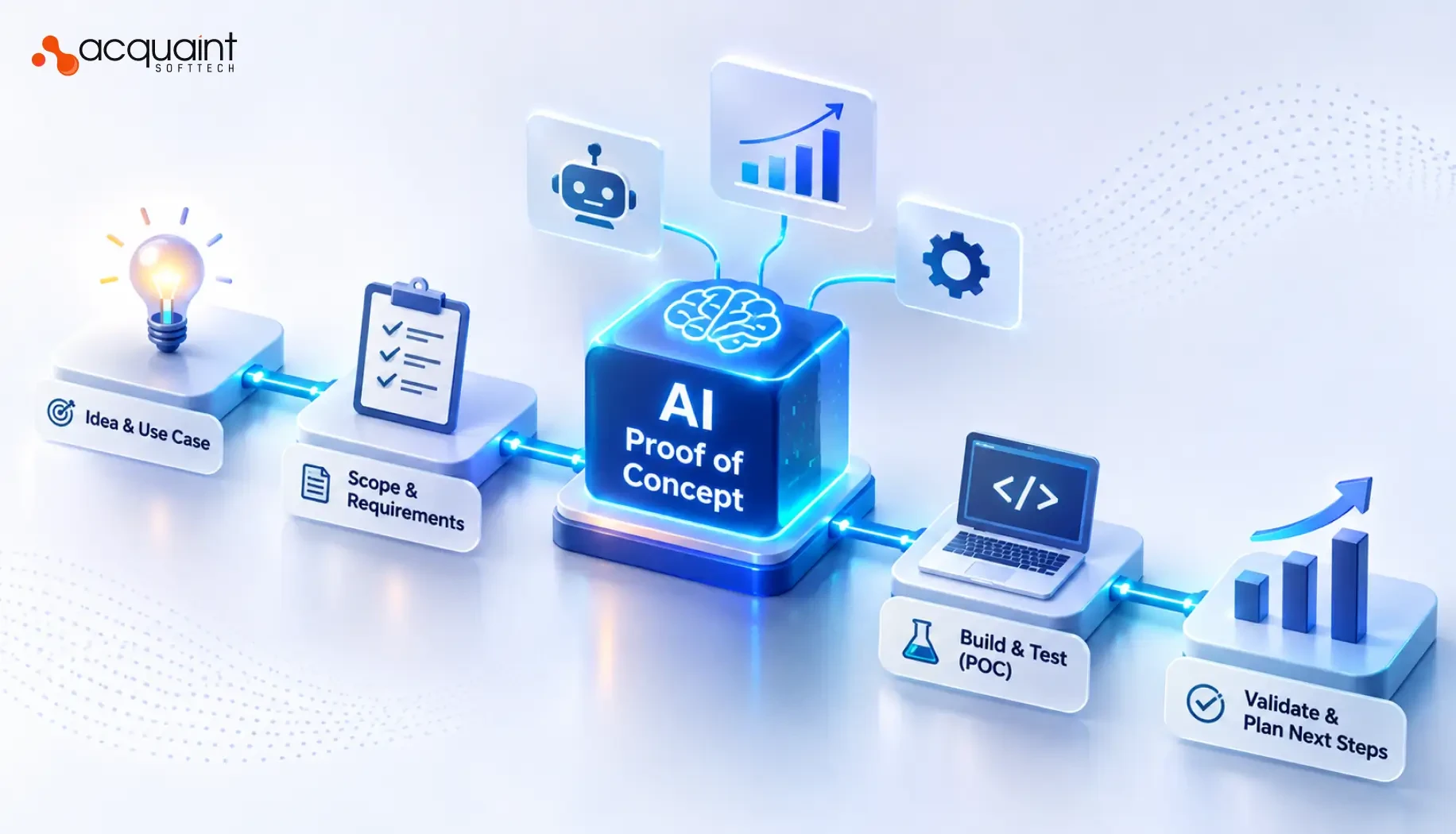
Yes, if your readiness score is in the middle band or the use case is unproven on your data. A proof of concept tests one use case against your success metric before you commit the full budget.
A fixed-price AI proof of concept costs $12,000 to $20,000, takes 2 to 3 weeks and ends with measured accuracy, a production cost forecast, a list of data gaps, and a go or no-go recommendation.
Skip the proof of concept only when the use case is well proven elsewhere, and your data is already clean and accessible, for example, adding a standard document summary feature to an existing app.
AI Readiness in Practice: Two Client Examples
Fix the Data First: Banking Technology
Ailleron, a banking-technology company, had analysts spending much of their time gathering data from several source systems. The readiness advice was to automate the data foundation first, then add AI on top, as shown in the banking data warehouse case study.
Pilot Before Rollout: Real Estate
Property Brokers, which operates from more than 80 locations in provincial New Zealand, wanted predictive valuation without risking a big-bang rollout. A staged pilot came first, and the property intelligence platform case study shows how it replaced scattered spreadsheets and sped up appraisal preparation.
Ready to find your best first AI use case?
Book a free 30-minute AI readiness call. You get an honest view of your readiness, the gaps to fix and the right first step, with an NDA signed first.
Frequently Asked Questions
-
What is an AI readiness assessment?
A structured review of your use cases, data, systems, people, governance, and budget to decide whether and where to start with AI.
-
How do I know if my business is ready for AI?
You are ready when one specific use case has a measurable goal, usable and permitted data, connectable systems, an owner, and budget for build and running costs.
-
What should an AI implementation roadmap include?
Prioritised use cases, success metrics, go or no-go points, build or buy decisions, budget per phase and governance rules.
-
Should I start with an AI proof of concept?
Yes, when the use case is unproven on your data. A proof of concept takes 2 to 3 weeks and costs $12,000 to $20,000.
-
How long does an AI readiness assessment take?
Usually 2 to 4 weeks, ending with ranked use cases, a business case, and a phased roadmap.
With over 11 years of experience in web application development and project management, I excel in leading cross-functional teams to deliver innovative digital solutions. My expertise spans eCommerce platforms, ERP systems, and JS & PHP-based frameworks, including WordPress, React JS, and Laravel. As a Technical Project Manager, I specialize in strategic planning, system design, and end-to-end project execution, transforming complex ideas into scalable, high-impact applications.
Table of Contents
Get Started with Acquaint Softtech
- 13+ Years Delivering Software Excellence
- 1300+ Projects Delivered With Precision
- Official Laravel & Laravel News Partner
- Official Statamic Partner
Related Blog

AI Development Cost in 2027: Pricing by Project Type, Team Size and Region
AI development costs $10,000 to $40,000 for a single AI feature, $25,000 to $250,000 for chatbots, predictive models, and AI agents, and $250,000 to $1 million or more for enterprise AI platforms. Budget in stages: a proof of concept first, then an MVP or production release, then running costs.

Mukesh Ram
November 3, 2026
AI and Data Analytics in Travel: Demand Forecasting, Price Optimization, and Customer Intelligence
AI and data analytics in travel use machine learning to turn booking, search, and customer data into revenue. The three core engines are demand forecasting, which predicts future occupancy and bookings; price optimization, which sets the best price in real time based on demand; and customer intelligence, which identifies high-value travellers and predicts who will book or cancel. Hotels using AI-driven pricing report revenue gains of 5 to 14%.

Manish Patel
June 29, 2026
AI and Machine Learning in Logistics: Demand Prediction, Route Optimization, and Anomaly Detection
AI and machine learning in logistics use historical and real-time data to predict demand, optimize delivery routes, and detect supply chain anomalies before they become costly problems. These technologies help businesses reduce costs, improve efficiency, and make faster, data-driven decisions.
Manish Patel
June 11, 2026India (Head Office)
203/204, Shapath-II, Near Silver Leaf Hotel, Opp. Rajpath Club, SG Highway, Ahmedabad-380054, Gujarat
USA
7838 Camino Cielo St, Highland, CA 92346
UK
The Powerhouse, 21 Woodthorpe Road, Ashford, England, TW15 2RP
New Zealand
42 Exler Place, Avondale, Auckland 0600, New Zealand
Canada
141 Skyview Bay NE , Calgary, Alberta, T3N 2K6