

AI and Data Analytics in Travel: Demand Forecasting, Price Optimization, and Customer Intelligence
AI and data analytics in travel use machine learning to turn booking, search, and customer data into revenue. The three core engines are demand forecasting, which predicts future occupancy and bookings; price optimization, which sets the best price in real time based on demand; and customer intelligence, which identifies high-value travellers and predicts who will book or cancel. Hotels using AI-driven pricing report revenue gains of 5 to 14%.

Manish Patel

- You run a hotel or OTA still setting prices by gut feel, not data.
- You are a founder or CTO planning to build AI and analytics into your travel platform.
- You are sitting on booking data you are not turning into revenue.
- You want to predict demand, cut cancellations, or spot high-value travellers.
- You need a clear travel AI and analytics build cost and timeline for 2026.
Introduction
Two hotels sit on the same street, same star rating, same room quality. One earns 14% more revenue per room than the other. The difference is not marketing or location. It is that one hotel prices with AI, and the other prices with a spreadsheet and a hunch.
This is the quiet revenue gap in travel. Most operators are sitting on years of booking, search, and customer data, and using almost none of it. They set prices manually, forecast by feel, and treat every traveller the same. Meanwhile competitors turn the same data into a measurable revenue edge.
The stakes are real. AI-driven dynamic pricing has reportedly boosted Hilton revenue by 5 to 8%, and one Dubai hotel group lifted occupancy 9.1% and revenue 13.7% year-on-year with AI pricing. Data sitting idle is money left on the table, every single night.
The fix is turning data into three working engines: forecasting, pricing, and customer intelligence. This guide explains each one, with real ROI figures and a build framework. It is part of the complete guide to travel and hospitality software development, and pairs with our breakdown of how hotel booking engines work, the system that generates the data these models learn from.
Acquaint Softtech has built AI and analytics platforms across five markets through its AI development services. With 1,300+ projects delivered, 70+ in-house engineers, and a 4.9/5 rating from 50+ verified Clutch reviews, the architecture here reflects production systems, not theory.
What AI and Data Analytics Mean in Travel
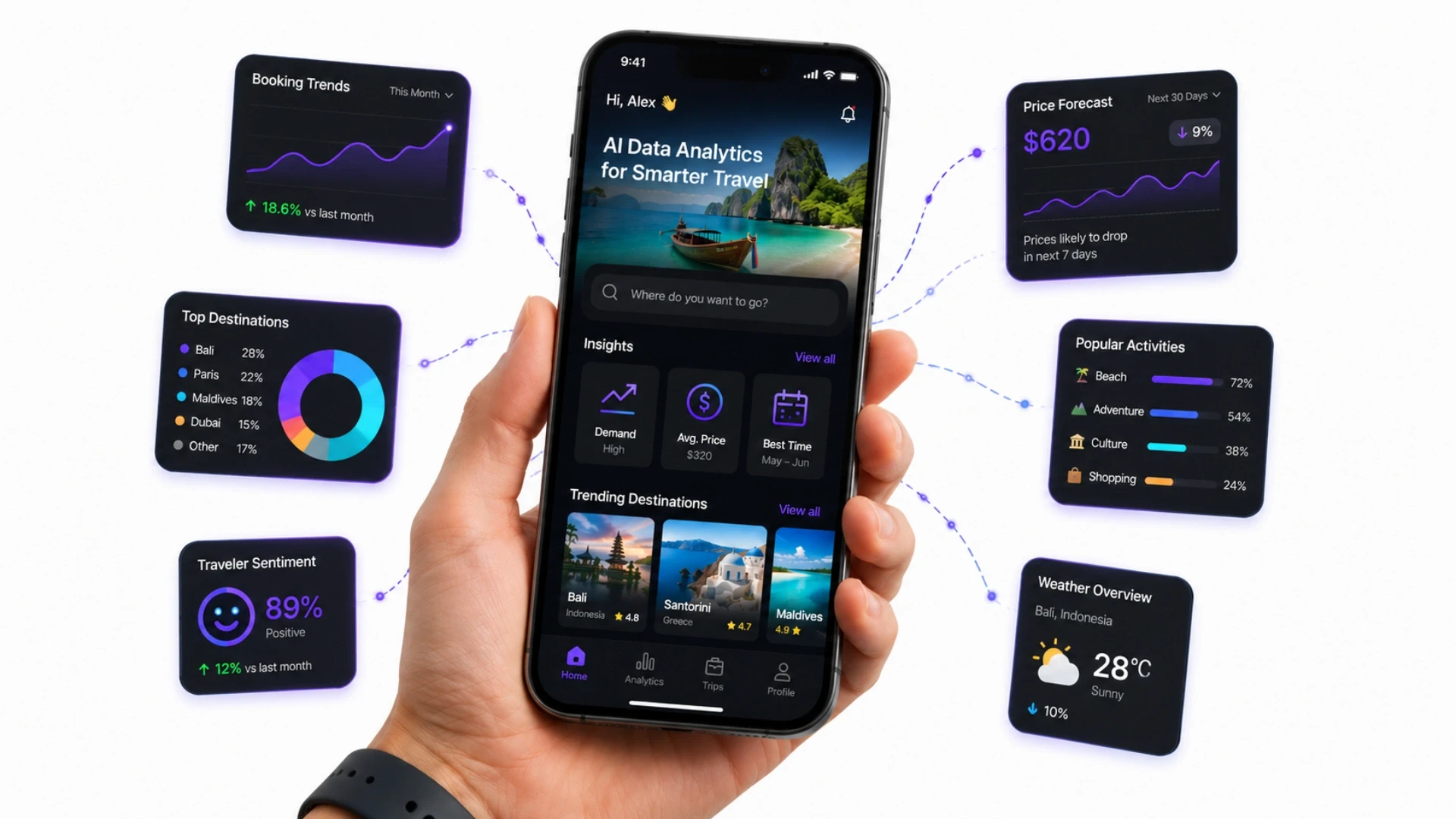
AI and data analytics in travel means using machine learning to find patterns in booking, search, pricing, and customer data, then acting on those insights automatically. It turns raw data into predictions like future demand, pricing changes, and traveller targeting. To build these systems at scale, you often need strong backend engineering like Hire MEAN Stack Developers. Analytics shows what happened, while AI predicts what will happen and what action to take next.
Why 2026 Is the Tipping Point
A 2025 Statista report found 40% of global consumers already use AI for travel planning. The travellers are ahead of the operators. Brands that do not match this with AI-driven pricing and personalisation are losing both revenue and relevance.
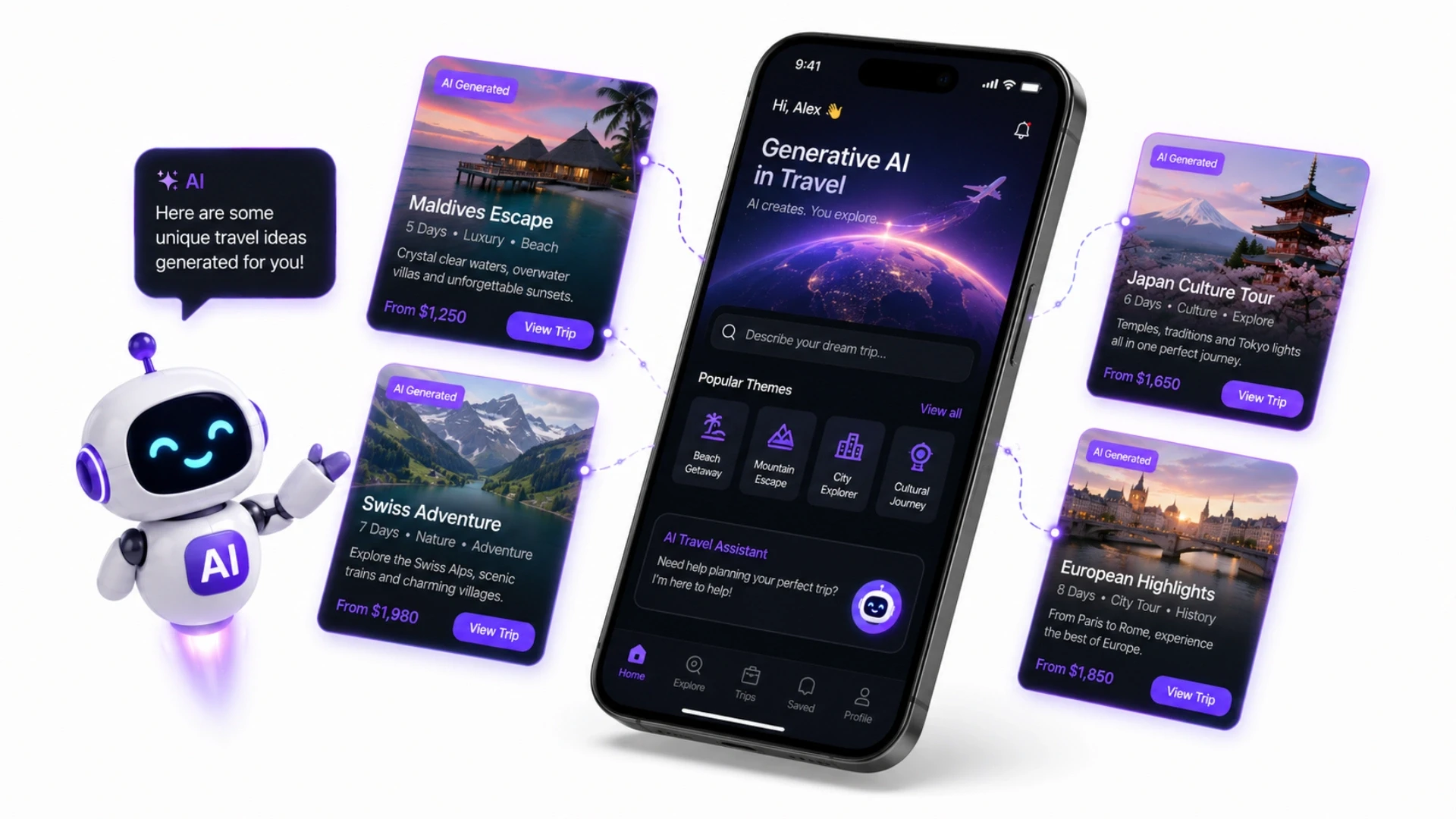
Modern travel AI also includes generative AI for trip planning and content. Building those assistants is its own discipline, covered in our guide Generative AI for Travel.
Teams that need engineers who have built travel ML models usually hire Python developers rather than training a general team on travel data. For the wider engagement context, see what staff augmentation is and how it works.
The 3 Engines: Forecasting, Pricing, and Intelligence
Travel AI is not one thing. It is three connected engines, each turning data into a different kind of decision. Most platforms build them in this order, because each one feeds the next.
Engine | What It Predicts | Business Result |
Demand Forecasting | Future occupancy and bookings | Better inventory and staffing |
Price Optimization | The best price for each date | 5-14% revenue uplift |
Customer Intelligence | Who books, who churns, who pays more | Higher retention and lifetime value |
The engines compound. Forecasting feeds pricing: you cannot price well without knowing demand. Pricing feeds intelligence: knowing who pays what reveals your high-value travellers. Built together, they create a flywheel that gets smarter with every booking.
All three engines run on a single data foundation. Building that warehouse is its own project, covered in our guide Building a Travel Data Warehouse. Surfacing the output to decision-makers ties into Building a Travel Business Intelligence Dashboard.
Most travel AI projects fail on data quality, not algorithms. For why AI and travel domain experience prevent that, read why Acquaint Softtech is the right travel and hospitality partner. Teams building the model layer often hire AI and ML engineers with NLP and forecasting experience.
Demand Forecasting: Seeing Bookings Before They Happen
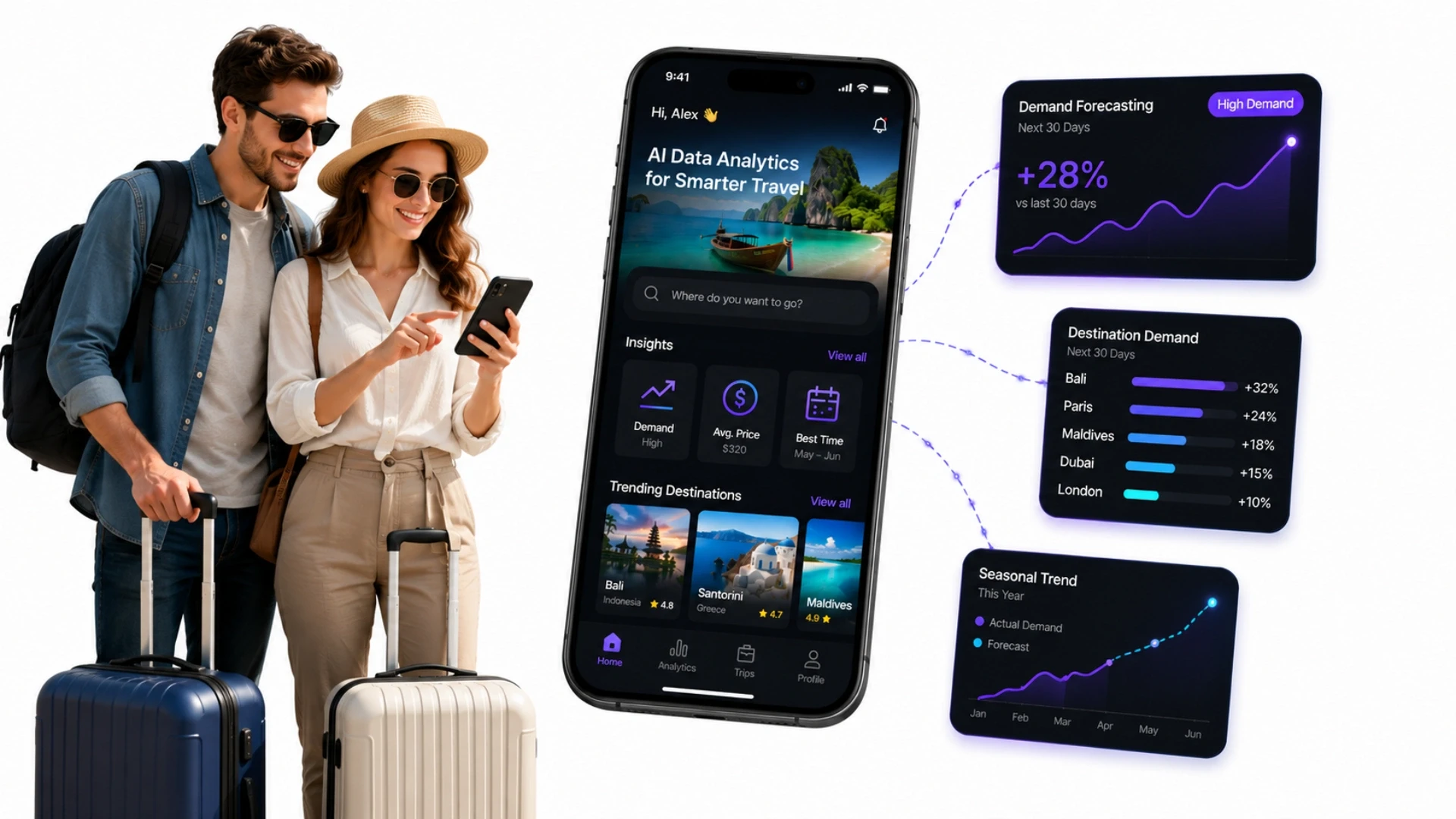
Demand forecasting uses machine learning to predict future occupancy and bookings, so operators can adjust pricing, inventory, and staffing before demand arrives, not after. It is the foundation the other two engines are built on. If you are planning to build this system, you can also hire MERN stack developers to accelerate development.
Why a Spreadsheet Cannot Compete
A human forecasting from last year's numbers misses the signals that actually move demand: a concert announced next month, a competitor selling out, a weather forecast, a currency shift. An ML model reads all of these at once and updates the forecast continuously.
The model learns from historical bookings, booking pace, local events, competitor rates, and seasonality. It outputs predicted demand by date with confidence levels, so a revenue manager knows not just the forecast but how sure the model is.
The full build, predicting occupancy with ML, events, and weather data, is covered in our guide Hotel Demand Forecasting. Visualising where demand is heading by location ties into Building a Destination Demand Heatmap.
A forecasting model needs clean historical data and ML expertise. Teams often hire Python developers for the model and data pipeline. For how distributed teams deliver ML reliably, see how to build a successful remote development team.
Sitting on Booking Data You Are Not Using?
Acquaint Softtech assesses your data readiness and shows you which AI engine, forecasting, pricing, or intelligence will deliver the fastest revenue return against the data you already have.
Price Optimization: Charging the Right Price Every Time
Price optimization uses AI to set the best possible price for every room, seat, or activity in real time, based on demand, competition, and timing. It is where travel AI delivers the clearest, fastest return on investment. You can also explore our DevOps development services to build scalable and high-performance travel systems that support these AI-driven pricing engines.
Why Dynamic Beats Fixed Every Time
A fixed price is wrong almost all the time. It is too low when demand is high, leaving money on the table, and too high when demand is low, losing the booking. A dynamic engine recalculates continuously, capturing revenue at the peak and filling rooms in the trough.
The results are documented. Hilton has reportedly boosted revenue 5 to 8% with AI pricing. A Dubai hotel group lifted occupancy 9.1% and revenue 13.7% year-on-year. These are not projections; they are reported outcomes from deployed systems.
Systems that adjust prices every second based on live demand are the cutting edge, covered in our guide Real-Time Travel Pricing Engine. For flights, predicting when fares will rise or fall is covered in Building a Flight Price Prediction Engine.
A pricing engine is high-stakes, real-time ML. Teams usually hire AI and ML engineers for the pricing models. To compare engagement models for this kind of build, staff augmentation vs dedicated team vs outsourcing.
Customer Intelligence: Knowing Who Will Book and Who Will Churn
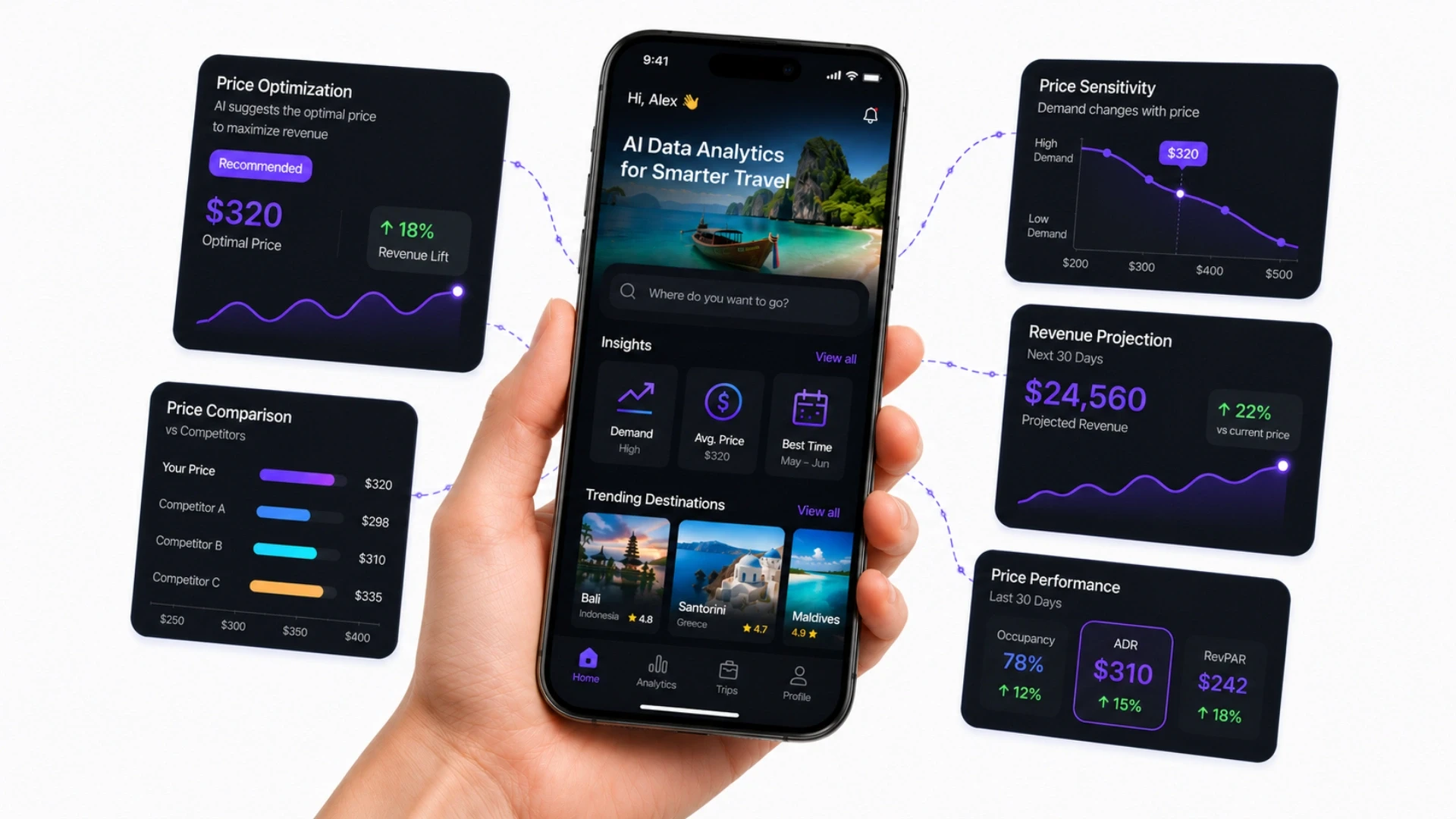
Customer intelligence uses AI to understand traveller behaviour: who is likely to book, who will pay more, who is about to cancel, and who is worth keeping. It turns a list of customers into a ranked map of opportunity.
Why Treating Every Customer the Same Costs You
Not all travellers are equal. A small group drives most of the profit, and a different group is quietly about to churn. Treating them all the same wastes marketing on low-value users and ignores the high-value ones until they leave.
AI fixes this by predicting customer lifetime value, scoring booking intent, and flagging cancellation risk before it happens. A booking the model flags as high-risk can be saved with a targeted offer, turning a likely cancellation into a kept reservation.
Predicting your most valuable travellers is its own model, covered in our guide Customer Lifetime Value for Travel. Catching cancellations before they happen is covered in Building a Smart Cancellation Prediction Model. Customer intelligence models need clean unified data and ML skill. Teams often hire dedicated developers with data science experience.
The Data Foundation: Why Most Travel AI Fails
Here is the truth most AI vendors will not tell you: the model is rarely the problem. The data is. Travel AI fails far more often from fragmented, dirty data than from weak algorithms. In many cases, fixing this starts with the right engineering team, like experienced hire Laravel developers who can structure and unify the backend properly.
Why Data Comes Before Models
A forecasting model trained on booking data split across a PMS, an OTA channel, a CRM, and three spreadsheets produces noise, not insight. Before any model is trained, the data has to be consolidated, cleaned, and unified into one source of truth.
This is why serious travel AI projects spend the first phase on data engineering, building a warehouse that pulls every source into one clean, queryable store. Skipping this step is the single most common reason AI projects fail to deliver ROI. For operators across the USA, UK, Europe, UAE, and India, this also means handling multi-currency and multi-market data consistently.
Building the data foundation needs data engineers, not just data scientists. Teams often hire AI and ML engineers who cover both. For the technical reference on the backend stack, see Laravel with React, Vue, and Angular.
Build vs Buy: When Custom Travel AI Pays Off
Not every operator needs custom AI. Off-the-shelf revenue management tools like IDeaS, Duetto, or Pace work well for standard hotel pricing. The question is when those tools stop fitting your business.
Use these signals. If two or more apply, a custom build starts to pay off.
Signal | Off-Shelf | Custom |
You have unique inventory or pricing rules | Capped | Full fit |
Your data is your competitive edge | Shared | Owned |
You are building an AI travel product | No | Required |
You need cross-engine intelligence | Siloed | Unified |
You want to own the models and data | No | Yes |
Off-the-shelf tools price per room or per booking and keep your data in their model. For a platform where data is the moat, custom AI is the only way to build a compounding advantage that competitors using the same vendor cannot copy.
Advanced capabilities like NLP review analysis and computer vision usually require custom builds, covered in our guides NLP for Travel and Computer Vision for Travel.
Travel tech teams often use staff augmentation services to embed pre-vetted AI engineers at pace. For a fuller view of engagement options, the Acquaint Softtech services range shows where each model fits.
Real Example: An AI Data Extraction Platform Built for Scale
Theory is useful. A real AI build is more convincing. Here is a verified engagement from Acquaint Softtech's portfolio, whose architecture maps directly to travel demand and customer intelligence systems.
Client | Hybopay Finance Ltd. | Dublin, Ireland | Financial Services |
The Problem | Manual document processing, data-entry errors, and no scalable way to extract and validate data at volume. |
What We Built | A custom AI data-extraction model, internal web console, document intelligence system, and API infrastructure |
The Result | Fast document validation, elimination of data-entry errors, every milestone delivered on schedule. 5.0/5.0 Clutch. |
The before-and-after is the lesson. Before: a business drowning in manual data work, with errors slipping through. After: an AI model extracting and validating data automatically at scale, with a clean console for the team.
This is the same architecture a travel AI platform needs: a custom ML model, an API layer, and clean data validation. Whether the data is financial documents or hotel bookings, the engineering approach is identical; only the domain data differs. The client noted Acquaint Softtech understood their constraints from the start and designed around them.
You can review this and other verified engagements on the Acquaint Softtech case studies page and the full Clutch profile, which holds a 4.9/5 rating across 50+ verified reviews with Premier Verified status.
Travel AI and Analytics Cost and Timeline (2026)
.webp "Travel AI and Analytics Cost and Timeline (2026)")
The honest answer to "how much does travel AI cost" depends on data readiness and how many engines you build. Here are real 2026 ranges for a dedicated team build.
Build Scope | India-Based Team | Timeline |
Data warehouse + BI dashboard | $25,000 - $60,000 | 8 - 14 weeks |
Demand forecasting + pricing engine | $45,000 - $110,000 | 4 - 7 months |
Full AI suite: 3 engines + intelligence | $110,000 - $250,000 | 7 - 12 months |
A Western agency in the USA, UK, or Europe typically charges 40% to 60% more for the same scope. The highest hidden cost is the data engineering phase, which most vendors leave out of the quote. It adds 4 to 8 weeks and is not optional.
For teams validating before full commitment, MVP development services deliver a data warehouse and a first forecasting model to prove value before the full suite. For ongoing model retraining after launch, support and maintenance services keep models accurate as booking patterns shift across seasons and markets.
Get a Fixed-Scope Travel AI Quote in 48 Hours
Share your data sources, goals, and markets. Acquaint Softtech sends a data-readiness assessment, developer profiles, and a fixed-scope cost estimate within 48 hours.
You interview the lead AI engineer before any engagement starts. Up to 40% cost savings vs. Western agencies. 1,300+ projects delivered. 4.9/5 on Clutch.
Frequently Asked Questions
-
How is AI used in travel?
AI is used for demand forecasting, dynamic pricing, customer intelligence, chatbots, fraud detection, and trip planning. It helps increase revenue and automate decisions across travel systems. This allows travel businesses to respond faster to market changes.
-
What is demand forecasting in hotels?
It predicts future hotel occupancy using historical bookings, seasonality, events, and booking patterns, helping hotels set pricing and staffing in advance. It improves planning accuracy and reduces revenue loss from empty inventory.
-
How does price optimization work in travel?
AI adjusts prices in real time based on demand, competition, and timing, helping maximize revenue and improve occupancy. This ensures every room or seat is sold at the best possible rate.
-
How much does travel AI cost to build?
Basic travel AI (data + dashboard) costs $25,000–$60,000, forecasting engines cost $45,000–$110,000, and full AI suites cost $110,000–$250,000. Western teams cost 40%–60% more. Cost varies mainly by integration complexity and scope.
-
What data is needed for travel AI?
You need booking history, pricing data, customer records, search behavior, and competitor rates, ideally unified in a data warehouse. Clean and centralized data is critical for accurate AI results.
-
What is customer intelligence in travel?
It uses AI to predict customer value, booking intent, and cancellation risk to improve marketing and retention strategies. This helps businesses focus only on high-value travellers.
-
Should I build custom travel AI or use tools?
Use off-the-shelf tools for standard pricing. Build custom if you need unique logic, deeper data control, or a competitive AI-driven product. The decision depends on your business complexity and growth goals.
-
What is a travel AI data warehouse?
It is a centralized system that combines data from PMS, OTA, CRM, and spreadsheets to power accurate forecasting and AI models. It becomes the foundation for all AI-driven travel decisions.
-
How does AI improve hotel revenue?
AI improves revenue by optimizing prices, reducing empty rooms, improving targeting, and increasing conversion rates (typically a 5%–14% gain). It ensures pricing adapts continuously to demand shifts.
-
Why do travel AI projects fail?
They fail mainly due to fragmented data, lack of unified systems, and missing integration between booking, CRM, and pricing tools. Without clean data, even advanced AI models cannot perform effectively.
I lead technology and client success at Acquaint Softtech with one goal in mind. Deliver work that feels personal, reliable, and worthy of long term trust. I stay close to both our clients and our developers to make sure every project moves with clarity, quality, and accountability.
Table of Contents
Get Started with Acquaint Softtech
- 13+ Years Delivering Software Excellence
- 1300+ Projects Delivered With Precision
- Official Laravel & Laravel News Partner
- Official Statamic Partner
Related Blog
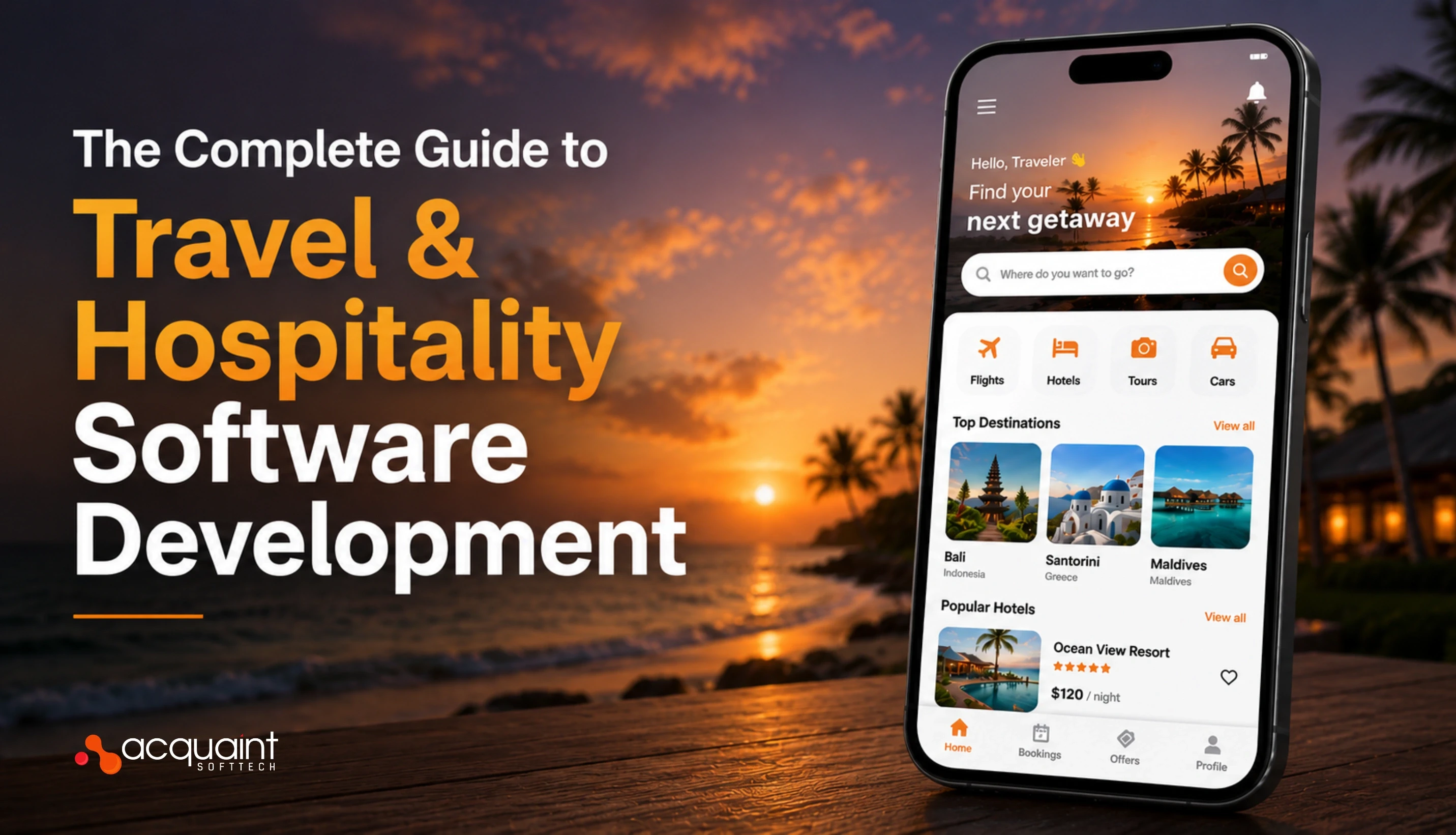
The Complete Guide to Travel & Hospitality Software Development in 2026
Most travel and hospitality platforms fail not because the idea was wrong, but because the technology architecture was underplanned. This guide explains every platform type, cost tier, and technology decision your team needs to make before writing the first line of code.

Acquaint Softtech
May 6, 2026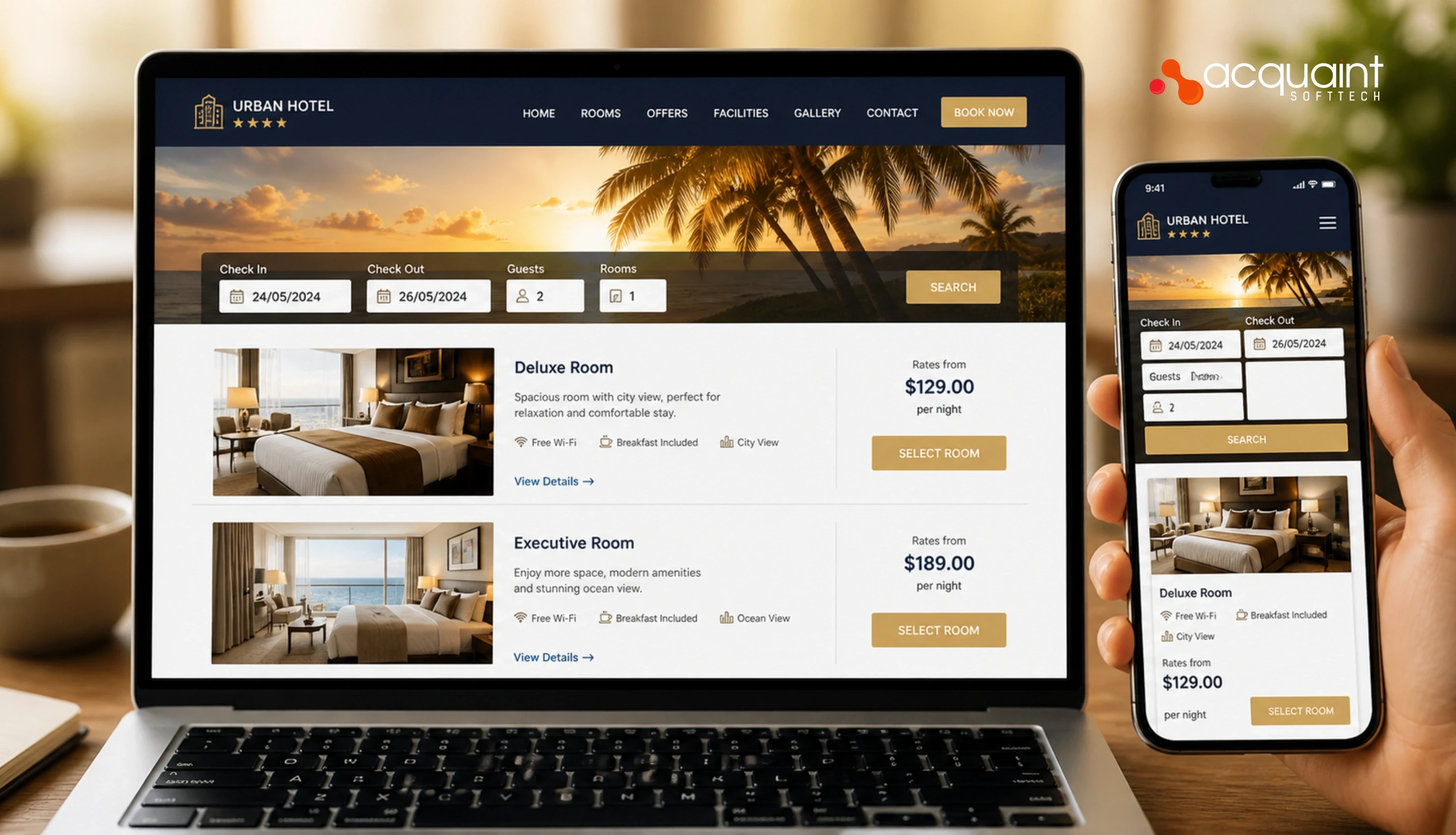
How Hotel Booking Engines Work: Search, Availability, Pricing, and Reservation Architecture
A hotel booking engine is not a search bar. It is an availability engine, a pricing decision system, a payment pre-authorisation layer, and a channel inventory synchroniser, all running simultaneously. This guide explains every architectural layer and how each one connects in a production system.
Manish Patel
May 12, 2026.webp "AI-Powered Guest Experience: Personalisation, Chatbots, and Predictive Service in Hospitality")
AI-Powered Guest Experience: Personalisation, Chatbots, and Predictive Service in Hospitality
AI-powered guest experience in hospitality is the use of machine learning, natural language processing, and predictive analytics to personalise every guest interaction from booking to checkout.
Manish Patel
June 1, 2026India (Head Office)
203/204, Shapath-II, Near Silver Leaf Hotel, Opp. Rajpath Club, SG Highway, Ahmedabad-380054, Gujarat
USA
7838 Camino Cielo St, Highland, CA 92346
UK
The Powerhouse, 21 Woodthorpe Road, Ashford, England, TW15 2RP
New Zealand
42 Exler Place, Avondale, Auckland 0600, New Zealand
Canada
141 Skyview Bay NE , Calgary, Alberta, T3N 2K6