

Automated Essay Grading With NLP: Building Rubric-Based Evaluation That Scales
Automated essay grading uses Natural Language Processing and Large Language Models to evaluate student writing against structured, rubric-based scales. The system ingests the prompt, the student essay, and a faculty-defined rubric, parses the rubric into traits like thesis clarity and evidence use, scores each trait on a defined scale such as 1 to 6, and maps sentences to criteria to justify the score. Scales are analytic (per trait) or holistic (one composite), and consistency comes from careful calibration.

Sanjay Prajapati
As a developer and Head of Business at Acquaint Softtech, I get a very specific request from EdTech and assessment founders: grade essays automatically, at scale, and make the scores defensible. That last word is the whole challenge, and it is where careful AI development services for education separate a real grading system from a clever demo.
Here is the honest framing. Automated essay grading with NLP is not about replacing judgement; it is about applying a rubric consistently to thousands of essays without fatigue or drift. Because those scores affect real grades, the system should be built against a responsible-AI standard such as the U.S. NIST AI Risk Management Framework, which sets out how to manage accuracy, bias, and reliability from the start.

- You need to grade essays at scale without losing rubric consistency.
- You want the real NLP architecture behind rubric-based scoring.
- You are a CTO, founder, or assessment leader weighing build versus buy.
- You want honest reliability, fairness, and cost, not hype.
This guide explains what automated essay grading is, how rubric-based NLP evaluation works, the pipeline you build to make it scale, how to keep it reliable and fair, and what it costs. It is part of our wider EdTech software development guide, so you can branch into any related engineering topic from here.
Everything below reflects delivery experience. Acquaint Softtech approaches education software development with the data, evaluation, and reliability layers a grading system needs, and this guide strips the concept down to what actually has to be engineered.
Automated essay grading explained: holistic vs rubric-based
Automated essay grading, or automated essay scoring, is the use of NLP and large language models to evaluate an essay against defined criteria and assign a score that aligns with human raters. That is automated essay grading explained in one line. The important distinction is holistic versus analytic: a holistic scale gives one overall score, while a rubric-based analytic scale gives a separate score for each trait, such as ideas, organization, style, and conventions.
Rubric-based analytic scoring is what scales defensibly, because it shows why a score was given, trait by trait. A single holistic number is hard to appeal; a set of trait scores mapped to rubric descriptors is transparent. Building that transparency is real custom software product development, because the value lives in the structure around the model, not the model alone.
From feature-based to LLM scoring
The field has a long history. Early automated essay scoring systems from the 1960s onward were feature-based, correlating surface signals like sentence length and vocabulary with human scores, and they needed large labelled datasets to train.
Modern systems use transformer LLMs that can apply a rubric directly through instructions, often without task-specific training. Research on this, from a survey of automated essay scoring covering challenges, advances and future directions to systematic literature reviews of automated essay scoring systems, tracks that shift clearly.
The practical upshot is faster setup and broader adaptability, though evaluation still matters: studies report agreement with human raters around a Quadratic Weighted Kappa of 0.68, which is substantial but not perfect. Understanding that trade-off is part of serious learning technology work on any edtech platform, and our overview of software product engineering companies explains the product ownership that building your own scoring system requires.
How rubric-based NLP evaluation works
Rubric-based NLP evaluation works in four moves: ingest the inputs, parse the rubric into traits, score each trait on a scale, and extract evidence for each score. The system takes the essay prompt, the student text, and a faculty-defined rubric together, breaks the rubric into discrete traits, assigns a number on a defined scale such as 1 to 4, 1 to 5, or 1 to 6 for each trait, and maps sentences in the essay to the criteria that justify the score.
The two scale types, and why evidence matters
There are two standard scale designs. Analytic trait scales generate separate scores for distinct sub-skills like ideas, organization, style, and conventions. Holistic scales give a single composite score, often 1 to 6, for overall competence.
Evidence extraction sits on top of both: advanced architectures link specific sentences to specific criteria, so a score is never an opaque guess. Getting this right is the domain of hire machine learning engineers who have built evaluation systems, not just chatbots.
Under the hood, the model reads the prompt, rubric, and response together, aligns the essay to each rubric descriptor, assigns the trait score, then generates two kinds of feedback: student-facing strengths and weaknesses, and an administrator-facing justification. Keeping this pipeline structured and queryable is why hired Python developers usually own the scoring service, and our guide to hiring Python developers covers the backend skills this NLP work demands.
A concrete rubric example
As an automated essay grading NLP rubric-based evaluation scale example, imagine a college essay scored on Content and Relevance at 40 percent, Structure and Organization at 20 percent, and Language and Vocabulary at 40 percent.
The system scores each trait, weights them, and returns both a composite and the per-trait breakdown. That structure is exactly what makes the result explainable, and it is why experienced hire Django developers often model the rubric and scoring schema as first-class data.
The architecture: how to build an AES pipeline that scales
How to build automated essay grading that scales comes down to a clear pipeline: an ingestion layer for prompts, essays, and rubrics, a rubric-modelling service, a per-trait scoring engine, an evidence-extraction step, an aggregation and weighting layer, and a human-review queue. Good edtech module design keeps each stage separate so you can tune scoring or swap the model without rebuilding the platform.
Pipeline stage | What it does | Why it must be separate |
Ingestion | Loads prompt, essay, and rubric | Inputs change per assignment |
Rubric model | Turns the rubric into scored traits | Rubrics differ by course |
Scoring engine | Assigns a value per trait | Where the model is tuned |
Evidence map | Links sentences to criteria | Makes scores explainable |
Review queue | Routes uncertain scores to humans | Trust depends on it |
Human-in-the-loop is a feature, not a fallback
At scale, the human-review queue is what keeps the system trustworthy. Low-confidence scores, borderline cases, and appeals route to a human rater, whose decisions feed back into calibration. This is core learning platform engineering, and a dedicated software development team that builds the queue and the scoring engine together tends to ship a system people actually trust.
The interface matters too, because teachers need to see scores, evidence, and overrides quickly. A hire MERN stack team often builds the grading dashboard while Python services handle the NLP.
Reliability, fairness and the limits you must engineer around
The three risks that sink an automated scoring system are inconsistency, bias, and mishandled records, and all three are engineering problems. Measure agreement against human raters, audit for bias across student groups, and treat grades as protected data. The known limits of AES missing nuance, over-rewarding polished writing, and hallucinated judgments, are exactly what you design controls around.
Measure agreement, audit for bias
Reliability is quantified, not assumed. Track Quadratic Weighted Kappa against human scores, monitor it over time, and adjudicate disagreements. Audit whether the system scores fairly across demographics and writing styles, because a model that over-rewards native-like fluency can quietly disadvantage some students. Bringing in senior help through software development outsourcing early is a common way to get this measurement discipline right from the start.
Student data is the sharpest concern, because grades are education records. That makes privacy a first-class requirement, aligned in the United States with FERPA student-privacy guidance, with consent, retention limits, and audit logging built in. Treating this as core education tech implementation, and validating the core before scaling, is the same discipline our overview of MVP development done properly applies to any first build.
Scaling and calibration: consistency across thousands of essays
Scaling automated essay grading is a calibration and cost problem as much as a modelling one. Consistency across thousands of essays comes from low-variance settings, example-rich prompt rubrics, and decision tables that pin down borderline cases. Do this well, and the same essay gets the same score whether it is the first of the day or the ten-thousandth.
The calibration playbook
Standardized calibration has a recipe. Use low-temperature model settings to reduce randomness, give the rubric example essays at each score point so the model has anchors, and encode a decision table for edge cases so scores do not drift. Then validate against a held-out set of human-scored essays before going live. Pairing this with hire automation and QA engineers who run large calibration batches and flag drift is how consistency is proven, not hoped for.
Cost and throughput matter at volume. Batch requests, cache rubric parsing, and reserve the largest models for the hardest essays to control per-essay inference cost. Students also expect fast turnaround on any device, so a smooth mobile experience, often built with a hire React Native developer, keeps feedback immediate. Our Laravel SaaS architecture blueprint shows the same MVP-to-scale discipline applied to a full platform.
Grading works in a pilot but drifts at scale?
Consistency across thousands of essays is a calibration problem, not luck. Low-variance settings, anchored rubrics and drift monitoring are what keep scores stable at volume.
Development cost and who builds it
Cost depends on scope. A rubric-based AES MVP for one assessment type, with a scoring engine, evidence extraction, and a review queue, typically runs from about $40,000 to $90,000. A full platform with multi-rubric support, calibration tooling, bias auditing, and dashboards usually falls between $100,000 and $240,000 in year one, plus model and hosting costs. That is the honest shape of the cost in 2026.
Scope | What it includes | Indicative year-1 |
Rubric MVP | Scoring engine, evidence, review queue | $40,000 to $90,000 |
Full platform | Calibration, bias audit, dashboards | $100,000 to $240,000 |
Model and ops | LLM usage, hosting, monitoring | $3,000 to $15,000 / mo |
Where location changes the maths
Edtech development cost in India, and the wider option to hire developers for automated grading work offshore, can cut engineering spend by up to 40 percent versus Western agencies without lowering quality. Many teams add NLP specialists through IT staff augmentation for the modelling and calibration phase, then scale down once the system is stable.
A custom learning platform, India-built or globally built, still needs senior technical direction to make the right model and calibration trade-offs. A virtual CTO service gives you that oversight without a full-time hire, which matters when you build education software whose fairness is the product. Our cost-saving software development tips show how to do this economically without piling up technical debt.
How Acquaint Softtech builds assessment-grade platforms
An automated grading system only works on a disciplined platform, and this verified project shows Acquaint Softtech delivering exactly that. A Singapore-based e-learning company hired us to build its online education portal from the ground up, and the engagement holds a 5.0 out of 5 rating on Clutch across quality, schedule, and cost. The clean data model and reliable delivery behind it are precisely the foundations an AES system depends on.
The question an assessment buyer asks | What the verified Singapore build shows |
Can they structure assessment data cleanly? | Yes. A structured PostgreSQL schema and CMS for the full course catalogue. |
Can they integrate third-party services reliably? | Yes. Zoom, Stripe, and Accredible integrated as first-class parts of the product. |
Do they handle education data responsibly? | Yes. Student records and payments handled inside a controlled data model. |
Do they ship on time with quality? | Yes. Full testing and bug fixing, delivered on schedule. |
Is the work independently verified? | Yes. Rated 5.0 / 5 on Clutch across quality, schedule, and cost. |
The client, a Singapore e-learning company teaching business skills, needed students to browse, enrol, pay, and learn without friction, backed by an admin console. Acquaint Softtech built the database architecture and CMS on Django, Python, and PostgreSQL, integrated the third-party services cleanly, and ran full testing before launch. None of that is an essay grader by itself, but a clean data model, reliable delivery, and responsible data handling are exactly the discipline an automated scoring system is built on.
Delivery discipline is what turns an ambitious grading engine into a shipped product. Assigning a dedicated hire project manager for your learning platform is how Acquaint Softtech sustains a 95 percent on-time sprint record across more than 1,300 projects, including data-heavy education builds.
Scoring systems also need care after launch, as rubrics change and models update. Long-term support and maintenance services keep calibration accurate and the audit trail intact over time.
Ready to grade essays at scale, fairly and defensibly?
Reliable automated grading is an engineering problem with a clear shape. A short scoping call turns your rubrics into a concrete architecture, timeline, and budget.
Frequently asked questions
-
How does automated essay grading work in EdTech?
It uses NLP and large language models to score writing against a rubric. The system reads the prompt, essay, and rubric together, scores each trait on a defined scale, and maps sentences to criteria as evidence. Low-confidence cases route to a human, and agreement with human raters is measured to keep it reliable.
-
What is the best implementation approach?
Start with one assessment type and one rubric. Build the scoring engine, evidence extraction, and a human-review queue, then calibrate with example essays at each score point. Validate against human-scored essays before going live, and only then add more rubrics and subjects.
-
What are the best practices for learning platforms?
Use analytic, rubric-based scoring so results are explainable, and keep ingestion, scoring, evidence, and review as separate modules. Measure Quadratic Weighted Kappa against human raters, audit for bias, calibrate with anchored examples, and treat grades as protected data with a full audit trail.
-
How much does automated essay grading cost to build?
A rubric-based MVP for one assessment type typically costs about $40,000 to $90,000. A full platform with calibration, bias auditing, and dashboards usually runs $100,000 to $240,000 in year one, plus model and hosting fees. Building offshore can cut these figures by up to 40 percent while keeping quality high.
-
Can AI grade essays with a rubric?
Yes. Modern LLMs can apply a rubric directly, scoring each trait and justifying the result with evidence from the text, often without task-specific training. Studies show substantial agreement with human raters, around a Quadratic Weighted Kappa of 0.68. A human-review queue handles the borderline cases where the model is least certain.
-
What is automated essay grading?
Automated essay grading is the use of NLP and AI to evaluate essays against defined criteria and assign a score aligned with human raters. It assesses dimensions like idea development, organization, coherence, and language, rather than just spelling and grammar. Rubric-based analytic scoring gives a separate score per trait, which makes results transparent and appealable.
-
Is a 3 on an essay good?
It depends on the scale. On a 1 to 4 analytic scale, a 3 is solid, above the midpoint and usually a proficient result. On a 1 to 6 holistic scale, a 3 is below the midpoint and signals room to improve. Always read the score against its rubric and scale, not on its own.
-
What is the best AI tool for grading essays?
There is no single best tool; it depends on your needs. General LLMs like GPT, Gemini, and Claude can score with a rubric, and platforms such as TestInvite package this for assessments. For an institution that needs full control over rubrics, fairness auditing, and data, a custom-built system is often the stronger long-term choice.
I am Sanjay Parjapati, a developer at heart and a Head of business by work. My journey started with coding and helped me grow towards becoming a head of business which led me to focus on dual skills, i.e. technical know-hows and the business know-hows. My journey of 10+ years has helped me grow immensely from a professional viewpoint.
Table of Contents
Get Started with Acquaint Softtech
- 13+ Years Delivering Software Excellence
- 1300+ Projects Delivered With Precision
- Official Laravel & Laravel News Partner
- Official Statamic Partner
Related Blog

MVP Chapter #9: MVP Development Cost
A typical MVP development cost ranges from $10,000 to $60,000 for basic to medium-complexity applications, while complex or AI-enabled builds often exceed $100,000. A simple MVP runs about $8,000 to $25,000, a medium MVP $25,000 to $60,000, and a complex or AI MVP $60,000 to $150,000+. At Acquaint Softtech, fixed-project MVP development starts from $5,000, and hiring a remote team can cut your costs by 40 to 60%.

Mukesh Ram
October 31, 2022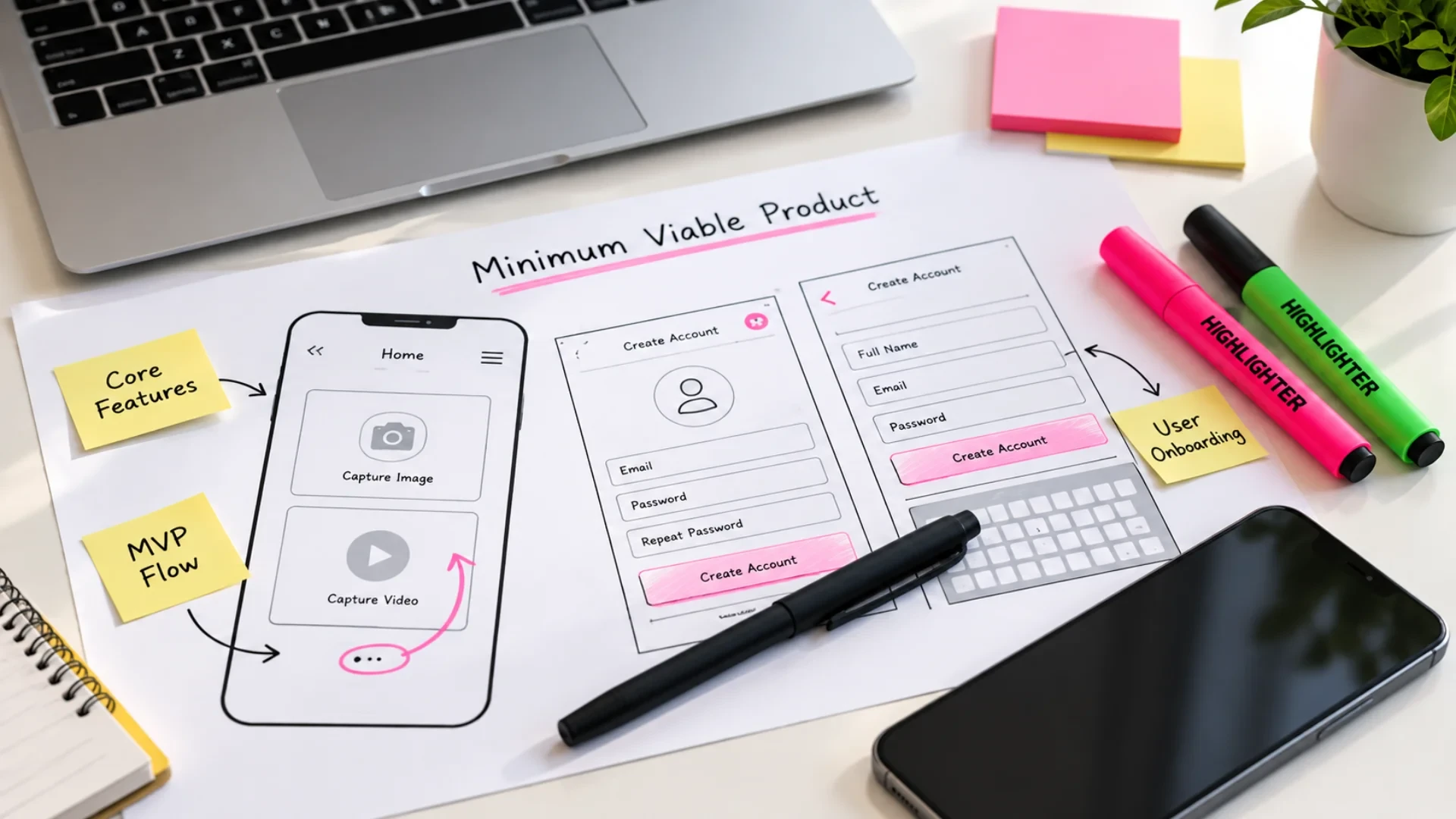
MVP Chapter #5: MVP - Meaning, Purpose & Real-life Examples
An MVP (Minimum Viable Product) is the most basic version of a new product that has just enough core features to work, solve a primary user problem, and satisfy early customers. Famous MVP examples include Dropbox (a demo video), Airbnb (air mattresses and a simple site), Amazon (a bare-bones online bookstore), and Uber (a basic iPhone app for a few black-car drivers). The pattern is the same: test demand cheaply, then scale.
Mukesh Ram
August 25, 2022
Top React JS Development Companies
React JS is one of the most widely used frontend technologies, powering over 40% of modern web applications, especially single-page apps like SaaS platforms and dashboards. Its component-based architecture and ecosystem tools like Next.js and Redux help reduce development time by up to 30% while improving performance. This is why businesses prefer working with a reliable React JS development company to build scalable, high-performing web applications.
However, finding the right partner is challenging due to the large number of agencies claiming expertise. To simplify this, we evaluated 100+ React JS development companies based on performance, scalability, and real-world delivery experience, helping you choose a React JS development company that can deliver reliable and future-ready frontend solutions.

Zubair Pateljiwala
April 21, 2026India (Head Office)
203/204, Shapath-II, Near Silver Leaf Hotel, Opp. Rajpath Club, SG Highway, Ahmedabad-380054, Gujarat
USA
7838 Camino Cielo St, Highland, CA 92346
UK
The Powerhouse, 21 Woodthorpe Road, Ashford, England, TW15 2RP
New Zealand
42 Exler Place, Avondale, Auckland 0600, New Zealand
Canada
141 Skyview Bay NE , Calgary, Alberta, T3N 2K6