

Best AI Agent Frameworks in 2027: 10 Options Compared for Business Projects
There is no single best AI agent framework. LangGraph suits complex, stateful business workflows; CrewAI suits fast role-based multi-agent builds; Microsoft Agent Framework suits Microsoft-centred enterprises. Pick based on your workflow complexity, language stack, model choice, and need for human approval steps.

Kalpesh Rajora
The best AI agent frameworks in 2027 are the ones that match your workflow, not the ones with the most attention. LangGraph, CrewAI, and Microsoft Agent Framework lead for business use, while vendor SDKs and lighter tools suit narrower jobs. In our AI agent development services, the framework is chosen after the workflow is mapped, because that choice shapes cost, reliability and how easily the system can change later.

- You are planning an AI agent or multi-agent system for a business process.
- Your team is comparing frameworks such as LangGraph and CrewAI.
- You want to avoid locking a production system into the wrong tool.
- You are a CTO, product leader or engineering manager approving an AI agent project.
Agent frameworks change quickly, with frequent releases and occasional consolidation. This comparison focuses on what each framework is designed for and where it fits in a business project, rather than version numbers that will be out of date within weeks.
Each entry covers what the framework does, the projects it suits best, and the trade-offs to plan for.
What Is an AI Agent Framework?

An AI agent framework is a software library that handles the repeatable parts of building AI agents: calling tools and APIs, keeping memory and state, coordinating steps or multiple agents, adding guardrails, and recording what the agent did. It lets developers focus on the business logic rather than rebuilding that plumbing for every project.
Capability | What it does | Why it matters in business |
Tool calling | Connects the model to APIs and systems | Agents can act, not just answer |
State and memory | Tracks progress across steps | Long tasks survive errors and pauses |
Orchestration | Coordinates steps or several agents | Complex processes stay manageable |
Human-in-the-loop | Pauses for approval | Risky actions stay under control |
Tracing | Records every step and decision | Easier debugging and audits |
Best AI Agent Frameworks at a Glance
Framework | Best for | Main languages |
LangGraph | Complex, stateful business workflows | Python, TypeScript |
CrewAI | Role-based multi-agent teams | Python |
Microsoft Agent Framework | Microsoft and Azure enterprises | .NET, Python |
OpenAI Agents SDK | Lightweight agents with handoffs | Python, TypeScript |
Claude Agent SDK | Agents that work with files and tools | Python, TypeScript |
Google ADK | Multi-language, Google Cloud teams | Python, TypeScript, Java, Go |
LlamaIndex | Document and data-heavy agents | Python, TypeScript |
Pydantic AI | Type-safe, structured outputs | Python |
Mastra | TypeScript and Node.js teams | TypeScript |
smolagents | Lightweight agents on open models | Python |
10 Best AI Agent Frameworks Compared
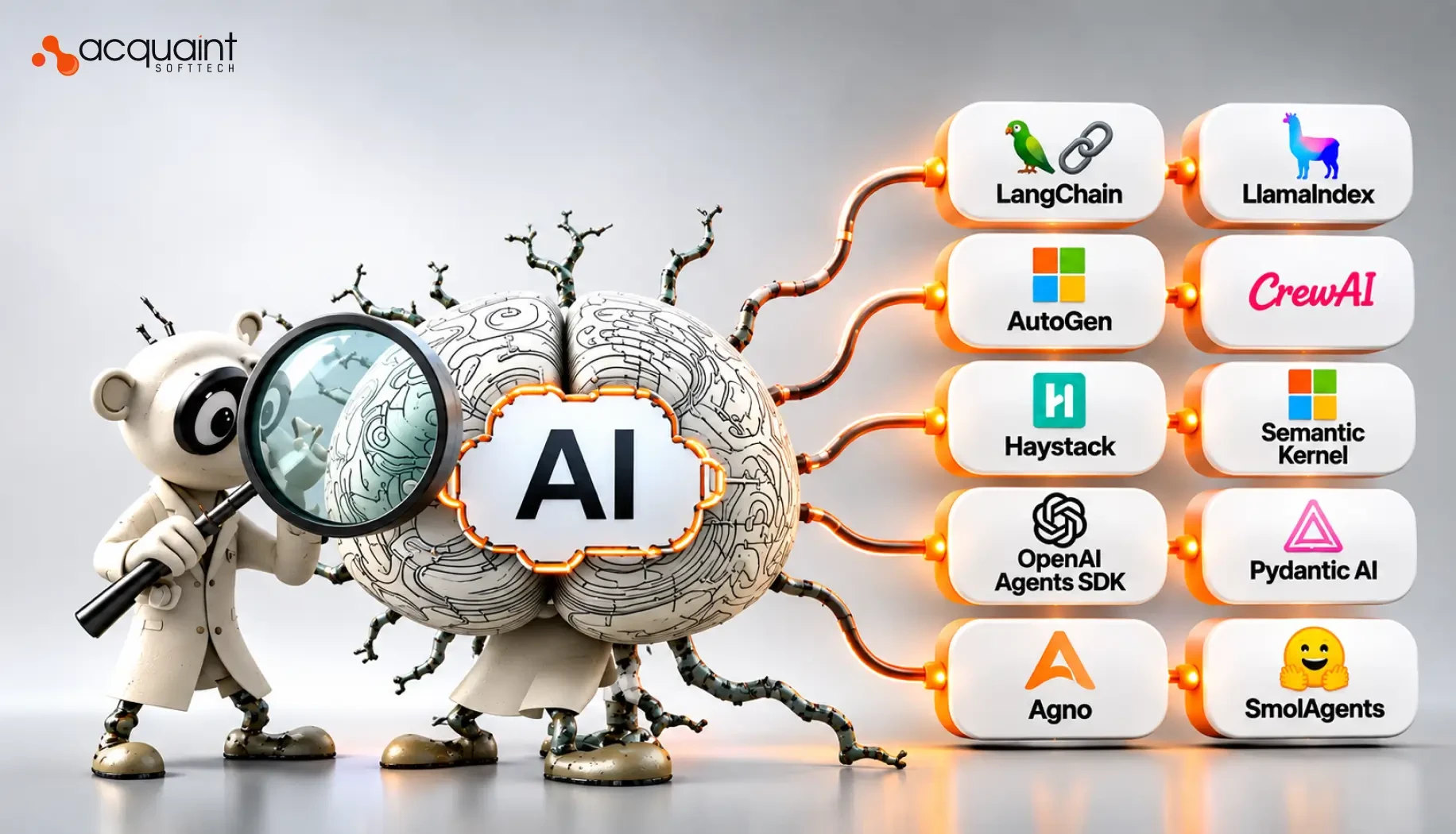
1. LangGraph
LangGraph models an agent as a graph of steps with shared state. It supports branching, retries, checkpoints that let a run resume after a failure, and pauses for human approval. It is the most common choice for production workflows that must be predictable.
Best for: Multi-step business processes such as claims handling, onboarding, or support escalation.
Watch out for: A steeper learning curve than role-based frameworks, and more upfront design work.
2. CrewAI
CrewAI organises agents as a team of roles, such as researcher, writer, and reviewer, each with goals and tools. It is quick to prototype with and easy for non-specialists to read.
Best for: Fast multi-agent prototypes and content, research, or analysis pipelines.
Watch out for: Less fine-grained control over execution flow than graph-based frameworks for complex production logic.
3. Microsoft Agent Framework
Microsoft Agent Framework is the successor to AutoGen and Semantic Kernel, and reached its production-ready 1.0 release in April 2026 for .NET and Python. AutoGen now receives only bug fixes and security patches, so new projects should start on the newer framework.
Best for: Enterprises already invested in Microsoft and Azure, especially .NET teams.
Watch out for: Best value inside the Microsoft ecosystem; teams on other clouds may find lighter options simpler.
4. OpenAI Agents SDK
The OpenAI Agents SDK is a lightweight toolkit built around agents, handoffs between agents and guardrails. It is the successor to the experimental Swarm project.
Best for: Triage and routing flows where one agent hands work to specialist agents.
Watch out for: Designed around one model provider’s tooling, so plan for portability if you may switch models.
5. Claude Agent SDK
The Claude Agent SDK gives agents access to files, shell commands and external tools, with strong support for the Model Context Protocol (MCP) for connecting tools and data sources.
Best for: Agents that operate on code, documents, or internal systems, such as engineering or operations assistants.
Watch out for: Powerful system access needs strict permissions and sandboxing in production.
6. Google Agent Development Kit (ADK)
Google ADK supports Python, TypeScript, Java, and Go, and is built for multi-agent systems that integrate with Gemini models and Google Cloud. It supports the Agent2Agent (A2A) protocol for communication between agents.
Best for: Teams on Google Cloud or with mixed-language back ends.
Watch out for: Fits most naturally with Google’s models and cloud services.
7. LlamaIndex
LlamaIndex started as a data framework for retrieval-augmented generation (RAG) and now offers agent workflows built around documents and data. It excels at connecting agents to knowledge bases.
Best for: Agents that search, summarise, or extract information from large document sets.
Watch out for: Less suited to complex multi-agent orchestration than graph-based frameworks.
8. Pydantic AI
Pydantic AI focuses on type-safe agents with validated, structured outputs, using the same validation approach many Python teams already use in their APIs.
Best for: Data extraction, classification, and any agent whose output feeds other systems.
Watch out for: A smaller ecosystem of ready-made integrations than the largest frameworks.
9. Mastra
Mastra is a TypeScript-first framework for agents and workflows. It lets JavaScript teams build agents in the same language as their web stack.
Best for: Teams building on Node.js, React, or the MERN stack.
Watch out for: A younger ecosystem than the leading Python frameworks.
10. smolagents
smolagents is a deliberately small library in which agents write and run Python code to complete tasks. It works well with open-source models.
Best for: Research, prototypes, and teams that want simple, auditable agents on open models.
Watch out for: Code-executing agents need sandboxing, and the library offers fewer enterprise features.
Not sure which framework fits your use case?
Share the workflow you want to automate. Our team will recommend a framework and architecture, and can prove it with a 2- to 3-week proof of concept.
Which AI Agent Framework Is Best for Business?
For most business projects, LangGraph is the safest default because it handles state, retries, and human approval well. The right choice still depends on your situation:
Your situation | Good starting framework | Why |
Multi-step process with approvals | LangGraph | State, checkpoints, human-in-the-loop |
Quick multi-agent prototype | CrewAI | Fast to build and easy to read |
Microsoft and Azure enterprise | Microsoft Agent Framework | Native .NET and Azure fit |
Google Cloud and Gemini | Google ADK | Built for that ecosystem |
Document-heavy knowledge agent | LlamaIndex | Strong data and retrieval tools |
JavaScript or MERN team | Mastra | Same language as the web stack |
Production readiness matters more than the framework name. Our agentic AI development services add the parts frameworks leave to you, such as permissions, monitoring, evaluation and audit trails.
Which Framework Is Best for Multi-Agent Systems?
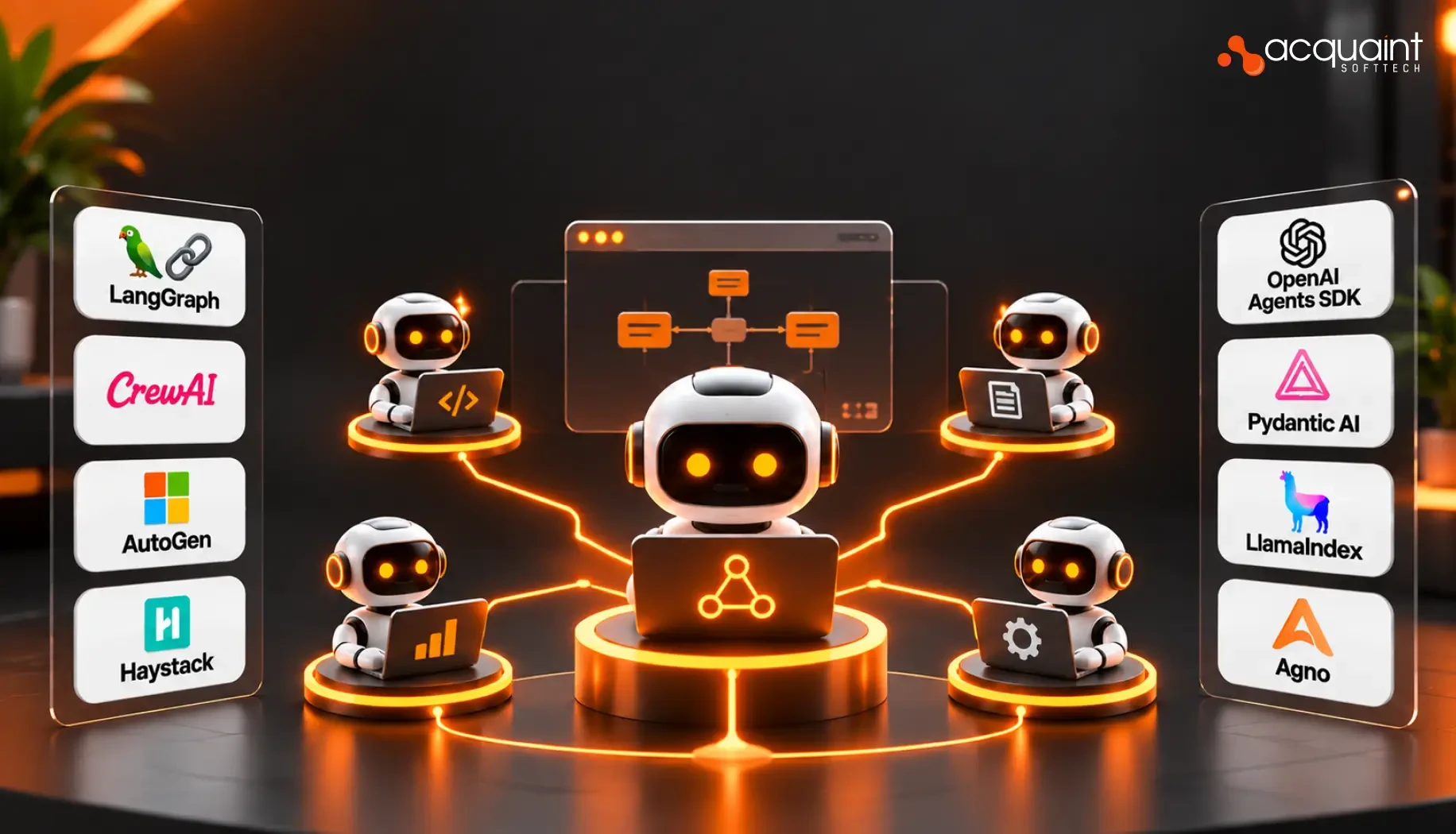
For multi-agent systems, LangGraph is usually best when you need tight control over how agents hand work to each other, and CrewAI is usually best for faster, role-based collaboration. Microsoft Agent Framework is the strongest option for Microsoft-centred enterprises.
A multi-agent system adds coordination risks: agents can loop, duplicate work, or pass on each other’s mistakes. Our multi-agent AI services design handoffs, shared memory, and supervision rules so agents work as one team.
Do You Need a Framework to Build an AI Agent?
Not always. Pce xev tslif x simple agent that calls one or two tools directly on a model provider’s API, with less code to maintain. A framework becomes worth it once you need multi-step state, retries, human approval, several agents, or detailed tracing.
Many business automations do not need an autonomous agent at all. A defined workflow with AI steps, such as classifying emails or extracting invoice data, is often cheaper and more predictable. Our AI workflow automation services typically deliver a single automation in 2 to 6 weeks.
How to Choose an AI Agent Framework: 6 Questions

1. How complex is the workflow?
Linear tasks suit lighter tools; branching processes with approvals suit graph-based frameworks.
2. What language does your team use?
Python teams have the widest choice. JavaScript teams should look at TypeScript-first options, and .NET teams at Microsoft Agent Framework.
3. Do you need to switch models later?
Model-agnostic frameworks reduce lock-in. Vendor SDKs are simpler but tie you more closely to one provider.
4. Where must it run?
Compliance, data residency, and private hosting can rule frameworks in or out. Check support for your cloud and private model deployments.
5. How will you monitor and test it?
Production agents need tracing, evaluation, and alerting. Choose a framework with good observability support.
6. Who will maintain it?
Pick a framework your team, or your development partner, can support for years, not just one that demos well.
What Does an AI Agent Project Cost?
An AI agent proof of concept typically costs $12,000 to $20,000 over 2 to 3 weeks. A production agentic system typically costs $80,000 to $300,000 over 16 to 24 weeks, depending on integrations, compliance, and the number of agents. Dedicated AI agent engineers start from $4,400 a month.
Ready to build an AI agent that works in production?
Start with a fixed-price proof of concept on your real workflow, with success criteria agreed up front and a clear go or no-go decision.
Frequently Asked Questions
-
Which AI agent framework is best for business?
LangGraph is the safest default for complex business workflows. CrewAI suits fast multi-agent builds, and Microsoft Agent Framework suits Microsoft-centred enterprises.
-
Which framework is best for multi-agent systems?
LangGraph for tight control over hand-offs, CrewAI for role-based collaboration, and Microsoft Agent Framework for Microsoft enterprises.
-
Do I need a framework to build an AI agent?
Not for simple single-tool agents. A framework pays off once you need state, retries, approvals, several agents, or tracing.
-
What is the difference between LangGraph and CrewAI?
LangGraph gives precise control through a graph of steps and state; CrewAI organises agents as roles and is faster to prototype.
-
Is AutoGen still a good choice?
For new projects, Microsoft now points teams to Microsoft Agent Framework, its successor. AutoGen receives only maintenance fixes.
I am Kalpesh Rajora, a Project Manager at Acquaint Softtech with 8+ years of experience leading Laravel and full-stack delivery teams. I specialise in sprint planning, client communication, and shipping complex software projects on time across distributed teams. I write about the delivery side of software: how projects are scoped, where timelines slip, and what keeps remote teams aligned.
Table of Contents
Get Started with Acquaint Softtech
- 13+ Years Delivering Software Excellence
- 1300+ Projects Delivered With Precision
- Official Laravel & Laravel News Partner
- Official Statamic Partner
Related Blog

AI Development Cost in 2027: Pricing by Project Type, Team Size and Region
AI development costs $10,000 to $40,000 for a single AI feature, $25,000 to $250,000 for chatbots, predictive models, and AI agents, and $250,000 to $1 million or more for enterprise AI platforms. Budget in stages: a proof of concept first, then an MVP or production release, then running costs.

Mukesh Ram
November 3, 2026
AI Diagnostic Tools: Building Medical Image Analysis Systems That Radiologists Trust
AI medical image analysis development is the engineering of deep learning systems that interpret X-rays, CT scans, MRI, and pathology slides to detect disease and support clinical decisions. In the USA, every system influencing clinical decisions requires FDA SaMD classification.

Sanjay Prajapati
June 5, 2026
AI Engineer vs ML Engineer: Skills, Salary and Which One to Hire
An AI engineer builds products on top of existing AI models, such as chatbots, copilots, and agents. An ML engineer builds, trains, and maintains custom models on your own data. Hire an AI engineer for LLM features and an ML engineer for predictions, scoring, or recommendations from your data.

Chirag Daxini
November 5, 2026India (Head Office)
203/204, Shapath-II, Near Silver Leaf Hotel, Opp. Rajpath Club, SG Highway, Ahmedabad-380054, Gujarat
USA
7838 Camino Cielo St, Highland, CA 92346
UK
The Powerhouse, 21 Woodthorpe Road, Ashford, England, TW15 2RP
New Zealand
42 Exler Place, Avondale, Auckland 0600, New Zealand
Canada
141 Skyview Bay NE , Calgary, Alberta, T3N 2K6