

Building a Health Insurance Claims Processing System: Adjudication and Auto-Pay
A health insurance claims processing system automates claims, eligibility, payments, and denials. It can auto-process 70–90% of claims and typically costs $150,000–$800,000.

Manish Patel
The administrative cost per healthcare claim in the USA rose from $43.84 in 2022 to $57.23 in 2023, driven primarily by manual labour in claims adjudication and denial management. Claims processing can take up to 20 days under manual workflows. The healthcare insurance administration market spends over $400 billion annually on claims handling, and an estimated 5 to 10 percent of claims involve some form of fraudulent activity, costing the US insurance industry $40 billion or more each year.
The consequence of these inefficiencies falls on three parties simultaneously: providers wait weeks for reimbursement and lose 3 to 5 percent of revenue to unrecovered denials, payers incur rising administrative costs that compress margins, and patients receive confusing Explanation of Benefits documents for claims they cannot track. A modern health insurance claims processing system built on a rules-based adjudication engine, EDI 837 and 835 integration, and AI-assisted fraud detection resolves all three problems by automating the claims lifecycle end to end. Acquaint Softtech's custom healthcare software development services cover claims processing system development from EDI integration through adjudication engine design, denial management workflows, and HIPAA-compliant infrastructure for payers, TPAs, and healthcare networks.

- You are building or modernizing a health insurance claims processing platform.
- You need to understand EDI 837 and 835, adjudication, and auto-pay engineering.
- You want to know how to achieve 80 or more percent auto-adjudication rates.
- You need verified cost data before presenting a claims system budget to leadership.
- You are evaluating a custom build versus upgrading an existing legacy claims platform.
The US Department of Health and Human Services mandates EDI X12 standards for all electronic healthcare claims transactions under HIPAA. The 837 transaction set (837P for professional, 837I for institutional, 837D for dental) is the mandatory format for electronic claim submission from providers to payers. Every custom claims processing system must implement these standards before handling any US health insurance claims.
This article covers the full claims lifecycle from EDI 837 submission to EDI 835 auto-pay, the adjudication engine architecture and auto-adjudication rate benchmarks, denial management, fraud detection, coordination of benefits, HIPAA compliance, tech stack, and verified cost data. For the complete healthcare software development context, read the guide to Healthcare Software Development. For HIPAA Security Rule technical safeguards that govern all claims PHI, the HIPAA Compliance for Software Developers: The Complete 2026 Checklist covers every technical safeguard requirement for claims data handling.
Why Health Insurance Claims Processing Is Broken and Who Pays the Price

A health insurance claims processing system in 2026 is software that automates claim submission, validation, adjudication, and payment between providers and payers. It is essential for insurers, TPAs, and self-insured employers handling high claim volumes where manual processing is no longer viable. Building such systems requires scalable engineering expertise, and teams often rely on experienced developers, such as when they choose to hire MEAN stack developers for secure, high-performance healthcare workflows.
Problem | Consequence | Automation Fix |
Manual adjudication up to 20 days | Delayed reimbursement, cash flow issues | Auto-adjudication processes clean claims in seconds |
High admin cost per claim ($57+) | Reduced payer and TPA margins | Rules engine reduces 70–90% manual work |
Claim denial rate (5–20%) | 3–5% revenue loss for providers | Denial tracking + root cause analytics |
Healthcare fraud (5–10%) | Multi-billion dollar annual losses | ML-based fraud detection in real time |
Manual coordination of benefits (COB) | Duplicate payments and billing errors | Automated COB rules engine for payer hierarchy |
Health insurance claims processing system market trends 2026 are driven by three converging forces: the mandate for HIPAA EDI 5010 compliance that makes electronic claims processing legally required for most payer-provider transactions, value-based care contracts that require granular claim-level outcome tracking, and AI adoption that is pushing auto-adjudication rates toward 90 percent in leading health systems. Benefits of health insurance claims processing system automation include an 80 percent reduction in claims processing time with accurate eligibility checks using the Best insurance verification software, and more than 50 percent of claims handled through straight-through processing with no human intervention.
Acquaint Softtech's AI development services build the machine learning fraud detection and predictive denial analytics layers that sit on top of the core claims adjudication engine, producing the AI-driven performance improvements that distinguish a 2026 claims system from a legacy rule-based platform.
The Claims Lifecycle: From EDI 837 Submission to EDI 835 Auto-Pay
How to build a health insurance claims processing system starts with mapping the complete claims lifecycle. Every module in the system exists to support a specific lifecycle stage. Building modules without a clear lifecycle map produces systems where claims fall into gaps between stages and require manual recovery.
The Health Insurance Claims Lifecycle: EDI Transaction Flow
Claim Submission (EDI 837): Provider submits claim via EDI 837P (professional), 837I (institutional), or 837D (dental) transaction set. The 837 carries patient demographics, subscriber information, provider NPI, diagnosis codes (ICD-10), procedure codes (CPT or HCPCS), service dates, and billed charges. Claims arrive directly from provider systems, via clearinghouses (Availity, Change Healthcare), or via provider portals.
999 Acknowledgement: The payer's EDI engine sends a 999 functional acknowledgement confirming receipt of the 837 batch and reporting any format-level validation failures. A 999 with accepted status confirms the 837 was structurally valid. A 999 rejection means the claim never entered the adjudication queue.
277CA Claim Acknowledgement: After format validation, the 277CA reports the payer's claim-level acceptance or rejection for each claim line in the 837 batch. A 277CA rejection at this stage typically indicates a missing NPI, invalid member ID, or duplicate claim detection.
Eligibility and Benefit Verification (EDI 270/271): For real-time eligibility, the system queries the payer's 271 eligibility response against the patient's plan enrollment record to confirm active coverage, deductible status, co-pay amount, and in-network or out-of-network determination for the claim date of service. For behavioral health providers, checking coverage before treatment can help avoid billing issues later. Behavioral health insurance verification services such as Prosperity behavioral health insurance verification, can make it easier to confirm eligibility and benefits in advance.
Claims Adjudication: The adjudication engine applies the plan's benefit rules, fee schedules, medical necessity criteria, prior authorization requirements, and coordination of benefits rules to each claim line. Clean claims route to auto-adjudication. Complex or exception claims route to a human reviewer queue.
Fraud Detection: AI and rules-based fraud detection runs during adjudication, flagging suspicious billing patterns (unbundling, upcoding, duplicate billing, provider anomalies) for human review before payment is authorized.
EDI 835 Electronic Remittance Advice and Auto-Pay: Approved claims generate an EDI 835 ERA transaction that communicates the payment amount, adjustment reason codes (CO, PR, OA codes), and denial explanations to the provider. Auto-pay triggers an ACH or EFT payment to the provider's bank account on the 835 payment date.
Denial Management and Appeals: Denied claims enter the denial management workflow: denial reason code analysis, appeal letter generation, clinical documentation request (if required), and resubmission routing. Analytics track denial rate by payer, denial reason, provider, and procedure code.
The 837 to 999 to 277CA to 835 transaction chain is the HIPAA EDI backbone of every US health insurance claims system. A system that cannot generate or parse all four transaction types cannot legally or operationally process US health insurance claims.
The Adjudication Engine: Rules, Logic, and the Auto-Adjudication Rate

The adjudication engine is the core of a health insurance claims processing system, responsible for deciding whether a claim is paid, partially paid, denied, or sent for manual review. Its key performance metric is the auto adjudication rate, which measures how many claims are processed without human intervention. Building and scaling such systems often requires experienced full-stack teams, and organizations typically hire MERN stack developers to implement fast, scalable, and compliant claims processing workflows.
Adjudication Component | Function | 2026 Benchmark |
Eligibility & Coverage Check | Verify active insurance, plan, deductible, OOP status | Real-time 270/271 in < 3 seconds |
Medical Necessity Rules Engine | Apply clinical coverage rules (ICD–CPT mapping, LOS criteria) | Quarterly updated payer policy database |
Fee Schedule Application | Apply contracted payer rates (PPO/HMO/Medicare) | Multi-payer contract version control system |
Prior Authorization Check | Verify approval before procedure | Real-time PA validation (no retrospective review) |
Duplicate Claim Detection | Detect repeated claims for same service | Automated 277CA-stage deduplication |
Auto-Adjudication Routing | Separate clean vs complex claims | 70–90% straight-through processing rate |
Key Insight
The auto-adjudication rate is the most important KPI in a claims processing system. A system achieving 90 percent auto-adjudication on a volume of 100,000 claims per day eliminates 90,000 manual adjudication decisions per day. At $57.23 per manual claim (Premier, 2025), that represents $5.1 million in daily avoided administrative cost on a single plan. Every percentage point improvement in auto-adjudication rate has direct revenue cycle impact that compounds over claim volume.
Acquaint Softtech's Laravel developers build the adjudication rules engine as a configurable, versioned rules framework, allowing payer benefit administrators to update coverage policies, fee schedules, and medical necessity criteria without requiring a code deployment. This is the architecture decision that separates a maintainable claims system from one that requires developer intervention every time a plan benefit changes.
Denial Management: Building the Workflow That Recovers Lost Revenue
Denial management is the revenue recovery engine of a health insurance claims processing system. A claims platform without denial management creates a black hole where denied claims disappear from the revenue cycle, and providers lose 3 to 5 percent of revenue annually to unrecovered denials.
The denial management workflow
Denial capture and classification. Every denied claim is captured from the EDI 835 ERA with its standardized denial reason code (CARC and RARC codes) and routed to the denial management queue. The system classifies denials by type: clinical (medical necessity, experimental), administrative (missing authorization, eligibility failure), billing (coding error, duplicate submission), and contract (fee schedule dispute).
Root cause analytics identifies denial patterns by aggregating data across payer, denial reason code, provider, procedure code, and time period, enabling proactive prevention rather than reactive appeals. For building scalable analytics interfaces and dashboards, modern teams often rely on mobile-ready UI layers such as React Native—see implementation capabilities at Hire React Native Developers to support real-time denial tracking and insights delivery across devices.
Appeal workflow automation. For denial types with a documented appeal pathway, the system generates a pre-populated appeal letter with the relevant clinical documentation request, submits the appeal within payer deadlines (typically 30 to 180 days from denial date depending on payer contract), and tracks the appeal status.
Denial trending and payer scorecard. Month-over-month denial rate tracking by payer surfaces systematic problems in payer adjudication behaviour: a payer with a 25 percent denial rate on a specific procedure code is either applying the rules incorrectly or has an undocumented coverage policy change. The payer scorecard becomes the basis for contract renegotiation.
The Building a Claims Denial Management System: Tracking, Appeals, and Analytics covers the denial management module architecture in full, including CARC and RARC code classification, appeal automation workflow design, and the analytics data model for denial trend analysis. Acquaint Softtech's software product development services include denial management as a standard claims system module, with configurable appeal templates and payer-specific deadline tracking.
Fraud Detection and Claims Integrity Architecture
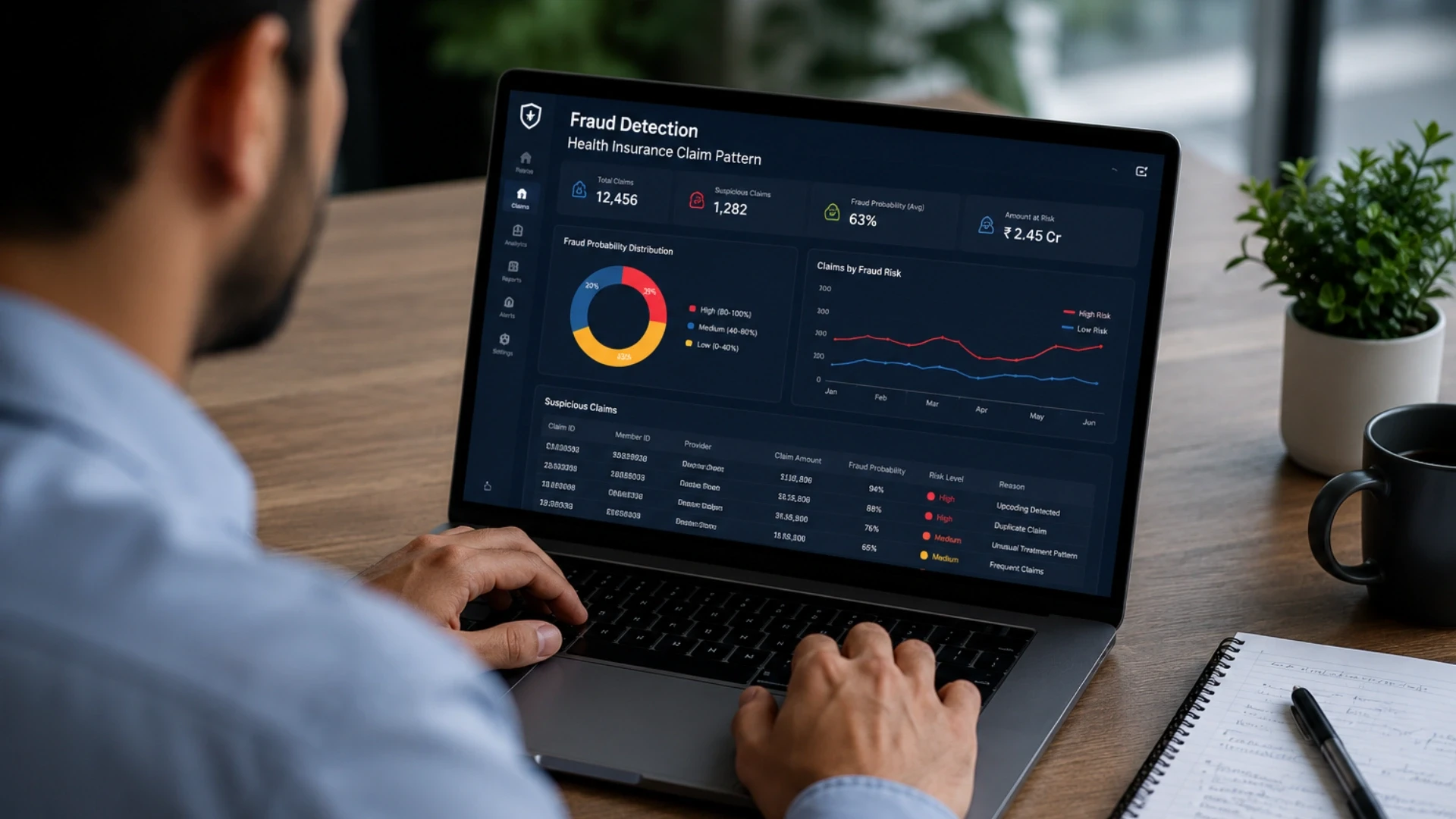
Healthcare claims fraud costs the US insurance industry $40 billion or more annually and accounts for 5 to 10 percent of non-health insurance claims by volume (FBI, cited by ScienceSoft). A claims processing system without embedded fraud detection is not a compliant or financially viable system for any payer handling significant claim volume.
Rule-based fraud detection (first-line defence)
Duplicate claim detection: same service date, same procedure code, same provider NPI, same patient, flag before adjudication queue entry
Billing pattern anomalies: same provider billing identical procedure codes in 100 percent of cases (no variation in a patient population indicates template billing)
Upcoding detection: consistent billing of highest-complexity codes (99215, 99285) without clinical documentation supporting complexity
Unbundling detection: separately billing procedure codes that should be bundled under a single comprehensive code per CMS bundling rules
Impossible billing detection: claims for services on dates when the patient was deceased, incarcerated, or enrolled in another plan that covered the service
ML-based fraud detection (second-line, pattern recognition)
Machine learning fraud detection analyses claim data at scale to identify suspicious patterns that rule-based systems miss. ML models achieve 95 percent accurate fraud detection, significantly higher than rule-based systems alone (ScienceSoft).
The ML approach uses historical claim data to train models that identify: provider outlier billing (billing significantly outside the statistical distribution of peer providers for the same specialty and geography), claim sequence anomalies (patterns of claims that individually pass rules but together indicate a coordinated fraud scheme), and network fraud detection (identifying fraud ring patterns across multiple provider NPI numbers and patient IDs).
Acquaint Softtech's AI and ML engineers build the fraud detection ML layer using Python (scikit-learn, XGBoost) with a training dataset from the payer's historical adjudicated claims. The model is retrained quarterly as fraud patterns evolve, and all fraud flags are routed to a human investigator queue for final determination, AI never autonomously denies a claim solely on fraud suspicion without human review.
Coordination of Benefits (COB): Multi-Payer Claims Processing
Coordination of Benefits (COB) is the process a claims system uses to determine the correct payment responsibility when a patient has coverage under more than one health insurance plan. Patients with multiple insurance policies may also work with PMI brokers to understand their coverage options and how different plans coordinate benefits. This makes accurate payer information and eligibility data especially important for avoiding duplicate payments and incorrect claims routing. COB errors, duplicate payments, incorrect primary payer determination, and missed secondary payer recovery, are among the largest sources of financial leakage in health insurance operations.
COB Scenario | Primary Payer Rule | System Requirement |
Employer + Spouse coverage | Birthday rule determines primary payer | Real-time COB data sync from both insurers |
Divorced parents coverage | Court order or birthday rule | Court order flag in member record |
Medicare + Employer plan | Employer primary (if >20 employees) | MSP rules engine with employer size check |
Medicare + Medicaid (dual eligible) | Medicare primary, Medicaid secondary | MSP + state Medicaid secondary billing rules |
Workers’ comp + Health plan | Workers’ comp primary for work injuries | Injury classification + auto routing to WC carrier |
The COB engine must have real-time access to member enrollment records from all payers in the coordination chain. A COB process that relies on batch nightly updates will make incorrect primary payer determinations for members whose coverage changes during the day. This is particularly consequential for Medicare Advantage plans and self-insured employer plans where mid-year coverage changes are frequent.
Acquaint Softtech's dedicated software development teams build the COB engine as a real-time rules service that queries member enrollment data via FHIR R4 Coverage resource or a proprietary enrollment API, returning the primary-to-secondary payer chain in under 500 milliseconds. The discovery workshop services identify all COB scenarios a client's plan needs to handle before any development is scoped, because COB complexity is one of the most frequently underestimated cost drivers in claims system projects.
HIPAA EDI Compliance Architecture for Claims Systems

Every health insurance claims processing system handling US health plan data must comply with HIPAA administrative simplification rules, including mandated EDI transaction formats, PHI security standards, and electronic transaction operating rules. Non-compliance can result in penalties of up to $1.9 million per violation category annually.
For teams building or scaling such systems, leveraging structured leadership support like Acquaint Softtech Virtual CTO Services can help ensure architecture and compliance decisions align with healthcare regulatory requirements.
Mandatory HIPAA EDI transactions for claims systems
EDI Transaction | X12 Standard | Claims System Role |
Health Care Claim (Submission) | 837P / 837I / 837D (005010) | Ingest and validate claims from providers/clearinghouses |
Functional Acknowledgement | 999 | Confirm structural acceptance/rejection of EDI batches |
Claim Status Request/Response | 276 / 277 | Provide real-time claim status updates and validation results |
Payment / Remittance Advice | 835 | Send payment details, adjustments, and denial reasons |
Eligibility Inquiry / Response | 270 / 271 | Real-time eligibility verification before claim submission |
Prior Authorization | 278 | Process and return authorization decisions for services |
HIPAA Security Rule requirements for claims PHI
AES-256 encryption at rest for all claim records, member enrollment data, provider data, and ERA payment records
TLS 1.3 for all PHI in transit: provider-to-clearinghouse, clearinghouse-to-payer, payer-to-provider, and API endpoints for member portals and provider portals
Role-based access control separating claims examiners (adjudication only), fraud investigators (flagged claims), finance (ERA and payment data), and member services (claim status query only)
Tamper-evident audit log for every claim-level access, adjudication decision, payment authorization, and denial action — retained for a minimum of 6 years under HIPAA
BAAs executed with all PHI-touching vendors: clearinghouse partners, cloud infrastructure provider, AI fraud detection vendor, and the development firm
Acquaint Softtech's DevOps engineers configure HIPAA-eligible AWS infrastructure for all claims system builds as a first-sprint deliverable, with Terraform-defined infrastructure as code for reproducible, auditable compliance controls.
Tech Stack for Health Insurance Claims Processing Software in 2026
The best tech stack for a health insurance claims processing system in 2026 depends on three core requirements: HIPAA-compliant EDI X12 transaction handling, high-throughput real-time and batch claim adjudication, and machine learning based fraud detection running alongside production workloads. In most enterprise cases, companies also accelerate delivery using Acquaint Softtech White Label Software Development to reduce build time and leverage pre-built healthcare engineering expertise while maintaining compliance and scalability.
Layer | Technology | Claims-Specific Reason |
Backend API & Adjudication Engine | Laravel (PHP) | Rules engine for claim adjudication with full audit logging |
EDI Processing (837/835) | Python (pyx12 / Mirth Connect) | Parse and generate X12 5010 compliant claim transactions |
High-Volume Batch Processing | Python (Celery / Spark) or Node.js queues | Handles large-scale claim processing without API blocking |
Fraud Detection ML | Python (scikit-learn, XGBoost) | Detects anomalies and suspicious billing patterns |
Frontend Portals | React.js | Dashboards for adjudicators, analysts, and finance teams |
Database Layer | PostgreSQL + AES-256 encryption | Secure, ACID-compliant storage for claims and member data |
Message Queue | RabbitMQ / AWS SQS | Async processing of EDI batches and claim workflows |
Cloud Infrastructure | AWS HIPAA-eligible services | Secure storage, processing, and audit compliance |
Python is the dominant language for EDI parsing, fraud detection ML, and claims analytics in healthcare insurance systems. The Laravel backend handles the application layer, RBAC, and API gateway, while Python handles the data-intensive processing workloads that require numerical computation and ML inference at claim volume.
Acquaint Softtech's Python developers build the EDI 837/835 parsing layer and ML fraud detection models, while the Laravel team builds the adjudication rules engine and provider portal APIs.
Case Study: Pharmaceutical Regulatory Compliance Platform: Affordable Medicines Europe

The following is drawn from a verified Clutch client review. Affordable Medicines Europe is the association of parallel importers and exporters of pharmaceuticals, representing more than 120 companies operating in 23 EU/EEA countries. Their mission is regulatory compliance in cross-border pharmaceutical trade, an industry where every transaction has regulatory documentation requirements, multi-party access control needs, and audit traceability obligations that map directly to the engineering requirements of a health insurance claims system.
Client: Affordable Medicines Europe - pharmaceutical parallel importer association, 120+ companies in 23 EU/EEA countries
Reviewer: Senior Policy Advisor, Affordable Medicines Europe
Project: Secure regulatory compliance and member data management platform with fine-grained role-based access control and full audit trail for sensitive pharmaceutical operational data
Technology: Laravel backend with Spatie Permissions for multi-role RBAC, secure RESTful APIs with authentication and authorization layers, audit trail on all sensitive operations, React.js frontend
Team: 2 to 5 Acquaint Softtech engineers
Clutch Verified: Yes - publicly verifiable at clutch.co/profile/acquaint-softtech-private
What this project demonstrates about claims system engineering
The Affordable Medicines Europe platform solved the same three core engineering problems that every health insurance claims processing system must solve: multi-party data access where each party (member company in their case, claims examiner or provider in a claims context) should see only data relevant to their role and no more; a complete, tamper-evident audit trail of every sensitive data access and modification event for regulatory inspection; and secure API architecture that allows external parties to exchange structured data without exposing the underlying system to unauthorised access.
Acquaint Softtech’s Laravel team delivered a fine-grained RBAC system using Spatie Permissions that enabled Affordable Medicines Europe to define role-based regulatory access across member companies, similar to adjudicator and compliance roles in insurance systems. The audit trail captured every access and modification event with timestamped user-level tracking, aligning with HIPAA-grade PHI logging requirements. Ongoing system stability and compliance are supported through their Support & Maintenance Services, ensuring continuous monitoring, updates, and regulatory alignment.
Health insurance claims processing system development company: scoped in 2 weeks.
Acquaint Softtech delivers health insurance claims platforms: EDI 837/835 integration, adjudication rules engine, AI fraud detection, denial management, COB engine, and HIPAA-compliant infrastructure. Fixed-scope proposal in 2 weeks. $25 to $49/hour. 50 or more Clutch reviews.
Health Insurance Claims Processing System Development Cost in 2026
Health insurance claims processing system development cost 2026 ranges from $150,000 for a basic adjudication engine with EDI integration to $800,000 or more for an enterprise platform with AI fraud detection, COB engine, denial management analytics, and multi-payer clearinghouse integration.
System Tier | Scope and Cost | Timeline |
Basic claims system | EDI 837/835, basic adjudication engine, eligibility check, denial queue, HIPAA infrastructure. $150,000 to $300,000. | 6 to 12 months |
Mid-tier claims platform | Full adjudication rules engine, COB module, denial management, provider and member portals, fraud rules engine. $300,000 to $500,000. | 10 to 18 months |
Enterprise claims platform | AI fraud detection (ML models), predictive denial analytics, multi-clearinghouse integration, real-time eligibility, prior auth automation. $500,000 to $800,000+. | 15 to 24 months |
What claims system projects consistently underestimate
EDI clearinghouse integration: each clearinghouse partner (Availity, Change Healthcare, Office Ally) requires bilateral trading partner agreements and technical setup. Initial integration adds $20,000 to $50,000 and 6 to 10 weeks per clearinghouse.
Fee schedule management: loading, versioning, and updating fee schedules for Medicare, Medicaid, and contracted commercial plans is a data management project in itself, adding $15,000 to $40,000 in data engineering and ongoing operational cost.
ML fraud detection model training: training an initial fraud detection model on historical claim data requires a clean, labelled dataset of adjudicated claims. Data preparation adds 6 to 12 weeks before model training begins.
Prior authorization integration: connecting the claims system to the payer's PA determination system adds $20,000 to $60,000 and 4 to 10 weeks per payer plan type.
HIPAA compliance audit and penetration test before go-live adds $15,000 to $40,000 and 4 to 8 weeks to the pre-launch timeline.
Outsource health insurance claims processing system development India: Acquaint Softtech delivers at $25 to $49 per hour, representing 40 percent average cost savings versus US agency rates. Flexible team scaling via the staff augmentation model allows adding EDI engineers, Laravel adjudication specialists, and Python ML engineers as claim volume and feature scope expand.
Hire developers for health insurance claims processing - HIPAA-compliant, EDI-ready, from sprint one.
Acquaint Softtech builds health insurance claims systems with EDI 837/835 parsing, configurable adjudication engines, AI fraud detection, COB processing, and HIPAA-compliant AWS infrastructure. 4.9/5, 50 or more Clutch reviews. Premier Verified. 1,300 or more projects in 13 or more years.
Frequently Asked Questions
-
How much does it cost to build a health insurance claims processing system?
A claims system costs $150,000–$300,000 (basic), $300,000–$500,000 (mid-tier), and $500,000–$800,000+ (enterprise AI). Costs vary based on EDI integration depth, automation level, and compliance requirements.
-
How much does it cost to implement AI in healthcare systems?
AI in healthcare ranges from $10,000–$50,000 (basic automation) to $500,000–$5M+ (enterprise AI models). Higher costs come from EHR integration, data preparation, and regulatory compliance.
-
What features does a health insurance claims system need?
It needs EDI 837/835 processing, eligibility checks, adjudication engine, denial management, fraud detection, COB, and audit logging. These features ensure accurate, fast, and compliant claim processing.
-
How long does it take to build a claims processing system?
It takes 6–12 months (basic), 10–18 months (mid-tier), and 15–24 months (enterprise AI). Timeline also increases with EDI onboarding and payer integrations.
-
What is Coordination of Benefits (COB) in insurance?
COB decides which insurer pays first when a patient has multiple policies. It ensures total payouts do not exceed 100% of allowable charges.
-
How is primary and secondary insurance decided in COB?
Primary insurance is based on rules like policyholder priority, birthday rule, employment status, and Medicaid last-payer rule. Secondary insurance covers remaining eligible costs after the primary EOB.
-
What is EDI 837 in healthcare claims processing?
EDI 837 is the HIPAA standard for submitting electronic claims (837P, 837I, 837D). It enables structured, automated communication between providers and payers.
-
What is auto-adjudication in claims systems?
Auto-adjudication is automated claim processing without human review. Modern systems achieve 70%–90% automation using rules, eligibility validation, and fraud checks.
-
What is the difference between EDI 835 and EOB?
EDI 835 is a machine-readable payment file used for automated posting in systems. EOB is a human-readable summary sent to patients explaining claim decisions.
-
What are the 4 types of apps?
The four types of apps are native apps, web apps, hybrid apps, and progressive web apps (PWAs). Each type differs in performance, cost, and platform flexibility.
-
Why is AI important in health insurance claims processing?
AI improves fraud detection, claim accuracy, and processing speed while reducing manual work. It also enables predictive analytics and lowers operational costs in insurance workflows.
I lead technology and client success at Acquaint Softtech with one goal in mind. Deliver work that feels personal, reliable, and worthy of long term trust. I stay close to both our clients and our developers to make sure every project moves with clarity, quality, and accountability.
Table of Contents
Get Started with Acquaint Softtech
- 13+ Years Delivering Software Excellence
- 1300+ Projects Delivered With Precision
- Official Laravel & Laravel News Partner
- Official Statamic Partner
Related Blog
The Complete Guide to Healthcare Software Development in 2026
Healthcare software development in 2026 is not a single discipline. It is six distinct product categories, each with its own compliance perimeter, integration burden, and cost curve.

Acquaint Softtech
May 1, 2026
How Telemedicine Apps Work: Architecture, Data Flow, and System Design Explained
A telemedicine app is not a video call with a medical logo. It is a distributed system that moves protected health information between four environments in under 200 milliseconds while staying inside HIPAA boundaries. Here is exactly how it works, layer by layer, with the tech stack, the data flow, and the numbers that matter.
Manish Patel
May 8, 2026
AI Diagnostic Tools: Building Medical Image Analysis Systems That Radiologists Trust
AI medical image analysis development is the engineering of deep learning systems that interpret X-rays, CT scans, MRI, and pathology slides to detect disease and support clinical decisions. In the USA, every system influencing clinical decisions requires FDA SaMD classification.

Sanjay Prajapati
June 5, 2026India (Head Office)
203/204, Shapath-II, Near Silver Leaf Hotel, Opp. Rajpath Club, SG Highway, Ahmedabad-380054, Gujarat
USA
7838 Camino Cielo St, Highland, CA 92346
UK
The Powerhouse, 21 Woodthorpe Road, Ashford, England, TW15 2RP
New Zealand
42 Exler Place, Avondale, Auckland 0600, New Zealand
Canada
141 Skyview Bay NE , Calgary, Alberta, T3N 2K6