

Python MVP Development How to Ship Fast Without Building Technical Debt
How to build a Python MVP in 2026 that ships fast without creating the technical debt that traps your V1. Scope, architecture, and engineering practices.

Acquaint Softtech
Introduction: The MVP That Becomes the V1 You Cannot Fix
Every founder's first Python MVP is shaped by two opposing forces. The first is the pressure to ship fast: investors are watching, the market window is closing, the team needs feedback before runway evaporates. The second is the structural reality that the MVP almost always becomes the codebase the company is still running two and three years later, which means every shortcut taken in Week 1 compounds into a constraint that limits the company forever. The founders who navigate this well end up with a product that shipped in 8 to 12 weeks and continued shipping cleanly through 100,000 users.
The trap is well documented and increasingly specific. According to a 2026 minimum viable product strategy guide by We Are Presta, the founders who lose are the ones who hit what the analysis calls the Scale-Up Cliff: ignoring basic system health while racing to ship means they must rewrite the entire codebase to handle their first 1,000 users, burning the runway they were trying to preserve.
This guide covers exactly how to build a Python MVP in 2026 that ships fast without becoming the V1 you cannot fix. It walks through the tension every founder faces and why most resolve it badly, the scope framework that distinguishes a shippable MVP from a feature-crowded fake MVP, the architectural choices that ship quickly without trapping you, the engineering practices that prevent technical debt from compounding, and how Acquaint Softtech structures Python MVP engagements specifically to ship in 8 to 16 weeks with the foundation that survives growth. It is written for founders, technical co-founders, and product leaders preparing to ship their first Python MVP who want to do it without paying for it twice.
If you are also evaluating who should build the MVP, the complete guide to hiring Python developers in 2026 sets the wider context. MVP work specifically requires senior engineers who can make architectural choices that ship fast without compounding debt, which is a profile meaningfully different from generic Python feature development.
The Tension: Speed vs Technical Debt (and Why Most Founders Solve It Wrong)
.webp "The Tension: Speed vs Technical Debt (and Why Most Founders Solve It Wrong)")
Most founders treat the speed-versus-quality tradeoff as binary: ship fast and accept the debt, or build it right and miss the window. Both framings are wrong, and the founders who win consistently find the third option that the binary framing obscures. The structural insight is that technical debt comes in different categories with very different costs, and the discipline of MVP engineering is choosing which categories of debt to take (cheap to fix later) and which to refuse (catastrophic to fix later).
The Three Categories of Technical Debt in an MVP
Cheap-to-fix debt (take this freely). Manual processes that should eventually be automated. UI polish that does not affect functionality. Features that are basic now but will need expansion later. Test coverage gaps in non-critical paths. These can all be addressed incrementally after the MVP validates the product, often in the same sprints that build new features, without rebuilding anything that exists.
Expensive-to-fix debt (avoid if possible, accept reluctantly). Wrong abstractions that touch many parts of the codebase. Missing observability that hides production issues. Hardcoded configurations that should be environment-driven. These cost real time to fix later but are addressable without rebuilding the foundation. Accept them when speed genuinely matters and you are explicitly tracking them in a debt log.
Catastrophic-to-fix debt (refuse always). Wrong database choices that touch every query. Authentication built without proper user model design. No tests anywhere, making any refactor terrifying. Synchronous patterns that block scaling. Hardcoded business logic in templates or views. These are the debts that produce the Scale-Up Cliff, where the only honest fix is a rewrite. The team that refused them in the MVP ships features in Year 2 while the team that accepted them is rebuilding.
Why Most Founders Take the Wrong Debts
They cannot tell the categories apart in the moment. Without engineering experience, every shortcut looks the same. The founder pressures the team to ship faster, the team takes whichever shortcuts are visible to them, and the catastrophic ones (the database choice, the auth model, the lack of tests) often look identical to the cheap ones in the moment they are taken.
They have not seen the consequences before. First-time founders have not personally lived through a Year 2 rewrite. Senior engineers who have, and who carry the scar tissue of catastrophic-debt rewrites, are the ones who instinctively refuse the dangerous shortcuts even under pressure. This is one of the strongest arguments for senior engineering presence on an MVP, not just senior architecture review afterwards.
Investors pressure them for speed and discount durability. Investor pressure to ship something demonstrable creates incentive to accept any debt that produces visible progress. This pressure is real and legitimate, but it should not be a license to take catastrophic-debt shortcuts that make the product unshippable at scale.
They confuse "basic" with "crappy". Minimum viable does not mean broken. UXPin's 2026 MVP guide is explicit: an MVP is not a buggy or half-finished product, it is a deliberately scoped product that solves one clearly defined problem for a specific audience. The MVP with three features that work cleanly beats the MVP with ten features that occasionally break.
The Python MVP Scope Framework: 3 to 5 Features, Not 30
The most reliable predictor of MVP failure is scope creep. According to a 2026 MVP software development guide by UXPin, most successful MVPs ship with 3 to 5 core features, not 30, and the technology choices that distinguish good MVP delivery are explicitly the ones that let your team move fast without creating technical debt you will regret. The same guide is direct that an MVP must solve one clearly defined problem for a specific audience, define success metrics before launch, and ship in two-week sprints that get core infrastructure and primary user flow live before any secondary features land. The discipline is structural, not aspirational; teams that aim for 3 to 5 features actually achieve fast launches with healthy foundations, while teams that aim for 10 to 15 features quietly slide into months of additional work and catastrophic debt.
The Python MVP Scope Discipline by Layer
Layer | What to Build in MVP | What to Defer to V2 |
|---|---|---|
Authentication | Email/password, simple session | SSO, OAuth, 2FA, role hierarchies |
Core feature 1 | The one thing users come for | Variants, customization, advanced options |
Core feature 2 to 4 | Supporting flows for the core action | Power user features, edge cases |
Admin panel | Django admin or basic dashboard | Custom admin UI, fine-grained permissions |
Payments | Stripe Checkout (managed) | Custom subscription logic, complex billing |
Notifications | Transactional email only | Push notifications, preferences, digests |
Analytics | PostHog or Mixpanel SDK | Custom analytics, complex funnels |
Infrastructure | Managed services, single region | Multi-region, auto-scaling complexity |
How to Scope Ruthlessly Without Cutting What Matters
Apply the MoSCoW method honestly. Must-have, Should-have, Could-have, Won't-have. The Must-haves are the MVP scope; everything else is V2 or later. MoSCoW prioritization has been shown to reduce development costs by 60% and increase chances of securing seed funding, because investors actually trust founders who can defend why specific features are deferred rather than founders who promise everything.
Define success metrics before scoping features. If you cannot measure whether the MVP is working, you cannot validate the hypothesis the MVP exists to test. Pick one north-star metric (activation rate, weekly retention, paying user conversion) and scope features that move that metric. Features that do not move the north-star metric should not be in the MVP.
Use the "painful tradeoff" test. If cutting a feature is painful, it is probably important. If cutting it is painless, it should not be in the MVP. Painless features are the ones founders include because they sound nice in the pitch deck, not because users actually need them.
Use managed services instead of building infrastructure. Stripe for payments. Auth0 or Clerk for authentication (if not using built-in Django auth). SendGrid for email. PostHog for analytics. Vercel or Railway for hosting in early stages. Every managed service you use is engineering work you do not have to do, which is engineering work that does not create technical debt.
A lean Python MVP with three to five core features, basic authentication, and a functional backend can start from $5,000 at Acquaint Softtech, with the final cost depending on scope and requirements, as detailed in the analysis on the minimum budget required to start a Python development project, which walks through the cost breakdowns across MVP phases and explains why founders who scope tightly ship for a fraction of the cost that founders who include everything quietly accumulate.
Ready to Build a Python MVP That Ships Fast and Survives Growth?
Acquaint Softtech delivers Python MVPs in 8 to 16 weeks with senior engineers, modular-first architecture, and the engineering discipline that prevents the Scale-Up Cliff. Lean MVP scope, transparent pricing starting at $5,000 for 3 to 5 core features, full IP assignment and NDA from day one.
The Architecture Choices That Ship Fast Without Trapping You
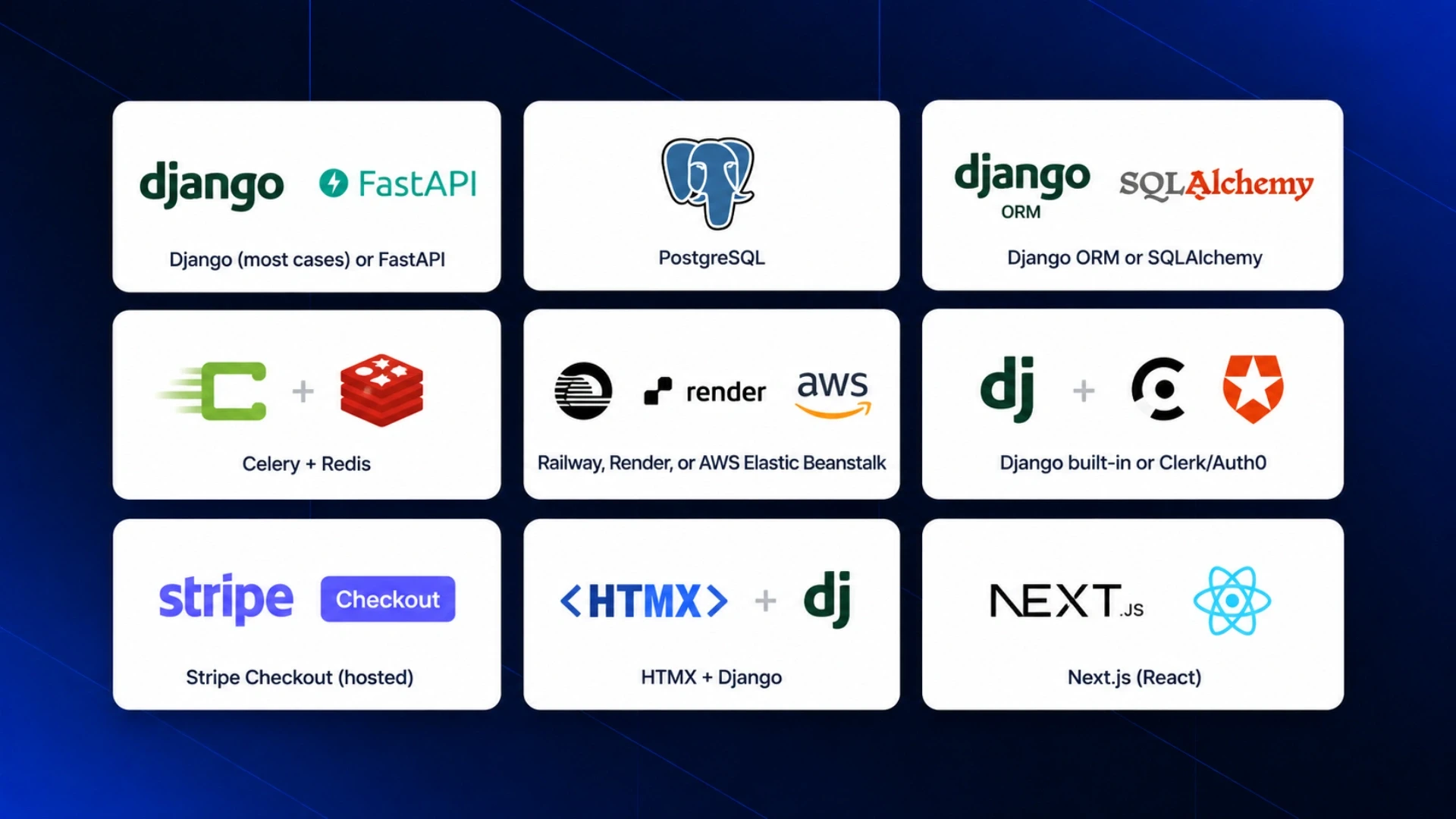
Architecture decisions made in MVP Week 1 have outsized influence on whether the codebase can be expanded cleanly or whether it produces the Year-2 rewrite. The good news is that the right MVP architecture is mostly the boring, proven option in each category, not the exciting new tool that sounds great on a podcast. The boring choices are boring precisely because they have been load-bearing for many production Python applications, which is exactly the property the MVP needs.
Python MVP Architecture Choices (Boring Wins)
Layer | Recommended for MVP | Why Not the Alternative |
|---|---|---|
Framework | Django (most cases) or FastAPI | Flask too minimal; framework-less too risky |
Database | PostgreSQL | MongoDB locks you into document model |
ORM/Queries | Django ORM or SQLAlchemy | Raw SQL hurts speed without enough payoff |
Background jobs | Celery + Redis | Adds operational complexity but earns it |
Hosting | Railway, Render, or AWS Elastic Beanstalk | Kubernetes premature for MVP |
Auth | Django built-in or Clerk/Auth0 | DIY auth never the right MVP call |
Payments | Stripe Checkout (hosted) | Custom integration creates compliance burden |
Frontend | HTMX + Django or Next.js (React) | Vue/Angular fine but smaller hiring pools |
The Modular-First Principle for Python MVPs
The structural answer to ship-fast versus avoid-debt is to build a modular monolith from day one. Not microservices (premature complexity that adds operational cost without solving any problem the MVP has). Not a tangled monolith (cheap today, catastrophic to refactor later). A modular monolith with clear bounded contexts, each module organized around a business capability, communicating through explicit interfaces. This is the architecture pattern that ships in 8 to 16 weeks for an MVP and continues shipping cleanly as the product grows toward 100,000 users without requiring decomposition.
Specific Choices That Save You From the Scale-Up Cliff
PostgreSQL from day one. PostgreSQL handles 100,000+ users on a single instance with proper indexing and connection pooling. MongoDB or DynamoDB lock you into a document model that often does not fit your real data. SQLite is fine for prototyping but generates real friction in production. The boring choice (PostgreSQL) is the one that scales further than any MVP will need.
Django ORM (or SQLAlchemy with FastAPI) over raw SQL. The ORM trades small performance overhead for significant development speed and maintainability. The team that uses an ORM ships features twice as fast as the team writing raw SQL, and the performance hit is rarely the bottleneck. When it becomes the bottleneck for specific queries, drop down to raw SQL there specifically without abandoning the ORM elsewhere.
Async background jobs from day one with Celery + Redis. Anything that takes more than 200ms (sending emails, generating reports, processing uploads, calling external APIs) goes to a background queue. This is structural for Python web applications and adds maybe two days to MVP setup. It prevents the request-blocking pattern that makes synchronous-by-default applications collapse under load.
Configuration via environment variables, not hardcoded. API keys, database URLs, feature flags, all configurable via environment. Costs maybe one hour to set up, prevents hours of pain every time you need to deploy a new environment, change a credential, or test locally without affecting production.
Logging and error tracking from day one. Structured logging (Python logging module with JSON formatter), Sentry for error tracking, and basic request logging through middleware. Together these take an afternoon to set up and provide the observability that lets you actually fix the inevitable bugs without resorting to print statements in production.
The framework choice between Django, FastAPI, and Flask determines a significant portion of how the MVP develops and what kind of debt accumulates. The detailed analysis on Django vs FastAPI vs Flask: framework decision guide walks through which framework is the right answer for each MVP scenario, with Django typically winning for content-heavy or admin-driven products and FastAPI winning for async-first API products or AI/ML serving.
The Engineering Practices That Prevent MVP-to-V1 Disaster
Architecture choices matter, but they are only half the equation. The other half is the engineering practices that the team applies during MVP development. The practices below are the ones that distinguish MVPs that survive growth from MVPs that hit the Scale-Up Cliff, and they cost surprisingly little in raw time while providing outsized protection against catastrophic-category debt.
Tests on critical paths, even if not everywhere. 100% test coverage is unrealistic for an MVP, but tests on the critical paths (authentication, payments, the core user action, data persistence) are non-negotiable. These are the areas where bugs cost the most and where refactoring without tests is most terrifying. Aim for 60 to 70% coverage on critical paths, accept lower coverage on edge cases.
Code review before merging, even if just one person. Every PR gets at least one set of eyes before it merges. This catches the obvious mistakes, propagates conventions across the team, and creates the documentation trail that explains why decisions were made. The 15 minutes a senior engineer spends reviewing each PR saves hours of debugging later.
Database migrations, not schema editing in production. Use Django migrations or Alembic from day one. Never edit production schemas directly. This is one of the cheapest disciplines (the tooling exists, it just needs to be used) and prevents the most common Year-2 disaster: a database state nobody can reproduce.
CI from day one, even basic CI. GitHub Actions or GitLab CI running the test suite on every PR. Costs an afternoon to set up, catches breakage before merge, and provides the foundation for everything else (automated deployment, dependency updates, security scanning) that the V1 codebase will need.
Technical debt log in the repo. A TECH_DEBT.md file (or equivalent in your issue tracker) tracking every shortcut taken, why, and what fixing it would require. The act of writing it down makes the team conscious of which debts they are accepting. When V2 planning happens, the debt log becomes the prioritization input that prevents the V2 from inheriting V1's worst decisions.
Sprint-end technical debt triage. At the end of every two-week sprint, the team spends 30 minutes reviewing the debt log. What is becoming painful? What new debts have been added? What is the next sprint's debt-paydown commitment? This single ritual prevents the slow corrosion that makes Year-2 rewrites feel inevitable.
The engineering practices that produce MVPs which survive growth are also the practices that determine total cost of ownership over the product lifecycle. The analysis on Python development cost for mid-sized businesses walks through how disciplined engineering during early-stage development compounds into significantly lower maintenance and scaling costs over the multi-year product lifecycle, which is the strongest financial argument for refusing catastrophic-category debt during the MVP.
How Acquaint Softtech Builds Python MVPs That Survive Growth
Acquaint Softtech is a Python development and IT staff augmentation company based in Ahmedabad, India, with 1,300+ Python projects delivered globally, including MVP engagements for startups across SaaS, FinTech, healthcare, EdTech, and consumer platforms. Our MVP delivery model follows the framework in the complete guide to hiring Python developers, with senior engineers, modular-first architecture, and the discipline that distinguishes MVPs which ship fast and continue shipping from MVPs that hit the Scale-Up Cliff inside the first year.
8 to 16 week MVP delivery with senior engineers. Lean scope (3 to 5 core features), modular monolith architecture, PostgreSQL from day one, managed services where they save engineering time, and Django or FastAPI based on the MVP's specific shape. Sprint-based delivery with bi-weekly demos that catch scope drift before it compounds.
Modular-first architecture as the default. Modular monolith with clear bounded contexts, designed to ship in MVP timelines and continue shipping cleanly through 100,000 users. No premature microservices, no exotic technology choices that add risk without solving a real problem, no decisions that create catastrophic-category debt.
Engineering discipline that prevents the Scale-Up Cliff. Tests on critical paths, code review before merge, database migrations from day one, CI from day one, technical debt log in the repository, sprint-end debt triage. These cost surprisingly little to apply and provide outsized protection against the catastrophic shortcuts that make first-time MVPs unshippable at scale.
Transparent pricing starting at $5,000 for lean MVPs. Lean Python MVPs with 3–5 core features can start from $5,000, with the final cost based on scope and requirements. Dedicated Python engineering teams start at $3,200/month per engineer.
Remote development teams have become the default for startup MVPs specifically because they combine speed and cost in ways that local hiring cannot match. The analysis on benefits of remote development teams for startups walks through how startups in particular benefit from accessing senior Python engineering capability without the overhead of local hiring, which is exactly the resource pattern that ships an MVP in 8 to 16 weeks.
To get senior Python engineers onto your MVP build quickly, with the architectural judgment and engineering discipline that ship fast without compounding debt, you can hire Python developers with profiles shared in 24 hours and a defined onboarding plan within 48.
The Bottom Line
Python MVP development is one of the highest-stakes engineering decisions a startup makes, because the MVP codebase almost always becomes the codebase the company is still running two and three years later. The founders who win navigate the speed-versus-quality tension by understanding that technical debt comes in different categories with different costs, and that the discipline of MVP engineering is choosing the right shortcuts (cheap-to-fix, accept freely) while refusing the wrong ones (catastrophic-to-fix, refuse always). Scope ruthlessly to 3 to 5 core features.
The engineering disciplines that prevent the Scale-Up Cliff cost surprisingly little to apply and provide outsized protection. Tests on critical paths. Code review before merge. Database migrations from day one. Basic CI from day one. A technical debt log that the team actually reviews. Sprint-end debt triage. These practices are the difference between an MVP that ships in 8 to 16 weeks and continues shipping cleanly through 100,000 users, and an MVP that ships in 8 to 16 weeks and burns the next year on a rewrite.
The technology choices and engineering practices that produce the first outcome are well documented and not exotic. The discipline to apply them under pressure to ship fast is the actual scarce resource. Choose the right shortcuts deliberately, refuse the wrong ones absolutely, and your Python MVP becomes the foundation the company actually builds on rather than the technical debt it cannot recover from.
Want a Python MVP That Ships Fast and Does Not Trap Your V1?
Book a free 30-minute MVP consultation. Tell us your product hypothesis, your timeline, and your budget, and we will give you an honest answer: what should be in the MVP scope, what should be deferred to V2, what architecture choices will let you ship in 8 to 16 weeks without creating the Scale-Up Cliff, and what the realistic cost is. No sales pitch. Just senior engineers who have built Python MVPs that survived growth and ones that did not.
Frequently Asked Questions
-
How long does a Python MVP actually take to build?
Most production-quality Python MVPs ship in 8 to 16 weeks with a small senior engineering team. The fast end (8 to 10 weeks) is achievable for MVPs scoped to 3 to 4 core features with managed services for payments, auth, and email. The slower end (12 to 16 weeks) covers MVPs with 5 core features, custom workflows, or specific compliance requirements. Anything claiming faster than 8 weeks for a production-quality MVP is usually either a no-code prototype, a smaller feature scope, or a build that will hit the Scale-Up Cliff before its first 1,000 users.
-
How much does a Python MVP cost?
Cost Component
Estimated Cost
Python MVP Development
Start from $5,000
Figma Prototype (Optional)
$3,000 – $5,000
Monthly Infrastructure (AWS/GCP)
$100 – $500/month
-
What is the right scope for a Python MVP?
3 to 5 core features that solve one clearly defined problem for a specific audience. Apply the MoSCoW method (Must-have, Should-have, Could-have, Won't-have) to scope ruthlessly. Defer SSO, OAuth, 2FA, role hierarchies, push notifications, custom analytics, and multi-region infrastructure to V2. Use managed services (Stripe Checkout, Auth0 or Clerk, SendGrid, PostHog) instead of building infrastructure that does not differentiate your product.
-
What is the Scale-Up Cliff and how do I avoid it?
The Scale-Up Cliff is the situation where ignoring basic system health during MVP construction means the codebase has to be rewritten to handle the first 1,000 users, which burns the runway the founder was trying to preserve. You avoid it by refusing catastrophic-category technical debt during the MVP: wrong database choices, DIY authentication, no tests anywhere, hardcoded business logic, no observability.
-
What technologies should a Python MVP use in 2026?
The boring proven choices in each category. Framework: Django for most cases (especially content-heavy or admin-driven), FastAPI for async-first APIs or AI/ML serving. Database: PostgreSQL, which handles 100,000+ users with proper indexing. ORM: Django ORM or SQLAlchemy. Background jobs: Celery + Redis. Hosting: Railway, Render, or AWS Elastic Beanstalk for the MVP (Kubernetes is premature). Auth: Django built-in or Clerk/Auth0. Payments: Stripe Checkout hosted. Logging: structured logging + Sentry. Boring wins because boring has been load-bearing across thousands of production Python applications.
-
Can I really ship a Python MVP without any technical debt?
No, and you should not try. Some technical debt is appropriate in an MVP because shipping speed matters and not every shortcut compounds badly. The discipline is choosing which debts to take and which to refuse. Cheap-to-fix debts (manual processes, UI polish, basic features that need expansion later) are fine.
-
How do I prevent my Python MVP from becoming a V1 I cannot fix?
Five disciplines applied during MVP construction. Refuse catastrophic-category technical debt regardless of time pressure. Use the modular monolith architecture pattern, not a tangled monolith and not premature microservices. Apply tests on critical paths even if not everywhere. Run a sprint-end technical debt triage where the team reviews the debt log and commits to specific paydowns.
We’re Acquaint Softtech, your technology growth partner. Whether you're building a SaaS product, modernizing enterprise software, or hiring vetted remote developers, we’re built for flexibility and speed. Our official partnerships with Laravel, Statamic, and Bagisto reflect our commitment to excellence, not limitation. We work across stacks, time zones, and industries to bring your tech vision to life.
Table of Contents
Get Started with Acquaint Softtech
- 13+ Years Delivering Software Excellence
- 1300+ Projects Delivered With Precision
- Official Laravel & Laravel News Partner
- Official Statamic Partner
Related Blog

How to Hire Python Developers Without Getting Burned: A Practical Checklist
Avoid costly hiring mistakes with this practical checklist on how to hire Python developers in 2026. Compare rates, vetting steps, engagement models, red flags, and more.
Acquaint Softtech
March 30, 2026
Total Cost of Ownership in Python Development Projects: The Full Financial Picture
The build cost is just the beginning. This guide breaks down the complete TCO of Python development projects across every lifecycle phase, with real benchmarks, a calculation framework, and 2026 data.
Acquaint Softtech
March 23, 2026
Python Developer Hourly Rate: What You're Actually Paying For
Python developer rates range $20-$150+/hr in 2026. See what experience, specialisation & hidden costs actually determine the price. Save 40% with vetted offshore talent.
Acquaint Softtech
March 9, 2026India (Head Office)
203/204, Shapath-II, Near Silver Leaf Hotel, Opp. Rajpath Club, SG Highway, Ahmedabad-380054, Gujarat
USA
7838 Camino Cielo St, Highland, CA 92346
UK
The Powerhouse, 21 Woodthorpe Road, Ashford, England, TW15 2RP
New Zealand
42 Exler Place, Avondale, Auckland 0600, New Zealand
Canada
141 Skyview Bay NE , Calgary, Alberta, T3N 2K6
Your Project. Our Expertise. Let’s Connect.
Get in touch with our team to discuss your goals and start your journey with vetted developers in 48 hours.